Showing posts with label Age. Show all posts

Friday, April 26, 2013

Eurosurveillance: H7N9 Virus-Host Interactions & Age Shift

image

H7N9 Age Curve - Credit CIDRAP 


# 7194


One of the ongoing mysteries surrounding the H7N9 outbreak in China is the disproportionate skewing of known cases towards elderly males – even though all ages in the community are assumed to be equally immunologically naive to this emerging virus.


This excellent chart by Laidback Al clearly shows the disproportionate impact H7N9 is having on the elderly, while the largest segment of the Chinese population –  middle-aged adults - are far less represented in the case counts.


image


Source FluTrackers Demographic and Geographic Overview of H7N9

For some additional discussion on this unusual patterning of cases, you may wish to revisit H7N9: The Riddle Of The Ages and last Monday’s WHO H7N9 Study: Preliminary Age & Sex Distribution.


While many epidemiologists are investigating exposure differences to poultry or other birds that might explain this age/sex shift, researchers from Canada are exploring a different scenario.


One that harkens back to a mystery still unresolved from the 2009 pandemic – the observation (particularly in Canada) that people who received the 2008 flu shot seemed to be more susceptible to catching the H1N1 pandemic strain the following spring.


The so-called `Canadian Problem’.


Fair warning, this letter from the Eurosurveillance  Journal offers up a hypothesis based on an extremely complex and poorly understood phenomenon. 


None of what follows is exactly `light’ reading.


Rather than mangle the author’s words by excerpting portions here, I would invite you to follow the link and read it in its entirety.


After you return, I’ll take a stab at trying to make it easier to understand (wish me luck).


Eurosurveillance, Volume 18, Issue 17, 25 April 2013

Letters

Virus-host interactions and the unusual age and sex distribution of human cases of influenza A(H7N9) in China, April 2013

D M Skowronski, N Z Janjua, T L Kwindt, G De Serres


What follows is a layman’s explanation of some poorly understood areas of our immune system. Real scientists may want to avert their eyes. 


Normally, after you’ve been infected by most viruses, you develop neutralizing antibodies that can recognize that pathogen and protect you from being infected again. Variances in individual immune systems and time since exposure can weaken these defenses.


But this is the reason why influenza viruses must continually mutate, else they’d run out of susceptible hosts.


But sometimes, the system doesn’t work as designed.


Sometimes - and for reasons that aren’t well understood - an earlier viral infection can set the host up for a more serious infection when exposed at a later date to a similar virus.


The classic example is with Dengue (DENV), which comes in four flavors (serotypes) – and which typically produces a mild illness with the first infection, regardless of which serotype is acquired.


The problem usually comes later, when a person is infected with a different serotype.


They often (but not always) experience a more severe illness, which can even progress into DHF (Dengue Hemorrhagic Fever).


The prevailing theory is that the host’s immune system - which already has neutralizing antibodies to the first DENV infection - mistakenly identifies the second DENV infection as being the same strain.


Rather than creating new neutralizing antibodies to fight the infection, it deploys its existing cross reactive, but non-neutralizing (read: ineffective) antibodies to the field of battle.


Sometimes called OAS or Original Antigenic Sin, this is the immunological equivalent of taking a knife to a gun fight.


Original Antigenic Sin was coined in 1960 by Thomas Francis, Jr. in the article On the Doctrine of Original Antigenic Sin) that postulates that when the body’s immune system is exposed to and develops an immunological memory to one virus, it may be less able to mount a defense against a subsequent exposure to a second slightly different version of the virus.

OAS has been described in relation to influenza viruses, Dengue Fever, and HIV. You can find a terrific background piece on OAS from 2009 by Robert Roos in my blog entitled CIDRAP On Original Antigenic Sin.


And if mistakenly sending the wrong antibodies into the fray isn’t bad enough, sometimes non-neutralizing antibodies can actually enhance a virus’s ability to enter a host’s cells via a process called ADE or Antibody-dependent enhancement.


The result can be either an increased susceptibility to infection, a more severe course of illness, or both.


In this paper, the authors are suggesting that researchers look beyond simple socio-cultural behaviors to explain the age shift with H7N9, and consider what potential immunological effects that decades of exposures to a variety of influenza viruses might be having on an older population.


It is, as they say, complicated.  And not without controversy.


For more on this fascinating, but unresolved `Canadian problem’ - which the authors suggest may have some bearing on the epidemiology of H7N9 - you may wish to revisit:


ICAAC: Ferreting Out The `Canadian Problem’


EID Journal: Revisiting The `Canadian Problem’


Flu Vaccines & The Temporary Immunity Hypothesis

Monday, April 22, 2013

WHO H7N9 Study: Preliminary Age & Sex Distribution


image


# 7173


From the Western Pacific Surveillance and Response Journal (WPSAR) we’ve a preliminary review of the age and gender demographics of H7N9 infection among China’s first 63 cases reported through April 16th.


You’ll recall we touched on a similar analysis by CIDRAP of some of these same issues on Friday in H7N9: The Riddle Of The Ages.


Unlike the previous infection patterns we’ve seen with the H5N1 avian flu in China – which has had its biggest impact in those 15-39 years of age – the H7N9 patients have been conspicuously older.


image

Figure 1. Age group and sex distribution of reported human infections with avian influenza A(H7N9) and A(H5N1) viruses, China, as of 16 April 2013


Another notable trend : H7N9 patients have been predominantly male, by a ratio of 2 to 1. 


This skewing towards elderly males runs counter to China’s population demographics, which is heavily weighted towards young and middle-aged adults and where there are more women than men among the elderly.


Today’s study doesn’t provide us with any answers for why these trends are appearing, but it does provide us with three possible avenues of investigation:


(1) differential exposure between males and females due to gender-associated practices and norms;

(2) biological differences between males and females in the clinical course post exposure/infection; and

(3) differential healthcare-seeking/access behaviour between male and females, leading to surveillance/detection bias.


The study, which was conducted by scientists working with the World Health Organization is open access. Below you’ll find some excerpts (slightly reparagraphed for readability) - follow the link to read it in its entirety.


Human infections with avian influenza A(H7N9) virus in China: preliminary assessments of the age and sex distribution

Perspective

Yuzo Arima,a Rongqiang Zu,a Manoj Murhekar,a Sirenda Vong,b Tomoe Shimadaa and the World Health Organization Regional Office for the Western Pacific Event Management Team*

(EXCERPTS)

Since 31 March 2013, the government of China has been notifying the World Health Organization (WHO) of human infections with the avian influenza A(H7N9) virus, as mandated by the International Health Regulations (2005).


While human infections with other subgroups of H7 influenza viruses (e.g. H7N2, H7N3, and H7N7) have previously been reported, the current event in China is of historical significance as it is the first time that A(H7N9) viruses have been detected among humans and the first time that a low pathogenic avian influenza virus is being associated with human fatalities.


In this rapidly evolving situation, detailed epidemiologic and clinical data from reported cases are limited—making assessments challenging—however, some key questions have arisen from the available data. Age and sex data, as one of the first and most readily available data, may be an important proxy for gender-specific behaviours/conditions and an entry point for response.


Here, we describe the age and sex distribution of the human cases of avian influenza A(H7N9) to better inform risk assessments and potential next steps.


Between 31 March and 16 April 2013, there were 63 reported cases of avian influenza A(H7N9). The median age was 64 years (range 4–87), and 45 cases (71%) were male. Notably, 39 of the 63 cases (62%) were ≥ 60 years of age.


When stratified by age and sex, elderly men were the most affected demographic group (Figure 1).


  • < SNIP  lengthy discussion of possible factors that might influence the age/gender demographics of H7N9 infection>

At this time, it is clear that there are more questions than answers. Based on the basic age and sex distribution, we identify several critical questions and options to guide the ongoing investigation:

  • What are the societal norms and common social practices among elderly men in the affected provinces? Qualitative approaches and involvement of anthropologists/ sociologists specializing in the sociology of health of the Chinese population may be beneficial.
  • What is the age and sex distribution of severe acute respiratory illnesses and key risk factors for respiratory illness (e.g. smoking) in the underlying population in the affected provinces? While detailed case-based clinical information is pending, data from the general population may be helpful for initial assessments.
  • What is the age and sex distribution of healthcare utilization in the Chinese population in the affected provinces? Ruling out any possible selection bias will be an important initial step in understanding both the clinical and epidemiologic spectrum of infection.

In these situations, it is easy to dismiss preliminary epidemiologic assessments as being too low in numbers or with too few variables of interest.


There is a need for further case-based information, such as zoonotic exposures and underlying medical conditions. However, for public health workers engaged in rapid response to acute events, it is essential to operate as observational scientists and assess available information to help formulate the next steps.


Following age and sex distributions closely over time may detect important changes in the epidemiology of this virus and with better understanding, high-risk populations, targeted interventions (e.g. gender-specific risk communication messages), prevention and control measures (e.g. vaccination) and treatment options (e.g. antivirals) may be identified.


While this brief and rapid communication cannot offer answers, we hope that public health practitioners involved in similar responses – at various capacities around the world – may consider these key concerns and questions to help them respond to not only the current virus but also other emerging infectious threats.


Over the past 15 years the study of the H5N1 avian flu virus has produced its share of unusual and unexpected findings (see Study: What Makes Avian Flu So Deadly.  Similarly, the 2009 H1N1 pandemic virus behaved in ways that were not anticipated (see There’s No Flu Like A New Flu).


Now it is H7N9 that is challenging our preconceived notions of how influenza viruses should act. 


The mantra of flu researchers is that influenza viruses are notoriously unpredictable.  H7N9, thus far, appears to be no different.

Thursday, December 13, 2012

BMC: Exploring The `Age Shift’ Of Pandemic Mortality


image

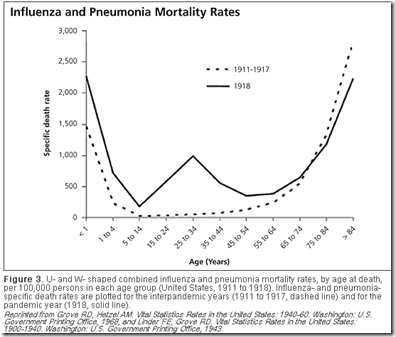
The infamous `W shaped curve’ of the 1918 pandemic clearly shows that the death rates among those in their teens, 20s, and 30s was much higher than was normally seen in previous influenza years. Those over the age of 65, however, saw a reduction in mortality during the pandemic.


# 6778


Seasonal influenza can strike people of any age, but exacts its greatest toll on the elderly – those over the age of 65 whose weaker immune systems (and comorbid conditions) often render them less able to fight off the infection.


Exact numbers remain elusive, since influenza is only rarely cited as the primary cause of death. If a cause of death (beyond`natural causes’) is given, comorbidities like COPD, heart disease, asthma are far more likely to listed on a death certificate.


Still, estimates are that 90% of seasonal flu mortality occurs in those over the age of 65 (cite CDC Pink book).


In 2010, (see Study: Years Of Life Lost Due To 2009 Pandemic), researchers estimated the median age of death due to seasonal influenza-related illness in the United States to be 76.


In contrast, pandemic influenza strains, at least during the first few years after their introduction, often produce a dramatic `age shift’ downward in mortality. 


The CDC’s estimate of average and median age of death due to the 2009 Pandemic virus reads:


Based on two CDC investigations of confirmed 2009 H1N1-related deaths that occurred during the spring and fall of 2009, the average age of people in the U.S. who died from 2009 H1N1 from April to July of 2009 was 40. The median age of death for this time period was 43. From September to October of 2009, the average age of people in the U.S. who died from 2009 H1N1 was 41, and the median age was 45.


Admittedly, younger fatalities are more likely to be investigated, and documented, than those that occur among the elderly, but still . . . this is a significant shift.


And it corresponds closely to the results of the Years Of Life Lost Study mentioned above, which found the mean age of death from the novel H1N1 virus to be half that of seasonal flu, or 37.4 years.


In terms of years of life lost (YLL), the average pandemic flu death has a many fold greater impact than the average seasonal flu fatality.   


This same pattern was repeated (to greater and lesser degrees) during the 1918, 1957, and 1968 pandemics  . . .  along with the 1977 return of the H1N1 virus after an absence of 20 years.


All of which has led to a good deal of speculation.


What drives this age shift?  Why were apparently healthy, younger flu victims, with robust immune systems more likely to die from pandemic flu?


Although not universally accepted, one popular theory has centered around the production of a `cytokine storm’, which is believed to be the product of a robust immune system typically found in younger, healthier individuals.


Cytokines are a category of signaling molecules that are used extensively in cellular communication. They are often released by immune cells that have encountered a pathogen, and are designed to alert and activate other immune cells to join in the fight against the invading pathogen.


This cascade of immune cells rushing to the site of infection, that if it races out of control, can literally kill the patient.


The patient’s lungs can fill with fluid (which makes a terrific medium for a bacterial co-infection), and cells in the lungs (Type 1 & Type II Pneumocytes) can sustain severe damage.


You can find more on this theory in these earlier posts:


Study: Calming The Cytokine Storm
Cytokine Storm Warnings

The Baskin Influenza Pathogenesis Study

Pt. 1               Pt. 2            Pt. 3


Another theory has held that older populations are more likely to have been exposed to a similar influenza strain in the past and are more likely to carry some level of immunity to the emerging pandemic strain.


This was clearly the case in 1977, when the H1N1 virus – supplanted by the H2N2 virus in 1957 – made an unexpected comeback.  Those born after the virus last circulated in the mid 1950s – were the hardest hit age group.


Again with the 2009 H1N1 pandemic virus, those born before the early 1950s appeared to have higher levels of immunity, resulting in fewer severe outcomes among older individuals.


All of which serves as prelude to a research article, published yesterday in BMC Medicine, that looks at the age shift during pandemic outbreaks.


The age distribution of mortality due to influenza: pandemic and peri-pandemic

Tom Reichert, Gerardo Chowell and Jonathan A McCullers

Background

Pandemic influenza is said to 'shift mortality' to younger age groups; but also to spare a subpopulation of the elderly population. Does one of these effects dominate? Might this have important ramifications?

Methods

We estimated age-specific excess mortality rates for all-years for which data were available in the 20th century for Australia, Canada, France, Japan, the UK, and the USA for people older than 44 years of age. We modeled variation with age, and standardized estimates to allow direct comparison across age groups and countries. Attack rate data for four pandemics were assembled.

Results

For nearly all seasons, an exponential model characterized mortality data extremely well; For seasons of emergence and a variable number of seasons following, however, a subpopulation above a threshold age invariably enjoyed reduced mortality. 'Immune escape', a stepwise increase in mortality among the oldest elderly, was observed a number of seasons after both the A(H2N2) and A(H3N2) pandemics. The number of seasons from emergence to escape varied by country. For the latter pandemic, mortality rates in four countries increased for younger age groups but only in the season following that of emergence. Adaptation to both emergent viruses was apparent as a progressive decrease in mortality rates, which, with two exceptions, was seen only in younger age groups. Pandemic attack rate variation with age was estimated to be similar across four pandemics with very different mortality impact.

Conclusions

In all influenza pandemics of the 20th century, emergent viruses resembled those that had circulated previously within the lifespan of then-living people. Such individuals were relatively immune to the emergent strain, but this immunity waned with mutation of the emergent virus. An immune subpopulation complicates and may invalidate vaccine trials. Pandemic influenza does not 'shift' mortality to younger age groups; rather, the mortality level is reset by the virulence of the emerging virus and is moderated by immunity of past experience. In this study, we found that after immune escape, older age groups showed no further mortality reduction, despite their being the principal target of conventional influenza vaccines. Vaccines incorporating variants of pandemic viruses seem to provide little benefit to those previously immune. If attack rates truly are similar across pandemics, it must be the case that immunity to the pandemic virus does not prevent infection, but only mitigates the consequences.

The complete article is available as a provisional PDF.


The entire article is worthy of your attention, and the authors delve into a good many areas, including future pandemic mitigation planning, and vaccine strategies. 


But essentially the authors propose that all recent influenza pandemics (over the past century) have involved `recycled’ flu strains to which some portion of the population had previously been exposed to.


They conclude:


Pandemics do not ‘shift’ mortality to younger ages

From this study, it is evident that pandemics do not ‘shift’ mortality to younger ages. Rather, the
entire mortality level is simply reset to the virulence level of the emergent virus. This reset is accompanied by immunoprotection in older age groups, which is determined by their level of previous experience with viruses similar to that emerging. 


In other words, were older populations not carrying some vestiges of immunity from previously flu encounters, these researchers suggest they would suffer the same levels (or higher) of mortality and morbidity as do younger populations.


The authors also point out that initial levels of immunity to emerging (or more properly, re-emerging) influenza viruses in older populations tends to wane in subsequent seasons, leading to what they call Immune Escape: `a stepwise increase in mortality among the oldest elderly’.


Does this blow the whole cytokine storm theory out of the water?


Not necessarily, although it does call into question just how much of an impact it has on the perceived `age shift’ in pandemic flu cases.


These two theories need not be mutually exclusive, however, and so I wouldn’t rule out the possibility that both may play a part in driving pandemic mortality demographics.

Thursday, October 08, 2009

NEJM: Review Of Hospitalized US Patients With Novel H1N1


# 3816


Tonight Maggie Fox of Reuters brings us an excellent overview of a new study, published today in the NEJM, which confirms just how hard the novel H1N1 virus has hit younger patients.


Unlike seasonal flu, which is most devastating to those over 65, this novel swine flu virus has a predilection for the young.  Ninety-five percent of the patients hospitalized included in this study were under the age of 65 and 45% were under the age of 18.


One of the other unusual aspect to this flu is the high percentage of vomiting and diarrhea reported.  The early application of antivirals was seen to be therapeutic, and once again the question of morbid obesity being a serious complicating factor is raised.


First the Reuters report, then a link to the study.  Follow the link below to read the entire article.


US flu study confirms H1N1 more serious in youth

Thu Oct 8, 2009 10:41pm BST

* 45 percent of those hospitalized were under 18

* Diarrhea, vomiting in 42 percent of children with H1N1

* Quick drug treatment may save lives

By Maggie Fox, Health and Science Editor

WASHINGTON, Oct 8 (Reuters) - A study of people who became seriously ill and died with the new pandemic swine flu confirms it is hitting a younger population than the seasonal flu and causes often different symptoms.


The study of 272 patients sick enough to be hospitalized showed about 40 percent had diarrhea and vomiting -- usually rare with seasonal flu -- and confirmed that quick treatment with antivirals could save lives.


Dr. Seema Jain of the U.S. Centers for Disease Control and Prevention, who led the study, said the findings had informed the CDC's advice on who should worry about the new H1N1 virus and when to get treatment.

(Continue . . . )


Published at www.nejm.org October 8, 2009 (10.1056/NEJMoa0906695)

Hospitalized Patients with 2009 H1N1 Influenza in the United States, April–June 2009

N Engl J Med 2009 0: NEJMoa0906695

Jain, Seema, Kamimoto, Laurie, Bramley, Anna M., Schmitz, Ann M., Benoit, Stephen R., Louie, Janice, Sugerman, David E., Druckenmiller, Jean K., Ritger, Kathleen A., Chugh, Rashmi, Jasuja, Supriya, Deutscher, Meredith, Chen, Sanny, Walker, John D., Duchin, Jeffrey S., Lett, Susan, Soliva, Susan, Wells, Eden V., Swerdlow, David, Uyeki, Timothy M., Fiore, Anthony E., Olsen, Sonja J., Fry, Alicia M., Bridges, Carolyn B., Finelli, Lyn, the 2009 Pandemic Influenza A (H1N1) Virus Hospitalizations Investigation Team,

ABSTRACT (Excerpts)


Background During the spring of 2009, a pandemic influenza A (H1N1) virus emerged and spread globally. We describe the clinical characteristics of the patients who were hospitalized with 2009 H1N1 influenza in the United States from April 2009 to mid-June 2009.

 
<SNIP>


Results Of the 272 patients we studied, 25% were admitted to an intensive care unit and 7% died. Forty-five percent of the patients were children under the age of 18 years, and 5% were 65 years of age or older. Seventy-three percent of the patients had at least one underlying medical condition; these conditions included asthma; diabetes; heart, lung, and neurologic diseases; and pregnancy.


Of the 249 patients who underwent chest radiography on admission, 100 (40%) had findings consistent with pneumonia. Of the 268 patients for whom data were available regarding the use of antiviral drugs, such therapy was initiated in 200 patients (75%) at a median of 3 days after the onset of illness. Data suggest that the use of antiviral drugs was beneficial in hospitalized patients, especially when such therapy was initiated early.


Conclusions During the evaluation period, 2009 H1N1 influenza caused severe illness requiring hospitalization, including pneumonia and death. Nearly three quarters of the patients had one or more underlying medical conditions. Few severe illnesses were reported among persons 65 years of age or older. Patients seemed to benefit from antiviral therapy.