Showing posts with label CIDRAP. Show all posts

Friday, May 22, 2015

Referral: CIDRAP Recaps Yesterday’s HPAI H5N2 News

image

Credit Minn. Board Animal Health


# 10,076


Although we’ve seen a decline in the number of new farms reporting HPAI H5 infection across the upper Midwest, the avian virus continues to impact additional farms in Iowa, and even states that haven’t reported a new cases in several days dare not relax.   


It is hoped that warmer weather will continue to diminish the avian flu threat over the summer, but what comes next fall and winter is anyone’s guess. 


Which is why Iowa announced yesterday that they will join Minnesota, New York, and several other states which have already decided to prohibit the display, trade, or sale of poultry at state and county fairs and other public venues through the end of 2015.  


Excerpts from the official statement follow:


EXHIBITIONS OF BIRDS CANCELLED FOR 2015 DUE TO AVIAN INFLUENZA


Fairs, livestock auctions, swap meet and exotic sales will not include birds

DES MOINES – The Iowa Department of Agriculture and Land Stewardship today announced an order to cancel all live bird exhibitions at county fairs, the Iowa State Fair, and other gatherings of birds due to avian influenza. The Department’s order begins immediately, is effective through the end of 2015, and also prohibits live birds from being sold at livestock auction markets, swap meets and exotic sales.

Iowa has over 25 million birds and more than 60 farms impacted by H5N2 highly-pathogenic avian influenza (HPAI). The purpose of the Department’s directive is to minimize the risk of potential further spread of the virus to other poultry.  The Center for Disease Control (CDC) and Iowa Department of Public Health consider the risk to the public related to HPAI H5 infections to be very low.  No human infections of the virus have ever been detected and there is no food safety risk for consumers.

“We are asking producers and bird owners to increase their biosecurity measures and we feel this is a needed step to further minimize the risk of spreading the virus,” said Iowa Secretary of Agriculture Bill Northey.  "The scale of this outbreak has been unprecedented, so we think it is important we take every possible step to limit the chance that this disease will spread any further."

(Continue . . . )


With more on all of this, plus concerns over media reports of lax biosecurity at some farms and a recap of recent outbreaks in Iowa, CIDRAP News  Editor Robert Roos penned the following report last night.


Iowa bans bird shows as avian flu outbreaks persist

Robert Roos | News Editor | CIDRAP News

May 21, 2015

Iowa state officials today announced a ban on live-bird shows and some sales for the rest of this year in an effort to stop the spread of avian flu, and followed up by reporting another chicken outbreak, which followed two turkey outbreaks announced yesterday.

Meanwhile, a Reuters story today said that on the basis of a reporter's experience, recommended biosecurity measures were not being enforced at several farms in northwestern Iowa, where the state's outbreaks are concentrated.

(Continue . . . )


Saturday, May 09, 2015

CIDRAP: H5N2 Roundup & Detection In Environmental Air Samples

image

54 of Minnesota’s 84 Outbreaks Are Clustered in 3 Counties


# 10,030


Although migratory and wild birds are believed responsible for the delivery of HPAI H5 viruses to North America last fall and the subsequent spread of H5N8, H5N2, and H5N1 to at least 18 states, the clustering of infected farms (particularly in Minnesota and Iowa) has many wondering if there isn’t a second – as yet unidentified - mode of transmission at work.


While Minnesota has recorded 84 outbreaks across 21 counties, more than 1/3rd of those are from one county (Kandiyohi n=32), while the three county nexus of Stearns, Meeker & Kandiyohi account for nearly 65% of all of the cases.


Similarly, in hard hit Iowa, out of 44 farms infected across 12 counties, 2 counties (Buena Vista & Sioux) account for fully half their total.


In the past, human activities – the movement of personnel, or equipment, or poultry related items – has been viewed as the likely source of local `lateral’ transmission between farms, but so far epidemiological investigations have failed to find any solid evidence of such. 


Somehow, despite elaborate biosecurity measures, the virus continues to make its way into scores of farms.   And with the likely return of the virus next fall, figuring this out is a priority.


One idea, increasingly being considered, is the possibility that the virus is being dispersed – at least across short distances - `on the wind’.  Carried on dust particles from one farm to another (see last April’s Bird Flu’s Airborne `Division’ for a discussion of previous studies on this possibility).


Last night CIDRAP carried an update (including the news of 7 new farms presumed infected in Iowa), that contained the first tangible information on the possible airborne spread of H5N2 in Minnesota. 


Follow the link to read:


Signs of airborne H5N2 found; Iowa reports more outbreaks

Robert Roos | News Editor | CIDRAP News

May 08, 2015

Evidence of the H5N2 avian influenza virus has been found in air samples collected in and near infected Minnesota poultry barns, a researcher said today, supporting the suspicion that the virus may go airborne for short distances, while Iowa reported seven new H5 outbreaks involving 4 million chickens and an unknown number of turkeys.

In addition, Wisconsin authorities today reported finding H5N2 in an owl along Green Bay, while hard-hit Minnesota had its second day this week without any new poultry outbreaks.

Air sampling findings

Montse Torremorell, DVM, PhD, of the University of Minnesota said she and three colleagues did a pilot air sampling study at three Minnesota farms with infected poultry.

"Our results indicated that influenza genetic material can be detected in air samples collected inside and immediately outside of infected poultry facilities. We still don't know whether virus was viable or not, and those analyses are in progress," said Torremorell, who holds the Allen D. Leman Chair in swine health and productivity.

"So far we have shown that HPAI [highly pathogenic avian influenza] can be aerosolized from infected facilities," she added. "However, the implications of these findings in terms of understanding the transmission of HPAI between flocks needs further investigation." The study focused on a total of four poultry barns on the three farms.

Torremorell said the study was commissioned by the US Department of Agriculture's Animal and Plant Health Inspection Service (APHIS). The agency's National Veterinary Services Laboratories (NVSL) in Ames, Iowa, are testing the samples to see if they contain any viable virus particles.

(Continue . .. )


Humidity, ambient air temperatures, UV ray exposure levels . . . even the pH of whatever medium the virus clings to as it rides the air currents  . . . are all likely factors affecting the viability (and longevity) of avian flu viruses in the environment.  


While ideal conditions are likely to be short-lived - if you add the right amount of air movement and relatively closely clustered farms – you might have a legitimate route for lateral transmission. 


For earlier blogs on the viability of influenza viruses (avian and human) in the environment, you may wish to revisit:


NIH Study: Climate & Influenza Transmission

PLoS One: High Humidity Reduces Flu’s Infectivity

Influenza Virus Survival At Opposite Ends Of The Humidity Spectrum

Study: (H5N1): Effects Of Physico-Chemical Factors On Its Survival

Wednesday, May 06, 2015

CIDRAP H5N2 Round Up - Iowa Adds 3 More Farms

image

States & Provinces with Confirmed HPAI H5

# 15,016


Last night I reported on two more Minnesota farms presumed to be infected with the H5N2 virus,  but we’ve two reports filed a bit later in the evening that add to yesterday’s bird flu information.  First , Jim Wappes of CIDRAP NEWS has an excellent round up of the day’s avian influenza news, followed by the latest report out of hard-hit Iowa.


H5N2 suspected on 5 more Iowa, Minnesota farms

 Jim Wappes | Editorial Director | CIDRAP News

May 05, 2015

Barn turkey

Courtesy of Minnesota Board of Animal Health

Officials in Iowa and Minnesota today reported five more likely outbreaks of H5N2 avian flu, while a Minnesota turkey company announced H5N2-related layoffs and federal officials freed up $330 million for response efforts.

The outbreaks in Iowa involve two turkey farms and a chicken laying operation of 60,000 hens, the Iowa Department of Agriculture and Land Stewardship (IDALS) said today. Initial tests showed that birds on all three operations tested positive for the H5 strain of avian flu, and confirmatory tests from the National Veterinary Services Laboratories (NVSL) in Ames, Iowa, are pending.

Both turkey farms are in Buena Vista County in northwestern Iowa. An IDALS news release said both farms experienced increased deaths in turkeys but did not specify the size of either flock. The county has now had 10 outbreaks.

The commercial laying operation is in Sioux County, which also lies in northwestern Iowa but borders South Dakota. The flock of an estimated 60,000 chickens also experienced increased mortality, the IDALS release said.

The agency said 20,096,846 poultry in 27 outbreaks in 11 counties have now been affected in Iowa. The vast majority of the birds—19,310,471—have been egg-laying chickens.

(Continue . . . )


Meanwhile, the Iowa Department of Agriculture has updated their website, showing that in that state alone the number of birds affected is very near 20 million.


For Immediate Release
Tuesday, May 5, 2015

THREE PROBABLE CASES OF HIGHLY PATHOGENIC AVIAN INFLUENZA IN BUENA VISTA AND SIOUX COUNTIES


CDC considers the risk to people to be low

DES MOINES – The Iowa Department of Agriculture and Land Stewardship is responding to three probable cases of highly pathogenic avian influenza (HPAI) in commercial poultry farms in Buena Vista and Sioux counties.  These three new cases would join 25 cases of the disease in Iowa that were previously announced. State officials have quarantined the premises and once the presence of the disease is confirmed, all birds on the property will be humanely euthanized to prevent the spread of the disease.

Buena Vista 9 – Turkey farm that has experienced increased mortality.  An estimate on the number of birds at the site is still pending. Initial testing showed it positive for H5 avian influenza.  Additional confirmatory testing is pending from the APHIS National Veterinary Services Laboratories (NVSL) in Ames.

Buena Vista 10 – Turkey farm that has experienced increased mortality.  An estimate on the number of birds at the site is still pending. Initial testing showed it positive for H5 avian influenza.  Additional confirmatory testing is pending from the APHIS National Veterinary Services Laboratories (NVSL) in Ames.

Sioux 4 – Commercial laying operation with an estimated 60,000 birds that has experienced increased mortality.  Initial testing showed it positive for H5 avian influenza.  Additional confirmatory testing is pending from the APHIS National Veterinary Services Laboratories (NVSL) in Ames.

As the Department receives final confirmations of the disease updated information will be posted to the Iowa Department of Agriculture and Land Stewardship’s website at www.iowaagriculture.gov/avianinfluenza.asp.

image

Friday, May 01, 2015

Referral: CIDRAP NEWS Recaps The Latest Avian Flu Outbreaks

image


# 9996


I was away from my desk for a few hours yesterday, and wasn’t able to to my usual summary of the latest H5N2 news, but luckily we have an excellent overview from CIDRAP NEWS Editor Robert Roos.  


Minnesota reports three additional farms infected, and their first detection of the virus in a wild bird, but the worst effects are being felt in Iowa.


Avian flu taking big toll in Iowa; virus found in Minnesota hawk

Robert Roos

Apr 30, 2015

Nine more outbreaks in Iowa put that state's losses at a quarter of the state's 60 million layer hens.

Nine more H5 avian influenza outbreaks that were reported on Iowa poultry farms in the past 2 days, combined with previous outbreaks, will mean the loss of about a quarter of the state's 60 million layer hens, state officials said today.

In addition, Minnesota officials today announced three more turkey-farm outbreaks and reported finding the virus in a dead hawk, the first known wild-bird infection in the state that has by far the most poultry outbreaks.

Six outbreaks in one Iowa county

The Iowa Department of Agriculture and Land Stewardship (IDALS) reported four outbreaks late yesterday and added five more today. Six of them are in Buena Vista County in the northwestern part of the state.

Initial testing pointed to a highly pathogenic (HP) H5 virus, but there was little doubt that it would be confirmed as H5N2. At an afternoon press conference, Iowa Agriculture Secretary Bill Northey said birds on all the farms are showing clinical signs, "so we highly suspect they'll come back with N2" confirmed.

(Continue . . .)

Wednesday, April 01, 2015

CIDRAP On The Lancet EV-D68 Analysis

image

CDC EV-D68 Fact Sheet


# 9890


In August of last year, a seldom seen (at least, in North America) non-polio enterovirus D-68 (EV-D68) appeared in America’s Midwest and quickly spread across the nation, causing a wide spectrum of respiratory illness, predominantly in young children and adolescents (see Kansas City Outbreak Identified As HEV 68).


At roughly the same time, a coincident rise in cases of neurological illness with AFP (acute flaccid paralysis) or limb weakness – often associated with a recent respiratory illness – was reported across the country.


A month later the CDC  issued a HAN: Acute Neurologic Illness with Focal Limb Weakness of Unknown Etiology in Children, alerting doctors around the country to be aware of this trend, and providing information on reporting cases. While primarily associated with respiratory symptoms, EV-D68 had previously been linked to neurological presentations, including a small cluster of cases the previous winter (see Acute Flaccid Paralysis Cases In California).


Although a causal link wasn’t established, due to the timing and the fact that other enteroviruses have been linked to neurological illnesses, there was a high degree of suspicion that the two conditions were linked.


Enteroviruses encompass a large family of small RNA viruses that include the three Polioviruses, along with myriad non-polio serotypes of Human Rhinovirus, Coxsackievirus, echovirus, and human, porcine, and simian enteroviruses.  We’ve looked at EV-71 and the Coxsackieviruses on numerous occasions in regards to AFP (Acute Flaccid Paralysis) and HFMD (see herehere & here).


According to the CDC  Non-Polio Enteroviruses (NPEVs) cause 10 to 15 million – mostly mild and often asymptomatic – infections in the United States each year, primarily among infants, children, and teenagers.


Fever, runny nose, sneezing, coughing, a skin rash or mouth blisters, and body and muscle aches are the most commonly reported symptoms.


First isolated in 1962, but only rarely reported in North America since, in 2011 – in MMWR: Clusters Of HEV68 Respiratory Infections 2008-2010 – we looked at a recent increase in EV-68 associated clusters reported in Asia, Europe, and the United States during 2008--2010.


We continued to watch the progress of this most recent outbreak over the winter (see CIDRAP: Likely That Polio-like Illness & EV-D68 Are Linked  & Eurosurveillance: Acute Flaccid Paralysis Following EV-D68 Infection – France), and the most recent CDC NCIRD update on last year’s outbreak was posted in early March.


Update

From August 2, 2014 to March 2, 2015, CDC has verified reports of 115 children in 34 states who developed acute flaccid myelitis that meets CDC’s case definition. CDC continues to collaborate with partners nationally to investigate reported cases, risk factors, and possible causes of this condition.

  • The median age of the children was about 8 years.
  • Almost all of them were hospitalized; some were put on breathing machines.
  • Most patients had fever and/or respiratory illness before onset of neurologic symptoms.
  • About two thirds of the children who have been observed (median 19 days) after their illness reported some improvement in symptoms, while about one third showed no improvement. Only two of the children have fully recovered.


          This week a genetic analysis of this emerging enterovirus was published in The LancetA novel outbreak enterovirus D68 strain associated with acute flaccid myelitis cases in the USA (2012–14): a retrospective cohort study – that not only strengthened the link between the EV-D68 infection and paralytic complications, but also identified the virus as being part of a new clade (B1) with polio-like changes that emerged about 5 years ago.


          Since Robert Roos of CIDRAP News  has already done a terrific job covering this study, I’ll simply refer you to last night’s story for the rest of the details.  Follow the link to read:


          Genetic study boosts evidence for EV-D68 in polio-like cases

          Robert Roos | News Editor | CIDRAP News

          |

          Mar 31, 2015

          A careful study of children at two Colorado and California hospitals who had polio-like illnesses strengthens the evidence that cases were related to enterovirus-D68, which caused a widespread outbreak of severe respiratory illnesses in US children last year, according to a report published today in The Lancet Infectious Diseases.

          The virus was found in 12 of 25 patients who had the polio-like condition, called acute flaccid myelitis (AFM), and the proportion probably would have been higher if respiratory samples had been collected earlier, the researchers said. In addition, a thorough genomic search for other viruses in the neural fluid of 14 of the patients found no signs of any other virus that could have caused the patients' limb weakness and related problems.

          "These findings strengthen the putative association between enterovirus D68 and acute flaccid myelitis and the contention that acute flaccid myelitis is a rare yet severe clinical manifestation of enterovirus D68 infection in susceptible hosts," the authors wrote.

          (Continue . . . )

          Thursday, March 19, 2015

          CIDRAP: Role Of Migratory Birds Questioned In US H5N2 Outbreaks

          image

          Major Global Migratory Flyways – Credit FAO


          # 9843


          Four months ago, in Bird Flu Spread: The Flyway Or The Highway?, we looked at the often contentious debate over the role that migratory birds play in the global spread of avian influenza viruses.  A week later, in H5N8: A Case Of Deja Flu?, we compared the recent spread of HPAI H5N8 to the 2005-2006 geographic expansion of H5N1.


          While poultry producers are often quick to blame wild or migratory birds, not everyone concurs, with a recent statement by the UN CMS/FAO Co-Convened Scientific Task Force on Avian Influenza and Wild Birds stating that typically the spread of HPAI virus is via contaminated poultry, poultry products and inanimate objects although wild birds may also play a role.


          The way that HPAI H5N8 virus spread out of  East Asia to Europe, Japan, Taiwan, and North America in less than 12 months certainly suggests that migratory birds played a role in its dissemination, although direct proof is lacking. We’ve seen that some birds can carry avian influenza viruses without ill effect, and when they encounter other birds, can `share’ their viral cargo along their migratory flyway. 


          And where flyways overlap, there is a greater chance of spreading a virus from one region to another. And as you can see by the map above, they overlap a lot.


          The USDA’s APHIS (Animal Plant Health Inspection Service) assessment on the arrival of HPAI H5 viruses to the Pacific Northwest this winter unambiguously focused on migratory birds.  In Update on Avian Influenza Findings in the Pacific Flyway dated Feb 4, 2015, they state:


          The H5N8 virus originated in Asia and spread rapidly along wild bird migratory pathways during 2014, including the Pacific flyway.  In the Pacific flyway, the H5N8 virus has mixed with North American avian influenza viruses, creating new mixed-origin viruses.  This is not unexpected.  These mixed-origin viruses contain the Asian-origin H5 part of the virus, which is highly pathogenic to poultry.  The N parts of these viruses came from North American low pathogenic avian influenza viruses.


          But the abrupt shift of the H5N2 virus from the Pacific Northwest to the heartland of America – a 1000 mile leap to the east in the dead of winter – has some questioning whether migratory birds are behind every outbreak.  Once introduced into a region’s poultry, we’ve seen avian flu viruses spread to other farms through lapses in biosecurity and the movement of poultry products, transport, or personnel.  


          With 900 poultry farms in Taiwan battling a multi-subtype outbreak of HPAI H5 this winter – even if the virus was initially introduced to the island by migratory birds – it stretches credulity that infected wild birds paid personal visits to each and every of them.


          CIDRAP News’s Robert Roos has much more on all of this, with a perspective article published last night.  Follow the link to read:


          Role of wild birds in US H5N2 outbreaks questioned

          Robert Roos | News Editor | CIDRAP News

          Mar 18, 2015

          Pintail duck

          LHG Creative Photography / Flickr cc Pintail duck.

          The notion that wild birds played a key role in bringing highly pathogenic avian influenza (HPAI) viruses from Asia to western North America and more recently to the Midwest has been implicit in government statements about recent outbreaks. But some wildlife disease experts are warning against jumping to easy conclusions.

          The story goes back to last November and December, when an HPAI H5N2 virus struck several poultry farms in southern British Columbia. Those outbreaks triggered increased surveillance for avian flu in the United States, and a matching virus showed up in December in a wild northern pintail duck in northwestern Washington state. At the same time, a Eurasian strain of H5N8 virus was found in a captive gyrfalcon in the same area.

          (Continue . . . )


          For more on this debate, you may wish to revisit:


          Erasmus Study On Role Of Migratory Birds In Spread Of Avian Flu
          PNAS: H5N1 Propagation Via Migratory Birds
          EID Journal: A Proposed Strategy For Wild Bird Avian Influenza Surveillance
          PLoS One: North Atlantic Flyways Provide Opportunities For Spread Of Avian Influenza Viruses


          Tuesday, February 17, 2015

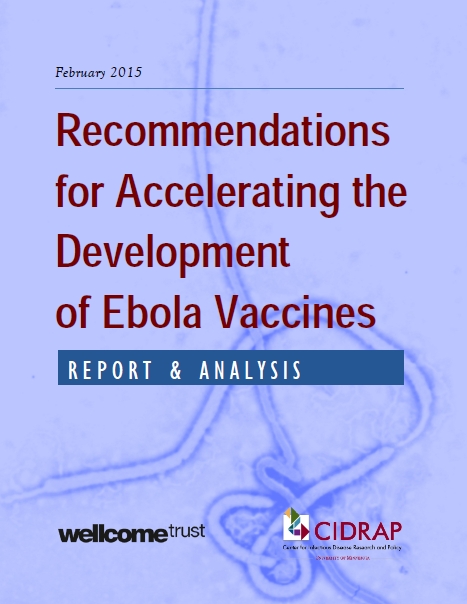
          CIDRAP/Wellcome Trust: Recommendations For Accelerating The Development Of Ebola Vaccines

          Ebola vaccine Team B report cover


          # 9722


          While the Ebola outbreak in West Africa has slowed, it is far from ended, and the specter of future outbreaks still remains, even when this epidemic ends.  The best hope for reducing the impact of future outbreaks – particularly among healthcare providers – is the development of a safe and effective vaccine.


          Today CIDRAP has announced the publication of a major (84 page PDF) expert committee report (Recommendations  for Accelerating the Development of Ebola Vaccines: Report & Analysis),  co-chaired by by Wellcome Trust Director Jeremy Farrar and CIDRAP Director Michael Osterholm that offers 48 specific recommendations for reaching that goal.


          Follow the link below to read the summary, and to download the entire report.


          Recommendations for Accelerating the Development of Ebola Vaccines: Report & Analysis


          Feb 17, 2015 – The ongoing and devastating Ebola epidemic in West Africa has galvanized the will and resources of the international community toward an unprecedented goal: to make and deliver safe, effective vaccines that protect against Ebola virus disease in record time.

          To help address this crucial public health undertaking, the Center for Infectious Disease Research and Policy (CIDRAP) at the University of Minnesota and the Wellcome Trust today published "Recommendations for Accelerating the Development of Ebola Vaccines: Report & Analysis" to analyze the issues and challenges involved and offer expert recommendations.

          The report represents careful, in-depth synthesis and advice from an international panel of 26 experts in public health, medicine, bioethics, pharmaceutical manufacturing, and humanitarian relief convened by the Wellcome Trust and CIDRAP.

          (Continue . . . )

          Friday, February 06, 2015

          Revisiting CIDRAP’s - The Need For Better Flu Vaccines

          image


          # 9780


          There’s an accusatory headline, and article, in the UK’s Telegraph today (see Flu vaccine: Ministers may have known of dangerous new strain last March), strongly suggesting that the World Health Organization and other public health entities (including the UK’s PHE) somehow bungled this year’s flu vaccine by not including the new `drifted’ strain’.


          I guess anytime you can blame the government,  it plays well in Portsmouth, and sells papers.


          A far more reasonable report can be found on the BBC website, called Why flu vaccines are underperforming this winter, which essentially attributes this year’s vaccine fiasco to `bad luck’.


          The cause of this consternation is the Eurosurveillance journal report, released yesterday, that calculated an abysmal 3.4% VE (Vaccine Effectiveness) rating for this year’s jab, down from the 50%-60% we normally see.  The inevitable result of this type of vaccine mismatch is a commensurate jump in the number of `excess winter deaths’ – primarily among the elderly.


          The problem is, as it has been for more than a half century, that it takes roughly 6 months to produce, prepare, and ship hundreds of millions of doses of flu vaccine, and so the strains to be included must be selected very early in the spring if the vaccine is to be ready by fall.


          Complicating matters, while we talk about 2 primary influenza A subtypes (H1N1 & H3N2), in truth there are multiple variations on each in circulation at any given time.   Usually, one of these versions – or clades – dominates over all of the others, but they are constantly playing a viral game of `king of the mountain’, and the balance of power can shift quickly.


          The change that the Ministers `knew’ about a new strain last March holds little sway when you look back at the Influenza Virus Characterization reports from the ECDC from last spring and summer that described multiple H3N2 variants.


          While a few of the viruses tested were antigenically different from the vaccine strain, the majority were still a match.


          Influenza Virus Characterisation, May 2014

          • Recently circulating A(H3N2) viruses have fallen within genetic group 3C represented by the recommended vaccine virus for the 2013–14 and 2014–15 seasons, A/Texas/50/2012, with viruses of genetic subgroup 3C.3 predominating. Antigenic analysis using antisera raised against cell-propagated H3N2 viruses indicates that the majority of circulating viruses are antigenically similar to those in circulation in the 2012–13 and 2013–14 influenza seasons.
          • A small set of viruses in genetic subgroup 3C.3 were not recognised well by the panel of antisera and their HA gene sequences encode several amino acid substitutions compared to other viruses in genetic group 3C.3.

          At this point, the components of this year’s vaccine had been `locked in’ for a couple of months, and it was really too late to change. And at this point, it wasn’t at all clear which strain would dominate come the fall.  By September (see ECDC’s Influenza virus characterisation, Summary Europe, September 2014), it was becoming apparent that this new subset of antigenic viruses were on the ascendant, and that report included:

          In light of the emergence of antigenically distinct groups of influenza A(H3N2) and the altered
          prevalence of influenza B viruses, the WHO recommended composition of influenza vaccines for use in the 2015 southern hemisphere influenza season differed from that recommended for use in the 2014–15 northern hemisphere influenza season.


          In early November, when I wrote A `Drift’ In A Sea Of Influenza Viruses,  the CDC was still reporting 70% of the  H3N2 viruses tested matched the vaccine component.  Since then, those numbers have fallen to 35% or so.  In Canada, and apparently in Europe as well, those numbers are even lower still.


          Twice each year, a group of distinguished influenza scientists gather to try to predict what seasonal flu viruses dominate in six month’s time. 


          And this year, quite frankly, they guessed wrong.  It happens.  No one has a crystal ball.


          One of the big obstacles, of course, is vaccine production time. If vaccine strains could be picked in June or July, and the vaccine produced in 60 days, we’d far see fewer vaccine mismatches.  And that would allow for the timely creation, production, and distribution of an emergency pandemic vaccine as well.


          But despite a good deal of research, most influenza vaccines are still produced using (admittedly updated) 1950s egg-based technologies.


          More than three two years ago, in CIDRAP: The Need For `Game Changing’ Flu Vaccines, we looked at major report – serving as a clarion call for a revolution in vaccine technology - that is as relevant today as the day it was published.


          Since reports like this one tend to make a big splash, and then are all too quickly forgotten, today seems a good day to revisit that study.


          The Compelling Need for Game-Changing Influenza Vaccines

          An Analysis of the Influenza Vaccine Enterprise and Recommendations for the Future

          Michael T. Osterholm, PhD, MPH, Nicholas S. Kelley, PhD, Jill M. Manske, PhD, MPH, Katie S. Ballering, PhD, Tabitha R. Leighton, MPH, Kristine A. Moore, MD, MPH


          For those not ready to commit to reading a 160-page report, there is a 12-page Executive summary available.


          At this point I’ll turn to the press release from CIDRAP, where Dr. Osterholm emphasizes the idea that our history of overestimating the effectiveness of the current vaccine serves as a barrier to developing new vaccine technologies.  A bias that perhaps this year, will change.


          New U of M-led analysis finds urgent need for new influenza vaccines

          Laurel Herold, Academic Health Center, 612-624-2449, hero0045@umn.edu
          Justin Paquette, Academic Health Center, 612-626-7037, jpaquett@umn.edu

          MINNEAPOLIS/ST. PAUL (October 15, 2012) – According to a new report from the University of Minnesota’s Center for Infectious Disease Research and Policy (CIDRAP), current influenza vaccines offer less protection against seasonal influenza than previously reported. As a result, the misperception that current vaccines are highly effective in fighting influenza has become a barrier to creating new, more effective vaccines.

          <SNIP>

          “We urge people to get their flu shot. The present vaccines are the best interventions available for seasonal influenza,” said Michael T. Osterholm, Ph.D., M.P.H., University of Minnesota infectious disease expert and the CCIVI report’s lead author. “However, these vaccines do not offer consistent, high-level protection – especially in individuals at risk of medical complications or those aged older than 65 years. Unfortunately, these are the populations where we need the vaccines to work the best.  We need new influenza vaccines that work for everyone, most of the time.”


          Researchers found that during some influenza seasons, current vaccines offer more protection for most of the population than being unvaccinated. However, compared to most routinely recommended vaccines, influenza vaccine protection is substantially lower.

          “We can no longer accept the status quo with regard to influenza vaccine research and development,” added CCIVI expert advisory group chair, Alfred Sommer, Ph.D, Johns Hopkins Bloomberg School of Public Health, after reviewing the latest report. “Only with new game-changing vaccines can we ever really be prepared for the next influenza pandemic.”

          (Continue . . .)


          Despite its limitations, I get the flu vaccine each year, and continue to recommend that others take it as well.  Not because I view it as perfect, or even very good.  At best, it provides a moderate level of protection against the flu – at worst . . . . well, all you have to do is look at this year’s FluView reports.


          But however flawed, flu vaccines remain our best protection against a virus that is estimated to kill a half million people around the globe each year. 


          Like wearing a seatbelt cannot guarantee you’ll walk away from a head-on collision,  a flu vaccine cannot guarantee you won’t get the flu this year.


          But most years, it reduces your odds of a bad outcome by about half.  And until something better comes along, you use what you can to your best advantage.

          Saturday, January 31, 2015

          CIDRAP News On The Lancet Oseltamivir (Tamiflu ®) Meta-Analysis

          image

          Photo Credit – Wikipedia


          # 9552


          I had plans this morning to write an overview of meta-analysis of Tamiflu effectiveness published January 29th in The Lancet, but I’m happy to note that last night Robert Roos of CIDRAP News has beaten me to it. Since I’m unlikely to improve upon his reportage, I’ll direct you to his excellent review – which you’ll want to read in its entirety - after which I’ll return with a little bit more.


          Meta-analysis supports oseltamivir use in adults, notes side effects

          Robert Roos | News Editor | CIDRAP News

          Jan 30, 2015

          A comprehensive new meta-analysis on the controversial topic of oseltamivir's effectiveness found that the drug reduces the duration of influenza symptoms and the risk of hospitalization in adults and adolescents, while increasing the risk of nausea and vomiting.

          A US-British team, with Arnold S. Monto, MD, of the University of Michigan as senior author, included in the analysis all randomized controlled trials sponsored by Roche, the drug's manufacturer, as well as other relevant trials. The study, reported yesterday in The Lancet, was funded by Roche, but the researchers worked independently.

          (Continue.  . . )


          Over the past few years we’ve seen the demonization of influenza antivirals in the media (see Daily Mail: Ministers blew £650MILLION on useless anti-flu drugs), warnings of potential aberrant psychiatric behavior (see 2007 New Worries On Tamiflu), and repeated Cochrane group analyses that have found insufficient evidence that the drug reduces influenza complications.


          Add in some serious foot-dragging by manufacturer Roche in releasing all of their testing data, and Tamiflu has become an easy drug for the public, and some doctors, to distrust.


          Despite all of this `baggage’  the CDC, ECDC, UK’s PHE, and other public health agencies have steadfastly supported the early use of oseltamivir in the treatment of severe flu (see this week’s CDC Antiviral Letter to Providers and ECDC Influenza Season Risk Assessment).


          The reason?

          Even without the `gold standard’ Randomized controlled trials (RCTs) that the Cochrane group relies on for their analyses, we’ve seen numerous observational studies that lend support to the use of antivirals in severe influenza.


          A few I’ve written about in the past include:


          Their main finding was antiviral therapy - principally oseltamivir - initiated within 48 hours of onset, reduced the likelihood of severe outcomes, namely admission to a critical care unit or death, by 49 to 65%.


          Added to this, we now have this new meta-analysis of the data from all published and unpublished clinical trials from 1997-2001, involving more than 4,300 patients. Patients with influenza (not just an ILI), who received the drug within 36 hours of onset of symptoms saw a reduction in the duration of their illness of 21% and a significant reduction in the risk of developing pneumonia or requiring hospitalization.


          While nausea (9.9% vs 6.2% in controls) and vomiting (8.0% vs 3.3%)  were common side effects, no serious adverse reactions were reported, with no increase in psychiatric or neurological symptoms.


          For uncomplicated influenza in a healthy individual (essentially what the Cochrane studies looked at), antivirals probably offer limited benefits.


          But for severe influenza, or for people at risk of complications . . .


          The preponderance of evidence shows that taking antivirals early can limit the severity and duration of symptoms – and for patients at risk of complications – that  could help keep them out of the hospital . . .  or worse.

          Thursday, January 08, 2015

          CIDRAP: FAO Reports Mutations In H5N1 Virus From Egyptian Poultry

          image


          # 9543


          Last night CIDRAP published a piece by News Editor Robert Roos which looks at genetic characterizations of H5N1 viruses sampled from Egyptian poultry recently. According to the FAO, this analysis showed signs of several troubling `mammalian adaptations’, although two isolates taken from humans recently reportedly showed no major genetic changes.


          First some excerpts from  Robert’s detailed report (but you’ll want to read the whole thing), then I’ll be back with a little more.


          FAO notes mutations in H5N1 samples from Egypt's poultry

          Robert Roos | News Editor | CIDRAP News

          Jan 07, 2015

          Amid a flurry of human H5N1 influenza cases in Egypt, scientists have found H5N1 viruses in Egyptian poultry that have two mutations that are usually associated with adaptation to mammals, a United Nations Food and Agriculture Organization (FAO) official reported today.

          Juan Lubroth, DVM, PhD, the FAO's chief veterinary officer, told CIDRAP News that the mutations were identified through genetic sequencing of 52 recent isolates from poultry. But he also said a recent analysis of viruses from two human patients in Egypt showed no major genetic changes.

          Egypt has had a surge of human H5N1 cases over about the past 7 weeks, after reporting very few during the preceding 2 years. According to media reports based on health ministry statements, the country had 29 cases with 11 deaths in 2014, most of them in November and December. All or nearly all of the patients had contact with poultry, and no signs of human-to-human transmission have been reported, but the cases have prompted some speculation about whether the virus has changed in some way.

          In addition, Egypt has had a big increase in reported poultry outbreaks of H5N1 recently, according to the FAO. A graph supplied by Lubroth showed about 70 outbreaks in November (2014) and close to 180 outbreaks in December, compared with fewer than 10 in each of those months in 2013.

          (Continue . . . )


          The evolutionary path that would take an avian influenza virus – like H5N1 – to the point where it was well-enough adapted to mammals to pose a pandemic threat isn’t well mapped. There are a lot of interactive `moving parts’ inside a virus, and how evolutionary changes (via accrued amino acid substitutions) affect the virus’s behavior are only partially understood.


          On a `macro level’, we know that avian viruses bind preferentially to the type of receptor cells (α-2,3) found in the gastrointestinal tract of birds, and that mammalian-adapted viruses would have to evolve to bind preferentially to α-2,6 receptor cells – they type found in the upper respiratory tract of mammals.


          We also believe that an adapted virus would have to thrive and replicate in the slightly cooler environment found in their upper respiratory tracts (birds run `hotter’  than mammals by several degrees).


          While both are viewed as important, it is likely that there are other – perhaps subtle – changes that must occur before an avian virus can effectively jump to a mammalian host.  Robert’s article cites the following changes:


          Genetic sequencing of 52 isolates revealed that the hemagglutinin (H5) genes in the virus continue to evolve but that all the isolates belong to clade 2.2.1, the same as seen in previous years. However, the scientists also identified two "fixed mutations": a "combination of [delta]129 and I151T," and a "T156A causing a loss of glycosylation at receptor binding site."

          "Both mutations enhance alpha 2-6 receptor binding (which is associated with mammalian adaptation)," the statement said. It added that the virus is nonetheless still regarded as an avian one.

          However, the FAO also reported the emergence in 2014 of a new H5N1 cluster with three other mutations—D54N, R189K, and R474K. It said this cluster also remains within clade 2.2.1, but the significance of the mutations needs to be assessed.


          Although we talk about the H5N1 virus as if it were a single entity, the virus has evolved into numerous clades, and sub-clades, around the globe – with a range of  variants within each.  As a result, the H5N1 virus circulating in Egypt is not the same H5N1 virus circulating in Cambodia. 


          H5N1 alone has produced more than 20 clades and sub-clades over the years (not all continue to circulate).

          image

          Diversity of circulating H5N1 Clades – Credit WHO


          While these evolutionary variations mostly come about slowly due to antigenic drift, more abrupt changes can come through antigenic `shift’ – or reassortment.  With the recent expansion of the constellation of HPAI H5 viruses expanding around the globe (including H5N1, H5N8, H5N6, H5N2, H5N3), the opportunities for reassortment only increase.


          Although concerning, we’ve seen similar pronouncements regarding `mammalian adaptations’  detected in H7N9, H9N2, and even H5N1 virus in recent years (see Study: H5 Clade 2.3.4.6 Receptor Binding & Nature Comms: Host Adaptation Of Avian Influenza Viruses), and yet none of these viruses has managed to make the leap to mammals.


          Some scientists suspect there may be some kind of `species barrier’ that will prevent any of these avian viruses from ever making the jump, pointing out that only H1, H2, and H3 influenza viruses have (at least, in the 120 year history we know about) caused significant human illness (see  Are Influenza Pandemic Viruses Members Of An Exclusive Club?).


          Other scientists point out that 120 years of influenza observation is hardly enough to base any solid conclusions.  That nature is full of surprises.


          So we watch these viruses circulate in the wild, watching for changes both in their genetics and in their behavior, in the hopes that we might get some early warning of a pandemic.  Time enough to make a vaccine, or with a lot of luck, time enough to contain an outbreak.


          The biggest problem being - that when you don’t know exactly what any novel pandemic virus will look like - you never really know how close – or how far away -  you are to seeing one emerge.

          Tuesday, December 16, 2014

          CIDRAP On The GOF Research Pause Debate

          image

          Credit CDC PHIL


          # 9446


          One of the topics we’ve revisited frequently over the past several years has centered around  the wisdom and safety of creating new and/or enhanced viruses in the laboratory.  Areas of research commonly called either  `Gain of Function’ (GOF) or DURC (Dual Use Research of Concern). 


          Some earlier blogs on this topic include:


          mBio: The Risks & Benefits Of `GOF’ Experimentation On Pathogens With Pandemic Potential

          The Laboratory Bio-Safety Backlash Continues

          ECDC Comment On Gain Of Function Research

          Lipsitch & Galvani: GOF Research Concerns


          While scientists engaged in this type of work insist that the risks are negligible (see Scientists For Science: GOF Research `Essential’ & Can be Done `Safely’), many others (see Updating The Cambridge Working Group) are not convinced.


          After several years of public and internal debate, two months ago the Obama administration ordered a temporary moratorium on Federally funded GOF research involving influenza, MERS, and SARS while new rules and regulations could be devised. 


          This policy change came after a summer which saw repeated high-profile stories of lab accidents and violations of biosafety protocols (see The Journal Nature Weighs In On Lab Accidents & Biosafety).


          Last night Jim Wappes, Editorial Director of  CIDRAP, wrote a long piece looking at both sides of this complicated and growing debate. Follow the link below to read:


          Experts debate research pause, gain-of-function issues

          Dual-Use Research

          Jim Wappes | Editorial Director | CIDRAP News

          Dec 15, 2014

           In anticipation of today's debate at the National Academy of Sciences (NAS) in Washington, DC, on "gain-of-function" (GOF) research, two recent editorials and three other opinion pieces in mBio discussed the US government's decision earlier this fall to pause controversial GOF research that might elevate the risks of a pandemic as a result of a bioterror attack or accidental pathogen release.

          "GOF" typically refers to experiments that involve enhancing the pathogenicity, transmissibility, or host range of a pathogen, with the aim of better understanding disease pathways and developing vaccines and drugs.

          One editorial, by Marc Lipsitch, PhD, director of the Center for Communicable Disease Dynamics at the Harvard School of Public Health, and Thomas V. Inglesby, MD, director of the Center for Health Security at the University of Pittsburgh Medical Center, supports the research pause and offers approaches for assessing risk. The second editorial, by mBio editor Michael J. Imperiale, PhD, and mBio founding editor-in-chief Arturo Casadevall, MD, PhD, questions the value of the GOF pause and asks for clarification of key elements in the policy.

          The Obama administration announced the moratorium on Oct 17 to assess the risks and benefits of federally funded GOF research involving influenza, MERS (Middle East respiratory syndrome), and SARS (severe acute respiratory syndrome) viruses and to develop federal policies. The National Science Advisory Board for Biosecurity (NSABB) is playing a lead role in the review, which is expected to last almost a year. On Nov 25 the NSABB expressed concerns over the pause.

          (Continue . . . )

          Tuesday, December 09, 2014

          CIDRAP Commentary: Sandman & Lanard On Ebola Crisis Communications Lessons

          image
          Credit CDC PHIL


          # 9426


          When it comes to clear-eyed, coherent risk communications, Dr. Peter Sandman & Dr. Jody Lanard are about as good as it gets – which is why their services have been used by corporations, organizations, and agencies around the globe – often in the midst of a crisis.


          I’ve quite happily featured their writings several times since the Ebola crisis began, including:

          Sandman & Lanard On Ebola & Failures Of Imagination

          NPR: Jody Lanard On Addressing Ebola Fears

          Sandman & Lanard: Ebola Risk Communications


          Today they’ve written a long, and valuable commentary for CIDRAP on the communications lessons (hopefully) learned from America’s brush with Ebola this fall – and lessons that could be applied the next time a `scary’ public health event takes place. 


          Without further ado, I invite you to follow the link below to read:


          COMMENTARY: When the next shoe drops — Ebola crisis communication lessons from October

          Peter M. Sandman, PhD, and Jody Lanard, MD

          Dec 09, 2014

          Lessons learned this fall: (1) don't over-reassure, (2) acknowledge uncertainty, (3) don't overemphasize panic, and (4) don't ridicule overreactions.

          (Continue . . .)


          For further reading, the Peter Sandman Risk Communications website is an invaluable repository of risk management advice, that quite frankly, should be second home for anyone involved in public relations or risk communications.

          Peter Sandman Website logo

          Friday, November 14, 2014

          CIDRAP: Migrations in West Africa seen as challenge to stopping Ebola

          image


          # 9326


          About six weeks ago CIDRAP Director Michael Osterholm penned an article that appeared in Politico Magazine called The Ebola Epidemic Is About to Get Worse. Much Worse which drew attention to the seasonal migration of West African workers away from their family farms after the fall harvests, to jobs in neighboring countries.


          This year, the concern is that some of these workers may leave the Ebola stricken regions of Liberia, Sierra Leone, and Guinea and carry the virus with them as they cross into Senegal, Burkina Faso, Mali, Cote d’Ivoire, Ghana, and Niger.


          Tonight CIDRAP News Editor Robert Roos has talked to several experts, and has  a much more detailed look at the potential for seasonal workers spreading the virus. Follow the link to read:


          Migrations in West Africa seen as challenge to stopping Ebola

          Robert Roos | News Editor | CIDRAP News

          Nov 14, 2014

          image

          Frank van den Bergh / iStock

          In much of West Africa, the annual harvest ends around October, and in the following months, countless young men hit the road to look for work elsewhere, such as on cocoa and coffee plantations in Ivory Coast or in fishing ports on the coast, according to people who know the region.

          That post-harvest migration is a prime example of the high mobility of the region's population. National borders are porous and don't mean a whole lot, and people cross them freely, by all accounts. And that fact worries some observers who are pondering the challenge of stopping the Ebola epidemic simmering in Guinea, Liberia, and Sierra Leone.

          With a high level of travel between the three hard-hit countries and their neighbors, these observers reason, there's a very good chance that travelers or migrants will bring more Ebola cases into other countries, such as Senegal, Mali, and Cote d'Ivoire (Ivory Coast), potentially triggering expansion of the epidemic.

          Continue . . .)

          Tuesday, October 14, 2014

          Johns Hopkins Ebola Symposium Video Now Online

          image


          # 9195


          A quick note, today’s Ebola Symposium at Johns Hopkins – featuring a terrific Keynote address by CIDRAP’s Dr. Michael Osterholm – plus a lot of other not-to-be-missed content, has now been posted (in two parts) online.


          http://www.jhsph.edu/events/2014/ebola-forum/webcast.html


          The first video runs about 3 hours, and features the individual presentations.  Dr. Osterholm’s remarks come at about the 2 hr 24 minute mark.   The second video – running about 90 minutes – is the panel discussion.


          The entire symposium is highly recommended.

          Thursday, September 18, 2014

          CIDRAP Commentary: Health workers need optimal respiratory protection for Ebola

          image

          Credit CIDRAP


          # 9090


          Last night CIDRAP published what I suspect will become a highly controversial commentary, which urges a higher standard of PPE (Personal Protective Equipment) for Healthcare Workers (HCWs) dealing with suspected or confirmed Ebola cases.  


          In doing so, they also revive the `airborne’ transmission debate.


          As things stand now, contact (gloves, gown) and droplet protection (surgical masks, eye protection) are recommended, but not respirators (ie. PAPR, N95) for patient care not involving aerosol generating procedures (AGPs).

          image

          http://www.cdc.gov/vhf/ebola/hcp/infection-prevention-and-control-recommendations.html


          The commentary, by Dr Lisa Brosseau and Dr  Rachel Jones , both from School of Public Health, Division of Environmental and Occupational Health Sciences, at the University of Illinois at Chicago is both lengthy and detailed, and should be read in its entirety, but the gist can be found in the following excerpt:


          COMMENTARY: Health workers need optimal respiratory protection for Ebola

          Lisa M Brosseau, ScD, and Rachael Jones, PhD

          Sep 17, 2014

          Healthcare workers play a very important role in the successful containment of outbreaks of infectious diseases like Ebola. The correct type and level of personal protective equipment (PPE) ensures that healthcare workers remain healthy throughout an outbreak—and with the current rapidly expanding Ebola outbreak in West Africa, it's imperative to favor more conservative measures.

          The precautionary principle—that any action designed to reduce risk should not await scientific certainty—compels the use of respiratory protection for a pathogen like Ebola virus that has:

          • No proven pre- or post-exposure treatment modalities
          • A high case-fatality rate
          • Unclear modes of transmission

          We believe there is scientific and epidemiologic evidence that Ebola virus has the potential to be transmitted via infectious aerosol particles both near and at a distance from infected patients, which means that healthcare workers should be wearing respirators, not facemasks.1

          (Continue . . . )


          Two weeks ago we saw a much different recommendation appear in The Lancet, where authors Jose M Martin-Moreno, Gilberto Llinás, Juan Martínez Hernández argued against the use of respiratory protection (see Is respiratory protection appropriate in the Ebola response?) for routine (non-AGP) care.


          Part and parcel to this debate is the definition of `airborne transmission’.  


          For now, there is no evidence that Ebola is `airborne’ in the classical – influenza, measles, chickenpox -  highly efficient – long duration aerosolized sort of way. But short distance droplet transmission appears likely. 


          Dr Ian Mackay & company delved into this debate last month in their highly recommended VDU blog : Ebola virus may be spread by droplets, but not by an airborne route: what that means


          Given that after decades of research there remain many open questions in the dynamics of influenza transmission and the relative effectiveness of different types of PPEs (see Influenza Transmission, PPEs & `Super Emitters’), one shouldn’t be terribly surprised to find ambiguity and disagreement over the transmissibility of Ebola.


          Caught in the middle of this controversy are healthcare workers – both in the United States and Europe where extra PPEs are available, and in Africa where basic PPEs are often in short supply – who are uncertain as to just how big a risk they are taking when treating an Ebola patient.


          While it may be some time before the risks of Ebola transmission are fully understood and quantified, there is perhaps some degree of comfort to be taken from MSF’s record of protecting their volunteers treating Ebola patients in the field using basic PPEs. 


          While they did report their first infection from an International volunteer yesterday (see MSF: French Volunteer Infected With Ebola, Will Be Evacuated), the circumstances behind this incident are unknown, and it comes after literally tens of thousands of HCW – Ebola patient contacts over the past few months.


          (Update:  According to the APSix local staff have been infected, three of whom died, though it was not clear that they had become sick at work and may have contracted the virus from the communities where they lived.)


          That said - and being a `belt and suspenders’ kind of guy - I fully understand the desire that many HCWs who will have direct contact with Ebola patients will want to have the maximum protection they can be practically afforded – even if current evidence suggests that a lesser degree of protection is probably adequate.


          The bottom line is pretty simple, and has little to do with the `best evidence’. 


          If you expect HCWs to step up and put themselves in harm’s way, they need to know you’ll go the extra mile to protect them.