Showing posts with label Economic Impact. Show all posts

Tuesday, February 11, 2014

WNV: The Economic Costs Of An Invasive Arbovirus

image


# 8288


In 1999 the West Nile Virus (WNV) - which is enzootic throughout much of Africa, parts of Europe, Asia and Australia -suddenly, and quite unexpectedly, appeared in New York City.  Over the next few years it spread rapidly across the United States.


From the USGS Factsheet on West Nile Virus

image

In 2002, however, the virus really exploded across the nation’s landscape.

image


Today, WNV is routinely detected across much of the lower 48 and into Canada, and while the impact varies from year to year (2012 was much more severe than 2013), it is responsible for hundreds of thousands of human infections annually.


Most people infected with WNV experience only mild, or sub-clinical symptoms, but  very small percentage develop WNV neuroinvasive disease (WNND), a form of encephalitis. For every serious presentation, there are probably 100 mild, or asymptomatic cases.


Yesterday researchers with the Arboviral Diseases Branch, Centers for Disease Control and Prevention, published the first estimate of the economic impact of this recently introduced mosquito-borne diseases in the United States, and found the virus has likely cost the nation nearly 800 million dollars.


Their estimates come from tracking the medical and lost-productivity costs of 38 WNV cases from Colorado, and extrapolating their costs across the larger case count reported in the United States.  They write:


Less than 1% of infected persons develop neuroinvasive disease, which typically manifests as encephalitis, meningitis, or acute flaccid paralysis (AFP). 5  Most patients with WNV meningitis or non-neuroinvasive disease recover completely, but fatigue and malaise can linger for weeks or months.6–8  Patients who recover from WNV encephalitis or AFP often have residual neurologic deficits. 9 Among patients with neuroinvasive disease, the overall case-fatality ratio is 10%, but it is notably higher for patients with WNV encephalitis and AFP.1


From 1999 to 2012, over 36,000 cases and 1,500 deaths caused by WNV disease were reported to the Centers for Disease Control and Prevention (CDC).1,10–12


The study, which appears in the American Journal of Tropical Medicine & Hygiene, may be read at the link below:


Initial and Long-Term Costs of Patients Hospitalized with West Nile Virus Disease

J. Erin Staples*, Manjunath Shankar, James J. Sejvar, Martin I. Meltzer and Marc Fischer

Abstract

There are no published data on the economic burden for specific West Nile virus (WNV) clinical syndromes (i.e., fever, meningitis, encephalitis, and acute flaccid paralysis [AFP]). We estimated initial hospital and lost-productivity costs from 80 patients hospitalized with WNV disease in Colorado during 2003; 38 of these patients were followed for 5 years to determine long-term medical and lost-productivity costs. Initial costs were highest for patients with AFP (median $25,117; range $5,385–$283,381) and encephalitis (median $20,105; range $3,965–$324,167). Long-term costs were highest for patients with AFP (median $22,628; range $624–$439,945) and meningitis (median $10,556; range $0–$260,748).

Extrapolating from this small cohort to national surveillance data, we estimated the total cumulative costs of reported WNV hospitalized cases from 1999 to 2012 to be $778 million (95% confidence interval $673 million–$1.01 billion). These estimates can be used in assessing the cost-effectiveness of interventions to prevent WNV disease.


The authors grant that this study has a number of limitations, including potential recall bias by the patients, differences in medical costs and procedures around the nation, and a small and non-random cohort of cases.  They believe their estimate of costs to be conservative, however, as it did not attempt to estimate costs incurred by non-hospitalized cases, or un-reported disease.


The rapid spread of WNV across North America is considered by many as a warning of what could happen in the future with other mosquito-borne illnesses that are spreading around the globe.


Two in particular – Dengue and Chikungunya (CHKV) – are viewed as imminent threats.


In December, in response to the first Chikungunya outbreak in the New World, we saw a CDC HAN Advisory On Recognizing & Treating Chikungunya Infection, and in 2012 the CDC, along with PAHO, produced a document  Preparedness and Response for Chikungunya Virus Introduction in the Americas in anticipation of its arrival.


Last November, in Locally Acquired Dengue In New York City, we saw yet another (still rare) example of local transmission of Dengue in the United States, but with reports from both Texas and Florida increasing each year (see Florida: Dengue Forces Suspension Of Blood Donations In Two Counties) concerns are this will only become more common as time goes by.


In 2009 the Natural Resources Defense Council (NRDC) released a report outlining the risks that Dengue could re-establish itself in North America, that included this map showing the areas of the United States that are vulnerable to the introduction of Dengue.

image

Northern climes are far less likely to see dengue take hold than say, Florida or Southern Texas. Still, in the 18th and 19th century, both Malaria and Yellow Fever were endemic up and down the mid-Atlantic coast.


It’s a not-so-subtle reminder that the barriers we erect against infectious diseases – like mosquito control programs, vaccinations, and public health departments – are as tenuous as they are vital, and can fail us if we do not maintain and support them. 


Of course the true burden of these diseases in measured in lives and health lost to or diminished by infection, and is not something we can readily put a dollar sign on.


But for the purposes of allocating funds to fight these diseases, develop vaccines and/or treatments, and prevent future entry of new viruses, having an idea of the economic burden of  the disease can greatly assist in making policy decisions.

Tuesday, June 28, 2011

The Ripple Effect


# 5657


image


In a bit of a follow up to yesterday’s blog OECD Report: Future Global Shocks and one from last week called Estimating The Economic Impact Of A San Andreas Quake we’ve a report out of New Zealand (h/t Sally Furniss, Managing Editor of FluTrackers) on the nationwide economic impact of the three recent Christchurch earthquakes.


The article, by Marta Steeman of BusinessDay.co.nz, describes how 2/3rds of all businesses in New Zealand have been economically impacted by these quakes – even those well beyond the damaged areas.


Quakes affect two-thirds of NZ businesses

MARTA STEEMAN

Last updated 11:22 28/06/2011

The September and February earthquakes have affected nearly two-thirds of New Zealand businesses, according to a 2011 Grant Thornton international survey.


The survey indicated 18 per cent of businesses had suffered long-term impacts, 26 per cent medium-term impacts and 20 per cent a short-term hit.

(Continue . . . )


Businesses in Christchurch, at the center of the quake damage, are the most severely affected with 18% of business establishments destroyed.  Half of businesses cited a fall in demand for their goods and services as being the most significant impact.


Another concern - as we saw in New Orleans after Hurricane Katrina – is that many skilled workers have left the Christchurch area since the quakes, further hindering the recovery.


But the repercussions have been felt across New Zealand.


While not in the category of a `future global shock’, the Christchurch quakes demonstrate how a local disaster can economically impact a much larger area.


Just as individuals and families need to be prepared for the immediate impact of a disaster, businesses need to have a robust and practical disaster plan that will keep them functioning during, or shortly after, a crisis.


While fortune 500 companies spend big bucks on disaster preparedness and recovery, Small businessesthose with fewer than 20 employees – make up nearly 90% of the companies (that have employees) in the United States.  


In 2004 they numbered over 5.2 million firms, which employed nearly 25 million people.In addition, there are nearly 22 million non-employer firms (as of 2007) – essentially self-employed individuals.


And these are the business enterprises that are the least likely to be prepared for a local, or global, disaster.


Ready.gov, the Small Business Administration,  and the American Red Cross are just a few of the agencies working to help small businesses prepare to survive the next disaster.


If you value your job, or your business, you owe it to yourself, and your employees to visit:

image

And

image


And to avail yourself of the free 123 point assessment survey at the American Red Cross’s Ready Rating Program.


image


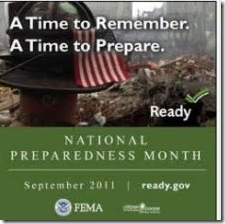
And of course, National Preparedness Month isn’t just for agencies, families, and individuals.


It is for businesses as well.


image


Like death and taxes, disasters are inevitable. 


We may not always be able to prevent them, but we can be better prepared to deal with them when they happen.  


And that can make all the difference whether your business ultimately survives or fails.

Wednesday, June 22, 2011

Estimating The Economic Impact Of A San Andreas Quake


# 5643


Japan, a little more than 100 days after their massive 9.0 earthquake and Tsunami, finds itself in recession with hundreds of thousands of people either displaced from their homes or out of work, and much of their manufacturing base in disarray.


The damage from these types of disasters continue long after the shaking stops.


Over the past 18 months we’ve seen major earthquakes along the Pacific rim ranging from Chile, to New Zealand, to Japan. Spared, thus far, have been the Pacific coasts of North America.


But California, Washington, Oregon, British Columbia, and Alaska all have significant seismic risks. 


Accordingly, the U.S. Bureau of Labor Statistics released a report yesterday that estimated the crippling impact a highly feasible (and long overdue) 7.8 magnitude Southern California earthquake would have on jobs and local businesses.


image

Download PDF file


A quake of this magnitude, they estimate, could affect  430,000 businesses and 4.5 million workers and deliver a devastating – and prolonged – blow to the local economy.


While huge death tolls are considered unlikely in this scenario, the untimely demise of thousands of unprepared businesses is all but assured.


As the following story in the Los Angeles Times points out, it is imperative that local businesses prepare now for an inevitable quake.


Else they risk not only their own economic future, but the futures of their employees and of the local economy.


Southland businesses urged to get ready for 'The Big One' -- a 7.8 earthquake

June 21, 2011 |  3:03 pm


Yesterday’s announcement makes this a pretty good time to remind my readers about the study last year (see Revised Risk Of `The Big One’ Along San Andreas Fault) that suggests that Southern California may be more overdue for another major quake than previously thought.


For more on how you can prepare for `the big one’ (even if you live someplace other than Los Angeles), I would recommend you download, read, and implement the advice provided by the The L. A. County Emergency Survival Guide.


image


And finally, from  the USGS Great Southern California Shakeout website,  we’ve this 4 and 1/2 minute video called Preparedness Now (Streaming | Video) that  “depicts the realistic outcome of a hypothetical, but plausible, magnitude 7.8 earthquake on the San Andreas fault in Southern California.”

image


To become better prepared as an individual, family, business owner, or community to deal with these types of disasters: visit the following preparedness sites.


FEMA http://www.fema.gov/index.shtm

READY.GOV http://www.ready.gov/

AMERICAN RED CROSS http://www.redcross.org/

Friday, September 25, 2009

Korea Cancelling Public Events Over Flu Fears


# 3768


The International Boat Industry news isn’t a place where one would expect to pick up important flu news, but then, this isn’t a normal flu season.


Although this story focuses on the very narrow industry concern over the cancellation of a boat show in Korea, the bigger story is the brief mentioning of 291 public events canceled in Korea by order of the central government.


Swine flu shuts down Korean boat show

By IBI Magazine

Next month's Yacht & Boat Korea has been cancelled because of swine flu. Organisers said the decision was out of their hands because the central government cancelled 291 public events because of fear of H1N1 outbreaks.


The World Health Organisation advised northern hemisphere countries in August to prepare for the second wave of the pandemic. H1N1 is the most dominant flu strain in the world.


"It is a real disappointment but exhibitors and intending visitors realise that the cancellation is out of the organiser's control and is in the interests of public health and safety," said Barry Jenkins, a consultant to the show. Organisers held an emergency meeting before making the announcement.


Similar reporting has appeared in some of the other boating industry magazines, including Marine Business News.


While not every country is likely to attempt this same level of mitigation, this pandemic is obviously having an important economic impact at a time when the global economy is already struggling.