Showing posts with label Ed Yong. Show all posts

Thursday, May 02, 2013

Science: A New H5N1 Reassortant Study


image

BSL-4 Lab Worker - Photo Credit –USAMRIID


# 7219


Ed Yong, writing for Nature News, has the details on a new H5N1 study that – like the Fouchier and Kawaoka studies from 2012 – involved the creation of a more transmissible bird flu virus.


A voluntary moratorium on`gain of function’ studies – those seeking to enhance the transmissibility and/or virulence of the H5N1 virus – went into effect in January of 2012 after biosecurity concerns were raised by a number of experts. (see Scientists Announced a 60 Day Moratorium On Some Types of H5N1 Research).


Objections were raised initially after the 2011 ESWI Influenza Conference in Malta, where Dutch researcher Ron Fouchier revealed that he’d created a more `transmissible’ form of the H5N1 virus (see Debra MacKenzie’s New Scientist: Five Easy Mutations).


That discovery, along with similar news coming from Yoshihiro Kawaoka, a highly respected virologist at the University of Wisconsin-Madison School of Veterinary Medicine, set alarm bells ringing in the biosecurity community.


The voluntary moratorium was later extended beyond two months to give time for international debate, and the formulation of safety rules.


The research papers by Fouchier and Kawaoka on the genetic changes needed to provide H5N1 with enhanced transmissibility have now been published, and the moratorium was lifted earlier this year.


As the following 3 minute NIAID Video explains, pandemic viruses can emerge when two (or more) flu viruses swap genetic material and create a new, hybrid strain.


The stated goal of these controversial experiments is to figure out in the lab which reassortments are likely to produce a human transmissible strain, before nature figures it out in the wild.


Today the Journal Science has published a new study where researchers in China reassorted the genes from the H5N1 and 2009 H1N1 flu viruses, creating 127 new `hybrids’. 


Of these, five showed an increased ability to transmit between guinea pigs, suggesting that they would transmit well among humans as well.


Lead author Professor Chen Hualan of the Harbin Veterinary Research Institute has been heavily involved over the past few weeks into the investigation of the H7N9 outbreak (see Study: Source Identification Of H7N9), and was the author of an EID Journal study from 2001 on H5N1 in wild birds (see EID Journal: H5N1 Branching Out).


First a link to the paper and abstract, then a jump to Ed Yong’s article.


H5N1 Hybrid Viruses Bearing 2009/H1N1 Virus Genes Transmit in Guinea Pigs by Respiratory Droplet

Ying Zhang,Qianyi Zhang, Huihui Kong, Yongping Jiang, Yuwei Gao, Guohua Deng, Jianzhong Shi, Guobin Tian, Liling Liu, Jinxiong Liu, Yuntao Guan, Zhigao Bu, Hualan Chen


  Nature | News

Scientists create hybrid flu that can go airborne

H5N1 virus with genes from H1N1 can spread through the air between mammals.

Ed Yong

02 May 2013

As the world is transfixed by a new H7N9 bird flu virus spreading through China, a study reminds us that a different avian influenza — H5N1 — still poses a pandemic threat.


A team of scientists in China has created hybrid viruses by mixing genes from H5N1 and the H1N1 strain behind the 2009 swine flu pandemic, and showed that some of the hybrids can spread through the air between guinea pigs. The results are published in Science1.


(Continue . . .)


Despite the lifting of the research moratorium, these types of experiments are still viewed  as controversial – and potentially dangerous -  by a number of experts. 


For more on this debate, you may wish to revisit:


The Furor Over H5N1 Research Continues
The Biosecurity Debate On H5N1 Research
Referral: Laurie Garrett On The Bird Flu Research Controversy
The Bird Flu Research Debate Continues

Monday, September 10, 2012

PNAS: Virulence & Transmissibility Of H1N2 Influenza Virus In Ferrets


# 6547


Timing is, as they say, everything.


And coming on the heels the announcement 10 days ago of three human infections with a swine-origin H1N2 influenza (see Minnesota Reports Swine H1N2v Flu), a study that appears today in PNAS is certainly well timed.


The study, conducted at Chungbuk National University South Korea examined viruses circulating in Korean swine (H1N2 & H3N2), and found - for the most part - they were not particularly pathogenic in ferrets.


The exception was a triple reassortant H1N2 virus dubbed Sw/1204, that had picked up two notable mutations, and it not only transmitted efficiently, it also caused severe (even fatal) disease in the test animals.


The study, is called:


Virulence and transmissibility of H1N2 influenza virus in ferrets imply the continuing threat of triple-reassortant swine viruses

Philippe Noriel Q. Pascua, Min-Suk Song, Jun Han Lee, Yun Hee Baek, Hyeok-il Kwon, Su-Jin Park, Eun Hye Choi, Gyo-Jin Lim, Ok-Jun Lee, Si-Wook Kim, Chul-Joong Kim, Moon Hee Sung, Myung Hee Kim, Sun-Woo Yoon, Elena A. Govorkova, Richard J. Webby, Robert G. Webster, and Young-Ki Choi


Ed Yong, writing for Nature has the details  on this paper:


Need for flu surveillance reiterated

Study of Korean pigs finds virus with pandemic potential.

Ed Yong 10 September 2012


One to the two mutations discussed in this paper is hemagglutinin (HA) (Asp-225-Gly) – also known as D225G – which is something we’ve looked at a number of times in the past.


This mutation involves a single amino acid change in the HA gene at position 225 (H3 numbering) from aspartic acid (D) or Asp to glycine (G), and was first linked to more severe pandemic flu by Norwegian Scientists in 2009.


The evidence for the D222G/N  amino acid substitution driving increased virulence, and deep lung infection, has been mixed, however. A few earlier blogs include:


Eurosurveillance: Debating The D222G/N Mutation In H1N1
Study: Receptor Binding Changes With H1N1 D222G Mutation
WER Review: D222G Mutation In H1N1


The second mutation, called NA-315 (serine to asparagine the in neuraminidase) isn’t as well studied, but is believed to assist the virus in breaking out of infected cells after replicating.


As Ed Yong mentions in his article - viruses often have multiple amino acid changes – and we are really just beginning to understand the ramifications of these different genetic combinations. 


Whether this particular virus ever ends up posing a public health threat is impossible to say, but it does illustrate these swine reassortant viruses aren’t always mild in mammals.


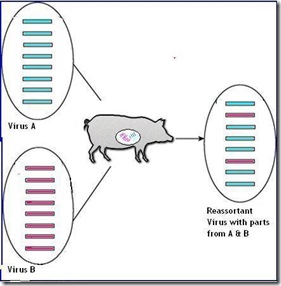
New strains of influenza come about from reassortment; the swapping of genetic material between two different flu strains in a common host. We tend to focus on swine, simply because they are highly susceptible to a variety of influenza viruses, and have a history of producing reassorted viruses.  


Reassortant pig


The pandemic virus that emerged in the spring of 2009 was the end product of several influenza strains that had kicked around the world’s swine population for many years, trading bits of genetic material back and forth, until they produced a version capable of jumping to humans.


But any host (human, swine, avian, or other mammal) could produce a reassorted virus.


For more on the flu risks from swine reassortments, I continue to heartily recommend Helen Branswell’s terrific piece in SciAm  from late 2010 called Flu Factories.

Flu Factories

The next pandemic virus may be circulating on U.S. pig farms, but health officials are struggling to see past the front gate

By Helen Branswell  | December 27, 2010 |


And for some of my earlier looks at swine influenza, you may wish to revisit:


H3N2v: When Pigs Flu

You Say You Want An Evolution?

The (Swine) Influenza Reassortment Puzzle

Friday, July 13, 2012

Referral: Ed Yong On Poultry Vaccine Recombination


# 6433


A fascinating report appears in the journal Science today, which looked at the unexpected recombination of two weakened herpesviruses used in poultry vaccines, that resulted in the generation of a more fit and virulent virus.


Attenuated Vaccines Can Recombine to Form Virulent Field Viruses

Sang-Won Lee, Philip F. Markham, Mauricio J. C. Coppo, Alistair R. Legione, John F. Markham, Amir H. Noormohammadi, Glenn F. Browning, Nino Ficorilli, Carol A. Hartley, Joanne M. Devlin


Ed Yong, writing in his excellent Not Exactly Rocket Science Blog for Discover Magazine has the details, background, and analysis of why this sort of unexpected merging of live attenuated viruses is unlikely to be a problem with human vaccines.


By all means, take a side trip to read Ed’s:


Chicken vaccines merged to form live viruses and caused outbreaks of irony

Friday, June 29, 2012

Researchers Discover New Flu Gene

image


# 6409


A reoccurring theme in this blog is just how much we have yet to learn about how our immune systems, influenza viruses, and other pathogens function.


Illustrative of this fact is the surprise announcement yesterday that researchers at Universities of Cambridge, Cork, Edinburgh and Utah, the Institute of Systems Biology in Seattle and the NIH have discovered a previously unknown gene hidden inside the influenza virus genome.


Dubbed PA-X, this gene (when active) helps attenuates the virulence of the virus. When this gene does not function properly, the flu virus can over stimulate the immune system, making the infection worse.


This discovery appears in a research article published yesterday by Science.


An Overlapping Protein-Coding Region in Influenza A Virus Segment 3 Modulates the Host Response

B. W. Jagger, H. M. Wise,J. C. Kash, K.-A. Walters, N. M. Wills, Y.-L. Xiao, R. L. Dunfee, L. M. Schwartzman, A. Ozinsky, G. L. Bell, R. M. Dalton, A. Lo, S. Efstathiou, J. F. Atkins, A. E. Firth, J. K. Taubenberger, P. Digard


While a short press release from the University of Edinburgh is available (see Gene discovery helps explain how flu can cause severe infections), Ed Yong’s Blog at Discover Magazine provides some of the best analysis of this research that I’ve seen. 


At this point, I will step aside and invite you to read Ed’s excellent article:


New flu gene found hiding in plain sight, and affects severity of infections

Ed Yong – Not Exactly Rocket Science