Showing posts with label Family. Show all posts

Wednesday, November 26, 2014

Thanksgiving Is National Family History Day

image

Note: This is an updated (including new links) version of my yearly post on National Family History Day.


# 9375


Every year since 2004 the Surgeon General of the United States has declared Thanksgiving – a day when families traditionally gather together - as National Family History Day.


As a former paramedic, I am keenly aware of how important it is for everyone to know their personal and family medical history.  Every day emergency room doctors are faced with patients unable to remember or relay their health history during a medical crisis. And that can delay both diagnosis and treatment.


Which is why I keep a medical history form – filled out and frequently updated – in my wallet, and have urged (and have helped) my family members to do the same.


The CDC and the HHS have a couple of web pages devoted to collecting your family history, including a web-based tool to help you collect, display, and print out your family’s health history.

Family History: Collect Information for Your Child's Health

Surgeon General's Family Health History Initiative

Using this online tool, in a matter of only a few minutes, you can create a basic family medical history.  But before you can do this, you’ll need to discuss each family member’s medial history. The HHS has some advice on how to prepare for that talk:

Before You Start Your Family Health History

Americans know that family history is important to health. A recent survey found that 96 percent of Americans believe that knowing their family history is important. Yet, the same survey found that only one-third of Americans have ever tried to gather and write down their family's health history.

Here are some tips to help you being to gather information:

    I’ve highlighted several other methods of creating histories in the past, some of which you may prefer.  A few excerpts (and links) from these essays. First, I’ll show you how I create and maintain histories for my Dad (who passed away several years ago) and myself.  This was featured in an essay called A History Lesson.

    Today I’m going to impart a little secret that will ingratiate yourself with your doctor and not only improve the care you receive, but also reduce the amount of time you spend in the exam room. When you go to your doctor, have a brief written history printed out for him or her.

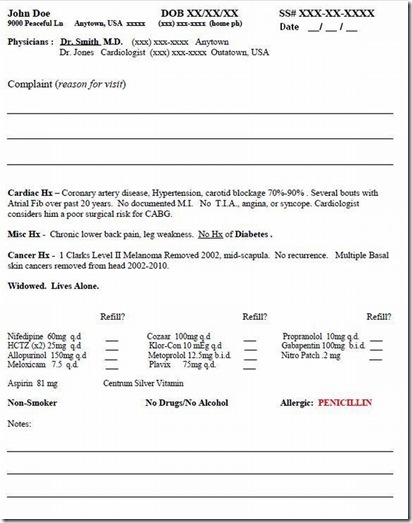
    I’ve created a sample based on the one I used for my Dad (the details have been changed).   It gets updated, and goes with him, for every doctor’s visit.

    And his doctors love it.

    hxa

    While every history will be different, there are a few `rules’.

    • First, keep it to 1 page.     Even if the patient has an `extensive history’.   If your doctor can’t scan this history, and glean the highlights, in 60 seconds or less . . . it isn’t of much use.
    • Second, paint with broad strokes.   Don’t get bogged down in details.  Lab tests and such should already be in your chart.
    • Third, always fill in a reason for your visit.   Keep it short, your doctor will probably have 10 to 15 minutes to spend with you.   Have your questions and concerns down in writing before you get there.
    • Fourth, list all Meds  (Rx and otherwise) and indicate which ones you need a refill on.   If you have a question about a med, put a `?’ next to it.   And if you have any drug allergies, Highlight them.
    • Fifth,  Make two copies!   One for your doctor to keep, and one for you.  As you talk to your doctor, make notes on the bottom (bring a pen) of your copy.  

    Once you create the basic template (using any word processor), it becomes a 5 minute job to update and print two copies out for a doctor’s visit.
    The history above is great for scheduled doctor’s visits, but you also should have a readily available (preferably carried in your wallet or purse), EMERGENCY Medical History Card.

    I addressed that issue in a blog called Those Who Forget Their History . . . .   A few excerpts (but follow the link to read the whole thing):

    Since you can’t always know, in advance, when you might need medical care it is important to carry with you some kind of medical history at all times.  It can tell doctors important information about your history, medications, and allergies when you can’t.

    Many hospitals and pharmacies provide – either free, or for a very nominal sum – folding wallet medical history forms with a plastic sleeve to protect them. Alternatively, there are templates available online.

    I’ve scanned the one offered by one of our local hospitals below. It is rudimentary, but covers the basics.

    medhx1

    medhx2

    And a couple of other items, while not exactly a medical history, may merit discussion in your family as it has recently in mine.

    • First, all adults should consider having a Living Will that specifies what types of medical treatment you desire should you become incapacitated.
    • You may also wish to consider assigning someone as your Health Care Proxy, who can make decisions regarding your treatment should you be unable to do so for yourself.
    • Elderly family members with chronic health problems, or those with terminal illnesses, may even desire a home DNR (Do Not Resuscitate) Order.

    Verbal instructions by family members – even if the patient is in the last stages of an incurable illness – are likely to be ignored by emergency personnel.

    In Florida, the form must be printed on yellow paper. Different states have different requirements.  You should check with your doctor, or the local department of health to determine what the law is in your location.

    image

    My father, who’s health declined greatly in his 86th year, requested a DNR in early 2011. That – along with securing home hospice care (see His Bags Are Packed, He’s Ready To Go) – allowed him to die peacefully at home in his own bed. 

    Admittedly, not the cheeriest topic of conversation in the world, but for a lot of people, this is an important issue to address.

    A few minutes spent this holiday weekend putting together medical histories could spare you and your family a great deal of anguish down the road.

    Wednesday, January 29, 2014

    Zhejiang Investigating Family Cluster Of H7N9 Cases

    image

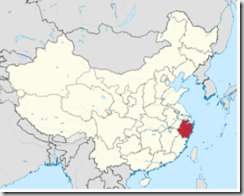
    Zhejiang Province – Credit Wikipedia

    # 8239


    We’ve a terse statement from the Zhejiang Ministry of Health this morning announcing their investigation into a family cluster of H7N9 cases.  Details are scant at this time, but what we know is 3 members of a family in Hangzhou all contracted the virus. 


    Whether this was due to a common environmental exposure, or human-to-human transmission is unknown at this time.  


    As we’ve discussed before, when it comes to proving human-to-human (H-2-H) transmission of an emerging virus, the bar is set pretty high.  When there are other, equally plausible explanations (e.g. shared environmental, or live bird exposures), then H-2-H cannot be assumed.


    Since we’ve seen suspected limited  H-2-H transmission of the H7N9 virus in the past (see BMJ: `Probable Person-to-Person Transmission’ Of H7N9), another occurrence – while of epidemiological interest - wouldn’t be a game changer.  We take notice primarily because it could be the first visible step in a chain of transmission.


    First the (machine translated) statement, then I’ll be back with a bit more.


    Hangzhou together on the progress of the investigation of human infection of avian influenza H7N9 cases in family aggregation

    Release date :2014-01-29


    January of this year, I appointed people infected with H7N9 reported confirmed cases of avian influenza have occurred in Xiaoshan District, a family clusters of cases, three people sick. In three patients before the onset of the existence of a common environmental exposure, there are close contacts, the exact cause of the infection, the national and provincial experts are studying, one has the final official results announced immediately to the public.


    Additional reportage indicates this cluster consists of a couple and their daughter.  This from AFP news.


    Three H7N9 cases in same Chinese family: Xinhua

    January 29, 2014 12:53 pm

    SHANGHAI - Three members of the same Chinese family have contracted H7N9 bird flu in the province worst-affected by the current spike in cases, the official Xinhua news agency reported. A couple and their daughter in Hangzhou, the capital of the eastern province of Zhejiang, were infected one after another, Xinhua said late Tuesday, without giving further details.

    (Continue . . .)


    In 2006, we saw large clusters of H5N1 infection in both Indonesia and Turkey, and yet, it never managed to gain enough momentum to spark a pandemic (see 2006 Karo Cluster Involved H2H Transmission).  Similarly, a family cluster in Pakistan in 2007 raised concerns, but once again failed to catch fire (see EID Journal: Unraveling Pakistan’s H5N1 Outbreak).


    Should we begin to see evidence of efficient and sustained H-2-H transmission (ie. 3rd, 4th, 5th generation transmission) - then things begin to get more interesting. 


    But for now, we’ve no indications of that happening.

    Sunday, December 01, 2013

    Updating The UAE MERS-CoV Family Cluster


    image

    UAE’s Proximity to Saudi Arabia


    # 8022


    Arabic media sources are carrying brief updates on the family cluster (husband, wife, and child) diagnosed with the MERS coronavirus this afternoon, and from the reading it appears the child is experiencing mild symptoms and was discovered during `contact testing’


    The parents both appear to be suffering acute respiratory infections, and are isolated in intensive care.


    A quick check of the  Abu Dhabi Health Authority and UAE Health Ministry websites turn up nothing `official’ on these cases.  But we’ve two translated media reports to choose from. The first from http://www.al-sharq.com.


    UAE recorded were newly infected with "Corona" to a child Jordanian

    Abu Dhabi - Agencies

    UAE health authorities announced the diagnosis of new cases of HIV, "Corona" that causes respiratory syndrome Middle East for Jordanian children at the age of eight years.

    According to the Health Authority in Abu Dhabi, said in a statement on Sunday, "appeared on the child's symptoms and was hospitalized simple to isolate and follow-up of the health situation."

    She said that the child's parents were wounded disease was discovered a few days ago and injuries to the child tests conducted precautionary Mkhaltth virtue of his parents turned out to viral infections.

    She said the Health Authority that they coordinate with the Ministry of Health and health authorities and the concerned authorities in the UAE in this regard and has taken the necessary measures and precautions in accordance with the recommendations of the scientific and conditions and criteria adopted by the World Health Organization, including epidemiological investigation of Mkhaltin.

    The Health Authority of Abu Dhabi announced on Thursday the diagnosis of new cases of infection of the virus to a patient Jordanian Corona and his wife Almqaman Emirates.


    This second report from http://www.ammonnews.net/


    Emirates recorded new infections "Corona" to a child Jordanian


    [12/1/2013 

    Ammon - (dpa) - The health authorities of the UAE diagnosis of new cases of HIV, "Corona" that causes respiratory syndrome Middle East for Jordanian children at the age of eight years.

    According to the Health Authority in Abu Dhabi, said in a statement on Sunday, "appeared on the child's symptoms and was hospitalized simple to isolate and follow-up of the health situation."

    She said that the child's parents were wounded disease was discovered a few days ago and injuries to the child tests conducted precautionary Mkhaltth by virtue of his parents turned out having the virus.

    She said the Health Authority that they coordinate with the Ministry of Health and health authorities and stakeholders the UAE in this regard and has taken the necessary measures and precautions in accordance with the recommendations of the scientific and conditions and criteria adopted by the World Health Organization, including epidemiological investigation of Mkhaltin.

    The Health Authority of Abu Dhabi announced on Thursday new cases diagnosed cases of HIV in a patient Jordanian Corona and his wife Almqaman Emirates.

    The patient's age 38 years and is currently receiving treatment in intensive care and his wife, eight months pregnant and infected with acute respiratory symptoms and receiving treatment in intensive care at a hospital in the UAE.


    Thursday, September 26, 2013

    NPM13: Create A Family Communications Plan

    image

    Note: This is day 25 of National Preparedness Month.  Follow this year’s campaign on Twitter by searching for the #NPM or #NPM13 hash tag.

    This month, as part of NPM13, I’ll be rerunning some updated  preparedness essays (like this one) , along with some new ones.


    # 7814


    Those of us who were living in Florida during the `bad old days’ of the cold war remember well the Cuban Missile Crisis of 1962.


    Although it is hard to imagine it today, much of Florida was on a war footing with fears of a nuclear attack that might come at any time, thousands of military streaming into the state, and schools running daily `duck & cover’ and emergency evacuation exercises.


    Kids were sent home with civil defense pamphlets on the basics of radiation poisoning and how to build an in-home fallout shelter.


    image

    As an 8-year-old with a scientific bent, these were exciting times.


    What I didn’t full appreciate at the time was my parents were faced with an agonizing dilemma. My twin-brother and I attended a nearby elementary school, while my 17-year old sister attended high school some distance away.


    If the alert went up, they realized they might only have time to get to one school to pick up their kids.


    Logic dictated that the pick up my brother and I, based on our ages, and the fact that there were two of us. My sister was given instructions to go to the home of one of her high school friends, and our folks would  either contact her or pick her up there.


    More than 50 years ago, in the face of a potential crisis, my family cobbled together their own emergency communications plan including an alternate rendezvous point.


    While a nuclear attack is (thankfully) far less likely today, the same principles hold true when it comes to having a communications plan, and a meet-up point.


    And since a tornado, earthquake, house fire, or some other disaster can strike without warning . . .  these are the sorts of plans every family needs to make now. Before they are needed.


    This from Ready.gov.


     MAKE A PLAN

    Your family may not be together when a disaster strikes so it is important to plan in advance: how you will get to a safe place; how you will contact one another; how you will get back together; and what you will do in different situations. Read more about Family Communication during an emergency.

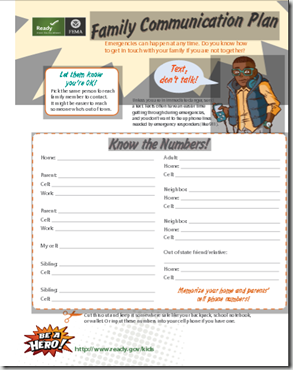
    Ready.gov has made it simple for you to make a family emergency plan. Download the Family Communication Plan for Parents and Kids (PDF - 1.2 Mb) and fill out the sections before printing it or emailing it to your family and friends.

    You should also inquire about emergency plans at places where your family spends time: work, daycare and school, faith organizations, sports events and commuting. If no plans exist, consider volunteering to help create one. Talk to community leaders, your colleagues, neighbors and members of faith or civic organizations about how you can work together in the event of an emergency. You will be better prepared to safely reunite your family and loved ones during an emergency if you think ahead and communicate with others in advance. Read more about school and workplace plans.


    READY.GOV has made things  easier today, as they’ve developed  several Family Emergency Communication Kits geared for both adults and kids, which can be downloaded from the net. With just a few minutes effort, you can have your own emergency communications plan and emergency meeting place set up.


    image

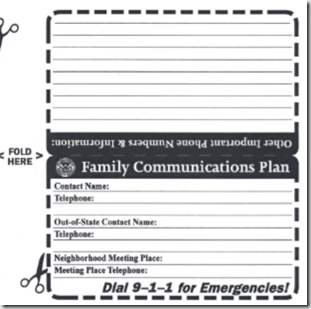
    While the above version is geared to kids, the version below is more suitable for teenagers and adults.


    image

    Appendix C of the Are You Ready? Guide (contains blank contact cards and a family communications plan form)


    Filling out these cards may seem a small step, but that's what most preparedness involves.


    Taking small, organized steps that, when put together, create a fabric of individual and community preparedness.  If you do just one small step each day, in almost no time you’ll find yourself and your family far better prepared to face any emergency.


    For more on how to prepare, visit these websites:


    FEMA http://www.fema.gov/index.shtm

    READY.GOV http://www.ready.gov/

    AMERICAN RED CROSS http://www.redcross.org/


    And you can use this link to read earlier NPM preparedness posts on this blog.