Showing posts with label Communications. Show all posts

Thursday, September 26, 2013

NPM13: Create A Family Communications Plan

image

Note: This is day 25 of National Preparedness Month.  Follow this year’s campaign on Twitter by searching for the #NPM or #NPM13 hash tag.

This month, as part of NPM13, I’ll be rerunning some updated  preparedness essays (like this one) , along with some new ones.


# 7814


Those of us who were living in Florida during the `bad old days’ of the cold war remember well the Cuban Missile Crisis of 1962.


Although it is hard to imagine it today, much of Florida was on a war footing with fears of a nuclear attack that might come at any time, thousands of military streaming into the state, and schools running daily `duck & cover’ and emergency evacuation exercises.


Kids were sent home with civil defense pamphlets on the basics of radiation poisoning and how to build an in-home fallout shelter.


image

As an 8-year-old with a scientific bent, these were exciting times.


What I didn’t full appreciate at the time was my parents were faced with an agonizing dilemma. My twin-brother and I attended a nearby elementary school, while my 17-year old sister attended high school some distance away.


If the alert went up, they realized they might only have time to get to one school to pick up their kids.


Logic dictated that the pick up my brother and I, based on our ages, and the fact that there were two of us. My sister was given instructions to go to the home of one of her high school friends, and our folks would  either contact her or pick her up there.


More than 50 years ago, in the face of a potential crisis, my family cobbled together their own emergency communications plan including an alternate rendezvous point.


While a nuclear attack is (thankfully) far less likely today, the same principles hold true when it comes to having a communications plan, and a meet-up point.


And since a tornado, earthquake, house fire, or some other disaster can strike without warning . . .  these are the sorts of plans every family needs to make now. Before they are needed.


This from Ready.gov.


 MAKE A PLAN

Your family may not be together when a disaster strikes so it is important to plan in advance: how you will get to a safe place; how you will contact one another; how you will get back together; and what you will do in different situations. Read more about Family Communication during an emergency.

Ready.gov has made it simple for you to make a family emergency plan. Download the Family Communication Plan for Parents and Kids (PDF - 1.2 Mb) and fill out the sections before printing it or emailing it to your family and friends.

You should also inquire about emergency plans at places where your family spends time: work, daycare and school, faith organizations, sports events and commuting. If no plans exist, consider volunteering to help create one. Talk to community leaders, your colleagues, neighbors and members of faith or civic organizations about how you can work together in the event of an emergency. You will be better prepared to safely reunite your family and loved ones during an emergency if you think ahead and communicate with others in advance. Read more about school and workplace plans.


READY.GOV has made things  easier today, as they’ve developed  several Family Emergency Communication Kits geared for both adults and kids, which can be downloaded from the net. With just a few minutes effort, you can have your own emergency communications plan and emergency meeting place set up.
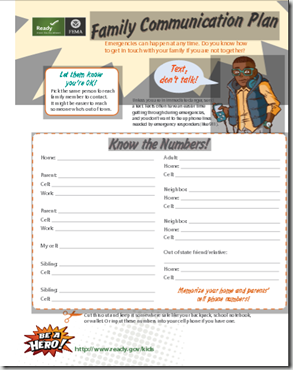
 

image

While the above version is geared to kids, the version below is more suitable for teenagers and adults.
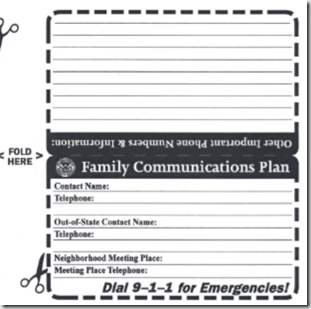
 

image

Appendix C of the Are You Ready? Guide (contains blank contact cards and a family communications plan form)


Filling out these cards may seem a small step, but that's what most preparedness involves.


Taking small, organized steps that, when put together, create a fabric of individual and community preparedness.  If you do just one small step each day, in almost no time you’ll find yourself and your family far better prepared to face any emergency.


For more on how to prepare, visit these websites:


FEMA http://www.fema.gov/index.shtm

READY.GOV http://www.ready.gov/

AMERICAN RED CROSS http://www.redcross.org/


And you can use this link to read earlier NPM preparedness posts on this blog.

Saturday, February 18, 2012

AAAS Webinar: Science Is Not Enough


# 6155


Yesterday, in Science at the Crossroads, I wrote about the public’s growing mistrust in science and in the scientific community. There are deep divisions over scientific claims of climate change, vaccine safety, the safety of genetically modified crops, and even the theory of evolution.


While there are many external reasons for this divide (including tabloid journalism, and the proliferation of pseudo-science on the internet), the way that scientists communicate about science is at least partially to blame.


The decision yesterday afternoon by the World Health Organization to hold back on the publication of controversial H5N1 research until they can `increase public awareness and understanding of this research’  would seem a tacit acknowledgment that scientists need to do a better job in communicating with the public.


Later today, the AAAS will webcast a plenary lecture on this very subject.

image


Science Is Not Enough: Plenary Panel and Live Webcast

18 February 2012
5:00-6:30 p.m. Pacific Standard Time
Vancouver Convention Centre, West Building, Ballroom C

Live-tweet your questions to #AAASmtg


Why do so many political leaders and citizens remain unconcerned about climate change, water scarcity, fisheries depletion, and a host of other science-related global challenges?


An exceptional plenary panel at the 2012 AAAS Annual Meeting will explore how scientists, educators, and students can help influence public perceptions and debate about science-related global challenges.


The panel will be moderated by Frank Sesno, an award-winning American journalist, former CNN correspondent, anchor and Washington bureau chief, and director of the School of Media and Public Affairs at George Washington University.


AAAS President Nina Fedoroff, a leading geneticist and molecular biologist, will preside. Fedoroff is Evan Pugh Professor of Biology and Willaman Professor of Life Science at Pennsylvania State University. She is also a distinguished visiting professor at the King Abdullah University of Science and Technology (KAUST) in Saudi Arabia.

Panelists

[PHOTOGRAPH] James Hansen

James Hansen

Director, NASA Goddard Institute for Space Studies; Adjunct Professor of Earth and Environmental Sciences, Columbia University

[PHOTOGRAPH] Olivia Judson

Olivia Judson

Research Fellow, Imperial College London

[PHOTOGRAPH] Hans Rosling

Hans Rosling

Professor of International Health, Karolinska Institute; Co-Founder, Gapminder Foundation


This should make for an interesting webcast.

Saturday, September 17, 2011

NPM11: Emergency Local Communications


Note: This is day 17 of National Preparedness Month.  Follow this year’s campaign on Twitter by searching for the #NPM11 hash tag.

image

This month, as part of NPM11, I’ll be rerunning some edited and updated older preparedness essays, along with some new ones.


# 5847


During a disaster, telephone service - whether via landline or cell phone - may be compromised. Even if the phone system remains intact, the service may overwhelmed by excessive traffic.


Note: Text messaging will sometimes work even when voice communications are down. 


Even if voice comms are available, during a crisis texting whenever possible is still preferable, because it places a lower burden on the phone system.


It can be advantageous, therefore, to have a backup form of short-range communications for when phones are either unavailable or are simply not the best solution.


As a liveaboard sailor, I spent several years without a telephone (or A/C, refrigeration, & running water for that matter). When we weren’t staying in a marina, cruising aboard a sailboat could be the ultimate in social isolation.


Sure, some days we'd gather on larger boats, or dockside, or on some isolated beach and kill some beers and tell some lies. But often we went days without direct human contact.


Of course, boaters just about all have a VHF radio aboard, and that was our link to one another.


Usually twice each day, in an anchorage of any size, we'd have a `radio roundup', where each boater would check in via the radio. If anyone needed anything, whether it was a recipe, a doctor, or a spare part, they could put out the call on the radio net.


Once `business' was taken care of, chit-chat ensued.


With multiple channels available, Boater A would often call upon Boater B to `meet me on Channel X', and they could depart and talk without cluttering main channel.


If a boater failed to check in, someone would usually row over and knock on their boat and make sure they were alright.


During an emergency - like an earthquake, flood, hurricane (or even a pandemic) - these same procedures could prove invaluable for just about any neighborhood or community.


While VHF radios are expensive, and overkill for most neighborhood settings, there is an easy alternative; FRS radio or Family Radio Service.


These are not your father's walkie-talkies.


They operate on a UHF band and are more reliable, and are less prone to static, than the old CB radio. And they are surprisingly inexpensive.


As regular readers are aware, I am a big proponent of the `disaster buddy’ concept - working with your friends and neighbors during an emergency (see In An Emergency, Who Has Your Back?).


Whether you live in a suburban neighborhood or an apartment complex, or a trailer park, these little radios can provide a ready way to communicate with your `disaster buddies’, even if your phone lines or cellular service are down.


For those walking a neighborhood watch patrol, they give an easy way to communicate with others patrolling the neighborhood, or with a home base.


For home security, they are hard to beat. One person can be watching a back door, while you monitor the front door, and you can communicate without shouting.


Or someone can go outside to check out a perceived threat, bring in supplies, or assist a neighbor and still remain in communications with the folks in the main house.


During a pandemic, earthquake, severe storm, search & rescue operation, or any other local or national emergency, they would be a valuable tool.


I own the Motorola T5000, and paid $28 for a pair. Other models are available from as little as $20 a pair. For $100, you could equip yourself, and 6 - 8 neighbors with transceivers. Not a bad bang for the buck.


These units can be purchased at WalMart, Best Buy, Radio Shack, Kmart, or practically any major department store. You can also order them online.


During a crisis, If you set up your own radio net meeting schedule (say 8am and 8pm), you can make sure everyone is safe and accounted for.


If power is available, and you elect to go with the rechargeable units, you can leave them on standby and in the charger 24/7, and anyone can holler if they have a problem.


While the claims of a 5 mile or 8 mile range should be taken with a large grain of salt (think boulder-sized), depending on terrain and man-made obstacles, they can be pretty effective for up to 1 mile.


As with most things, the more you pay, the more you get.


Tech Details (United States)

FRS radios do not require a license.

You may operate on up to 14 channels with an output of 1/2 watt. Some FRS radios (like mine) also give you an additional 8 channels of GMRS (General Mobile Radio Service) which may utilize up to 5 watts of power.


YOU DO NEED A LICENSE to operate on the GMRS bands. But the range of communication will be several time farther than FRS.


If you buy a hybrid unit, you do not need a license to use the lower 14 channels.

While 14 channels may not seem like a lot, each channel can incorporate up to 38 different `privacy codes', which can block the reception of others on your channel.


These CTCSS (Continuous Tone Coded Squelch System) codes effectively give you 532 channels of operation, if you desire. Just set up a common code for your radio net, and you won't hear other's and it is likely that other's won't hear you.


NOTE: This is not `secure-comms', because anyone with an FRS radio can turn off this feature and hear all traffic on any channel.


Most units also provide a channel scan feature, which will pick up traffic on all 14 channels. Other features (dependant on price) include built in GPS, battery indicators, backlighting of dial, VOX support, ear buds, and even vibrating alert.


You other big decision will be the power source. Most units come with rechargeable batteries and a a duel charging stand. You will need 110 volt power, or a battery/inverter setup to keep these charged.


You can also buy units that run off of AAA batteries, in which case you will need lots of replacement batteries. Talk time on disposable batteries is reportedly between 20 and 30 hours. Use the higher output GMRS bands, and that will go down.


As I have a solar panel/battery/inverter setup I elected to go with the charging stand. You can read about my system, and how you can make one for yourself at Preparedness: Solar Power On A Budget.


solar1


If you have neighbors you'd like to remain in contact with, or need a way for a family member to remain in contact while outside or on the other side of the house, these little gems will likely to the job.

Monday, September 05, 2011

NPM11: Creating A Family Communications Plan


Note: This is day 5 of National Preparedness Month.  Follow this year’s campaign on Twitter by searching for the #NPM11 hash tag.

image

This month, as part of NPM11, I’ll be rerunning some edited and updated older preparedness essays, along with some new ones.


# 5813


Those of us who were living in Florida during the `bad old days’ of the cold war remember well the Cuban Missile Crisis of 1962.


Although it is hard to imagine it today, much of Florida was on a war footing with fears of a nuclear attack that might come at any time, thousands of military streaming into the state, and schools running daily `duck & cover’ and emergency evacuation exercises.


Kids were sent home with civil defense pamphlets on the basics of radiation poisoning and how to build an in-home fallout shelter.


image


As an 8-year-old with a scientific bent, these were exciting times.


What I didn’t full appreciate at the time was my parents were faced with an agonizing dilemma. My twin-brother and I attended a nearby elementary school, while my 17-year old sister attended high school some distance away.


If the alert went up, they realized they might only have time to get to one school to pick up their kids.


Logic dictated that the pick up my brother and I, based on our ages, and the fact that there were two of us. My sister was given instructions to go to the home of one of her high school friends, and our folks would  either contact her or pick her up there.


Nearly 50 years ago, in the face of a potential crisis, my family cobbled together their own emergency communications plan including an alternate rendezvous point.


While a nuclear attack is (thankfully) far less likely today, the same principles hold true when it comes to having a communications plan, and a meet-up point.


And since a tornado, earthquake, house fire, or some other disaster can strike without warning . . .  these are the sorts of plans every family needs to make now.


Before they are needed.


Luckily FEMA and READY.GOV have made things a bit easier today.  They’ve developed a Family Emergency Communications Kit, which can be downloaded free from the net. 


With just a few minutes effort, you can have your own emergency communications plan and emergency meeting place set up.


Family Communications
Image of family communication plan

Your family may not be together when disaster strikes, so plan how you will contact one another. Think about how you will communicate in different situations.


Complete a contact card for each family member. Have family members keep these cards handy in a wallet, purse, backpack, etc. You may want to send one to school with each child to keep on file. Pick a friend or relative who lives out-of-state for household members to notify they are safe.


Family Communications Plan which should be completed and posted so the contact information is readily accessible to all family members. A copy should also be included in your family disaster supplies kit.


Appendix C of the Are You Ready? Guide (contains blank contact cards and a family communications plan form)


You’ll find the Ready.gov version of the kit available HERE.

Thursday, April 14, 2011

Neighborhood Communications


With the Atlantic Hurricane season just six weeks away, and as the disaster in Japan unfolds each day in the news, it seems a good time to update some of the preparedness essays I’ve written in the past.


Today we turn to emergency neighborhood communications using FRS radios.

This is an edited and updated version of a blog that last appeared in May of 2010.


# 5490


Living aboard a sailboat was, at times, the ultimate in social isolation.


Sure, some days we'd gather on larger boats, or dockside, or on some isolated beach and kill some beers and tell some lies. But a lot of the time, we went days without direct human contact.


Of course, boaters just about all have a VHF radio aboard, and that was our link to one another.


Usually twice each day, in an anchorage of any size, we'd have a `radio roundup', where each boater would check in via the radio. If anyone needed anything, whether it was a recipe, a doctor, or a spare part, they could put out the call on the radio net.


Once `business' was taken care of, chit-chat ensued.


With multiple channels available, Boater A would often call upon Boater B to `meet me on Channel X', and they could depart and talk without cluttering main channel.


If a boater failed to check in, someone would usually row over and knock on their boat and make sure they were alright. 


During an emergency - like an earthquake, flood, hurricane (or even a pandemic) - these same procedures could prove invaluable for just about any neighborhood or community.


While VHF radios are expensive, and overkill for most neighborhood settings, there is an easy alternative; FRS radio or Family Radio Service.


These are not your father's walkie-talkies.


They operate on a UHF band and are more reliable, and are less prone to static, than the old CB radio. And they are surprisingly inexpensive.


As regular readers are aware, I am a big proponent of the `disaster buddy’ concept - working with your friends and neighbors during an emergency (see In An Emergency, Who Has Your Back?).


Whether you live in a suburban neighborhood or an apartment complex, or a trailer park, these little radios can provide a ready way to communicate with your `disaster buddies’, even if your phone lines or cellular service are down.


For those walking a neighborhood watch patrol, they give an easy way to communicate with others patrolling the neighborhood, or with a home base.  


For home security, they are hard to beat. One person can be watching a back door, while you watch the front door, and you can communicate without shouting.


Or someone can go outside to check out a perceived threat, bring in supplies, or assist a neighbor and still remain in communications with the folks in the main house.


During a pandemic, earthquake, severe storm, search & rescue operation, or any other local or national emergency, they would be a valuable tool.


I own the Motorola T5000, and paid $28 for a pair. Other models are available from as little as $20 a pair. For $100, you could equip yourself, and 6 - 8 neighbors with transceivers. Not a bad bang for the buck.


These units can be purchased at WalMart, Best Buy, Radio Shack, Kmart, or practically any major department store. You can also order them online.


During a crisis, If you set up your own radio net meeting schedule (say 8am and 8pm), you can make sure everyone is safe and accounted for.


If power is available, and you elect to go with the rechargeable units, you can leave them on standby and in the charger 24/7, and anyone can holler if they have a problem.


While the claims of a 5 mile or 8 mile range should be taken with a large grain of salt (think boulder-sized), depending on terrain and man-made obstacles, they can be pretty effective for up to 1 mile.


As with most things, the more you pay, the more you get.


Tech Details (United States)

FRS radios do not require a license.

You may operate on up to 14 channels with an output of 1/2 watt. Some FRS radios (like mine) also give you an additional 8 channels of GMRS (General Mobile Radio Service) which may utilize up to 5 watts of power.


YOU DO NEED A LICENSE to operate on the GMRS bands. But the range of communication will be several time farther than FRS.


If you buy a hybrid unit, you do not need a license to use the lower 14 channels.


While 14 channels may not seem like a lot, each channel can incorporate up to 38 different `privacy codes', which can block the reception of others on your channel.


These CTCSS (Continuous Tone Coded Squelch System) codes effectively give you 532 channels of operation, if you desire. Just set up a common code for your radio net, and you won't hear other's and it is likely that other's won't hear you.


NOTE: This is not `secure-comms', because anyone with an FRS radio can turn off this feature and hear all traffic on any channel.


Most units also provide a channel scan feature, which will pick up traffic on all 14 channels. Other features (dependant on price) include built in GPS, battery indicators, backlighting of dial, VOX support, ear buds, and even vibrating alert.


You other big decision will be the power source. Most units come with rechargeable batteries and a a duel charging stand. You will need 110 volt power, or a battery/inverter setup to keep these charged.


You can also buy units that run off of AAA batteries, in which case you will need lots of replacement batteries. Talk time on disposable batteries is reportedly between 20 and 30 hours. Use the higher output GMRS bands, and that will go down.


As I have a solar panel/battery/inverter setup I elected to go with the charging stand. You can read about my system, and how you can make one for yourself at Preparedness: Solar Power On A Budget.


solar1


If you have neighbors you'd like to remain in contact with, or need a way for a family member to remain in contact while outside or on the other side of the house, these little gems will likely to the job.

Tuesday, September 07, 2010

NPM10: A Family Communications Plan


Note:  Today is Day 7 of National Preparedness Month.

You can follow this month long campaign on Twitter by searching the #NPM10  hash tag.


# 4878


During the `bad old days’ of the cold war, things heated up considerably here in Florida in 1962 during the Cuban Missile Crisis.  The military was mobilized, concertina wire rolled out on the beaches, and fears of a nuclear attack were rampant.


Schools immediately began `duck & cover’ drills, emergency evacuation exercises, and sent home civil defense pamphlets on radiation poisoning and how to build an in-home fallout shelter.


image


As an 8-year-old with a scientific bent, these were exciting times.


What I didn’t know was my parents were faced with an agonizing dilemma.  My twin-brother and I attended an elementary school, while my 17-year old sister attended high school some distance away. 


If the alert went up, they realized they might only have time to get to one school to pick up their kids.  


Logic dictated that the pick up my brother and I, based on our ages, and the fact that there were two of us. 


My sister was given instructions to go to the home of one of her high school friends, and our folks would  either contact her or pick her up there.


Nearly 50 years ago, in the face of a potential crisis, my family cobbled together their own emergency communications plan including an alternate rendezvous point.


While a nuclear attack is (thankfully) far less likely today, the same principles hold true when it comes to having a communications plan, and a meet-up point.


And since a tornado, or an earthquake, or some other disaster can strike without warning . . .  these are the sorts of plans every family needs to make now.  


Before they are needed.


Luckily FEMA and READY.GOV have made things a bit easier today.  They’ve developed a Family Emergency Communications Kit, which can be downloaded free from the net. 


With just a few minutes effort, you can have your own emergency communications plan and emergency meeting place set up.


Family Communications

Image of family communication plan


Your family may not be together when disaster strikes, so plan how you will contact one another. Think about how you will communicate in different situations.


Complete a contact card for each family member. Have family members keep these cards handy in a wallet, purse, backpack, etc. You may want to send one to school with each child to keep on file. Pick a friend or relative who lives out-of-state for household members to notify they are safe.


Family Communications Plan which should be completed and posted so the contact information is readily accessible to all family members. A copy should also be included in your family disaster supplies kit.


You’ll find the Ready.gov version of the kit available HERE.

Monday, September 06, 2010

NPM10: Neighborhood Communications


Note:  Today is Day 6 of National Preparedness Month, and so with that in mind,  I’m re-running my essay on FRS handheld radios. 

You can follow this month long campaign on Twitter by searching the #NPM10  hash tag.


# 4875


Living aboard a boat was, at times, the ultimate in social isolation.


Sure, some days we'd gather on larger boats, or dockside, or on some isolated beach and kill some beers and tell some lies, but a lot of the time, we went days without direct human contact. But boaters just about all have a VHF radio aboard, and that was our link to one another.


Usually twice each day, in an anchorage of any size, we'd have a `radio roundup', where each boater would check in via the radio. If anyone needed anything, whether it was a recipe, a doctor, or a spare part, they could put out the call on the radio net.


Once `business' was taken care of, chit-chat ensued. With multiple channels available, Boater A would often call upon Boater B to `meet me on Channel X', and they could depart and talk without cluttering main channel. If a boater failed to check in, someone could row over and knock on their boat and make sure they were alright.


Sometimes, we had a rule that we'd do a personal check after a boater missed two consecutive radio checks.


While VHF radios are expensive, and overkill for most neighborhood settings, there is an easy alternative. FRS radio or Family Radio Service.


These are not your father's walkie-talkies. They operate on a UHF band and are more reliable, and are less prone to static, than the old CB radio.


And they are surprisingly inexpensive.


Whether you live in a suburban neighborhood or an apartment complex, or a trailer park, these little radios can provide a ready way to communicate, even if the phone lines are down. For those walking a neighborhood watch patrol, they give an easy way to communicate with others patrolling the neighborhood, or with a home base.


For home security, they can't be beat. One member of your household can be watching a back door, while you watch the front door, and you can communicate without shouting.


Or one person can go outside to check out a perceived threat, bring in supplies, or check on a neighbor and remain in communications with the folks in the main house.


During a pandemic, earthquake, storm or any other local or national emergency, they would be an essential tool. Highly recommended.


I own the Motorola T5000, and paid $28 for a pair. Other models are available from as little as $20 a pair. For $100, you could equip yourself, and 6 - 8 neighbors with transceivers. Not a bad bang for the buck.


These units can be purchased at WalMart, Best Buy, or practically any major department store. You can also order them online.


Set up your own radio net meeting schedule (say 8am and 8pm) and make sure everyone is accounted for. If power is available, and you elect to go with the rechargeable units, you can leave them on standby and in the charger 24/7, and anyone can holler if they have a problem.


While the claims of a 5 mile or 8 mile range should be taken with a large grain of salt (think boulder-sized), they are pretty effective for 1/2 to 1 mile.

As with most things, the more you pay, the more you get.


Tech Details (United States) 

FRS radios do not require a license.

You may operate on up to 14 channels with an output of 1/2 watt. Some FRS radios (like mine) also give you an additional 8 channels of GMRS (General Mobile Radio Service) which may utilize up to 5 watts of power. YOU DO NEED A LICENSE to operate on the GMRS bands. But the range of communication will be several time farther than FRS.


If you buy a hybrid unit, you do not need a license to use the lower 14 channels.


While 14 channels may not seem like a lot, each channel can incorporate up to 38 different `privacy codes', which can block the reception of others on your channel. These CTCSS (Continuous Tone Coded Squelch System) codes effectively give you 532 channels of operation, if you desire. Just set up a common code for your radio net, and you won't hear other's and it is likely that other's won't hear you.


This is not `secure-comms', because anyone with an FRS radio can turn off this feature and hear all traffic on any channel.


Most units also provide a channel scan feature, which will pick up traffic on all 14 channels. Other features (dependant on price) include built in GPS, battery indicators, backlighting of dial, VOX support, ear buds, and even vibrating alert.


Your other big decision will be the power source.


Most units come with rechargeable batteries and a a duel charging stand. You will need 110 volt power, or a battery/inverter setup to keep these charged.


You can also buy units that run off of AAA batteries, in which case you will need lots of replacement batteries. Talk time on disposable batteries is reportedly between 20 and 30 hours. Use the higher output GMRS bands, and that will go down.


As I have a solar panel/battery/inverter setup I elected to go with the charging stand.


If you have neighbors you'd like to remain in contact with, or need a way for a family member to remain in contact while outside, or on the other side of the house, these little gems will likely to the job.

Sunday, May 16, 2010

Neighborhood Communications


# 4570


With Hurricane Season almost upon us, it seems an appropriate time to re-run some of the preparedness essays I’ve produced over the  years.


Today we turn to emergency communications using FRS radios.   This is a reprint of an essay that last appeared on this site in September of 2009.


Living aboard a boat was, at times, the ultimate in social isolation.


Sure, some days we'd gather on larger boats, or dockside, or on some isolated beach and kill some beers and tell some lies, but a lot of the time, we went days without direct human contact. But boaters just about all have a VHF radio aboard, and that was our link to one another.


Usually twice each day, in an anchorage of any size, we'd have a `radio roundup', where each boater would check in via the radio. If anyone needed anything, whether it was a recipe, a doctor, or a spare part, they could put out the call on the radio net.


Once `business' was taken care of, chit-chat ensued. With multiple channels available, Boater A would often call upon Boater B to `meet me on Channel X', and they could depart and talk without cluttering main channel. If a boater failed to check in, someone could row over and knock on their boat and make sure they were alright.


Sometimes, we had a rule that we'd do a personal check after a boater missed two consecutive radio checks.


While VHF radios are expensive, and overkill for most neighborhood settings, there is an easy alternative. FRS radio or Family Radio Service. These are not your father's walkie-talkies. They operate on a UHF band and are more reliable, and are less prone to static, than the old CB radio. And they are surprisingly inexpensive.


Whether you live in a suburban neighborhood or an apartment complex, or a trailer park, these little radios can provide a ready way to communicate, even if the phone lines are down. For those walking a neighborhood watch patrol, they give an easy way to communicate with others patrolling the neighborhood, or with a home base.


For home security, they can't be beat. One member of your household can be watching a back door, while you watch the front door, and you can communicate without shouting. Or one person can go outside to check out a perceived threat, bring in supplies, or assist a neighbor and remain in communications with the folks in the main house.


During a pandemic, or any other local or national emergency, they would be an essential tool. Highly recommended.


I own the Motorola T5000, and paid $28 for a pair. Other models are available from as little as $20 a pair. For $100, you could equip yourself, and 6 - 8 neighbors with transceivers. Not a bad bang for the buck.


These units can be purchased at WalMart, Best Buy, Circuit City, or practically any major department store. You can also order them online.

Set up your own radio net meeting schedule (say 8am and 8pm) and make sure everyone is accounted for. If power is available, and you elect to go with the rechargeable units, you can leave them on standby and in the charger 24/7, and anyone can holler if they have a problem.


While the claims of a 5 mile or 8 mile range should be taken with a large grain of salt (think boulder-sized), they are pretty effective for up to 1 mile. As with most things, the more you pay, the more you get.


Tech Details (United States)


FRS radios do not require a license.


You may operate on up to 14 channels with an output of 1/2 watt. Some FRS radios (like mine) also give you an additional 8 channels of GMRS (General Mobile Radio Service) which may utilize up to 5 watts of power. YOU DO NEED A LICENSE to operate on the GMRS bands. But the range of communication will be several time farther than FRS.


If you buy a hybrid unit, you do not need a license to use the lower 14 channels.


While 14 channels may not seem like a lot, each channel can incorporate up to 38 different `privacy codes', which can block the reception of others on your channel. These CTCSS (Continuous Tone Coded Squelch System) codes effectively give you 532 channels of operation, if you desire. Just set up a common code for your radio net, and you won't hear other's and it is likely that other's won't hear you.


This is not `secure-comms', because anyone with an FRS radio can turn off this feature and hear all traffic on any channel.


Most units also provide a channel scan feature, which will pick up traffic on all 14 channels. Other features (dependant on price) include built in GPS, battery indicators, backlighting of dial, VOX support, ear buds, and even vibrating alert.


You other big decision will be the power source. Most units come with rechargeable batteries and a a duel charging stand. You will need 110 volt power, or a battery/inverter setup to keep these charged.


You can also buy units that run off of AAA batteries, in which case you will need lots of replacement batteries. Talk time on disposable batteries is reportedly between 20 and 30 hours. Use the higher output GMRS bands, and that will go down.


As I have a solar panel/battery/inverter setup I elected to go with the charging stand.


If you have neighbors you'd like to remain in contact with, or need a way for a family member to remain in contact while outside, or on the other side of the house, these little gems will likely to the job.

Tuesday, May 04, 2010

When Words Fail Us


# 4545


Note: I’m having ISP connectivity problems this morning, and have just managed to get online.  Hopefully the problem is now resolved.


A hat tip to Crof at Crofsblog, who picked up a story I missed last night, featuring CIDRAP’s Michael Osterholm.   It appears in Medscape News, and is entitled Lessons Learned From the H1N1 Pandemic Are Meager.


A small excerpt, but as Crof says, you’ll want to read the whole article, there’s a lot there to take in.


Lessons Learned From the H1N1 Pandemic Are Meager

Bob Roehr

(EXCERPT)


"We have been our own worst enemy, continuing to say there have been 36,000 deaths every year from seasonal flu, and then we put numbers out that say there have been 12,000 deaths" this year from H1N1.


"We have not done the job to describe the impact on society," said Dr. Osterholm, who is now with the University of Minnesota, Minneapolis, and is a former Minnesota state public health official. 


"The current mild, moderate, severe measurement system is outdated, antiquated, and should be thrown away," asserted Dr Osterholm. "It is fine to talk about cases that way," but the system does not work when dealing with a broader public health event. 


(Continue . . .)


As a blogger who has penned more than 1500 essays over the past 12 months, I’ve struggled with the most accurate and appropriate way to describe this pandemic on a daily basis.  


And to be honest, I haven’t always succeeded.


The words we use are important and more powerful than we realize, and I’ve often found myself agonizing over which ones to choose.


Very early on it was apparent that novel H1N1 wasn’t a 1918-like pandemic, although it always retained the potential to intensify.  I felt it was imperative not to `oversell’ this threat with hyperbole, but I also did not want to minimize it either.


So over last summer and fall, I used terms such as `moderate, `mild’, and `less severe than’ to describe this pandemic, although I was never really satisfied with any those terms.


Last June, for lack of a better term, I began to call it a High Morbidity-Low Mortality pandemic.


One that sickened many, but killed relatively few


Clumsy, but somewhat descriptive.   But even that didn’t tell the whole story.


In fact, I never managed to come up with a term, or even a phrase, that I felt adequately described this pandemic.   Instead I relied on lengthy passages such as this one from last July, written about 6 weeks into the pandemic:


The apparent `mildness’ (a relative term) of this first wave of H1N1 is heartening news, and we may find that the pandemic of 2009-2010 turns out to be far less serious than first feared.  But influenza viruses are unpredictable, and we’ve a long way to go before the final chapter of this pandemic play is written.


The impacts, particularly in the health care delivery field, are likely to be significant even in a low fatality pandemic.   And if it is you, or a loved one that is severely hit by the virus, you won’t think of this pandemic as having been `mild or moderate’.


Okay, so it isn’t Hemmingway


Complicating matters has been the spotty surveillance and reporting from around the world.  We really have no idea how many people have died as a result of the H1N1 virus, and probably never will.


Numbers, such as the ones released by the WHO (World Health Organization) are so far from reality as to be useless (not their fault, btw, since they are reliant upon reports submitted to them). 


They have, however, been used to great effect by pandemic deniers who point to them and demand, `why all the fuss?’.


Last August, in Apples, Oranges, And Influenza Death Tolls, I wrote of the problems involved in trying to assess and compare the impact of the pandemic.  That blog ran over 1700 words. 


Not exactly the makings of a meme.


A month later, as I watched the growing age-shift of cases (and fatalities), I wrote a blog entitled Numbers Don’t Tell The Whole Story.  


And here, finally, I was getting closer to describing the real impact of the pandemic (and no, this wasn’t some epiphany or giant mental leap on my part. I was writing about the concerns that many public health officials were openly expressing). 


In the case of novel H1N1, most of the infections and 90% of the deaths we’ve seen have been UNDER 65.


This is the opposite of what we would normally expect from seasonal influenza, and much harder for a society to accept. We are talking relatively young adults and children dying from a disease that normally kills the elderly.


One could easily argue that the death of a child is 10 times (or perhaps a 1000 times) more tragic, and costly to society, than the death of an 90-year-old in a nursing home. 


<Snip>


While we obsess over the numbers, and try to quantify the importance and severity of this pandemic, the truth is the numbers don’t tell the whole story.

That would require equating the death of a 10 year-old child or a 30 year-old pregnant woman, to that of a 90-year old nursing home resident.


And while it may sound insensitive, from a societal standpoint, they are worlds apart in terms of impact.


Alas, brevity is the soul of public communications.   


And long and nuanced discourses, such as the ones above, don’t filter through well to the public.  For that, you really need a short, simple sound bite.


But pandemics aren’t simple.  They are incredibly complex, and they defy a one word, or even one sentence description. 


For every impeccably researched and thoughtful news story on this pandemic by the likes of Helen Branswell, Maggie Fox, Jason Gale, Mayrn McKenna et al., there have been a hundred editorials, blogs, or offhand comments by cable news talking heads that described H1N1 as `mild’, `overblown’, or a `non-event’.


One word descriptions that people can easily latch on to.


Which is why the public perception of this pandemic differs from what many doctors and public health officials saw and experienced. 


Last March, we saw the first attempt to quantify this pandemic’s impact in terms of Years of Life Lost (YLL), a metric that I believe more accurately reflects the severity of a pandemic.  This study, of which Michael Osterholm co-authored, helps put the pandemic of 2009 into perspective.


Simply put, if an 80 year-old dies from a flu-related illness, statistically they were deprived of but a handful of years.


If a 40 year-old succumbs to the flu, they lost decades of life.


In terms of YLL, the death of a 40 year-old probably has a ten-fold greater impact than the death of an 80 year-old.


And when you take the estimated number of deaths, and and correct for the age-shift, it turns out that the H1N1 pandemic of 2009 has probably matched, or perhaps even exceeded, the number of years of life lost due to the 1968 pandemic.


Preliminary Estimates of Mortality and Years of Life Lost Associated with the 2009 A/H1N1 Pandemic in the US and Comparison with Past Influenza Seasons

By Cecile Viboud, Mark Miller, Don Olson, Michael Osterholm et al (5 authors)


image


Although it is important to get all of this right from a historical and scientific standpoint, how we view this pandemic also impacts the way we will react to the next one. 


Far too many people have come away from this experience with the false belief that it was all hype, overblown to benefit vaccine manufacturers, and just another in a long line of `scare stories’ perpetrated by the media to garner ratings.


Granted, we got lucky.


This pandemic didn’t turn into a repeat of 1918, and for that we can all be thankful.  But we do great damage to any future public response by trivializing its true impact. 


Communicating clearly, concisely, and accurately to the public in a crisis can save lives. And that becomes all the more important when a long-term event like a pandemic is in progress, since advice may change over time, or vary by region.


And anything you say has to cut through the `noise’ issued forth by competing interests. 


But to do that, we have to find the right words


Words that will resonate with the public, cut through the nonsense and malarkey, and that will inform, but not inflame.


And so far, finding them hasn’t proven to be easy.

Thursday, April 15, 2010

None So Blind As Those Who Will Not Listen


# 4500


There’s an editorial today in Canada’s National Post expressing outrage that the World Health Organization continues to label the spread of novel H1N1 a `pandemic’, and castigating the WHO for not retracting the pandemic declaration (and apologizing) once the severity of the H1N1 virus proved to be less than catastrophic.


For those interested, you can read The WHO’S Biggest Mistake, although it is comprised mostly of the standard anti-WHO rhetoric that has become so popular over the past year. 


I’ll only pull one short passage – which seems to be the author’s biggest point – to discuss.


“By the time the WHO realized that swine flu was not a pandemic in the layman's sense of that word (infecting a high percentage of a population and killing a high percentage of those infected), it should have issued a mea culpa for overstating H1N1's risks. It didn't.”


And this is a curious notion indeed; that public health officials and scientists should rely on layman’s definitions when making policy or issuing advice.


While that may sound reasonable, the reason doctors and scientists endeavor to use precise scientific terms is to avoid ambiguity.  


As far as I know, there is no single popular `lay’ definition of a pandemic.   Not one that is applicable and well understood across all cultures and societies of the globe. 


The popular `lay’  perception of a pandemic – at least in the western world – seems to be based on novels like George R. Stewarts Earth Abides,  Stephen King’s The Stand, and the BBC’s production of Survivors.  


George Romero fans would argue that if it doesn’t involve zombies, it doesn’t really qualify as a pandemic.


By those standards, the status of 1918 as a pandemic would be in doubt.


Lacking a global consensus, the WHO decided they had to define a pandemic.  They chose – wisely or not – to base the definition on the geographic spread of a new virus, not on its severity.


Severity, they felt, could vary widely by economic and societal regions.  A virus that might be mild in North America could prove devastating to sub-Saharan Africa.  And the severity of a virus can change over time – sometimes abruptly.


None of this was a secret, of course.   The WHO stated repeatedly in the weeks leading up to their declaration of a pandemic exactly what their criteria was.   


That it was not based on the severity of the virus.


In fact it was pretty apparent even in May and early June that the novel H1N1 virus – while spreading like a pandemic – was less virulent than initially feared.


One of the advantages to having 4500 blogs archived on this site is we have a pretty good chronicle of the events leading up to the declaration of a pandemic.


On May 9th (see ECDC Daily Situation Reports), just a couple of weeks after news of the novel virus hit the media, I wrote :


Under the current WHO guidelines, should sustained transmission be detected in 2 or more (of the 6) WHO regions, pandemic phase 6 would be declared.


A `Pandemic’ - using the WHO’s definition and not Stephen King’s - is based on geographic spread of a new disease . . . not the severity of illness.

WHO Member States are grouped into six regions. Each region has a regional office. The map shows the WHO regions and the location of the regional offices.


This is a mantra that I, along with many others, repeated often.  Three days later (see Sunday Morning WHO Update (# 24)), I wrote:


Despite public misconceptions, severity of the virus is not (currently) taken into account when declaring a pandemic.


Just geographic spread.


There are calls, however, to change the WHO pandemic definition, to take `mild’ illnesses into account.


And you’ll find this message repeated again and again, including in:


CIDRAP: WHO Sees Problems With Pandemic Severity Index
A (New) Pandemic Primer


It was obvious, of course, that the definition of a pandemic wasn’t perfect, and there was much debate at the time over including some sort of `severity’ qualifier to any pandemic declaration.  


The problem was . . . no one could predict how severe the pandemic would be across the globe.   Countries with antivirals, reasonable health care facilities, and eventually vaccines could be expected to fare better than countries without.


The decision was eventually made to stick with the existing pandemic definition, and hope that people would appreciate that there are differing degrees of pandemic severity. 


As far as the perceived virulence of this novel virus was concerned, it was apparent long before the pandemic was declared that novel H1N1 was looking like a low mortality-high morbidity pathogen.  


A virus that killed relatively few, but sickened many.  


In late May, in  Fear Of Fluing, I wrote about the apparent low lethality of the virus.  In An Appropriate Level Of Concern I stressed the uncertainty of any pandemic predictions, and on on June 11th – hours before the pandemic was officially declared – I wrote in A (New) Pandemic Primer:


The good news (at least so far) is that this virus doesn’t appear to have the virulence (severity) that some pandemic strains have demonstrated in the past.


None of this is to suggest that this virus is benign.   It isn’t.  It is fully capable of producing serious, even fatal, illness in some small percentage of its victims.


For now, the WHO is calling this virus `moderate’not mild.


Early studies have suggested that it may be roughly equivalent to the 1957 `Asian Flu’ in virulence, but it is probably too soon to say with any certainty. 


If all of this sounds less like `panic mongering’ than some editorialists of today would have you believe, you’re right.


The appropriate words were being spoken, just too few people heard them. 


I didn’t weave all of this `moderate’ information out of whole cloth.  I was getting it from the CDC’s daily news conferences, reports from the ECDC, and of course statements by the World Health Organization.   


Regrettably, much of the media at the time conveniently ignored many of nuanced messages issued by public health officials, and concentrated on the more `marketable’ aspects of the story.


Could the WHO have done a better job in getting out this message?


Absolutely.    And that is something they need to work on. 


I literally cringed a few times last summer when listening to some of the statements made by WHO officials.  Not so much for the accuracy of what they said, but for the naiveté they exhibited by not realizing how their statements would be interpreted by a deadline (and headline) driven press.


Doctors and scientists often place more value on words like `may’ or `could’ or ‘possibly’ than do reporters.  Those nuances have real meaning in the scientific world.  


To many reporters, they simply get in the way of a good story, and are easily ignored.


But I also recognize that the WHO is hampered by the diplomatic niceties required when dealing with 200+ sovereign nations, scores of of languages, and thousands of varying cultures.


And that they ran into a buzz-saw of harsh media (and Internet) critics, driven by agendas that ranged from anti-vaccine activists to those who view the WHO as an extension of the New World Order and as a threat to their national sovereignty.


This was literally a no-win situation for public health officials from the start.  An unenviable position, perhaps, but one that the CDC and the HHS managed far better than the WHO.


The WHO could take a page from the HHS’s playbook, and look at how they utilized social media, made frequent (often daily) press conferences, and (horrors!) actually engaged in conversation with bloggers during this pandemic.


Like it or not, the Internet, social media, and an often free-wheeling press are realities that the World Health Organization must learn to effectively deal with. 


They, like the pandemic threat, aren’t going away.


Trying to find an appropriate`one-size fits all’ approach to pandemic messaging may prove impossible.  Crafting target specific messages – appropriate for subsets of the globe – may be the only real solution.


But to do that, the WHO needs to abandon the 20th century approach of issuing statements from on high, and get into the Internet trenches and learn how to effectively communicate in this new medium.


In this 21st century, one either embraces the changes brought on by our digital world, or risk being consumed by it.

Sunday, September 13, 2009

Neighborhood Communications


# 3724


September is National Preparedness Month, and so it seems an appropriate time to re-run some of the preparedness essays I’ve produced over the  years.

Today we turn to emergency communications using FRS radios.   This is a reprint of an essay that last appeared on this site in December of 2008.


Living aboard a boat was, at times, the ultimate in social isolation.


Sure, some days we'd gather on larger boats, or dockside, or on some isolated beach and kill some beers and tell some lies, but a lot of the time, we went days without direct human contact. But boaters just about all have a VHF radio aboard, and that was our link to one another.


Usually twice each day, in an anchorage of any size, we'd have a `radio roundup', where each boater would check in via the radio. If anyone needed anything, whether it was a recipe, a doctor, or a spare part, they could put out the call on the radio net.


Once `business' was taken care of, chit-chat ensued. With multiple channels available, Boater A would often call upon Boater B to `meet me on Channel X', and they could depart and talk without cluttering main channel. If a boater failed to check in, someone could row over and knock on their boat and make sure they were alright.


Sometimes, we had a rule that we'd do a personal check after a boater missed two consecutive radio checks.


While VHF radios are expensive, and overkill for most neighborhood settings, there is an easy alternative. FRS radio or Family Radio Service. These are not your father's walkie-talkies. They operate on a UHF band and are more reliable, and are less prone to static, than the old CB radio. And they are surprisingly inexpensive.


Whether you live in a suburban neighborhood or an apartment complex, or a trailer park, these little radios can provide a ready way to communicate, even if the phone lines are down. For those walking a neighborhood watch patrol, they give an easy way to communicate with others patrolling the neighborhood, or with a home base.


For home security, they can't be beat. One member of your household can be watching a back door, while you watch the front door, and you can communicate without shouting. Or one person can go outside to check out a perceived threat, bring in supplies, or assist a neighbor and remain in communications with the folks in the main house.


During a pandemic, or any other local or national emergency, they would be an essential tool. Highly recommended.


I own the Motorola T5000, and paid $28 for a pair. Other models are available from as little as $20 a pair. For $100, you could equip yourself, and 6 - 8 neighbors with transceivers. Not a bad bang for the buck.


These units can be purchased at WalMart, Best Buy, Circuit City, or practically any major department store. You can also order them online.


Set up your own radio net meeting schedule (say 8am and 8pm) and make sure everyone is accounted for. If power is available, and you elect to go with the rechargeable units, you can leave them on standby and in the charger 24/7, and anyone can holler if they have a problem.


While the claims of a 5 mile or 8 mile range should be taken with a large grain of salt (think boulder-sized), they are pretty effective for up to 1 mile. As with most things, the more you pay, the more you get.


Tech Details (United States)

FRS radios do not require a license.


You may operate on up to 14 channels with an output of 1/2 watt. Some FRS radios (like mine) also give you an additional 8 channels of GMRS (General Mobile Radio Service) which may utilize up to 5 watts of power. YOU DO NEED A LICENSE to operate on the GMRS bands. But the range of communication will be several time farther than FRS.


If you buy a hybrid unit, you do not need a license to use the lower 14 channels.


While 14 channels may not seem like a lot, each channel can incorporate up to 38 different `privacy codes', which can block the reception of others on your channel. These CTCSS (Continuous Tone Coded Squelch System) codes effectively give you 532 channels of operation, if you desire. Just set up a common code for your radio net, and you won't hear other's and it is likely that other's won't hear you.


This is not `secure-comms', because anyone with an FRS radio can turn off this feature and hear all traffic on any channel.


Most units also provide a channel scan feature, which will pick up traffic on all 14 channels. Other features (dependant on price) include built in GPS, battery indicators, backlighting of dial, VOX support, ear buds, and even vibrating alert.


You other big decision will be the power source. Most units come with rechargeable batteries and a a duel charging stand. You will need 110 volt power, or a battery/inverter setup to keep these charged.


You can also buy units that run off of AAA batteries, in which case you will need lots of replacement batteries. Talk time on disposable batteries is reportedly between 20 and 30 hours. Use the higher output GMRS bands, and that will go down.


As I have a solar panel/battery/inverter setup I elected to go with the charging stand.


If you have neighbors you'd like to remain in contact with, or need a way for a family member to remain in contact while outside, or on the other side of the house, these little gems will likely to the job.