Showing posts with label plan. Show all posts

Thursday, September 26, 2013

NPM13: Create A Family Communications Plan

image

Note: This is day 25 of National Preparedness Month.  Follow this year’s campaign on Twitter by searching for the #NPM or #NPM13 hash tag.

This month, as part of NPM13, I’ll be rerunning some updated  preparedness essays (like this one) , along with some new ones.


# 7814


Those of us who were living in Florida during the `bad old days’ of the cold war remember well the Cuban Missile Crisis of 1962.


Although it is hard to imagine it today, much of Florida was on a war footing with fears of a nuclear attack that might come at any time, thousands of military streaming into the state, and schools running daily `duck & cover’ and emergency evacuation exercises.


Kids were sent home with civil defense pamphlets on the basics of radiation poisoning and how to build an in-home fallout shelter.


image

As an 8-year-old with a scientific bent, these were exciting times.


What I didn’t full appreciate at the time was my parents were faced with an agonizing dilemma. My twin-brother and I attended a nearby elementary school, while my 17-year old sister attended high school some distance away.


If the alert went up, they realized they might only have time to get to one school to pick up their kids.


Logic dictated that the pick up my brother and I, based on our ages, and the fact that there were two of us. My sister was given instructions to go to the home of one of her high school friends, and our folks would  either contact her or pick her up there.


More than 50 years ago, in the face of a potential crisis, my family cobbled together their own emergency communications plan including an alternate rendezvous point.


While a nuclear attack is (thankfully) far less likely today, the same principles hold true when it comes to having a communications plan, and a meet-up point.


And since a tornado, earthquake, house fire, or some other disaster can strike without warning . . .  these are the sorts of plans every family needs to make now. Before they are needed.


This from Ready.gov.


 MAKE A PLAN

Your family may not be together when a disaster strikes so it is important to plan in advance: how you will get to a safe place; how you will contact one another; how you will get back together; and what you will do in different situations. Read more about Family Communication during an emergency.

Ready.gov has made it simple for you to make a family emergency plan. Download the Family Communication Plan for Parents and Kids (PDF - 1.2 Mb) and fill out the sections before printing it or emailing it to your family and friends.

You should also inquire about emergency plans at places where your family spends time: work, daycare and school, faith organizations, sports events and commuting. If no plans exist, consider volunteering to help create one. Talk to community leaders, your colleagues, neighbors and members of faith or civic organizations about how you can work together in the event of an emergency. You will be better prepared to safely reunite your family and loved ones during an emergency if you think ahead and communicate with others in advance. Read more about school and workplace plans.


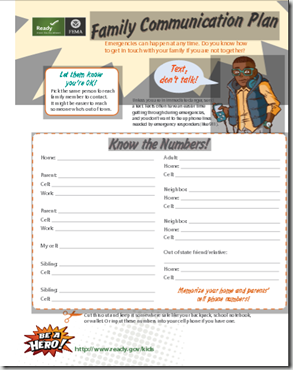
READY.GOV has made things  easier today, as they’ve developed  several Family Emergency Communication Kits geared for both adults and kids, which can be downloaded from the net. With just a few minutes effort, you can have your own emergency communications plan and emergency meeting place set up.
 

image

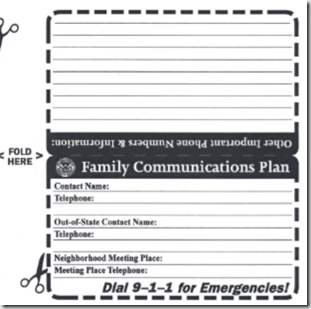
While the above version is geared to kids, the version below is more suitable for teenagers and adults.
 

image

Appendix C of the Are You Ready? Guide (contains blank contact cards and a family communications plan form)


Filling out these cards may seem a small step, but that's what most preparedness involves.


Taking small, organized steps that, when put together, create a fabric of individual and community preparedness.  If you do just one small step each day, in almost no time you’ll find yourself and your family far better prepared to face any emergency.


For more on how to prepare, visit these websites:


FEMA http://www.fema.gov/index.shtm

READY.GOV http://www.ready.gov/

AMERICAN RED CROSS http://www.redcross.org/


And you can use this link to read earlier NPM preparedness posts on this blog.

Wednesday, August 22, 2012

Hong Kong Updates Their Pandemic Preparedness Plan


image


# 6509


Although there are no immediate or obvious pandemic threats on the horizon, public health officials and emergency planners know that pandemics tend to arise quickly, and with scant warning.


For that reason, public health agencies around the world have created, and continue to maintain and upgrade, their pandemic preparedness plans. 


Today Hong Kong announced the release of their 2012 Revised Pandemic Plan, a 36-page PDF document that outlines three pandemic alert levels (Alert, Serious, Emergency) and the coordinated response to each.


Here is the press release from info.gov.hk

Preparedness Plan for Influenza Pandemic 2012 launched

The Government today (August 22) announced the launch of the Preparedness Plan for Influenza Pandemic 2012. The plan is an updated version based mainly on the framework of the previous plan having regard to experience in recent years including the human swine influenza pandemic in 2009.


A spokesman for the DH said, "The Government is committed to continuous enhancement of preparedness to cater for possible risks of influenza pandemic.


"The updated plan continues to uphold the established principles of reducing the risk of human infection, early detection, prompt treatment and control, and responsive risk communication."


In the updated plan, the three response levels, namely Alert, Serious and Emergency, are classified with each response level representing a graded risk of pandemic affecting Hong Kong instead of the scenario-based approach in the previous plan.


The key factors in risk level assessment cover areas of transmissibility, geographical spread, clinical severity, pre-existing immunity, availability of effective preventive measures and recommendations of international health authorities.


"With the new approach in defining the response level, the responsiveness of the plan is expected to bring about improvements, especially in terms of a broader range of scenarios in relation to not only avian influenza but also other forms of novel influenza," the spokesman stressed.


The updated plan also includes comprehensive response measures for an influenza pandemic, fine-tuned command structures, and mechanisms for the activation and standing down of response levels.


An influenza pandemic is a global spread of disease caused by a novel influenza virus against which the human population has low or no immunity. The Preparedness Plan for Influenza Pandemic was developed in 2005 to enhance emergency preparedness and response for an influenza pandemic.


The plan defines the three response levels, sets out the corresponding command structures and outlines the measures to be taken having regard to the development of a pandemic.


The spokesman added, "The Government will review the plan from time to time having regard to the latest practices and recommendations to ensure that the appropriate response measures are adopted."


More information on the plan can be accessed at the webpage of the Centre for Health Protection at www.chp.gov.hk/en/guideline1/29.html.

Ends/Wednesday, August 22, 2012
Issued at HKT 18:40

Monday, September 05, 2011

NPM11: Creating A Family Communications Plan


Note: This is day 5 of National Preparedness Month.  Follow this year’s campaign on Twitter by searching for the #NPM11 hash tag.

image

This month, as part of NPM11, I’ll be rerunning some edited and updated older preparedness essays, along with some new ones.


# 5813


Those of us who were living in Florida during the `bad old days’ of the cold war remember well the Cuban Missile Crisis of 1962.


Although it is hard to imagine it today, much of Florida was on a war footing with fears of a nuclear attack that might come at any time, thousands of military streaming into the state, and schools running daily `duck & cover’ and emergency evacuation exercises.


Kids were sent home with civil defense pamphlets on the basics of radiation poisoning and how to build an in-home fallout shelter.


image


As an 8-year-old with a scientific bent, these were exciting times.


What I didn’t full appreciate at the time was my parents were faced with an agonizing dilemma. My twin-brother and I attended a nearby elementary school, while my 17-year old sister attended high school some distance away.


If the alert went up, they realized they might only have time to get to one school to pick up their kids.


Logic dictated that the pick up my brother and I, based on our ages, and the fact that there were two of us. My sister was given instructions to go to the home of one of her high school friends, and our folks would  either contact her or pick her up there.


Nearly 50 years ago, in the face of a potential crisis, my family cobbled together their own emergency communications plan including an alternate rendezvous point.


While a nuclear attack is (thankfully) far less likely today, the same principles hold true when it comes to having a communications plan, and a meet-up point.


And since a tornado, earthquake, house fire, or some other disaster can strike without warning . . .  these are the sorts of plans every family needs to make now.


Before they are needed.


Luckily FEMA and READY.GOV have made things a bit easier today.  They’ve developed a Family Emergency Communications Kit, which can be downloaded free from the net. 


With just a few minutes effort, you can have your own emergency communications plan and emergency meeting place set up.


Family Communications
Image of family communication plan

Your family may not be together when disaster strikes, so plan how you will contact one another. Think about how you will communicate in different situations.


Complete a contact card for each family member. Have family members keep these cards handy in a wallet, purse, backpack, etc. You may want to send one to school with each child to keep on file. Pick a friend or relative who lives out-of-state for household members to notify they are safe.


Family Communications Plan which should be completed and posted so the contact information is readily accessible to all family members. A copy should also be included in your family disaster supplies kit.


Appendix C of the Are You Ready? Guide (contains blank contact cards and a family communications plan form)


You’ll find the Ready.gov version of the kit available HERE.

Tuesday, September 07, 2010

NPM10: A Family Communications Plan


Note:  Today is Day 7 of National Preparedness Month.

You can follow this month long campaign on Twitter by searching the #NPM10  hash tag.


# 4878


During the `bad old days’ of the cold war, things heated up considerably here in Florida in 1962 during the Cuban Missile Crisis.  The military was mobilized, concertina wire rolled out on the beaches, and fears of a nuclear attack were rampant.


Schools immediately began `duck & cover’ drills, emergency evacuation exercises, and sent home civil defense pamphlets on radiation poisoning and how to build an in-home fallout shelter.


image


As an 8-year-old with a scientific bent, these were exciting times.


What I didn’t know was my parents were faced with an agonizing dilemma.  My twin-brother and I attended an elementary school, while my 17-year old sister attended high school some distance away. 


If the alert went up, they realized they might only have time to get to one school to pick up their kids.  


Logic dictated that the pick up my brother and I, based on our ages, and the fact that there were two of us. 


My sister was given instructions to go to the home of one of her high school friends, and our folks would  either contact her or pick her up there.


Nearly 50 years ago, in the face of a potential crisis, my family cobbled together their own emergency communications plan including an alternate rendezvous point.


While a nuclear attack is (thankfully) far less likely today, the same principles hold true when it comes to having a communications plan, and a meet-up point.


And since a tornado, or an earthquake, or some other disaster can strike without warning . . .  these are the sorts of plans every family needs to make now.  


Before they are needed.


Luckily FEMA and READY.GOV have made things a bit easier today.  They’ve developed a Family Emergency Communications Kit, which can be downloaded free from the net. 


With just a few minutes effort, you can have your own emergency communications plan and emergency meeting place set up.


Family Communications

Image of family communication plan


Your family may not be together when disaster strikes, so plan how you will contact one another. Think about how you will communicate in different situations.


Complete a contact card for each family member. Have family members keep these cards handy in a wallet, purse, backpack, etc. You may want to send one to school with each child to keep on file. Pick a friend or relative who lives out-of-state for household members to notify they are safe.


Family Communications Plan which should be completed and posted so the contact information is readily accessible to all family members. A copy should also be included in your family disaster supplies kit.


You’ll find the Ready.gov version of the kit available HERE.