Showing posts with label Guidance. Show all posts

Tuesday, March 24, 2015

CDC: HPAI H5 Viruses In The United States

image


Note: As I was away over the weekend, I missed this update posted late Friday on the CDC’s website.


# 9857


With several highly pathogenic H5 avian flu strains being reported in North America for the very first time, and good prospects that they will continue to spread via wild and migratory birds beyond the 10 states already reporting cases, the CDC has published a number of new guidance documents.

image


First a link to the H5 Summary (follow the links included for more detailed information), followed by excerpts from the CDC’s current risk assessment, after which I’ll return with a bit more.


H5 Viruses in the United States

Highly pathogenic avian influenza (HPAI) H5 infections have been reported in U.S. domestic poultry (backyard and commercial flocks), captive wild birds, and wild birds. HPAI H5 detections began in December 2014 and have continued into March 2015.

No human infections with these viruses have been detected at this time, however similar viruses have infected people in other countries and caused serious illness and death in some cases. While the public health risk posed by these domestic HPAI outbreaks is considered low at this time, it is possible that human infections with these viruses may occur.

Most human infections with avian influenza viruses have occurred after close and prolonged contact with infected birds or the excretions/secretions of infected birds (e.g., droppings, oral fluids). CDC has posted guidance for clinicians and public health professionals, and is working with state health departments and animal health colleagues to minimize public health risk.

CDC Recommends
  • As a general precaution, people should avoid wild birds and observe them only from a distance; avoid contact with domestic birds (poultry) that appear ill or have died; and avoid contact with surfaces that appear to be contaminated with feces from wild or domestic birds.
  • People who have had contact with infected bird(s) should monitor their own health for possible symptoms (for example, conjunctivitis, or flu-like symptoms).
  • People who have had contact with infected birds may also be given influenza antiviral drugs preventatively.
  • Health care providers evaluating patients with possible HPAI H5 infection should notify their local or state health departments which in turn should notify CDC. CDC is providing case-by-case guidance at this time.
  • There is no evidence that any human cases of avian influenza have ever been acquired by eating properly cooked poultry products.
  • CDC will update the public as new information becomes available.


Update: Outbreaks of Avian Influenza A H5 in U.S. Wild and Domestic Birds: Human Health Implications

CDC Risk Assessment

Most human infections with avian influenza viruses (including Asian HPAI H5 viruses and LPAI H7N9 in China) have occurred in people with direct or close contact with infected birds. Limited transmission from person-to-person has been documented rarely, after very close and prolonged contact with someone who is sick. Sustained human-to-human transmission with avian influenza has not been documented.

CDC considers the risk to people from these HPAI H5 infections in U.S. birds and poultry to be low at this time because infections with avian influenza viruses are rare and – when they occur – these viruses have not spread easily to other people. However it’s possible that human infections with HPAI viruses associated with these outbreaks in birds may occur at some time.

The U.S. Department of Interior and the USDA are the lead federal departments for outbreak investigation and control in wild birds and the USDA’s Animal and Plant Health Inspection Service (APHIS) is the lead agency for such activities in domestic birds. CDC is communicating and coordinating with state health departments on appropriate human health measures and is working with animal health colleagues to evaluate and minimize public health risk.

 (continue . . . )


Although closely related to the HPAI H5N8 viruses that have been reported in Asia and Europe, the HPAI H5N2 and H5N1 viruses detected in the United States are all reassortants, with genes contributed by both H5N8 and by North American Avian viruses.


In short order we’ve seen the arrival of H5N8, a `new’ reassorted H5N1, and a reassorted H5N2 emerge, and additional subtypes may evolve as they encounter other avian, human, or swine flu viruses.

image 


While none of these HPAI H5 viruses have shown the ability to infect humans, they are related to viruses that have, and therefore must be watched for signs that they too are adapting to mammalian hosts. 


The risks right now from these viruses are low, but not zero.


The USDA offers the following biosecurity advice for those who may come in contact with wild birds:


Bird Enthusiasts:

Do not pick up deceased or obviously sick birds. Contact your State, tribal, or Federal natural resources agency if you find sick or dead birds.

  • Wear rubber gloves when cleaning your bird feeders.
  • Wash hands with soap and water immediately after cleaning feeders.
  • Do not eat, drink, or smoke while cleaning bird feeders.

Hunters:

Follow routine precautions when handling wild birds.

  • Do not handle or consume game animals that are obviously sick or found dead.
  • Do not eat, drink, or smoke while cleaning game.
  • Wear rubber gloves when cleaning game.
  • Wash hands with soap and water, or alcohol wipes, immediately after handling game.
  • Wash tools and working surfaces with soap and water and then disinfect.
  • Keep uncooked game in a separate container, away from cooked or ready-to-eat foods.
  • Cook game meat thoroughly; poultry should reach an internal temperature of 165 degree Fahrenheit to kill disease organisms and parasites.
  • To report unusual signs in birds you have seen in the wild, call 1-866-4-USDA-WS. To learn more about how you can help, visit usda.gov/birdflu.

Saturday, March 21, 2015

HK SCEZD: Management Of Contacts of Human Avian Flu Cases

image


# 9851


With 13 imported H7N9 cases over the past two winters, several brushes with H5N1 over the years, and even an occasional H9N2 infection popping up, Hong Kong has a good deal of experience dealing with avian flu cases.


They have also followed up on hundreds of close contacts of these cases, and have even set aside a holiday camp as a quarantine facility (see Hong Kong: Epidemiological Update On Imported H7N9 Case).


Yesterday Hong Kong’s SCEZD (Scientific Committee on Emerging and Zoonotic Diseases) released the following guidance on the management of close contacts of avian flu cases.


20 March 2015

Latest recommendations from SCEZD on management of close contacts of cases of human infection with avian influenza 

The Centre for Health Protection (CHP) of the Department of Health announced today (March 20) the latest recommendations by the Scientific Committee on Emerging and Zoonotic Diseases (SCEZD) on management of close contacts of cases of human infection with avian influenza.


Based on review of the recommendations on contact tracing for human infection with avian influenza cases by the World Health Organization, and experiences and practices of other health authorities, the SCEZD recommends the CHP to continue to conduct contact tracing of contacts of confirmed human cases of avian influenza. Antiviral prophylaxis with oseltamivir (tamiflu) should be given to the close contacts at an appropriate treatment dose for five days.  Medical surveillance is to be undertaken for 10 days after the last exposure, where the close contacts should report to CHP promptly if fever or any respiratory symptom develops.


Moreover, close contacts should wear a face mask for 10 days since last exposure to a confirmed case while the case was infectious. There are no restrictions for work or other daily activities during the surveillance period. If the close contacts are contraindicated / intolerant to or refuse antiviral prophylaxis with oseltamivir, they should be put under quarantine for 10 days since last exposure.


"The above recommendations are based on the most current scientific understanding of the risk of human-to-human transmission of avian influenza A (H7N9) virus, which also apply to human infections with other types of avian influenza viruses with low risk of human-to-human transmission, like avian influenza A (H5N1)," a spokesman for CHP explained.

The SCEZD notes that avian influenza viruses may change unpredictably, including its transmissibility and pathogenicity. It advises CHP to closely monitor the latest scientific development on avian influenza viruses and review the above recommendations if in future new scientific evidence suggests changes in the potential of human-to-human transmission and antiviral susceptibility.

The public may visit the CHP's pages about avian influenza below for more information:
* The avian influenza page (
www.chp.gov.hk/en/view_content/24244.html);
* The weekly Avian Influenza Report (
www.chp.gov.hk/en/view_content/3879.html); and
* Global statistics and affected areas of avian influenza (
www.chp.gov.hk/files/pdf/global_statistics_avian_influenza_e.pdf).

Ends/Friday, March 20, 2015

Tuesday, February 03, 2015

MMWR: Outbreaks Of HPAI H5N2, H5N8 & H5N1 Among Birds – United States

image

# 9668


Over the weekend, in  CDC Interim Guidance On Antiviral Chemoprophylaxis For Persons With Exposure To Avian Flu  and CDC Interim Guidance For Testing For Novel Flu, we looked at new guidance released by the CDC on Friday night in light of recent detections of HPAI H5 viruses in wild birds and poultry in the United States.


While human infection with these specific H5 viruses have not been reported, they are related to H5 subtypes that have caused severe (even fatal) infections before.  Therefore, the CDC is taking a cautious approach.


Today in an Early Release from the MMWR, we get an overview of the recent incursion of Highly Pathogenic H5 avian flu into North America, along with links to the new guidance documents, and some rationale behind the CDC’s cautious stance.


Outbreaks of Avian Influenza A (H5N2), (H5N8), and (H5N1) Among Birds — United States, December 2014–January 2015

Early Release

February 3, 2015 / 64(Early Release);1-1

Michael A. Jhung, MD1, Deborah I. Nelson, PhD2 (Author affiliations at end of text)

During December 15, 2014–January 16, 2015, the U.S. Department of Agriculture received 14 reports of birds infected with Asian-origin, highly pathogenic* avian influenza A (HPAI) (H5N2), (H5N8), and (H5N1)† viruses. These reports§ represent the first reported infections with these viruses in U.S. wild or domestic birds. Although these viruses are not known to have caused disease in humans, their appearance in North America might increase the likelihood of human infection in the United States. Human infection with other avian influenza viruses, such as HPAI (H5N1) and (H5N6) viruses and (H7N9) virus, has been associated with severe, sometimes fatal, disease (1–3), usually following contact with poultry.

The 14 HPAI H5 detections, seven (H5N2), six (H5N8), and one (H5N1), occurred in five northwestern states (California, Idaho, Oregon, Utah, and Washington). Outbreaks occurred in five domestic, backyard flocks, two captive wild birds, and seven wild aquatic birds. All backyard flocks were destroyed after identification of HPAI H5 virus. Of 24 persons reporting exposure to infected birds, one person developed influenza-like illness (ILI) after exposure but subsequently tested negative for influenza.

CDC has developed testing (http://www.cdc.gov/flu/avianflu/severe-potential.htm) and influenza antiviral prophylaxis (http://www.cdc.gov/flu/avianflu/guidance-exposed-persons.htm) guidance for persons exposed to birds possibly infected with HPAI H5 viruses. Until more is known about these viruses, CDC is taking a cautious approach, and recommendations are largely consistent with guidance for influenza viruses associated with severe disease in humans. Clinicians and public health workers should consider the possibility of infection with HPAI H5 viruses in patients with ILI who have had recent contact with sick or dead birds, especially in areas where these viruses have been identified. Persons exposed to birds infected with HPAI H5 should be monitored for ILI for 10 days after their last exposure, and influenza antiviral prophylaxis may be considered to prevent infection. Persons who develop ILI after exposure to HPAI H5-infected birds should be tested immediately for influenza by the state health department. State health departments are encouraged to investigate all possible human infections with HPAI H5 virus and should notify CDC promptly when testing for influenza in persons with ILI who have been exposed to birds possibly infected with these viruses.

1Influenza Division, National Center for Immunization and Respiratory Disease, CDC. 2Animal and Plant Health Inspection Service, U.S. Department of Agriculture, Fort Collins, Colorado (Corresponding author: Michael A. Jhung, mjhung@cdc.gov, 404-639-3747)

References
  1. Uyeki TM. Human infection with highly pathogenic avian influenza A (H5N1) virus: review of clinical issues. Clin Infect Dis 2009;49:279–90.
  2. Gao HN, Lu HZ, Cao B, et al. Clinical findings in 111 cases of influenza A (H7N9) virus infection. N Engl J Med 2013;368:2277–85.
  3. Bi Y, Mei K, Shi W, et al. Two novel reassortants of avian influenza A (H5N6) virus in China. J Gen Virol 2015. Epub ahead of print.

* Highly pathogenic refers to the spectrum of illness seen in birds.

† The H5N1 virus isolated from a U.S. wild bird is a new mixed-origin virus (a reassortant) that is genetically different from the avian H5N1 viruses that have caused human infections with high mortality in several other countries (notably in Asia and Africa). No human infections with this new reassortant H5N1 virus have been reported.

Tuesday, December 02, 2014

CDC: Ebola Hospital Preparedness & Designated Ebola Treatment Centers

image

# 9398


While we’ve not seen the oft-predicted deluge of Ebola cases entering this country, the fact remains that as long as the virus continues to circulate out of control in West Africa, the risks of seeing imported cases will continue.  


Which is why so much effort has gone into producing guidance, and training materials, for healthcare workers across the nation (see CDC Ebola Guidance: Web Based PPE Training).


The CDC today has released a series of interim guidance documents, and fact sheets, on the nation’s efforts to prepare medical facilities to receive, identify, and safely treat Ebola cases. Much of this information will be of interest primarily only to state and local health departments and frontline healthcare facilities.


Factsheet: CDC's Ebola Response Team[PDF - 2 pages] - December 2, 2014

Interim Guidance for U.S. Hospital Preparedness for Patients with Possible or Confirmed Ebola Virus Disease: A Framework for a Tiered Approach - December 2, 2014

Interim Guidance for Preparing Frontline Healthcare Facilities for Patients with Possible Ebola Virus Disease - December 2, 2014

Interim Guidance for Preparing Ebola Assessment Hospitals - December 2, 2014

Interim Guidance for Preparing Ebola Treatment Centers - December 2, 2014


The HHS has also published a press release naming 35 hospitals around the country that have been designated Ebola Treatment centers.  This list will be updated each week, as more hospitals are set up to receive and treat Ebola patients.

35 U.S. hospitals designated as Ebola treatment centers

CDC trains and assesses Ebola hospital readiness in collaborative effort

An increasing number of U.S. hospitals are now equipped to treat patients with Ebola, giving nationwide health system Ebola readiness efforts a boost.  According to the Centers for Disease Control and Prevention (CDC), state health officials have identified and designated 35 hospitals with Ebola treatment centers, with more expected in the coming weeks.

Hospitals with Ebola treatment centers have been designated by state health officials to serve as treatment facilities for Ebola patients based on a collaborative decision with local health authorities and the hospital administration.

Ebola treatment centers are staffed, equipped and have been assessed to have current capabilities, training and resources to provide the complex treatment necessary to care for a person with Ebola while minimizing risk to health care workers.

“We continue our efforts to strengthen domestic preparedness and hospital readiness. I am pleased to announce that 35 hospitals have been designated by state health officials as Ebola treatment centers that are prepared, trained, and ready to provide care for a patient with Ebola,” said Health and Human Services Secretary Sylvia M. Burwell.

More than 80 percent of returning travelers from Ebola-stricken countries live within 200 miles of an Ebola treatment center. During their active monitoring, state or local public health authorities communicate every day with potentially exposed individuals to check for symptoms and fever for the 21 day incubation period of the Ebola virus.

(Continue . . . )


Current Ebola Treatment Centers

This list will be updated weekly. The 35 hospitals with Ebola treatment centers as of 12/2/2014 are:

  • Kaiser Oakland Medical Center; Oakland, California
  • Kaiser South Sacramento Medical Center; Sacramento, California
  • University of California Davis Medical Center; Sacramento, California
  • University of California San Francisco Medical Center; San Francisco, California
  • Emory University Hospital; Atlanta, Georgia
  • Ann & Robert H. Lurie Children’s Hospital of Chicago; Chicago, Illinois
  • Northwestern Memorial Hospital; Chicago, Illinois
  • Rush University Medical Center; Chicago, Illinois
  • University of Chicago Medical Center; Chicago, Illinois
  • Johns Hopkins Hospital; Baltimore, Maryland
  • University of Maryland Medical Center; Baltimore, Maryland
  • National Institutes of Health Clinical Center; Bethesda, Maryland
  • Allina Health’s Unity Hospital; Fridley, Minnesota
  • Children’s Hospitals and Clinics of Minnesota - Saint Paul campus; St. Paul, Minnesota
  • Mayo Clinic Hospital - Rochester, Saint Marys Campus; Rochester, Minnesota
  • University of Minnesota Medical Center, West Bank campus, Minneapolis, Minnesota
  • Nebraska Medicine - Nebraska Medical Center; Omaha, Nebraska
  • North Shore System LIJ/Glen Cove Hospital; Glen Cove, New York
  • Montefiore Health System; New York City, New York
  • New York-Presbyterian/Allen Hospital; New York City, New York
  • NYC Health and Hospitals Corporation/HHC Bellevue Hospital Center; New York City, New York
  • Robert Wood Johnson University Hospital; New Brunswick, New Jersey
  • The Mount Sinai Hospital; New York City, New York
  • Children's Hospital of Philadelphia; Philadelphia, Pennsylvania
  • Hospital of the University of Pennsylvania; Philadelphia, Pennsylvania
  • University of Texas Medical Branch at Galveston; Galveston, Texas
  • Methodist Hospital System in collaboration with Parkland Hospital System and the University of Texas Southwestern Medical Center; Richardson, Texas
  • University of Virginia Medical Center; Charlottesville, Virginia
  • Virginia Commonwealth University Medical Center; Richmond, Virginia
  • Children’s Hospital of Wisconsin, Milwaukee; Milwaukee, Wisconsin
  • Froedtert & the Medical College of Wisconsin – Froedtert Hospital, Milwaukee; Milwaukee, Wisconsin
  • UW Health – University of Wisconsin Hospital, Madison, and the American Family Children’s Hospital, Madison; Madison, Wisconsin
  • MedStar Washington Hospital Center; Washington, D.C.
  • Children's National Medical Center; Washington, D.C.
  • George Washington University Hospital; Washington, D.C.

Wednesday, November 05, 2014

CDC: Decontamination & Removal Of Contaminated Waste From Residences Where An Ebola Patient Has Stayed

image

October 15th  Outside Nina Pham’s Apartment


# 9287


One of the more striking images that emerged out of America’s first couple of brushes with the Ebola virus involved Hazmat-suited responders sealing off and then entering – and attempting to decontaminate – spaces where an Ebola infected individual had stayed. 


Out of an abundance of caution – and no doubt to reassure a nervous public - common areas at apartment buildings were sprayed down with disinfectants, hand rails in hospital parking lots sanitized, and air carriers took planes out of service for repeated cleanings - which in some cases included removing sections of their carpet and seat covers.


According to the Dallas Morning News (see Cleanup crews try to salvage most of Ebola nurses’ belongings), some of the `extreme cleaning’ measures were taken in the apartments of the nurses who were infected while treating America’s index case included:


Cushions were removed from furniture, linens stripped, carpets and padding ripped out, all surfaces were `triple-wiped’ with industrial strength cleaners, and multiple barrels of `potentially contaminated’ personal effects were removed and incinerated. 


While some of this may seem excessive, there isn’t a great deal of data on the environmental persistence of the Ebola virus.  The CDC’s Interim Guidance for Environmental Infection Control in Hospitals for Ebola Virus has this to say:


How long does the Ebola virus persist in indoor environments?

Only one laboratory study, which was done under environmental conditions that favor virus persistence, has been reported. This study found that under these ideal conditions Ebola virus could remain active for up to six days.1 In a follow up study, Ebolavirus was found, relative to other enveloped viruses, to be quite sensitive to inactivation by ultraviolet light and drying; yet sub-populations did persist in organic debris.2

In the only study to assess contamination of the patient care environment during an outbreak, conducted in an African hospital under "real world conditions", virus was not detected by either nucleic acid amplification or culture in any of 33 samples collected from sites that were not visibly bloody. Virus was detected on a blood-stained glove and bloody intravenous insertion site by nucleic acid amplification, which may detect non-viable virus, but not by culture for live, infectious virus.3 Based upon these data and what is known regarding the environmental infection control of other enveloped RNA viruses, the expectation is with consistent daily cleaning and disinfection practices in U.S. hospitals that the persistence of Ebola virus in the patient care environment would be short – with 24 hours3 considered a cautious upper limit.


With the likelihood that we will see more Ebola cases in the United States in the coming weeks and months, there is great need for guidance on residential decontamination that provides for the safety of the public, but that doesn’t unnecessarily involve an all out `scorched-earth’ strategy.


Although those with Ebola are very infectious in the latter stages of their illness – early on – before vomiting and diarrhea set in, we’ve seen very little evidence of significant viral shedding. 


Using this as a line of demarcation between the types of cleanup and decontamination, yesterday the CDC released interim guidance called:


Interim Guidance for the U.S. Residence Decontamination for Ebola Virus Disease (Ebola) and Removal of Contaminated Waste

image

Key Points:

  • Effective disinfectant product(s): Use an Environmental Protection Agency (EPA)-registered hospital disinfectant according to manufacturer’s instructions with a label claim against a non-enveloped virus, such as norovirus, rotavirus, adenovirus, or poliovirus. Currently, no EPA-registered disinfectant products will have a statement on the label that specifically says it can kill Ebola virus. However, any EPA-registered disinfectant that is effective against a non-enveloped virus will also be effective against Ebola virus.

    One simple way to identify an appropriate product effective against Ebola virus is to use a product included in EPA’s List L: Disinfectants for Use Against the Ebola Virus.

  • Level of cleaning and decontamination: Once a person has been confirmed to have Ebola, the way to decontaminate the residence depends on the person’s symptoms at the time they were in the residence:
    1. Cleaning by residents - If the person with Ebola only had a fever with no gastrointestinal (e.g., diarrhea, vomiting) or hemorrhagic (bleeding) symptoms while he or she was in the residence, the person should not be contaminating their environment. Therefore, remaining members of the residence can clean and launder as normal.
    2. Cleaning by contract company - If the person with Ebola had a fever AND diarrhea, vomiting, and/or unexplained bleeding, public health and/or assigned authorities may need to contact a contract company who will assess the residence to determine the proper decontamination and disposal procedures. Remaining members of the residence should avoid contaminated rooms and areas until after the completion of the assessment and decontamination.
  • Which contract companies can conduct the cleaning?: Companies with experience in cleaning biohazard and crimes scenes. OSHA provides guidance for cleaning and decontaminating in non-healthcare settings. Any contract company conducting such work must comply with the its state’s Ebola policies and with OSHA standards for, among others that may apply, bloodborne pathogens (29 CFR 1910.1030), personal protective equipment (PPE) (29 CFR 1910.132), respiratory protection (29 CFR 1910.134), and hazard communication (29 CFR 1910.1200) (e.g., for chemical hazards). In states that operate their own occupational safety and health
  • Transport of waste: Transportation of Ebola-contaminated waste (i.e., materials that cannot be decontaminated and were in contact with the person with Ebola having fever AND diarrhea, vomiting, and/or unexplained bleeding) must be packaged and transported in accordance with regulations on the transportation of Ebola contaminated items provided by the U.S. Department of Transportation (DOT): U.S. DOT Hazardous Materials Regulation for Category A Infectious Substance. If a contract company is handling the waste, requirements in OSHA standards, including Bloodborne Pathogens (29 CFR 1910.1030) may also apply.

(Continue . . . )


Interim guidance is exactly what it says on the tin.  Guidance that is constantly subject to review and revision.  


As we gain more experience with dealing with the Ebola virus in the developed world, we’ll get a much better idea of the risks – and the most effective countermeasures – involved. 

Sunday, November 02, 2014

CDC Guidance: Ambulatory Care Evaluation Of Patients With Possible EVD (Ebola Virus Disease)

image
Credit CDC PHIL


# 9277


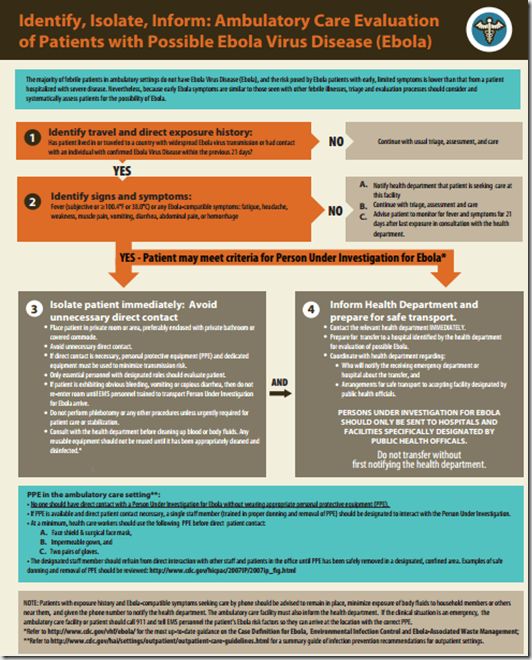
A week ago, in CDC Ebola Guidance: ER Protocols To Identify, Isolate & Inform, we looked at the recommended procedures for Emergency rooms to follow when evaluating patients for possible EVD (Ebola Virus Disease).  Included were an infographic, and a PDF file Algorithm – Identify, Isolate, Inform: Emergency Department Evaluation and Management of Patients with Possible Ebola Virus Disease[PDF - 975 KB].


Given the relatively mild early symptoms of illness, and the proliferation of medical `walk-in clinics’ in this country, it is also possible for an EVD suspect to show up at an ambulatory care facility or a doctor’s office.. 


While ambulatory settings share many things in common with ER presentations, there are enough differences – particularly in preparing to transport to a hospital - to warrant a separate set of guidance.  Hence the publication, yesterday, of the following interim guidance.


image

Friday, October 31, 2014

WHO Updates Personal Protective Equipment Guidelines for Ebola response

image


# 9271


Earlier today in WHO Video: Updated Recommendations For PPEs For Current Ebola Outbreak, we looked at a 40 minute video press briefing by Dr. Edward Kelley, Director, Service Delivery and Safety, at the World Health Organization on updated  Ebola PPE recommendations.


The PDF file has now gone live on the WHO site, and can be downloaded from:

http://apps.who.int/iris/handle/10665/137410#


Accompanying this guidance document we get the following (emailed) press release from WHO.


WHO Updates Personal Protective Equipment Guidelines for Ebola response

31 October 2014 ¦ GENEVA   As part of the World Health Organization’s commitment to safety and protection of healthcare workers and patients from transmission of Ebola virus disease, WHO has conducted a formal review of personal protective equipment (PPE) guidelines for healthcare workers and is updating its guidelines in context of the current outbreak.


These updated guidelines aim to clarify and standardize  safe and effective PPE options to protect health care workers and patients, as well as provide information for procurement of PPE stock in the current Ebola outbreak.


The guidelines are based on a review of evidence of PPE use during care of suspected and confirmed Ebola virus disease patients.  The Guidelines Development Group convened by WHO included participation of a wide range of experts from developed and developing countries, and international organizations including the United States Centers for Disease Control and Prevention,  Médecins Sans Frontières, the Infection Control Africa Network and others.


“These guidelines hold an important role in clarifying effective personal protective equipment options that protect the safety of healthcare workers and patients from Ebola virus disease transmission,” says Edward Kelley, WHO Director for Service Delivery and Safety.  “Paramount to the guidelines’ effectiveness is the inclusion of mandatory training on the putting on, taking off and decontaminating of PPE, followed by mentoring for all users before engaging in any clinical care.”


Guidelines were developed from an accelerated development process that meets WHO’s standards for scientific rigour and serves as a complement to the Interim Infection Prevention and Control Guidance for Care of Patients with Suspected or Confirmed Filovirus Haemorrhagic Fever in Health-Care Settings, with Focus on Ebola, published by WHO in August 2014.


Experts agreed that it was most important to have PPE that protects the mucosae – mouth, nose and eyes – from contaminated droplets and fluids. Given that hands are known to transmit pathogens to other parts of the body, as well as to other individuals, hand hygiene and gloves are essential, both to protect the health worker and to prevent transmission to others. Face cover, protective foot wear, gowns or coveralls, and head cover were also considered essential to prevent transmission to healthcare workers.


“Although PPE is the most visible control used to prevent transmission, it is effective only if applied together with other controls including facilities for barrier nursing and work organization, water and sanitation, hand hygiene, and waste management,” says Marie-Paule Kieny, Assistant Director General of Health Systems and Innovation.  Benefits derived from PPE depend not only on choice of PPE, but also adherence to protocol on use of the equipment.


A fundamental principle guiding the selection of different types of PPE was the effort to strike a balance between the best possible protection against infection while allowing health workers to provide the best possible care to patients with maximum ease, dexterity, comfort and minimal heat-associated stress. In this situation where evidence is still being collected, to see what works best and on an effective sustainable basis, it was considered prudent to provide options for selecting PPE. In most cases, there was no evidence to show that any one of the options recommended is superior to other options available for healthcare worker safety.


Further work is needed to gather scientific experience and data from the field in systematic studies, in order to understand why some health workers are infected in the current outbreak and to increase effective clinical care.  WHO is committed to working with international partners on these issues to build this evidence base.

###

Thursday, October 30, 2014

CDC Guidance: Considerations For Discharging Persons Under Investigation For Ebola

image

CDC Infographic: Is it flu, or Ebola?


# 9268


As has already been demonstrated, while a fair number of people may be initially suspected of having Ebola, few will actually end up being infected with the virus. The CDC has fielded calls on scores of `suspected’ Ebola cases from hospitals around the country – performed testing on dozens – and yet only small handful have tested positive for the virus. 


Today the CDC has issued guidance on the steps hospitals and clinicians should take when deciding whether to discharge someone who is (or was) a  PUI (Patient Under Investigation) for Ebola infection.


As you will see, Ebola cannot be ruled out by laboratory testing early in the symptomatic phase of the illness. It can take as long as 72 hours after symptoms appear for rt-PRC testing to pick up the virus. Which explains why some patients have been isolated – and retested – for 2 or 3 days before a final determination can be made. 


A negative test or no test conducted, and a change in symptoms inconsistent with Ebola infection, however, can be used – assuming the patient can be properly monitored after discharge.  


Considerations for Discharging Persons Under Investigation (PUI) for Ebola Virus Disease (Ebola)

The decision to discharge a patient being evaluated as a Person Under Investigation (PUI) for Ebola who has not had a negative RT-PCR test for Ebola (RT-PCR testing for Ebola virus infection has not yet been performed or RT-PCR test result on a blood specimen collected less than 72 hours after onset of symptoms is negative) should be based on clinical and laboratory criteria and on the ability to monitor the PUI after discharge, and made by the medical providers caring for the PUI, along with the local and state health departments.

Health care providers evaluating a PUI should consider these criteria when deciding to discharge a PUI:
  1. In the clinical judgment of the medical team, the PUI’s illness no longer appears consistent with Ebola.
  2. The PUI is afebrile off antipyretics for 24 hours, or there is an alternative explanation for fever.
  3. All symptoms that are compatible with Ebola (e.g., diarrhea or vomiting) have either resolved or can be accounted for by an alternative diagnosis.
  4. The PUI has no clinical laboratory results consistent with Ebola, or those that could be consistent with Ebola have been otherwise explained.
  5. The PUI is able to self-monitor (or to monitor a child, if the PUI is a child) and comply fully with active monitoring and controlled movement.
  6. There is a plan in place for the PUI to return for medical care if symptoms recur, which has been explained to the PUI, and the PUI understands what to do if symptoms recur.
  7. Local and state health departments have been engaged and concur.
  8. Active monitoring and controlled movement still apply for persons who have had Ebola virus exposures and are under follow-up as contacts for the full 21-day period following their last exposure.
Important information about RT-PCR testing for Ebola virus:
  • A negative RT-PCR test result for Ebola virus from a blood specimen collected less than 72 hours after onset of symptoms does not necessarily rule out Ebola virus infection.
    • If the patient is still symptomatic after 72 hours, the test should be repeated.
    • If the patient has recovered from the illness that brought them to medical attention, a repeat test is not required.
  • A negative RT-PCR test result for Ebola virus from a blood specimen collected more than 72 hours after symptom onset rules out Ebola virus infection.
  • Positive Ebola virus RT-PCR results are considered presumptive until confirmed by CDC.

Monday, October 27, 2014

CDC Updates Traveler’s Movement & Monitoring Guidance For Ebola

image

Credit CDC


Update:  Transcript | Audio now available for the CDC’s Monday Afternoon press conference.


# 9257


If there is anything good that can be said to be coming out of the Ebola epidemic, it is that it is forcing us to take a hard look at our emergency response and pandemic preparedness plans – and to work out the kinks – before we find ourselves blindsided by a more rapidly moving and highly virulent pandemic.


CDC interim guidance on Ebola continues to evolve as more is learned about dealing with the virus in modern healthcare settings and in a highly mobile developed nation, and it is not unreasonable to assume that over time that guidance may change further.


Last week the CDC announced a program of Active Post-Arrival Monitoring for Travelers from Impacted Countries, which provided arrivals from Ebola affected countries with a CARE (Check & Report Ebola) Kit and instructions on taking their temperature, and maintaining contact with local health department officials.


While introducing a higher degree of monitoring,  it relied upon the traveler to self-check and to report symptoms on a daily basis during the 21 day incubation period, and imposed no real restrictions on movement or travel. 


Two days later New York City detected their first imported Ebola case – and the newspapers had a field day analyzing that person’s movements around the city prior to calling in that he was ill.  As a result, the Governors of New York and New Jersey announced their own, more restrictive quarantine protocols, which have sparked heated debate.


Today, CDC Director Thomas Frieden held a press conference to announce new, tighter CDC guidelines – that while less restrictive than some of the state plans rolled out over the weekend – he believes are appropriate and not overly onerous. 


Whether individual states will adopt them – or continue to go their own way – is something we will have to wait to see. 


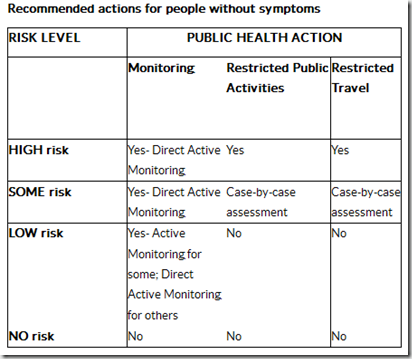
Today’s guidance also includes guidance on monitoring and movement control protocols for people who may have been exposed (i.e. Healthcare workers, family members, etc.) to an Ebola case in this country.  For the purposes of triage, potentially exposed people are divided into 4 risk groups:

  • High Risk
  • Some Risk
  • Low Risk (but not zero)
  • No Risk


Full details on how each risk group would be treated can be viewed at the link below:


Monitoring Symptoms and Controlling Movement to Stop Spread of Ebola

For Immediate Release: Monday, October 27, 2014
Contact:
Media Relations, Office of Communication
(404) 639-3286
Fact Sheet

Purpose

This fact sheet explains CDC’s updated guidance to protect America from Ebola. This updated guidance focuses on strengthening how we monitor people who may have been exposed to Ebola and how medical professionals will oversee their care and, when warranted to protect the public health or our communities, limit their movement or activities. Through these changes, CDC and state and local health departments seek to support people who may have been exposed to Ebola, while also continuing to stop Ebola at its source in West Africa through the valor of our health care workers who serve. These changes will help ensure their symptoms are monitored and a system is in place to quickly recognize when they need to be routed to care. These actions will better protect potentially exposed individuals and the American public as a whole.

Key changes to the movement and monitoring guidance

  • New risk levels are given for people who may have been exposed to Ebola, as well as for those not at risk for the disease.
  • The guidance recommends stricter actions  for escalating level of risk based on the type of exposure.
  • State and local public health authorities are advised to use active monitoring or direct active monitoring rather than having people monitor themselves.
  • Specific guidance is given about monitoring health care workers who cared for patients with Ebola in a country with widespread transmission, and people who visited an Ebola Treatment Unit in one of those countries.
  • Specific guidance is also given about monitoring health care workers who provided care of patients with Ebola in the United States

New risk levels

The new guidance defines four risk levels based on degree of exposure:

High risk—direct contact of infected body fluids through:

  • needle stick, or splashes to eyes, nose, or mouth
  • getting body fluids directly on skin
  • handling body fluids, such as in a laboratory, without wearing personal protective equipment (PPE) or following recommended safety precautions
  • touching a dead body without correctly wearing PPE in a country with widespread Ebola transmission
  • living with and caring for a person showing symptoms of Ebola

Some risk—

  • close contact with a person showing symptoms of Ebola such as in a household, health care facility, or the community (no PPE worn). Close contact means being within 3 feet of the person with Ebola for a long time without wearing PPE.
  • in countries with widespread Ebola transmission: direct contact with a person showing symptoms of Ebola while wearing PPE

Low risk (but not zero)—

  • having been in a country with widespread Ebola transmission within the previous 21 days and having no known exposure
  • being in the same room for a brief period of time (without direct contact) with a person showing symptoms of Ebola
  • having brief skin contact with a person showing symptoms of Ebola when the person was believed to be not very contagious
  • in countries without widespread Ebola transmission: direct contact with a person showing symptoms of Ebola while wearing PPE
  • travel on an airplane with a person showing symptoms of Ebola

No risk—

  • contact with a person who is NOT showing symptoms AFTER that person was in contact with a person with Ebola
  • contact with a person with Ebola BEFORE the person was showing symptoms
  • having traveled to a country with Ebola outbreak MORE than 21 days ago
  • having been in to a country where there is no widespread Ebola transmission (e.g., the United States), and having no other exposures to Ebola

Public health officials will use these risk levels along with assessing symptoms to decide how best to monitor for symptoms and what other restrictions may be needed. The table on the following page provides further information about CDC’s recommended action for each risk level.

(Continue  . . . )

Sunday, October 26, 2014

CDC Ebola Guidance: ER Protocols To Identify, Isolate & Inform

image
Credit CDC PHIL


# 9252


Although only a very small number of Ebola-infected individuals are likely to ever make their way to the United States, it is imperative that Emergency Rooms around the country be alert of the possibility of having a case walk in.


They must also know how to identify a possible infected individual, what to do to minimize the risk to the staff and other patients - and once a suspected case is identified -  who to inform.


Today the CDC has posted the following recommendations based on the lessons learned from the first Ebola case seen in Dallas.


Identify, Isolate, Inform: Emergency Department Evaluation and Management for Patients Who Present with Possible Ebola Virus Disease


Algorithm – Emergency Department Evaluation and Management for Patients Who Present with Possible Ebola Virus Disease

Algorithm – Identify, Isolate, Inform: Emergency Department Evaluation and Management of Patients with Possible Ebola Virus Disease[PDF - 975 KB]

Background: The procedures in the accompanying algorithm provide guidance on the Emergency Department (ED) evaluation and management of patients who present with possible Ebola Virus Disease. The guidance in this document reflects lessons learned from the recent experiences of U.S. hospitals caring for Ebola patients.

The risk of transmission of Ebola virus from a patient to a healthcare worker depends upon the likelihood that the patient will have confirmed Ebola Virus Disease combined with the likelihood and degree of exposure to infectious blood or body fluids. That risk depends on the severity of disease; severe illness is strongly associated with high levels of virus production. In addition, close contact with the patient and invasive medical care can increase opportunities for transmission.

In general, the majority of febrile patients presenting to the ED do not have Ebola Virus Disease, and the risk posed by patients with early, limited symptoms is lower than that from a patient hospitalized with severe Ebola Virus Disease. Nevertheless, because early symptoms of Ebola Virus Disease are similar to other febrile illnesses, triage and evaluation processes in the ED should consider and systematically assess patients for the possibility of Ebola Virus Disease. Healthcare facilities must implement administrative and environmental controls (e.g., designated area for further evaluation of patient with possible Ebola Virus Disease), and provide onsite management and oversight on the safe use of PPE. Best practice would include continuous safety checks through direct observation of healthcare workers during the process of putting on (donning) and taking off (doffing) PPE.

Triage Recommendations:

  1. Immediately upon entrance to the ED, or in advance of entry if possible, a relevant exposure history should be taken including exposure criteria of whether the patient has resided in or traveled to a country with widespread Ebola transmission or had contact with an individual with confirmed Ebola Virus Disease within the previous 21 days. Because the signs and symptoms of Ebola Virus Disease may be nonspecific and are present in other infectious and noninfectious conditions that are more frequently encountered in the United States, relevant exposure history should be first elicited to determine whether Ebola Virus Disease should be considered further. If the patient is unable to provide history due to clinical condition or other communication barrier, history should be elicited from the next most reliable source (e.g. family, friend or EMS provider).
  2. Patients who meet the exposure criteria should be further questioned regarding the presence of signs or symptoms compatible with Ebola Virus Disease. These include: fever (subjective or ≥100.4°F or 38.0°C) or headache, weakness, muscle pain, vomiting, diarrhea, abdominal pain, or hemorrhage (e.g., bleeding gums, blood in urine, nose bleeds, coffee ground emesis or melena).
    All patients should be routinely managed using precautions to prevent any contact with blood or body fluids.  If an exposure history is unavailable, clinical judgment should be used to determine whether to empirically implement the following protocol. If a relevant exposure history is reported and signs or symptoms consistent with Ebola Virus Disease are present, the following measures should be implemented IMMEDIATELY:
  3. Isolate the patient in a private room or separate enclosed area with private bathroom or covered, bedside commode and adhere to procedures and precautions designed to prevent transmission by direct or indirect contact (e.g. dedicated equipment, hand hygiene, and restricted patient movement). If the patient is arriving by EMS transport, the ED should be prepared to receive the patient in a designated area (away from other patients) and have a process in place for safely transporting the patient on the stretcher to the isolation area with minimal contact with non-essential healthcare workers or the public.
    To minimize transmission risk, only essential healthcare workers with designated roles should provide patient care. A log should be maintained of all personnel who enter the patient’s room. All healthcare workers who have contact with the patient should put on appropriate PPE based on the patient’s clinical status. If the patient is exhibiting obvious bleeding, vomiting, copious diarrhea or a clinical condition that warrants invasive or aerosol-generating procedures (e.g., intubation, suctioning, active resuscitation), PPE designated for the care of hospitalized patients as outlined in
    CDC guidance* should be used. If the patient requires active resuscitation, this should be done in a pre-designated area using equipment dedicated to the patient. If these signs and symptoms are not present and the patient is clinically stable, healthcare workers should at a minimum wear: 1) face shield, 2) surgical face mask, 3) impermeable gown and 4) two pairs of gloves. All equipment used in the care of these patients should not be used for the care of other patients until appropriate evaluation and decontamination.
  4. Notify the Hospital Infection Control Program and other appropriate staff and report to the relevant local health department immediately of patients with Ebola Virus Disease exposure history regardless of symptoms.
  5. Once appropriate PPE has been put on, continue obtaining additional history and performing physical examination and routine diagnostics and interventions which may include placement of peripheral IV and phlebotomy. The decision to test patient for Ebola Virus Disease should be made in consultation with the relevant local health department. Patient evaluation should be conducted with dedicated equipment as required for patients on transmission-based precautions.

* CDC Guidance on Personal Protective Equipment To Be Used by Healthcare Workers During Management of Patients with Ebola Virus Disease in U.S. Hospitals, Including Procedures for Putting On (Donning) and Removing (Doffing)

Tuesday, October 21, 2014

CDC: Updated Interim PPE Guidance For HCWs Dealing With Ebola

image

Credit CDC


# 9225


The updated CDC guidance on donning and doffing PPEs when working with suspected or confirmed Ebola cases - which we previewed last night (see CDC Announces Stricter PPE Recommendations For Ebola) - is fleshed out in the following document posted overnight on the CDC’s Ebola web portal.


When you return you’ll find a short listing of non-CDC online resources (listed on the CDC site) with experience dealing with Ebola.


Guidance on Personal Protective Equipment To Be Used by Healthcare Workers During Management of Patients with Ebola Virus Disease in U.S. Hospitals, Including Procedures for Putting On (Donning) and Removing (Doffing)


On this Page

This guidance is current as of October 20, 2014

The following procedures provide detailed guidance on the types of personal protective equipment (PPE) to be used and on the processes for donning and doffing (i.e., putting on and removing) PPE for all healthcare workers entering the room of a patient hospitalized with Ebola virus disease (Ebola). The guidance in this document reflects lessons learned from the recent experiences of U.S. hospitals caring for Ebola patients and emphasizes the importance of training, practice, competence, and observation of healthcare workers in correct donning and doffing of PPE selected by the facility.

This guidance contains the following key principles:

  1. Prior to working with Ebola patients, all healthcare workers involved in the care of Ebola patients must have received repeated training and have demonstrated competency in performing all Ebola-related infection control practices and procedures, and specifically in donning/doffing proper PPE.
  2. While working in PPE, healthcare workers caring for Ebola patients should have no skin exposed.
  3. The overall safe care of Ebola patients in a facility must be overseen by an onsite manager at all times, and each step of every PPE donning/doffing procedure must be supervised by a trained observer to ensure proper completion of established PPE protocols.

In healthcare settings, Ebola is spread through direct contact (e.g., through broken skin or through mucous membranes of the eyes, nose, or mouth) with blood or body fluids of a person who is sick with Ebola or with objects (e.g., needles, syringes) that have been contaminated with the virus. For all healthcare workers caring for Ebola patients, PPE with full body coverage is recommended to further reduce the risk of self-contamination.

To protect healthcare workers during care of an Ebola patient, healthcare facilities must provide onsite management and oversight on the safe use of PPE and implement administrative and environmental controls with continuous safety checks through direct observation of healthcare workers during the PPE donning and doffing processes.

(Continue . . . .)


External (Non-CDC) Resources on PPE


Monday, October 20, 2014

CDC Guidance: Initial Steps In Caring For A Suspected Ebola Patient

image

Credit FEMA


# 9220


Given the current concerns over the possibility of having another Ebola patient walk into a hospital Emergency room, Clinic, or Doctor’s office the CDC has been working on various types of guidance, and we expect updated advice on PPEs to be released in the next few days (see NIH: `More Stringent’ PPE Standards For Ebola On The Way).


While clinicians have been asked to be alert for the signs of Ebola in anyone with recent travel history to West Africa, there hasn’t been a set of coordinated guidelines telling healthcare workers what to do next.


Yesterday, in an attempt to provide some `first steps’  for front line workers confronted with a possible Ebola patient, the CDC released the following infographic and advice, outlining what steps `should’ and `should not be done for a patient under investigation (PUI) for Ebola.


image

Could it be Ebola?[PDF - 1 page]


When Caring for Suspect or Confirmed Patients with Ebola

 What SHOULD be done for a patient under investigation (PUI) for Ebola virus disease?

  1. Activate the hospital preparedness plan for Ebola, which should include
    1. Initiate the notification plan for suspect or confirmed Ebola patient immediately.
    2. Ensure hospital infection control is notified.
    3. Create a clinical care team led by a senior level experienced clinician that includes at a minimum a hospital infection control specialist, a senior nurse, an infectious disease specialist, and critical care consultants.
    4. Assign a senior staff member from the clinical care team to coordinate testing and reporting of results from the hospital laboratory, state health department laboratory, CDC, and local and state public health. For a list of state and local health department phone numbers, see http://www.cdc.gov/vhf/ebola/outbreaks/state-local-health-department-contacts.html.
  2. Isolate the patient in a separate room with a private bathroom.
  3. Ensure a standardized protocol is in place for how and where to remove and dispose of personal protective equipment (PPE) properly and that this information is posted in the patient care area.
  4. When interviewing the patient, collect data on:
    1. Earliest date of symptom onset and the sequence of sign/symptom development preceding presentation to an emergency department.
    2. Detailed and precise travel history (e.g., dates, times, locations).
    3. Names of any persons with whom the patient may have had contact during and any time after the earliest date of symptom onset.
  5. Consider and evaluate for all potential alternative diagnoses (e.g. malaria, typhoid fever).
  6. Reassure patient and family that appropriate care will be provided.
  7. Ensure patient has the ability to communicate with family.

What SHOULD NOT be done for a patient under investigation for Ebola virus disease?

  1. Don’t have any physical contact with the patient (e.g., perform examination, collect clinical samples, position for x-rays) without first putting on appropriate PPE and using recommended infection control practices necessary to prevent Ebola virus transmission.
  2. Don’t neglect the patient’s medical needs; assess and treat patient’s other medical conditions as indicated (e.g., diabetes, hypertension).
  3. Don’t forget to evaluate for all potential alternative diagnoses (e.g. malaria, typhoid fever).
  4. Don’t perform elective tests or procedures; minimize sample collection, laboratory testing, and diagnostic imaging (e.g., blood draws, X-rays) to those procedures necessary to provide acute care.
  5. Don’t allow family members to visit without putting on appropriate PPE; provide a telephone for family to communicate with patient.

Don’t judge or snub the patient; maintain a professional and compassionate atmosphere.

General Information

Sunday, October 05, 2014

CDC Updated Guidance: Environmental Infection Control in Hospitals for Ebola Virus

image
Credit CDC PHIL


# 9148


The CDC continues to roll out interim guidance documents for dealing with possible introduction of Ebola cases into the United States, and on Friday updated and reworked their previously published Hospital Environmental Infection Control guidance.


As always, these are `works in progress’, and are subject to revision over time as more is learned about dealing with this virus.


While laboratory experiments have shown that the Ebola virus can remain viable on solid surfaces for up to 6 daysat least under ideal environmental conditions -  very limited `real world’  field testing has suggested a far less hardy organism; one that is susceptible to degradation by sunlight, desiccation, and time.


The precise role of environmental transmission of Ebola is far from settled - but given its lethality and low infectious dose - guidance in these matters tends to err on the side of caution. Also included is a Frequently Asked Questions section (FAQ), which poses (and answers) several interesting questions, including:


3. How should spills of blood or other body substances be managed?
4. How should disposable materials (e.g., any single-use PPE, cleaning cloths, wipes, single-use microfiber cloths, linens, food service) and linens, privacy curtains, and other textiles be managed after their use in the patient room?
5. Is it safe for Ebola patients to use the bathroom?


I’ve only reproduced a few excerpts from this guidance, so follow the link to read it, and the accompanying FAQ in its entirety.


Interim Guidance for Environmental Infection Control in Hospitals for Ebola Virus

(EXCERPTS)

As part of the care of patients who are persons under investigation, or with probable or confirmed Ebola virus infections, hospitals are recommended to:

  • Be sure environmental services staff wear recommended personal protective equipment (PPE) including, at a minimum, disposable gloves, gown (fluid resistant/ impermeable), eye protection (goggles or face shield), and facemask to protect against direct skin and mucous membrane exposure of cleaning chemicals, contamination, and splashes or spatters during environmental cleaning and disinfection activities. Additional barriers (e.g., leg covers, shoe covers) should be used as needed. If reusable heavy-duty gloves are used for cleaning and disinfecting, they should be disinfected and kept in the room or anteroom. Be sure staff are instructed in the proper use of personal protective equipment including safe removal to prevent contaminating themselves or others in the process, and that contaminated equipment is disposed of appropriately. (see question 8).
  • Use a U.S. Environmental Protection Agency (EPA)-registered hospital disinfectant with a label claim for a non-enveloped virus (e.g., norovirus, rotavirus, adenovirus, poliovirus) to disinfect environmental surfaces in rooms of patients with suspected or confirmed Ebola virus infection. Although there are no products with specific label claims against the Ebola virus, enveloped viruses such as Ebola are susceptible to a broad range of hospital disinfectants used to disinfect hard, non-porous surfaces. In contrast, non-enveloped viruses are more resistant to disinfectants. As a precaution, selection of a disinfectant product with a higher potency than what is normally required for an enveloped virus is being recommended at this time. EPA-registered hospital disinfectants with label claims against non-enveloped viruses (e.g., norovirus, rotavirus, adenovirus, poliovirus) are broadly antiviral and capable of inactivating both enveloped and non-enveloped viruses.
  • Avoid contamination of reusable porous surfaces that cannot be made single use. Use only a mattress and pillow with plastic or other covering that fluids cannot get through. Do not place patients with suspected or confirmed Ebola virus infection in carpeted rooms and remove all upholstered furniture and decorative curtains from patient rooms before use.
  • To reduce exposure among staff to potentially contaminated textiles (cloth products) while laundering, discard all linens, non-fluid-impermeable pillows or mattresses, and textile privacy curtains into the waste stream and disposed of appropriately.
  • The Ebola virus is a classified as a Category A infectious substance by and regulated by the U.S. Department of Transportation’s (DOT) Hazardous Materials Regulations (HMR, 49 C.F.R., Parts 171-180). Any item transported offsite for disposal that is contaminated or suspected of being contaminated with a Category A infectious substance must be packaged and transported in accordance with the HMR. This includes medical equipment, sharps, linens, and used health care products (such as soiled absorbent pads or dressings, kidney-shaped emesis pans, portable toilets, used Personal Protection Equipment (gowns, masks, gloves, goggles, face shields, respirators, booties, etc.) or byproducts of cleaning) contaminated or suspected of being contaminated with a Category A infectious substance.6, 7 (see question 8).

(Continue. . .)