Showing posts with label Suspected. Show all posts

Saturday, March 07, 2015

MERS: Watching Turkey Again . . .

image


# 9790


With the very strong caveat that all we have right now are multiple media reports – and I find nothing on the Turkish MOH site – the Turkish press is lit up this morning with reports of three suspected MERS cases isolated in the Province of Van after returning from doing Umrah in Saudi Arabia.


First, an English language report from an Azerbaijani news source, which unlike the other reports, doesn’t call these `suspected cases’Caveat lector.

Three coronavirus cases revealed in Turkey

7 March 2015, 12:27 (GMT+04:00)

Three cases of infection with a coronavirus were revealed in the Turkish province of Van, the Sabah newspaper reported March 7.

Reportedly, two of the infected are women. The infected are the Turkish citizens and have previously come from pilgrimage in Saudi Arabia. No further details were disclosed.

(Continue . . .)


From the Turkish language press we get a couple of somewhat more detailed, but less definitive, reports.


3 people were quarantined on suspicion of Van MERS

2 female 3 people indicated that they returned from Umrah in Van, taken on suspicion of MERS disease quarantine at the hospital in the city.

Saturday, March 7, 2015 09:11

According to the information received, returned from a visit to Umrah 71 years old Gift Aydin name a couple that can not be learned, headaches since a week, cough, nausea, vomiting, shortness of breath and fever increases, on Dursun Centenary College with a private hospital in the city, was admitted to Odabaş Medical Center.

A 'also according to the news, and then tests the chest in the interviews conducted with experts and infection specialists, it was decided that one of the referral to the suspicion of MERS disease Van Regional Training and Research Hospital.

Future releases will be made regarding the patients quarantined in hospital health status learned, after referral to the couple's Van Regional Training and Research Hospital, a private hospital patients, relatives and staff of the mask he wore, and the cleaning staff hospital of the inner and outer parts of the start washing was observed.

(Continue . . .)


Van MERS virus will be quarantined

Saturday March 7, 2015 12:01


pilgrimage return Mers virus was found in the van. 3 people returning from a pilgrimage to the Mers were quarantined virus cases. Cough and was taken to hospital due to high fever. Out that it is the Mers were immediately quarantined and began to treat the virus. 1 week finds headache, evil 3 people at home who was hospitalized with fever and cough cause with the help of neighbors.

(Continue . . .)


While MERS may be suspected – understandable, given their recent travel history – influenza and other respiratory illnesses are rife this time of year, and so the diagnosis will have to wait for laboratory confirmation.  Still, if MERS is confirmed in one or more of these pilgrims, it wouldn’t be the first time for Turkey.


Last October we learned of Turkey’s first imported MERS case (see Turkey Announces MERS Fatality – ex KSA).


Native to the Arabian peninsula, MERS has managed to travel well beyond the region via international travel, with 13 countries outside of the Middle East seeing imported cases over the past two years.  With an incubation period of up to 15 days, it is all to easy for someone to become exposed in the region and travel – asymptomatically for a week or longer – before falling ill.

image

Credit - ECDC risk assessment on MERS-CoV


While the yearly Hajj pilgrimage, which sees in excess of 2 million visitors to Saudi Arabia over a few short weeks, is viewed as the biggest mass gathering MERS risk, millions of other religious pilgrims travel to the Holy cities throughout the year.


All able bodied Muslims are required to make at least one major pilgrimage to Mecca during their lifetime, at the time of the hajj. This is known as the fifth pillar of Islam, and is one of the duties incumbent upon all Muslims.


The faithful may also make `lesser pilgrimages’, called  omra (or Umrah), at other times of the year. These minor pilgrimages don’t absolve the faithful of making the hajj journey unless they take place during Ramadan (this year: June 17h-July 17th).


As a result, the Kingdom of Saudi Arabia (KSA) receives more than 6 million visitors each year. Most will arrive during the month of Ramadan and during the Hajj ( which begins the last week of September this year), but Umrah pilgrims come and go by  the tens of thousands each month.


With the expected spring surge in MERS cases – particularly in Saudi Arabia - the next few months will probably hold the greatest prospects for seeing additional exported MERS cases from the region.

Sunday, December 28, 2014

Miyazaki, Japan: Another Farm With Suspected Bird Flu

image

Credit Wikipedia


# 9501


On December 16th we saw a report of a small farm infected with the H5N8 virus (see Japan: Preliminary Positive Test For H5 Bird Flu In Miyazaki) which last Friday was announced by NARO: Miyazaki H5N8 Outbreak A Different Sub Clade than previous Japanese outbreaks.


Now another, larger, poultry farm in the same prefecture has tested positive in a preliminary test, although additional testing will be needed to confirm the subtype (and ultimate, the sub clade).


This report from NHK.


Suspicion of poultry farms avian influenza in Miyazaki

December 28 21:22

The 28th in the poultry farm in Miyazaki, and found the dead one after another chicken, a result of the simple test, positive reaction of the bird flu virus was out of this Five birds.

Miyazaki Prefecture as well as perform a detailed inspection, to such as poultry farms located within 10 km radius of this farm, was asked to refrain from moving, such as chicken and eggs.

The 28th morning, there is a report from the poultry farm in Miyazaki Takaoka-cho, that "the number of die chicken is increasing", where Miyazaki Prefecture were examined, of approximately 42 000 birds that have been raised in this poultry farm of chicken The out 30 birds is dead I was confirmed.

(Continue . . .)

Monday, October 20, 2014

CDC Guidance: Initial Steps In Caring For A Suspected Ebola Patient

image

Credit FEMA


# 9220


Given the current concerns over the possibility of having another Ebola patient walk into a hospital Emergency room, Clinic, or Doctor’s office the CDC has been working on various types of guidance, and we expect updated advice on PPEs to be released in the next few days (see NIH: `More Stringent’ PPE Standards For Ebola On The Way).


While clinicians have been asked to be alert for the signs of Ebola in anyone with recent travel history to West Africa, there hasn’t been a set of coordinated guidelines telling healthcare workers what to do next.


Yesterday, in an attempt to provide some `first steps’  for front line workers confronted with a possible Ebola patient, the CDC released the following infographic and advice, outlining what steps `should’ and `should not be done for a patient under investigation (PUI) for Ebola.


image

Could it be Ebola?[PDF - 1 page]


When Caring for Suspect or Confirmed Patients with Ebola

 What SHOULD be done for a patient under investigation (PUI) for Ebola virus disease?

  1. Activate the hospital preparedness plan for Ebola, which should include
    1. Initiate the notification plan for suspect or confirmed Ebola patient immediately.
    2. Ensure hospital infection control is notified.
    3. Create a clinical care team led by a senior level experienced clinician that includes at a minimum a hospital infection control specialist, a senior nurse, an infectious disease specialist, and critical care consultants.
    4. Assign a senior staff member from the clinical care team to coordinate testing and reporting of results from the hospital laboratory, state health department laboratory, CDC, and local and state public health. For a list of state and local health department phone numbers, see http://www.cdc.gov/vhf/ebola/outbreaks/state-local-health-department-contacts.html.
  2. Isolate the patient in a separate room with a private bathroom.
  3. Ensure a standardized protocol is in place for how and where to remove and dispose of personal protective equipment (PPE) properly and that this information is posted in the patient care area.
  4. When interviewing the patient, collect data on:
    1. Earliest date of symptom onset and the sequence of sign/symptom development preceding presentation to an emergency department.
    2. Detailed and precise travel history (e.g., dates, times, locations).
    3. Names of any persons with whom the patient may have had contact during and any time after the earliest date of symptom onset.
  5. Consider and evaluate for all potential alternative diagnoses (e.g. malaria, typhoid fever).
  6. Reassure patient and family that appropriate care will be provided.
  7. Ensure patient has the ability to communicate with family.

What SHOULD NOT be done for a patient under investigation for Ebola virus disease?

  1. Don’t have any physical contact with the patient (e.g., perform examination, collect clinical samples, position for x-rays) without first putting on appropriate PPE and using recommended infection control practices necessary to prevent Ebola virus transmission.
  2. Don’t neglect the patient’s medical needs; assess and treat patient’s other medical conditions as indicated (e.g., diabetes, hypertension).
  3. Don’t forget to evaluate for all potential alternative diagnoses (e.g. malaria, typhoid fever).
  4. Don’t perform elective tests or procedures; minimize sample collection, laboratory testing, and diagnostic imaging (e.g., blood draws, X-rays) to those procedures necessary to provide acute care.
  5. Don’t allow family members to visit without putting on appropriate PPE; provide a telephone for family to communicate with patient.

Don’t judge or snub the patient; maintain a professional and compassionate atmosphere.

General Information

Wednesday, June 25, 2014

Spain Testing Traveler For Possible Ebola Infection

image


UPDATED 1350 HRS EDT:  Spanish Media: Negative Test Reported On Suspected Ebola Case


# 8779


While we don’t know yet if it will amount to anything, over the past 16 hours or so the Spanish press has been reverberating with reports of a suspected imported Ebola case, hospitalized and being tested, in Valencia (see FluTrackers thread). 


The patient, who apparently fell ill (shortness of breath, fever, nosebleed) on a flight from Morocco on Monday, is reportedly  `clinically stable’ in isolation at Hospital La Fe de Valencia, as test results are awaited.  


Given the ongoing Ebola outbreak in West Africa (see WHO Ebola Update – June 24th), and out of an abundance of caution, anyone with recent travel history to the region who displays signs of severe illness is likely to trigger a full scale public health response such as this. 


Typical of the media coverage of this event is the following from Teinteresa.es.


The possible case of Ebola evolves favorably isolated on Faith

  EFE , Castellón

The patient is isolated in the hospital La Fe suspected of having Ebola, of Guinean origin and landed in Valencia from Morocco, is progressing well from a clinical point of view while trying to determine if you have this pathology.


The Minister of Health, Manuel Llombart, has provided this information on statements to the media in Castellón, where today signed a collaboration agreement with the University Jaume I.


According Llombart, the patient, who has not offered more data, presented a series of symptoms during a flight from Morocco, as oxygen requirement and nasal bleeding, they did suspect the crew that could be infected by the Ebola virus.

(Continue . . .)


The prodromal symptoms of Ebola infection are nonspecific enough that they could be easily confused with a number of other viral (or malarial) illnesses, and so we’ll have to wait for test results before we know the score.  But even if this patient tests positive, the rapid isolation of the patient by local public health authorities is likely to prevent further spread.


Movies like 1995’s Outbreak with Dustin Hoffman, and books like Tom Clancy’s Executive Orders and The Hot Zone by Richard Preston, have helped to turn Ebola into the ultimate nightmare disease in the eyes of the public.


But the reality is, the spread of African Viral Hemorrhagic Fevers (VHFs which includes Ebola, Marburg & Lassa) have traditionally been geographically limited. The illness strikes quickly, with profound and debilitating symptoms, and that helps to limit human-to-human spread.


That isn’t to say it is inconceivable for one of these viruses to be exported outside of Africa. After all, over the past decade we’ve seen three cases of Lassa fever imported in the United States (see Minnesota: Rare Imported Case Of Lassa Fever). 


But for now, the risks of seeing Ebola get a foothold outside of Western and Central Africa is considered low. 


In the most recent ECDC Rapid Risk Assessment on Ebola (June 9th), experts worked out several scenarios where the Ebola virus might travel to the European Union, including a scenario similar to the one that is currently under investigation. 


As you will see, the recommendations are quite specific, and not as draconian as many might suppose:


Scenario 3: Passenger with symptoms compatible with EVD on board an airplane

Cabin crew that identify a sick passenger on board and suspect an infectious disease, and ground staff receiving the passenger at the destination, should strictly follow the IATA guidelines for suspected communicable diseases.

These guidelines provide information on how to handle a sick passenger during the flight, how to reduce the risk of transmission on board the aircraft, how to communicate the event to the destination airport, and how to record  contact details on passenger locator cards for the passengers in the two rows around the case. Public health authorities and emergency medical services at the airport of destination should be informed in advance of arrival.

On arrival, the sick passenger should be put in a separate room awaiting medical assessment. The assessment of possible exposure to ebolavirus and of the compatibility of the symptoms with Ebola virus disease is outside the  scope of the airline crew’s actions and should be performed by medically trained ground staff.


The population incidence of Ebola virus infection is low, even during an outbreak, and it is considered highly
unlikely that a passenger infected with Ebola virus boards an airplane. In addition, the prodromal presentation of the disease is not characteristic enough to distinguish an Ebola virus infection from many other viral diseases. The public health response to a sick passenger on an aircraft should be based on a thorough assessment of the patient’s possible exposure to ebolavirus rather than on the clinical presentation. The evaluation of the exposure should check if, within the past three weeks, the passenger has:


•  visited a country where ebolavirus disease has been confirmed (for the current outbreak: Guinea, Sierra Leone and Liberia); AND
•  been in contact with a sick or dead wild animal (particularly bats) while there;

OR

•  cared for and touched a severely ill or dead person.

A ‘yes’ to question 1 and to either question 2 or 3 would signify that the ill passenger has been potentially exposed to Ebola virus in an affected country in the past three weeks. If the investigation does not conclude a  significant  risk of exposure to ebolavirus (no specific exposure for the sick traveller, no symptoms during the flight), contact tracing is not indicated. If the passenger is at risk of having been exposed to Ebola virus, the following epidemiological measures based upon proximity to the index patient should be considered (ECDC RAGIDA guidelines):


•  Passengers and crew with reported direct contact


Co-travellers and crew members who had reported direct body contact with the index case should be tracedback. To gather this information, any records of significant events on the flight should be obtained from the airline.

•  Passengers seated one seat away from the index patient

As direct contact is the main route of transmission for Ebola virus, only passengers who were seated one seat
away from the index case in all directions should be included in the trace-back. If the index case occupied an
aisle seat, the three passengers seated directly across the aisle from the index case should also be traced-back.

•  Crew members of plane section

Crew members who provided in-flight service in the section of the aircraft where the index case was seated
should be included in the trace-back, as well as other crew members who had direct contact with the patient.

•  Cleaning staff of plane section

The staff that cleaned the section seat where the index case was seated and the toilet facilities (if used by the
index case) should be traced-back.

Traced-back passengers, crew members and cleaning staff who have been identified should be assessed for their specific level of exposure. The risk for transmission is considered low if no direct contact with the passenger or with material potentially contaminated by the passenger’s bodily fluids has occurred. Self-monitoring of temperature should be considered for 21 days for all contacts. The same measures should be considered when a patient reports symptoms during a flight but fails to alert the crew.


There is no reason to quarantine the airplane upon arrival when a passenger presents with symptoms during the flight.


It should be noted that we don’t know if the suspect case meets the criteria (had recent contact with sick or dead wild animals or cared for or touched a severely ill or dead person), only that he supposedly hails from Guinea and fell ill on the flight. 


Hopefully we’ll get test results later today to either confirm or rule out Ebola. 


But either way those tests come out the risks to his fellow airline passengers, the general public in Spain (and the rest of Europe), remain low.

Monday, May 05, 2014

Egypt Investigating Suspected MERS Death

image


# 8571


Nine days after Egypt’s first imported case of MERS was discovered, Egyptian authorities are apparently investigating the death of a woman who last week returned from completing Umrah in Saudi Arabia. 


Over the past few hours the Arabic press has been filled with numerous reports, denials, and promises of test results in the coming hours.


With the caveat that this is currently just a suspected case – two reports – the first from Reuters via Arab News.


Egypt investigates suspected MERS coronavirus death

Published — Monday 5 May 2014

ISMAILIA, Egypt: Egyptian authorities are investigating whether a 60-year-old woman who has died in the city of Port Said had the SARS-like Middle East Respiratory Syndrome (MERS). If confirmed, it would be Egypt’s first death from the virus.

The woman had recently returned from an Islamic pilgrimage in Saudi Arabia, where the MERS coronavirus emerged in 2012, Helmi El-Efni, a Health Ministry official from the city on the Suez Canal, said.

(Continue . . . )


A second report, from The Cairo Post.  Despite the affirmative headline, test results aren’t expected until later today.


First case of death by coronavirus in Port Said

May. 05, 2014 11:30

By THE CAIRO POST

CAIRO: The first case of death by corona virus was in Port Said fever hospital, directorate of Health Affairs in Port Said declared Monday morning, Al-Shorouq reported.

The test results for woman who died on Monday and suspect of being infected with HIV corona will release within hours, sources at the Ministry of Health reported to Youm7.

(Continue . . . )


Note: I’ll be away from my desk part of this afternoon, so you’ll want to check Crofsblog or FluTrackers for updates to this story.

Friday, March 21, 2014

Watching Egypt Again . . .

image


# 8392


After holding the dubious honor of reporting the most human infections with the H5N1 virus for four years running (2009=39, 2010=29, 2011=39, 2012=11), the reported number of cases out of Egypt has plummeted last year (2013)  to only 4.


As this drop in cases occurred pretty much concurrent with the revolution and ongoing political turmoil in Egypt, and with that - a decided reduction in press freedom - it has become increasingly more difficult to discern the level of H5N1 activity in that country over the past couple of years.


We’ve occasionally seen murmurs in the press suggestive of H5N1 or MERS cases (see Egypt: 4th Doctor Dies Of Pneumonia), but Egypt’s Ministry of Health has been quick to issue blanket denials.  The last H5N1 case in Egypt reported to the World Health Organization was in the spring of 2013.


With those caveats in place, the Arabic media has been reporting on a pair of H5N1 cases over the past few hours, although a quick check of Egypt’s Ministry of Health & Population website shows nothing as yet.


Sharon Sanders on FluTrackers has started a thread (here), and already has a couple of reports posted.


Below you find a  screen shot of a report from ONA (Oman News Agency) that I picked up, along with the translated text of the report:


image

The Ministry of Health and Population for the two cases of human infection with avian influenza A H5N1, and was the first infection of a woman 56 years old housewife in Beheira (Damanhur) and is currently on a ventilator and in poor condition.

She added that the second case of a child age 4 years in Damietta (Annaana) and his health condition is moderate, and pointed out the statement of Health it has been giving both cases the drug "Tamiflu", and is considered both cases are the first two cases during the year 2014 and are still under treatment at the hospital, and was the last human case of bird flu in a month April 2013.


While this report seems pretty straight forward,  we’ll have to wait to see what official response (if any) will be forthcoming from the Egyptian MOH.

Sunday, November 24, 2013

Watching Indonesia Again


image


# 8005


We’ve a pair of local media reports this morning out of Indonesia indicating that a veterinarian who recently conducted inspection of poultry in the Klaten Regency of Central Java, Indonesia has been hospitalized (in isolation) with a suspected H5N1 infection.


At this point all this appears precautionary, as their  suspicion of H5N1 is driven by the patient’s clinical symptoms (which could also match seasonal flu, and many other viral infections) and his recent exposure to poultry. 


A positive H5N1 test has not been announced.


While the number of H5N1 cases reported out of Indonesia has dropped markedly over the past couple of years, ten days ago we were informed of Indonesia’s third bird flu fatality of 2013 (see Indonesia: MOH Reports H5N1 Fatality), and reports of poultry die offs and poultry culling remain common.


Veterinarian Allegedly Infected with H5N1 after Check Poultry

Solopos.com, KLATEN - A veterinarian initials DA suspected bird flu after checking poultry in a number of areas in the region of Klaten. Currently victims undergoing treatment in the isolation room dr. Moewardi, Solo, DA to ensure the correctness of contracting the H5N1 strain of virus.


The vet suspected of contracting the virus that causes the disease avian influenza (AI) was served in the Division of Animal Husbandry Agriculture (Dispertan) Klaten. Head of Division (Head) Ranch Dispertan Klaten DA Sri Muryani exposing alleged H5N1 was mid last week.


When contacted Solopos.com, Sunday (11/24/2013), he explained earlier this week with a team of health Dispertan DA checks Klaten Klaten in some areas. Among areas examined in the region and Manisrenggo Gantiwarno.


Initially, Wednesday (20/11/2013), the DA had a high fever accompanied by shortness of breath, cough, and headache. Because not heal, DA health check to one of the private physician who is not far from where he lives.


Based on the symptoms experienced DA, known indications of bird flu infection. "Because we do not want to missed, DA finally taken to the hospital. Moewardi to ensure the disease on Thursday (21/11/2013) afternoon, "he told Solopos.com Sunday.

A second report, also from Solopos.com, repeats that this is just a suspected infection, but also carries a warning from the Klaten Head of Livestock Dispertan - Sri Muryani – for people to be wary of the signs of infection in their poultry, stating:


"We are not sure which area of ​​bird flu. Hopefully, when people know the symptoms of bird flu may provide information to us and direct culling poultry suspected of AI, "he said.


We’ll have to wait for lab results before we know if this veterinarian is actually infected with the bird flu virus.  This is, however, another reminder that while we are more focused on H7N9 and MERS-CoV at the present, the H5N1 virus remains a threat and must be closely monitored as well.

Tuesday, November 12, 2013

Kuwait: Media Report Of A Suspected MERS Case

image


# 7966


A hat tip to Sharon Sanders on FluTrackers for picking up a pair of media reports that indicate at least one suspected MERS case is hospitalized in Kuwait, with the added suspicion that his doctor may be infected as well.  You can follow these, and future reports on this thread.


The translation of first report Sharon posted is severely syntax challenged, but the second one is clearer.  Aden is located to the immediate south of Kuwait City.


machine translation


Alert in the 'force' after suspected transmission of the infection to the doctor


The first injury 'Corona' in Kuwait


Sources healthy familiar with «opinion» About the appearance of the first cases of HIV «Corona» of a citizen lying in intensive care in a hospital in Adan, described the doctors his condition as «dangerous».

Sources healthy familiar with «opinion» About the appearance of the first cases of HIV «Corona» of a citizen lying in intensive care in a hospital in Adan, described the doctors his condition as «dangerous».

Sources said he also suspected of infecting the physician supervising the patient, where she developed symptoms of high temperature.

The sources pointed out that Doctors Hospital of communicable diseases were not able to transfer the patient to the hospital due to his poor health, referring to the lifting of the state of emergency in the «force» in anticipation of receiving infected cases, and joins Kuwait to the rest of the Gulf states, which appeared «Corona» except Bahrain.


http://www.alraimedia.com/Alrai/Arti...&date=13112013

I’ve checked KUNA, the English Language Kuwait Press Agency, but so far have not found any mentions of this case.


Thursday, November 15, 2012

NSW: Hen Facility Quarantined Under Suspicion Of Avian Influenza

image

Photo Credit – FAO

UPDATED: I see Crof has picked up a story indicating Australia: Bird flu at chicken farm is H7 strain


# 6718


While H5N1 gets most of our attention, there are many varieties of avian influenza including H7s and H9s. Some are highly pathogenic (HPAI)  and produce high rates of morbidity and mortality in flocks – while others are of lower pathogenicity (LPAI).


The OIE requires their notification whenever an avian influenza of the H5 or H7 strains are identified, because these strains have a history of evolving from LPAI into HPAI strains.


We’ve seen many non-H5N1 outbreaks in local poultry operations in places like the UK, Mexico, and Canada. And while exceeding rare, we’ve seen sporadic human infection from these strains as well (see MMWR: Mild H7N3 Infections In Two Poultry Workers - Jalisco, Mexico).


If not quickly contained, these outbreaks can force the culling of tens of millions of bird and can inflict devastating economic losses.


Today authorities in Australia’s state of New South Wales are reporting a suspected outbreak of an as-yet unidentified avian influenza (not suspected to be H5N1) at a hen facility in the Lower Hunter region.


Details are a bit scant, but here is the official release  from the  NSW Department of Primary Industries.


Authorities respond to suspect NSW Avian Influenza case

15 Nov 2012

The Department of Primary Industries (DPI) has quarantined a layer hen facility in the Lower Hunter region following a suspect case of Avian Influenza.


"The suspected virus is definitely not the highly pathogenic H5N1 strain that has gained worldwide attention — nor is it closely related to that strain," NSW Chief Veterinary Officer Ian Roth said.


"Australia has previously had a small number of outbreaks of Avian Influenza viruses which were all quickly and successfully eradicated.


"The property has been placed under quarantine and initial tracing and surveillance is being undertaken to confirm that the virus hasn’t spread. We currently have no evidence to suggest it has.


"DPI’s First Response Team has been dispatched to monitor the locked-down property."


Dr Roth said the peak egg industry body Australian Egg Corporation has been advised and the property owners are co-operating with authorities.


"We are still waiting on final confirmation from CSIRO’s Australian Animal Health Laboratory which is expected later this afternoon," Dr Roth said.


Dr Roth said people who notice sick or dead birds should contact their local veterinarian or call the Emergency Animal Disease Watch Hotline 1800 675 888.


For further information on avian influenza is available.


Beyond the question of the type of avian influenza at work here will come questions on how this virus was introduced into this flock.  


Although Australia has been largely spared from avian influenza outbreaks over the past decade, this is not the first incident reported in 2012.


In Janaury a duck farm in Victoria was depopulated due to a LPAI outbreak. Although the strain is not identified in the government press release below, according to the OIE REPORT it was an LPAI H5 strain.


Low Pathogenic Outbreak January 2012

6 June 2012

In January 2012 The Department of Primary Industries (DPI) quarantined a commercial duck farm in two locations north-west of Melbourne after birds there tested positive to Low Pathogenicity Avian Influenza (LPAI).


To prevent spread of the disease, and in accordance with the Livestock Disease Control Act 1994, the Minister of Agriculture declared Restricted and Control areas around the infected properties in which movement of birds and eggs was restricted.


Subsequently, the infected properties were depopulated and decontaminated and the results of surveillance have shown that LPAI is no longer present. On 5th June 2012 the Minister revoked the movement restrictions around the infected properties.


I’ll post an update to this blog when CSIRO releases their analysis of the strain.

Sunday, October 07, 2012

Hong Kong Investigating Possible Coronavirus Case


image

Coronavirus – Credit CDC PHIL


UPDATED: Hong Kong Boy Tests Negative For Coronavirus


# 6614


My thanks to Crof who picked up an announcement from the Centre for Health Protection  today (see Hong Kong: Suspected coronavirus case investigated) indicating that Queen Mary Hospital is testing a 4-year old boy - recently arrived from Jeddah, Saudi Arabia - for the novel coronavirus recently detected in two patients from the Middle East.


Right now, this is just a suspected case, and we must await test results before we can know the cause of this boy’s illness. 


Anyone who develops a respiratory illness within 10 days of visiting the Middle East is a prime candidate for testing, as we saw 10 days ago with five Danish Patients Negative For Coronavirus.


Here is the CHP announcement.  I’ll be away from my desk for a few hours this evening, so check with Crofsblog (who very often has the news first) as well as here for any updates.


Suspected case of severe respiratory disease associated with novel coronavirus under investigation


The Centre for Health Protection (CHP) of the Department of Health received a report from Ruttonjee Hospital (RH) today (October 7) of a suspected case of Severe Respiratory Disease associated with Novel Coronavirus affecting a four-year-old boy who came from Jeddah, the Kingdom of Saudi Arabia (KSA).


The boy presented with fever, cough and vomiting today and attended the Accident and Emergency Department of RH. The boy has been transferred to Queen Mary Hospital for isolation. His current condition is stable.


Respiratory specimen has been taken from the patient and test result is pending.


The CHP's investigation revealed that the boy travelled with his father from KSA to Hong Kong on October 3. His father also had fever two days ago but has recovered.


"The CHP is also closely liaising with the Hospital Authority to monitor the situation," a CHP spokesman said.


The spokesman advised travellers who fall sick within 10 days after visiting from affected countries should put on a mask and seek medical advice immediately, as well as report their travel history to the doctor concerned.

Ends/Sunday, October 7, 2012
Issued at HKT 22:02


Sunday, September 16, 2012

Watching Egypt


UPDATED 9/18/12:  Sharon Sanders on FluTrackers has posted a notice from Egypt’s Undersecretary of Health stating that these three cases have tested negative.

# 6558


Overnight a number of Arabic-Language news reports have emerged from Egypt indicating that three brothers (ages 19,16, 9) from the village of Manshiet Galal are being tested for suspected `bird flu’.


Sharon Sanders at FluTrackers started a thread last night, with several of these news reports, and Laidback Al has produced a handy map of the location.


image


Meanwhile Crof, at Crofsblog, has prevailed upon an Arabic-speaking friend to translate one of the news reportsthat increases its readability considerably over machine translations - which you’ll find at Egypt: Suspected H5N1 in three brothers.


We haven’t heard much out of Egypt this year, with the last confirmed H5N1 infection reported in early June (see WHO: Egypt Announces New H5N1 Case) – making Egypt’s 10th case of 2012.


Given the ongoing political and social turmoil in the Middle-East, it isn’t entirely clear how diligent surveillance and reporting on disease outbreaks like H5N1 are right now.


For now, these three cases reported today are just suspected cases, and it is often the case that suspected cases prove to have some other illness.


I’ll provide an update when we learn more.

Friday, June 17, 2011

Watching Indonesia Again


# 5634


image


Thanks go to Ida at the Bird Flu Information Corner – a joint project of Kobe University in Japan and the Institute of Tropical Disease, Airlangga University, Indonesia – for this report from the Indonesian media on a family in West Sumatra suspected of H5N1 infection.


Agam, West Sumatera ::: A family treated of bird flu suspicion

Posted by Ida on June 17, 2011

Agam – A family, E (43 years old) and his children, Adi (14), Gilang Ramadhan (9) and Nuzuli (5.5), from Jorong Koto Panjang Nagari Kapau, Kecamatan Tilatang Kamang, Agam, suspected of contracting bird flu H5N1 after the family’s chickens had suddenly died since Friday last week. The family started to feel sick and to have high fever since Monday. A sample of dead chickens was tested positive bird flu infection.


The family has been referred to Adam Malik hospital in Bukittinggi for medical examination.


The original media report indicated that 7 chickens kept as family pets began to die about a week ago, and since then the family has experienced recurrent high fevers. 


There are a number of other illnesses common to Indonesia that could produce similar symptoms - including seasonal influenza and dengue fever – and so their diagnosis at this time is anything but certain.


Until we get laboratory confirmation, these are simply `suspected cases’.


Unfortunately, all too often, we never get a follow up on these cases that are reported in the media.


For several years the Indonesian MOH (Ministry of Health) has been slow to provide details about human cases and has refused to share viral samples with the World Health Organization.


Since former Minister of Health Supari was replaced by Dr. Endang Rahayu Sedyaningsih in 2009, we’ve seen some subtle signs of greater transparency. And recently an agreement was reached on the sharing of viral samples (see WHO Announcement On Framework For Virus Sharing). 


Hopeful signs.


Although we continue to see isolated human infections in Indonesia, Egypt, and around the world - for now H5N1 is primarily a threat to poultry.


The virus remains poorly adapted to human physiology, and despite ample opportunities to cause illness in humans, only causes rare, sporadic infections.


The concern, of course, is that over time that may change.  That the virus will mutate into a form that is easily acquired and passed on by humans.

Thursday, March 03, 2011

More Indonesian Bird Flu Suspicions


# 5351


Despite only one confirmed human case of H5N1 from the Indonesian Ministry of Health for 2011, the local media continues to be filled with reports of suspected cases of bird flu infection.


Many (perhaps even most) are likely something other than bird flu, since there are a number of far more common respiratory viruses (ie. H1N1, H3N2, RSV) circulating in Indonesia, all of which can produce `bird-flu symptoms’.


But local authorities are reporting a great many poultry die-offs due to bird flu over the past month - and when humans in close proximity begin to develop flu-like symptoms - the only reasonable recourse is to consider them suspect cases and isolate them until proven otherwise.


While I don’t try to blog every report, the diligent newshounds on the Flu Forums (I tend to frequent FluTrackers and The Flu Wiki ), along with bloggers like Ida at BFIC, Arkanoid Legent, Crof, and Chen Qi are all much better at monitoring and tracking these cases.


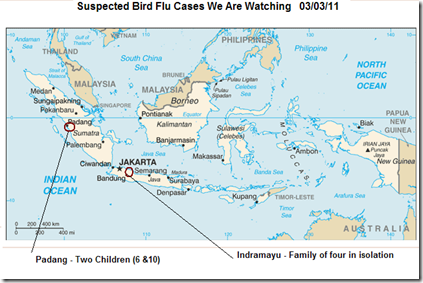
Today, a pair of reports from Ida at the Bird Flu Information Corner - a joint project of Kobe University in Japan and the Institute of Tropical Disease, Airlangga University, Indonesia – on suspected cases in two different locations.


 image


Indramayu, West Java ::: Family of 4 treated as bird flu suspects

Posted by Ida on March 3, 2011

Indramayu – Four residents of Kecamatan Bongas are under intensive treatment of bird flu suspicion in Indramayu regional hospital, West Java.


Patients are a family; two of them are children aged 6 and 7-year-old. Patients showed initial signs such as high fever, coughing and abdominal pain.


The signs appeared after dozens of chickens had died around their house. Rapid test to the dead chickens showed positive bird flu H5N1 infection. Indramayu hospital applied infectious disease standard protocol to the patients.


Source: Indonesia TV news, Metro TV News.


Padang, West Sumatera ::: Hospital treats two bird flu suspects

Posted by Ida on March 3, 2011

Padang – M Djamil hospital in Padang is treating two bird flu suspect patients. They were referred from public health centers, Gurun Lawas Padang and Alai.


Patient Rif (10-month-old), a resident of Parak Lawas, Kecamatan Nanggalo, developed high fever after chickens reared by a neighbor suddenly died. He was admitted to M Djamil hospital on 26 February 2011.


Patient Raf (6-year-old), a resident of Balai Baru, Kecamatan Kuranji, Kota Padang, developed high fever after his family’s chickens suddenly died.  He was admitted to M Djamil hospital on 2 March 2011.

Source: Indonesia local newspaper, NonBlok.


As the Indonesian Ministry of Health has a habit of waiting weeks (or longer) before commenting on the status of suspected cases, we may not learn the true cause of these illnesses for some time.


Despite the obvious concerns over human exposure to bird flu, the H5N1 virus remains primarily adapted to avian physiology. Humans have only rarely contracted the virus, usually after direct exposure to infected birds.


The concern, of course, is that over time the virus may adapt better to humans, and spark another pandemic.


So we remain at Pre-pandemic Phase III for H5N1 and and monitor reports such as these with considerable interest.

Tuesday, January 25, 2011

Japan: Another Poultry Farm Being Tested For Bird Flu


# 5256


Via Treyfish and Makoto on FluTrackers, we’ve multiple Japanese language media reports this morning regarding a poultry farm – this time in Kagoshima prefecture (near Izumi City where over-wintering Hooded Cranes died from the H5N1 virus last December) being tested for bird flu.


For earlier reports from this region, see Japan: 5 Hooded Cranes Test Positive For H5N1 and Japan’s Bird Flu Dilemma.


Rapid tests, and the number of recent poultry deaths on this medium sized farm, suggest bird flu.  But the results of full viral testing won’t be known for several hours.


Bird Flu Japan

Most recent suspected outbreak near Izumi City.


Kagoshima prefecture, in addition to hosting a major wild bird preserve, is a major poultry producing region.  An outbreak here could have a serious impact on the industry.


If a positive result is returned, this will make the 3rd poultry farm in a week, and the 4th poultry farm in three months, to test positive for the virus in Japan.


In the meantime, you can follow preliminary reports as they come in on this FluTrackers Thread.

Thursday, December 30, 2010

Korea: 2nd Farm Investigated For Bird Flu


# 5189


Yesterday we saw a report of suspected bird flu at a duck farm in Cheonan (see South Korea Investigating Cheonan Duck Farm).  Overnight, we’ve several media reports regarding suspected avian flu at a second farm, this time in Iksan, North Jeolla Province.


Test results on both of these farms are awaited.


Iksan is more than 100 km south of Cheonan, and is in the heart of Korea’s poultry processing region.


The past month has seen several H5N1 detections among wild birds and domesticated poultry in both Japan & Korea (Aprox. locations shown below).


Cheonan


This report comes from Xinhau News.


S. Korea reports suspected case of bird flu

SEOUL, Dec. 30 (Xinhua) -- A suspected case of bird flu has been reported from a chicken farm in a southeastern region of the country, raising concerns over a fresh outbreak of bird flu amid South Korea's struggle with the spread of foot-and-mouth disease, the Ministry for Food, Agriculture, Forestry and Fisheries said Thursday.


The ministry said a chicken farm in Iksan, North Jeolla Province, reported a suspected case of bird flu late Wednesday. Another suspected case was reported from a duck farm in Cheonan, South Chungcheong Province.


Health officials are testing samples from both farms, the ministry said.

(Continue . . . )


Additional media reports  (hat tips Shiloh, Arkanoid Legent, Dutchy on this FluTrackers thread) suggest that culling may have begun on at least one farm.

Wednesday, December 29, 2010

South Korea Investigating Cheonan Duck Farm


# 5187


After three detections of the H5N1 bird flu virus in wild and/or migratory birds this month (see South Korea Finds 2 H5N1 Infected Owls and Korea: Bird Flu Discovered In Teal Ducks), it comes as little surprise that Korean Agriculture authorities are now investigating a duck farm where some of the birds there are showing signs suggestive of avian flu.


First the AFP report, appearing on Terra Daily, then some background.


S.Korea reports suspected bird flu case

by Staff Writers
Seoul (AFP) Dec 29, 2010


A South Korean duck farm has reported a suspected case of bird flu, the agriculture ministry said Wednesday.


A quarantine zone has been declared around a farm in Cheonan, about 90 kilometres (54 miles) south of Seoul, where ducks showed symptoms of avian influenza, the ministry said.

(Continue . . .)


Testing is underway, and we should know in a day or so if this is, indeed, H5N1.


South Korea has seen three previous major outbreaks of avian influenza in their poultry population.  The first in the winter of 2003-2004, and then a second time in 2006.


The largest, and most costly outbreak occurred in April of 2008, which resulted in the culling of more than 8 million birds.  You can read some of the coverage of that outbreak in these blogs:


Korea: Cat Death Attributed To Bird Flu
South Korea Investigating New Outbreak
S. Korea Finds 2 More Suspected Outbreaks


At the same time as these Korean outbreaks in 2008, Japan reported the discovery of the H5N1 virus in four swans in Akita Prefecture (see Japan Confirms Swans Infected With H5N1).


Similarly, this month Japan and Korea are once again both reporting multiple instances of H5N1 in wild and/or migratory birds.  I’ve plotted the general locations on the map below.

Cheonan


All of which has agricultural interests in Japan and Korea on high alert, in hopes of avoiding another widespread outbreak like was seen two years ago.

Tuesday, December 07, 2010

Watching Egypt Again


# 5124


On Sunday (see Egypt Reports Bird Flu Fatality) we saw a terse report from KUNA announcing Egypt’s 113th H5N1 infection, and 37th fatality.  


The patient was identified as a 30 year-old woman from the `western province’ which probably refers to Al-Gharbiyah (h/t Laidback Al).


Today newshounds on FluTrackers are following another report, this time of a 30 year-old male from Al Daqahliyah, that has reportedly died from the H5N1 virus.


We’ve only one Arabic news article at this time, and since Al-Gharbiyah and Al Daquahliyah are adjacent to each other, and both cases are listed as 30 years old, there is always the possibility that these cases are one-in-the-same.


Still, there are enough differences in these reports (including location, gender, and date of death) to make one suspect these may be two separate cases.


The report (h/t Twall) comes from Youm7, a normally reliable Arabic news source. The story references 5 others – presumably contacts of the fatal case – who are being tested for the virus.


The case of the death of bird flu in Dakahlia and suspected in 5 others

Tuesday, December 7, 2010 - 16:17

Dakahlia - Sheriff El-Deeb

At the citizen Amr Maghazi (30 years) was killed yesterday evening, al-Sadr hospital in Zagazig wounds sustained bird flu virus.


Maghazi was dead center of immersion Daqhlieh, has been detained as soon as the symptoms of the disease.


Have been detained in 5 cases of suspected bird flu patients in hospitals after the emergence of Dakahlia introduce the virus to them, where they detained two of the city infected with the virus Talkha, in addition to a state hospital and other Belkas Bhmyat Mansoura and the status of the village of Cbrahor.


Samples were taken from cases infected with HIV Bmshat of the throat, and sent to central laboratories to make sure of being infected with the virus or not.

(Continue . .. )


You can follow additional reports on this case on this thread from FluTrackers.  When we get something a little more definitive, I’ll report back here.

Wednesday, December 01, 2010

Indonesian Toddler Suspected Bird Flu


# 5105


We’ve another media report of a suspected H5N1 infection in Indonesia, this time of a 19 month old toddler from Padang, West Sumatra.


Indefatigable newshound Dutchy has started this thread on FluTrackers, with this machine translation of a news report from Kompas.


Unforeseen Bird Flu Treated in Padang


Correspondent Report KOMPAS Ingki Rinaldi


Wednesday, December 1, 2010 |


PADANG, KOMPAS.com - A toddler with initials NEL on Wednesday (01/12/2010) treated at room Suspect Bird Flu (Avian Influenza / AI) Dr. M. Djamil, the city of Padang, West Sumatra.


19-month-old toddler was rushed to the hospital since Tuesday (30/11).


Laila (37), the biological mother of NEL said she brought his youngest daughter to the hospital on the initiative of her husband.


One of the doctors who are members of Team AI Dr. M. Djamil city of Padang, Dr. Yaniv Sp. A Fitry Finny said, Nel allegedly infected with AI disease.


Finny added, in addition to being treated in the living suspect, NEL was also given a dose of oseltamivir and take a sample of fluid mucus from the throat and sent to the Laboratory of the Ministry of Health to look at the fit /compatibility.


Kompas


Reports such as this one are fairly common in Indonesia, particularly between late fall and spring.  Unfortunately, we often never hear any follow up to these stories.


Indonesian officials have worked to `manage’ the bird flu story for several years now, typically parceling out brief press releases every few months, providing little more than an update of the number infected or killed.


It is likely that a lot of these suspected cases we hear about are false alarms.


There are, after all, a good many other illnesses that can cause similar symptoms (including seasonal flu, pneumonia, malaria, and dengue) – particularly in the first few days of infection.


So newshounds and bloggers dutifully hunt for, translate, and post these stories even though they know we may never hear how a lot of them turn out. 


Of course, if we do hear something.  The newshounds will be all over it.

Tuesday, November 23, 2010

Watching Indonesia Again


# 5081


Arkanoid Legent has a translated report overnight from Metro Balikpapan News, indicating that two siblings are currently under observation with bird flu-like symptoms at RSKD hospital in Balikpapan.

Indonesia : Two Brothers Suspected Bird Flu Suspect

Translated report from Metro Balikpapan :
" Isolated in RSKD, DKK Still Perform Inspection

BALIKPAPAN : Spread of the H5N1 virus or bird flu (avian influenza) is not only in poultry. After a few citizens who allegedly suspected H5N1 declared negative, according to latest information there were two other residents who allegedly infected with the deadly virus after the revocation status of human bird flu alert. "There are two suspected suspect bird flu, now they are more isolated in RSKD," said Chief Medical Officer of the City (DKK) Balikpapan drg Dyah Muryani Hj.

(Continue . . . )


Over the past several months there have been multiple outbreaks of H5N1 in poultry in the Balikpapan region of East Kalimantan, Indonesia. 


image


A number of suspected human infections have been isolated in the local hospital (see Ongoing Bird Flu Reports Out Of Indonesia), but so far, none of these have been announced to have tested positive for the virus.


There are, admittedly, a great many illnesses common to Indonesia that can mimic bird flu. Testing for the H5N1 virus is time consuming, and must be repeated before being accepted at accurate.


So we tend to see a lot of suspect cases put in isolation pending laboratory confirmation, many of whom turn out not to test positive for the virus.


Indonesia continues to lead the world in the number of confirmed H5N1 cases, and so this abundance of caution is understandable.


Edit: In my wanderings I noticed Treyfish also had this story on FluTrackers early last evening.

Tuesday, November 02, 2010

Another Bird Flu Suspect In Indonesia


(See update at bottom)

# 5026


We’ve still no word on the laboratory results on the 5 year-old that died last week (see Indonesia: Suspected Bird Flu Fatality) at M Djamil hospital in West Sumatera, although doctors suspected that H5N1 might have been the cause.


Today, another story – this time from Tangerang, Indonesia (in the past a bird flu hotspot, located a few kilometers west of the capital Jakarta)– of an 8-year-old being treated for possible avian influenza. 


The article states that the child has been sick for a week, is receiving antivirals (Tamiflu), and his condition is not improving. Lab results are awaited, so this remains only a suspected case.


There is also, according to this report, no history of contact with sick or dead birds.


image


This from The Jakarta Post.


Tangerang hospital treats possible avian flu patient

The Jakarta Post, Jakarta | Tue, 11/02/2010 6:14 PM | Jakarta


An 8-year-old boy from Cipadu Jaya in Tangerang who was suspected of having contracted the avian flu virus was being treated at Tangerang General Hospital, on Tuesday.

“His condition is getting worse, but we are still waiting for test results,” Tangerang General Hospital disease control chief Dr. Ati Pramudji said Tuesday, as reported by tempointeraktif.com.

(Continue . . . )


UPDATE:


Literally within a few minutes of making this post, I discovered that  Dutchy  at FluTrackers had 3 more (machine translated) articles from the Indonesian Press on this story.


You can find these and future reports on this FluTrackers Thread.


In addition to the child’s treatment, family members and neighbors are being provided with prophylactic antivirals.