Showing posts with label H3N2v. Show all posts

Friday, January 30, 2015

FluView Week 3: Senior Hospitalizations Soar & H1N1v In Minnesota

 image

  *** Correction ***  H1N1v was inadvertently listed as H3N2v in original post – Mea culpa.


# 9650


Since we’ve got a drifted `H3N2’ virus running rampant across much of the northern hemisphere, an unusually vigorous outbreak of H5N1 in Egypt, our regular winter H7N9 mini-epidemic in China, avian HPAI H5 viruses spreading impressively internationally, and even a pair of imported H7N9 cases in Canada this week  . . .it makes perfect sense that the latest MMWR & FluView would include news of an uncharacteristically out-of-season H1N1v infection in Minnesota as well.


H1N1v is  a swine H1N1 virus - that when it jumps to humans - gets the `variant’ tag.


Although telegraphed in yesterday’s MMWR, the following announcement appears in today’s FluView Report.

Novel Influenza A Virus:

One human infection with a novel influenza A virus was reported by the state of Minnesota. The person was infected with an influenza A (H1N1) variant (H1N1v) virus, and has fully recovered from their illness. No ongoing human-to-human transmission has been identified and the case patient reported contact with swine in the week prior to illness onset.

Early identification and investigation of human infections with novel influenza A viruses are critical in order to evaluate the extent of the outbreak and possible human-to-human transmission. Additional information on influenza in swine, variant influenza infection in humans, and strategies to interact safely with swine can be found at http://www.cdc.gov/flu/swineflu/index.htm.


Over the past few years we’ve watched as several swine variant influenza viruses (H1N1v, H1N2v or H3N2v) have made tentative jumps into the human population (see Keeping Our Eyes On The Prize Pig) and each summer the CDC has issued advice on preventing infection at county and state fairs (see Measures to Minimize Influenza Transmission at Swine Exhibitions, 2014).


We’ve not seen many reported cases the past couple of years, but during the summer of 2012 more than 300 cases were detected, with Indiana and Ohio accounting for roughly 80% of the cases. 


Illnesses were usually mild or moderate (1 fatality was recorded), and infection usually occurred in the summer and fall and was associated with attendance of local and state fairs where pigs were being shown.  Of course, some people have contact with swine all year round, and so while uncommon, it isn’t terribly surprising that someone would contract H3N2v during the winter.


What is surprising is that it  - like we saw with H7N9 in Canada earlier this week – this novel virus was detected against the background noise of a particularly nasty H3N2 influenza season. 


While occasional cases are not particularly alarming,  we keep an eye on these swine variant viruses because research has shown there to be only limited community immunity against them (see CIDRAP: Children & Middle-Aged Most Susceptible To H3N2v).

Of more immediate concern is this year’s seasonal flu activity, which remains brisk across much of the country, although in some states are seeing a drop in cases. 


Hospitalization rates for the elderly (65+) are the highest ever recorded since the CDC began tracking that data in 2005, and the CDC continues to remind providers of value of early administration of antiviral medications (see Antiviral Letter to Providers).


This from today’s FluView Report.


2014-2015 Influenza Season Week 3 ending January 24, 2015

All data are preliminary and may change as more reports are received.

Synopsis:

During week 3 (January 18-24, 2015), influenza activity remained elevated in the United States.

  • Viral Surveillance: Of 23,339 specimens tested and reported by U.S. World Health Organization (WHO) and National Respiratory and Enteric Virus Surveillance System (NREVSS) collaborating laboratories during week 3, 4,651 (19.9%) were positive for influenza.
  • Novel Influenza A Virus: One human infection with a novel influenza A virus was reported.
  • Pneumonia and Influenza Mortality: The proportion of deaths attributed to pneumonia and influenza (P&I) was above the epidemic threshold.
  • Influenza-associated Pediatric Deaths: Five influenza-associated pediatric deaths were reported.
  • Influenza-associated Hospitalizations: A cumulative rate for the season of 40.5 laboratory-confirmed influenza-associated hospitalizations per 100,000 population was reported.
  • Outpatient Illness Surveillance: The proportion of outpatient visits for influenza-like illness (ILI) was 4.4%, above the national baseline of 2.0%. All 10 regions reported ILI at or above region-specific baseline levels. Puerto Rico and 29 states experienced high ILI activity; New York City and seven states experienced moderate ILI activity; six states experienced low ILI activity; eight states experienced minimal ILI activity; and the District of Columbia had insufficient data.
  • Geographic Spread of Influenza: The geographic spread of influenza in Puerto Rico and 44 states was reported as widespread; the U.S. Virgin Islands and five states reported regional activity; and the District of Columbia, Guam, and one state reported local activity.

Pneumonia and Influenza (P&I) Mortality Surveillance:

During week 3, 9.1% of all deaths reported through the 122 Cities Mortality Reporting System were due to P&I. This percentage was above the epidemic threshold of 7.1% for week 3.

Pneumonia And Influenza Mortality
 

Influenza-Associated Pediatric Mortality:

Five influenza-associated pediatric deaths were reported to CDC during week 3. Four deaths were associated with an influenza A (H3) virus and occurred during weeks 53, 1, 2, and 3 (weeks ending January 3, January 10, January 17, and January 24, 2015, respectively). One death was associated with an influenza A virus for which no subtyping was performed and occurred during week 1.

A total of 61 influenza-associated deaths have been reported during the 2014-2015 season from New York City [1] and 24 states (Arizona [1], Colorado [2], Florida [2], Georgia [1], Indiana [1], Iowa [3], Kansas [2], Kentucky [3], Louisiana [2], Michigan [1], Minnesota [4], Missouri [1], North Carolina [2], Nevada [3], New York [1], Ohio [5], Oklahoma [4], Pennsylvania [1], South Carolina [1], South Dakota [1], Tennessee [4], Texas [7], Virginia [3], and Wisconsin [5]).
Additional data can be found at:
http://gis.cdc.gov/GRASP/Fluview/PedFluDeath.html.

Click on image to launch interactive tool

View Interactive Application | View Full Screen | View PowerPoint Presentation

Influenza-Associated Hospitalizations:

Between October 1, 2014 and January 24, 2015, 11,077 laboratory-confirmed influenza-associated hospitalizations were reported. The overall hospitalization rate was 40.5 per 100,000 population. The highest rate of hospitalization was among adults aged ≥65 years (198.4 per 100,000 population), followed by children aged 0-4 years (38.2 per 100,000 population). Among all hospitalizations, 10,690 (96.6%) were associated with influenza A, 290 (2.6%) with influenza B, 29 (0.3%) with influenza A and B co-infection, and 62 (0.5%) had no virus type information. Among those with influenza A subtype information, 3,016 (99.7%) were A(H3N2) virus and nine (0.3%) were A(H1N1)pdm09.

Clinical findings are preliminary and based on 1,729 (15.6%) cases with complete medical chart abstraction. The majority (93.7%) of hospitalized adults had at least one reported underlying medical condition; the most commonly reported were cardiovascular disease, metabolic disorders, and obesity. There were 230 hospitalized children with complete medical chart abstraction, 94 (40.9%) had no identified underlying medical conditions. The most commonly reported underlying medical conditions among pediatric patients were asthma, obesity, neurologic disorders and immune suppression. Among the 173 hospitalized women of childbearing age (15-44 years), 47 were pregnant.

Additional FluSurv-NET data can be found at: http://gis.cdc.gov/GRASP/Fluview/FluHospRates.html and http://gis.cdc.gov/grasp/fluview/FluHospChars.html

image

(Continue . . .)


Despite its reduced effectiveness, the CDC continues to recommend that people get the flu shot – partially because it may provide some modicum of protection against this drifted flu strain, and partly because we often see a wave of Influenza B late in the flu season, and the shot can help protect against that virus.


Beyond that, practicing good flu hygiene remains your best strategy for staying well; Staying home when sick, washing your hands, covering your coughs, and disposing of your tissues properly .

Friday, August 01, 2014

Fair Biosecurity & H3N2 In North Dakota Show Pigs

image


# 8901


County and State Fair season is underway in the northern states and will continue across the nation well into fall. One of the highlights for many visitors are the agricultural exhibits, including livestock exhibitions.  While educational, entertaining, and financially lucrative, there are admittedly some downsides.


Bringing together animals from farms all over the region provides unique opportunities to swap pathogens amongst themselves, and potentially spread them to handlers and the public.


In years past, the concern has centered primarily on swine flu, but the recent emergence of two new swine coronaviruses – PEDV & PDCoV  (see SECD: Another Emerging Coronavirus Threat) have complicated matters as well.  Unlike the swine influenzas, however, SECDs - or Swine Enteric Coronavirus Diseases – are not known to transmit to humans.


While they generally cause mild symptoms in adult pigs, among piglets, the mortality rate can run close to 100%. 


In some regions, fair administrators have implemented a terminal show policy – where pigs exhibited at the fair must be sent to market at the show’s end, rather than back home (or worse, to another fair) to prevent the potential spread of porcine diseases. 


This report (and video) from a local Wisconsin TV station.

Terminal show policy in place to control swine virus

The PED virus has had a significant impact on pig populations in the United States in the last two years

Author: Dave Delozier, ddelozier@wisctv.com

Published On: Jul 25 2014 05:44:58 PM CDT

PORTAGE, Wis. -

While most pig exhibitors attend county fairs with the expectation their animal will be sold to market, it is now becoming a certainty.  Because of concerns about the spread of a deadly virus, Porcine Epidemic Diarrhea or PED, county fairs have adopted a terminal show policy.  That means a pig shown at a county fair must be sold to market at the shows end and cannot be taken back to a farm.

(Continue . . . )


Beyond the opportunities for porcine diseases to spread between pigs, fairs also provide lots of human-animal contact, which can lead to the spread of infections from humans-to-pigs, and from pigs-to-humans. 


Illustrating the two-way nature of disease sharing - shortly after the 2009 H1N1 virus emerged in the human population - it began showing up in pig herds around the world (see Study: Reassortants of H1N1pdm & Swine H1 & H3 Viruses in Japan)

image


With the emergence of several swine variant influenza viruses in the past few years (H1N1v, H1N2v, H3N2v) – all able to jump to humans (albeit, not able to transmit efficiently) -  we are seeing a greater emphasis on fair biosecurity than ever before (see CDC: Measures to Minimize Influenza Transmission at Swine Exhibitions, 2014).

. 

Last week, in EID Journal: H3N2v Swine To Human Transmission At Agricultural Fairs – 2012, we looked at what was the most active year for swine variant transmission to humans, where the authors cautioned:


Swine-to-human transmission and human-to-swine transmission of influenza A virus are known to occur at fairs (28), highlighting the fact that swine in this setting are potentially exposed to multiple lineages of influenza A viruses simultaneously, making fairs ideal locations for genomic reassortment and novel virus formation.


Swine are highly susceptible to a variety of flu viruses (human, swine, avian) - and are viewed as excellent `mixing vessels’, allowing viruses to reassort into new hybrid strains.  This is how the 2009 H1N1 pandemic virus was created, after bouncing around swine herds for a decade or more.

Reassortant pig[6]


State & local  fairs have instituted inspections for any signs of illness in livestock – but as we’ve discussed previously (see Asymptomatic Pigs: Revisited) - pigs can sometimes carry these viruses without showing any outward signs of infection.


While we’ve not seen any reports of human infection with swine variant influenza this summer, fair officials and health departments are understandably on heightened alert, and are taking steps to try to prevent that from happening.  All of which serves as prelude to this announcement (yesterday) by North Dakota’s Department of Health.


Influenza A H3N2 Variant Viruses (H3N2v)

Influenza A H3N2v is a non-human influenza virus that normally circulates in pigs. In 2011, a small number of humans were found to be infected with this virus. From 2011 to 2013, a total of 340 cases of H3N2v was identified in 13 states, resulting in 17 hospitalizations and one death. Most of these cases occured in the summer months, and most reported contact with pigs. Symptoms and severity of H3N2v infections in humans resemble that of seasonal influenza, and include fever, cough, sore throat, body aches, and headache. No cases have been identified at this time for 2014, and no cases in North Dakota have ever been reported.

On July 31, 2014 it was reported that three pigs at the 2014 North Dakota State Fair had been removed for illness and had tested positive for an H3N2 virus. The North Dakota Department of Agriculture put out the following news release:

North Dakota Department of Agriculture
July 31, 2014

For immediate release

Precautions advised regarding influenza


BISMARCK – The North Dakota Department of Agriculture (NDDA) and North Dakota Department of Health (NDDoH) received results from the National Veterinary Services Laboratory confirming that three pigs exhibited at the state fair in Minot have tested positive for an influenza A H3N2 virus strain. Although influenza can be passed from swine to people, there is no evidence at this time that any people have become ill as a result of exposure to these pigs.

 
NDDA animal health division staff inspects all animals displayed at the North Dakota State Fair. The pigs appeared healthy when they arrived at the fair and became ill thereafter. After being tested, they were removed from the fairgrounds by their owners at the recommendation of veterinarians. This is the first time that an influenza virus has been confirmed in swine at a fair in North Dakota.

“Fairs and exhibits are an excellent way to showcase livestock and expose the public to animal agriculture production,” said Agriculture Commissioner Doug Goehring. “When appropriate precautions are taken, there is minimal risk of spreading disease to the public.”

 
However, some influenza viruses can spread from pigs to people and from people to pigs. Spread from infected pigs to humans is thought to happen in the same way that seasonal influenza viruses spread between people; mainly through infected respiratory droplets created when an infected pig coughs. Swine influenza has not been shown to be transmissible to people through eating properly handled and prepared pork or other products derived from pigs.

According to the NDDoH, appropriate precautions to prevent the spread of influenza from pigs to people include the same types of measures used to prevent the spread of influenza between people; frequent hand washing and avoiding contact with those that are ill. Other precautions include not eating or drinking around animals and avoiding contact with material, such as bedding material, which has been in contact with pigs. Any exhibitor or visitor at high risk of serious flu complications, who is planning to attend a fair where pigs will be present, should consider avoiding pigs and swine barns. The NDDoH also encourages those who work with pigs to take precautions to avoid the spread of illness. Use masks and gloves when you work with ill animals to protect yourself against transfer of the virus.


“Washing hands prior to working with or handling animals and likewise after working with animals is a good practice,” State Veterinarian, Dr. Susan Keller said. “Swine producers should contact their veterinarians if they have any questions about influenza-like illnesses in their pigs. Vaccines are available that may prevent illness.”


According to the NDDoH, if you experience symptoms of influenza (fever, cough, sore throat, body aches, headache) after contact with animals, report that contact to your primary health care provider. Conversely, if you have influenza, avoid contact with pigs during your illness and for another week after symptoms have disappeared.


For more information about influenza, including the H3N2v flu, visit the health department’s influenza website at www.ndflu.com or call the North Dakota Department of Health at 701-328-2378. For recommendations for swine producers, visit the NDDA website at www.nd.gov/ndda/disease/h3n2-influenza or call the State Veterinarian’s office at 701-328-2655.


Although only 19 swine variant flu infections were reported last year,  in 2012 more that 300 cases were reported, with nearly all linked to fairgoers, mostly in Indiana & Ohio.  Given the limits of surveillance, and the likelihood that some number of mild or asymptomatic cases went undetected, both numbers probably under represent the true incidence of the disease.


Nevertheless, these swine variant viruses do no yet appear ready for prime time, as they have yet to show signs of sustained and efficient transmission in the community.  


They do, however, bear watching as research has shown only limited community immunity to these variant strains (see CIDRAP: Children & Middle-Aged Most Susceptible To H3N2v).

Wednesday, July 23, 2014

EID Journal: H3N2v Swine To Human Transmission At Agricultural Fairs – 2012

image


# 8860


I hadn’t planned on writing another swine variant influenza-related blog again so soon (see yesterday’s blog CDC: Measures to Minimize Influenza Transmission at Swine Exhibitions, 2014), but today the CDC’s EID Journal has posted an analysis of the 2012 outbreak of H3N2v associated with attendance of agricultural fairs in Ohio in 2012.


Although only 19 swine variant flu infections were reported last year,  in 2012 more that 300 cases were reported, with nearly all linked to fairgoers, mostly in Indiana & Ohio.


State & local  fairs have instituted inspections for any signs of illness in livestock – but as we’ve discussed previously (see Asymptomatic Pigs: Revisited) - pigs can sometimes carry these viruses without showing any outward signs of infection.


The concern with these variant swine flu infections, as it is with any animal flu that jumps to humans, is that it gives the virus another opportunity to better adapt to human physiology.


While humans have a long history of exposure to seasonal H3N2 flu viruses, research has shown only limited community immunity to these variant strains (see CIDRAP: Children & Middle-Aged Most Susceptible To H3N2v). The good news is that while several hundred infections were recorded in 2012, sustained and efficient community transmission was not observed, and for the most part, the virus only caused mild to moderate illness.


Today’s study confirms the link between fairs with H3N2v infected pigs, and human cases, and confirms that the strains detected in humans, and those detected in pigs, were > 99.7% identical.  Follow the link below to read:.


Swine-to-Human Transmission of Influenza A(H3N2) Virus at Agricultural Fairs, Ohio, USA, 2012

 Andrew S. BowmanComments to Author , Sarah W. Nelson, Shannon L. Page, Jacqueline M. Nolting, Mary L. Killian, Srinand Sreevatsan, and Richard D. Slemons

Author affiliations: The Ohio State University, Columbus, Ohio, USA (A.S. Bowman, S.W. Nelson, J.M. Nolting, R.D. Slemons); Ohio Department of Health, Columbus (S.L. Page); US Department of Agriculture National Veterinary Services Laboratories, Ames, Iowa, USA (M.L. Killian); University of Minnesota, Saint Paul, Minnesota, USA (S. Sreevatsan)

Abstract

Agricultural fairs provide an opportunity for bidirectional transmission of influenza A viruses. We sought to determine influenza A virus activity among swine at fairs in the United States. As part of an ongoing active influenza A virus surveillance project, nasal swab samples were collected from exhibition swine at 40 selected Ohio agricultural fairs during 2012.

Influenza A(H3N2) virus was isolated from swine at 10 of the fairs. According to a concurrent public health investigation, 7 of the 10 fairs were epidemiologically linked to confirmed human infections with influenza A(H3N2) variant virus. Comparison of genome sequences of the subtype H3N2 isolates recovered from humans and swine from each fair revealed nucleotide identities of >99.7%, confirming zoonotic transmission between swine and humans.

All influenza A(H3N2) viruses isolated in this study, regardless of host species or fair, were >99.5% identical, indicating that 1 virus strain was widely circulating among exhibition swine in Ohio during 2012.

(Continue . . . .)


Swine are highly susceptible to a variety of flu viruses (human, swine, avian) - and are viewed as excellent `mixing vessels’, allowing viruses to reassort into new hybrid strains.

Reassortant pig[6]


While a handful of novel swine variant flu infections that don’t appear to transmit efficiently may not sound like a big deal, as the authors of this paper point out, Agricultural Fairs provide a favorable environment for multiple swine flu viruses to get together. They write:


Swine-to-human transmission and human-to-swine transmission of influenza A virus are known to occur at fairs (28), highlighting the fact that swine in this setting are potentially exposed to multiple lineages of influenza A viruses simultaneously, making fairs ideal locations for genomic reassortment and novel virus formation.


And not only can swine pass flu viruses on to people, people can pass flu viruses on to swine.  Something we saw happen around the world after the 2009 H1N1 pandemic virus emerged and began transmitting in humans. 


This bi-directional transfer of influenza viruses allows for even greater mixing and matching of genes, and explains how the H3N2v virus picked up the M (matrix) gene from the 2009 H1N1pdm virus in 2012.


The authors write:


The results of this study support previous calls for enhanced surveillance of influenza A viruses among swine, especially at high-risk swine–human interfaces


For more on swine variant influenza viruses, and why they matter, you may wish to revisit:


J. Virol: Continued Reassortment Of Swine Flu Viruses With Genes From pH1N1 In China
Keeping Our Eyes On The Prize Pig
Study: Novel & Variant Swine Influenzas In Korean Pigs
Seroprevalence Study: Avian Flu In Chinese Pigs

Saturday, June 28, 2014

Keeping Our Eyes On The Prize Pig

image

Credit Wikipedia


# 8792


To give you an idea of how rapidly things change in the world of emerging infectious diseases, two summers ago (June 2012), no one had ever heard of the MERS coronavirus, the H7N9 avian flu virus was still 8 months away from breaking out in China, and avian H5N8, H10N8, H6N1 and H5N6 weren’t on anyone’s radar screen.


Aside from the perennial concerns over change in transmissibility of H5N1 virus, our primary emerging disease concerns that summer lay in a major outbreak of West Nile Virus (see DVBID: 2012 Record Number Of West Nile Fatalities), and an outbreak of human infection with variant influenza  contracted from show pigs displayed at county and state fairs. 


The CDC describes Swine Variant viruses in their Key Facts FAQ.

What is a variant influenza virus?

When an influenza virus that normally circulates in swine (but not people) is detected in a person, it is called a “variant influenza virus.” For example, if a swine origin influenza A H3N2 virus is detected in a person, that virus will be called an “H3N2 variant” virus or “H3N2v” virus.

Although the actual number of human variant flu infections that occur each year is unknown, the CDC has reported 1 or 2 cases each year since 2005. In 2010, that number jumped to 8, and in 2011, to 12. During the summer of 2012 more than 300 cases were recorded across the United States, and nearly all were linked to contract with pigs displayed at county and state fairs that summer.

image


Last year we only saw a handful of cases, but with state and county fair season once again upon us (it runs June-November around the nation) the potential exists for seeing cases again this summer and fall. 


While fairs have instituted inspections for any signs of illness in livestock – as we’ve discussed previously (see Asymptomatic Pigs: Revisited) - pigs can carry this virus without showing any outward signs of infection.


Swine are highly susceptible to a variety of flu viruses (human, swine, avian) - and can serve as `mixing vessels’, allowing viruses to reassort into new hybrid strains, a topic well covered by Helen Branswell a few years ago in a SciAm article called called Flu Factories.


Reassortant pig[6]

.

Some of my earlier blogs on swine variant influenza include: H3N2v: When Pigs Flu , You Say You Want An Evolution? & The (Swine) Influenza Reassortment Puzzle.


These swine variant strains are – like the 2009 H1N1 pandemic virus – reassortants, that continue to circulate (and evolve) in swine herds.  Starting in 2011, the H1N1v virus was found to have acquired the M (matrix) gene from the 2009 H1N1 pandemic virus. Since then, this M gene has been showing up regularly in all three swine variant viruses (H1N1v, H1N2v, H3N2v).


The CDC has speculated that `This M gene may confer increased transmissibility to and among humans, compared to other variant influenza viruses.’


The concern with these variant swine flu infections, as it is with any animal flu that jumps to humans, is that it gives the virus another opportunity to better adapt to human physiology. While humans have a long history of exposure to seasonal H3N2 flu viruses, research has shown only limited community immunity to these variant strains (see CIDRAP: Children & Middle-Aged Most Susceptible To H3N2v).


The good news is that while some limited community transmission of these variant flu strains appears to have occurred during the summer of 2101, sustained and efficient human-to-human transmission did not, and for the most part, the virus only caused mild to moderate illness.


But as we’ve seen so often in the past, things can change quickly in the world of infectious diseases.


So while Chikungunya, West Nile Virus and MERS will be getting the bulk of the headlines this summer,  public health officials will also be on the lookout for any new swine variant infections - and more importantly - for any signs that the behavior of the virus has changed.


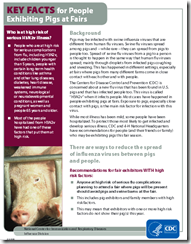
In the meantime, the CDC offers this advice for those planning to visit the fair this year:

image


Exhibitors of swine, and those in charge of the venue, will want to consult  Guidance Associated with Fairs.

Monday, October 21, 2013

ECDC: Joint Scientific Opinion On Likelihood Of H3N2v Spreading To Europe

image

Reassortment of H3N2v - Credit CDC


# 7882


In 2011 a new strain of swine influenza  - originally dubbed trH3N2 but renamed H3N2v (swine variant influenza) in late 2011 – was discovered to have evolved in American pigs.  What made this virus different from the earlier trH3N2 novel strains was that it was a reassortant swine H3N2 which had acquired the matrix (M) gene from the 2009 H1N1 pandemic virus.


We first heard about this new strain on Sept. 2nd, 2011, via an early release from the CDC’s MMWR, which described two young children – one in Indiana and another in Pennsylvania - who were infected by a new swine-origin H3N2 virus (see Swine-Origin Influenza A (H3N2) Virus Infection in Two Children --- Indiana and Pennsylvania, July--August 2011). 


While these first two cases first appeared to be one-off, dead end transmissions, it was only a few days later that Pennsylvania Reported 2 More Novel Flu Cases.  On September 9th, 2011 the CDC updated their SOIV (Swine Origin Influenza Virus) page (see CDC Update On Recent Novel Swine Flu Cases), acknowledging the possibility that limited human-to-human transmission of this trH3N2 virus might be occurring.


By the end of 2011, 12 cases had been reported across 5 states.  While most human infections with this virus have only produced mild to moderate illness - as a precaution - in December of 2011 the CDC announced their intention of Developing A trH3N2 Seed Vaccine.


In 2012 more than 300 swine `variant’ infections were confirmed (see A Variant Swine Flu Review) in the United States, mostly linked to attendance of state and county fairs. Based on recently published studies, this was likely a substantial undercount (see CID Journal: Estimates Of Human Infection From H3N2v (Jul 2011-Apr 2012).


This year has seen far fewer reported infections, with just 19 cases reported thus far.  Exactly why we’ve seen this drop off isn’t clear, although better biosecurity at swine exhibits and improved hygiene by those in direct contact with pigs may be partially responsible.

image


Recently, scientists in Korea revealed they had found an H3N2v virus genetically closely related to the strains seen in the United States (see Study: Novel & Variant Swine Influenzas In Korean Pigs). Other regions  – particularly in Europe and Hong Kong -  have increased surveillance of their swine herds, looking for any signs this variant virus has shown up in their livestock as well.  


All of which serves as prelude to a report from the ECDC today on a recent joint scientific assessment of the risks of H3N2v showing up in European swine.   While they consider the risks to be low, they also acknowledge that:


It is not possible to predict which changes within H3N2v virus might  enable it to develop pandemic properties. Hence, it is not possible at present to set up a specific system to monitor such a risk. Nevertheless, it is recommended to reinforce the monitoring of influenza strains circulating in pigs in EU.


Follow the link below to access the full report.


Joint scientific opinion assesses the likelihood of swine-origin influenza A(H3N2) in the EU as low

21 Oct 2013

Influenza A(H3N2v) risks in EU

​The likelihood of the swine-origin influenza A(H3N2)v appearing in the EU is low. Nevertheless, it is important to reinforce the monitoring of influenza strains circulating in pigs and link this to surveillance of influenza viruses in humans concludes the joint scientific opinion of three EU agencies, European Food Safety Authority, European Medicines Agency and European Centre for Disease Prevention and Control. The opinion assesses and advises on the possible risks posed by influenza A(H3N2)v virus for animal health and the potential implications for animal and human health.

Pigs are an important host in influenza virus ecology since they are susceptible to infections with both avian and human influenza A viruses and can play a role in interspecies transmission. This can lead to co-infection and genetic reassortment of viruses of swine, human or avian origin.

In 2011, the United States of America reported a cluster of cases of human infection with a swine-origin influenza A(H3N2) variant virus H3N2v. In 2012, 309 influenza H3N2v virus infections in humans were identified in the US and 12 cases so far in 2013.


The joint scientific opinion assesses the following:

  • risk of introduction of H3N2v in EU
  • diagnostic capabilities to early detect H3N2v incursion in EU
  • implications and consequences of the possible evolution of H3N2v virus on pig health
  • the use of vaccines in relation to the possible evolution of variants of influenza viruses posing a risk to public and animal health
  • factors to be monitored that would suggest a risk for the emergence of a new pandemic influenza strain from the influenza A(H3N2v) virus


The joint opinion concludes that it is recommended to reinforce the monitoring of influenza strains circulating in pigs in EU because it is not possible to predict nor monitor changes to the H3N2v virus that might enable it to develop pandemic properties.

Links: - Joint scientific opinion on influenza A(H3N2)


Saturday, August 31, 2013

Study: Novel & Variant Swine Influenzas In Korean Pigs

Reassortant pig[6]

Since pigs can be infected by more than one flu virus at the same time, it is possible for two viruses to swap genetic material (reassort), resulting in a new hybrid strain.


# 7621


We’ve more evidence today that nature’s laboratory continues to produce new, and possibly troublesome, flu viruses from a report that appeared yesterday in the journal Influenza and other Respiratory Viruses.


Swine are considered excellent `mixing vessels’ for influenza because they are susceptible to a variety of human, swine, and avian strains of flu.  As such, they have the opportunities to be co-infected by two different strains simultaneously.


The most common swine flu viruses are H1N1, H1N2, H3N1, H3N2, and H2N3. These viruses, when they jump to humans, are called variant viruses (e.g. H3N2v).


Starting in 2011, the H1N1v virus was found to have acquired the M (matrix) gene from the 2009 H1N1 pandemic virus. Since then, this M gene has been showing up regularly in all three swine variant viruses (H1N1v, H1N2v, H3N2v).


The CDC has speculated that `This M gene may confer increased transmissibility to and among humans, compared to other variant influenza viruses.’ – CDC HAN 2012


The concern with these variant swine flu infections, as with any novel flu, is that each new human exposure provides the virus another opportunity to better adapt to human physiology.


All of which brings us to a new study that has not only found the first evidence of H3N2v in swine outside of the United States, but also finds a new H3N1 reassortant virus that appears to transmit well among ferrets and replicate well in human cell lines.


Excerpts from the study’s abstract follow, after which I’ll return with more:


Emergence of H3N2pM-like and novel reassortant H3N1 swine viruses possessing segments derived from the A (H1N1)pdm09 influenza virus, Korea

Philippe Noriel Q. Pascua, Gyo-Jin Lim, Hyeok-il Kwon, Su-Jin Park, Eun-Ha Kim, Min-Suk Song, Chul Joong Kim, Young-Ki Choi

Article first published online: 30 AUG 2013

Result

We identified reassortant H3N2 (H3N2pM-like) and H3N1 swine viruses containing A(H1N1)pdm09-like segments in Korean pigs that are genetically closely related to strains recently detected in pigs and humans in North America.


Although the H3N2pM-like and novel H3N1 reassortants demonstrated efficient replication in mice and ferrets, all the H3N1 strains exhibited growth advantage over the representative H3N2pM-like virus in human airway cells.


Interestingly, A/swine/Korea/CY02-07/2012(H3N1) and A/swine/Korea/CY03-13/2012(H3N1) reassortants were more readily transmitted to respiratory-droplet-contact ferrets compared with the H3N2pM-like (A/swine/Korea/CY02-10/2012) isolate. Furthermore, serologic evaluation showed poor antigenicity to contemporary reference human seasonal H3N2 vaccine strains.

Conclusions

We report here for the first time the isolation of H3N2pM-like viruses outside North America and of novel reassortant swine H3N1 viruses with A(H1N1)pdm09-derived genes. Apart from further complicating the genetic diversity of influenza A viruses circulating in domestic pigs, our data also indicate that these strains could potentially pose threat to public health asserting the need for continuous virus monitoring in these ecologically important hosts.


One of the biggest lessons learned from the past few years was that influenza viruses don’t always follow the script.


Not only did the last pandemic virus emerge from the `wrong’ species (pigs instead of birds), it came from the `wrong’ continent (North America instead of Asia) and from a completely unexpected lineage (H1N1).


While pigs have long been considered potential mixing vessels for influenza viruses, today that threat is taken more seriously than it was in the past. The continued evolution in swine viruses, particularly reassorting with `humanized’ strains like H1N1pdm, is of particular concern.


image


Undoubtedly, influenza reassortments happen all the time and mostly outside the view of scientists. Most are viral flashes in the pan, are unable to compete with more biologically fit flu viruses, and quickly disappear into the evolutionary dustbin.


But occasionally, the right genetic combination will be generated, and a new emerging virus is born.


All of which highlights the need for continual and enhanced surveillance of humans, livestock, and wild birds for emerging viral threats. Because it isn’t a question of if another pandemic will emerge.


It’s only a matter of when.

Thursday, August 29, 2013

Michigan Reports 1st H3N2v Case Of 2013

image 

Credit CDC


# 7615


Compared to last year, when more than 300 cases of H3N2v were reported across the country (mostly associated with livestock exposure at county & state fairs),  2013 has seen relatively few cases of swine variant influenza reported.


Prior to today, just 16 cases have been reported to the CDC over the summer.  Nevertheless, the CDC and local public health departments remain on alert for new cases, and it is likely that some cases go unidentified.


Last weekend, in CDC Updates H3N2v County & State Fair Advice, we looked at the latest guidance from the CDC for fairgoers and exhibitors.


On July 5th, the CDC released a HAN Advisory On H3N2v, alerting doctors to the possibility that more cases could turn up this summer.


Also in July the CDC also released two new interim guidance documents on H3N2v for local public health agencies; one on case definitions, and the other on surveillance and specimen collection.


The CDC’s most recent assessment of the risk of H3N2v reads:


CDC Assessment

It's possible that sporadic infections and even localized outbreaks among people with this virus will continue to occur. While there is no evidence at this time that sustained human-to-human transmission is occurring, all influenza viruses have the capacity to change and it's possible that this virus may become widespread. Illness associated with H3N2v infection so far has been mostly mild with symptoms similar to those of seasonal flu. Like seasonal flu, however, serious illness, resulting in hospitalization and death is possible. In 2012, for example, 309 infections with H3N2v were detected. Of these cases, 16 people were hospitalized and one of these people died. Most of the people who were hospitalized and the person who died had one or more health or age factor that put them at high risk of serious flu-related complications.

People at high risk of serious complications from seasonal influenza and H3N2v include children younger than 5, people with certain chronic conditions like asthma, diabetes, heart disease, weakened immune systems, pregnant women and people 65 years and older.

CDC has issued guidance for people attending fairs where swine might be present this fair season, including additional precautions for people who are at high risk of serious flu complications. Limited serologic studies indicate that adults may have some pre-existing immunity to this virus while children do not. Most cases of H3N2v infection have occurred in children who have little immunity against this virus.


Today Michigan reports their first detection of a swine variant flu infection this year, that of a child who was exposed to an infected pig at the Berrien County Youth Fair, which ran from August 12th to the 17th.


Here is a link to the Berrien County Health Department’s announcement of today’s case.


First Case of Influenza A H3N2 Variant Detected for 2013
FOR IMMEDIATE RELEASE: August 29, 2013

LANSING – Today, August 29, 2013, the Michigan Departments of Community Health (MDCH), and Agriculture and Rural Development (MDARD), along with the Berrien County Health Department (BCHD) have identified one case of an H3N2 variant (H3N2v) in a child who was a swine exhibitor at the recent Berrien County Youth Fair, which took place August 12-17, 2013.


The child, who was not hospitalized, is reported to have contracted H3N2v after exposure to swine at the fair. In addition, a sick pig from the fair tested positive for Influenza A H3N2 at the National Veterinary Services Laboratories in Ames, Iowa. MDCH, MDARD, and BCHD are working with the Berrien County Youth Fair (BCYF) board to reach out to swine exhibitors who attended the fair to identify additional illnesses. As a precaution, Michigan public health agencies have conducted an extensive multi-state outreach to meat processing plants that were identified as being in receipt of live swine from the fair. These facilities have been made aware of the potential exposure to their employees, symptoms of illness, and given instruction on seeking care and testing. MDARD has notified managers at eight additional fairs scheduled to take place in the coming weeks, and asked them to reach out to swine exhibitors and the fair veterinarians about the H3N2v case and to use proper safety measures to prevent spreading illnesses.


“Influenza is common to swine and is not a food safety concern,” said Dr. James Averill, MDARD Animal Industry Division Director and State Veterinarian. “Berrien County Youth Fair had hand washing stations, posters, and good biosecurity practices in place, and it’s important that all fairs continue these practices.”


Symptoms of H3N2v infection in people are similar to those of seasonal flu viruses and can include fever and respiratory symptoms, such as cough and runny nose, and possibly other symptoms, such as body aches, nausea, vomiting, or diarrhea. Infections with influenza viruses (including variant viruses like H3N2v) can sometimes cause severe disease, even in healthy people. This can include complications, such as pneumonia, which may require hospitalization, and sometimes results in death. People who are at high risk of developing complications if they get influenza include children younger than 5 years of age, people 65 years of age and older, pregnant women, and people with certain long-term health conditions, such as asthma, diabetes, heart disease, weakened immune systems, and neurological or neurodevelopmental conditions.


“While this variant flu virus has rarely been shown to spread from person to person, we remain on the look-out for such secondary cases. In addition, any individual with flu-like-symptoms at this time, prior to the traditional flu season, should contact their medical provider and local health department,” said Dr. Rick Johansen, Medical Director of the BCHD.


The incubation period (the time it takes from exposure to illness) for this influenza, like the usual seasonal influenza, is 1 to 7 days; and most commonly 2 days. Therefore, it is unlikely that there will be new cases from direct exposure at the recent Berrien County Youth Fair. Early treatment works best and may be especially important for people with a high risk condition. Currently there is no vaccine for H3N2v and the seasonal flu vaccine will not protect against H3N2v.


"While Michigan did see a handful of H3N2v cases in 2012, this first case for 2013 should serve as an important reminder of the simple steps that can be taken to protect our health as we would with any flu season," said Dr. Matthew Davis, Chief Medical Executive with the MDCH. "Washing your hands, covering your nose and mouth when you sneeze or cough, and staying home when you feel sick are some of the best ways to protect yourself and others from becoming ill. This serves as a good reminder for Michigan residents that everyone 6 months and older should get a seasonal flu vaccine each year."

Below are some steps that you can take to protect yourself and prevent the spread of any illness:

  • Avoid close contact with sick people.
  • Cover your nose and mouth with a tissue when you cough or sneeze. Throw the tissue in the trash after you use it.
  • Wash your hands often with soap and water. If soap and water are not available, use an alcohol-based hand rub.
  • Do not eat or drink in livestock barns or show rings.
  • Avoid touching your eyes, nose and mouth. Germs spread this way.
  • If you are sick, stay home from work or school until your illness is over.
  • Avoid contact with pigs if you have flu-like symptoms. Wait 7 days after your illness started or until you have been without fever for 24 hours without the use of fever-reducing medications, whichever is longer. If you must have contact with pigs while you are sick, take the protective actions listed above.
  • Get an annual influenza vaccination.

For more information about H3N2v, visit www.cdc.gov/flu/swineflu/h3n2v-basics.htm.

Sunday, August 25, 2013

CDC Updates H3N2v County & State Fair Advice

image


# 7599


After last year’s sudden jump in the number of human swine-variant flu infections linked to exposure to pigs at state and county fairs - from a dozen in 2011 to 300+ in 2012 -  authorities this year have been braced for a repeat performance.


This year, we’ve yet to see a repeat of last year’s mini-epidemic. Friday’s FluView report summarizes this year’s activity:


Novel Influenza A Viruses:

No additional infections with influenza A (H3N2) variant (H3N2v) virus were reported to CDC during week 33. A total of 16 H3N2v cases have been reported this summer (Illinois [1], Indiana [14], and Ohio [1]).


So far during 2013, one person has been hospitalized as a result of H3N2v illness; no deaths have occurred. At this time no ongoing human-to-human transmission has been identified and all 16 cases have reported close contact with swine in the week prior to illness onset.


Nonetheless, fair season runs through late fall, and there remain ample opportunities for variant flu transmission to humans.  On Thursday The CDC updated their advice on preventing the spread of flu at the fair, and for people exhibiting pigs at fairs this year on their


image 


image


On Thursday, Minnesota Public Radio carried the following report on how that state is working to prevent flu transmission at their state fair, which runs through September 2nd (Labor Day).


State Fair watching closely for signs of swine flu

by Lorna Benson, Minnesota Public Radio

August 22, 2013

ST. PAUL, Minn. — Hundreds of thousands of visitors will wander through the animal barns at the Minnesota State Fair over the next 12 days to view some of the state's top farm animals.


Whenever people and animals are in close proximity there's always a chance that a disease can pass between them.


A strain of swine influenza swept through fairs last summer sickening 309 people in a dozen states, including Minnesota. One person died from the new virus. This year 16 people have contracted influenza from pigs after visiting fairs in Indiana, Illinois and Ohio. So far, Minnesota hasn't had any cases.

(Continue . . .)


Although it is likely (see CID Journal: Estimates Of Human Infection From H3N2v (Jul 2011-Apr 2012)) that the number of confirmed cases (this year, and in previous years) under-represents the total number of infections that occur each year - for now, the threat to the public from these swine variant viruses appears low.


The CDC, in a statement on June 28th of 2013, offered this assessment:


CDC will continue to watch this virus closely to make sure there are no changes in the epidemiology of related human infections. That means watching for any changes in the severity of illness caused by infection with this virus and any signs that the virus is becoming more adept at spreading from person-to-person. Like all influenza viruses, it’s possible that mutations could occur that would allow this virus to become more severe or to spread more easily between people.


The risk of this virus triggering a full-blown pandemic is considered relatively low, however, because serology studies have suggested that significant numbers of adults have some existing immunity against this virus. Children younger than about 10 years old, however, have little to no immunity against H3N2v virus. Given this, a more likely scenario if H3N2v were to become more transmissible among people would be localized outbreaks in pockets of the population that do not have immunity against this virus, for example, in day care or school settings.

Friday, August 02, 2013

Illinois Reports H3N2v Infection

image

H3N2 Characterization – Credit CDC


#7536


While the numbers remain small this summer, yesterday a new state (Illinois) reported a confirmed case of H3N2v (Swine variant) influenza in a human – bringing to 15 the total thus far in 2013 (previous reports: Ohio 1, Indiana 13).


Until a couple of years ago we rarely saw more than 3 or 4 human cases each year, but 2011 saw a dozen cases reported, and last year (2012) more than 300 infections confirmed - mostly in Midwestern states, and nearly all associated with attendance at county and state fairs.


Last year’s big spike in cases did not come until August, and so it is a little too soon to know how this year will compare. And a reminder: these numbers are likely an undercount of actual infections, as not everyone who gets sick seeks medical care, or gets tested.


The most commonly reported strain:  H3N2v –  a reassorted swine H3N2 virus which acquired the M (matrix) gene from the 2009 H1N1 virus - was first detected in humans in July of 2011.


While this virus appears no more severe than seasonal flu (which can sometimes be very serious) and does not as yet transmit in humans in  a sustained and efficient manner, the CDC is nonetheless monitoring it closely. 


This from the CDC’s H3N2v BASICs FAQ.

Why is CDC concerned about H3N2v?

CDC is concerned about H3N2v for a few reasons.


First, infections with influenza viruses (including variant viruses like H3N2v) can sometimes cause severe disease, even in healthy people. This can include complications (like pneumonia), which can require hospitalization, and sometimes result in death.


Second, this virus seems to spread more easily to humans from pigs than other swine influenza viruses.


Third, influenza viruses are always changing. It’s possible the H3N2v virus could change and begin spreading easily from person to person.


Fourth, studies conducted by CDC and others have indicated that children younger than about 10 years old have little to no immunity against H3N2v virus. Adults seem to have more immunity, perhaps because they might have been previously exposed to similar viruses in their lifetimes.


Is H3N2v dangerous?

Currently, the severity of human illness associated with H3N2v resembles that of seasonal flu.


Keep in mind that even seasonal influenza can be a serious disease. Sometimes seasonal influenza can lead to complications (like pneumonia). It also can lead to hospitalization and even death.


Next stop, the State of Illinois announcement on their H3N2v detection, then I’ll return with a little more.


FOR IMMEDIATE RELEASE

August 1, 2013

CONTACT:

Sabrina L. Miller
(312) 814-8194

www.idph.state.il.us

State Health Department Confirms H3N2v Influenza Case

Common flu precautions recommended

CHICAGO – The Illinois Department of Public Health (IDPH) laboratory has confirmed one case of what is known as the H3N2v influenza virus, which has now been reported in three states this year –Illinois, Indiana and Ohio. IDPH is working with local health officials to alert the public on ways to reduce the risk of transmission of this virus. The confirmed case is a Boone County child with mild symptoms who had contact with swine while helping an exhibitor at the DuPage County Fair which was held in late July.


H3N2v is a variant form of influenza A, which was first detected in swine in 2011 and the first human cases were reported in 2012, including four cases in Illinois. The CDC is currently reporting more than a dozen cases in the U.S. this year. All infections in 2013 have occurred in people following contact with swine, and cases of the virus being transmitted from person to person are rare. So far, the severity of illnesses associated with this virus in people has been similar to the severity of illnesses associated with seasonal flu virus infections.


“The H3N2v virus is relatively new, but the Illinois Department of Public Health, the Illinois Department of Agriculture and our federal partners are monitoring this situation closely,” said IDPH Director Dr. LaMar Hasbrouck. “We want you to enjoy your time at the state or county fair, so one key thing to do to stay healthy is to wash your hands frequently, especially if you are around swine.”


Tips to avoid influenza include:

  • Wash your hands frequently with soap and water before and after exposure to animals.
  • Do not take food or drinks into animal areas; do not eat, drink or put anything in your mouth while visiting animal areas.
  • Do not take toys, pacifiers, cups, baby bottles, strollers or similar items into animal areas.
  • Avoid close contact with animals, especially swine.
  • Avoid contact with animals if you have influenza-like symptoms.
  • Use caution when deciding to visit an animal area if you have an underlying health condition or if persons are younger than 5 years or older than 65 years or pregnant.

Influenza is contracted through droplets when an infected person or animal coughs or sneezes. Those droplets can either be inhaled or can be on a surface you touch with your hand, and then touch your mouth or nose.


Influenza symptoms include fever, cough, sore throat, runny or stuffy nose, body aches, headache and fatigue. Illness can last a week or two. Certain people have a higher risk of serious infection from influenza including the very young, elderly, pregnant women, people with weakened immune systems and those with asthma, diabetes and heart disease. If you have, or do come into contact with swine and are experiencing influenza symptoms, contact your health care provider.


On July 5th, the CDC released a HAN Advisory On H3N2v, alerting doctors to the possibility that more cases could turn up this summer.


Last month the CDC also released two new interim guidance documents on H3N2v for local public health agencies; one on case definitions, and the other on surveillance and specimen collection.


We’ll be checking the CDC’s  FluView report later today for any other cases that may have been detected over the past week.


While the public health risk posed by these variant flu viruses appears low right now, emerging flu viruses can abruptly change, and so could that assessment.


Which is why we always pay particularly close attention whenever a novel (or variant) flu strain tries to jump to humans.

Friday, July 26, 2013

FluView: Two More Novel (H3N2v) Flu Infections Detected

image


# 7518


Although our attentions have been focused primarily on MERS-CoV and the emerging H7N9 avian virus in China, swine variant influenza viruses have been on the radar this summer as well. 


Until about two years ago we rarely saw more than 3 or 4 human cases each year, but 2011 saw 12 cases reported, and last year (2012) more than 300 infections were recorded - mostly in Midwestern states, and nearly all associated with attendance at county and state fairs.


The H3N2v strain has been the most widely reported, with H1N1v and H1N2v far less common.  Earlier this month we saw 12 cases reported in Indiana (see Indiana Reports 8 More H3N2v Cases).


On July 5th, the CDC released a HAN Advisory On H3N2v, alerting doctors to the possibility that more cases could turn up this summer.


With the county and state fair season well underway, earlier this month the CDC also released two new interim guidance documents on H3N2v for local public health agencies; one on case definitions, and the other on surveillance and specimen collection.


Today, the CDC’s FluView reports two more confirmed cases; one in Ohio and one in Indiana. 


2012-2013 Influenza Season Week 29 ending July 20, 2013

All data are preliminary and may change as more reports are received.

Novel Influenza A Viruses:

Two new human infections with influenza A (H3N2) variant (H3N2v) virus were reported to CDC during week 29 (Indiana [1] and Ohio [1]). A total of 14 H3N2v cases have been reported this summer. No hospitalizations or deaths have occurred. At this time no ongoing human-to-human transmission has been identified and all 14 cases have reported close contact with swine in the week prior to illness onset. Public health and agriculture officials are investigating the extent of disease among humans and swine, and additional cases may be identified as the investigation continues.


Because of reporting schedules, state totals posted by CDC may not always be consistent with those reported by state health departments. If there is a discrepancy between state and CDC case counts, data from the state health department should be used as the most accurate number.


Early identification and investigation of human infections with novel influenza A viruses is critical in order to evaluate the extent of the outbreak and possible human-to-human transmission. Additional information on influenza in swine, variant influenza infection in humans, and strategies to interact safely with livestock can be found at http://www.cdc.gov/flu/swineflu/h3n2v-cases.htm.


It is likely (see CID Journal: Estimates Of Human Infection From H3N2v (Jul 2011-Apr 2012)) that the number of confirmed cases under-represents the total number of infections that occur each year.


For now, the threat to the public appears low, and we remain in a watchful waiting mode. But anytime a virus jumps species – as this one has - we are particularly attentive.


The CDC offers the following advice to fairgoers to help reduce their odds of contracting this virus:


Preventive Actions

CDC Recommendations For People At High Risk:

  • If you are at high risk of serious flu complications and are going to a fair where pigs will be present, avoid pigs and swine barns at the fair. This includes children younger than 5 years, people 65 years and older, pregnant women, and people with certain long-term health conditions (like asthma, diabetes, heart disease, weakened immune systems, and neurological or neurodevelopmental conditions).

If you are not at high risk, take these precautions:

  • Don’t take food or drink into pig areas; don’t eat, drink or put anything in your mouth in pig areas.
  • Don’t take toys, pacifiers, cups, baby bottles, strollers, or similar items into pig areas.
  • Wash your hands often with soap and running water before and after exposure to pigs. If soap and water are not available, use an alcohol-based hand rub.
  • Avoid close contact with pigs that look or act ill.
  • Take protective measures if you must come in contact with pigs that are known or suspected to be sick. This includes wearing personal protective equipment like protective clothing, gloves and masks that cover your mouth and nose when contact is required.
  • To further reduce the risk of infection, minimize contact with pigs in the pig barn and arenas.