Showing posts with label Imported. Show all posts

Wednesday, May 13, 2015

WHO Statement On 1st Imported Ebola Case In Italy

image

Location of Sardinia


# 10,046


Yesterday it was reported that nurse who had been working in Sierra Leone up until a week ago had fallen ill Sunday on the island of Sardinia, and had subsequently been diagnosed with Ebola.  Today the World Health Organization has issued the following statement on this patient’s itinerary, and onset of symptoms.


Ebola virus disease – Italy

Disease outbreak news
13 May 2015

On 12 May 2015, WHO received notification of a laboratory-confirmed case of Ebola virus disease (EVD) in Italy. This is the first EVD case to be detected on Italian soil.

Details of the patient are as follows

The patient is a healthcare worker who has returned from volunteering at an Ebola treatment centre in Sierra Leone. The patient flew from Freetown to Rome via Casablanca, Morocco on 7May. The arrival of the case had been communicated to the Ministry of Health, according to the health surveillance procedures in force since October 2014 for individuals coming back from Ebola affected countries in West Africa. At the arrival in Rome, the case displayed no symptoms of infectious Ebola.

On 10 May, 72 hours after his return to Italy, the patient developed symptoms. The patient self-isolated at home and was transported on 11 May to the infectious diseases ward of the Hospital of Sassari, Sardinia. Clinical samples have been tested by the national reference centre of the National Institute for Infectious Diseases (INMI) Lazzaro Spallanzani of Rome on 12 May, confirming EVD infection.

The patient was transferred from the Hospital of Sassari to the INMI of Rome with the specially equipped aircraft of the Italian Air Force, to assure high-containment precautions.

Since the onset of symptoms occurred 72 hours after the last flight, contact tracing of the passengers of the flights is not considered necessary.

Healthcare workers of the Hospital in Sassari, who examined the patient, were well equipped with personal protective equipment and are now under surveillance, as well as the close contacts of the case.

Future WHO updates on EVD in Italy will not be posted on the Disease Outbreak News. Further information will be available in WHO’s Ebola Situation Reports which provide regular updates on the WHO response:

Tuesday, February 24, 2015

Hong Kong: Update On 3rd Imported H7N9 Case

image


# 9746


We’ve an update from Hong Kong’s CHP this morning on their epidemiological investigation into this seasons’ 3rd imported H7N9 case. This is the 13th known importation into Hong Kong since H7N9 emerged two years ago, and authorities have contact tracing and surveillance pretty much down to a science. 


While human-to-human transmission of the H7N9 virus has only rarely been reported, the incubation period is thought to be up to 10 days, and so arrangement are being made for asymptomatic contacts to be quarantined at the Lady MacLehose Holiday Village in Sai Kung.

Lady MacLehose Holiday Village

We’ve seen similar arrangements in the past both in Hong Kong and in Singapore (see Singapore MOH Puts Quarantine Chalets On Standby).  Symptomatic contacts are quartered in hospital isolation rooms.


Here is today’s update, after which I’ll return with a bit more:


Update on imported human case of avian influenza A(H7N9)

The Centre for Health Protection (CHP) of the Department of Health (DH) today (February 24) reported the latest updates on the third imported human case of avian influenza A(H7N9) in Hong Kong this winter, and again urged the public to maintain strict personal, food and environmental hygiene both locally and during travel.


Epidemiological investigations by the CHP have so far located 17 close contacts and 99 other contacts of the patient.

(A) Close contacts
------------------
The close contacts will be put under quarantine and prescribed with antiviral presumptive treatment until the completion of the five-day treatment, or 10 days since last exposure to the patient, whichever is earlier. They include:

  • An asymptomatic family member of the patient who tested negative for influenza A virus;
  • Five asymptomatic healthcare workers (HCWs) involved in Queen Mary Hospital (QMH);
  • Seven in-patients admitted to the same cubicle as the confirmed patient in QMH among which six were asymptomatic while the remaining one is under tracing; and
  • Three patients and one who accompanied one of them attending the same private clinic in Aberdeen with the confirmed patient. They are all asymptomatic.

The Lady MacLehose Holiday Village in Sai Kung under the Leisure and Cultural Services Department has been converted to a quarantine centre for asymptomatic close contacts, including the HCWs involved in QMH.

(B) Other contacts
------------------
Other contacts have been put under medical surveillance and they include:

  • Another asymptomatic family member who visited the confirmed patient in QMH;
  • 77 HCWs involved in QMH;
  • 15 asymptomatic clinic contacts including a private doctor, staff and patients of the private clinic; and
  • Six colleagues of the patient among whom one had mild upper respiratory tract infection symptoms before exposure to the patient while the rest are asymptomatic.

Investigations and contact tracing are ongoing.

Ends/Tuesday, February 24, 2015
Issued at HKT 17:18
NNNN


As mentioned yesterday, with this year’s severe, and concurrent, seasonal flu outbreak in Hong Kong there are enhanced concerns that someone could be simultaneously infected by both the H7N9 virus and H3N2.  Although the outcome of such a rare event is unpredictable, it could theoretically lead to the creation of a `hybrid’ or reassortant virus.


Yesterday the HK CHP released the following statement regarding the genetic profile of H7N9 viruses detected this year (excluding the latest one, on which genetic characterization is under way).


"While the activity of avian influenza viruses in the Mainland and human seasonal influenza viruses in Hong Kong remains high this winter and heightened vigilance and extra attention to hygiene are warranted, we will closely monitor the virus activity and genetic nature. Genetic analysis to date has revealed that H7N9 viruses confirmed in Hong Kong have remained to be of avian origin and had no significant differences from those detected in the Mainland, nor has there been evidence of reassortment with genes from human seasonal influenza viruses or resistance to the antiviral oseltamivir (Tamiflu)."


Previously, in the Lancet: Coinfection With H7N9 & H3N2, we saw the first evidence of co-infection with the newly emerged H7N9 virus and a seasonal flu virus in a human. While last October, in EID Journal: Human Co-Infection with Avian and Seasonal Influenza Viruses, China, we looked at co-infections in 2 patients in Hangzhou, in January 2014.


In all of three of these cases, no reassortant virus was detected.  Yet we know from experience that these sorts of events are possible (see pH1N1 – H3N2 A Novel Influenza Reassortment).


While rarely detected, influenza A coinfections are probably more common than we realize.  Luckily, most do not result in the creation of a reassorted virus - and of those that do - most end up being evolutionary failures.


The odds of any one viral tryst producing a viable, humanized virus is probably fairly remote.


The concern is, if these viruses get enough rolls of the genetic dice, they will eventually roll a natural.  Which is why we watch Hong Kong, mainland China, and Egypt so carefully this time of year.

Tuesday, December 30, 2014

Hong Kong: Positive H7 Serological Test On Imported Chickens

Photo: ©FAO/Tariq Tinazay

Credit FAO


# 9515


The 7 million+ residents of Hong Kong consume more poultry than can be produced locally, so every week a large quantity of live poultry is imported from neighboring Guangdong Province. In order to protect both the residents, and the poultry operations, in Hong Kong a small number of chickens in each batch is tested – both by PCR and by Serology – for avian flu viruses.


While PCR testing can tell if there is a current infection, serology can show evidence of earlier infections.   And that can help define just how big a problem a virus is becoming.


Testing is particularly important for H7N9, as the virus does not cause symptoms in poultry, but can be deadly for humans. Often we only first learn of an outbreak in poultry when exposed humans fall ill. 


Last year the use of both testing methods by Hong Kong led to considerable political friction, as powerful mainland agricultural interests felt the serological tests were unfairly prejudicial against their product (see  Hong Kong: Dr. Ko Wing-man On H7N9 Testing Of Poultry).  

Today we learn that a small number of imported chickens have tested positive by serology (but not PCR) for the H7 virus, and that additional PCR testing is underway to determine if there are any actively infected birds in this shipment.  Results should be available in a few hours.


Samples of imported live chickens tested positive in serological tests for H7 avian influenza

The Government today (December 30) found in a consignment of imported live chickens a number of samples tested positive in H7 avian influenza (AI) serological tests, whilst all swab samples collected from the same consignment of live chickens were tested negative in H7 Polymerase Chain Reaction (PCR) tests. According to the established risk management protocol, the relevant government departments are now collecting 120 additional swab samples from the same consignment of live chickens to conduct PCR testing.  Preliminary results will be available around midnight at the earliest.


The serological test serves as a surveillance measure on birds or farms to determine if they have been infected with H7 AI in the past. While a positive result in serological test reflects the fact that the live poultry have been infected in the past, it does not mean the concerned chickens are carrying AI virus at the time when being tested. To ascertain if individual birds are carrying AI virus, the accepted protocol is to rely mainly on PCR testing for H7 AI which is currently in use.


If the additional 120 swab samples are all tested negative in the H7 PCR tests, it reflects that the consignment of live chickens is not carrying AI virus and can be released to the market. For good measure, the Hong Kong Government will notify the relevant Mainland authorities for strengthened surveillance and investigation on the registered farm concerned.  After both sides have agreed on the investigation result, the farm in question may continue to supply live poultry to Hong Kong.


If any of the additional 120 swab samples is tested positive in the H7 PCR tests, it would suggest that the consignment of live chickens carries H7 AI virus.  The Government will accordingly activate the AI contingency plan.

Ends/Tuesday, December 30, 2014
Issued at HKT 20:55
NNNN

Sunday, June 22, 2014

`Carrion’ Luggage & Other Ways To Import Exotic Diseases

image

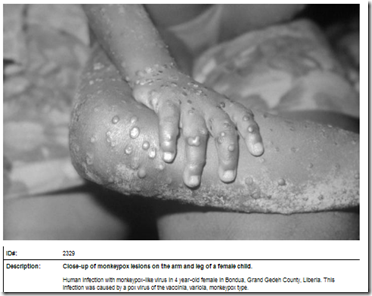
Monkeypox – Credit  CDC PHIL


#  8769


There are reports this weekend of a possible outbreak of monkeypox in the Democratic Republic of the Congo  (see ProMed Mail report).  Reportedly 12 people have been infected, and two have died. While monkeypox is suspected, we won’t have a definitive answer until laboratory test results are released.


Human monkeypox was first identified in 1970 in the DRC, and since then has sparked mostly small, spoardic outbreaks in the Congo Basin and Western Africa.


But in 1996-97, a major outbreak occurred in the Democratic Republic of Congo (see Eurosurveillance Report), where more than 500 cases in the Katako-Kombe and Lodja zones were identified.  Mortality rates were lower for this outbreak (1.5%) than earlier ones, but this was the biggest, and longest duration outbreak on record.


The name `monkeypox’  is a bit of a misnomer. It was first detected (in 1958) in laboratory monkeys, but further research has revealed its host to be rodents or possibly squirrels.  Humans can contract it in the wild from an animal bite or direct contact with the infected animal’s blood, body fluids, or lesions.


Consumption of undercooked bushmeat is also suspected as infection risk, but human-to-human transmission is also possible.  This from the CDC’s Factsheet on Monkeypox:


The disease also can be spread from person to person, but it is much less infectious than smallpox. The virus is thought to be transmitted by large respiratory droplets during direct and prolonged face-to-face contact. In addition, monkeypox can be spread by direct contact with body fluids of an infected person or with virus-contaminated objects, such as bedding or clothing.


While we talk often about the risks of infected individuals boarding planes and flying anywhere in the world (see The Global Reach Of Infectious Disease), human carriers aren’t the only concern. 


A little over a decade ago – at roughly the same time as the global SARS outbreak was winding down – the United States experienced an unprecedented outbreak of Monkeypox  - when an animal distributor imported hundreds of small animals from Ghana, which in turn infected prairie dogs that were subsequently sold to the public (see 2003 MMWR  Multistate Outbreak of Monkeypox --- Illinois, Indiana, and Wisconsin, 2003).


By the time this outbreak was quashed, the U.S. saw 37 confirmed, 12 probable, and 22 suspected human cases.  Among the confirmed cases 5 were categorized as being severely ill, while 9 were hospitalized for > 48 hrs; although no patients died (cite). 


The CDC describes the signs and symptoms of monkeypox as being ` similar to those of smallpox, but usually milder. . .  In Africa, monkeypox is fatal in as many as 10% of people who get the disease; the case fatality ratio for smallpox was about 30% before the disease was eradicated.’


As it turns out, there are at least two strains of the monkeypox virus (see Virulence differences between monkeypox virus isolates from West Africa and the Congo basin), with the West African variety being less virulent, and less transmissible, than the Central African strain. 


And in 2003, we got lucky. The imported strain was the West African variety, which no doubt lessened its impact.


The trade in exotic pets (whether legal or illegal), and in (often illegal) `bush meat’, provides an easy avenue for the cross-border introduction of zoonotic diseases around the globe.  Monkeypox is just one of many possible pathogenic passengers.


And despite heightened airport security around the world, more contraband gets through than most people think.


While these are stories of successful interdiction, we shouldn’t be too comforted, as they appear to represent a small percentage of the illicit trade. Three years ago British papers were filled with reports of `bushmeat’ being sold in the UK. A couple of links to articles include:


Meat from chimpanzees 'is on sale in Britain' in lucrative black market

Chimp meat discovered on menu in Midlands restaurants

The slaughtering of these intelligent primates for food (but mostly profit) is horrific its own right, but it also has the very real potential of introducing zoonotic pathogens to humans. 


While most people think of bushmeat hunting as something that a few indigenous tribes in Africa might do to feed their protein-starved communities, the reality is that hundreds of tons of bushmeat are butchered and exported (usually smuggled) to Europe, Asia, and North America every year.


In the summer of 2010 headlines were made when a study – published in the journal Conservation Letters looked at the amount of smuggled bushmeat (414 lbs) that was seized coming into Paris's Charles de Gaulle airport over a 17 day period on flights from west and central Africa.


Researchers estimated that about five tons of bushmeat gets into Paris each week (cite AP article). 


Experts were not able to identify all of the bushmeat seized, but among the species they could ID, they found monkeys, large rats, crocodiles, small antelopes and pangolins (anteaters). Sobering when you consider the current outbreak of Ebola in Western Africa likely began with the killing, butchering, and consumption of infected bushmeat.


In 2005, the CDC’s EID Journal carried a perspective article on the dangers of bushmeat hunting by Nathan D. Wolfe, Peter Daszak, A. Marm Kilpatrick, and Donald S. Burke; Bushmeat Hunting, Deforestation, and Prediction of Zoonotic Disease


It describes how it may take multiple introductions of a zoonotic pathogen to man – over a period of years or decades – before it adapts well enough to human physiology to support human-to-human transmission.


It has been estimated that as much as three-quarters of human diseases originated in other animal species, and there are undoubtedly more out there, waiting for an opportunity to jump to a new host. Sadly, the role of `wild flavor’ cuisine in SARS epidemic in China and the introduction of HIV to humans via the hunting of bushmeat in Africa, are lessons we have yet to fully embrace.


On the frontlines attempting to interdict the next emerging pathogen is the above mentioned Dr. Nathan Wolfe, whom I’ve written about several times before, including:


Nathan Wolfe And The Doomsday Strain
Nathan Wolfe: Virus Hunter


You can watch a fascinating TED Talk by Dr. Wolfe HERE on preventing the `next pandemic’.

Tuesday, April 22, 2014

Taiwan Announces 3rd Imported Case Of H7N9

image


# 8512


Even though the number of H7N9 cases being reported on the Chinese mainland has decreased markedly over the past month, we continue to see exported cases turning up in places like Hong Kong, Malaysia, and today - for the third time – Taiwan.


This report from Focus Taiwan.


Taiwan confirms 3rd imported H7N9 case (update)

2014/04/22 23:17:38

Taipei, April 22 (CNA) The Centers for Disease Control confirmed Tuesday the third imported case of H7N9 avian flu since April last year.


The patient, a 44-year-old woman from China's Jiangsu Province, entered Taiwan April 17 as part of a tour group. She is currently in serious condition in a hospital intensive care unit.


The woman had a dry cough and muscle soreness when she arrived in Taiwan and went to a clinic in New Taipei for treatment that day.


On April 18, she developed nausea and fever and sought treatment at a hospital the following day, where an X-ray showed that she had pneumonia and pleural effusion.


On April 20, she was taken to a medical center accompanied by her tour group leader and was given tamiflu. The medical center then notified the CDC of a suspected H7N9 avian flu case.

(continue . . .)


Although the number of H7N9 cases has declined, since the first of April FluTrackers has recorded 16 cases on their H7N9 Case Line List,  three of which were exported from the Chinese mainland (2 to Hong Kong, 1 to Taiwan).


  • #414 - Man, 67 [Yim] from Zongyang, April 8 confirmed case in Tongling a hospital for treatment Anhui province
  • #415 - Woman, 82, with underlying medical conditions, lives in Liwan, Guangzhou, withblood-stained sputum since April 7, no fever; confirmed in Hong Kong on April 9; exposure history to poultry under investigation. Hospitalized in HK, stable. Guangdong province
  • #416 - Woman, 81, [Hemou] Guangzhou City native, living in Liwan District of Guangzhou City. Confirmed on April 8, currently in critical condition in a Guangzhou hospital. Guangdong province
  • #417 - Man, 37, [Liu], Shantou City native, living Jinping District. Confirmed on April 9, currently in critical condition, in a Shantou city hospital. Guangdong province
  • #418 - Woman, 71, Heyuan City native, residing in Heyuan City. Confirmed on April 9, currently in critical condition, in a Heyuan City hospital. Guangdong province
  • #419 - Man, 79, [Luomou], Guangzhou native, residing in Haizhu District of Guangzhou, w/underlying conditions. Confirmed on April 10, currently in critical condition in a Guangzhou hospital. Guangdong province Death
  • #420 - Woman, 85, Hong Kong PRC SAR, developed fever, cough with blood-stained sputum and shortness of breath since April 11, earlier traveled to Dongguan from April 4 to 5, confirmed on Apr 13. Currently hospitalized in critical condition. Guangdong province
  • #421 - Man, 52, from Chongqing, unemployed. Seek treatment on April 10 at a clinic, hospitalized on April 13 in Changzhou after exacerbations. Confirmed on April 13. Currently in serious condition. Jiangsu province
  • #422 - Man, 30, [Wang], Hengyang Hengyang County, currently in a hospital for treatment [Nanhua University]. Hunan province
  • #423 - Man, 60, [Wu] hospitalized in serious condition, exposure to poultry Jiangsu province
  • #424 - Man, 70, [Zhang] Tongling City, April 16 confirmed cases of human infection of H7N9 avian influenza, April 14 died. Anhui province Death
  • #425 - Man, 34, [Pu]. Confirmed on April 17, currently in a Wuxi hospital in critical condition. Jiangsu province
  • #426 - Woman, 35, [Lumou]. Confirmed on April 19, currently in a Wuxi City hospital in critical condition. Jiangsu province
  • #427 - Woman, 55, [Wang], Shantou City. Confirmed on April 19, currently in critical condition in a Shantou city hospital. Guangdong province
  • #428 - Man, 50, [Tang Moumou], Yongzhou Lanshan, currently in a Yongzhou hospital for treatment. Hunan province
  • #429 - Woman, 44, resident in Nanjing, Jiangsu Province, China, Onset on April 17, hospitalized on April 19 in Taipei, confirmed on April 22. Currently in critical condition in a Taipei hospital. Jiangsu province

Saturday, March 08, 2014

NYC Health Department Investigating Measles Outbreak

image 

Photo Credit CDC


# 8359


Measles are back in the news again this week (see Thursday’s ECDC: Risk Assessment On Measles Outbreak Aboard Cruise Ship), with a CDC travel Notice issued for an outbreak in the Philippines, and reports of cluster of cases in New York City.


Our first stop, a press release from the New York City Department of Health:


Health Department Investigating Measles Outbreak in Northern Manhattan and the Bronx

Department urges all New Yorkers to make sure they are vaccinated against measles

infants should be vaccinated at 12 months of age 

March 7, 2014 – The Health Department announced today that it has identified 16 cases of measles in northern Manhattan and the Bronx. Seven adult cases and 9 pediatric cases have been identified to date. New Yorkers are urged to make sure all household members, including young children, are vaccinated. To date, there have been four hospitalizations as a result of this outbreak.

Measles is a highly contagious viral infection characterized by a generalized rash and high fever, accompanied by cough, red eyes, and runny nose, lasting five to six days. The illness typically begins with a rash on the face and then moves down the body, and may include the palms of the hands and soles of the feet.  People who contract the measles virus can spread the infection for four days before developing a rash, and for four days after the rash sets in. Measles can spread easily through the air to unprotected individuals. If you suspect you have measles, call and explain your symptoms to your doctor or medical provider BEFORE leaving to avoid exposing others to the measles virus.

The Health Department is working with New York City hospitals to prevent additional exposure to the virus in emergency departments. The Health Department is also asking pediatric-care facilities in Manhattan and the Bronx to identify and vaccinate children who have not received the MMR vaccine and to give the second dose of MMR vaccine to children at the next medical visit. Adults who are unsure of their vaccination history can be revaccinated or obtain a blood test to see if they are immune. Several adults who are included in this outbreak thought they had been vaccinated in the past, but lacked documentation.

As many as one in three people with measles develop complications. These complications from measles can be very serious and include pneumonia, miscarriage, brain inflammation, hospitalization and even death. Infants under one year of age, people who have a weakened immune system and non-immune pregnant women are at highest risk of severe illness and complications.

(Continue . . . )


Maggie Fox with NBC News has more on this story:


New York City Investigates Measles Outbreak

By Maggie Fox

New York City health officials said Friday they are investigating an outbreak of measles that’s made at least 16 people sick.

It might be part of a bigger national outbreak linked to the Philippines.

Health officials are quick to declare concern when they see someone with measles, which is one of the most contagious human diseases. Although it was once seen as a normal childhood infection, it’s easily prevented with a vaccine. And it should be, because fully a third of patients develop complications from the virus, including pneumonia, miscarriage and brain inflammation that can put patients into the hospital or even kill them.

(Continue . . .)


The outbreak in the Philippines, mentioned in Maggie’s article, is the subject of the following travel notice from the CDC.

image

  • Updated Measles in the Philippines Updated March 06, 2014 According to the Department of Health of the Philippines, 1,163 cases of measles and a number of measles deaths were reported in the country from January 1 through January 11, 2014. CDC recommends that travelers to the Philippines protect themselves by making sure they are properly vaccinated against measles. Clinicians should keep measles in mind when treating patients with fever and rash, especially if the patient has recently traveled internationally. Read More >>
  •  

    The measles vaccine – which was introduced in the United States in the mid-1960s - quickly reduced the incidence of the disease by more than 90%.  In the decades that followed, improved vaccination protocols were established and implemented, and in the year 2000 the United States achieved its long sought goal of  `measles elimination’.


    `Elimination’ refers to a local or regional victory over a disease, while `eradication’   indicates global success.


    Thus far, only two infectious diseases – smallpox and rinderpest – have been considered successfully eradicated, although considerable progress has been made on many others (ie. polio, yaws, Dracunculiasis).


    While the number of measles cases in the United States had dropped from nearly a million each year in the 1950s - to roughly 60 each year in the first decade of the 21st century – the virus continued to flourish elsewhere in the world, providing the opportunity for the virus to `reseed’ itself in the US.


    image


    In 2010, we began to see an uptick in the number of `imported’ measles cases.  This from the  MMWR report  Measles — United States, 2011

    During 2011, a total of 222 measles cases (incidence rate: 0.7 per 1 million population) and 17 measles outbreaks (defined as three or more cases linked in time or place) were reported to CDC, compared with a median of 60 (range: 37–140) cases and four (range: 2–10) outbreaks reported annually during 2001–2010.

    This report updates an earlier report on measles in the United States during the first 5 months of 2011 (2). Of the 222 cases, 112 (50%) were associated with 17 outbreaks, and 200 (90%) were associated with importations from other countries, including 52 (26%) cases in U.S. residents returning from abroad and 20 (10%) cases in foreign visitors. Other cases associated with importations included 67 (34%) linked epidemiologically to importations, 39 (20%) with virologic evidence suggesting recent importation, and 22 (11%) linked to cases with virologic evidence of recent importation.

    Most patients (86%) were unvaccinated or had unknown vaccination status. The increased numbers of outbreaks and measles importations into the United States underscore the ongoing risk for measles among unvaccinated persons and the importance of vaccination against measles (3).


    Imported diseases such as measles, polio, dengue, malaria (and many others) remain an ongoing threat – even in places where they have been officially `eliminated’.  Likewise, emerging diseases, like Chikungunya, H5N1, or MERS-CoV can easily expand to new geographic regions due to enhanced global travel and trade.

    image

    Photo Credit- CDC


    As both the CDC and the World Health Organization reminded us last month (see The Global Reach Of Infectious Disease), pathogens are excellent international travelers. A few recent blogs on other `imported’ disease threats includes:


    Chikungunya Update & CDC Webinar Online
    CDC Statement On 1st H5N1 Case In North America
    Pathogens At the Gate

    Wednesday, February 12, 2014

    Hong Kong Reports Fifth Imported H7N9 Case

    image


    # 8291


    On the heels of the announcement earlier today out of Malaysia (see Malaysia Reports Their 1st Imported H7N9 Case) Hong Kong’s CHP is reporting their 5th imported case of H7N9, in a 65-year-old recently arrived from Guangdong Province.


    Imported human case of avian influenza A(H7N9) in Hong Kong under CHP investigation

    The Centre for Health Protection (CHP) of the Department of Health (DH) is today (February 12) investigating an imported human case of avian influenza A(H7N9) in Hong Kong affecting a man aged 65.


    The patient, with underlying medical conditions, lives in Sha Tin. He has developed fever and cough since February 8 and consulted a private medical practitioner on February 9. He was admitted to Kwong Wah Hospital (KWH) yesterday (February 11) for persistent illness and was then transferred to isolation ward for further management. He is now in critical condition.


    His nasopharyngeal aspirate was positive for avian influenza A(H7N9) virus upon laboratory testing by the CHP's Public Health Laboratory Services Branch.

    Preliminary epidemiological investigations by the CHP revealed that, the patient had travelled to Kaiping, Guangdong from January 24 to February 9 and had stayed in his local residence. Information so far indicated that his family had bought a slaughtered chicken from a village in Kaiping on January 29.


    The patient's seven family members in Hong Kong have remained asymptomatic and five of them (classified as close contacts) will be admitted to Princess Margaret Hospital for observation and testing.


    Further investigations into his travel and exposure histories are ongoing, in parallel with tracing of other contacts of the patient, including the doctor and patients of the private clinic which the patient attended, patients who stayed in the same room with the patient in KWH, and relevant visitors and healthcare workers of KWH, who will be put under medical surveillance.


    The CHP will liaise with relevant Mainland health authority to follow-up the patient's contacts during his stay in the Mainland.


    "The Serious Response Level under the Government's Preparedness Plan for Influenza Pandemic remains activated and the CHP's follow-up actions are in full swing," a spokesman for the DH remarked.


    This is the fifth confirmed human case of avian influenza A(H7N9) in Hong Kong. The CHP will notify the World Health Organization (WHO), the National Health and Family Planning Commission as well as health and quarantine authorities of Guangdong and Macao.

    (Continue . . .)

    I’ll have details on additional cases already being reported today from Zhejiang, Hunan, and Guangdong provinces later in the morning. The best way to keep track of all of these cases is via FluTrackers (absolutely indispensible) H7N9 Case Line Listing, which I refer to constantly.


    Despite the steady stream of cases, and the occasional small clusters reported, thus far we’ve not seen any evidence of sustained and efficient transmission of this virus in the community. 

    Monday, January 27, 2014

    Hong Kong : Imported Chickens Suspected Of H7N9 Infection

    Photo: ©FAO/Tariq Tinazay

    Credit FAO

    # 8226


    The debate over H7N9 testing of Mainland chickens being brought into Hong Kong has been a bit of diplomatic hot potato these past few weeks (see Hong Kong: No Deal On Poultry Import Restrictions From Areas With Human H7N9 Cases & H7N9: Roundup of Reports From Hong Kong & Shenzhen), with serum testing (for antibodies) finally begun just last week (see HK Standard report Imported poultry up for serum test in hunt for H7N9).


    The concern being that live birds, imported primarily from Guangdong Province, could bring the virus into Hong Kong’s Markets, and potentially spread to humans.


    Today Hong Kong’s Government has issued a very brief statement, indicating that a preliminary PCR test has indicated the presence of H7N9 in a batch of chickens imported from Foshan, in Guangdong Province.  A region that has recently reported several human H7N9 infections.


    Live poultry imported from Mainland suspected to have H7 virus


    A spokesman for the Food and Health Bureau confirmed today (January 27) that the preliminary result of H7 Polymerase Chain Reaction (PCR) test on a batch of live chicken imported from a registered poultry farm in Shunde District of Foshan City of Guangdong Province was suspected to be H7 positive. The Agriculture, Fisheries and Conservation Department is conducting further tests and the results will be available later today.

    Ends/Monday, January 27, 2014
    Issued at HKT 19:03


    Should these tests be confirmed, it will likely reignite the debate on the importation of live poultry into Hong Kong from places where the virus is known to be circulating.

    Wednesday, January 08, 2014

    H5N1 In Canada: A Matter Of Import

    image

    Scheduled airline traffic around the world, circa June 2009 – Credit Wikipedia


    # 8142


    On a day when Hong Kong has also reported an imported case of bird flu (see HK CHP Statement On Third (likely) Imported H7N9 Case) from China, the news media is scrambling to cover the announcement of a fatal imported case of H5N1 in Canada ((see Alberta Canada Reports Fatal (Imported) H5N1 Infection).


    While obviously a concern to public health authorities, the  two most surprising things about this story are that 1) it’s H5N1 avian flu, not the currently more prevalent H7N9s strain and 2) it hadn’t already happened years ago.


    As our ability to travel quickly from one continent to the next improves, so does the ability of pathogens to easily cross oceans and borders.  Each year we see hundreds of exotic infections imported into North America or Europe from around the world, and with each importation, their is a low, but non-zero risk of the virus spreading.


    None of this is to suggest that today’s report of the importation of H5N1 into Canada heralds a serious bird flu outbreak in North America (the odds are, it won’t). But it does illustrate how easily a virus can wing its way from some far flung area of the world and show up without warning in New York, or London,  Sydney . . . or Alberta, Canada.


    In 2003, we saw the SARS virus hop the Pacific on a flight taken by a 78-year-old woman who had stayed at Hong Kong’s Metropole Hotel, where a doctor who had been treating atypical pneumonia cases inadvertently spread the virus to at least a dozen guests.  Two days after returning from Hong Kong the woman fell ill in Toronto, and before that outbreak was contained, 251 people in Canada had been infected, and 44 died (see SARS And Remembrance).


    Dengue fever, not seen in my state for 60 years, returned to South Florida in 2009, likely carried by an international traveler (see (see MMWR: Dengue Fever In Key West). Similarly, the West Nile Virus arrived in New York in the late 1990s, and since then quickly spread across the continent (see  CDC West Nile Update) and now infects thousands of people each year.


    Last month, the Caribbean saw their first outbreak of the Chikungunya virus (see CDC Update On Chikungunya In The Caribbean), which up until 2005 was only seen in parts of Africa.  Now it spans much of the Indian Ocean, and arrived – almost certainly via an international traveler – to the island of Saint Martin this fall.


    Over the years we’ve looked at a number of studies that have modeled the potential epidemic spread of a novel virus via air travel, including:


    Science: The Hidden Geometry of Complex, Network-Driven Contagion Phenomena
    MIT: Contagion Dynamics Of International Air Travel
    Fluing The Friendly Skies (Revisited)


    The world’s airlines carry 2.6 billion passengers each year, on more than 17 million flights.  And as the map at the top of this post indicates, millions of them are international flights.


    With most viral diseases having an incubation period of several days or longer, someone who is newly infected with a virus easily could change planes and continents several times before showing their first signs of illness.


    Which is why, last year, the CDC  and Canada’s PHAC issued guidance to  health departments on the testing and isolation of both H7N9 and MERS coronavirus cases (see PHAC: Interim Guidelines For Surveillance Of MERS-COV & H7N9 In Canada), simply because of the real potential of someday seeing imported cases.


    And along with these studies, we’ve also looked at research that has found little benefit to airport screening of passengers for possible infection, as the success rate of such screening (including thermal scanners) is relatively poor.


    Branswell: Limitations Of Airport Disease Screening

    Pathogens At the Gate

    Japan: Quarantine At Ports Ineffective Against Pandemic Flu


    While attempts will be made to intercept and quarantine potentially contagious travelers during any type of novel flu outbreak, no one should comfort themselves with thoughts that a new, highly contagious flu could be kept out of any country for very long.


    The bottom line is that we ignore global healthcare and infectious disease outbreaks – even in the remotest areas of the world – at our own peril. Vast oceans and extended travel times no longer offer us protection, and there is no technological shield that we can erect that would keep an emerging pandemic virus out.


    The place to try to stop the next pandemic is not at the airport gate, but in the places around the world where they are likely to emerge.


    Which makes the funding and support of international public health initiatives like the World Health Organization, animal health initiatives like the FAO and OIE , and disease surveillance grows more important with every passing year.


    No matter where on this globe you happen to live.

    Media Reports: Hong Kong Isolates Suspected Imported H7N9 Case

    image

    Photo credit Hong Kong’s CHP


    # 8140


    Although we are awaiting an official statement on Hong Kong’s CHP website, as I mentioned in my earlier blog, multiple media sources in Hong Kong are reporting that a 66 year-old man, who recently arrived from Shenzhen, has been hospitalized in critical condition at Queen Mary Hospital, and has tested positive for the H7N9 virus.


    Details are sparse at this time, and hopefully we’ll get more details later in the day (it is late evening in Hong Kong right now).  Some samples of the media reports, starting with RTHK News.


    HK confirms third case of H7N9

    08-01-2014

    Doctors have diagnosed Hong Kong's third case of H7N9 bird flu.

    A 66-year-old man is being treated in intensive care at Queen Mary Hospital.

    It's thought he could have caught the virus in Shenzhen, but the Centre for Health Protection say he hasn't been in contact with poultry recently.

    Last month, an 80-year-old Shenzhen resident became the first person infected with the virus to die in Hong Kong.

    A domestic helper, who was the territory's first case, is also thought to have caught the virus across the border.


    And this report from Sina.com.hk 


    Hong Kong confirmed an H7N9 case

    01 - 08 20:45


    [News] Hong Kong now confirmed a suspected imported from confirmed cases of H7N9 avian influenza.

    Infected a 66-year-old man was in critical condition, he was isolated in the intensive care unit of Queen Mary Hospital. Laboratory results, confirmed he was infected with H7N9 avian influenza.

    Patients with chronic diseases, in brief before admission to Shenzhen, passing a sale of live poultry markets, the authorities are tracing the source of infection.

    now.com News - Breaking News


    If confirmed, this would be the third imported H7N9 case into Hong Kong in less than a month.  I’ll update this story when we get an official statement from Hong Kong’s Centre for Health Protection.

    Friday, November 08, 2013

    Hong Kong: No Deal On Poultry Import Restrictions From Areas With Human H7N9 Cases

    Photo: ©FAO/Tariq Tinazay

    Credit FAO


    # 7950


    One of the things that sets the H7N9 virus apart from H5N1 is that it doesn’t cause illness or death in poultry – making it an LPAI (Low Pathogenic Avian Influenza) in birds – and very difficult to detect.  In people, however, it can produce severe, even life threatening symptoms.


    While the assumption is that people are being infected from contact with infected poultry, in actual fact, we don’t have a lot of direct evidence of that.


    Roughly 140 human cases identified (and many more are estimated to have occurred see Lancet: Clinical Severity Of Human H7N9 Infection), yet very few birds have tested positive for the virus. Still, the closing of live-bird markets appears to have quickly stifled the spread of the virus last spring – giving considerable weight to the `contact with poultry’ transmission argument.


    Understandably, Hong Kong – which imports a great deal of poultry from Mainland China – would like to put a halt to chicken imports from regions where human cases of  H7N9 have recently been reported, believing that poultry there are likely the source of the infection.


    Poultry producers argue that until their birds test positive for the virus, no such restrictions are warranted.


    Details over this, as yet, unresolved debate come from the Hong Kong Standard. 


    No flu deal on live chicken, Ko admits


    Eddie Luk


    Friday, November 08, 2013

    Hong Kong and mainland health experts have yet to agree over whether Chinese poultry farms should stop exporting chickens to the SAR once a human case of H7N9 avian flu is found, the health chief said.


    The admission came after the territory's health experts voiced concern that Dongguan poultry farms are still supplying live chickens to the SAR after a three-year-old boy there was diagnosed with the potentially deadly bird flu.


    Ko Wing-man said the consensus between Hong Kong and mainland experts on imposing a ban on poultry imports was limited to situations in which H7N9 was found in poultry.

    (Continue . . . )


    When asked if Hong Kong could unilaterally block poultry imports from regions with recent human H7N9 cases, Dr. Ko Wing-man stated, `The  live poultry import chain is not run solely by the Hong Kong side. We are in close cooperation with the mainland."


    Hong Kong will reportedly send inspection teams to inspect poultry near Dongguon, where Guongdong Provinces’ latest H7N9 case was identified (see WHO Update On Two Recent H7N9 Cases). But for now, Hong Kong’s much vaunted H7N9 surveillance and prevention program must live with a potential hole in their defenses.


    In other H7N9-related news, the Hong Kong government did announce some general progress coming out of a 2-day meeting between Guangdong, Macau, and Hong Kong Health officials on the control of infectious diseases. 


    Consensus reached at Tripartite Meeting on Communicable Diseases 

    8 November 2013

    Guangdong, Macau and Hong Kong's health authorities have agreed to further strengthen mutual communication and co-operation in combating communicable diseases. The consensus was reached at the 13th Tripartite Meeting on the Prevention and Control of Communicable Diseases held in Hong Kong yesterday and today (November 7 and 8).

    During the two-day meeting, public health and medical experts of the three places reviewed their collaboration in the prevention and control of communicable diseases and the notification system. The participants had in-depth discussions and experience-sharing on the overall situation of communicable diseases in the three places, human infection by avian influenza A(H7N9), prevention and control of dengue fever and Japanese encephalitis, the latest situation of various major infectious diseases and emergency response to communicable diseases

    After thorough discussions, the meeting reached the following consensus:

    • to continue stepping up communication and co-operation in the preparedness and response to human infection by avian influenza A(H7N9) to minimise the public health risk in the three places.
    • to foster co-operation in scientific researches on infectious diseases, including human infection by avian influenza A(H7N9) and mosquito-borne infections.
    • to continue implementing thoroughly the agreement of co-operation in public health emergencies in the three places.
    • to continue refining the notification system.
    • to continue co-operation on exchanges and training of health care professionals in disease surveillance, outbreak investigations, field epidemiology, contingency management, laboratory testing, infection control and clinical management.


    Members agreed that the Health Bureau of Macau SAR would organise the 14th Tripartite Meeting on the Prevention and Control of Communicable Diseases.


    Participating at the meeting were the Deputy Director General of the Health and Family Planning Commission of Guangdong Province, Mr Chen Zhusheng; the Deputy Director of the Health Bureau of Macau SAR, Dr Cheang Seng Ip; the Director of Health of Hong Kong SAR, Dr Constance Chan and about 60 experts in communicable diseases from the three places.

    Ends/Friday, November 8, 2013