Showing posts with label Italy. Show all posts

Wednesday, May 13, 2015

WHO Statement On 1st Imported Ebola Case In Italy

image

Location of Sardinia


# 10,046


Yesterday it was reported that nurse who had been working in Sierra Leone up until a week ago had fallen ill Sunday on the island of Sardinia, and had subsequently been diagnosed with Ebola.  Today the World Health Organization has issued the following statement on this patient’s itinerary, and onset of symptoms.


Ebola virus disease – Italy

Disease outbreak news
13 May 2015

On 12 May 2015, WHO received notification of a laboratory-confirmed case of Ebola virus disease (EVD) in Italy. This is the first EVD case to be detected on Italian soil.

Details of the patient are as follows

The patient is a healthcare worker who has returned from volunteering at an Ebola treatment centre in Sierra Leone. The patient flew from Freetown to Rome via Casablanca, Morocco on 7May. The arrival of the case had been communicated to the Ministry of Health, according to the health surveillance procedures in force since October 2014 for individuals coming back from Ebola affected countries in West Africa. At the arrival in Rome, the case displayed no symptoms of infectious Ebola.

On 10 May, 72 hours after his return to Italy, the patient developed symptoms. The patient self-isolated at home and was transported on 11 May to the infectious diseases ward of the Hospital of Sassari, Sardinia. Clinical samples have been tested by the national reference centre of the National Institute for Infectious Diseases (INMI) Lazzaro Spallanzani of Rome on 12 May, confirming EVD infection.

The patient was transferred from the Hospital of Sassari to the INMI of Rome with the specially equipped aircraft of the Italian Air Force, to assure high-containment precautions.

Since the onset of symptoms occurred 72 hours after the last flight, contact tracing of the passengers of the flights is not considered necessary.

Healthcare workers of the Hospital in Sassari, who examined the patient, were well equipped with personal protective equipment and are now under surveillance, as well as the close contacts of the case.

Future WHO updates on EVD in Italy will not be posted on the Disease Outbreak News. Further information will be available in WHO’s Ebola Situation Reports which provide regular updates on the WHO response:

Monday, March 30, 2015

OIE/FAO Notifications Of Bird Flu In Italy & Romania

image

A busy avian flu season for Europe (prior to Mar. 13th)  – Credit Defra


# 9884


On Friday, in Media Reports: Bird Flu Detected In Romania & Italy, we looked at two  reported bird flu outbreaks in Europe. The Romanian outbreak – reportedly H5N1 – came on the heels of a similar announcement earlier last week from neighboring Bulgaria.


The outbreak in Italy wasn’t immediately identified, but it follows earlier outbreaks of LPAI H7, LPAI H5, and HPAI H5N8 viruses.


Today we’ve confirmation of both of these outbreaks, and of their subtypes, from separate reports issued by the OIE and the FAO.


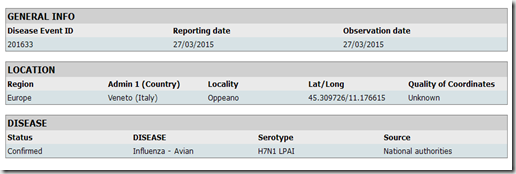
First stop, Italy – where low path (LPAI) H7N1 has been identified on a farm in the Veneto region in the following FAO report.


image


Of greater concern is an outbreak of HPAI H5N1 in waterfowl around the Danube Delta, as described in the following OIE Report, which describes 64 dead pelicans. 


image

image


Source of the outbreak(s) or origin of infection

  • Unknown or inconclusive

Epidemiological comments


On 25 March, the County Sanitary Veterinary and Food Safety Directorate (CSVFSD) of Tulcea was notified by the Danube Delta Biosphere Reserve Administration (ARBDD) about the identification of 64 carcasses of pelicans in an inhabited area, on Ceaplace island, Sinoe lake. This area is located at the border of Tulcea and Constanta Counties, and no other localities with domestic birds are found on a radius more than 10 km. The entire population of pelicans counted initially more than 250 birds, adults and young. Excluding the dead pelicans (found in different stages of putrefaction), no other birds were observed with clinical signs in the area. Also, in the area were observed other birds species, still unspecified.


After several years of relative quiescence on the bird flu front (at least, outside of China), we are suddenly seeing a remarkable surge in activity, involving several different strains.  


H5N1 is not only on the move in migratory birds – showing up in Eastern Europe, and Nigeria after five years absence – it is also raging in poultry in Egypt, and is spilling over into humans this winter at a record rate (see FAO: Egypt’s H5N1 Case Count Continues To Climb).


Meanwhile, the recently emerged H5N8 virus has not only spread across much of Eastern Asia, and into both Europe and North America, it has spawned a number of `local’ reassortant viruses. `New’ versions of H5N2, H5N3, and H5N1 have appeared in Taiwan, and in North America, and already they have had major impacts on the poultry industry in both regions. 


And while far less worrisome for now, we’ve also seen an unusual number of low path (LPAI) outbreaks (H5s & H7s) in poultry from Italy, to the UK, to Kansas.   


In many ways, the winter of 2014-15 has seen more bird flu activity – over a greater geographic range – than we’ve seen since the great bird flu expansion of 2006, when H5N1 escaped the confines of Asia and barnstormed much of  Europe (see H5N8: A Case Of Deja Flu?).


All of which has brought, once again, the role of migratory and wild birds in the spread of these viruses back to the forefront.  


While there are still a lot of missing pieces to this puzzle – and outbreaks often appear linked to or exacerbated by the movement of poultry products (legal and illicit), equipment, or personnel – this resurgence in bird flu has brought wild and migratory birds under new scrutiny.  


A few recent blogs on the topic include:


Erasmus Study On Role Of Migratory Birds In Spread Of Avian Flu
FAO On The Potential Threat Of HPAI Spread Via Migratory Birds
The North Atlantic Flyway Revisited

Friday, March 27, 2015

Media Reports: Bird Flu Detected In Romania & Italy

image


# 9875


Yesterday’s bird flu report from Bulgaria, very near the Romanian border (see OIE: H5N1 Kills 21 Pelicans In Bulgaria) has been quickly followed by multiple media reports that dead pelicans found this week in Romania have now tested positive for the H5N1 virus as well.


If confirmed by the OIE, this would be the first appearance of H5N1 in Romania since 2010.

Bird flu in Romania. Authorities found infected pelicans in the Danube

BURCHAREST  Romanian authorities have found in the Danube Delta for more than six decades of dead pelicans and laboratory tests six bodies have confirmed the presence of avian influenza virus H5N1. Informed on Friday by Agerpres, citing the report of the State Veterinary Office.

According to information from this office was 64 dead pelicans already discovered on Wednesday 25 March. Six bodies were handed over to the following day tests at the Central Veterinary Laboratory for the control of food safety and confirmed the occurrence of the virus H5N1 in all samples.

According to experts, is now in the Danube Delta are also other kinds of birds, but apart from pelicans was found dead bodies of any of them.

Any dead birds are the Dalmatian Pelican (Pelecanus crispus). It is a migratory birds in this annual time migrate from Africa to the Danube Delta.

Romanian authorities announced that in connection with the occurrence of bird flu in the Danube Delta tightened veterinary supervision of bird populations. Introduced three kilometers around the outbreak protection zone and a ten-kilometer control zone.

(Continue . . . )

A second report indicates these birds were discovered in Tulcea County, Romania.

image

Credit Wikipedia.


March 27, 2015 3:14 p.m.

Alert avian influenza in the Danube Delta. The virus was found in corpses of pelicans

Veterinary authorities in Tulcea County are on alert after Ceaplace island in the Danube Delta has been confirmed avian influenza virus. The disease was detected in several pelicans, found dead. The case came to the attention of Tulcea, after the island Ceaplace was notified that there are more dead pelicans. Inspectors have taken six corpses DSVSA Tulcea pelicans that have undergone testing. Following laboratory tests found the presence of avian influenza virus. These samples were sent for confirmation to the National Institute for Animal Health Diagnostic, which is the National Reference Laboratory for avian influenza. Integral on adevarul.ro


Meanwhile, a somewhat less informative media report out of Oppeano, Italy stating that `bird flu’ has broken out at a farm in the Veneto region, but without specifying the subtype of influenza.  Italy has reported H5N8, H5N1, and H7 subtypes previously, so we’ll probably  have to wait for an FAO or OIE notification to learn the cause of this outbreak.

image 

Credit Wikipedia


Outbreak of bird flu discovered in farm

It is a farm with an adjoining farm. Recommended immediate control measures with slaughter of all susceptible animals

OPPEANO - Discovered in a herd, also home to a farm , to Oppeano, an outbreak of avian influenza .
The Section veterinary and food safety of the region Veneto , with a note sent to the mayor of the town in the province of Verona and the veterinary service of ' Ulss 21 Legnago, has recommended the adoption of immediate measures to control, with slaughter of all susceptible animals and the destruction of carcasses and materials.


The positive virological and serological virus was confirmed by the National Reference Centre for the ' AI Institute zooprofilattico delle Venezie. " The positive virological - is written in the note of the Region - testifies to the presence of avian influenza in the company and the finding of only one out of 20 seropositive taken may indicate a recent introduction of virus ', which more so requires immediate action to prevent the disease from spreading.


A second report reads:


Outbreak of bird flu discovered on a farm

Alerting Oppeano in Veronese. The Health Authority of Legnago ordered the immediate slaughter of all the heads

OPPEANO .A outbreak of bird flu was discovered in a herd, also home to a farm, to Oppeano, in the province of Verona. Section veterinary and food safety of the region Veneto, with a note sent to the mayor of Oppeano and Veterinary Service Ulss 21 Legnago (Verona) recommended the adoption of immediate measures to control, with slaughter of all susceptible animals and the destruction of carcasses and materials. The National Reference Centre for Avian Influenza Institute of zooprofilattico venezie confirmed virological and serological positivity to the virus.


These past few months have seen a remarkable spread of HPAI H5 viruses around the world, arguably the most impressive geographic expansion of bird flu since the great H5N1 diaspora of 2006 (see H5N8: A Case Of Deja Flu?). 


Europe, Asia, Africa, and North America have all see either the return, or in some cases – the very first arrival – of these highly pathogenic viruses, and the losses to the poultry industry have been substantial. 


With the exception of Egypt’s record-setting H5N1 outbreak and occasional human cases in China, the impact on human health this winter been negligible.  Some of these viruses (H5N8 and H5N2) have no record of infecting humans, but as they are related to far less benign strains, they are viewed with understandable caution.


As these viruses spread through wild and migratory birds, and among commercial poultry, they have the potential to come in contact with other influenza viruses, and possibly reassort into new hybrids.  A process that could yield new subtypes with unpredictable results.

Sunday, November 30, 2014

Italy: AIFA Investigating Deaths Among Flu Vaccine Recipients

image


# 9389


Flu vaccines have a long and enviable history of safety, and while side effects have been reported, serious reactions are very rare.  But no vaccine, or any other drug or medicine for that matter, is 100% safe or benign. 


Complicating matters, drugs and vaccines are often used by the elderly or those with pre-existing medical problems, making it difficult to sort out the cause whenever an untoward medical event occurs. 


This weekend, in Italy, officials are trying to determine if two specific lots of Novartis flu vaccine played any role in the recent deaths of a number of (mostly) elderly vaccine recipients.  Right now, there is no proof that the vaccines are at fault, but the use of two lots of the vaccine has been temporarily suspended.  


First, a status report from the Italian Pharmaceutical Agency (AIFA), followed by statements by Novartis, and by the European Medicines Agency.


Fluad vaccine. The AIFA takes stock of the situation

Twelve reports of deaths after vaccination received to date. 8000 people die each year from the consequences of influenza

29/11/2014

The AIFA informs that after the ban on the use of lots 143 301 and 142 701 vaccine Fluad after reporting three deaths occurred between 7 and 18 November, yesterday were included eight other reports (deaths occurring between 15 and 28 November ) of which the Agency has requested a detailed clinical report that so far has not yet been received for any of them.


In the day today has been registered in the National Network of
Pharmacovigilance (RNF) a new death occurred on November 24, and yesterday received a 'e-mails on a death that has yet to be verified. The total number of cases reported through the RNF is therefore 12. A first analysis of these signals allows to draw the following conclusions exclusively preliminary:

  • In 8 cases (67%) seen in people aged ≥ 80 years.
  • 7 cases are female and 5 male gender.
  • In eight cases death occurred in the first 24 hours.
  • In eight cases death occurred from cardiovascular causes.
  • The reports concern 6 Regions: Sicily (2); Molise (1); Puglia (2); Tuscany (2); Emilia Romagna (2); Lombardy (2); Lazio (1).
  • The lots involved have passed from 2 to 6 for a total of 1,357,399 doses.
  • The signals are received by the RNF with a time range from immediate (same day of death) to 13 days later.
  • If all of the doses of these 6 lots had been administered, the percentage of deaths would rise from 0,001% (1.2 each 100.00) at 0.0009% (0.9 each 100.00) with a dilution of 25% of the signal.
  • If it had been given even half the number of deaths would be hundreds of times less than expected in the same non-vaccinated population (about 8,000 deaths per year for flu complications).

The AIFA confirms the correlation time for suspected cardiovascular events in the first 24 hours after administration in patients suffering from over eighty polypathology and polypharmacy. The Fluad however expressly indicated in this population

(Continue . . .)


This from Novartis:


Safety and efficacy of Fluad vaccinations in Italy

November 28, 2014 18:00 CET

Regarding the precautionary suspension of two batches of Fluad® in Italy, Novartis underlines that no causal relationship to the vaccine has been established to date.

Fluad is approved for vaccination of elderly patients (65+) and often prescribed to patients who suffer from pre-existing underlying medical conditions and have a weaker immune system. Serious medical events and deaths are unfortunately quite common in this patient population and hence a coincidental timely association with vaccination is not unusual.

The two suspended batches comprising of 500,000 doses were distributed solely in Italy after having passed all required safety and quality testing, including review by regulatory authorities before release to market.

Worldwide, more than 7 million doses of Fluad have been distributed. No unusual frequency of adverse events has been reported through the extensive pharmacovigilance system.

Fluad is an important vaccine to protect the elderly from influenza. They are at high risk of serious complications from influenza infections. In Europe alone, the death toll is estimated at 40,000 each year. Fluad was licensed in 1997 and has a solid safety history. The vaccine has been tested in clinical trials with 70,000 patients and more than 65 million doses have been distributed to date.


And this from the EMA.


Investigation into reports of serious adverse events following use of Fluad

EU regulatory authorities following up on suspension of two batches of flu vaccine in Italy

The European Medicines Agency (EMA) is working with the Italian medicines agency (AIFA) and other EU medicines regulatory authorities to investigate the cause of serious adverse events, including deaths, in a small number of elderly patients who had received Fluad flu vaccine. There is so far no evidence to suggest a causal link between the vaccine and the reported adverse events. The suspension is a precautionary measure.

AIFA has suspended the use of two batches of the flu vaccine produced by Novartis. Testing of the batches is underway, as well as a detailed analysis of the case reports from Italy. This includes examining all available information on the affected patients’ age, health condition and medication regime.

The issue will be discussed by EMA’s Pharmacovigilance Risk Assessment Committee (PRAC), a scientific body that brings together Europe’s best experts on the safety of medicines, at their meeting starting on Monday, 1 December 2014.

Member States across the European Union continue with their annual flu vaccination campaigns as influenza can cause severe illness or death especially in the elderly and in people with long-term conditions. The World Health Organisation (WHO) estimates that annual influenza epidemics result in about 3 to 5 million cases of severe illness worldwide, and about 250,000 to 500,000 deaths. Influenza vaccines are the most effective way to prevent the disease and/or the serious complications it can cause.

Fluad is authorised in the EU in a number of EU Member States. For the current vaccination campaign, 4 million doses of Fluad have been distributed in Italy. In the EU, the vaccine has also been distributed for the 2014-15 flu vaccination campaign in Austria, Germany and Spain.

Monday, September 02, 2013

Italy: MOH Reports Human H7N7 Infection

image 

Modified OIE map showing location of Outbreak


UPDATED:  Although we’ve no confirmation from the Italian MOH website, media sources are now reporting on a second suspected case, whose lab results are expected tomorrow.  


This from La Republica.


Avian influenza, a positive operator Emilia, I suspect the latter case

The National Institute of Health has reported one case in a person occupationally exposed to sick birds belonging to the establishment of the company Mordano Eurovo. He is now in his home on antibiotics. And at this time came the news of another probable human infection

<SNIP>


This second employee works on the farm of Valentonia and have experienced symptoms of conjunctivitis. The analysis of the specialized laboratory of St. Ursula will arrive in the evening and in the case, tomorrow will be asked to confirm the institute of Health. To explain is Alba Carola Finarelli, responsible for infectious diseases of public health service in the region Emilia-Romagna.

(Continue . . . )


# 7627


On August 15th Italy notified the OIE of an outbreak of highly pathogenic H7 avian influenza in poultry, in and around the municipality of Ostellato, in the Italian region of Emilia-Romagna. 


According to an overview printed on Friday by The Poultry Site, more than 850,000 commercially raised birds have been affected in these first few weeks.


H7 avian influenzas (with the exception of China’s recently emerged H7N9) have mostly been viewed as a threat to poultry, as it is only rarely reported in humans and usually produces mild symptoms. 


This afternoon (h/t Ironorehopper on FluTrackers) we learn that the Italian Ministry of Health has announced a rare human infection. The entire release may be read at this link, but I’ve reproduced the pertinent part below (machine translated).


The National Institute of Health had recorded a positive for the H7N7 avian influenza virus in a person suffering from conjunctivitis and occupationally exposed to sick birds belonging to the farms in the region of Emilia Romagna, in which it was found to have such viral infection. The H7N7 virus is not easily transmitted to humans, which can become infected only if it is to be situated in direct contact with a sick or dead animal.


Unlike other avian viruses (such as H7N9 or H5N1), H7N7 tends to give the man a mild disease (such as conjunctivitis), as already observed in a human outbreak occurred years ago in the Netherlands. Being rare transmission from person to person, the human outbreaks tend to self-restraint, so the risk of community is extremely low or even negligible.


The Emilia Romagna Region, in cooperation with the Ministry of Health, having readily identified outbreaks animals, has taken all the necessary procedures to bring the infection under control.


Ten years ago, a large cluster (n=89) of human H7 infection associated with poultry exposure was recorded in the Netherlands. Out of these cases, one person died, while the remainder saw relatively mild symptoms.


Details were reported in the December 2005 issue of the Eurosurveillance Journal Human-to-human transmission of avian influenza A/H7N7, The Netherlands, 2003.


More recently, in Mexico we saw two mild human cases last summer (see see MMWR: Mild H7N3 Infections In Two Poultry Workers - Jalisco, Mexico).  The World Health Organization published this Summary and assessment as of 10 September 2012.

Sporadic human cases of influenza A(H7N3) virus infection linked with outbreaks in poultry have been reported previously in Canada, Italy and the UK, with H7N2 in US and the UK, and with H7N7 in the UK and the Netherlands. Most H7 infections in humans have been mild with the exception of one fatal case in the Netherlands, in a veterinarian who had close contact


Of course, the emergence of a highly pathogenic (in people) H7N9 virus in China last spring has researchers giving H7 viruses a bit more respect than they have commanded in the past.


Still . . . it is likely that - as we’ve seen with human H7 infections in Mexico, the UK, Canada and the Netherlands in years past - that this H7N7 virus poses little public health risk.


But H7 flu strains - like all influenza viruses - are constantly mutating and evolving. What is mild, or relatively benign today, may not always remain so.


They are deserving of our attention, and our respect.


For more on the history of H7 viruses, you may wish to revisit A Brief History Of H7 Avian Flu Infections.

Friday, June 14, 2013

MERS-CoV: Italy Ends Monitoring Of Contacts – No New Cases


image


# 7397


Italy’s first imported case of MERS-CoV resulted in two additional infections (see Italy: MOH Confirms Two More MERS Cases), but after a two-week observation period, none of their several dozen contacts have shown signs of illness.


Today, Italy’s MOH sounded the all clear with this (machine translated) announcement on their website.


New coronavirus, no other case at the end of the monitoring period.

Coronavirus

With the conclusion of the incubation period known for the novel coronavirus responsible for the Mers occur without additional cases can be considered closed the small "clusters" for a total of 3 cases occurred in Tuscany from a case of importation.


The extremely limited number of "secondary cases" confirms one hand, the information on the low diffusivity of the virus and the other the proper functioning of the health system and the timely implementation of all necessary measures to contain the disease.


The Ministry, with their joint border, and the regions continue to pay close attention to the evolution of the international framework in line with the guidelines provided by WHO.

Friday, June 07, 2013

Italy: MERS `Index’ Case Released From Hospital


image

Distribution of MERS-CoV Cases – Credit VDU MERS-CoV


# 7371


The last of Italy’s confirmed MERS cases – a 46 year old man with recent travel to Jordan – was released from the hospital last night after his tests no longer showed positive for the virus.


The unnamed patient was hospitalized on May 28th - and in stark contrast to many of the other cases we’ve seen - his condition has always been described as `good’.


Two others - a 2 year-old relative, and a co-worker - were also hospitalized for several days after developing mild symptoms, and testing positive for the virus.


This from La Nazione.


The new Sars, contagions in Flzorence was discharged the first case report

Florence, June 7, 2013 -

(EXCERPT)

At this point, all three patients (man, woman and child) who were hospitalized in Florence for the Mers (Middle East Respiratory Syndrome) are well and at home. Continuous health monitoring of people who are come into contact with the three, and to date no 'was recorded no new cases.


The mysteries surrounding this emerging coronavirus continue to deepen, particularly in light of the unusually mild course of illness in these three patients. While we’ve seen a few scattered `mild’ cases over the past year, the vast majority of those diagnosed have displayed serious, even fatal illness.


Again from Dr. Ian Mackay’s MERS-CoV website.


image


Unknown at this time is to what degree a person’s pre-existing medical conditions (or age, or even gender) may influence the course, and outcome, of infection.


Again, from Ian’s website:

image

Most MERS-CoV cases are in males (includes surviving and fatal cases) but the bias towards males among the fatal cases is extreme. This is likely linked to the high proportion of underlying medical conditions among males who died and were positive for the virus. It may also be due to some other factor that puts males at greater risk of exposure to the suspected animal host(s) of MERS-CoV.


Mild cases also raise concerns that there could be more undiagnosed cases out there not being picked up by surveillance, and that we are only seeing the proverbial `sickest of the sick’.


While contact testing has failed to show a high rate of human transmission, we probably won’t know how widespread this virus really is until seroprevalence studies can be conducted.

Wednesday, June 05, 2013

Referral: MacKay On Italy’s MERS-CoV Testing Issues

image

Credit Wikipedia


# 7364


Although the dust has settled in the Italian press in the 24 hours since the ISS announced that a second round of testing had found `8 contacts’ of their MERS case negative – there remain a great many questions about how these patients initially tested positive, and their actual status.


Italy’s Ministry of Health website has remained silent on MERS since their June 3rd statement on the first three cases.  The `big’ health news on the site today apparently involves an MOH report on e-cigarettes. 


A visit to Italy’s National Institute for Health (ISS) – which reportedly conducted the second round of testing – fails to turn up anything as well.


Which leaves us with the mystery of how the first round of tests came out positive. 


Dr. Ian MacKay - associate professor of clinical virology at the University of Queensland – who runs the terrific Virology Down Under website, has some thoughts on how this testing might have gone astray.


I’ve only included an excerpt.  Follow the link to read all of Ian’s comments over the past few days.


MERS asymptomatic cases: NOT CONFIRMED

In other words, the reference lab could not confirm the testing described by Professor Alessandro Bartoloni of the Azienda Ospedaliera Universitaria Careggi yesterday.


This from Drs Giovanni Rezza and Isabella Donatelli of the Department of Infectious Diseases, Istituto Superiore di Sanita (ISS; National Institute of Health), Rome via ProMED.


Not a very inspiring performance.


We now await some information on what actually happened.

  1. Was the wrong test used (see comment yesterday about panCoV primers-picking up a known, endemic CoV like OC43, 229E, NL63 or HKU1) Did/does this lab have a contamination problem (false positives due to positive control contamination, carry-over contamination from previous PCR product or cross-reaction with something else)
  2. A long shot - is there another related but different virus or MERS-CoV genetic variant, that cross-reacted with Prof Batoloni's(?) MERS-specific PCR but not the ISS MERS-CoV assay.

     (Continue  reading . . . )


Given the difficulties in testing earlier MERS-CoV cases – particularly when dealing with throat swabs, and the extended incubation period (said to be 10 to 14 days) – it may be another week or so before anyone can say with absolute certainty that all of these contacts are out of the woods.


For now, the news looks promising, as the latest reports still have these (and roughly 50 other) contacts under surveillance, at home, and all asymptomatic. 


The latest press report I can find this morning is dated June 5th from il Firenze.


New Sars: No new cases. There remain 3 affected

Wed, 05/06/2013 - 01:02 - The Editors

No new case of SARS so far. Samples of eight people, which in Florence in a first screening were tested positive, according to tests carried out by the Istituto Superiore di Sanita 'are negative and therefore have contracted the virus. Remain thus three people with coronavirus - the first case, the forty-five Jordanian, her granddaughter and her co-worker - are all well and will be discharged as soon as their exams will fail.


The surveillance but 'remains and will continue' until the people - sixty - come into contact with them will not have exceeded 10 days of incubation, ie from the moment of their first 'close encounter' with the carriers of the virus.

(Continue . . .)

Tuesday, June 04, 2013

Italy: Media Now Report 8 Contacts Negative For MERS-CoV


image

Credit Wikipedia


# 7360


Earlier today (see Italy: Unconfirmed Media Reports On MERS Contact Testing ) I expressed reservations over multiple media reports that `10-12’ contacts of the MERS-CoV patient recently diagnosed in Italy had tested positive for the virus.


Fast forward about six hours, and now multiple media sources in Italy are reporting that a second round of tests on the `8 contacts’ have come back negative.


A couple of media links:


Sars, according to test negative for eight patients

Rezza: "There are no new cases." Lorenzin: "No scaremongering."

New Sars tests negative remain only three cases

Eight are not contaminated by the virus, it ensures the National Institute of Health. Sixty people who remain under control. The Minister Lorenzin: "Situation under control"


As with the earlier reports of positive tests, the Italian Ministry of Health website has offered no confirmation, denial, or update as of this posting.  All we have right now are another round of media reports.


As before, I’m waiting for something official to hang my hat on.

Italy: Unconfirmed Media Reports On MERS Contact Testing


# 7358


A story has been kicking around the Italian media since last evening regarding contacts of the traveler recently returned from Jordan hospitalized with the MERS coronavirus. The reports state that `10 to 12’ contacts have tested positive for the MERS-CoV, but all remain asymptomatic and are not hospitalized.


Crof wrote about it here,this FluTrackers thread has multiple media reports, and ProMed Mail put out an RFI in the middle of the night.


All of the media stories seem to stem from remarks offered by Professor Alessandro Bartoloni, head of infectious diseases at AOU Careggi. Importantly, most of the stories indicate that samples have been forwarded to a national lab for confirmation.


So far, I’ve been unable to get any corroboration from the World Health Organization or via the Italian Ministry of Health site, and the story doesn’t appear to have been picked up by Reuters or AP.


As you might imagine – if true – this story could represent a major change in how this virus (at least in this Italian cluster) is behaving.  


But before we go down that rabbit hole, we really need official corroboration, confirmatory re-testing (to rule out PCR contamination and/or false positives), and then we need to give these patients a few days to see if they all remain `mild’ or asymptomatic.


If there is anything to this story, we ought to hear more about it later today. 

Monday, June 03, 2013

Italy: MOH Statement On MERS-CoV Cases – June 3rd

image

Credit Wikipedia


#7356


Perhaps more reassuring than informative, an update this morning from the Italian Ministry of Health takes center stage on their MOH homepage. This statement also contains links to the following related websites:


New coronavirus (CoV-Mers), Minister Lorenzin: situation under control

coronarovirus

There are three confirmed cases in our country until today New coronavirus (Mers-Cov). The conditions of the sick are not serious.

'' At the moment the situation is under control - said yesterday the Minister of Health Beatrice Lorenzin - We had a case of importation, which has generated two secondary cases. Fortunately the conditions of the people involved are under control and also the child is improving. We're now watching - added the Minister - with the authorities of Tuscany, all the people who have had contact with the sick. We work in close collaboration with the National Institute of Health. As already announced with the ministerial notes doctors ensure that this virus is transmitted from person to person through close contact and prolonged only '.'


Given the variable incubation period (which may be as long as two weeks cite), it may be some time before the `all clear’ can be sounded on the contacts of these three cases.


For now, in contrast to most of the other cases we’ve seen, all three of these cases are reportedly only suffering `mild’ symptoms.


Again, we’ll have to wait to see whether their status changes.

Saturday, June 01, 2013

Italy: MOH Confirms Two More MERS Cases

image


# 7350


The Italian Ministry of Health this afternoon has released a statement indicating that they’ve identified two additional MERS coronavirus cases – both contacts of the 45-year old man recently returned from Jordan who was hospitalized on May 28th. 


They are a 2-year old child and a co-worker. Both are hospitalized in Florence, and reportedly doing well. The following is a machine translation from the MOH site.


PRESS RELEASE

NEW CORONAVIRUS, TWO NEW CASES CONFIRMED IN ITALY

· It is two people who have had close contact with the first case, and both are in good health.


· Ministry is closely monitoring the situation


The Region of Tuscany in the late afternoon announced today that the Ministry of Health two subjects already under medical surveillance because it entered into close contact with the first case of infection with Italian MERS CoV, have developed a clinical form of respiratory infection, which at the time presents a framework for both non-serious.


Laboratory investigations, carried out in collaboration between health authorities of Tuscany and the National Institute of Health, confirmed the diagnosis of infection with MERS CoV.


The two new cases refer to a child of about two years, part of the family of the first patient, and a co-worker of the same.


Both patients are hospitalized in isolation at health facilities in Florence.


The transmission of infection from diseased to people who have had prolonged close contact with them has already been documented, even in Europe, in the home and hospital.


The Ministry of Health is closely monitoring the situation in close contact with the health authorities of Tuscany.


Updating Italy’s MERS-CoV Case

image


# 7348


We’ve a few more details on yesterday’s report (see Italian MOH: Imported MERS-CoV Case in Italy) on that country’s first imported case of the novel coronavirus.


Today we learn from La Nazione that the 5 year-old grandson of the 45-year old Jordanian patient has been hospitalized as a precaution (he has a `cough’, but is otherwise said to be well), and that 43 other close contacts are under surveillance.


As this syntax-challenged machine translation reveals, the index patient is doing better, and test results on some of his relatives are expected as soon as tonight.


New SARS, the first case in Tuscany: the patient is better

Meyer admitted to his grandson as a precaution dle patient than 5 years: 43 people under surveillance

Florence, June 1, 2013 - It 'been hospitalized pediatric Meyer, but just as a precaution, the grandson of five years of patient Jordanian who lives in Florence affected by the new Sars. The child is not sick, he just a little 'cough, as he explained in a press conference this morning, Professor Alessandro Bartoloni, head of the department of infectious diseases where the man is being treated in isolation.


Under supervision over the child, it was explained, there are 43 people, including health professionals and relatives and co-workers who have been in contact with the forty-five. For all, it was stressed, there is no prophylaxis but just be careful if you presented in any of them a symptom of the virus. The results of the analysis on the patient's niece will be announced tonight.

(Continue . . .)


Another report this morning, this time from Giornalettismo describes the current situation:


Coronavirus: fear for the new Sars in Italy

by Dario Ferri - Experts explain how to protect themselves from infection

<EXCERPT>

THE CASE IN FLORENCE - There are about fifteen doctors and nurses, health care workers come into contact with the 45 year old, came under observation for the risk of contagion. The man presented himself at the hospital, in recent days, the onset of symptoms and was then promptly transferred to the department for control infectious diseases. Subsequently, he was placed in solitary confinement. The exams are still going on even on his brother, the only person who would remain in contact for a long time and in a range for a long time.

(continue . . . )


This marks the second time in 10 days that we’ve seen a traveler – recently returned from the Middle East – diagnosed with the MERS coronavirus (see KUNA Report On Tunisian Coronavirus Case). 


With Umrah pilgrimages expected to bring more than a million visitors to the Middle East over the next 60 days, and the upcoming Hajj in October, these two incidents are raising concerns that this virus may be exported to other countries around the world.


Today, Vietnam sent a dispatch to all hospitals in that country to be on the lookout for suspicious respiratory cases. 


We also learn from the following SGGP report that Vietnam has their own medical mystery to unravel; the Central Tropical Disease Hospital and Bach Mai Hospital in Hanoi have admitted several patients - gold diggers from the highland areas of Dak Lak Province – with serious lung ailments of, as yet, unknown etiology.


Vietnam warns of Corona Virus

Following a World Health Organization's warning of the Corona Virus, the Ministry of Health on May 31 sent a dispatch to all hospitals across the country asking to raise awareness of the new virus strain.

As per the dispatch, medical workers should be aware of respiratory diseases due to the virus by taking X-rays and tests to early detect the virus.

WHO has issued a blunt assessment of the Corona Virus outbreak, acknowledging for the first time that there are concerns the virus may be spreading from person to person, at least in a limited way.

(Continue . . .)


With the enhanced surveillance and viral vigilance around the world, I fully expect that we are going to see a lot of reports of people being isolated and tested over the next several months. 


Many (likely most) will be shown to have something far more mundane than this emerging coronavirus.


But along with determining just how widespread (and serious) the MERS coronavirus really is, this heightened surveillance may tell us a good deal more about the types of respiratory infections that are currently circulating around the globe.


And that could turn out to be a treasure trove of data for epidemiologists around the world.

Tuesday, May 29, 2012

5.8 Mag. Quake Rocks Northern Italy


# 6353


For the second time in 10 days, a strong temblor has rocked northern Italy, and early reports indicate at least ten people have died as a result. In the hours since the 5.8 quake struck, there have been several lesser aftershocks.


image


If you say `earthquake’ and `Europe’ in one sentence, most people would naturally assume you are talking about Italy, or perhaps Greece. Eastern and central Mediterranean regions after all, are well known for seismic activity.


But two of the strongest earthquakes to strike Europe over the past millennium occurred in Switzerland  and Portugal.


And as the following Seismic Hazard Map (produced by GSHAP – Global Seismic Hazard Assessment Program) shows, other areas of western, central and northern Europe are vulnerable as well.

image


Last year in A Look At Europe’s Seismic Risks, we took look at some of the devastating earthquakes to strike Europe over the past 700 years, including the quake that leveled the Swiss town of Basel in 1356 and the horrific earthquake and tsunami that struck Portugal in 1755 on November 1st (All Saint’s Day).


In December of last year, in WHO e-Atlas Of Natural Disaster Risks To Europe, we looked at some of the seismic risks to Europe. And in April of 2011 (see UNDP: Supercities At Seismic Risk) we saw a report that stated that half of the world’s supercities (urban areas with 2 million – 15 million inhabitants) are at high risk for seismic activity.


And more recently, in January of this year (see UN Agency Warns On Global Seismic Risks), the United Nations International Strategy For Disaster Reduction (UNIDSR.Org) issued a cautionary warning about ignoring seismic threats.

 
UNISDR warns against ignoring seismic threats as quakes wreak havoc for second year

302 human impact disasters claimed 29,782 lives; affected 206 million and inflicted record economic damages of $366 billion in 2011

Geneva, 18 January 2012 – For two consecutive years the long-term disasters trend has been bucked by major earthquakes which claimed thousands of lives and affected millions in both 2010 and 2011, according to new statistics published today by CRED and the UN office for disaster risk reduction, UNISDR.


UNISDR Chief, Margareta Wahlström, said today: “The Great East Japan Earthquake and the accompanying tsunami is a reminder to us all that we cannot afford to ignore the lessons of history no matter how forgotten. The many major cities located in seismic zones need to take seriously the probability of return events even if many years have passed since the last seismic event of major magnitude.

(Continue . . . )


While we can’t predict where the next earthquake will strike, or do anything to stop it, we can prepare to deal with one when it happens.


For good, solid information on how prepare for `the big one’ (even if you live someplace other than Los Angeles), I would recommend you download, read, and implement the advice provided by the The L. A. County Emergency Survival Guide.

image


While US-centric, FEMA  has an earthquake hazard webpage with a lot of resources that would be of use to just about anyone, including the following preparedness information.


Emergencies happen every day.  Disasters, admittedly, less often. But in either event, preparedness is key.


At a bare minimum, every household should have a disaster plan, a good first aid kit (and the knowledge to use it), and emergency supplies to last a minimum of 72 hours during a disaster.


Personally, I’d be uncomfortable with anything less than a week.


To become better prepared as an individual, family, business owner, or community to deal with these types of disasters: visit the following preparedness sites.

FEMA http://www.fema.gov/index.shtm

READY.GOV http://www.ready.gov/

AMERICAN RED CROSS http://www.redcross.org/