Showing posts with label Mainland China. Show all posts

Monday, March 09, 2015

Hong Kong CHP Notified Of 19 H7N9 Cases From Mainland China

image


# 9797


One of the frustrations with this year’s wave of H7N9 in China over the past two years has been the delays in reporting of cases by a number of Mainland provinces.  We’ve looked at this issue several times, including in Jiangsu Province’s Uncertain H7N9 Count, and as a result  the size and scope of this year’s outbreak is difficult to quantify.


Today Hong Kong’s CHP published their notification of 19 H7N9 cases, from 6 different provinces, going back more than six weeks.  Individual case details, however, are not included.


Although we have seen several of these `bulk’ announcements this winter, there are still several provinces that have reported cases in previous years, but that we’ve not heard from this year (including Henan, Jilin, and Hebei).


CHP notified of additional human cases of avian influenza A(H7N9) in Mainland

The Centre for Health Protection (CHP) of the Department of Health (DH) today (March 9) received notification of 19 additional human cases of avian influenza A(H7N9) with the onset dates in the past five weeks prior to February 25 from the National Health and Family Planning Commission, and again urged the public to maintain strict personal, food and environmental hygiene both locally and during travel.


The patients comprise 13 males and six females aged from 3 to 76. Three of them (one man and two women) died and two (one man and one woman) were in critical condition. Eleven cases are from Zhejiang, three are from Jiangsu, two are from Hunan, one is from Fujian, one is from Guizhou and one is from Jiangxi.


To date, 618 human cases of avian influenza A(H7N9) have been reported by the Mainland health authorities in Guangdong (181 cases), Zhejiang (167 cases), Jiangsu (73 cases), Fujian (59 cases), Shanghai (45 cases), Hunan (26 cases), Anhui (24 cases), Xinjiang (10 cases), Jiangxi (10 cases), Shandong (six cases), Beijing (five cases), Henan (four cases), Guangxi (three cases), Jilin (two cases), Guizhou (two cases) and Hebei (one case).

(Continue. . . .)

Saturday, February 28, 2015

Guangdong & Anhui Provinces Report H7N9 Cases

 image


# 9765


Unlike last winter, day-to-day reporting of H7N9 cases from much of Mainland China has been slow, although it isn’t entirely clear how much of this is due to an actual reduction in cases and how much is due to a change in the way some provinces are reporting. 


We’ve seen some case announcements turn up belatedly in Provincial EOM epidemiological reports.


Earlier this week the World Health Organization, in their most recent Antigenic and genetic characteristics of zoonotic influenza viruses and candidate vaccine viruses developed for potential use in human vaccines, described this year’s H7N9 activity and virus evolution as:


Influenza A(H7N9) activity from 24 September 2014 to 23 February 2015


During this period, 148 human cases of avian influenza A(H7N9) virus infection were reported to WHO, bringing the total number of cases to 602 with 227 deaths reported4. All human cases were detected in China, or in travelers who visited China (2 in Canada). Increased genetic heterogeneity of HA and NA gene sequences was observed among recent viruses from humans, poultry and environmental samples. Comparison of these viruses using haemagglutination inhibition (HI) assays showed that the majority remained antigenically similar to the CVVs derived from A/Anhui/1/2013-like viruses.


`Increased genetic heterogeneity of HA and NA gene sequences’  is evidence  that the H7N9 virus continues to evolve, something we’ve looked at previously in Eurosurveillance: Genetic Tuning Of Avian H7N9 During Interspecies Transmission &  EID Journal: H7N9 As A Work In Progress.


Two reports this morning courtesy of Hong Kong’s CHP.


HP notified of additional human case of avian influenza A(H7N9) in Guangdong


The Centre for Health Protection (CHP) of the Department of Health (DH) is today (February 27) closely monitoring an additional human case of avian influenza A(H7N9) in Guangdong notified by the Health and Family Planning Commission of Guangdong Province (GDHFPC), and again urged the public to maintain strict personal, food and environmental hygiene both locally and during travel.


According to the GDHFPC, a male patient aged 80 in Shantou was hospitalised for treatment in critical condition.

To date, 589 human cases of avian influenza A(H7N9) have been reported by the Mainland health authorities in Guangdong (176 cases), Zhejiang (156 cases), Jiangsu (70 cases), Fujian (58 cases), Shanghai (45 cases), Hunan (24 cases), Anhui (19 cases), Xinjiang (10 cases), Jiangxi (nine cases), Shandong (six cases), Beijing (five cases), Henan (four cases), Guangxi (three cases), Jilin (two cases), Guizhou (one case) and Hebei (one case).


After not having reported any H7N9 cases this winter, Anhui Province – which reported two cases on February 25th (see CHP closely monitors three additional human cases of avian influenza A(H7N9) in Mainland) – has apparently notified Hong Kong’s Centre for Health Protection of two more cases (1 from Anqing City and the other from Tongling).


HP closely monitors two additional human cases of avian influenza A(H7N9) in Mainland


The Centre for Health Protection (CHP) of the Department of Health (DH)is today (February 28) closely monitoring two additional human cases of avian influenza A(H7N9) in the Mainland, and again urged the public to maintain strict personal, food and environmental hygiene both locally and during travel.


According to the Health and Family Planning Commission of Anhui Province, a male patient and a female patient, both aged 58 with poultry exposure before onset, were hospitalised for management. They were in critical condition.


To date, 591 human cases of avian influenza A(H7N9) have been reported by the Mainland health authorities in Guangdong (176 cases), Zhejiang (156 cases), Jiangsu (70 cases), Fujian (58 cases), Shanghai (45 cases), Hunan (24 cases), Anhui (21 cases), Xinjiang (10 cases), Jiangxi (nine cases), Shandong (six cases), Beijing (five cases), Henan (four cases), Guangxi (three cases), Jilin (two cases), Guizhou (one case) and Hebei (one case).

Wednesday, February 25, 2015

HK CHP Notified Of 3 New H7N9 Cases In Guangdong, 2 In Anhui

image


# 9751


For reasons we can only speculate on - except for Guangdong Province – Mainland China has been very slow to report H7N9 cases this winter.  We’ve seen some batch announcements - often buried in end-of-month provincial statistical reports - but daily reporting has been rare.


Of the 16 provinces that have  reported cases during the first two waves, only about half of those have reported cases this winter.


While it is possible that H7N9 activity has diminished greatly across the region, when you figure in the irregular reporting, it does stretch credulity a bit. The point being that the numbers we are seeing posted by Hong Kong’s CHP may under-reflect the level of activity across the mainland during this third wave.


That said, we’ve two updates from the Centre For Health Protection, describing 5 new cases.


CHP closely monitors three additional human cases of avian influenza A(H7N9) in Mainland

The Centre for Health Protection (CHP) of the Department of Health (DH) is today (February 25) closely monitoring three additional human cases of avian influenza A(H7N9) in the Mainland, and again urged the public to maintain strict personal, food and environmental hygiene both locally and during travel.

According to the notification of the Health and Family Planning Commission (HFPC) of Guangdong Province, the male patient aged 59 in Zhaoqing was hospitalised for management in critical condition.

In addition, according to the HFPC of Anhui Province, the two male patients aged 48 and 75 with poultry exposure before onset were hospitalised for management. Both were in critical condition.

To date, 585 human cases of avian influenza A(H7N9) have been reported by the Mainland health authorities in Guangdong (172 cases), Zhejiang (156 cases), Jiangsu (70 cases), Fujian (58 cases), Shanghai (45 cases), Hunan (24 cases), Anhui (19 cases), Xinjiang (10 cases), Jiangxi (nine cases), Shandong (six cases), Beijing (five cases), Henan (four cases), Guangxi (three cases), Jilin (two cases), Guizhou (one case) and Hebei (one case).

(Continue . . . )

CHP notified of two additional human cases of avian influenza A(H7N9) in Guangdong

The Centre for Health Protection (CHP) of the Department of Health (DH) is today (February 25) closely monitoring two additional human cases of avian influenza A(H7N9) in Guangdong notified by the Health and Family Planning Commission of Guangdong Province (GDHFPC), and again urged the public to maintain strict personal, food and environmental hygiene both locally and during travel.


According to the GDHFPC, a male patient aged 3 in Heyuan and a female patient aged 18 in Foshan were hospitalised for treatment, and are in a stable and critical condition respectively.


To date, 587 human cases of avian influenza A(H7N9) have been reported by the Mainland health authorities in Guangdong (174 cases), Zhejiang (156 cases), Jiangsu (70 cases), Fujian (58 cases), Shanghai (45 cases), Hunan (24 cases), Anhui (19 cases), Xinjiang (10 cases), Jiangxi (nine cases), Shandong (six cases), Beijing (five cases), Henan (four cases), Guangxi (three cases), Jilin (two cases), Guizhou (one case) and Hebei (one case).

(Continue . . . )

Even the best surveillance and reporting will fail to detect cases, and those who end up tested and counted are almost always the sickest of the sick – the ones who are sickened enough to go to the hospital.   

Mild and moderate cases are very likely to go uncounted.

In Lancet: Clinical Severity Of Human H7N9 Infection we saw a study that proposed, after roughly 130 cases were confirmed in the spring of 2013, that:


Our estimate that between 1500 and 27 000 symptomatic infections with avian influenza A H7N9 virus might have occurred as of May 28, 2013, is much larger than the number of laboratory-confirmed cases.


How accurate these estimates are is unknown, but any official case count almost certainly under-represents the real burden of H7N9, perhaps by a sizable margin.

Wednesday, February 04, 2015

HK CHP Notified Of 49 Recent H7N9 Cases In Mainland China

image


# 9670


I’ve been grousing for more than a month that – other than Guangdong Province – the rest of mainland China appeared to be `holding back’ information on H7N9 cases. 


Well, today we get word from Hong Kong’s CHP that they’ve been notified of 49 recent cases spread across four provinces and the Xinjiang Uyghur Autonomous Region.


CHP notified of additional human cases of avian influenza A(H7N9) in Mainland

The Centre for Health Protection (CHP) of the Department of Health (DH) today (February 4) received notification of 49 additional human cases of avian influenza A(H7N9) in the past six weeks from the National Health and Family Planning Commission and Health and Family Planning Commission of Guangdong Province , and again urged the public to maintain strict personal, food and environmental hygiene both locally and during travel.


The patients comprise 38 men and 11 women aged from one to 88 and nine of them (eight men and one woman) died. 30 cases are from Fujian, 10 from Zhejiang, seven from Jiangsu, one from Guangdong and one from Xinjiang Uyghur Autonomous Region (Xinjiang).


To date, 555 human cases of avian influenza A(H7N9) have been reported by the Mainland health authorities, respectively in Zhejiang (156 cases), Guangdong (145 cases), Jiangsu (70 cases), Fujian (58 cases), Shanghai (44 cases), Hunan (24 cases), Anhui (17 cases), Xinjiang (10 cases), Jiangxi (nine cases), Shandong (six cases), Beijing (five cases), Henan (four cases), Guangxi (three cases), Jilin (two cases), Guizhou (one case) and Hebei (one case).

(Continue . . .)


Of note, over the first two epidemic waves, 16 provinces and regions have reported H7N9 cases, but over the past month we’ve only seen reports from a handful of them.

Wednesday, January 14, 2015

Hong Kong Notified Of Additional H7N9 Cases On Mainland

image 


# 9572


During the first two winter waves of H7N9, affected Chinese provinces posted reasonably detailed end-of-day updates on their provincial health department websites, and within 24 hours Hong Kong’s CHP would release a summary.  


While we certainly never believed these reports reflected the total burden of the epidemic, they were a pretty solid indicator of those cases sick enough to be hospitalized and tested.


This year the reporting is less organized, with some cases not announced until days or even weeks after the fact (see Jiangsu Province’s Uncertain H7N9 Count), while other times we only see reports appearing in the Chinese media.  Some provinces (like Guangdong) appear to be quicker to publicly announce cases than others. 


And in just about all case reports this winter we are seeing considerably less detail than in  previous years. All which makes keeping  track of this year’s cases much more difficult.


Our first stop this morning is Guangdong Province, which for the 3rd day in a row, reports 2 new H7N9 cases.


Dongguan report two cases of H7N9 cases

2015-01-14 16:01:16   Ministry of Health and Family Planning  | 

Health and Family Planning Commission of Guangdong Province January 14 briefing, Dongguan City, reported two cases of H7N9 confirmed cases.


Patient 1 Zhang, female, 52 years old, currently living in Dongguan Qiaotou, history of pulmonary tuberculosis. January 13 diagnosed cases of H7N9, the current patient in critical condition, in Dongguan City, admitted to inpatient hospitals.


Patient 2 Xu, male, 37 years old, now lives in Changping Town, Dongguan City, a history of hypertension. January 13 diagnosed cases of H7N9, sicker patients currently in Dongguan City, admitted to inpatient hospitals.


Our next stop is Hong Kong’s CHP which reports on the above two cases, along with 14 additional cases (most of which I’ve announced previously in this blog) from four other provinces, bringing CHP’s total to 478 cases.

HP notified of human cases of avian influenza A(H7N9) in Mainland

The Centre for Health Protection (CHP) of the Department of Health (DH) is today (January 14) closely monitoring 16 additional human cases of avian influenza A(H7N9) notified by the Mainland health authorities, and again urged the public to maintain strict personal, food and environmental hygiene both locally and during travel.


According to the Health and Family Planning Commission of Guangdong Province, the two cases from Dongguan include a female patient aged 52 and a male patient aged 37 who were hospitalised for treatment in critical and serious conditions respectively.


The remaining 14 cases (including three deaths) in Fujian (five cases), Jiangsu (four cases), Zhejiang (four cases) and Xinjiang Uyghur Autonomous Region (Xinjiang) (one case) were notified by the National Health and Family Planning Commission. The patients include seven men and seven women aged 20 to 83. Apart from the three deaths, the other 11 patients were in critical condition.

To date, 478 human cases of avian influenza A(H7N9) have been reported by the Mainland health authorities, respectively in Zhejiang (145 cases), Guangdong (121 cases), Jiangsu (63 cases), Shanghai (42 cases), Fujian (28 cases), Hunan (24 cases), Anhui (17 cases), Xinjiang (nine cases), Jiangxi (eight cases), Beijing (five cases), Shandong (five cases), Henan (four cases), Guangxi (three cases), Jilin (two cases), Guizhou (one case) and Hebei (one case).

(Continue . . .)


Based on the information provided (absent onset dates, ages and genders) it makes it all-but-impossible to maintain a reasonable line-listing (and difficult even, to match them up with earlier reports), but hopefully some of these data gaps will be filled in by the next World Health Organization update.


In the meantime, based on the limited data we have, it is safe to say this year’s H7N9 wave on the Chinese mainland appears to be well underway.

Wednesday, June 04, 2014

Jiangsu & Shandong Provinces Report 4 New H7N9 Cases

image

Credit Hong Kong Centre For Health Protection 


#8703


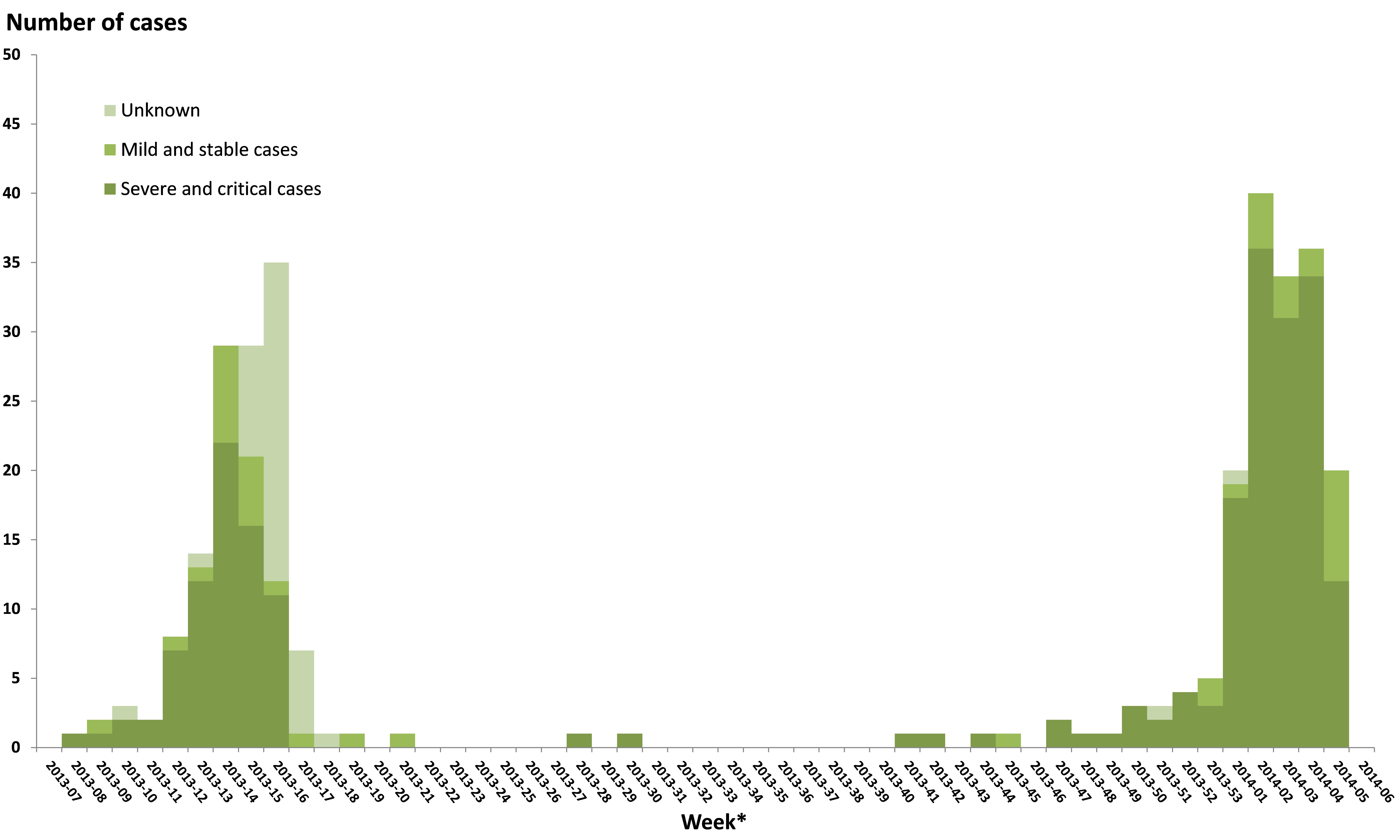
Having only emerged in the spring of 2013, H7N9 is only just barely in its second year of circulation, and so we only have one summer season under our belts when it comes to defining its behavior.  Last year, as the chart below illustrates, case reports in China all but disappeared after the first week of May, with only three cases reported between mid-May and late September.

image

Credit ECDC Epidemiological Report Feb 7th, 2014


The return of warm weather, and the closing of live-markets, was credited with this remarkable drop in cases.


This year, while the number of cases being reported remains fairly low (at least compared to the two large winter/spring outbreaks we’ve seen), we haven’t seen the sharp cutoff in cases yet.  We continue to see a few human infections – particularly from the more northern provinces (Anhui, Shandong, Jiangsu)  trickle in - despite the calendar now reading early June. 


Last week, in Shandong Province: Two Related H7N9 Cases, we saw reports of a father-son family cluster, with the father dying from the virus, while the WHO reported on 3 cases from Anhui province from earlier in the month.


Today Hong Kong’s CHP is reporting on 4 new cases from the Mainland; 2 from Shandong province, and 2 from Jiangsu.  Today’s update doesn’t provide us with much in the way of epidemiological information on these cases, other than one fatal case had poultry exposure.


CHP notified of four additional human cases of avian influenza A(H7N9) in Mainland

The Centre for Health Protection (CHP) of the Department of Health (DH) today (June 4) received notification of four additional human cases of avian influenza A(H7N9) in Jiangsu (two cases) and Shandong (two cases) from the National Health and Family Planning Commission.

The two patients in Jiangsu are a man and a woman, both aged 51, who are now hospitalised for treatment. The two cases in Shandong involve a man aged 61 who had poultry exposure and died and a man aged 33 who is hospitalised for management.

A total of 433 human cases of avian influenza A(H7N9) have been confirmed in the Mainland, including Zhejiang (138 cases), Guangdong (108 cases), Jiangsu (56 cases), Shanghai (41 cases), Hunan (23 cases), Fujian (22 cases), Anhui (17 cases), Jiangxi (eight cases), Shandong (five cases), Beijing (four cases), Henan (four cases), Guangxi (three cases), Jilin (two cases), Guizhou (one imported case from Zhejiang) and Hebei (one case).

"Locally, enhanced disease surveillance, port health measures and health education against avian influenza are ongoing. We will remain vigilant and maintain liaison with the World Health Organization (WHO) and relevant health authorities. Local surveillance activities will be modified upon the WHO's recommendations," a spokesman for the DH said.


"In view of human cases of avian influenza A(H7N9) confirmed locally and in the Mainland, further sporadic cases are expected in affected and possibly neighbouring areas. Those planning to travel outside Hong Kong should maintain good personal, environmental and food hygiene at all times," the spokesman urged.

"All boundary control points have implemented disease prevention and control measures. Thermal imaging systems are in place for body temperature checks of inbound travellers. Random temperature checks by handheld devices have also been arranged. Suspected cases will be immediately referred to public hospitals for follow-up investigation," the spokesman added.


Regarding health education for travellers, display of posters in departure and arrival halls, in-flight public announcements, environmental health inspection and provision of regular updates to the travel industry via meetings and correspondence are proceeding.


     The spokesman advised travellers, especially those returning from avian influenza-affected areas and provinces with fever or respiratory symptoms, to immediately wear masks, seek medical attention and reveal their travel history to doctors. Health-care professionals should pay special attention to patients who might have had contact with poultry, birds or their droppings in affected areas and provinces.

  • Members of the public should remain vigilant and take heed of the preventive advice against avian influenza below:
  • Do not visit live poultry markets and farms. Avoid contact with poultry, birds and their droppings;
  • If contact has been made, thoroughly wash hands with soap;
  • Avoid entering areas where poultry may be slaughtered and contact with surfaces which might be contaminated by droppings of poultry or other animals;
  • Poultry and eggs should be thoroughly cooked before eating;
  • Wash hands frequently with soap, especially before touching the mouth, nose or eyes, handling food or eating; after going to the toilet or touching public installations or equipment (including escalator handrails, elevator control panels and door knobs); or when hands are dirtied by respiratory secretions after coughing or sneezing;
  • Cover the nose and mouth while sneezing or coughing, hold the spit with a tissue and put it into a covered dustbin;
  • Avoid crowded places and contact with fever patients; and
  • Wear masks when respiratory symptoms develop or when taking care of fever patients.

The public may visit the CHP's avian influenza page (www.chp.gov.hk/en/view_content/24244.html) and website (www.chp.gov.hk/files/pdf/global_statistics_avian_influenza_e.pdf) for more information on avian influenza-affected areas and provinces.

Ends/Wednesday, June 4, 2014
Issued at HKT 12:12
NNNN


While it is always worrisome whenever a novel flu jumps to humans, the good news is that H7N9 remains primarily an avian-adapted virus. The vast majority of cases appear to have contracted the virus from direct exposure to infected poultry, and only a handful of cases are even suspected as due to human-to-human transmission. 


The concern, of course, is that these viruses are constantly changing (see EID Journal: H7N9 As A Work In Progress) and that what we say about their behavior today may not hold true tomorrow.

Tuesday, December 17, 2013

HK CHP Notified Of Fatal H10N8 Infection In Jiangxi

image

Jiangxi Province – Credit Wikipedia


# 8083


While we watch primarily for H7N9 and H5N1 avian influenza infections, over the years we’ve seen a handful of other avian strains infecting humans.   


In 2003, an outbreak of H7N7 at a poultry farm in the Netherlands went on to infect at least 89 people (mostly mildly, but 1 death), and many more may have been infected subclinically.

In Egypt - in 2004 -  2 infants were shown to be infected by the H10N7 avian flu virus.

In 2006 1 person in the UK was confirmed to have contracted H7N3, and the following year, 4 people tested positive for H7N2 – both following local outbreaks in poultry.

And in 2012, in EID Journal: Human Infection With H10N7 Avian Influenza, we learned of H10N7 avian influenza virus detected in two poultry abattoir workers in Australia from 2010. Although 7 abattoir workers reported symptoms, only 2 tested positive for the H10 virus.


We honestly don’t know how often these seldom seen influenza strains infect humans, as testing is rarely done.  With the heightened alert for H7N9 in China, however, more testing that normal is going on, which probably explains why Hong Kong’s CHP has been notified of another `oddball’ avian flu strain that infected, and killed, an immunocompromised patient in Jiangxi;  H10N8.


CHP notified by NHFPC of human fatal case of avian influenza A(H10N8) in Jiangxi

The Centre for Health Protection (CHP) of the Department of Health (DH) today (December 17) received notification from the National Health and Family Planning Commission (NHFPC) of a human fatal case of avian influenza A(H10N8) affecting a woman aged 73 in Jiangxi.

The immunocompromised patient with underlying illnesses was admitted to a local hospital on November 30 for treatment. Her clinical diagnosis was severe pneumonia and she passed away on December 6.

According to the relevant authority, the patient had visited a local live poultry market. Her home and close contacts, who are under medical surveillance, have remained asymptomatic and no abnormalities have been found so far.

"Influenza A(H10) is currently not a local statutorily notifiable infectious disease but the Public Health Laboratory Services Branch of the CHP is capable of detecting this virus by culture or genetic testing. No confirmed human cases have been recorded so far in Hong Kong," a spokesman for the CHP said.

The CHP will follow-up with the World Health Organization (WHO) and the Mainland health authorities to obtain more information on the case.

"Locally, enhanced disease surveillance, port health measures and health education against avian influenza have been proceeding. We will remain vigilant and maintain liaison with the WHO and relevant health authorities. Local surveillance activities will be modified upon the WHO's recommendations," the spokesman remarked.

All border control points have implemented disease prevention and control measures. Suspected cases of infectious disease will be immediately referred to public hospitals for follow-up investigation.

The spokesman urged travellers not to visit live poultry markets and avoid direct contact with poultry, birds and their droppings during travel. If contact has been made, they should thoroughly wash their hands with soap and water. If fever or respiratory symptoms develop, they should immediately wear facial masks, seek medical attention and reveal their travel history to doctors.

Members of the public should remain vigilant and are reminded to take heed of the following preventive advice against avian influenza:


* Poultry and eggs should be thoroughly cooked before eating;
* Wash hands frequently with soap, especially before touching the mouth, nose or eyes, handling food or eating; after going to the toilet or touching public installations or equipment such as escalator handrails, elevator control panels or door knobs; or when hands are dirtied by respiratory secretions after coughing or sneezing;
* Cover the nose and mouth while sneezing or coughing, and hold the spit with a tissue and put it into a covered dustbin;
* Avoid crowded places and contact with fever patients; and
* Wear a mask when respiratory symptoms develop or when taking care of fever patients.
     The public may visit the CHP's avian influenza page (
www.chp.gov.hk/en/view_content/24244.html) and its website (www.chp.gov.hk/files/pdf/global_statistics_avian_influenza_e.pdf) for more information on avian influenza-affected areas.

Ends/Tuesday, December 17, 2013
Issued at HKT 22:05