Showing posts with label Masks. Show all posts

Monday, May 05, 2014

Singapore To Distribute 1.2M N95 Preparedness `Starter Kits’

image


# 8569


Singapore (pop. 5.5 million) – which was heavily impacted by the SARS outbreak in 2003 (and to a far lesser extent, by Malaysia’s Nipah outbreak of 1999) – has understandably adopted a proactive stance when it comes to public health. Long considered The Crossroads of the Orient, Singapore is truly an international city, and therefore vulnerable to many imported disease threats.


Consequently Singapore has been very active in making pandemic preparations (see In The Wake Of SARS, Singapore Prepares), and in 2010 ordered 1 million doses of H5N1 vaccine for their national stockpile.


Last summer, when the threat of imported MERS from Umrah and Hajj travelers began to ramp up, we saw Singapore’s MOH Put Quarantine Chalets On Standby, and when infectious diseases threaten, Singapore’s airports are often quick to break out thermal scanners (see Travel-Associated H1N1 Influenza in Singapore).


The health threats to Singapore’s citizenry also extends to environmental hazards, as last summer record-setting smoke & haze from fires burning in Sumatra and Borneo sent air pollution levels into the hazardous range, prompting a run on N95 masks and shortages.


These combined threats – infectious disease and air pollution – have prompted Temasek Cares, the philanthropic unit of Temasek Holdings, to hand out 1.2 million N95 `starter packs’ – one to every household in the city.   While not a full supply, it is hoped that this will inspire citizens to become better prepared for any eventuality.


This report from News Channel Asia.


All households to receive free N95 masks from this week

SINGAPORE: All households in Singapore will receive free N95 masks in their mailboxes from May 6-12.

The masks will be distributed under a community programme by Temasek Cares, the philanthropic unit of Temasek Holdings, together with Singapore Power and SingPost.

It is hoped that some 1.2 million "Stay Prepared" starter kits -- each containing three 3M masks and useful numbers to call in case of an emergency -- will come in useful in the event of a flu pandemic or severe haze.

"We hope the kits will prompt individuals and families to develop their own emergency plans," said Temasek Cares chairman Richard Magnus.

(Continue . . .)


In March of this year, it was also announced that the government had 16 million N95 masks stockpiled in Singapore: report, primarily in response to last year’s severe air pollution event.


While we aren’t currently facing a pandemic threat, I certainly advocate that everyone’s emergency kit contain at least a few N95 respirators (or a box of surgical facemasks).  If you are caring for a family member at home – whether they have seasonal flu, or something more exotic – wearing PPEs can help reduce transmission within the household.


The problem with waiting for an emergency – like an epidemic– to be declared is that once that happens, supplies of masks and other PPEs will become scarce almost immediately.


Our Strategic National Stockpile contains more than 100 million  N95 and surgical masks (see Caught With Our Masks Down), but at one time the HHS estimated the nation would need 30 billion masks (27 billion surgical, 5 Billion N95) to deal with a major pandemic (see Time Magazine A New Pandemic Fear: A Shortage of Surgical Masks).


Like any other prep (water, food, first aid kit), they are only truly effective if you think of  them, and prepare them, before the need arises.


Last July, in The Great Mask Debate Revisited I wrote about the pros and cons regarding facemasks, and the various studies comparing the protective qualities of surgical masks vs. N95 masks.  


Neither type should be regarded as perfect protection against infection, and with regards to the more expensive N95s, it takes more than just having a box in your closet (see Survival Of The Fit-tested) to protect you.


The bottom line, is that you hope to avail yourself of the (admittedly, limited) protection afforded by facemasks during an emergency, your best bet is to buy any supplies well before you need them.

Saturday, April 26, 2014

MERS: Are Two Surgical Masks Better Than One?

image

Photo Credit PHIL (Public Health Image Library)


#8533


A question was posed to Dr. Ian Mackay on twitter overnight as to whether wearing a double layer of surgical masks would be `safer’ against MERS than just a standard single layer.  Ian expressed doubt that it would help very much but said he didn’t know, then hand-passed it to me (legal under Aussie rules) to see if I had any references on the subject.


Well, references I’ve got.   Definitive answers, on other hand, are in somewhat shorter supply. The quick answer (if you can call it one), is:  Maybe . . . a little.


The problem is that while surgical (or in some regions, cloth) masks are ubiquitous in healthcare settings, tend to show up in public places during epidemic outbreaks, and have been recommended for wear in crowds in Saudi Arabia during the Hajj  – they are primarily designed to prevent the wearer from spreading germs.


Not, as most people assume, to protect the wearer.


That is not to say there isn’t some protective benefit to wearing surgical masks.  There is, although the degree of protection is subject to considerable debate (see The Great Mask Debate Revisited). 


For HCWs dealing with MERS, the CDC strongly recommends wearing a fit-tested N95 mask, eye protection, gown & gloves (see Survival Of The Fit-tested).  And I heartily agree.


But as the question posed dealt with surgical masks (double or single layer), we’ll limit ourselves to the wearing of masks in a community settings or low resource medical settings


Since there is a great deal we do not yet know about how the MERS virus is being transmitted (particularly now, with large nosocomial outbreaks in Saudi Arabia & the UAE), we have to look back to the SARS coronavirus outbreak of 2003 for guidance. 


One study that is particularly on point  (albeit conducted in a healthcare setting),  was published in in the Journal of Hospital Infection in 2005.


Protecting healthcare staff from severe acute respiratory syndrome: filtration capacity of multiple surgical masks

J.L. Derrick*, C.D. Gomersall

Department of Anaesthesia and Intensive Care, The Chinese University of Hong Kong, Prince of Wales Hospital, Shatin, Hong Kong, China

Summary Guidelines issued by the Centers for Disease Control and Prevention and the World Health Organisation state that healthcare workers should wear N95 masks or higher-level protection during all contact with suspected severe acute respiratory syndrome (SARS). In areas where N95 masks are not available, multiple layers of surgical masks have been tried to prevent transmission of SARS. The in vivo filtration capacity of a single surgical mask is known to be poor. However, the filtration capacity of a combination of masks is unknown.


This was a crossover trial of one, two, three and five surgical masks in six volunteers to determine the in vivo filtration efficiency of wearing more than one surgical mask. We used a Portacount to measure the difference in ambient particle counts inside and outside the masks. The best combination of five surgical masks scored a fit factor of 13.7, which is well below the minimum level of 100 required for a half face respirator.


Multiple surgical masks filter ambient particles poorly. They should not be used as a substitute for N95 masks unless there is no alternative.


The results of this study found that two layered surgical masks provided nearly 40% more filtration than a single mask. Three layers boosted that to 70%, and five layers roughly doubled the filtration.


The author’s conclude by writing:


In conclusion, our data show that no combination of multiple surgical masks was able to meet the requirements for a respirator. If protection against airborne organisms is required, an N95 respirator or better should be used, as currently recommended by the CDC and WHO guidelines for SARS prevention.

Multiple surgical masks will reduce the number of viruses inhaled, but whether the degree of reduction is sufficient to produce significant protection is unknown and cannot be predicted at present. Multiple surgical masks should, therefore, only be used if N95 masks are not available.


So, the short answer is a double layer of surgical masks does appear to provide more filtration.  How much protection that affords in the real world, is another matter.


Cloth or other improvised masks are often used as an alternative to single-use surgical or N95 masks, particularly in resource poor nations, and again, the evidence of their effectiveness is lacking.   Last year,  the International Journal of Infection Control published:


Use of cloth masks in the practice of infection control – evidence and policy gaps

Abrar Ahmad Chughtai, Holly Seale, Chandini Raina MacIntyre

Abstract

Cloth masks are commonly used in low and middle income countries. It is generally believed that the primary purpose of cloth masks is to prevent spread of infections from the wearer. However, historical evidence shows that they had been used in the past for protection of health care workers (HCWs) from respiratory infections. Currently there is a lack of evidence on the efficacy of cloth masks. In this paper, we examined the evidence on the efficacy of cloth masks and discuss the use of cloth masks as a mode of protection from infections in HCWs. We also discuss various methods to improve the effectiveness of cloth masks; for example; type of fabric, masks design and face fit. Further research is required to validate the use of cloth masks in HCWs for prevention of respiratory infections.


In 2006, the IOM published a report entitled Reusability of Facemasks During an Influenza Pandemic: Facing the Flu, which cited the expected demand for respiratory protective gear during a pandemic for HCWs, and for the American public.


CDC estimates that in the event of a severe influenza pandemic, at least 1.5 billion medical masks would be needed by the healthcare sector and an additional 1.1 billion would be needed by the public. Demand for N95 respirators by the healthcare sector could exceed 90 million for a 42-day outbreak (CDC, 2006)


Given current stockpiles, and that most of the manufacturing of these items has now moved offshore, shortages during a severe pandemic are considered likely. A topic we looked just over a month ago in NIOSH: Options To Maximize The Supply of Respirators During A Pandemic.


The 2006 IOM report mentioned above addresses the issue of `improvised’ masks during a pandemic, and while not exactly endorsing them, accepts the will likely be necessary.


Regulatory standards require that a medical mask should not permit blood or other potentially infectious fluids to pass through to or reach the wearer’s skin, mouth, or other mucous membranes under normal conditions of use and for the duration of use. It is not clear that cloth masks or improvised masks (e.g., towels, sheets) can meet these standards.


Without better testing and more research, cloth masks or improvised masks can not be recommended as effective respiratory protective devices or as devices that would prevent exposure to splashes.


However, these masks and improvised devices may be the only option available for some individuals during a pandemic. Given the lack of data about the effectiveness of these devices in blocking influenza transmission, the committee hesitates to discourage their use but cautions that they are not likely to be as protective as medical masks or respirators. The committee is concerned that their use may give users a false sense of   protection that will encourage risk-taking and/or decrease attention to other hygiene measures.


Personally, this is why I have a small stockpile of N95 masks in my prep closet, and encourage others to acquire a small quantity while supplies are adequate and supplies chains remain uncompromised.  I also have a couple of small boxes of surgical masks for street or `casual wear’. 


If I were out of N95s, and found myself caring for someone who was infected with the MERS virus (or any other respiratory virus), I’d probably `double up’ with the surgical masks.


I just wouldn’t have a whole lot of faith that I was getting much in the way of protection.  


Not exactly ideal.  Still, I have to believe that wearing any mask has got to beat having no mask at all. 


Friday, October 04, 2013

Masks, MERS, and The Upcoming Hajj

image

Credit Wikipedia


# 7834


Although it has been mentioned previously (see last July’s KSA MOH Updates Health Protection Advice For Umrah & Hajj),  this week the Saudi Ministry of Health has reiterated their advice to pilgrims going to the Hajj this month to wear facemasks when in crowded areas.  While seemingly prudent advice - unless visitors are given some instruction on how to safely don and remove these protective devices, the need for constant good hand hygiene (before and after handling the masks), and how to properly dispose of a mask after use - its actual value may prove more psychological than physical.


Complicating matters will be the incessant heat (forecast today, 108F or 42C) - which will make wearing a mask for prolonged periods of time uncomfortable - the uncertain protective qualities of surgical masks (see The Great Mask Debate Revisited) against the MERS coronavirus, and the need for fit testing (see Survival Of The Fit-tested) for the more protective N95 respirator.


Additionally, facemasks don’t address another potential route of infection, via the eyes (see PPEs & Transocular Influenza Transmission).


Limitations that may at least  partially explain why the World Health Organization has not advised travelers to Saudi Arabia to wear masks (see WHO: Interim Travel Advice On MERS-CoV For KSA Pilgrimages), and is instead focusing on issues like good hand hygiene, and avoiding contact with farm animals, and seeking medical attention if they develop `a significant acute respiratory illness with fever and cough’.


First, this report from the Arab News, after which I’ll return with more:


MERS safety: Pilgrims must wear masks

mask.jpg

RIYADH: MD RASOOLDEEN

Published — Thursday 3 October 2013

The Ministry of Health advised Haj pilgrims on Wednesday to wear face masks in the holy cities to protect themselves from the deadly MERS virus.


Dr. Nazreen Sherbini, a specialist in infectious diseases and influenza, said MERS is transmitted through droplets from coughing and sneezing.


“Pilgrims should wear protective masks that cover the noses and mouths in crowded places and follow basic health etiquette while sneezing or coughing,” Sherbini said.


She advised pilgrims to avoid people who cough and sneeze incessantly, have runny noses, and temperature over 38 degrees Celsius.

(Continue . . . )


Although it is unlikely that many pilgrims en route to the Hajj will be reading this blog, it is important for everyone to know how to safely don and remove a facemask or respirator in the event of a serious respiratory outbreak.  So this morning, a handful of short tutorials on the wearing of facemasks and N95 respirators.

image image

Surgical Facemask N-95 Respirator 

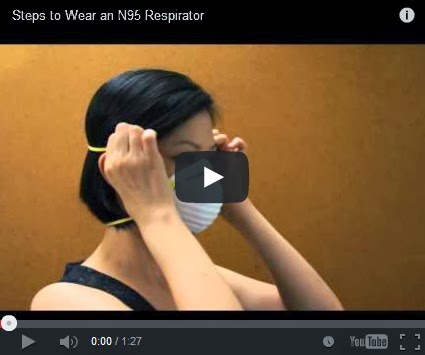
First, a short video on donning and removing an N95 respirator from Raffles Hospital in Singapore: 

NOTE: You should first be fit-tested to determine the proper N95 style that fits your face.


Next  from the CDC/NIOSH, a poster (suitable for framing) on using the N95 respirator (link):

image


From the San Francisco Department of Public Health, steps for putting on and removing surgical masks.

Note: Surgical masks have traditionally been used to prevent the wearer from spreading germs, and its effectiveness in protecting the wearer has been the subject of some debate.


How to Put on and Remove a Face Mask (Excerpts)


How to put on and remove a face mask

Disposable face masks should be used once and then thrown in the trash. You should also remove and replace masks when they become moist.

Always follow product instructions on use and storage of the mask, and procedures for how to put on and remove a mask.  If instructions for putting on and removing the mask are not available, then follow the steps below.

How to put on a face mask

1 Clean your hands with soap and water or hand sanitizer before touching the mask.

2 Remove a mask from the box and make sure there are no obvious tears or holes in either side of the mask.

3 Determine which side of the mask is the top. The side of the mask that has a stiff bendable edge is the top and is meant to mold to the shape of your nose.

4 Determine which side of the mask is the front. The colored side of the mask is usually the front and should face away from you, while the white side touches your face.

5 Follow the instructions below for the type of mask you are using.

  • Face Mask with Ear loops: Hold the mask by the ear loops. Place a loop around each ear.
  • Face Mask with Ties: Bring the mask to your nose level and place the ties over the crown of your head and secure with a bow.
  • Face Mask with Bands: Hold the mask in your hand with the nosepiece or top of the mask at fingertips, allowing the headbands to hang freely below hands.  Bring the mask to your nose level and pull the top strap over your head so that it rests over the crown of your head.  Pull the bottom strap over your head so that it rests at the nape of your neck.

6 Mold or pinch the stiff edge to the shape of your nose.

7 If using a face mask with ties: Then take the bottom ties, one in each hand, and secure with a bow at the nape of your neck.

8 Pull the bottom of the mask over your mouth and chin.

How to remove a face mask

1 Clean your hands with soap and water or hand sanitizer before touching the mask.

2 Avoid touching the front of the mask. The front of the mask is contaminated. Only touch the ear loops/ties/band.

3 Follow the instructions below for the type of mask you are using.

  • Face Mask with Ear loops: Hold both of the ear loops and gently lift and remove the mask.
  • Face Mask with Ties: Untie the bottom bow first then untie the top bow and pull the mask away from you as the ties are loosened.
  • Face Mask with Bands: Lift the bottom strap over your head first then pull the top strap over your head.

4 Throw the mask in the trash.

5 Clean your hands with soap and water or hand sanitizer.


While a fit-tested N95 respirator is undoubtedly more protective, N95s are far more expensive, bulky, and can be more uncomfortable to wear for extended periods of time than a surgical mask. During any major respiratory epidemic or pandemic, N95s are likely to be in very short supply as well (see Caught With Our Masks Down).


Which means, if all I had  available were surgical masks, and I was expecting to be in a potential exposure situation, I wouldn’t hesitate to use them.


As we saw last month in CDC: Infection Control Guidance For Home Care Of MERS-CoV Cases, facemasks are recommended for use (worn by either by the patient, or caregivers) in a home environment.  This advice would also apply during any major flu epidemic (including bird flu).


Which means that while supplies are ample, and prices are low, it wouldn’t be such a terrible idea to pick up a box of surgical masks to tuck away with the rest of your disaster and emergency supplies.

Monday, September 23, 2013

Algeria: Masking Their Hajj Concerns


image

Credit CDC Yellow Book.


# 7799


Despite reassuring statements from the Saudi government (see Middle East Online Hajj pilgrimage without MERS outbreaks: Saudi Arabia remains optimistic), mass gatherings like the Hajj have the potential to spark disease outbreaks, and the emergence of the MERS coronavirus on the Arabian peninsula this year only serves to accent those concerns.


Earlier this summer, during Ramadan, the KSA MOH Updated Health Protection Advice For Umrah & Hajj, where they urged thee elderly, those with chronic illnesses, immune dysfunctions, as well as pregnant women and children not to make a pilgrimage this year. This, however, was only a suggestion – not a mandate.


The  KSA’s document Hajj and Umrah requirements for the year 1434 AH, issued September 04, 1434  (July 12th, 2013), also contains this advice:


It also included requirements set of tips and guidance health awareness for citizens, residents and pilgrims of them; pollutants to wash your hands thoroughly with soap and water or disinfectant other allocated to it, especially after coughing and sneezing, as well as the use of tissue when coughing or sneezing and dispose of the waste basket, in addition to not touch eyes, nose and mouth by hand, and the reduction of direct contact with the injured and non-participation tools personal, as well as the wearing of masks in crowded locations, and maintaining personal hygiene as a whole.


The advice to wear a facemask is not exactly new, as ARIs (Acute Respiratory Infections) have been common health complaints during the Hajj and Umrah, and calls for wearing masks have been made often over the years.


Last year, in The Hajj: communicable and non-communicable health hazards and current guidance for pilgrims masks were recommended to reduce the spread of TB and other respiratory illnesses, and similar calls have been made in the past, including in 2009 during the H1N1 pandemic.


The wearing masks is mentioned repeatedly on the KSA MOH web page on Health Tips to Be Followed During Hajj


Which brings us to a (machine translated) report today from El Watan, in Algeria (h/t Pathfinder on FluTrackers) indicating that the Algerian government is providing 50 facemasks for each pilgrim as they depart for the Hajj.


Protective masks for Algerian Hajjis

the 09.22.13 | 10:00

Each of the 28,800 Algerian pilgrims received 50 masks in anticipation of risks related to the development, Saudi Arabia, severe respiratory syndrome in the Middle East (coronavirus), said the Ministry of Health, Population and Hospital Reform in a statement.


"Before their departure, pilgrims each received 50 masks in anticipation of risks related to the development, Saudi Arabia, severe respiratory syndrome in the Middle East by the novel coronavirus," says do we. A first group of 200 Hajis left Wednesday afternoon at Houari Boumediene International Airport (Algiers) to the two holy places of Islam, while the deadline for the submission of the visa for pilgrimage set by the Ministry of the Interior and Local Government in September 23. "A pilgrim's guide with important guidelines and health recommendations was presented to each of them," Does it said.

(Continue . . .)


While the distribution of nearly 1.5 million masks would be cheap insurance if they prevented the spread of the MERS virus back to Algeria, compliance may be spotty, as Islam teaches that women may not `cover their face’ while in Ihram (a sacred state which a Muslim must enter in order to perform the Hajj or Umrah).


During the 2009 Pandemic the Grand Mufti of Saudi Arabia permitted the use of masks while performing the Umrah, stating that it was not the same as `covering the face’, but stated `that it should not be used unless needed.’


In the November 2009 edition of the EID Journal, a report entitled Hajj Pilgrims’ Knowledge about Acute Respiratory Infections, noted that:


National Health Service for England does not advise the use of masks, considering compliance with this advice unlikely because many Muslims believe that covering the face during the Hajj is prohibited and because masks need to be of high quality and changed at least every 6 hours to remain effective (7).


There are also concerns that masks could give the wearer a false sense of security, and that might lead to more risky behavior, or a failure to maintain hand hygiene.


The best use of surgical or procedure masks is undoubtedly having the person who is sick and symptomatic wear one.


Those contemplating using masks for personal protection should be aware that there’s considerable debate over how effective surgical or procedure masks are at preventing respiratory virus transmission.  Topics we’ve explored before, including:


Survival Of The Fit Tested
Why Size Matters
Study: Aerosolized Transmission Of Influenza
NPI’s and Influenza
NEJM Perspective: Respiratory Protection For HCWs

Sunday, July 14, 2013

The Great Mask Debate Revisited

image

Photo Credit PHIL (Public Health Image Library)


# 7479


Fears over the MERS coronavirus (and avian flu), and the recent call by the Saudi government for pilgrims to wear face masks during Ramadan and the Hajj, will no doubt reawaken the debate over the appropriateness, effectiveness and logistics of mask wearing in public to prevent infection during a pandemic. 


As you’ll see, while it may seem like a no-brainer, there’s conflicting evidence of their effectiveness, the supply of face-masks is finite, and governments and public health agencies around the world are not all on the same page with their advice.


Our primary defense against any pandemic (until a vaccine can be developed and deployed) are called NPIs (non-pharmaceutical interventions).

NPI’s can be as simple as hand hygiene, covering your coughs, and avoiding crowds, or can involve the use of personal protective barriers like N95 or surgical masks, latex or vinyl gloves, and eye protection.


School closures, public education, staying home when sick, and engineered barriers to avoid exposure are also examples of NPIs.


There are two basic types of masks available to the public; surgical or medical masks and N95 respirators. Given the higher costs, and their likely limited supply during a pandemic or epidemic, N95 masks are less likely to be used by the general public.

 

 image image

Surgical Facemask N-95 Respirator 


The simple surgical mask has the advantage of being cheap (a box of 50 is usually under $4), easy to don, and easier to breath through than the N95 respirator. Its role has traditionally been to protect others from the coughs or sneezes of someone who may be infected.


A 2008 NIOSH Science blog called Influenza Pandemic and the Protection of Healthcare Workers with Personal Protective Equipment describes their effectiveness thusly:


Medical masks are not designed or certified to protect the wearer from exposure to airborne hazards. They may offer some limited, as yet largely undefined, protection as a barrier to splashes and large droplets.


However, because of the loose-fitting design of medical masks and their lack of protective engineering, medical masks are not considered personal protective equipment.


This of course assumes a healthcare setting, where HCWs are in close, prolonged contact with probable or confirmed infected patients, and a higher standard of protection is required.


  • The evidence for the protective qualities of surgical masks is mixed, but in 2010 we looked at a study (see (see Efficacy of Facemasks Vs. Respirators), that suggests that inexpensive facemasks may be more effective than previously thought in protecting against the H1N1 virus.


  • And in 2009 (see JAMA: Surgical Masks vs N95 Respirators) we looked a report that HCWs using surgical masks experienced `noninferior rates of laboratory-confirmed influenza’. The implication here, according to the authors, is that surgical masks provide similar protection to N95 respirators in a routine health care setting.


Other studies have been less sanguine about the effectiveness of surgical masks to prevent infection in the wearer (see PPEs & Transocular Influenza Transmission), although they do appear to provide some degree of protection.  


Use of the N95 mask, which the CDC recommends for HCWs who may be exposed to the MERS coronavirus or H7N9 (along with gloves, gown, & eye protection – see CDC: Interim Infection Control Guidelines For MERS-CoV) would be somewhat problematic for the general public.


  • They are uncomfortable to wear for long periods of time. 
  • They saturate with exhaled moisture relatively quickly, and must be changed out every couple of hours. 
  • The must be fit tested for each wearer (see Survival Of The Fit-tested)
  • They are 10 times more expensive than surgical masks.
  • They are considered a `last line of defense’ by the CDC and are really only effective when combined with gloves, hand hygiene, and eye protection.   
  • They must be removed and disposed of properly, to avoid contamination
  • And lastly, our national supply of N-95s is likely inadequate to supply even our Health Care Workers during a prolonged severe pandemic wave.


The bottom line is that surgical masks (and N95 respirators) may be somewhat protective for the wearer, but they will be in short supply during a severe pandemic, and are certainly not guaranteed to protect the wearer.


Which is why the World Health Organization has been reluctant to recommend the wearing of masks by the general public (see WHO: MERS, Masks, And The Media and More From WHO on MERS & Masks).


image

Credit @WHO June 13th, 2013


In Advice on the use of masks in the community setting in Influenza A (H1N1) outbreaks Interim guidance  - while not recommending the public use of masks - WHO doesn’t come out strongly against them, either. And should the threat from MERS change, WHO could very well adjust their recommendations down the line.


The HHS issued guidance in 2007, as part of their H5N1 and pandemic flu preparedness push, on the use of facemasks by the public during a pandemic.


Interim Public Health Guidance for the Use of Facemasks and Respirators in Non-Occupational Community Settings during an Influenza Pandemic

May 2007

This document describes interim guidance for the use of facemasks and respirators in certain public settings during an influenza pandemic. Very little information is available about the effectiveness of facemasks and respirators in controlling the spread of pandemic influenza in community settings. In the absence of scientific data, this document offers interim recommendations that are based on public health judgment and on the historical use of facemasks and respirators in other settings. In brief, these interim recommendations advise the following:

  • Whenever possible, rather than relying on the use of facemasks or respirators, close contact and crowded conditions should be avoided during an influenza pandemic.
  • Facemasks should be considered for use by individuals who enter crowded settings, both to protect their nose and mouth from other people's coughs and to reduce the wearers' likelihood of coughing on others.  The time spent in crowded settings should be as short as possible.
  • Respirators should be considered for use by individuals for whom close contact with an infectious person is unavoidable. This can include selected individuals who must take care of a sick person (e.g., family member with a respiratory infection) at home.

Facemasks and respirators should be used in combination with other preventive measures, such as hand hygiene and social distancing, to help reduce the risk for influenza infection during a pandemic. This interim guidance will be updated as new information becomes available.

(Continue . . . )

In 2008 (see The HHS Revised Mask Recommendations) new draft guidance for mask use by the public was released with even stronger recommendations, but that document appears to be no longer online. Although it wasn’t formally adopted, the interim advice offered by the HHS in 2008 still seems prudent to me:


Pandemic outbreaks in communities may last 6 to 12 weeks.[3]  Persons who cannot avoid commuting on public transit may choose to purchase 100 facemasks for use when going to and from work.  An additional supply of facemasks also could be purchased for other times when exposure in a crowded setting is unavoidable or for use by an ill person in the home when they come in close contact with others.[4]


The problem, of course, is supply.


Our Strategic National Stockpile contains more than 100 million  N95 and surgical masks (see Caught With Our Masks Down), but the demand for PPEs during a serious pandemic would far exceed the supply. 


At one time the HHS estimated the nation would need 30 billion masks (27 billion surgical, 5 Billion N95) to deal with a major pandemic (see Time Magazine A New Pandemic Fear: A Shortage of Surgical Masks).


Which means that if you intend to avail yourself of the (admittedly limited) protection of face masks during a pandemic, your best bet is to buy any supplies well before a pandemic erupts.


Another alternative (offered without recommendation) was published in the CDC’s Journal of Emerging Infectious Diseases back in 2006 (see The Man In The Ironed Mask); A homemade reusable mask made out of Tee-shirt material.


Emerging Infectious Diseases Volume 12, Number 6, June 2006

Simple Respiratory Mask

Virginia M. Dato, David Hostler & Michael E. Hahn

Figure. Prototype mask. A) Side view, B) Face side. This mask consisted of 1 outer layer (≈37 cm × 72 cm) rolled and cut as in panel B with 8 inner layers (<18 cm2) placed inside (against the face). The nose slit was first placed over the bridge of the nose, and the roll was tied below the back of the neck. The area around the nose was adjusted to eliminate any leakage. If the seal was not tight, it was adjusted by adding extra material under the roll between the cheek and nose or by pushing the rolled fabric above or below the cheekbone. Tie b was tied over the head. A cloth extension was added if tie b was too short. Finally, tie c was tied behind the head. The mask was then fit tested.

image


Another study, which appeared in PLoS One  in 2008 (see What Everyone Will Be Wearing During The Next Pandemic Flu Season), found that homemade masks – while not as effective as N95s – could offer some degree of protection against viral infection.


Professional and Home-Made Face Masks Reduce Exposure to Respiratory Infections among the General Population

Marianne van der Sande, Peter Teunis, Rob Sabel


Although I would certainly prefer the protection of an N95 mask (and eye protection), I’ve always believed that in an potentially infectious environment, any mask beats having no mask at all.


But as always, your mileage may vary.

Thursday, June 13, 2013

More From WHO on MERS & Masks

image

Credit @WHO June 13th, 2013


# 7391


Yesterday, in WHO: MERS, Masks, And The Media, we looked at a story published by the International Business Times that (incorrectly) stated that the World Health Organization recommended that pilgrims going to Saudi Arabia for Umrah or this year’s Hajj wear masks in public.


This story, as you might imagine, immediately went viral.  Despite attempts by WHO to set the record straight, It was re-tweeted vigorously on Twitter, and picked up by other wire services.


Overnight, WHO’s social media arm again tried to correct the story, referring to a 2009 statement (excerpts below) on mask wearing during the H1N1 pandemic.


For the record, WHO defines `masks’ as:

The term “mask” is used here to include home-made or improvised masks, dust masks and surgical masks (sometimes called “medical masks”). Masks have several designs. They are often single use and labelled as either surgical, dental, medical procedure, isolation, dust or laser masks. Masks frequently used outside health-care settings may also be made out of cloth, or paper or similar material. Masks, names and standards differ among countries.


Advice on the use of masks in the community setting in Influenza A (H1N1) outbreaks Interim guidance


3 May 2009


This document provides interim guidance on the use of masks in communities that have reported community-level outbreaks caused by the new Influenza A(H1N1) virus. It will be revised as more data become available.


<SNIP>


In health-care settings, studies evaluating measures to reduce the spread of respiratory viruses suggest that the use of masks could reduce the transmission of influenza. Advice on the use of masks in health-care settings is accompanied by information on additional measures that may have impact on its effectiveness, such as training on correct use, regular supplies and proper disposal facilities.  In the community, however, the benefits of wearing masks has not been established, especially in open areas, as opposed to enclosed spaces while in close contact with a person with influenza-like symptoms.  


Nonetheless, many individuals may wish to wear masks in the home or community setting, particularly if they are in close contact with a person with influenza-like symptoms, for example while providing care to family members.


Furthermore, using a mask can enable an individual with influenza-like symptoms to cover their mouth and nose to help contain respiratory droplets, a measure that is part of cough etiquette.


Using a mask incorrectly however, may actually increase the risk of transmission, rather than reduce it.  If masks are to be used, this measure should be combined with other general measures to help prevent the human-to-human transmission of influenza, training on the correct use of masks and consideration of cultural and personal values.


<SNIP>


If masks are worn, proper use and disposal is essential to ensure they are potentially
effective and to avoid any increase in risk of transmission associated with the incorrect
use of masks. The following information on correct use of masks derives from the practices in
health-care settings

• place mask carefully to cover mouth and nose and tie securely to minimise any gaps between the face and the mask


• while in use, avoid touching the mask

 
− whenever you touch a used mask, for example when removing or washing, clean hands by washing with soap and water or using an alcohol-based handrub


• replace masks with a new clean, dry mask as soon as they become damp/humid


• do not re-use single-use masks 


− discard single-use masks after each use and dispose of them immediately upon removing.


Although some alternative barriers to standard medical masks are frequently used (e.g. cloth
mask, scarf, paper masks, rags tied over the nose and mouth), there is insufficient information
available on their effectiveness.


If such alternative barriers are used, they should only be used once or, in the case of cloth masks, should be cleaned thoroughly between each use (i.e. wash with normal household detergent at normal temperature).  They should be removed immediately after caring for the ill.  Hands should be washed immediately after removal of the mask. 

(Continue . . . .)


While not recommending the public use of masks, WHO doesn’t come out strongly against them, either.  And should the threat from MERS change, WHO could very well adjust their recommendations down the line.


The best use of surgical or procedure masks is undoubtedly having the person who is sick and symptomatic wear one.


Those contemplating using masks for personal protection should be aware that there’s considerable debate over how effective surgical or procedure masks are at preventing respiratory virus transmission.


The data is mixed, and we’ve looked at a number of studies, including:


Why Size Matters
Study: Aerosolized Transmission Of Influenza
NPI’s and Influenza
NEJM Perspective: Respiratory Protection For HCWs


And while we don’t know much about how MERS-CoV is transmitted, we do know that some respiratory viruses can enter a host through the eyes ( see PPEs & Transocular Influenza Transmission), significantly limiting the effectiveness of just wearing a mask.


There is also a concern that masks could give the wearer a false sense of security, and that might lead to more risky behavior, or a failure to maintain hand hygiene.


Although supplies are not a problem now - during a severe pandemic – the world would be faced with a severe shortage of masks.


At one time the HHS estimated the United States alone would need 30 billion masks (27 billion surgical, 5 Billion N95) to deal with a major pandemic (see Time Magazine A New Pandemic Fear: A Shortage of Surgical Masks).


All of which – when taken together – makes it difficult for the WHO, or any other public health agency, to recommend the use of masks in public at this time.


Personally, while I have a modest stash of surgical & N95 masks in my emergency kit – during a serious local outbreak of a respiratory virus -  my preference would be to try to avoid situations where I felt a mask would be advisable.


But if that proved impossible or impractical, I’d go with some form of respiratory protection as part of a larger strategy to avoid infection; one that emphasized avoiding close contact to those visibly ill, enhanced hand hygiene, not touching my face, and staying away from crowds.