Showing posts with label N95. Show all posts

Friday, September 05, 2014

NIOSH: Today Is N95 Day

image


# 9042


PPEs (Personal Protective Equipment), including N95 respirators, are important tools to ensure worker safety in a variety of hazardous environments, and the government agency in charge of testing and certifying many types of PPEs is the NPPTL  (National Personal Protective Technology Laboratory) a division of NIOSH.


Each year, on September 5th, they promote N95 day to help educate employers, workers, hobbyists - and anyone else who might need respiratory protection - on how, and when, to use N95 respirator


For more on today’s festivities, and how you can participate,  we’ve the following announcement from the NPPTL.  


Happy N95 Day to all users, manufacturers, educators, and general fans of N95 respirators!

N95 Day is a time to recognize the importance of respiratory protection in the workplace and familiarize yourself with the resources available to help you make educated decisions when selecting and wearing a respirator.

Information Updated 9/5/2014

image

 Click image for Video


NOSH is excited! September 5 is here, and that means so is one of our favorite holidays – N95 Day! Once again we will be reaching out through our social media channels to bring you the best N95 filtering facepiece respirator information. There will be several ways for you to partake in the celebration, including a NIOSH Twitter chat, webinar, new infographics, and more! We know that life is busy. Work is even busier. If N95s are part of your workplace respiratory protection program, please take some time on September 5 to focus on your safety and get to know NIOSH and the resources we provide.

NIOSH Twitter Chat

NIOSH respiratory protection experts are practicing their words per minute typing speed! This forum is an opportunity to ask all your N95 respirator questions. @NIOSH and @NPPTL will focus on best practices when using N95 respirators. This is a non-industry specific chat, so we hope to hear from representatives across all types of N95-using workplaces.

Join us at 2:00 p.m. EST. We will be using the hashtag: #N95Chat for this Twitter chat. The best way to tune into this chat is by typing #N95Chat into your Twitter search box. Leading the discussion will be the Director of the NIOSH National Personal Protective Technology Laboratory, Dr. Maryann D’Alessandro.


Webinar

This year, the NIOSH National Personal Protective Technology Laboratory, the Total Worker Health group, and the Health Effects Laboratory Division are teaming up to focus on an important message that every N95 user and respiratory protection program administrator should always keep in mind– respirator preparedness is about proper practices every day. This N95 Day webinar will focus specifically on the healthcare industry. A panel of three NIOSH experts will talk about their individual research involving N95 respirators and how that research is important to respiratory protection programs and, ultimately, the N95 users in healthcare.

For more detailed information, go to our N95 Day 2014 Webinar page: Respirator Preparedness in Healthcare: Where Technology Meets Good Practices

Follow us @NPPTL and @NIOSH on twitter (#N95Day) and as well as on the NIOSH facebook page.


Some earlier blogs on N95 day, and the use of N95 respirators include:

MERS: A Close Shave For PPEs 

NIOSH Webinar: Debunking N95 Myths

NIOSH: 9/5 Is N95 Day

Survival Of The Fit-tested

Tuesday, August 19, 2014

NPPTL N95 Day Webinar: Respirator Preparedness in Healthcare

image


# 8973


A follow up to yesterday’s post (CDC Guidance: Donning & Removing PPEs), two weeks from this coming Friday (Sept 5th), NIOSH and NPPTL (The National Personal Protective Technology Laboratory) will hold a webinar designed for Health care workers on Respirator Preparedness as part of their annual  N95 day promotion.


For details on how to register (attendance is limited), and for more on other N95 day activities, here are some excerpts from the N95 day webpage:


Coming Soon! The NIOSH-Approved Holiday, N95 Day!

N95 Day is a time to recognize the importance of respiratory protection in the workplace and familiarize yourself with the resources available to help you make educated decisions when selecting and wearing a respirator.

NIOSH Twitter Chat

NIOSH respiratory protection experts are practicing their words per minute typing speed! This forum is an opportunity to ask all your N95 respirator questions. @NIOSH and @NPPTL will focus on best practices when using N95 respirators. This is a non-industry specific chat, so we hope to hear from representatives across all types of N95-using workplaces.

Join us at 2:00 p.m. EST. We will be using the hashtag: #N95Chat for this Twitter chat. The best way to tune into this chat is by typing #N95Chat into your Twitter search box. Leading the discussion will be the Director of the NIOSH National Personal Protective Technology Laboratory, Dr. Maryann D’Alessandro.


Webinar

This year, the NIOSH National Personal Protective Technology Laboratory, the Total Worker Health group, and the Health Effects Laboratory Division are teaming up to focus on an important message that every N95 user and respiratory protection program administrator should always keep in mind– respirator preparedness is about proper practices every day. This N95 Day webinar will focus specifically on the healthcare industry. A panel of three NIOSH experts will talk about their individual research involving N95 respirators and how that research is important to respiratory protection programs and, ultimately, the N95 users in healthcare.

For more detailed information and to register, go to our N95 Day 2014 Webinar page: Respirator Preparedness in Healthcare: Where Technology Meets Good Practices

As a refresher, check out the N95 Day articles on the NIOSH Blog from the last two years. These blog posts highlight the spirit of the day, encouraging users everywhere to familiarize themselves with the N95 literature and guidelines available from NIOSH:

N95 Day 2012: http://blogs.cdc.gov/niosh-science-blog/2012/09/05/n95day/

N95 Day 2013: http://blogs.cdc.gov/niosh-science-blog/2013/09/05/n95-day-2013/

We hope respirator users will look forward to the festivities as we tout our N95 resources through the channels of Facebook, Twitter, and the NIOSH blog once again. To take part in the day, mark N95 Day on your calendar for September 5th and keep an eye on your social media.

Follow us @NPPTL and @NIOSH on twitter (#N95Day) and as well as on the NIOSH facebook page.


As September is also National Preparedness Month, it is worth mentioning that having a box of N95 respirators tucked away in you disaster kit isn’t such a bad idea.


Of course, having a stash of N95s isn’t enough. You need to be fit tested, and learn how to don them, and take them off (see Survival Of The Fit-tested).


For more on the differences between N95 and surgical masks, particularly when dealing with infectious diseases, you may wish to look a a blog I wrote last summer,  called The Great Mask Debate Revisited.

Monday, May 26, 2014

MERS: A Close Shave For PPEs

image

A plethora of options – Credit NIOSH


# 8665


An infection control topic was raised on twitter last night by Dr. Ian Mackay that has ramifications for a lot of bearded men, myself included; how to get a good N95 respirator fit?  As we’ve discussed previously (see Survival Of The Fit-tested), while N95 respirators can provide excellent protection, that falls apart if a proper seal isn’t maintained.


My personal attack plan involves a pair of scissors, a razor, and no small amount of regret. 


But in many societies beards are more than just a fashion choice, they have deep social and religious meaning, making their removal a far more difficult decision.  Despite the difficulty (some might say, impossibility) of maintaining a decent seal, we’ve seen more than a few bearded health care workers (HCWs) attempting to wear N95 respirators in Saudi Arabia.


One can’t help but wonder how much of a role ill-fitting N95 respirators (or worse, the use of surgical masks, and no eye protection) has played in the nosocomial spread of the MERS virus in the Middle East.  


In the United States OSHA regulates worker safety, and that agency’s respiratory protection standard, 1910.134, requires workers to be clean shaven when wearing an N95 respirator.  Facial hair, including some sideburns, can effectively destroy a respirator’s seal.


The experts in protective equipment for HCWs are the folks at the National Personal Protective Technology Laboratory (NPPTL) which is part of The National Institute for Occupational Safety and Health (NIOSH),  have put together a FAQ on respirator use, which addresses the issue of beards.


What do you do with employees who have facial hair? (What if the beard or mustache is small enough that it is contained inside the respirator?)

Tight-fitting respirators require the wearer’s face to be clean shaven where the respirator’s seal comes in contact with the skin. If the facial hair does not extend far enough to interfere with the device’s seal in any way, or interfere with the function of the exhalation valve, the wearer may wear it with the approval of the respiratory protection administrator.

Loose-fitting respirators, such as Powered Air-Purifying Respirators (PAPRs) with loose-fitting hoods, do not form a tight seal with the face and, therefore, do not require the wearer to have a clean shaven face. Loose-fitting respirators (i.e. respirators with loose-fitting hoods or helmets) are the only type of respirators that may be worn with facial hair and do not require fit testing.


In response to a question posed on the NIOSH Science blog N95 Respirators and Surgical Masks by Lisa Brosseau, ScD, and Roland Berry Ann, we learn that the tolerance for beard stubble is pretty low:


For men working in healthcare or EMS with long shift length sometimes exceeding 12 hours how do you suggest ensuring adequate mask to face interface for an appropriate seal or do you suggest a PAPR.


Paragraphs (g)(1)(i) and (g)(1)(ii) in OSHA’s 29 CFR 1910.134 are intended to ensure that facial hair is prevented from interfering with the facepiece seal or valve function. We are unaware of any interpretive OSHA compliance or NIOSH policies defining a time duration between shaves or length of “stubble” or beard growth that would be prohibited. Although the growth and beard density varies among individuals, generally, a one-day’s growth of facial hair is deemed acceptable to avoid interfering with the facepiece’s ability to seal to the wearer’s face.


While far more expensive, the alternative to wearing a disposable N95 mask is to wear a battery powered PAPR (Powered Air Purifying Respirator).   These may be full face, or hooded designs.

 
Powered Air Purifying Respirator


Credit CDC – NIOSH


Being a powered respirator, they are easier to work in and breath with for long periods of time, and it are  preferred protection when performing AGPs (aerosol generating procedures) over the N95 respirator.


This from the Minnesota Department of Health:


Choosing a PAPR

A PAPR may be selected for use if:

The N95 respirator choice(s) does not fit.

Employee has facial hair or facial deformity that would interfere with mask-to-face seal.

The N95 respirator choice(s) are unavailable.

Desired for high-risk aerosol-generating procedures.

PAPRs can be used by persons who are medically certified, but who cannot wear
N95 -disposable respirators
(e.g. persons with facial hair). 

see also>> Respirator Selection: Public Health Respiratory Protection Program Template

What is a PAPR?

The equipment is battery operated, consists of a half or full facepiece, breathing tube, battery-operated blower, and particulate filters (HEPA only).

A PAPR uses a blower to pass contaminated air through a HEPA filter, which removes the contaminant and supplies purified air to a facepiece.

A PAPR is not a true positive-pressure device because it can be over-breathed when inhaling.

A face shield may also be used in conjunction with a half-mask PAPR respirator for protection against body fluids.


While generally considered superior protection over N95 respirators, PAPRs have a high initial cost which ranges from several hundred to several thousands of dollars.  PAPRs can also be hot , heavy, and for some users  – claustrophobic to wear. Their battery packs require recharging – usually after 8 hours of operation -  and PAPRs require replacement filters.  


Although PAPRs are a potential solution for the bearded HCWs, their cost and availability in most healthcare settings are likely to be major obstacles to everyday use.


The CDC’s Updated Guidance on MERS Infection Control.


Interim Infection Prevention and Control Recommendations for Hospitalized Patients with Middle East Respiratory Syndrome Coronavirus (MERS-CoV)

Standard, contact, and airborne precautions are recommended for management of hospitalized patients with known or suspected MERS-CoV infection, based on CDC's case definition for patient under investigation. Note that additional infection prevention precautions or considerations may be needed if a MERS-CoV patient has other conditions or illnesses that warrant specific measures (e.g., tuberculosis, Clostridium difficile, multi-drug resistant organisms).

Though these recommendations focus on the hospital setting, the recommendations for personal protective equipment (PPE), source control (i.e., placing a facemask on potentially infected patients when outside of an airborne infection isolation room), and environmental infection control measures are applicable to any healthcare setting.

(Continue . . . )


For more on appropriate respiratory protection for HCWs dealing with MERS patients, you may wish to revisit last weeks CIDRAP Commentary: Protecting HCWs From MERS-CoV. 


And a couple of more MERS infection control blogs that may be of interest:


MERS: Are Two Surgical Masks Better Than One?
Voting On MERS Transmission: Do The Eyes Have It?


UPDATED:  Added a short Youtube video from Kimberly-Clark on Fit testing N95 masks.

image

Tuesday, May 20, 2014

CIDRAP Commentary: Protecting HCWs From MERS-CoV

image

Credit CDC


# 8642\


One of the harsh lessons of the SARS outbreak of 2003 is that doctors originally underestimated its ability to infect healthcare workers, while at the same time, overestimated the level of protection offered by standard PPEs (personal protective equipment). 


As a result, many HCWs were infected by the SARS virus, and a number of them died, including two nurses in Toronto: Nelia Laroza, age 52 - and Tecla Lin, age 58.


The Campbell Commission SARS report (2006), a damning account of the failures of hospitals to protect their workers during the 2003 outbreak in Ontario, offers one overriding piece of advice:


Most important, the problems include Ontario’s failure to recognize in hospital worker safety the precautionary principle that reasonable action to reduce risk, like the use of a fitted N95 respirator, need not await scientific certainty. – SARS Commission Executive Summary.


Today we are faced with a similar situation.


MERS, much like SARS, is an emerging coronavirus from a zoonotic source, one that can cause a wide spectrum of illness including severe respiratory distress (and possibly death), and one that has spread most efficiently in a hospital environment.


A little over a year ago, in WHO: Interim Infection Control Guidance On nCoV (MERS), we looked at the advice from the World Health Organization on PPEs to be used by HCWs in direct contact with suspected, probable and confirmed MERS-CoV infection:

In addition to Standard Precautions, all  individuals, including visitors and HCWs, when in close contact (within 1 m) or upon entering the room or cubicle of patients with probable or confirmed nCoV infection should always:

  • wear a medical mask;
  • wear eye protection (i.e. goggles or a face shield);
  • wear a clean, non-sterile, long-sleeved gown; and gloves (some procedures may require sterile
    gloves);
  • perform hand hygiene before and after contact with the patient and his or her surroundings and
    immediately after removal of PPE.
 

The CDC recommends the use of fit-tested N95 respirators as a minimum level of protection caregivers, but this upgrade in PPEs is only recommended by the WHO for use during `aerosol generating procedures’. 


Admittedly, in hospitals located in resource limited nations, even these standards might be very difficult to achieve or maintain.


Since then, we’ve seen an explosion of cases in hospitals in Saudi Arabia and the UAE, begging the questions:


Are hospitals and employees not fully and consistently implementing the WHO PPE guidelines?

Or are these guidelines simply inadequate to the task of protecting against this virus?


Last night CIDRAP published a long, and pointed commentary on this issue, which should be required reading by every hospital administrator, nurse, and doctor who may soon be called upon to deal with the arrival of a MERS case.


Not only do the author’s call for an immediate upgrade to the WHO infection control standards for dealing with MERS, they call for upgrades to the CDC’s interim guidance for MERS-CoV infection control as well.


You’ll want to take your time reading this thoughtful analysis. After you return, I’ll have a bit more:


COMMENTARY: Protecting health workers from airborne MERS-CoV—learning from SARS

Lisa M Brosseau, ScD, and Rachael Jones, PhD|

May 19, 2014

Editor's Note: Today's commentary was submitted to CIDRAP by the authors. Dr Brosseau is a Professor and Dr Jones an Assistant Professor in the School of Public Health, Division of Environmental and Occupational Health Sciences, at the University of Illinois at Chicago.

_____________________________________

Although US and European officials recommend airborne precautions for the routine care of MERS-CoV (Middle East respiratory syndrome coronavirus) patients, the World Health Organization (WHO) does not, and that needs to change.


Compelling evidence and prudence dictate higher levels of respiratory protection, and even guidance from the US Centers for Disease Control and Prevention (CDC) falls short. In addition, the example 2 days ago of likely MERS transmission in Indiana after contact in a business setting illustrates that recommendations need to lean toward conservative measures for this unpredictable virus.

(Continue . . .)


Long time readers of this blog are aware that we’ve discussed N95 respirator use and safety often in the past (see Survival Of The Fit-tested) and the uncertain protective qualities of surgical masks (see The Great Mask Debate Revisited). 


Another issue, often revisited, is our finite supply (and likely shortage of) PPEs during any serious pandemic and the likely reluctance of HCWs to work (or worse, their attrition from acquired infection) due to inadequate PPEs.


Our Strategic National Stockpile reportedly contains well over 100 million  N95 and surgical masks (see Caught With Our Masks Down), but the demand for PPEs during a serious pandemic would far exceed the available supply.  At one time the HHS estimated the nation would need 30 billion masks (27 billion surgical, 5 Billion N95) to deal with a major pandemic (see Time Magazine A New Pandemic Fear: A Shortage of Surgical Masks).


In May of 2008 - in OSHA's Proposed Guidance On Respirators And Facemasks, we looked at their preliminary estimates of mask use by hospital and EMS/First Responders in a single pandemic wave. 

image

Source DRAFT Workplace Stockpiling of Respirators and Facemask for Pandemic Influenza


In 2009 the Minnesota Center for Health Care Ethics and University of Minnesota Center for Bioethics  released draft ethical pandemic guidelines on the rationing of scarce resources, where they estimated their were only enough PPE’s in the state of Minnesota to last 3 weeks into a severe pandemic.


This is perceived as being a big enough problem that recently we saw a report from NIOSH: Options To Maximize The Supply of Respirators During A Pandemic.  


As long as MERS remains a rare infection, and no other pandemic virus rises to the forefront, we’ve ample PPEs (at least in developed countries) to deal with the situation.  But should a major pandemic ever erupt, the world would quickly find itself dealing with serious shortages of disposable protective equipment.


While we aren’t currently facing a pandemic threat, it is inevitable that we will again someday.


Which is why I recommend that everyone’s emergency kit contain at least a few N95 respirators and some surgical facemasks.  Not so much for wearing when outside the home, but for use when caring for a family member at home – whether they have seasonal flu, or something more exotic. 


Masks and respirators should not be regarded as perfect protection against infection, and with regards to the more expensive N95s, it takes more than just having a box in your closet (see Survival Of The Fit-tested) to protect you.


The bottom line, is that you hope to avail yourself of the (admittedly, limited) protection afforded by facemasks during an emergency, your best bet is to buy any supplies well before you need them.

Monday, May 05, 2014

Singapore To Distribute 1.2M N95 Preparedness `Starter Kits’

image


# 8569


Singapore (pop. 5.5 million) – which was heavily impacted by the SARS outbreak in 2003 (and to a far lesser extent, by Malaysia’s Nipah outbreak of 1999) – has understandably adopted a proactive stance when it comes to public health. Long considered The Crossroads of the Orient, Singapore is truly an international city, and therefore vulnerable to many imported disease threats.


Consequently Singapore has been very active in making pandemic preparations (see In The Wake Of SARS, Singapore Prepares), and in 2010 ordered 1 million doses of H5N1 vaccine for their national stockpile.


Last summer, when the threat of imported MERS from Umrah and Hajj travelers began to ramp up, we saw Singapore’s MOH Put Quarantine Chalets On Standby, and when infectious diseases threaten, Singapore’s airports are often quick to break out thermal scanners (see Travel-Associated H1N1 Influenza in Singapore).


The health threats to Singapore’s citizenry also extends to environmental hazards, as last summer record-setting smoke & haze from fires burning in Sumatra and Borneo sent air pollution levels into the hazardous range, prompting a run on N95 masks and shortages.


These combined threats – infectious disease and air pollution – have prompted Temasek Cares, the philanthropic unit of Temasek Holdings, to hand out 1.2 million N95 `starter packs’ – one to every household in the city.   While not a full supply, it is hoped that this will inspire citizens to become better prepared for any eventuality.


This report from News Channel Asia.


All households to receive free N95 masks from this week

SINGAPORE: All households in Singapore will receive free N95 masks in their mailboxes from May 6-12.

The masks will be distributed under a community programme by Temasek Cares, the philanthropic unit of Temasek Holdings, together with Singapore Power and SingPost.

It is hoped that some 1.2 million "Stay Prepared" starter kits -- each containing three 3M masks and useful numbers to call in case of an emergency -- will come in useful in the event of a flu pandemic or severe haze.

"We hope the kits will prompt individuals and families to develop their own emergency plans," said Temasek Cares chairman Richard Magnus.

(Continue . . .)


In March of this year, it was also announced that the government had 16 million N95 masks stockpiled in Singapore: report, primarily in response to last year’s severe air pollution event.


While we aren’t currently facing a pandemic threat, I certainly advocate that everyone’s emergency kit contain at least a few N95 respirators (or a box of surgical facemasks).  If you are caring for a family member at home – whether they have seasonal flu, or something more exotic – wearing PPEs can help reduce transmission within the household.


The problem with waiting for an emergency – like an epidemic– to be declared is that once that happens, supplies of masks and other PPEs will become scarce almost immediately.


Our Strategic National Stockpile contains more than 100 million  N95 and surgical masks (see Caught With Our Masks Down), but at one time the HHS estimated the nation would need 30 billion masks (27 billion surgical, 5 Billion N95) to deal with a major pandemic (see Time Magazine A New Pandemic Fear: A Shortage of Surgical Masks).


Like any other prep (water, food, first aid kit), they are only truly effective if you think of  them, and prepare them, before the need arises.


Last July, in The Great Mask Debate Revisited I wrote about the pros and cons regarding facemasks, and the various studies comparing the protective qualities of surgical masks vs. N95 masks.  


Neither type should be regarded as perfect protection against infection, and with regards to the more expensive N95s, it takes more than just having a box in your closet (see Survival Of The Fit-tested) to protect you.


The bottom line, is that you hope to avail yourself of the (admittedly, limited) protection afforded by facemasks during an emergency, your best bet is to buy any supplies well before you need them.

Monday, March 17, 2014

NIOSH: Options To Maximize The Supply of Respirators During A Pandemic


image


# 8383


Although we only had a taste of in 2009 (due to the relatively mild nature of the pandemic H1N1 virus),  one of the realities we’d face with any severe respiratory outbreak would be coping with a finite supply of disposable PPEs (Personal Protective Equipment) for Health Care Workers (HCWs), such as N95 masks, gloves, and gloves.


While much would depend upon the severity, infectiousness, and duration of a pandemic wave, at one time the HHS estimated the nation would need 30 billion masks (27 billion surgical, 5 Billion N95) to deal with a major pandemic (see Time Magazine A New Pandemic Fear: A Shortage of Surgical Masks).


Our Strategic National Stockpile reportedly contains well over 100 million  N95 and surgical masks (see Caught With Our Masks Down), but the demand for PPEs during a serious pandemic would far exceed the available supply. 


In May of 2008 - in OSHA's Proposed Guidance On Respirators And Facemasks, we looked at their preliminary estimates of mask use by hospital and EMS/First Responders in a single pandemic wave. 

image 

(Click to Enlarge) Source DRAFT Workplace Stockpiling of Respirators and Facemask for Pandemic Influenza


The numbers of HCW's that will be working during a pandemic are unknown, but according to the CDC, there are 18 million Health Care Workers in this country. It is probably safe to assume that many HCW's who now have limited contact with critically ill patients would be called upon to treat flu victims during an emergency.


If just 1/3rd of these health-care workers were to provide direct care during a pandemic, and each required 480 N95 masks, then we'd need nearly 3 billion masks.  And of course there will be plenty of non-HCW related positions that would presumably involve potential virus exposure (police, firefighters, national guard, etc).


Whatever the actual demand for masks and respirators would end up being during a severe pandemic, it will very likely exceed the available supply.


In 2009 the Minnesota Center for Health Care Ethics and University of Minnesota Center for Bioethics  released draft ethical pandemic guidelines on the rationing of scarce resources, where they estimated their were only enough PPE’s in the state of Minnesota to last 3 weeks into a severe pandemic.


Strategies to maximize the existing supply of respirators during a pandemic emergency are of great importance, and this past week NIOSH (the National Institute For Occupational Safety & Health) released updated guidelines on two ways to do just that.


First stop, an overview from NIOSH, followed by excerpts from the actual guidance document.


PANDEMIC PLANNING

Options to Prolong Existing and Surge Capacity Supplies of Respirators during Infection with Novel Influenza A Viruses Associated with Severe Disease

This webpage provides options for prolonging existing and surge capacity supplies of respirators during an infectious disease outbreak or pandemic. These options are for use by professionals with responsibility to manage a healthcare institution’s respiratory protection program.

Supplies of NIOSH-certified and FDA-cleared Surgical N95 filtering facepiece respirators can become depleted during an influenza pandemic or wide-spread respiratory pathogen outbreak. When facing depleted inventories as a result of these types of events, healthcare facilities should consider a combination of approaches to conserve supplies of N95 respirators:

  • Minimize the number of individuals who need to use respiratory protection through the preferential use of engineering and administrative controls;
  • Use alternatives to N95 respirators (e.g., other classes of filtering facepiece respirators, elastomeric half-mask and full facepiece air purifying respirators, powered air purifying respirators) where feasible;
  • Implement practices allowing extended use and/or limited reuse of N95 respirators; and
  • Prioritize the use of N95 respirators for those personnel at the highest risk of contracting or experiencing complications of infection.

Page last updated: March 14, 2014


The two primary strategies explored in the guidance document are `extended use’ and `reuse’ of disposable N95 respirators.  These are defined as:


Extended use refers to the practice of wearing the same N95 respirator for repeated close contact encounters with several patients, without removing the respirator between patient encounters.

Reuse1 refers to the practice of using the same N95 respirator for multiple encounters with patients but removing it ('doffing') after each encounter. The respirator is stored in between encounters to be put on again ('donned') prior to the next encounter with a patient.


Admittedly, neither is ideal, but extended use and/or reuse of respirators could help conserve and maximize the availability of finite supplies of  PPEs.  While both options are explored in depth, the guidance suggests: 


Extended use is favored over reuse because it is expected to involve less touching of the respirator and therefore less risk of contact transmission.


It is important to note that these are not `one size fits all’ recommendations, with the guidance further advising:


The decision to implement these practices should be made on a case by case basis taking into account respiratory pathogen characteristics (e.g., routes of transmission, prevalence of disease in the region, infection attack rate, and severity of illness) and local conditions (e.g., number of disposable N95 respirators available, current respirator usage rate, success of other respirator conservation strategies, etc.).


Given the complexity of the issues, and the length of this guidance document, I've only excerpted the opening paragraphs.  Follow the link below to read it in its entirety.


PANDEMIC PLANNING

Recommended Guidance for Extended Use and Limited Reuse of N95 Filtering Facepiece Respirators in Healthcare Settings

Background

This document recommends practices for extended use and limited reuse of NIOSH-certified N95 filtering facepiece respirators (commonly called “N95 respirators”). The recommendations are intended for use by professionals who manage respiratory protection programs in healthcare institutions to protect health care workers from job-related risks of exposure to infectious respiratory illnesses.

Supplies of N95 respirators can become depleted during an influenza pandemic (1-3) or wide-spread outbreaks of other infectious respiratory illnesses.(4) Existing CDC guidelines recommend a combination of approaches to conserve supplies while safeguarding health care workers in such circumstances. These existing guidelines recommend that health care institutions:

  • Minimize the number of individuals who need to use respiratory protection through the preferential use of engineering and administrative controls;
  • Use alternatives to N95 respirators (e.g., other classes of filtering facepiece respirators, elastomeric half-mask and full facepiece air purifying respirators, powered air purifying respirators) where feasible;
  • Implement practices allowing extended use and/or limited reuse of N95 respirators, when acceptable; and
  • Prioritize the use of N95 respirators for those personnel at the highest risk of contracting or experiencing complications of infection.

This document focuses on one of the above strategies, the extended use and limited reuse of N95 respirators only; please consult the CDC or NIOSH website for guidance related to implementing the other recommended approaches for conserving supplies of N95 respirators.

There are also non-emergency situations (e.g., close contact with patients with tuberculosis) where N95 respirator reuse has been recommended in healthcare settings and is commonly practiced.(5-9) This document serves to supplement previous guidance on this topic.

(Continue . . . )


One of the great (but rarely voiced) concerns about a particularly severe pandemic is that when the personal protective equipment runs out, many HCWs will decide they are no longer willing to work without basic respiratory protection.


Even were they to agree to work without protection, the attrition rate from infection would likely reduce their numbers quickly, rendering any noble gesture on their part short-lived. 


So any steps that can increase the useful life of existing PPEs, and give hospitals time to restock their supplies (which, admittedly, may be very difficult in a pandemic), are crucial if healthcare facilities are to remain operational.


For more on the thorny issues of HCWs working during a pandemic, you may wish to revisit:


Study: Willingness of Physicians To Work During A Severe Pandemic

Downton Abbey Rekindles An Old HCW Debate

UK Poll: Will HCW’s Work In A Pandemic?

Friday, October 25, 2013

NIOSH Webinar: Debunking N95 Myths


image


#7901


Roughly 20 million Americans use respirators as part of their work, yet there remain some common myths over how to properly use these protective devices.  We’ve discussed N95 respirator use and safety in the past (see Survival Of The Fit-tested) and the uncertain protective qualities of surgical masks (see The Great Mask Debate Revisited).


On September 5th, 2013 in NIOSH: 9/5 Is N95 Day, I wrote about a NIOSH (National Institute for Occupational Safety & Health) webinar on Debunking the Myths Regarding N95 Respirator Use.   For those who were unable to watch live, NIOSH has posted a 1 hour video of the presentation, along with the slides, on their website:


Debunking the Myths Regarding N95 Respirator Use - Thursday, September 5, 2013

View the video recording of this webinar [92.5.2M]External Web Site Icon

View the slide presentation of this webinar  [PDF - 2.7M]External Web Site Icon


This presentation covers 10 major myths regarding N95s, plus a lot more.  


The infographic below comes from the NIOSH Science Blog Happy N95 Day! A Guide to N95 Resources by Jaclyn Krah, MA.  You’ll find a wealth of additional information in this blog post, including links to NIOSH Safety Videos and OSHA Respiratory Protection Training Videos.

image

Friday, October 04, 2013

Masks, MERS, and The Upcoming Hajj

image

Credit Wikipedia


# 7834


Although it has been mentioned previously (see last July’s KSA MOH Updates Health Protection Advice For Umrah & Hajj),  this week the Saudi Ministry of Health has reiterated their advice to pilgrims going to the Hajj this month to wear facemasks when in crowded areas.  While seemingly prudent advice - unless visitors are given some instruction on how to safely don and remove these protective devices, the need for constant good hand hygiene (before and after handling the masks), and how to properly dispose of a mask after use - its actual value may prove more psychological than physical.


Complicating matters will be the incessant heat (forecast today, 108F or 42C) - which will make wearing a mask for prolonged periods of time uncomfortable - the uncertain protective qualities of surgical masks (see The Great Mask Debate Revisited) against the MERS coronavirus, and the need for fit testing (see Survival Of The Fit-tested) for the more protective N95 respirator.


Additionally, facemasks don’t address another potential route of infection, via the eyes (see PPEs & Transocular Influenza Transmission).


Limitations that may at least  partially explain why the World Health Organization has not advised travelers to Saudi Arabia to wear masks (see WHO: Interim Travel Advice On MERS-CoV For KSA Pilgrimages), and is instead focusing on issues like good hand hygiene, and avoiding contact with farm animals, and seeking medical attention if they develop `a significant acute respiratory illness with fever and cough’.


First, this report from the Arab News, after which I’ll return with more:


MERS safety: Pilgrims must wear masks

mask.jpg

RIYADH: MD RASOOLDEEN

Published — Thursday 3 October 2013

The Ministry of Health advised Haj pilgrims on Wednesday to wear face masks in the holy cities to protect themselves from the deadly MERS virus.


Dr. Nazreen Sherbini, a specialist in infectious diseases and influenza, said MERS is transmitted through droplets from coughing and sneezing.


“Pilgrims should wear protective masks that cover the noses and mouths in crowded places and follow basic health etiquette while sneezing or coughing,” Sherbini said.


She advised pilgrims to avoid people who cough and sneeze incessantly, have runny noses, and temperature over 38 degrees Celsius.

(Continue . . . )


Although it is unlikely that many pilgrims en route to the Hajj will be reading this blog, it is important for everyone to know how to safely don and remove a facemask or respirator in the event of a serious respiratory outbreak.  So this morning, a handful of short tutorials on the wearing of facemasks and N95 respirators.

image image

Surgical Facemask N-95 Respirator 

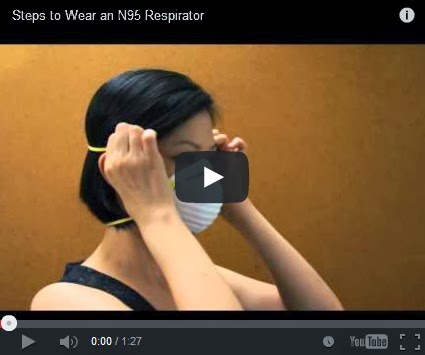
First, a short video on donning and removing an N95 respirator from Raffles Hospital in Singapore: 

NOTE: You should first be fit-tested to determine the proper N95 style that fits your face.


Next  from the CDC/NIOSH, a poster (suitable for framing) on using the N95 respirator (link):

image


From the San Francisco Department of Public Health, steps for putting on and removing surgical masks.

Note: Surgical masks have traditionally been used to prevent the wearer from spreading germs, and its effectiveness in protecting the wearer has been the subject of some debate.


How to Put on and Remove a Face Mask (Excerpts)


How to put on and remove a face mask

Disposable face masks should be used once and then thrown in the trash. You should also remove and replace masks when they become moist.

Always follow product instructions on use and storage of the mask, and procedures for how to put on and remove a mask.  If instructions for putting on and removing the mask are not available, then follow the steps below.

How to put on a face mask

1 Clean your hands with soap and water or hand sanitizer before touching the mask.

2 Remove a mask from the box and make sure there are no obvious tears or holes in either side of the mask.

3 Determine which side of the mask is the top. The side of the mask that has a stiff bendable edge is the top and is meant to mold to the shape of your nose.

4 Determine which side of the mask is the front. The colored side of the mask is usually the front and should face away from you, while the white side touches your face.

5 Follow the instructions below for the type of mask you are using.

  • Face Mask with Ear loops: Hold the mask by the ear loops. Place a loop around each ear.
  • Face Mask with Ties: Bring the mask to your nose level and place the ties over the crown of your head and secure with a bow.
  • Face Mask with Bands: Hold the mask in your hand with the nosepiece or top of the mask at fingertips, allowing the headbands to hang freely below hands.  Bring the mask to your nose level and pull the top strap over your head so that it rests over the crown of your head.  Pull the bottom strap over your head so that it rests at the nape of your neck.

6 Mold or pinch the stiff edge to the shape of your nose.

7 If using a face mask with ties: Then take the bottom ties, one in each hand, and secure with a bow at the nape of your neck.

8 Pull the bottom of the mask over your mouth and chin.

How to remove a face mask

1 Clean your hands with soap and water or hand sanitizer before touching the mask.

2 Avoid touching the front of the mask. The front of the mask is contaminated. Only touch the ear loops/ties/band.

3 Follow the instructions below for the type of mask you are using.

  • Face Mask with Ear loops: Hold both of the ear loops and gently lift and remove the mask.
  • Face Mask with Ties: Untie the bottom bow first then untie the top bow and pull the mask away from you as the ties are loosened.
  • Face Mask with Bands: Lift the bottom strap over your head first then pull the top strap over your head.

4 Throw the mask in the trash.

5 Clean your hands with soap and water or hand sanitizer.


While a fit-tested N95 respirator is undoubtedly more protective, N95s are far more expensive, bulky, and can be more uncomfortable to wear for extended periods of time than a surgical mask. During any major respiratory epidemic or pandemic, N95s are likely to be in very short supply as well (see Caught With Our Masks Down).


Which means, if all I had  available were surgical masks, and I was expecting to be in a potential exposure situation, I wouldn’t hesitate to use them.


As we saw last month in CDC: Infection Control Guidance For Home Care Of MERS-CoV Cases, facemasks are recommended for use (worn by either by the patient, or caregivers) in a home environment.  This advice would also apply during any major flu epidemic (including bird flu).


Which means that while supplies are ample, and prices are low, it wouldn’t be such a terrible idea to pick up a box of surgical masks to tuck away with the rest of your disaster and emergency supplies.

Thursday, September 05, 2013

NIOSH: 9/5 Is N95 Day


image

N95 Respirator – Credit CDC PHIL


# 7633


As any disease geek knows, N95 masks are the preferred personal protective equipment (PPE) to wear when dealing with airborne infectious diseases. But protective N95 respirators are used in many occupational settings, not just healthcare.


Which is why NIOSH is working to help educate employers, workers, hobbyists - and anyone else who might need respiratory protection - on how, and when, to use N95 respirators.


Accordingly, NIOSH (the National Institute for Occupational Safety & Health) had declared today, September 5th, as N95 DAY (get it?  9/5 for N95).


Today NIOSH will hold a N95 Day Webinar. While REGISTRATION IS FULL for the live webinar, a link to the recorded webinar will be made available.


Debunking the Myths Regarding N95 Respirator Use - Thursday, September 5, 2013


Also new for this year is a NIOSH publication:

cover of 2013-138


Respirator Awareness: Your Health May Depend On It

Personal Protective Equipment for Healthcare Workers

One of the occupational hazards in the healthcare setting is the airborne transmission of certain infectious diseases. The potential of exposure is not limited to physicians, nurses, and support personnel in direct patient care. It extends to those delivering food, cleaning patient rooms, and performing maintenance. Anyone working in areas with patients infected with airborne-transmissible diseases is potentially at risk.

Respirator Awareness: Your Health May Depend On ItAdobe PDF file [PDF - 4.7 MB]


Last stop, the NIOSH Blog, where the festivities continue.


It’s September 5th! You know what that means….

Happy N95 Day to all users, manufacturers, educators, and general fans of N95 respirators!

Healthcare workers wearing N95 respirators

Our anticipation has been high as we awaited this opportunity to bring the N95 respirator community together through awareness of educational materials promoting the proper use and selection of this piece of personal protective equipment. One of the main events of the day will be the webinar on Debunking the Myths of N95 Respirator Use. Due to the high demand, registration for this event has closed. But don’t worry – we will be posting the audio and slides of the presentation soon after the N95 Day event on the NIOSH National Personal Protective Technology Laboratory website.

(Continue . . .)


As this is also National Preparedness Month, it is worth mentioning that having a box of N95 respirators tucked away in you disaster kit isn’t such a bad idea.  


Of course, having a stash of N95s isn’t enough. You need to be fit tested, and learn how to don them, and take them off (see Survival Of The Fit-tested).


For more on the differences between N95 and surgical masks, particularly when dealing with infectious diseases, you may wish to look a a blog I wrote earlier this summer,  The Great Mask Debate Revisited.

Wednesday, September 05, 2012

NIOSH: 9/5 Is N95 Day

image

N95 Respirator – Credit CDC PHIL


# 6537


I am a bit chagrined to admit that – until about 12 hours ago – I didn’t know that the good folks at NIOSH (the National Institute for Occupational Safety & Health) had declared today, September 5th, as N95 DAY (get it?  9/5 for N95).


Anyway . . . moving on.


As any good disease geek knows, N95 masks are the preferred personal protective equipment (PPE) to don when dealing with many airborne infectious diseases.


But N95s are used in many occupational settings, not just healthcare.


Which is why NIOSH is working to help educate employers, workers, hobbyists - and anyone else who might need respiratory protection - on how, and when, to use N95 respirators.


To help their cause along, today a few links to some helpful N95 use and selection information, and a video on how to properly don and doff (yes, those are the correct terms) these protective respirators.


Respirator Trusted-Source Information

Section 1: NIOSH-Approved Respirators – What are they? How can they be identified? Where can I get them?

Provides information explaining the different types of respirators, how to identify approved models, as well as distribution information.

Section 2: Use of NIOSH Respirators

Provides information on how to implement the appropriate use of respirators in the workplace. This section also contains a listing of recently revoked respirator approvals as well as relevant User Notices.

Section 3: Ancillary Respirator Information

Frequently asked Questions and Answers about respirators, the Science behind Respirator Function and Performance, and a listing of all NIOSH-approved and FDA-cleared surgical N95 respirators.


A link to the NIOSH SCIENCE BLOG, which today features:


Happy N95 Day!


In a related story, a report from CIDRAP last night on research that looked at the added burden that breathing through an N95 mask placed on people when working or exercising moderately.


Study: Physiologic effects of N-95 respirators are small

The physiologic effects of wearing N-95 respirators are small and shouldn't pose an obstacle for healthy people, according to a study yesterday in the American Journal of Infection Control.

(Continue . . .)


And finally, the controversy over the appropriateness of N95 respirators vs. surgical masks as PPEs when protecting against influenza continues. Those interested in the debate may wish to revisit some of these earlier blogs.


Study: Aerosolized Influenza And PPEs
Study: Longevity Of Viruses On PPEs
Why Size Matters
IOM: PPEs For HCWs 2010 Update

Friday, March 30, 2012

Study: Aerosolized Influenza And PPEs

image

Photo Credit PHIL (Public Health Image Library)


# 6253


We’ve a new study, appearing yesterday in the journal Clinical Infectious Diseases, that once again raises questions over the effectiveness of different types of PPEs (Personal Protective Equipment) used by Health Care Workers (HCWs) in an infectious environment.


image

Ideally, the well-protected HCW (Health Care Worker) working in an infectious environment would be wearing an N95 mask, gloves, gown and eye protection.


But during the opening months of the 2009 pandemic, it became apparent that our world faced a shortage of PPEs, and so strategies were adopted to maximize their use.


In some cases nurses were issued only one N95 mask to be used for an entire 8 hour shift, and told to don it only when in direct contact with a potentially infected patient.


In other venues, HCWs were issued surgical masks in lieu of N95s, despite the recommendation at the time from the CDC that N95 masks were the preferred level of protection.


Fortunately, the virulence of the novel 2009 H1N1 virus was less than originally feared. Had the pandemic carried a higher mortality and morbidity rate, the lack of PPEs would have become a much bigger issue.


For decades, the assumption was that only properly fitted N95 masks protected the wearer, and that surgical masks were only worn by HCWs to protect the patient during invasive procedures.


image image

N-95 Respirator         Surgical mask


But in recent years we’ve seen dueling studies that alternately show surgical masks to be a reasonable protective barrier against respiratory viruses  . . . or pretty much useless.


Take your pick.


A brief tour of these conflicting reports include:


In October of 2009 the NEJM published a perspective article (see NEJM Perspective: Respiratory Protection For HCWs) based on a 2009 IOM evaluation of surgical masks vs. respirators, and came out in favor of the N95.


A few days later JAMA (Journal of the American Medical Association) published a study which reported that HCWs using surgical masks experienced `noninferior rates of laboratory-confirmed influenza’.


In March of 2010, we saw the following study (see Study: Efficacy of Facemasks Vs. Respirators) in Clinical Infectious Diseases, that suggested that surgical masks are just as effective as respirators in protecting HCWs.


In guidance, updated as late as March of 2010, the CDC continued to recommend N95 respirators for HCWs who came in close contact with suspected or confirmed influenza patients.


But in June of 2010, the CDC proposed new guidance that relaxed those recommendations to using surgical masks for routine care, and reserving N95 masks for aerosol producing procedures (intubation, suctioning, etc).


Still, the controversy remains. 


Adding to the confusion, we’ve seen recent studies that give more credence to the notion that influenza may be spread in aerosolized form (see Study: Aerosolized Transmission Of Influenza), as opposed to primarily by large droplets, and may also be contracted via the transocular route.


Our knowledge of how influenza spreads, and what barriers work well to protect HCWs, remains limited.


All of which serves as prelude to this new study, that simulates the aerosolization of influenza viruses and measured the protective qualities of surgical masks and respirators by constructing a simulated  exam room using `coughing and breathing manikins’.


Although the full paper is behind a pay wall, we can get a pretty good idea of the study’s content from the abstract.


Detection of Infectious Influenza Virus in Cough Aerosols Generated in a Simulated Patient Examination Room

John D. Noti, William G. Lindsley, Francoise M. Blachere, Gang Cao, Michael L. Kashon, Robert E. Thewlis, Cynthia M. McMillen, William P. King, Jonathan V. Szalajda, and Donald H. Beezhold

ABSTRACT (Excerpts)

Methods. National Institute for Occupational Safety and Health aerosol samplers collected size-fractionated aerosols for 60 minutes at the mouth of the breathing manikin, beside the mouth, and at 3 other locations in the room. Total recovered virus was quantitated by quantitative polymerase chain reaction and infectivity was determined by the viral plaque assay and an enhanced infectivity assay.

Results. Infectious influenza was recovered in all aerosol fractions (5.0% in >4 μm aerodynamic diameter, 75.5% in 1–4 μm, and 19.5% in <1 μm; n = 5). Tightly sealing a mask to the face blocked entry of 94.5% of total virus and 94.8% of infectious virus (n = 3). A tightly sealed respirator blocked 99.8% of total virus and 99.6% of infectious virus (n = 3). A poorly fitted respirator blocked 64.5% of total virus and 66.5% of infectious virus (n = 3). A mask documented to be loosely fitting by a PortaCount fit tester, to simulate how masks are worn by healthcare workers, blocked entry of 68.5% of total virus and 56.6% of infectious virus (n = 2).

Conclusions. These results support a role for aerosol transmission and represent the first reported laboratory study of the efficacy of masks and respirators in blocking inhalation of influenza in aerosols. The results indicate that a poorly fitted respirator performs no better than a loosely fitting mask.


The results here are fascinating.


First, this study provides more evidence of the role of aerosolized virus particles in the transmission of influenza. Important because these particles can stay aloft and viable for some time, and spread further than large droplets can.


From a more practical standpoint, the big revelation is that a surgical mask, as normally worn by HCWs, only blocked 56.6% of infectious virus particles.


But . . . if you tightly seal the surgical mask against the face , you can achieve a level of protection approaching that of a well fitted N95 respirator (94.8% versus 99.6%).


And a poorly fitted N-95 respirator provided little more protection (66.5%) than a loosely fitted surgical mask.


This study will no doubt add further fuel to the debate over what constitutes appropriate PPEs for healthcare workers during a pandemic.


For the rest of us, the takeaway message here is that surgical masks (which are much cheaper, and easier to stockpile) appear to provide a reasonable level of protection against aerosolized influenza viruses when tightly sealed against the face.


Which means, I suppose, that now I need to think about beefing up my supply of paper surgical tape.