Showing posts with label Russia. Show all posts

Monday, April 27, 2015

Russia Reports H5N1 In Migratory Birds

image

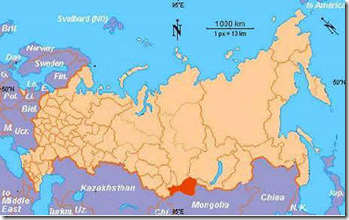
Location Of Astrakhan Oblast in Global Flyway


# 9980


While North America has taken center stage in Avian flu reporting these past few weeks we know that various strains of these viruses continue to spread around the globe.  Egypt continues to deal with an unprecedented outbreak of H5N1 – in both humans and in poultry – and reports continue to filter out of South Korea and Taiwan on their battles against the H5N8 virus and its reassortants.


In recent weeks we’ve seen Niger and Burkina Faso battling the H5N1 virus, while Vietnam and China continue to deal with outbreaks of H5N1 and and H5N6.


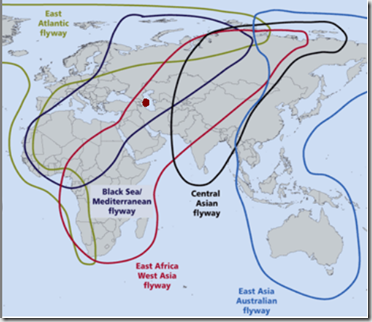
And earlier this year we saw multiple reports of H5N1 in migratory birds  in Eastern Europe (see OIE: H5N1 Kills 21 Pelicans In Bulgaria), which is part of the Black Sea / Mediterranean Flyway. 


With summer on the way, birds that were wintering in Southern Europe or Africa are now headed north to their summer breeding grounds, and so it is not terribly surprising that we are beginning to see reports of H5N1 in migratory birds along that route.


First a translated media report (one of many on the news wires overnight), followed by the official statement from Russia’s Rosselkhoznadzor (Federal Service for Veterinary and Phytosanitary Surveillance), which carried a small item yesterday announcing the detection of the H5N1 avian virus.


Curiously, neither report indicates when these samples were taken.  First this, from Rio Novosti.


The bird flu virus was recorded in the Astrakhan region

08:35 27.04.2015551

Also, the agency added that the study isolates showed that they belong to the Asian genetic lineage HPAI virus and proximity to isolates of influenza A virus subtype H5N1 bird isolated in the Altai region in 2014, as well as subtypes of the same virus isolated in Vietnam and China in 2012-2014.

MOSCOW, April 27 - RIA Novosti / Prime. Rosselkhoznadzor revealed genome of influenza A virus subtype H5N1 bird in the territory Ikryaninskiy region Astrakhan region, said the Russian authorities.

"Subordinate to the Rosselkhoznadzor Federal Centre for Animal Health in research within the federal epizootic monitoring in samples of biological material selected from the Dalmatian pelicans in the territory Ikryaninskiy region Astrakhan region, identified the gene of influenza A virus subtype H5N1 bird" - said in a statement.

Also, the agency added that the study isolates showed that they belong to the Asian genetic lineage HPAI virus and proximity to isolates of influenza A virus subtype H5N1 bird isolated in the Altai region in 2014, as well as subtypes of the same virus isolated in Vietnam and China in 2012-2014.

Pathogenic avian influenza virus H5N1, which emerged in 2003-2005, is widely circulated among birds. It is dangerous to humans because people have no immunity to it.


  And this statement from he official Rosselkhoznadzor  website.


Clarification of Rosselkhoznadzor flu infected migratory birds in the Astrakhan region

April 26, 2015

Subordinated to the Rosselkhoznadzor Federal Centre for Animal Health in research within the federal epizootic monitoring in samples of biological material taken from the territory of curly pelicans Ikryaninskiy region Astrakhan region, identified the gene of influenza A virus subtype H5N1 bird. Research isolates showed that they belong to the Asian genetic lineage HPAI virus and proximity to isolates of influenza A virus subtype H5N1 bird isolated in the Altai region in 2014, as well as subtypes of the same virus isolated in Vietnam and China in 2012-2014 .


Although we don’t get a lot of reporting out of Russia, you may recall that late last year they announced the detection of H5N8  (see OIE Report: H5N8 Detected In Eastern Russia) in a Eurasian widgeon collected last October -  a full month before Europe reported their first H5N8 outbreak.


These past six months we’ve seen HPAI H5 virus on the move around the world, with H5N8 making it to North America and Europe, and H5N1 showing up in countries that haven't reported outbreaks since 2006-2007.


Although most migratory flyways are predominantly north-south corridors, their overlapping allows for a lateral (east-west) movement of avian viruses as well – often via shared nesting areas and ponds. As you can see, the Black Sea/Mediterranean Flyway shares territory with both the East Africa West Asia flyway, and the East Atlantic Flyway.


For more on how scientists are studying the spread of avian flu viruses via these flyways, you may wish to revisit:

Erasmus Study On Role Of Migratory Birds In Spread Of Avian Flu
PNAS: H5N1 Propagation Via Migratory Birds
EID Journal: A Proposed Strategy For Wild Bird Avian Influenza Surveillance
PLoS One: North Atlantic Flyways Provide Opportunities For Spread Of Avian Influenza Viruses

Friday, December 26, 2014

OIE Report: H5N8 Detected In Eastern Russia

image


# 9489


A hat tip to @NLInteligence for tweeting a link to a new OIE report announcing the detection of the H5N8 virus in a hunted Eurasian Wigeon – a dabbling duck  - taken apparently early in October in the far north town of Belaya Gora in Sakha,  Republic of Russia.


When H5N8 turned up in both poultry and wild birds in  Europe last month, it had traveled nearly 8,000 km from where it initially broke out in South Korea in January of this year, with no reports from the vast territory lying in between.

image

Reporting and surveillance in these regions is minimal, but today’s report adds at least one more dot on the map (3000 km north of South Korea) showing the spread of the H5N8 virus, and bolsters the theory that migratory birds are likely behind the spread of this avian virus westward into Europe.


The following is a mash up of some of the details from today’s OIE REPORT.


image

Friday, February 15, 2013

Russia: Hundreds Injured By Meteorite Strike


# 6938


On the same day that a medium-sized asteroid (2012 DA14) will pass safely by our planet, millions of people in Russia had a brief encounter with a much smaller vagabond of space.  


Russian media overnight is reporting that a meteor entered the atmosphere, and broke into several pieces, then crashed into the Russian Urals, near Chelyabinsk.


Three impact sites have been indentified, hundreds of people have reportedly been injured, and and a number of buildings have been damaged from the blast effects.


The Russian space agency Roskosmos estimated the size of the object at about 10 tons before entry into our atmosphere, and has stated:


“According to preliminary estimates, this space object is of non-technogenic origin and qualifies as a meteorite. It was moving at a low trajectory with a speed of about 30 km/s.”


In this age of cell phones, and video cameras, it is not completely unexpected that we have some remarkable audio and video of the event.   This from RT News.


Meteorite hits Russian Urals: Fireball explosion wreaks havoc, over 500 injured (PHOTOS, VIDEO)

Published: 15 February, 2013, 08:36
Edited: 15 February, 2013, 15:25

Russia’s Urals region has been rocked by a meteorite explosion in the stratosphere. The impact wave damaged several buildings, and blew out thousands of windows amid frigid winter weather. Hundreds are seeking medical attention for minor injuries.


­Follow RT's LIVE UPDATES.


Eyewitness accounts of the meteorite phenomenon, handpicked by RT.


Army units found three meteorite debris impact sites, two of which are in an area near Chebarkul Lake, west of Chelyabinsk. The third site was found some 80 kilometers further to the northwest, near the town of Zlatoust. One of the fragments that struck near Chebarkul left a crater six meters in diameter.


Servicemembers from the tank brigade that found the crater have confirmed that background radiation levels at the site are normal.


<SNIP>

As of 15:00 Moscow time, 725 people have sought medical attention in Chelyabinsk alone because of the disaster, 112 of whom have been hospitalized .Among the injured there are 84 children, Emergency ministry reported.


(Continue . . . )


While an unusual event, today’s damaging meteor impact is not unprecedented. The most famous impact in modern times was the Tunguska event, which occurred in Siberia, Russia in 1908 and is estimated to have generated an explosion more than 1,000 times greater than the Hiroshima bomb.

image

Had that impact occurred in a populated region of the world the results would have been devastating.

More recent close encounters with space rocks include the Great Daylight 1972 Fireball (or US19720810) which spectacularly passed through our atmosphere but did not impact the earth’s surface.

Other close encounters include the January 18th, 2000 fireball exploded over the city of Whitehorse in the Canadian Yukon and the September 15th, 2007 meteor crash near the village of Carancas in southeastern Peru near Lake Titicaca.


It has been estimated that 4 meter diameter space rocks  impact somewhere around the earth about once every year or so, while 7 meter objects make an appearance  – on average – every 4.6 years.

Most end up in the sea, or explode high up in the atmosphere, but occasionally they can cause damage and injuries on the ground.


It is NASA’s NEO (Near Earth Object) Program’s job to keep track of potential earth-bound objects.  But while they certainly track smaller meteors – like the one that struck last night – their emphasis is on larger, more damaging objects.

image

What Is The Purpose Of The Near-Earth Object Program?

The purpose of the Near-Earth Object Program is to coordinate NASA-sponsored efforts to detect, track and characterize potentially hazardous asteroids and comets that could approach the Earth. The NEO Program will focus on the goal of locating at least 90 percent of the estimated 1,000 asteroids and comets that approach the Earth and are larger than 1 kilometer (about 2/3-mile) in diameter, by the end of the next decade. In addition to managing the detection and cataloging of Near-Earth objects, the NEO Program office will be responsible for facilitating communications between the astronomical community and the public should any potentially hazardous objects be discovered.


How Many Near-Earth Objects Have Been Discovered So Far?

As of February 12, 2013, 9697 Near-Earth objects have been discovered. Some 861 of these NEOs are asteroids with a diameter of approximately 1 kilometer or larger. Also, 1378 of these NEOs have been classified as Potentially Hazardous Asteroids (PHAs).


While no one should lay awake at night worried that there’s a meteor with their name on it, this is just another example of the many ways that nature can throw us a curve, and of the value of being prepared  for any emergency.


Which is why FEMA, Ready.gov, the HHS, CDC, and dozens of other agencies and organizations all encourage citizen preparedness.


FEMA http://www.fema.gov/index.shtm

READY.GOV http://www.ready.gov/

AMERICAN RED CROSS http://www.redcross.org/


And finally, some of my own preparedness articles may be of interest:


When 72 Hours Isn’t Enough

In An Emergency, Who Has Your Back?

An Appropriate Level Of Preparedness

The Gift of Preparedness 2012

Tuesday, September 21, 2010

The Krasnoyarsk Duck Die Off


# 4818


image


Yesterday Dutchy on FluTrackers tracked down, translated, and posted an article from a Russian online news source that detailed the die off of `500’ birds.


Crof mentioned this story yesterday here.


First the original reports, then some follow ups:


Unknown virus in Krasnoyarsk lake killed 500 birds
KRASNOYARSK, September 20. On the shore of Lake Tagar in the Krasnoyarsk Territory ornithologists found dead migratory birds.


Among the dead birds - ducks (mallard, Cherokee, shelohvost) and crows. According EMERCOM Russia in Krasnoyarsk region, only found about 500 animals.


In connection with the emergency on the lake and 100-meter zone of sanitary quarantine. 2 posts were put up DPS and get information boards. Moreover, in Minusinsk District banned the hunting passes Ngs.ru


Causes of death of the birds are being investigated. Presumably, the death of the birds could occur as a result of acute viral disease. In this regard, there are already several reports on the return of bird flu.


Since then, the story has evolved (you can follow new reports on this thread), with additional contributions first from Sally Furniss and again from Dutchy.


1.09.2010 | 06:38


The cause of mass deaths of migratory birds in the area of Lake Tagar in the Krasnoyarsk Territory became virus type "A"


These are the preliminary findings of the Professional Regional Veterinary Service. According to ITAR-TASS, they completed this morning blood tests dead birds. It is reported that the general form of the virus.


Its varieties are numerous / avian, swine flu, etc. / and represent a significant risk in epidemiological terms. Currently Minusinsk region, where there was an emergency, completed a survey area, the collection of biomass dead birds, which will subsequently be burned. All poultry entered the edge closure of birds.


Apparently the exact type of influenza has not been nailed down, but given the mass die off, a highly pathogenic avian influenza (like H5N1) seems highly likely.


This next report from Dutchy not only asks if this is the return of Bird Flu, but also expands the size of the die off to `thousands’.


There is also a 2.5 minute Russian language news clip you can watch with video of the lake and the collection of dead and dying birds.


image


Although influenza appears to be the prime suspect here, other possibilities have been floated as well. The article below calls into question the original theory that blamed a blue-green algae bloom as the cause – and casts doubt on this being some kind of man-made toxin.


That said, poisonings (intentional or accidental), are often behind large bird die offs.


For now the culprit does appear to be a flu virus, and the leading candidate is H5N1.


Has bird flu returned?
21/09/2010
In the Krasnoyarsk region trying to find out what caused the mass deaths of migratory birds in the southern region.


In the Lake Tagar found about thousands of dead ducks. Specialists suggest that they died from the virus that is dangerous not only for birds but for the man.

- snip -


Among the dead and sick birds, biologists have discovered not just different species of ducks: mallards, teal, sorokonosku, but even a few crows and wagtails. All dead birds feed in different ways, and this fact is called into question the original version of the epidemic - the poisoning of ducks, blue-green algae.


No companies with environmentally dangerous production next either. Xiii and version of the intentional poisoning of ducks. Such mass mortality of wild birds in the Krasnoyarsk region has never been. And the epidemic is local in character.


More (machinetranslation in English)


News stories out of Russia (or anywhere else, for that matter) should always be taken with a grain of salt.  Early reports are often wrong or misleading and `facts’ – such as in the number of birds killed – are often revised in later reports.


Those caveats aside, this incident is definitely worth following.  As Crof said yesterday, it reminds one of the Qinghai Lake mass die off in 2005.


Earlier this summer, you may remember I blogged on an H5N1 Avian Flu Wild Bird Deaths On Russian-Mongolian Border


You can keep tabs on these latest reports by hitting the FluTrackers Thread.  Of course, I’ll  post any major updates here, as well.


For more on how the volunteer newshounds find, translate, and analyze foreign language news reports like this, you might wish to read Newshounds: They Cover The Pandemic Front.

Tuesday, June 29, 2010

WAHID Notification Of Russian H5N1


# 4682


Eleven days ago I wrote about the discovery of wild bird deaths from an unspecified (but likely H5N1) avian flu, along the Russian-Mongolian border at Uvs Nuur lake.


image


Over the past couple of days Russian authorities have submitted two reports to the OIE’s  WAHID (World Animal Health Information Database) Interface.


As expected, the laboratory testing has come back positive for highly pathogenic H5N1  and the total number of dead birds recovered is now 367.


Species affected included Great Crested Grebe (Podiceps cristatus), Goosander (Mergus merganser), Grey Heron (Ardea cinerea), Gadwall (Anas strepera), Eurasian Spoonbill (Platalea leucorodia).


This is the third die off of birds due to H5N1 in this region since 2006. 


A reminder that, while we don’t often read about it, avian flu continues to circulate in the wild. 

Friday, June 18, 2010

Avian Flu Wild Bird Deaths On Russian-Mongolian Border


# 4660


Nine days ago, the newshounds at FluTrackers had reports of a die off of wild birds from the H5N1 virus in Tibet (see H5N1 Bird Deaths In Tibet).


Today, new reports of bird deaths from an unspecified (but likely H5N1) avian flu, but this time it comes from the Russian-Mongolian border at Uvs Nuur lake. 


image


Sally Furniss of FluTrackers has posted a series of translated news articles from the Russian press in this thread over the past 24 hours.


Typical of these reports is the following, from 1nsk.ru.


Incidents


Service of veterinary supervision Tuva found hotbed of infection of avian influenza on the lake Uvs Nuur on the border with Mongolia. The specialists went to the scene to dispose of 85 carcasses of waterfowl. But until the epidemic of influenza is too early, reported on June 17 Tayge.info at the Department of State Veterinary Inspection and the health of animals Tuva.


"On the perishing in the lake Uvs Nuur birds in early June, officials said Reserve" Uvs Nuur Basin. June 7 Head of State Veterinary Inspection went to the place of inspection and found 85 carcasses of wild waterfowl. Eight biological samples sent to Kemerovo laboratory. June 11 in the four samples was identified avian influenza virus ", - told companion, adding that information from Tuva had already been sent to the Itar-Tass and the Moscow Veterinary Centre.


To localize the infection created a synthesis of anti detachment, which on June 15 went to the lake. Experts put their carcass birds in deep pits and burned. After the destruction of the pit will be backfilled, enclosed by barbed wire and equipped with warning signs. Telephone communications with participants of the detachment there, the latest data on the development of the disease will be known no earlier than June 25.


According to the staff member vetnadzora, now out of the lake Uvs Nuur is prohibited, "but there and in ordinary times, no one comes, even the inhabitants of the nearest village" Akchera. Interlocutor assured that there is no danger to humans. Send comment representatives Rosselkhoznadzor June 17 Tayge.info failed.


In addition to the lake Uvs Nuur, where in 2006 and 2009 has already seen outbreaks of bird flu, experts vetnadzora Tuva spent monitoring lakes Andaygyn and White, located in different parts of the country. Laboratory analysis of biological samples showed that the avian flu here has not yet arrived.


As noted in this article, bird flu has been detected in this area on two previous occasions. In 2006 and again in 2009.

Monday, November 09, 2009

Russia Begins Pandemic Vaccination Program


# 3980


Russia begins vaccinating against the H1N1 virus today, but a bit unusually, with the first vaccines going to  utility workers who bring vital water, heat, and electric power to much of the nation.


The second tier to receive the vaccine (starting in late November) will be Health Care Workers, teachers, and medical students while vaccination of pregnant women, children, and those with chronic diseases won’t begin before December.


This report from Itar-Tass.


Russia to launch vaccination against new flu

09.11.2009, 02.10

MOSCOW, November 9 (Itar-Tass) -- Russia will launch a vaccination campaign against new flu on Monday. The first stage of the vaccination will be held in the Altai Territory, the Moscow, Tyumen, Bryansk and Voronezh regions.


Minister of Health and Social Development Tatiana Golikova will visit a hospital in Lvovsky, Podolsk district of the Moscow region on this occasion.


The first stage of the vaccination will embrace utility workers (the housing and utilities complex, water and electric power supplies, as well as the communications), the press service of the Ministry of Health and Social Development told Itar-Tass.


Medical workers, teachers, senior students of medical higher educational institutions will be vaccinated since late November. The next stage of the vaccination will embrace other categories of the population in the risk groups exposed to the threat of severe complications of the disease – people with chronic diseases, pregnant women and children.


Four vaccines were developed, passed pre-clinical and clinical tests, proved their efficiency and full safety in the tests and were registered, the press service recalled. “The Russian government allocated four billion roubles for the purchases of first 43 million vaccines,” the press service reported. The Microgen federal state unitary enterprise, which is one of the vaccine’s producers, has already concluded a state contract for the first anti-A(H1N1) flu vaccine supplies (1.3 million vaccines).

Friday, November 06, 2009

Two Reports Out Of Russia


# 3964


As the H1N1 virus continues its fall and winter march across the Northern Hemisphere, reports of its impact are starting to emerge from places like the Ukraine, Belarus, and now Russia.


Thus far, the reports we get describe a pandemic that is very wide, but not terribly deep. 


A lot of illness, but relatively low mortality rates.


Today we learn, via Dutchy on FluTrackers, that Moscow will keep their schools closed for at least an additional week on top of the current school holiday now in progress. 


MOSCOW SCHOOLS SHUT BECAUSE OF FLU

05.11.2009

School holidays in Moscow will last a week longer than scheduled - until November 16 inclusive. As reported in Thursday, November 5, in the City of sanitation and epidemic commission, the decision was taken because of the epidemic of seasonal flu and SARS.(=ILI, ed) Teachers call up the students and tell them the news.


Holidays, which began Monday, were to be completed on November 8.


This information was confirmed spokesman Sergei Tsoi mayor. As reported earlier press office of Mayor and the Moscow government, the incidence of SARS and avian influenza in Russia's capital to date has exceeded the epidemic threshold by almost half.


As of 1 November, in Moscow, SARS and flu are sick more than 166 thousand people, including nearly 106 thousand children.


Recall, registered in Russia for 13 deaths from swine influenza. The most unfortunate situation with the epidemic develops in Transbaykal, Krasnoyarsk, Khabarovsk, Primorsky regions, Sakhalin Oblast, and Moscow. Vaccination against swine influenza begin in Moscow for November 9.


According to WHO, worldwide, most cases still occur in adolescents and young adults, with the highest rates of hospitalization observed among very young children. From 1% to 10% of patients with clinical manifestation of disease require hospitalization. Of the hospitalized patients from 10% to 25% need to be admitted to ICUs and from 2% to 9% die.


In general, from 7% to 10% of all hospitalized patients are pregnant women in the second or third trimester of pregnancy. Compared with the general population the likelihood that pregnant women need medical care in the intensive care ward, ten times higher.


And from Itar-Tass News agency, a column (as opposed to a news story) about how the pandemic is progressing across Russia.   While calling the situation in the Ukraine `alarming’, this report tries to downplay the impact in Russia and the `tone’ is reassuring.


An interesting read, but as always, Caveat Lector. A hat tip to Cathy M  on the Flu Wiki for finding and posting this report.


Flu situation in Russia not as bad as in Ukraine, but far from calm

05.11.2009, 20.06

By Itar-Tass World Service writer Lyudmila Alexandrova

Over 3,000 cases of swine flu have been registered in Russia. Fourteen patients have died from the disease. In most cases the victims turned for medical assistance when it was already too late. Although the situation in Russia is not as alarming as in neighboring Ukraine, where swine flu and viral respiratory diseases have killed 86, it is far from calm.


"There are no fears over the risk of a negative pandemic scenario," says Deputy Health and Social Development Minister Veronika Skvortsova. So far laboratory tests have confirmed 3,122 cases of A/H1N1 flu in Russia. Most of those who contracted it have recovered and 1,200 others are still sick. In six percent of patients the illness has proved grave.


Skvortsova warned against breeding panic for which there is absolutely no reason. A total of 4,000 patients die in Russia every month of cardiovascular diseases, 24,000 of cancer, and 2,600 of infection diseases. In the meantime, swine flu has claimed only fourteen lives.


"Our country is among those where the march of events is favorable," she said. Russia has managed to avoid a negative flu epidemic scenario.


At the same time the republic of Buryatia on November 4 declared a state of emergency due to the highly pathogenic virus. As at November 72 patients in Buratia were down with swine flu. On the whole, the epidemiological threshold has been exceeded 3.1 times. All crowded events have been canceled, including conferences, public festivities and rallies. The same applies to business trips.


Wearing masks in public places is obligatory and visiting patients in hospitals is not allowed.


(Continue . . . )