Showing posts with label Severity. Show all posts

Tuesday, February 11, 2014

Research: Low Vaccination Rates Among 2013-2014 ICU Flu Admissions

image

Yearly Flu Hospitalizations by Age Cohort – CDC FluView

Showing 2009-10 & 2013-14 Hitting ages 18-64 unusually hard


# 8286


Despite reduced VE (Vaccine Effectiveness) estimates in recent years, and a production schedule that requires predicting – 6 months in advance – what flu strains will dominate in the upcoming flu season, we continue to see evidence that most years the seasonal flu shot manages to convey a fairly decent level of protection against influenza.


Despite the mantra of the CDC, and other public health organizations, urging people to get the yearly jab, only just over 1/3rd of adults (aged 18-64) got the flu shot last year (see TFAH Report Finds Low Uptake Of Flu Shots Among Young Adults). 


This year, we are seeing the pH1N1 strain dominate for the first time since 2010, and as it did in 2009, it appears to be targeting younger adults harder than usual. As a result, we’ve seen reports of an uptick in ICU hospitalizations, and deaths, among younger adults across the nation this winter.


Which brings us to a research letter, published yesterday in the American Journal of Respiratory and Critical Care Medicine, that finds – between November 2013 and January 8th, 2014 – a `high number of otherwise healthy individuals with critical illness requiring care in the ICU. Most patients who required ICU level care were not previously vaccinated.’


High ICU admission rate for 2013-2014 Influenza is associated with a low rate of vaccination

Jelena Catania, Loretta G Que, Joseph A Govert, John W Hollingsworth, and Cameron R Wolfe


While most of this letter is behind a pay wall, we have a press release from Duke University, with some of the details. First an excerpt, after which I’ll return with more.


Duke University Medical Center

Young, unvaccinated adults account for severest flu cases

DURHAM, N.C. – A snapshot of patients who required care at Duke University Hospital during this year's flu season shows that those who had not been vaccinated had severe cases and needed the most intensive treatment.

In an analysis of the first 55 patients treated for flu at the academic medical center from November 2013 through Jan. 8, 2014, Duke Medicine researchers found that only two of the 22 patients who required intensive care had been vaccinated prior to getting sick.

The findings were published online in Monday, Feb. 10, 2014, in the American Journal of Respiratory and Critical Care Medicine.

"Our observations are important because they reinforce a growing body of evidence that the influenza vaccine provides protection from severe illness requiring hospitalizations," said lead author Cameron Wolfe, M.D., assistant professor of medicine at Duke. "The public health implications are important, because not only could a potentially deadly infection be avoided with a $30 shot, but costly hospitalizations could also be reduced."

Wolfe said this year's flu season was marked by hospitalizations of previously healthy young people, with a median age of 28.5 years. Among those who were hospitalized at Duke, 48 of the 55 were infected with the H1N1 virus that caused the 2009 pandemic. That outbreak also hit young adults particularly hard.

(Continue . . .)

This research also found a high rate of failure of the rapid flu test (something we’ve discussed before in MMWR: Evaluating RIDTs and No Doesn’t Always Mean No) which has led to delays in starting antiviral treatment for some patients.

The authors conclude:

Together, our observations during this influenza season support a high prevalence of the H1N1 virus affecting young adults and requiring ICU care, high false negative rates of rapid flu tests, and delay in starting antiviral treatment," Wolfe said. "Added to the finding of very low vaccination rates among both hospitalized and ICU admissions, our observations support previous findings that vaccination reduces the severity of disease and vaccinations should be encouraged as recommended by the U.S. Centers for Disease Control and Prevention."


While the effectiveness of the seasonal flu shot has often been oversold, I certainly get one every year, and urge others to do the same.  


Not because it is guaranteed protection, but because – like wearing a seatbelt in a vehicle – it improves your odds of a good outcome.


And despite disappointing VE numbers (see CIDRAP: A Comprehensive Flu Vaccine Effectiveness Meta-Analysis) - particularly among the elderly ( see PLoS One: Limited Effectiveness Of Flu Vaccines In The Elderly & BMC Infectious Diseases: Waning Flu Vaccine Protection In the Elderly) - we continue to see evidence of benefit from the shot, even if full protection isn’t conveyed to the recipient.


In  2011,  NFID - the National Foundation for Infectious Diseases - convened a group of experts to address the issues of influenza and the elderly. From that panel a 5-page brief has emerged, called: Understanding the Challenges and Opportunities in Protecting Older Adults from Influenza.

image

Although the elderly generally see less protection from the flu vaccine, older individuals may still mount a robust immune response. In populations 65 and older, the brief points out that:

  • Hospitalization rates for influenza and pneumonia are lower in community-dwelling adults who received the seasonal influenza vaccine.
  • Immunization is associated with reduced hospitalization of older patients for cardiac, respiratory, and cerebrovascular diseases.

While the goal of vaccinating the younger population is to prevent infection, the authors point out that:

  • . . . the goal in older adults is to prevent severe illness, including exacerbation of underlying conditions, hospitalization, and mortality.


Similarly, over the past couple of years, we’ve seen studies suggesting the flu vaccine may reduce the risk of heart attack and stroke (see JAMA: Flu Vaccine and Cardiovascular Outcomes & Study: Flu Vaccine May Reduce Heart Attack).  Not a slam dunk, but intriguing nonetheless.


There is obviously a great need for better, and faster to market, flu vaccines.  A topic that was well addressed back in 2012 by CIDRAP: The Need For `Game Changing’ Flu Vaccines.


But until they can be developed - the flu shots we have –  when coupled with good `flu hygiene’ (washing hands, covering coughs, staying home when ill)  remain the best preventative actions you can take against the flu.


And this year’s flu season shows that being young, and healthy, is no reason to avoid getting the shot.

Wednesday, August 14, 2013

BMJ: Risk Factors For Children With Pandemic Flu


image

The chart above (Aug 2012) illustrates the sharp rise in pediatric deaths from flu-related complications during the 2009-2010 H1N1 pandemic seasons in the United States.


# 7571


The BMJ has published this week research from an international team of medical scientists who looked at presenting symptoms and comorbidities of 265 pediatric cases from 79 emergency rooms in 12 countries presenting with the H1N1 pandemic flu. 


The team was able to identify several factors that they could associate with a higher risk of severe infection, complications, or death.


It is hoped that these findings could help guide physician decisions on treatment of children, or their admission to the hospital, in future influenza outbreaks.


First a link to the study (which is available, in full, online) then some excerpts from a news release from the University of Auckland.


Research

Predictors of severe H1N1 infection in children presenting within Pediatric Emergency Research Networks (PERN): retrospective case-control study

BMJ 2013; 347 doi: http://dx.doi.org/10.1136/bmj.f4836 (Published 12 August 2013)

Cite this as: BMJ 2013;347:f4836

Stuart R Dalziel, paediatrician, John MD Thompson, senior research fellow, Charles G Macias, associate professor, Ricardo M Fernandes, paediatrician4, David W Johnson, professor, Yehezkel Waisman, professor, Nicholas Cheng, paediatrician, Jason Acworth, paediatrician, James M Chamberlain, professor, Martin H Osmond, professor, Amy Plint, associate professor, Paolo Valerio, paediatrician, Karen JL Black, paediatrician, Eleanor Fitzpatrick, research coordinator, Amanda S Newton, assistant professor, Nathan Kuppermann, professor, Terry P Klassen, professor for the Pediatric Emergency Research Networks (PERN) H1N1 working group

Abstract

(EXCERPT)

Main outcome measures Severe outcomes included death or admission to intensive care for assisted ventilation, inotropic support, or both. Multivariable conditional logistic regression was used to compare cases and controls, with effect sizes measured as adjusted odds ratios.


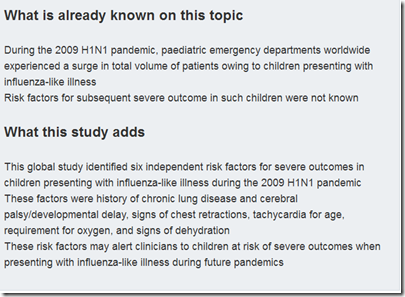
Results 151 (57%) of the 265 cases were male, the median age was 6 (interquartile range 2.3-10.0) years, and 27 (10%) died. Six factors were associated with severe outcomes in children presenting with influenza-like illness: history of chronic lung disease (odds ratio 10.3, 95% confidence interval 1.5 to 69.8), history of cerebral palsy/developmental delay (10.2, 2.0 to 51.4), signs of chest retractions (9.6, 3.2 to 29.0), signs of dehydration (8.8, 1.6 to 49.3), requirement for oxygen (5.8, 2.0 to 16.2), and tachycardia relative to age).

Conclusion These independent risk factors may alert clinicians to children at risk of severe outcomes when presenting with influenza-like illness during future pandemics.

image

(Continue . . . )


The news release from the University of Auckland provides some additional background on this study.


Top risk factors identified for children during influenza pandemics

14 August 2013

Auckland medical scientists have helped to identify crucial risk factors for children most susceptible to life threatening infections from the H1N1 influenza virus.


Lead study author Dr Stuart Dalziel and senior research fellow Dr John Thompson from The University of Auckland worked with an international team of paediatric specialists to identify the risk factors.


It is the first study to detail which clinical factors in children at hospital arrival with influenza-like illness and H1N1 infection, are associated with the progressive risk to either severe infection or death.

<SNIP>

The study, which assessed each patient’s clinical history and physical examination, identified the following predictors of severe H1N1 infection and potentially fatal outcomes in children:

  • History of chronic lung disease
  • History of cerebral palsy/developmental delay
  • Signs of chest retractions (difficulty breathing)
  • Signs of dehydration
  • Requires oxygen to keep blood levels normal
  • Heart rate that exceeds normal range (tachycardia) relative to age

“Having a more accurate idea of what to look for in paediatric cases, especially during a pandemic, would be especially important to clinicians because it provides crucial guidance for those who would be trying to direct the appropriate levels of treatment for many patients in a short time,” said one of the study’s co-authors Nathan Kuppermann, professor and chair of emergency medicine at the University of California.

(Continue . . . )


We’ve seen earlier studies on the impact of the 2009 H1N1 pandemic on children, some of which have produced similar findings.


Study: Kids, Underlying Conditions, And The 2009 Pandemic Flu

Lancet: Pediatric Mortality Related To Pandemic H1N1

Study: Pediatric Neurological Complications With H1N1


While it is axiomatic that - `if you’ve seen one flu pandemic . . . you’ve seen one flu pandemic’ - many of the lessons learned from the last pandemic are still likely to prove useful during the next global health crisis.


Even if the next pandemic differs substantially from what we went through in 2009.

Sunday, May 09, 2010

Study: Pandemic H1N1 In India Linked To Severe Disease


# 4556


Although many observers have been quick to pronounce the pandemic H1N1 virus of 2009 as being `mild’, `overhyped’, or even a `non-event’ - the gathering and analysis of the data on its global impact is still in its early stages. 


As expected, the virus has produced a wide spectrum of illness. And it hit some regions and peoples harder than others. 


A scenario I blogged (somewhat acerbically) about a year ago in A Tale of Two Pandemics.


While I believe the jury is still out on what this virus ends up doing, pundits who snort, and write about the H1N1 virus with derision and scorn, may actually have a point.


At least if you are relatively well off financially, live in a developed country with good medical care, are in relatively good health, and are older than the `target age’ for this virus – which seems to be from about 5 years – to 24 years of age.


If you meet these requirements (and shouldn’t everybody?), then this virus understandably scores pretty low on your daily threat assessment. 


As more data comes in we are learning just how complex and diverse the effects of the pandemic have been around the world.


One such study was published yesterday in Plos One, entitled:


Pandemic Influenza (H1N1) 2009 Is Associated with Severe Disease in India

Akhilesh C. Mishra*, Mandeep S. Chadha, Manohar L. Choudhary, Varsha A. Potdar


National Institute of Virology, Pune, India

Abstract


Background


Pandemic influenza A (H1N1) 2009 has posed a serious public health challenge world-wide. In absence of reliable information on severity of the disease, the nations are unable to decide on the appropriate response against this disease.

Methods

Based on the results of laboratory investigations, attendance in outpatient department, hospital admissions and mortality from the cases of influenza like illness from 1 August to 31 October 2009 in Pune urban agglomeration, risk of hospitalization and case fatality ratio were assessed to determine the severity of pandemic H1N1 and seasonal influenza-A infections.


Results


Prevalence of pandemic H1N1 as well as seasonal-A cases were high in Pune urban agglomeration during the study period. The cases positive for pandemic H1N1 virus had significantly higher risk of hospitalization than those positive for seasonal influenza-A viruses (OR: 1.7). Of 93 influenza related deaths, 57 and 8 deaths from Pune (urban) and 27 and 1 death from Pune (rural) were from pandemic H1N1 positive and seasonal-A positive cases respectively. The case fatality ratio 0.86% for pandemic H1N1 was significantly higher than that of seasonal-A (0.13%) and it was in category 3 of the pandemic severity index of CDC, USA. The data on the cumulative fatality of rural and urban Pune revealed that with time the epidemic is spreading to rural areas.


Conclusions


The severity of the H1N1 influenza pandemic is less than that reported for ‘Spanish flu 1918’ but higher than other pandemics of the 20th century. Thus, pandemic influenza should be considered as serious health threat and unprecedented global response seems justified.


The entire study is available online for your perusal.  


Although these researchers peg the CFR (Case Fatality Ratio) of novel H1N1 as being significantly higher than seasonal influenza, this is a limited study and considerable controversy exists over the best way to count (or more precisely, estimate) seasonal and pandemic CFRs.


The observation that this pandemic was less severe than 1918  (by a wide margin) seems self-evident. 


The author’s assertion that 2009 was more severe than the other pandemics of the 20th century is more controversial, as is their comparison of the virus’s CFR  to a CDC Category 3 pandemic.  


Although, if we use YLL (Years of Life Lost), the costs of the 2009 pandemic appear to equal or exceed 1968, and may be approaching that of 1957.


For more on YLL calculations,and other measures of pandemic severity, see:


When Words Fail Us
The Measure Of A Pan
There’s No Flu Like A New Flu
Study: Years Of Life Lost Due To 2009 Pandemic


Again, it will take time and analysis before we will know with any degree of certainty the real impact of the novel H1N1 virus.  This is but one study, and not the final word.


And lest we forget, the pandemic is still ongoing. 


The final chapter may not have been written, and may not be for a couple of more years.