Showing posts with label Research. Show all posts

Friday, July 18, 2014

ECDC Comment On Gain Of Function Research

image

Credit CDC PHIL


# 8847


My thanks to Dr. Marc Lipsitch for tweeting the link to the ECDC’s comment on recent GOF (Gain of Function) work being performed on 1918-like influenza viruses.  I blogged about this particular study last month in Cell Host & Microbe: 1918-like Avian Viruses Circulating In Birds Have Pandemic Potential, where I wrote about the ongoing concerns over this type of research.


Simply put, GOF research involves laboratory manipulation of a virus’s genetics in order to enhance its transmissibility, virulence, or host range.


While proponents argue that these experiments can help us discover what strains have the most pandemic potential, and could help in the early development of a vaccine.  Opponents argue that these potential benefits are overstated, and the risks of an accidental release from the lab are too great.


And despite bland reassurances from many researchers on the safety of high containment labs, recent serious biosafety lapses at CDC and FDA labs involving anthrax, H5N1 bird flu, and smallpox all point out that accidents happen even in the best of labs.


Here then is an ECDC_EU review of the Cell Host & Microbe paper, along with a cautionary comment.


Circulating Avian Influenza Viruses Closely Related to the 1918 Virus Have Pandemic Potential

 16 Jul 2014

​A recent article by Watanabe et al. in the Cell Host & Microbe journal describes an attempt to assess the risk of emergence of pandemic influenza viruses closely related to the 1918 influenza virus.

Reverse genetics methods were used to generate an avian influenza virus closely related to the 1918 influenza virus, based on sequence information reported from various avian influenza viruses. Further experiments were done to demonstrate what mutations are required for this virus to become easily transmissible between mammals. Effectiveness of the current influenza vaccine and the antiviral drug oseltamivir against the 1918-like influenza virus was also assessed.

It was experimentally demonstrated that a 1918-like avian influenza virus with a limited number of additional mutations exhibits relatively high pathogenicity in mammals, although lower than the original 1918 influenza virus strain that was also recreated with reverse genetics technology in the laboratory. In the transmissibility studies, only some constellations of the virus genes allowed transmissibility between ferrets, suggesting roles for RNA replication complex, HA and NA in virus transmission.

To further assess the risk of the emergence of such avian influenza viruses that could infect humans, the team examined the prevalence of avian influenza viruses that are similar to the 1918 influenza virus, and looked for avian influenza viruses possessing human-type amino acid residues.

The study thus demonstrated the continued circulation of such avian influenza viruses that possess 1918 virus-like proteins and viruses that may acquire 1918 virus-like properties. This would suggest that a potential exists for a 1918-like pandemic virus to emerge from the avian virus gene pool.

ECDC comment

The study by Watanabe et al. is the latest in a series of genetic engineering experiments where research groups have created influenza viruses of pandemic potential. The new study discussed here further confirms the power of recombinant technology to create pathogenic viruses that are not currently circulating in nature. From the public health perspective, this poses a risk both for the laboratory personnel working with these viruses, even in very secure biosafety conditions, and to the general public in case of a laboratory escape. Recent incidents remind us that laboratory accidents and laboratory escapes can happen with dangerous pathogens, even if the highest security standards are applied [1,2,3]. The developments in technology should not and cannot be stopped and research laboratories should have the freedom to apply the latest technologies for science purposes as long as this is done with full adherence to good ethical and biosafety practices. However, the decision to fund this type of gain of pathogenic function studies in influenza viruses and other human pathogens has stirred scientific controversy about the mechanisms currently in place to ensure sound assessment of risk and benefits by independent reviewers [4].

The public health perspective to the critical review of funding such dual-use research of concern including studies aiming at the creation of potential pandemic pathogens has been so far limited. Very often the research groups justify their research agenda with pandemic preparedness and better understanding of the avian influenza viruses without further specifying how exactly the results may improve the preparedness plans. It is important to ask what this type of result adds to the field of pandemic influenza preparedness and how the prediction of efficacy of influenza vaccines or antivirals against influenza viruses is improved based on these results. Furthermore, it is pertinent to ask for justification of the methods, and if any of those could be replaced by safer experiments. It is of utmost importance that the biosafety practices and controls in the laboratories undertaking such research are kept to a high standard. A forum for public health discussion around dual-use research of concern topics is not yet available at European level. ECDC advocates for open discussion about studies where potential pandemic threats are created. The research community should in all their work apply the medical ethical principle of “first do no harm”.

References:

1: Normile D. Mounting Lab Accidents Raise SARS Fears. Science. 2004;304(5671):659-61.
2: CDC Lab Determines Possible Anthrax Exposures,
CDC Media Statement, 19 June 2014
3: CDC Director Releases After-Action Report on Recent Anthrax Incident; Highlights Steps to Improve Laboratory Quality and Safety, CDC Press Release, 11 July 2014
4: Gigi Kwik Gronvall.
National-level biosafety norms needed for dual-use research .Front. Public Health, 14 July 2014 | doi: 10.3389/fpubh.2014.00084


Over the past three years we’ve touched on these issues dozens of times, but a partial list of blogs on this topic you might wish to revisit include:


The Debate Over Gain Of Function Studies Continues
Lipsitch & Galvani: GOF Research Concerns
The Call For Urgent Talks On `GOF’ Research Projects
Laurie Garrett On Biosecurity Reforms
H7N9: Reigniting The `Gain Of Function’ Research Debate
Nature: H5N1 viral-engineering dangers will not go away


Wednesday, July 09, 2014

BMJ: The `Hawthorne Effect’ On Hospital Hand Hygiene Compliance

image

Credit WHO


# 8816


One hundred and sixty-six years ago, a Hungarian physician named Ignaz Semmelweis published a controversial medical book called Etiology, Concept and Prophylaxis of Childbed FeverSemmelweis demonstrated that infections could be greatly reduced by simply having doctors wash their hands before performing gynecological exams.


While that makes sense today, at the time his theories were considered radical (Pasteur wouldn’t come up with his `germ theory’ for another 17 years). Besides, it was outrageous to suggest that doctors might actually be causing disease and death among their patients.


Semmelweis was ridiculed, ostracized and eventually forced to leave his hospital post. He died at the age of 47 in an asylum, a broken man. Remarkably,16 decades later, infection control professionals must still continually remind HCWs (Health Care Workers) of the importance of good hand hygiene.


This assessment from the CDC on the burden of Hospital Acquired Infections in the United States is from 2011.

image


Which is the reason that the CDC, the ECDC, and the World Health Organization (among others) have promoted enhanced hand hygiene as the first – and most basic – step in reducing HAIs.  A few of their campaigns I’ve covered in the past include:


Aye, There’s The Rub
Fomite to Fingers To Face: A Triple Play Combination
A Movement With Five Moments
Global Clean Your Hands Day


And based on a variety of metrics, including onsite auditors – whose job it is to observe and track compliance of HCWs – many hospitals are reporting much better hand hygiene stats.


But we’ve a new study, published in the BMJ, that suggests some of this new-found compliance may be due to observational bias – the so called `Hawthorne Effect’ – where the compliance of `watched’ HCWs may be significantly higher than those not under observation.


First a link to the open access study, which is long, detailed, and worth very much reading in its entirety.


BMJ Qual Saf doi:10.1136/bmjqs-2014-003080

  • Original research

Quantification of the Hawthorne effect in hand hygiene compliance monitoring using an electronic monitoring system: a retrospective cohort study

Open Access

Jocelyn A Srigley1,2, Colin D Furness3,4, G Ross Baker1, Michael Gardam5,6 

Published Online First 7 July 2014

Abstract

Background The Hawthorne effect, or behaviour change due to awareness of being observed, is assumed to inflate hand hygiene compliance rates as measured by direct observation but there are limited data to support this.

Objective To determine whether the presence of hand hygiene auditors was associated with an increase in hand hygiene events as measured by a real-time location system (RTLS).

Methods The RTLS recorded all uses of alcohol-based hand rub and soap for 8 months in two units in an academic acute care hospital. The RTLS also tracked the movement of hospital hand hygiene auditors. Rates of hand hygiene events per dispenser per hour as measured by the RTLS were compared for dispensers within sight of auditors and those not exposed to auditors.

Results The hand hygiene event rate in dispensers visible to auditors (3.75/dispenser/h) was significantly higher than in dispensers not visible to the auditors at the same time (1.48; p=0.001) and in the same dispensers during the week prior (1.07; p<0.001). The rate increased significantly when auditors were present compared with 1–5 min prior to the auditors’ arrival (1.50; p=0.009). There were no significant changes inside patient rooms.

Conclusions Hand hygiene event rates were approximately threefold higher in hallways within eyesight of an auditor compared with when no auditor was visible and the increase occurred after the auditors’ arrival. This is consistent with the existence of a Hawthorne effect localised to areas where the auditor is visible and calls into question the accuracy of publicly reported hospital hand hygiene compliance rates.

(Continue . . . )


You’ll find a summary of this research the following press release from the University Health Network


Health-care worker hand hygiene rates increase three-fold when auditors visible

Hand hygiene rates were found to be three times higher when auditors were visible to healthcare workers than when there were no auditors present, according to a study in a major Canadian acute care hospital.

<SNIP>

The study examined the Hawthorne effect, also known as observation bias – the tendency of people to change their behavior when they are aware of an observer – using an electronic monitoring hand hygiene system in real-time, eliminating many of the biases inherent to human observation. Ultrasound "tags" on soap dispensers transmitted a signal to a nearby receiver each time the levers were pushed, and a time-stamped hand hygiene wash was recorded in a central data base.

<SNIP>

"The difference in hand hygiene rates, when an auditor is present compared to those times when one is not, is huge in this study, and we showed this effect to be very consistent," says Dr. Gardam, who is also an Associate Professor of Medicine at the University of Toronto.

"The magnitude of what we found calls into question the accuracy of directly observed hand hygiene rates and the usefulness of measuring and reporting them," says Dr. Gardam. "That said, human auditing of hand hygiene has been helpful to draw attention to this important preventative measure—we just can't stop focusing on it because our posted rates are not nearly as high as we think they are."

(Continue . . . )


While it stands to reason that `watched’ HCWs are probably more inclined to hit the hallway mounted alcohol dispenser as they walk by, the surprise here is the three-fold difference in compliance levels when auditors are present. This study is subject to a number of limitations (which are described in the BMJ article).


For more on the ongoing battle against HAIs, you may with to revisit:


Assessment Of Hand Hygiene Strategies In US Healthcare Facilities
SHEA Infection Control Recommendations On HCW Attire
Study: Exam Gloves, Dispensers & Bacterial Contamination

Friday, February 28, 2014

Cytokine Storm Chasers

image


# 8338


Readers with good memories will recall that in 2011, in Study: Calming The Cytokine Storm, we looked at research from The Scripps Research Institute  that found a protein located on the surface of endothelial cells, called S1P1, to be largely responsible for flu-associated cytokine storms.


Rather than trying to combat the specific virus – which has a nasty habit of evolving resistance to antivirals – Scripps researchers were looking at ways of reducing the body’s sometimes excessive immune response to viral infection known as a Cytokine Storm.


Cytokines are a category of signaling molecules that are used extensively in cellular communication. They are often released by immune cells that have encountered a pathogen, and are designed to alert and activate other immune cells to join in the fight against the invading pathogen.


This cascade of immune cells rushing to the infection, if it races out of control, can literally kill the patient. Their lungs can fill with fluid (which makes a terrific medium for a bacterial co-infection), and cells in the lungs (Type 1 & Type II Pneumocytes) can sustain severe damage.


Previously, in Swine Flu Sequelae and Cytokine Storm Warnings, we looked at some of the severe lung damage during the 2009 pandemic that was thought to be due to this overreaction of the immune system.


More recently, we looked at a study by Professor Peter Doherty (see PNAS: Genetic Marker & Cytokine Levels Linked To Severity Of Human H7N9 Infection) that linked a specific genetic marker; IFITM3 CC gene variant (aka C/C Genotype)  to hypercytokinemia (aka a `Cytokine Storm’), and a severe outcome, in H7N9 infections.


This genetic marker– while comparatively rare in Caucasians - is far more common in Han Chinese, and may (partially) account for some of the particularly high mortality rates we’ve seen with novel influenza’s in Asia. 


Last month, China’s CDC made specific mention of the role of excess cytokine production in H7N9 infection (see NHFPC: H7N9 Avian Flu Guidance Update) where they warn: H7N9 avian influenza virus after infection the human body, can induce cytokine storm, leading to systemic inflammation, may appear ARDS, shock and multiple organ failure.


Traditionally, ARDS (Acute Respiratory Distress Syndrome) patients end up on mechanical ventilation in ICUs, and are treated with a variety of pharmacological agents to reduce infection (antibiotics) and lung inflammation (corticosteroids, Nitric Oxide, etc.). 


The use of high dose corticosteroids – while fairly common with SARS and and early H5N1 cases – has been discouraged by the WHO and other health agencies due to poor long-term survival rates. 


Hence the need for a better tolerated,  more effective, and targeted drug regimen against the cytokine storm.


All of which serves as prelude to a new report from the The Scripps Research Institute updating their search for a drug to modulate the body’s immune response, and mapping the cytokine signaling and production process.  Their findings appear this week in the early edition of the journal PNAS.

Mapping the innate signaling cascade essential for cytokine storm during influenza virus infection

John R. Teijaroa, Kevin B. Walsha,1, Stephanie Ricea, Hugh Rosenb,c,2, and Michael B. A. Oldstonea,2

Significance

Cytokine storm plays an essential and commanding role in the clinical outcome and pathogenesis of influenza virus infection. We previously documented that a small molecule that activates sphingosine-1-phosphate-1 receptor (S1P1R) signaling is primarily responsible for blunting cytokine storm to protect the infected host from the consequences of influenza infection. In the present study, we map host innate signaling pathways of cytokine storm and chart where along those pathways the drug is effective. We find that the efficacy of S1P1R agonist in blunting cytokine storm is through global inhibition downstream of myeloid differentiation primary response gene 88 and IFN-β promoter stimulator-1 signaling.

(Continue . . .)


Although the bulk of this study is behind a pay wall, we get a pretty detailed overview from the following press release from the Scripps Institute.


News Release

Scripps Research Institute Scientists Describe Deadly Immune ‘Storm’ Caused by Emergent Flu Infections

LA JOLLA, CA—February 27, 2014—Scientists at The Scripps Research Institute (TSRI) have mapped key elements of a severe immune overreaction—a “cytokine storm”—that can both sicken and kill patients who are infected with certain strains of flu virus.

Their findings, published in this week’s online Early Edition of the Proceedings of the National Academy of Sciences, also clarify the workings of a potent new class of anti-inflammatory compounds that prevent this immune overreaction in animal models.

“We show that with this type of drug, we can quiet the storm enough to interfere with the virus-induced disease and lung injury, while still allowing the infected host to mount a sufficient immune response to eliminate the virus,” said John R. Teijaro, an assistant professor in TSRI’s Department of Immunology and Microbial Science and first author of the study.

“This study provides insights into mechanisms that are chemically tractable and can modulate these cytokine storms,” said Hugh Rosen, professor in TSRI’s Department of Chemical Physiology and senior author of the study with Michael B. A. Oldstone, professor in TSRI’s Department of Immunology and Microbial Science.

Calming the Storm

A cytokine storm is an overproduction of immune cells and their activating compounds (cytokines), which, in a flu infection, is often associated with a surge of activated immune cells into the lungs. The resulting lung inflammation and fluid buildup can lead to respiratory distress and can be contaminated by a secondary bacterial pneumonia—often enhancing the mortality in patients.

This little-understood phenomenon is thought to occur in at least several types of infections and autoimmune conditions, but it appears to be particularly relevant in outbreaks of new flu variants. Cytokine storm is now seen as a likely major cause of mortality in the 1918-20 “Spanish flu”—which killed more than 50 million people worldwide—and the H1N1 “swine flu” and H5N1 “bird flu” of recent years. In these epidemics, the patients most likely to die were relatively young adults with apparently strong immune reactions to the infection—whereas ordinary seasonal flu epidemics disproportionately affect the very young and the elderly.

For the past eight years, Rosen’s and Oldstone’s laboratories have collaborated in analyzing the cytokine storm and finding treatments for it. In 2011, led by Teijaro, who was then a research associate in the Oldstone Lab, the TSRI team identified endothelial cells lining blood vessels in the lungs as the central orchestrators of the cytokine storm and immune cell infiltration during H1N1 flu infection.

In a separate study, the TSRI researchers found that they could quiet this harmful reaction in flu-infected mice and ferrets by using a candidate drug compound to activate immune-damping receptors (S1P1 receptors) on the same endothelial cells. This prevented most of the usual mortality from H1N1 infection—and did so much more effectively than the existing antiviral drug oseltamivir, although the combination of both therapies worked even better. “That was really the first demonstration that inhibiting the cytokine storm is protective,” said Teijaro.

(Continue . . . )


This press release goes on to state that the experimental drug – CYM5442 – is now being tested in clinical trials, with uses that extend far beyond just influenza-related ARDS.


An optimized version of CYM5442, initially developed by Rosen and fellow TSRI chemist Ed Roberts, has been licensed to the pharmaceutical company Receptos. It is now in Phase 3 clinical trials for treating relapsing-remitting multiple sclerosis and Phase 2 trials for ulcerative colitis. Other S1P1 receptor agonists are in development for inflammatory conditions. A less-specific S1P receptor agonist—which hits S1P1, but also hits S1P3, S1P4 and S1P5, with potential off-target effects—is already approved for treating multiple sclerosis.


While it is hard to find anything `good’ to say about the emergence of novel viral threats over the past dozen years (H5N1, SARS, H7N9, etc.), it has prompted a remarkable amount of research – not only into the pathogens themselves - but into the complex and far from completely understood inner workings of our own immune system.


Research that has the potential to pay health benefits far beyond simply treating viral infections.

Monday, December 23, 2013

The Call For Urgent Talks On `GOF’ Research Projects

image

BSL-4 Lab Worker - Photo Credit –USAMRIID


# 8101


It’s been more than two years since Dutch Virologist and flu researcher Dr. Ron Fouchier announced, at the  2011 ESWI Influenza Conference in Malta, that he’d created a `more transmissible’ form of the H5N1 virus (see Debra MacKenzie’s New Scientist: Five Easy Mutations).


That, combined with a similar announcement from Yoshihiro Kawaoka, a highly respected virologist at the University of Wisconsin-Madison School of Veterinary Medicine, set alarm bells ringing in the biosecurity community


In the months that followed we saw a protracted, and at times rancorous, debate over the merits and safety of so-called `Gain of Function’  (GOF) research on dangerous pathogens. GOF research involves the creation of viruses and/or  bacteria with enhanced virulence, transmissibility, or host range. 


By December of 2011 The Biosecurity Debate On H5N1 Research reached fevered pitch, which led to a group of internationally renowned Scientists to Announce a 60 Day Moratorium On Some H5N1 Research in January, 2012. That moratorium was subsequently extended until January of 2013 (see NIH Statement On Lifting Of The H5N1 Research Moratorium).

In March of 2012 the NIH - which funds many of these research projects - promulgated new DURC Oversight Rules (Dual Use Research of Concern), which also includes some types of GOF research. For those unfamiliar with the lexicon of biomedical research, DURC in this new policy is defined as:


. . . life sciences research that, based on current understanding, can be reasonably anticipated to provide knowledge, information, products, or technologies that could be directly misapplied to pose a significant threat with broad potential consequences to public health and safety, agricultural crops and other plants, animals, the environment,


After much heated debate, during the summer of 2012 Science Published The Fouchier Ferret Study and Nature Published The Kawaoka H5N1 Study.  But the debate over the safety, merits, and wisdom of conducting these sorts of experiments has continued.


Researchers in favor of GOF studies argue against undue restrictions and `censorship’ of science (see mbio Science Should Be in the Public Domain by Vincent R. Racaniello), while critics point out that the benefits of such research have been overstated (see Options VIII: Dr. Marc Lipsitch Argues Against HPAI GOF Experiments) and the risks have been downplayed.


All of which serves as prelude to an article over the weekend in in the Journal Nature (and SciAm) regarding a letter – signed by 56 scientists – sent to the European Commission, calling for `urgent talks’ over the future course of GOF research on influenza viruses, and other pathogens.


Scientists call for urgent talks on mutant-flu research in Europe

Benefits and risks of ‘gain-of-function’ work must be evaluated, they say.

Heidi Ledford

20 December 2013

A group of over 50 researchers has called on the European Commission to hold a scientific briefing on research that involves engineering microbes to make them more deadly.

In an 18 December letter to European Commission president José Manuel Barroso, the scientists — including representatives from the non-profit Foundation for Vaccine Research in Washington DC — urged the commission to organize the briefing, and to formally evaluate the risks and benefits of such 'gain-of-function' research.

(Continue . . . )


Although initial concerns were that the publication of the Fouchier or Kawaoka papers could serve as a blueprint for `bad actors’ to create a bio weapon, of even greater concern is the possibility of a laboratory accident that could result in the release of an `enhanced pathogen’.    


While accidents in well regulated Bio-level 4 labs are rare, they are not unheard of.  And many researchers doing GOF studies only have access to Bio-level 3 or 3+ labs, where safety standards are not as rigorous.


Last November, in BMC Medicine: Containing Laboratory Escape Of Pandemic Viruses, we looked at a report that found the risks of seeing an accidental release from one of these labs is far from zero.


They calculated a .3% chance of release from any given lab each year, which works out to be roughly one every 100 years of lab operation.  With hundreds of of BSL-3 and BSL-4 labs around the world, the odds of seeing an accident in any given year somewhere in the world go up substantially.


Between 2003 and 2009, US government laboratories had 395 incidents that involved the potential release of select agents, according to this report from CIDRAP NEWS.  While only 7 related infections were reported, this does add weight to some of the concerns being expressed by GOF research critics.  


Whether `an urgent meeting’  will help resolve  this controversy is difficult to predict, as there are strong feelings on both sides of this issue.  But as I wrote nearly 2 years ago, in Science At The Crossroads, one need only look at the public’s reaction to vaccines, GMO foods, and nuclear power to see that their trust in science, and scientists, continues to ebb badly.  


While seemingly a debate for Academia, how this debate is conducted, and how this issue is resolved, has to potential  to greatly affect the public’s perception – for better or worse – of the entire scientific community.


Stay tuned.

Wednesday, December 04, 2013

H2N2: What Went Around, Could Come Around Again

image

H2N2  Pandemic Waves - NEJM 2009


# 8040


Although our understanding and identification of humanized influenza viruses only goes back about a century, in our limited experience only three subtypes of influenza (H1, H2, H3) have circulated widely in humans.  Yes, occasionally we’ve seen one-off infections and small clusters of H5 and H7 avian strains, but so far (knock on wood), these remain primarily avian-centric pathogens.


Currently, and for almost the past 40 years, the two humanized flu strains have been the H1N1 and H3N2 varieties.  But in 1957, after roughly 40 years of flu dominance by the H1N1 descendants of the Spanish Flu of 1918, a new H2N2 flu virus emerged from China and sparked a pandemic.


For the next decade – until 1968 – H2N2 influenza reigned supreme, supplanting the old H1N1 strain, and causing millions of flu related deaths.  It was replaced in 1968 by the last pandemic strain of the 20th century – H3N2 – and has not been seen in the human population in the last 45 years.


Which means that a substantial portion of the world’s population – particularly those under the age of 50 – have little or no immunity to the H2N2 influenza virus, making them an easy target for the virus should it re-emerge.  For now the virus resides quietly (primarily) in aquatic birds, but that status could change as it did in the 1950s.


While we don’t have any good data on what flu viruses may have circulated in the 19th century or earlier, some scientists believe that they were likely of the H1, H2, or H3 variety – as they are the ones best adapted to human hosts.  All of which suggests that the next pandemic virus could well come from a reassortment of an H1, H2, or H3 virus.


In 2011, in Nature: A Preemptive H2N2 Vaccine Strike?, we looked at an article in Nature, where authors Gary J. Nabel,Chih-Jen Wei & Julie E. Ledgerwood  discuss the idea of possibly heading off the next pandemic by launching a preemptive strike against the H2N2 virus.


And in 2007, friend and fellow flu blogger Scott McPherson broached the subject of H2 returning as a pandemic virus way back in 2007 in the following blog:


Will H2N3 reassortant prove Maurice Hilleman correct?

Posted on Wednesday, December 19, 2007


Earlier this year, in MIT: The Risks Of An Emerging H3N2 Pandemic Virus, we looked at concerns over seeing a reassorted H3N2 virus emerge from swine. And the surprise H1N1 pandemic of 2009 proved that a reassorted H1 virus – a cousin to the most durable human flu virus of the past century – could indeed spark a global outbreak.


All of which serves as prelude to a new study, which appears in the Journal of Virology, that takes the most detailed look at H2N2 viruses in the wild to date, and concludes that this virus could well pose a threat to humanity again.  First a link, and some excerpts from the abstract, then part of the press release from St. Jude Children's Research Hospital.


Risk Assessment of H2N2 Influenza Viruses from the Avian Reservoir

Jeremy C. Jones, Tatiana Baranovich, Bindumadhav M. Marathe, Angela F. Danner, Jon P. Seiler, John Franks, Elena A. Govorkova, Scott Krauss and Robert G. Webster#

Department of Infectious Diseases, St. Jude Children's Research Hospital, Memphis, TN, USA

ABSTRACT

H2N2 influenza A viruses were the cause of the 1957-1958 pandemic. Historical evidence demonstrates they arose from avian virus ancestors, and while the H2N2 subtype has disappeared from humans, it persists in wild and domestic birds. Re-emergence of H2N2 in humans is a significant threat due to the absence of humoral immunity in individuals under the age of 50. Thus, examination of these viruses, particularly those from the avian reservoir, must be addressed through surveillance, characterization, and antiviral testing.

The data presented here are a risk assessment of 22 avian H2N2 viruses isolated from wild and domestic birds over 6 decades. Our data showed that they have a low rate of genetic and antigenic evolution and remained similar to isolates circulating near the time of the pandemic. Most isolates replicated in mice and human bronchial epithelial cells, but replication in swine tissues was low or absent. Multiple isolates replicated in ferrets, and 3 viruses were transmitted to direct-contact cagemates. Markers of mammalian adaptation in HA and PB2 proteins were absent from all isolates, and they retained a preference for avian-like α2-3 linked sialic acid receptors.

Most isolates remained antigenically similar to pandemic A/Singapore/1/57 (H2N2) virus, suggesting they could be controlled by the pandemic vaccine candidate. All viruses were susceptible to neuraminidase inhibitors and adamantanes. Nonetheless, the sustained pathogenicity of avian H2N2 viruses in multiple mammalian models elevates their risk potential for human infections and stresses the need for continual surveillance as a component of pre-pandemic planning.

While this study is behind a pay wall, we have a press release from St. Jude Children's Research Hospital to provide additional detail.  Follow the link to read it in its entirety, after which I’ll return with a bit more.


1950s pandemic influenza virus remains a health threat, particularly to those under 50

St. Jude Children's Research Hospital scientists report that avian H2N2 influenza A viruses related to 1957-1958 pandemic infect human cells and spread among ferrets; may aid identification of emerging threats

(MEMPHIS, TENN. – December 3, 2013) St. Jude Children's Research Hospital scientists have evidence that descendants of the H2N2 avian influenza A virus that killed millions worldwide in the 1950s still pose a threat to human health, particularly to those under 50. The research has been published in an advance online edition of the Journal of Virology.


The study included 22 H2N2 avian viruses collected from domestic poultry and wild aquatic birds between 1961 and 2008, making it the most comprehensive analysis yet of avian H2N2 viruses.


Researchers reported the viruses could infect human respiratory cells. Several strains also infected and spread among ferrets, which are susceptible to the same flu viruses as humans. Based on those and other indicators, one virus was classified as posing a high risk for triggering a pandemic.


Researchers found evidence the viruses were susceptible to current antiviral medications and could likely be controlled with an available prototype vaccine.


Such protection was unavailable in 1957 when an H2N2 virus that included genes from avian flu viruses emerged. Federal health officials estimate the 1957-58 pandemic killed 1 to 2 million people worldwide. While the H2N2 strain disappeared from flu viruses circulating in humans in 1968, it has persisted in the world's bird population.


"This study suggests H2N2 has the characteristics necessary to re-emerge as a significant threat to human health in part because most individuals under the age of 50 lack immunity to the virus," said corresponding author Robert Webster, Ph.D., a member of the St. Jude Department of Infectious Diseases. "This highlights the importance of continued surveillance of viruses circulating in animals and additional research to enhance our ability to identify viruses that are emerging health threats."

(Continue . . . )


In early 1976, after an absence of nearly two decades, a never-before-seen strain of H1N1 swine flu appeared at Ft. Dix, New Jersey – prompting a national emergency response for its expected return in the fall.  While that virus failed to return (see Deja Flu, All Over Again),  the following year we were blindsided by the abrupt return of the H1N1 virus last seen in the mid-1950s.


Although those over the age of 20 carried some immunity to the virus, it slammed kids and teenagers very hard, and today is viewed as a `pseudo-pandemic’ (see  Pseudo Pandemics And Viral Interlopers).


While we understandably watch novel flu strains like H5N1 and H7N9 with a certain amount of trepidation – if you base your risk assessment on pandemics past – then we should be preparing for a variation of one of the H1, H2, H3 viruses which actually have a track record of sparking a pandemic.


Or to put it another way, those who forget their viral history may well be doomed to repeat it.

Tuesday, September 03, 2013

mBio: A Strategy To Estimate The Number Of Undiscovered Viruses

image

BSL-4 Lab Worker - Photo Credit –USAMRIID


# 7629


Every few months we seem to learn of a new virus, previously unrecognized, circulating in a non-human species but with the potential to infect humans.  Over the past three decades, we’ve seen dozens of these zoonotic pathogens identified.


The question is, just how deep is this viral pool, and how many more viruses wait to be identified?


Researchers at Columbia University's Mailman School of Public Health, EcoHealth Alliance, the NIH, and universities and research centers around the world have worked out a strategy to estimate the number of viruses in the wild, awaiting discovery.


Their findings are published today in the open access journal mBio. The good news is, the estimated number of viruses out there is finite, the bad news is, we are talking 6 figures.


First a link to the research article, then a excerpts from a couple of press releases.


A Strategy To Estimate Unknown Viral Diversity in Mammals

Simon J. Anthony, Jonathan H. Epstein, Kris A. Murray, Isamara Navarrete-Macias, Carlos M. Zambrana-Torrelio, Alexander Solovyov, Rafael Ojeda-Flores, Nicole C. Arrigo, Ariful Islam, Shahneaz Ali Khan, Parviez Hosseini, Tiffany L. Bogich, Kevin J. Olival, Maria D. Sanchez-Leon, William B. Karesh, Tracey Goldstein, Stephen P. Luby, Stephen S. Morse, Jonna A. K. Mazet, Peter Daszak, W. Ian Lipkin

ABSTRACT

The majority of emerging zoonoses originate in wildlife, and many are caused by viruses. However, there are no rigorous estimates of total viral diversity (here termed “virodiversity”) for any wildlife species, despite the utility of this to future surveillance and control of emerging zoonoses.


In this case study, we repeatedly sampled a mammalian wildlife host known to harbor emerging zoonotic pathogens (the Indian Flying Fox, Pteropus giganteus) and used PCR with degenerate viral family-level primers to discover and analyze the occurrence patterns of 55 viruses from nine viral families. We then adapted statistical techniques used to estimate biodiversity in vertebrates and plants and estimated the total viral richness of these nine families in P. giganteus to be 58 viruses.


Our analyses demonstrate proof-of-concept of a strategy for estimating viral richness and provide the first statistically supported estimate of the number of undiscovered viruses in a mammalian host.


We used a simple extrapolation to estimate that there are a minimum of 320,000 mammalian viruses awaiting discovery within these nine families, assuming all species harbor a similar number of viruses, with minimal turnover between host species. We estimate the cost of discovering these viruses to be ~$6.3 billion (or ~$1.4 billion for 85% of the total diversity), which if annualized over a 10-year study time frame would represent a small fraction of the cost of many pandemic zoonoses.


IMPORTANCE Recent years have seen a dramatic increase in viral discovery efforts. However, most lack rigorous systematic design, which limits our ability to understand viral diversity and its ecological drivers and reduces their value to public health intervention. Here, we present a new framework for the discovery of novel viruses in wildlife and use it to make the first-ever estimate of the number of viruses that exist in a mammalian host. As pathogens continue to emerge from wildlife, this estimate allows us to put preliminary bounds around the potential size of the total zoonotic pool and facilitates a better understanding of where best to allocate resources for the subsequent discovery of global viral diversity.


From EcoHealth Alliance we get the following press release:


New Research Identifies a Possible Finite Number of New Viruses

September 3, 2013

Scientists Determine New Strategy to Estimate Total Viral Diversity in Mammals

NEW YORK - September 3, 2013 - EcoHealth Alliance, a nonprofit organization that focuses on local conservation and global health issues, and the Center for Infection and Immunity (CII) at Columbia University's Mailman School of Public Health announced a new strategy to identify the total number of wildlife viruses that could potentially cause emerging disease outbreaks that threaten both public and wildlife health.


Combining field investigations with a new statistical approach, scientists estimate that there may exist a minimum of 320,000 viruses awaiting discovery from mammals alone.  With over three-quarters of the emerging infectious diseases originating from wildlife this research gives scientists an estimate of the number of viral agents that may eventually cause a pandemic.


Diseases such as SARS, West Nile virus, HIV/AIDS, Ebola and Avian influenza are all examples of a zoonotic diseases - those that originate in wildlife and are spread to humans.  "For decades, we've faced the threat of future pandemics without knowing how many viruses are lurking in the environment, in wildlife, waiting to emerge. Finally we have a breakthrough - there aren't millions of unknown virus, just a few hundred thousand, and given the technology we have it's possible that in my lifetime, we'll know the identity of every unknown virus on the planet," says Peter Daszak, PhD, corresponding author and president of EcoHealth Alliance.


(Continue . . .)


From Columbia University's Mailman School of Public Health we get the following press summary.


First estimate of total viruses in mammals

Minimum of 320,000 viruses; identifying them could help mitigate disease outbreaks; total cost less than a single pandemic

Scientists estimate that there is a minimum of 320,000 viruses in mammals awaiting discovery. Collecting evidence of these viruses, or even a majority of them, they say, could provide information critical to early detection and mitigation of disease outbreaks in humans. This undertaking would cost approximately $6.3 billion, or $1.4 billion if limited to 85% of total viral diversity -- a fraction of the economic impact of a major pandemic like SARS.


Close to 70% of emerging viral diseases such as HIV/AIDS, West Nile, Ebola, SARS, and influenza, are zoonoses -- infections of animals that cross into humans. Yet until now, there has been no good estimate of the actual number of viruses that exist in any wildlife species.

(Continue . . . )


More than 40 years ago, in the movie The Graduate, Dustin Hoffman was cornered at his graduation party and famously offered the following career advice:

Mr. McGuire: I just want to say one word to you. Just one word.


Benjamin: Yes, sir.


Mr. McGuire: Are you listening?


Benjamin: Yes, I am.


Mr. McGuire: Plastics.


Given the explosive growth in molecular biology and virology, and the apparent ocean of viruses still yet to be discovered, I would amend this advice just slightly for this 21st century.


I just want to say one word to you. Just one word.


Viruses


Thursday, August 29, 2013

Branswell: Universal Flu Vaccines & The `Canadian Problem’

image


# 7613


The most intriguing read of the morning, by far, is Helen Branswell’s long report that looks at a study that raises some red flags on the prospects of creating the Holy Grail of immunology; the Universal Flu Vaccine.


The problem, which we’ve discussed before, has recently been dubbed VAERD – or Vaccine Associated Enhanced Respiratory Disease.

Since no one covers these issues better than Helen, I’ll step aside and invite you to read her entire article, after which I’ll be back with a little more.


Study raises red flag for universal flu vaccine

By: Helen Branswell The Canadian Press, Published on Wed Aug 28 2013

Phenomenon, known as the “Canadian problem,” sees vaccination against one strain of flu actually seems to raise the risk of severe infection after exposure to a related but different strain


It is worth noting that 4 years ago, Helen Branswell, was among the first to report on the so-called `Canadian Problem’ (see Branswell On The Canadian Flu Shot Controversy).


First stop, the link to the study and abstract, which appears in the Journal Science Translational Medicine:


Sci Transl Med 28 August 2013:
Vol. 5, Issue 200, p. 200ra114
Sci. Transl. Med. DOI: 10.1126/scitranslmed.3006366

Research Article

Influenza

Vaccine-Induced Anti-HA2 Antibodies Promote Virus Fusion and Enhance Influenza Virus Respiratory Disease

Surender Khurana, Crystal L. Loving, Jody Manischewitz, Lisa R. King, Phillip C. Gauger, Jamie Henningson, Amy L. Vincent, and Hana Golding


For those looking for more can examine contributing author Phillip C. Gauger’s 2012 186-page PhD dissertation - Characterization of vaccine-associated enhanced respiratory disease (VAERD) in swine administered an inactivated δ-cluster influenza vaccine and challenged with pandemic A/H1N1 virus - which is available from Iowa State University’s Digital Repository.  


We’ve looked at other research studies in the past which dealt with related issues of OAS (Original Antigenic Sin) and ADE (Antigenic Dependent Enhancement), which you may wish to revisit. 


Eurosurveillance: H7N9 Virus-Host Interactions & Age Shift

EID Journal: Revisiting The `Canadian Problem’


Last September, in ICAAC: Ferreting Out The `Canadian Problem’, we saw an interview with Dr. Danuta Skowronski, who was involved in the original Canadian studies, and who had recently duplicated the vaccine effect using ferrets in a double-blind study.


How VAERD and OAS and ADE all tie together, and their implications for the creation of a universal flu vaccine remains poorly understood.


What we are learning is that the human immune response is far more complex than we ever imagined and the constantly-changing antigenic face of influenza adds an even greater layer of complexity.


While the development of a `universal flu vaccine’ is a laudable (and hopefully, obtainable) goal – given the limits of our current understanding of our own immune system – a degree of caution remains warranted as research moves forward.

Wednesday, August 14, 2013

BMJ: Risk Factors For Children With Pandemic Flu


image

The chart above (Aug 2012) illustrates the sharp rise in pediatric deaths from flu-related complications during the 2009-2010 H1N1 pandemic seasons in the United States.


# 7571


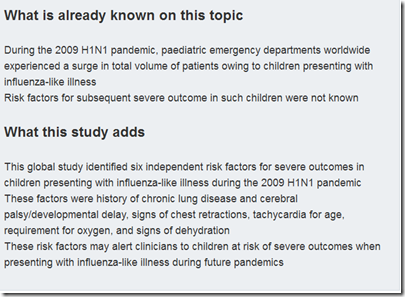
The BMJ has published this week research from an international team of medical scientists who looked at presenting symptoms and comorbidities of 265 pediatric cases from 79 emergency rooms in 12 countries presenting with the H1N1 pandemic flu. 


The team was able to identify several factors that they could associate with a higher risk of severe infection, complications, or death.


It is hoped that these findings could help guide physician decisions on treatment of children, or their admission to the hospital, in future influenza outbreaks.


First a link to the study (which is available, in full, online) then some excerpts from a news release from the University of Auckland.


Research

Predictors of severe H1N1 infection in children presenting within Pediatric Emergency Research Networks (PERN): retrospective case-control study

BMJ 2013; 347 doi: http://dx.doi.org/10.1136/bmj.f4836 (Published 12 August 2013)

Cite this as: BMJ 2013;347:f4836

Stuart R Dalziel, paediatrician, John MD Thompson, senior research fellow, Charles G Macias, associate professor, Ricardo M Fernandes, paediatrician4, David W Johnson, professor, Yehezkel Waisman, professor, Nicholas Cheng, paediatrician, Jason Acworth, paediatrician, James M Chamberlain, professor, Martin H Osmond, professor, Amy Plint, associate professor, Paolo Valerio, paediatrician, Karen JL Black, paediatrician, Eleanor Fitzpatrick, research coordinator, Amanda S Newton, assistant professor, Nathan Kuppermann, professor, Terry P Klassen, professor for the Pediatric Emergency Research Networks (PERN) H1N1 working group

Abstract

(EXCERPT)

Main outcome measures Severe outcomes included death or admission to intensive care for assisted ventilation, inotropic support, or both. Multivariable conditional logistic regression was used to compare cases and controls, with effect sizes measured as adjusted odds ratios.


Results 151 (57%) of the 265 cases were male, the median age was 6 (interquartile range 2.3-10.0) years, and 27 (10%) died. Six factors were associated with severe outcomes in children presenting with influenza-like illness: history of chronic lung disease (odds ratio 10.3, 95% confidence interval 1.5 to 69.8), history of cerebral palsy/developmental delay (10.2, 2.0 to 51.4), signs of chest retractions (9.6, 3.2 to 29.0), signs of dehydration (8.8, 1.6 to 49.3), requirement for oxygen (5.8, 2.0 to 16.2), and tachycardia relative to age).

Conclusion These independent risk factors may alert clinicians to children at risk of severe outcomes when presenting with influenza-like illness during future pandemics.

image

(Continue . . . )


The news release from the University of Auckland provides some additional background on this study.


Top risk factors identified for children during influenza pandemics

14 August 2013

Auckland medical scientists have helped to identify crucial risk factors for children most susceptible to life threatening infections from the H1N1 influenza virus.


Lead study author Dr Stuart Dalziel and senior research fellow Dr John Thompson from The University of Auckland worked with an international team of paediatric specialists to identify the risk factors.


It is the first study to detail which clinical factors in children at hospital arrival with influenza-like illness and H1N1 infection, are associated with the progressive risk to either severe infection or death.

<SNIP>

The study, which assessed each patient’s clinical history and physical examination, identified the following predictors of severe H1N1 infection and potentially fatal outcomes in children:

  • History of chronic lung disease
  • History of cerebral palsy/developmental delay
  • Signs of chest retractions (difficulty breathing)
  • Signs of dehydration
  • Requires oxygen to keep blood levels normal
  • Heart rate that exceeds normal range (tachycardia) relative to age

“Having a more accurate idea of what to look for in paediatric cases, especially during a pandemic, would be especially important to clinicians because it provides crucial guidance for those who would be trying to direct the appropriate levels of treatment for many patients in a short time,” said one of the study’s co-authors Nathan Kuppermann, professor and chair of emergency medicine at the University of California.

(Continue . . . )


We’ve seen earlier studies on the impact of the 2009 H1N1 pandemic on children, some of which have produced similar findings.


Study: Kids, Underlying Conditions, And The 2009 Pandemic Flu

Lancet: Pediatric Mortality Related To Pandemic H1N1

Study: Pediatric Neurological Complications With H1N1


While it is axiomatic that - `if you’ve seen one flu pandemic . . . you’ve seen one flu pandemic’ - many of the lessons learned from the last pandemic are still likely to prove useful during the next global health crisis.


Even if the next pandemic differs substantially from what we went through in 2009.

Monday, August 12, 2013

Proposed MicroRNA-based Strategy to Mitigate Risks Of GOF Influenza Studies

image

BSL-4 Lab Worker - Photo Credit –USAMRIID


# 7564


An interesting report appeared yesterday in the journal Nature Biotechnology that describes a potential method to help mitigate the risks of influenza GOF (Gain of Function) research.


Gain of function influenza research involves the creation (in the lab) of flu strains that have increased transmissibility, pathogenicity, or altered host range.


We looked at some of the issues (and controversies) surrounding this type of research last week in H7N9: Reigniting The `Gain Of Function’ Research Debate.


While there are multiple concerns over this type of research, one that has been cited often is the fear an `engineered’ virus could escape the lab and spark an epidemic.


Accidents and serious breaches in laboratory protocols and integrity, while rare, have occurred in the past.


One group of researchers believes that by genetically altering the influenza virus - it can be made less infectious to humans, but still transmit and infect ferrets – allowing for GOF research while reducing the risk of accidental human infection or release.


MicroRNA-based strategy to mitigate the risk of gain-of-function influenza studies

Ryan A Langlois, Randy A Albrecht, Brian Kimble, Troy Sutton, Jillian S Shapiro, Courtney Finch, Matthew Angel, Mark A Chua, Ana Silvia Gonzalez-Reiche, Kemin Xu, Daniel Perez, Adolfo García-Sastre & Benjamin R tenOever

Nature Biotechnology (2013) doi:10.1038/nbt.2666

Recent gain-of-function studies in influenza A virus H5N1 strains revealed that as few as three-amino-acid changes in the hemagglutinin protein confer the capacity for viral transmission between ferrets .


As transmission between ferrets is considered a surrogate indicator of transmissibility between humans, these studies raised concerns about the risks of gain-of-function influenza A virus research.


Here we present an approach to strengthen the biosafety of gain-of-function influenza experiments. We exploit species-specific endogenous small RNAs to restrict influenza A virus tropism. In particular, we found that the microRNA miR-192 was expressed in primary human respiratory tract epithelial cells as well as in mouse lungs but absent from the ferret respiratory tract. Incorporation of miR-192 target sites into influenza A virus did not prevent influenza replication and transmissibility in ferrets, but did attenuate influenza pathogenicity in mice.

This molecular biocontainment approach should be applicable beyond influenza A virus to minimize the risk of experiments involving other pathogenic viruses.


For more on this, The Scientist has a report describing this strategy.


Safe Flu Research Strategy

Researchers develop a new “molecular biocontainment” strategy for safely studying deadly flu viruses.

By Chris Palmer | August 12, 2013

Following a year-long, worldwide moratorium on H5N1 research stemming from fears of a global pandemic after researchers showed that the avian flu virus could be spread among ferrets, scientists have released a new “molecular biocontainment” strategy for the safe study of deadly viruses. The protocol, detailed in a paper published Sunday (August 11) in Nature Biotechnology, involves introducing viruses to be studied to human lung cells, which inactivate the viruses. 


(Continue . . . )


All of this is – quite frankly – well above my pay grade, so I pass it on without comment, and will leave it those more qualified to discuss the the merits and feasibility of this approach.

Monday, March 04, 2013

H5N1 Vaccine Research

image

BSL-3 – Credit CDC PHIL


# 6979


Seven years ago, when the H5N1 virus suddenly leapt out of a handful of southeast Asian countries to invade parts of Europe and the Middle East, pandemic concerns were understandably heightened.


As a result many countries hastened to create - or acquire - an emergency stockpile of experimental bird flu vaccine. 


In 2007, I wrote:


Switzerland has reportedly purchased 8 million doses of pre-pandemic vaccine, enough to inoculate their entire citizenry.  Denmark, it was widely reported last January, ordered in enough pre-pandemic vaccine for half of their population.  And in Australia, there has been talk of inoculating their entire nation.


New Zealand recently announced they had enough pre-pandemic vaccine on hand for 100,000 essential workers, and the UK is exploring the purchase of large quantities of vaccine.


While the WHO has never endorsed the idea, obviously there are a good many nations that view having a pre-pandemic vaccine as being a matter of national security.


Japan, Taiwan, the United States and others eventually acquired small to medium-sized quantities of H5N1 vaccine over the next couple of years.


With only a limited shelf life (usually around 3 years) - and based on an older clade of the virus - those early stockpiles have either already expired or will shortly.


While the feared bird flu pandemic has thus far failed to materialize, some countries have adopted a `use it or lose it strategy, offering the aging H5N1 jab to health care workers, veterinarians, and other high risk groups (see Hong Kong: H5N1 Vaccine Recommended For Certain Lab Workers).


Countries opting to `store’ their vaccine stockpile in the arms of healthcare and public safety workers have included Japan (see Japan Begins Pre-Pandemic Inoculation Of Health Care Workers) and Taiwan (see Taiwan Offers Public Bird Flu Vaccinations.)


Over the weekend, after the spate of H5N1 cases reported in Cambodia since the New Year, Taiwan once again announced plans to provide their H5N1 vaccine to certain high risk individuals.


Certain groups entitled to free avian flu vaccinations


2013/03/02 15:24:22

Taipei, March 2 (CNA) Taiwan has begun to provide free vaccinations against avian influenza H5N1 to people at high risk of contracting the deadly virus, such as laboratory staff, a senior health official said Saturday.

(Continue . . .)


Just as with the seasonal flu,  the H5N1 virus evolves into new clades, meaning that updated vaccines must be created and tested. The following chart from the World Health Organization shows just how much diversity the virus has acquired.


image

(click to load larger image)


While not garnering the sort of headlines that we saw in 2006-2007, researchers continue to work on creating and testing the next generation of bird flu vaccines.


Which brings us to a press release, sent to me by a reader, regarding a recent call (January, 2013) for volunteers to take part in an H5N1 vaccine clinical trial being conducted by the Wesley Research Institute in Queensland, Australia.


Wesley Research Institute conducts new bird flu vaccine study


Posted on January 14, 2013

The Wesley Research Institute Clinical Trials Centre is seeking volunteers aged 65 and over to participate in a new avian influenza (bird flu) vaccine study that may prevent the spread of infection and death.


H5N1 type influenza virus is a specific strain that resulted in rapid spread of influenza in birds and poultry (bird flu) across Asia, Europe and Africa. This strain has been associated with over 550 human cases (spread from animals) and about 320 deaths.


The number of Australians travelling overseas has grown at an unprecedented rate over recent years. 70% of Australians 60 years old and over, taking a holiday overseas in the last 12 months visited or at least stopped over at the Pacific Asia region where in 1997 the first outbreak of bird flu occurred.


The symptoms of bird flu are similar to those of other types of flu and the onset is sudden. The time from infection to the start of symptoms is usually three to five days, although in some cases it can be up to seven days. Symptoms usually last for up to a week. In many cases, bird flu can cause rapid deterioration, pneumonia (inflammation of the tissue of one or both lungs) and multiple organ failure, all of which can be fatal.


Travel safe, keep bird flu away!

You may be suitable to participate if:

  • Generally healthy
  • Aged 65 years old and over
  • Able to attend visits at The Wesley Hospital in Auchenflower

Study volunteers will be compensated for their time and travel.

DOWNLOAD FLYER


While the H5N1 virus remains a major concern, there are other avian and swine influenza viruses that are being watched closely for signs of pandemic potential as well. Accordingly, the World Health Organization regularly updates their list of candidate flu strains for vaccine research and development.


Antigenic and genetic characteristics of A(H5N1), A(H7N3), A(H9N2) and variant influenza viruses and candidate vaccine viruses developed for potential use in human vaccines

February 2013

This summary provides a review on the A(H5N1), A(H7N3), A(H9N2) and variant influenza virus activity and virus characterization, and describes the current status of the development of candidate vaccine viruses for pandemic preparedness purposes. It is meant to provide guidance for national authorities and vaccine companies on the selection of candidate viruses for use in vaccine development.