Showing posts with label history. Show all posts

Wednesday, November 26, 2014

Thanksgiving Is National Family History Day

image

Note: This is an updated (including new links) version of my yearly post on National Family History Day.


# 9375


Every year since 2004 the Surgeon General of the United States has declared Thanksgiving – a day when families traditionally gather together - as National Family History Day.


As a former paramedic, I am keenly aware of how important it is for everyone to know their personal and family medical history.  Every day emergency room doctors are faced with patients unable to remember or relay their health history during a medical crisis. And that can delay both diagnosis and treatment.


Which is why I keep a medical history form – filled out and frequently updated – in my wallet, and have urged (and have helped) my family members to do the same.


The CDC and the HHS have a couple of web pages devoted to collecting your family history, including a web-based tool to help you collect, display, and print out your family’s health history.

Family History: Collect Information for Your Child's Health

Surgeon General's Family Health History Initiative

Using this online tool, in a matter of only a few minutes, you can create a basic family medical history.  But before you can do this, you’ll need to discuss each family member’s medial history. The HHS has some advice on how to prepare for that talk:

Before You Start Your Family Health History

Americans know that family history is important to health. A recent survey found that 96 percent of Americans believe that knowing their family history is important. Yet, the same survey found that only one-third of Americans have ever tried to gather and write down their family's health history.

Here are some tips to help you being to gather information:

    I’ve highlighted several other methods of creating histories in the past, some of which you may prefer.  A few excerpts (and links) from these essays. First, I’ll show you how I create and maintain histories for my Dad (who passed away several years ago) and myself.  This was featured in an essay called A History Lesson.

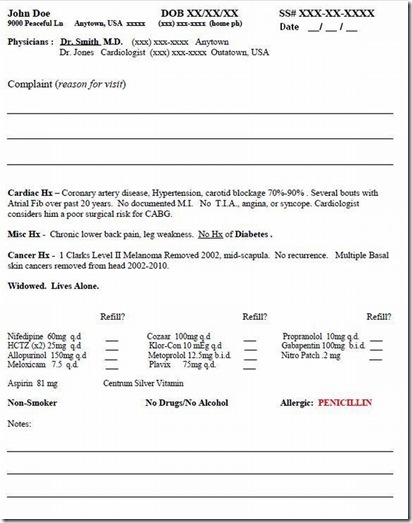
    Today I’m going to impart a little secret that will ingratiate yourself with your doctor and not only improve the care you receive, but also reduce the amount of time you spend in the exam room. When you go to your doctor, have a brief written history printed out for him or her.

    I’ve created a sample based on the one I used for my Dad (the details have been changed).   It gets updated, and goes with him, for every doctor’s visit.

    And his doctors love it.

    hxa

    While every history will be different, there are a few `rules’.

    • First, keep it to 1 page.     Even if the patient has an `extensive history’.   If your doctor can’t scan this history, and glean the highlights, in 60 seconds or less . . . it isn’t of much use.
    • Second, paint with broad strokes.   Don’t get bogged down in details.  Lab tests and such should already be in your chart.
    • Third, always fill in a reason for your visit.   Keep it short, your doctor will probably have 10 to 15 minutes to spend with you.   Have your questions and concerns down in writing before you get there.
    • Fourth, list all Meds  (Rx and otherwise) and indicate which ones you need a refill on.   If you have a question about a med, put a `?’ next to it.   And if you have any drug allergies, Highlight them.
    • Fifth,  Make two copies!   One for your doctor to keep, and one for you.  As you talk to your doctor, make notes on the bottom (bring a pen) of your copy.  

    Once you create the basic template (using any word processor), it becomes a 5 minute job to update and print two copies out for a doctor’s visit.
    The history above is great for scheduled doctor’s visits, but you also should have a readily available (preferably carried in your wallet or purse), EMERGENCY Medical History Card.

    I addressed that issue in a blog called Those Who Forget Their History . . . .   A few excerpts (but follow the link to read the whole thing):

    Since you can’t always know, in advance, when you might need medical care it is important to carry with you some kind of medical history at all times.  It can tell doctors important information about your history, medications, and allergies when you can’t.

    Many hospitals and pharmacies provide – either free, or for a very nominal sum – folding wallet medical history forms with a plastic sleeve to protect them. Alternatively, there are templates available online.

    I’ve scanned the one offered by one of our local hospitals below. It is rudimentary, but covers the basics.

    medhx1

    medhx2

    And a couple of other items, while not exactly a medical history, may merit discussion in your family as it has recently in mine.

    • First, all adults should consider having a Living Will that specifies what types of medical treatment you desire should you become incapacitated.
    • You may also wish to consider assigning someone as your Health Care Proxy, who can make decisions regarding your treatment should you be unable to do so for yourself.
    • Elderly family members with chronic health problems, or those with terminal illnesses, may even desire a home DNR (Do Not Resuscitate) Order.

    Verbal instructions by family members – even if the patient is in the last stages of an incurable illness – are likely to be ignored by emergency personnel.

    In Florida, the form must be printed on yellow paper. Different states have different requirements.  You should check with your doctor, or the local department of health to determine what the law is in your location.

    image

    My father, who’s health declined greatly in his 86th year, requested a DNR in early 2011. That – along with securing home hospice care (see His Bags Are Packed, He’s Ready To Go) – allowed him to die peacefully at home in his own bed. 

    Admittedly, not the cheeriest topic of conversation in the world, but for a lot of people, this is an important issue to address.

    A few minutes spent this holiday weekend putting together medical histories could spare you and your family a great deal of anguish down the road.

    Saturday, July 19, 2014

    Are Influenza Pandemic Viruses Members Of An Exclusive Club?

    image

    Credit - HHS Interim Pre-Pandemic Planning Guidence: Community Strategy For Pandemic Influenza Mitigation In the United States.


    # 8851


    While we watch novel avian flu strains like H5N1, H7N9, H9N2 and new upstarts like H10N8 for signs they might better adapt to humans and someday start a pandemic, there is a school of thought the holds that only H1, H2, and H3 influenza viruses have ever been known to spread efficiently in humans, and we ought to be looking more at that pool of viruses, than avian strains.


    The caveat being that our knowledge of what flu strains have infected, and spread, in humans only goes back roughly a 100 years.


    History suggests at least a dozen `influenza-like’ pandemics occurred in the 400 years prior to the 20th century, but we’ve little to no evidence to suggest what subtypes may have been responsible. 

    image


    The oldest pandemic we can be certain of was the 1918 `Spanish Flu’, which killed anywhere between 40 million and 100 million people, and was caused by an H1N1 virus, followed by H2N2 in 1957, H3N2 in 1968, and H1N1 in 2009.  

    image

    Earlier than that, the 1890-93 `Russian flu’ pandemic has generally been ascribed as to being caused by H2N2 virus, while the H3N8 virus has been tentatively pegged as causing the 1900 epidemic (see Transmissibility and geographic spread of the 1889 influenza pandemic).


    The progression of human influenza pandemics over the past 130 years has been H2, H3, H1, H2, H3, H1, H1 . . . . 


    While none of this means that an H5 or an H7 virus couldn’t adapt to humans (or hasn’t in the past), it does make one perk their ears anytime we see a novel H1, H2, or H3 influenza virus emerging in the wild.


    And in recent years – probably mostly due to better testing and surveillance – we have seen a number of these H1-H3 viruses appear.


    Back in 2007 (see The Reassortment Tango) I wrote about the discovery of a mammalian-adapted H2N3 virus, isolated in swine at two separate Missouri farms in 2006. Previously, the H2N3 virus had only been known to infect birds, and this was the first detection of an H2 influenza virus in a mammalian host since 1968, when the human H2N2 virus was supplanted by the the H3N2 pandemic virus.


    This is important as those born after 1968 are likely to have little immunity against an emerging H2 virus.


    In 2012, a PLoS One article (Recently Emerged Swine Influenza A Virus (H2N3) Causes Severe Pneumonia in Cynomolgus Macaques) found this swine H2N3 produced greater pathogenicity in a non-human primate than did the human H2N2 virus.


    Over the past five years we’ve also been watching the evolution of several swine variant viruses (H1N1v, H1N2v, H3N2v) , all of which have reassorted with - and picked up the M gene segment from – the 2009 H1N1 virus (see Keeping Our Eyes On The Prize Pig).


    Although the actual number of human swine variant flu infections that occur each year is unknown, the CDC has reported 1 or 2 cases each year since 2005. In 2010, that number jumped to 8, and in 2011, to 12. During the summer of 2012 more than 300 cases were recorded across the United States, and nearly all were linked to contract with pigs displayed at county and state fairs that summer.


    Swine are highly susceptible to a variety of flu viruses (human, swine, avian) - and are viewed as excellent `mixing vessels’, allowing viruses to reassort into new hybrid strains, a topic well covered by Helen Branswell a few years ago in a SciAm article called called Flu Factories.

    Reassortant pig[6]

    .

    Some of my earlier blogs on swine variant influenza include: H3N2v: When Pigs Flu , You Say You Want An Evolution? & The (Swine) Influenza Reassortment Puzzle while just over a week ago we looked at J. Virol: Continued Reassortment Of Swine Flu Viruses With Genes From pH1N1 In China


    But of course, it isn’t just pigs that can host, and reassort, H1, H2, and H3 flu viruses. 


    Among the more exotic hosts, last month we looked at Equine H3N8 In Mongolian Bactrian Camels, while in 2011 we saw a major die-off of seals in New England, that was eventually traced to a new mammalian adapted influenza virus mBio: A Mammalian Adapted H3N8 In Seals


    Of greater concern, however, are birds and companion animals, both of which tend to mix and mingle not only with their own kind, but with humans and other species capable of hosting flu viruses.


    Last April, the journal Biomed Environ Sci. carried a report on ` A novel reassortant H2N3 influenza virus isolated from China from a live poultry market in Guangdong province in 2009.

    RESULTS:

    The genes of this virus belong to Eurasian-lineage avian viruses. The virus is a reassortant with the HA gene from an H2N2 virus and the NA gene from an H5N3 virus. The PB1, PB2, and NP genes were from an H4N6 virus, the PA was from an H3N8 virus, the M gene was from an H1N3 virus, and the NS gene was from an H10N6 virus.

    CONCLUSION:

    A novel avian-origin reassortant H2N3 influenza virus was detected in a live poultry market. Its potential impacts and evolution should be closely monitored.


    While last Last December, in H2N2: What Went Around, Could Come Around Again, we looked at the results of a study conducted by scientists working at St. Jude Children's Research Hospital published in the Journal of Virology, that takes the most detailed look at H2N2 viruses in the wild to date, and concludes that this virus could well pose a threat to humanity again. 


    While generally regarded as being less susceptible to influenza than either birds or pigs, companion animals like dogs and cats are also viewed as potential `mixing vessels’ as well (see Study: Dogs As Potential `Mixing Vessels’ For Influenza).


    In Interspecies Transmission Of Canine H3N2 In The Laboratory, we saw another study that showed that cats (and to a far lesser degree, ferrets) were susceptible to the recently emerged Korean canine H3N2 virus. 


    And the list goes  on . . . .


    If the H1, H2, H3 human pandemic exclusivity club does indeed exist, then one could logically conclude that the next human pandemic ought to come from an H2 strain.   And there appear to be a lot of options circulating in the wild.


    But that’s a pretty big `if’.


    The idea is taken seriously enough that in 2011, in  Nature: A Preemptive H2N2 Vaccine Strike?, we looked at a bold proposal by Gary J. Nabel, Chih-Jen Wei & Julie E. Ledgerwood to Vaccinate for the next H2N2 pandemic now.  


    Like the proposal made earlier by  Dr. Klaus Stohr (see The Prime Of Our Lives), supporting the idea of global pre-pandemic vaccination against H5N1, this idea hasn’t gained much traction – primarily because trying to guess the next pandemic strain is such a crap shoot.


    Despite the pattern of H1, H2 & H3 hemagglutinin viruses causing pandemics over the past 130 years, I wouldn’t be too quick to rule out the possibility that an H5, H7, or H9  (or other exotic combination) might spark the next pandemic.   As Yogi Berra famously pointed, out – Predictions, particularly about the future, are always difficult.


    The point of this Saturday morning ramble is that we don’t have to wait for an exotic avian strain to somehow figure us out and adapt to human physiology - we could just as easily be hit by a `retread’ of a previously seen humanized virus -  much in the same way as we did in 2009 with the H1N1 pandemic.


    And with so many avian, swine, canine, equine, and other hosts out there mixing and matching flu genes, we can’t assume we have another 30 years until the next pandemic. 


    Which means maybe it is time to start talking seriously again about  pandemic preparedness – for governments, businesses, communities, and individuals.


    For some of my earlier blogs on  pandemic planning, and preparedness, you  may wish to revisit:

    NPM13: Pandemic Planning Assumptions
    The Pandemic Preparedness Messaging Dilemma
    Pandemic Planning For Business

    Monday, November 04, 2013

    Professor Peter Doherty On Pandemics & History

    image

    Credit Wikipedia


    # 7933


    Laureate Professor Peter C. Doherty (who shared the 1996 Nobel Prize for medicine for his work in immunology) divides his time between St Jude Children’s Research Hospital in Memphis and the Department of Microbiology and Immunology at the University of Melbourne.


    Professor Doherty is also an author, with several books to his credit, the latest being Pandemics: What Everyone Needs to Know (Oxford).


    Today, a long interview (by Robin Lindley) with Professor Doherty appears on George Mason University’s History News Network, where they discuss the `enormous influence’ that pandemics have had on human history.


    From Alexander the Great (who many believe died from malaria at the age of 32), to the devastating Black Death of Europe in the 1300s, to the Spanish Flu of 1918 – epidemics and pandemics have often dictated the course of human events. 


    Follow the link below to read the interview in its entirety.


    11-4-13


    Peter C. Doherty: Pandemics Have Had "Enormous Influence" on History [INTERVIEW]

    tags: public health, history of medicine, pandemics
    by Robin Lindley


    For more on Professor Doherty, you may wish to revisit the following blogs:

     
    mBio: Taubenberger et al. On the 1918 Spanish Flu
    Peter Doherty On H5N1 Research
    Prof. Peter Doherty On Influenza’s Threat
    Professor Peter Doherty On Bird Flu

    Monday, January 07, 2013

    EID Journal: A Brief History Of Quarantine


    image

    Photo Credit CDC PHIL


    # 6832


    Although controversial, and often misunderstood, quarantines have a long and successful history of helping to curb the spread of disease transmission during epidemics.


    With the emergence of SARS early in the last decade, the use of quarantines made headlines once again around the world, eliciting both praise and concern.


    Just so we are all on the same page, here is how the CDC defines Quarantine and Isolation:


    The CDC applies the term "quarantine" to more than just people. It also refers to any situation in which a building, conveyance, cargo, or animal might be thought to have been exposed to a dangerous contagious disease agent and is closed off or kept apart from others to prevent disease spread.

    Photo of doctor with patient The Centers for Disease Control and Prevention (CDC) is the U.S. government agency responsible for identifying, tracking, and controlling the spread of disease. With the help of the CDC, state and local health departments have created emergency preparedness and response plans. In addition to early detection, rapid diagnosis, and treatment with antibiotics or antivirals, these plans use two main traditional strategies—quarantine and isolation—to contain the spread of illness. These are common health care practices to control the spread of a contagious disease by limiting people's exposure to it.

    The difference between quarantine and isolation can be summed up like this:

    • Isolation applies to persons who are known to be ill with a contagious disease.
    • Quarantine applies to those who have been exposed to a contagious disease but who may or may not become ill.


    During the 2003 SARS epidemic, Isolation was used in the United States for patients who were ill, but since transmission of the virus was very limited here, quarantine was not recommended for those exposed (cite).


    In other countries, where transmission risks were greater, quarantines were used – quite successfully – in order to contain the virus. 

    • Singapore was one of the first countries to mandate quarantines when more than 800 family members of SARS patients were ordered to stay in their homes. 
    • Hong Kong sealed part of the Amoy Gardens Apartment complex after scores of cases erupted there, and later moved all remaining residents to two holiday camps where they were quarantined.
    • And Toronto, Canada closed schools and quarantined thousands in their bid to contain the virus (see The SARS Experience In Ontario, Canada).


    The graph below shows two distinct phases of disease transmission in Canada, both apparently dampened by the implementation of quarantines.


    image


    While the aggressiveness of quarantine measures taken in Toronto have been criticized by some (see Severe acute respiratory syndrome: Did quarantine help?), many experts have stated that quarantining those exposed (usually in their own homes) helped to halt the epidemic.


    A 2003 MMWR report from China’s CDC, called Efficiency of quarantine during an epidemic of severe acute respiratory syndrome--Beijing, China, 2003 found:


    The use of quarantine, in combination with enhanced surveillance, isolation of SARS patients, and comprehensive use of PPE by health-care workers, appears to have been effective in controlling the recent epidemic of SARS in Beijing.


    Limiting quarantine to persons who have contact with an actively ill SARS patient will likely improve the efficiency of quarantine and allow for better focus of resources in future outbreaks.


    Disease transmission dynamics are different with different pathogens, so the lessons from SARS may not be applicable to the next pandemic.  


    All of which serves as prelude to an interesting look at the history of quarantine through the ages that appears today in the CDC’s EID Journal.


    Historical Review

    Lessons from the History of Quarantine, from Plague to Influenza A

    Eugenia Tognotti
    Abstract

    In the new millennium, the centuries-old strategy of quarantine is becoming a powerful component of the public health response to emerging and reemerging infectious diseases. During the 2003 pandemic of severe acute respiratory syndrome, the use of quarantine, border controls, contact tracing, and surveillance proved effective in containing the global threat in just over 3 months. For centuries, these practices have been the cornerstone of organized responses to infectious disease outbreaks.


    However, the use of quarantine and other measures for controlling epidemic diseases has always been controversial because such strategies raise political, ethical, and socioeconomic issues and require a careful balance between public interest and individual rights.


    In a globalized world that is becoming ever more vulnerable to communicable diseases, a historical perspective can help clarify the use and implications of a still-valid public health strategy.

    (Continue . . . )


    While unlikely ever to be popular (particularly among those caught up in one) – with novel emerging infectious diseases like SARS  - particularly early in an outbreak, quarantines may be the only effective tool that public health officials have in their arsenal.


    That said, the value of quarantines tends to diminish quickly as the number of cases, and geographic spread of a disease, increases.

    Friday, December 14, 2012

    The 1919 Influenza Blues . . .


    image

    Arhoolie F-1018  Released in the 1960s Essie Jenkins et al.


    # 6782


    As it’s Friday, and some of my other interests run towards vintage audio recordings (and OTR: Old Time Radio), I was delighted to see a tweet by fellow blogger Jim Garrow ( @jgarrow & The Face of the Matter Blog) alerting his followers to a piece that appears today in Philly.com.


    From 'TB Blues' to 'Bacteria': A musical medical history playlist

    POSTED: Friday, December 14, 2012, 6:30 AM


    You’ll find links to songs by a couple of early pioneers of American `Folk Music’ – Woody Guthrie and Jimmie Rogers – along with a  prohibition song by a lesser known, but still prolific in the 1920s & 30s, Asa Martin.


    Essie Jenkins delivers the 1919 Influenza Blues. Regrettably, I’m unable to find much about her online.


    Rounding out this old time playlist is a new entry, called Bacteria put together by Jonathan Coulton, cleverly using resampled audio from a KFC training video.

    Thursday, October 18, 2012

    University of Michigan: Influenza Encyclopedia 1918-1919

    image

    The Motor Corps of St. Louis chapter of the American Red Cross on ambulance duty during the influenza epidemic, October 1918. Photo Credit – UM Influenza Encyclopedia Image Gallery


    # 6641


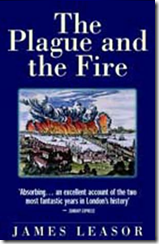
    I confess to being a major medical history buff, a predilection that began nearly a half century ago when I read James Leasor’s account of two pivotal years in the history of London (1665-1666) - which began with the Great plague, and ended with the Fire of London.


    image


    In the 1970s, after the Swine Flu scare of 1976 (see my account of that event in Deja Flu, All Over Again.), I often asked my patients (who had been teenagers or young adults in 1918) about their memories of the 1918 Spanish Flu.


    And I’m currently reading (a gift from a friend: thanks, John)  Infectio., a fascinating history of infectious diseases and their early treatments, by Werner Schreiber and Friedrich Karl Mathys.


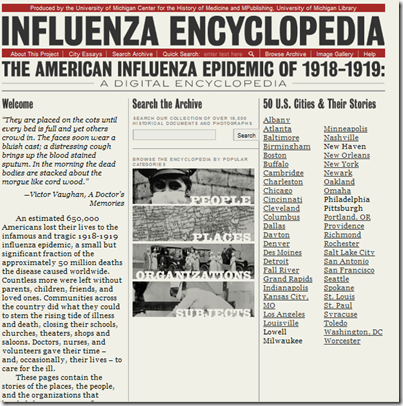
    So I was particularly pleased to get a head’s up overnight from Eric Starbuck that the University of Michigan’s Center for the History Of Medicine has published their impressive digital encyclopedia (containing more than 18,000 historical documents) of the 1918 Spanish Flu Pandemic.


    image


    I’m just beginning to explore this site, but I’m very impressed with what I’ve seen so far.  Not only as a chronicle of the great pandemic, but also as a glimpse back at life in the United States nearly 95 years ago.


    With this much to explore, I fear I won’t get much work done today.  But nevertheless . . .


    Highly recommended.

    Monday, October 08, 2012

    Diary From The HMNZ Tahiti During The 1918 Pandemic

    image

    Troop Ship Tahiti in Wellington Harbor, circa 1918-19  Unknown Photographer


    # 6617


    For years historians, epidemiologists, and virologists have been attempting to peel back the cobwebs of time in order to analyze the deadliest pandemic in human history; the 1918 Spanish Flu Pandemic.


    John Barry’s The Great Influenza: The Epic Story of the Greatest Plague in History, has probably done more to reawaken memories of that awful time than any other source, but many gaps in our knowledge remain.


    Jeffrey  K. Taubenberger and David Morens - both researchers at NIAID – have added considerably to our understanding of the H1N1 virus and the events surrounding its emergence. Taubenberger was the first to sequence the the genome of the 1918 Spanish Flu virus while David Morens is a prominent medical historian.


    See Morens & Taubenberger on Influenza’s History for a fascinating look back at influenza through the ages. Highly recommended.


    Spanish Flu broke out in the spring and summer of 1918, while WWI was still underway. It so devastated troops on both sides of the conflict that historians believed it helped to hasten the end of the war.


    Soldiers and sailors – living in cramped and often unhygienic quarters – bore the early brunt of the pandemic, while troop trains and ships helped to spread it around the globe.


    While there are many horrific accounts from the pandemic – including some small villages in Alaska entirely wiped out – some of the best documented events occurred onboard troop ships. 


    One of the most famous was the HMNZ Troop Carrier Tahiti, which during August-September of 1918 carried 1217 troops and crew (almost double what the ship was rated to carry) from New Zealand to Plymouth, England with provisioning stops at Cape Town and Sierra Leone. 


    Since fever was reported in Sierra Leone, no crew or passengers reportedly went ashore , but locals came aboard to coal the ship.  Within a few days of leaving port, half the men on the ship were sick, and in a matter of days, more than 80 would perish.


    The University of Otago has an well done 1-page synopsis of the investigation, which you can access here.


    image


    The detailed report, on which this exhibit is based, appeared in the CDC’s EID Journal in December of 2010.

    Historical Review

    Mortality Risk Factors for Pandemic Influenza on New Zealand Troop Ship, 1918

    Jennifer A. SummersComments to Author , Nick Wilson, Michael G. Baker, and G. Dennis Shanks


    Adding another dimension to this story, Jennifer A. Summers returns to the October, 2012 edition of the EID Journal with excerpts from a recently uncovered diary, kept by one of the troops aboard that ship.


    Pandemic Influenza Outbreak on Troop Ship—Diary of a Soldier in 1918

    Jennifer A. Summers
    Abstract

    A newly identified diary from a soldier in 1918 describes aspects of a troop ship outbreak of pandemic influenza. This diary is the only known document that describes this outbreak and provides information not officially documented concerning possible risk factors such as overcrowding and the suboptimal outbreak response by military leaders. It also presents an independent personal perspective of this overwhelming experience.

    (Continue . . . )


    The diary entries make fascinating reading, as does the commentary provided by the author. Well worth following the link and to read in its entirety.


    For more on the history and impact of the 1918 Spanish flu, you may wish to pay a visit to Flu.gov’s Pandemic history page, with offerings such as:


    Sunday, August 05, 2012

    Novel Viruses & Chekhov’s Gun


    # 6475


    Although the attribution is suspect, there is an old adage in literary circles – credited most often to Russian playwright Anton Chekhov – that if you show a gun hanging on the wall in the first act, it absolutely must go off by the third.


    It is such a well used device, that I suspect it leads many people to believe we are on the brink of a pandemic every time a novel influenza virus is reported in humans.


    Fortunately, emerging infectious diseases are not compelled to follow the dictums of modern literary convention. New flu viruses are constantly cropping up in humans, but only rarely do they portend a pandemic.

    With headlines last month on a novel H3N8 `Seal flu’ with supposed pandemic potential, and several small clusters of H3N2v swine flu infections in the Midwest over the past few weeks, today seemed like a good day take a historical look at a few viral contenders that tried, and failed, to spark a pandemic.

    Novel flu viruses are most likely to be zoonotic; jumping from another animal species to man, either directly, or through an intermediary host, or via reassortment. 

    image

    Over the past 100 years, we’ve seen four of these viral jumps spark a pandemic. The H1N1 pandemic of 1918, the H2N2 pandemic of 1957, H3N2 in 1968, and novel H1N1 in 2009.

    Flu Timeline 2010

    But interspersed among these global pandemics have been numerous novel viruses that have infected humans and yet ultimately failed to produce a pandemic.


    The most obvious example is the H5N1 virus, which first appeared 15 years ago in Hong Kong - and after a 5 year hiatus - returned in 2003.


    Since that time has infected more than 600 people.


    Yet despite morphing into more than 20 distinct clades, and spreading from Asia to Europe and the Middle East, this virus remains poorly adapted to human physiology and has (thus far) proved incapable of sparking a pandemic.


    The caveat being, that this could change.


    H5N1, like all flu viruses, is constantly evolving.  As long as it is out there, it poses a potential pandemic threat.


    Similarly, we’ve seen scattered human infections by the H9N2 avian virus, and sporadic attempts by various strains of the H7 avian virus to jump to man.


    • In 2003 an outbreak of H7N7 at a poultry farm in the Netherlands went on to infect at least 89 people. Most of the victims were only mildly affected, but one person died.
    • In 2004 two people in British Columbia tested positive for H7N3 (see Health Canada Report) during an outbreak that resulted in the culling of 19 million birds.
    • In 2006 and 2007 there were a small number of human infections in Great Britain caused by H7N3 (n=1)  and H7N2 (n=4), again producing mild symptoms.


    But beyond these avian strains, we’ve seen human adapted flu viruses that have threatened – but ultimately failed – to spark a pandemic.


    The first example comes from shortly after the end of WWII with what would become known as the `pseudo-pandemic’ or vaccine failure of 1947.


    Fearing that crowded ships and barracks could give rise to a reprise of the 1918 pandemic, the United States Military  commissioned Dr. Thomas Francis of the University of Michigan and his protégé Jonas Salk to come up with a viable influenza vaccine in 1943.


    Within a year a vaccine based on the 1934 and 1943 flu strains was in wide use in the military, and for several years the Francis/Salk vaccine worked well.


    But in 1947, a new variant of the H1N1 virus appeared on military bases in Japan,and quickly spread from there infecting hundreds of millions around the globe (see 2002 PNAS article).


    While it produced a generally mild illness, and few excess deaths, this new strain apparently had drifted enough antigenically to evade both the vaccine and community immunity acquired from earlier strains.


    Had it been more virulent, the 1947 flu virus might well have been considered a pandemic.  Today it is barely remembered, except by virologists.


    Four years later, a far more ominous flu strain made a brief appearance during the 1950-51 flu season.


    For about six weeks, a highly virulent influenza erupted in Liverpool, England and then spread across the UK and to Eastern Canada.


    For a time, it was as deadly as the 1918 pandemic.

    image

    This startling graphic comes from the March 16th, 1951 Proceedings of The Royal Society of Medicinepage 19 – and shows in detail the tremendous spike in influenza deaths in early 1951 over the (admittedly, unusually mild) 1948 flu season. 


    The CDC's EID Journal  has a stellar account of this 1951 event, and is very much worth reading.


    Viboud C, Tam T, Fleming D, Miller MA, Simonsen L. 1951 influenza epidemic, England and Wales, Canada, and the United States. Emerg Infect Dis [serial on the Internet]. 2006 Apr [date cited].


    Despite its virulence, and obvious ability to spread efficiently from human-to-human, this virus died out as suddenly and mysteriously as it appeared.  


    It remains a medical mystery.


    Fast forward to  February 1976, and a young recruit at Ft. Dix, New Jersey fell ill and died from a virus that was later isolated and dubbed A/New Jersey/76 (Hsw1N1).


    This swine-flu virus went on to infect more than 200 soldiers on the base, and caused severe respiratory disease in 13 of them. How and why it appeared in New Jersey remains unknown.


    While the death rate was very low, this virus appeared to easily transmissible among humans. This led to the swine flu pandemic scare of 1976, which I chronicled several years ago in Deja Flu, All Over Again


    The feared swine flu pandemic never materialized, and for reasons we cannot explain, the virus simply disappeared.


    In the `close but no cigar’ category,  a year later we did see an epidemic - at least among children - with the return of the H1N1 virus after a 20 year absence. It was dubbed the `Russian Flu’, as it was believed to have escaped from a Russian research laboratory.


    Given the limits of testing and surveillance, there have most certainly been other failed viruses – of which we are unaware – that simply `flu beneath our radar’


    In recent years we’ve also seen a number of  non-flu viruses, such as the 2003 SARS outbreak, Clusters Of HEV68 Respiratory Infections, and various adenovirus outbreaks, that have produced illness and concerns, but no pandemic.


    None of this tells us what will become of the H3N2v swine flu virus, or any of the other novel strains that are currently out there. Another pandemic will occur.  We just don’t know when, or from what source.


    But it does provide some perspective.


    While all pandemics are caused by novel viruses, not all novel viruses produce pandemics.


    Emerging viruses deserve our attention and respect, and H3N2v is certainly no exception. In time, this variant virus may prove to be a significant public health threat.


    But as we watch these myriad novel viruses crop up around the globe, it should provide some solace to remember: history shows us that in the world of emerging infectious diseases . . .


    . . .  by the time act III comes along – we often find that Chekhov’s gun is loaded with blanks.

    Friday, November 25, 2011

    Pseudo Pandemics And Viral Interlopers


    # 5978


    With the recent detections of a novel trH3N2 virus (see MMWR dispatch) among a handful of people across four states, today seems like a opportune time to look back at some viral contenders that threatened . . . but failed to produce a full blown pandemic.


    Given that surveillance and testing methods have improved over the years, it is possible (perhaps even likely) that similar novel influenza viruses have briefly emerged in the past and simply gone undetected.


    image


    But interspersed between the pandemics of 1918, 1957, 1968 and 2009 we are aware of at least four other influenza strains that could have sparked a pandemic, but didn’t.


    One was extremely mild and widespread, another extremely virulent but geographically limited and short lived, the third disappeared mysteriously, and the fourth affected mostly children and adolescents.


    The first example comes from shortly after the end of WWII with what would become known as the `pseudo-pandemic’ or vaccine failure of 1947.


    In 1943, the US military – fearing that crowded ships and barracks could give rise to a reprise of the 1918 pandemic – commissioned Dr. Thomas Francis of the University of Michigan and his protégé Jonas Salk to come up with a viable influenza vaccine.  


    Within a year a vaccine based on the 1934 and 1943 flu strains was in wide use in the military, and for several years the Francis/Salk vaccine worked well. 


    But in 1947, a new variant of the H1N1 virus appeared on military bases – first in Japan – and quickly spread from there infecting hundreds of millions around the globe (see 2002 PNAS article).


    While it produced a generally mild illness, and few excess deaths, this new strain apparently had drifted enough antigenically to evade both the vaccine and community immunity acquired from earlier strains.


    1947 is little remembered today, except for the lesson it taught us; that vaccines must be updated each year to take into account antigenic drift (or newly emerging flu strains).


    Four years later, a far more ominous viral strain made an appearance on the global stage, during what was an otherwise mild and unremarkable 1950-51 flu season. 


    This outbreak is commonly called the Liverpool Flu.


    For about six weeks, a highly virulent influenza erupted in Liverpool, England and then spread across the UK and to Canada – that for a time was as deadly as the 1918 pandemic.


    image


    This startling graphic comes from the March 16th, 1951 Proceedings of The Royal Society of Medicinepage 19 – and shows in detail the tremendous spike in influenza deaths in early 1951 over the (admittedly, unusually mild) 1948 flu season. 


    The CDC's EID Journal  has a stellar account of this 1951 event, and is very much worth reading.


    Viboud C, Tam T, Fleming D, Miller MA, Simonsen L. 1951 influenza epidemic, England and Wales, Canada, and the United States. Emerg Infect Dis [serial on the Internet]. 2006 Apr [date cited].


    This aberrant strain never spread much beyond the UK and eastern Canada, and died out as the flu season came to a close. Thankfully, it did not return the following year. 


    What made it so virulent, and why it failed to return the following year, remains a medical mystery.


    The 1957 and 1968 pandemics – while mild in comparison to the Spanish Flu of 1918 – followed.


    In February of 1976, a young recruit at Ft. Dix, New Jersey fell ill and died within 24 hours. The virus went on to infect more than 200 soldiers and caused severe respiratory disease in 13 of them. It circulated on the base for nearly a month.


    The virus was isolated and dubbed A/New Jersey/76 (Hsw1N1). How it arrived on the base was unknown. While the death rate was very low, this virus appeared to easily transmissible among humans.


    And the fear was, it might develop a higher mortality rate as it mutated.


    This led to the swine flu pandemic scare of 1976, which I chronicled several years ago in Deja Flu, All Over Again


    The feared swine flu pandemic never materialized, and for reasons we cannot explain, the virus simply disappeared.


    But a year later, we did see an epidemic, at least among children, with the return of the H1N1 virus after a 20 year absence.


    The 1918 H1N1 virus, and its descendents, monopolized the world’s influenza scene for nearly 40 years until the H2N2 strain appeared in 1957, and replaced it. Another replacement occurred in 1968, when the H3N2 strain supplanted H2N2.


    It appeared that in the normal scheme of things, only one major Influenza A strain could circulate at a time.


    But that theory was turned on its head when, in 1977, H1N1 resurfaced. How and why it returned is a mystery, although many believe it was the result of an accidental release from a Russian or Chinese research laboratory (see Vince Racaniello’s  Origin of current influenza H1N1 virus).


    It was dubbed the `Russian Flu’, and quickly spread among the under-20-somethings who had no immunity. 


    But this time things were different. It didn’t replace or drive out the existing (H3N2) virus.


    The two strains (H3N2 and H1N1) co-circulated, and since then having two main `A’ strains in circulation (along with some `B’ viruses) has become the norm.


    The reason most commonly given is that older people were less affected by the returning H1N1 virus – since those born before 1957 had previous exposure – and so they remained a reservoir of the H3N2 virus.


    The seasonal H1N1 virus was supplanted in 2009 by the arrival of the  pandemic H1N1 virus, which, while no longer a pandemic strain, co-circulates today with H3N2.


    None of this tells us what will become of the trH3N2 virus we are currently watching, or any of the other novel strains that we’ve seen jump to humans over the past few years.


    But it does provide some perspective.


    It shows that new, emerging influenza viruses can appear - and even transmit efficiently among humans –and still fail to spark a global pandemic. These viral interlopers can sometimes simply run out of steam and die out, for no discernable reason. 


    And even if one spreads globally – as we saw in 1947 – it can turn out to be exceedingly mild.


    Of course, the opposite can be true. The pandemics of 1918, 1957, 1968, and 2009 show us that.


    The bottom line is that influenza viruses are notoriously unpredictable. They certainly deserve our attention and respect.


    Whether trH3N2 becomes a contender, or ends up a footnote in the history of influenza, is something we will have to wait to see.


    But with a wide constellation of viruses out there, constantly evolving, looking for new hosts and an evolutionary advantage, the smart money is on being prepared.


    Because, regardless of its source, pandemics happen.


    It’s just a matter of time.

    Thursday, January 06, 2011

    UK: Revisiting An Earlier Flu Epidemic


    # 5207


    As the UK struggles with a serious outbreak of influenza, the Guardian.co.uk  newspaper has reprinted a 60 year-old tidbit from their archives, harkening back to another – much worse – flu season.


    I present this cautionary tale as a reminder that influenza is utterly unpredictable, and deserving of our respect. It is not offered as a prediction of how the current UK outbreak will progress.


    A little background, and then a link to the article.


    Regular readers of this blog, and those with eclectic historical interests, are probably aware of the short-lived, but devastating `Liverpool’ flu outbreak of 1951. It is an intriguing bit of influenza lore that I’ve written about several times (including here and here).


    Briefly: During an otherwise unremarkable and mild influenza season, for about six weeks, a highly virulent influenza erupted in Liverpool, England and then spread across the UK and to Canada – that for a time was as deadly as the 1918 pandemic.


    image

    This startling graphic comes from the March 16th, 1951 Proceedings of The Royal Society of Medicinepage 19 – and shows in detail the tremendous spike in influenza deaths in early 1951 over the (admittedly, unusually mild) 1948 flu season. 


    The CDC's EID Journal  has a stellar account of this 1951 event, and is very much worth reading.


    Viboud C, Tam T, Fleming D, Miller MA, Simonsen L. 1951 influenza epidemic, England and Wales, Canada, and the United States. Emerg Infect Dis [serial on the Internet]. 2006 Apr [date cited].


    This aberrant strain never spread much beyond the UK and eastern Canada, and died out as the flu season came to a close. Thankfully, it did not return the following year. 


    What made it so virulent remains a medical mystery.


    The newspaper article below comes from the early days of that outbreak, before the full impact of the epidemic was apparent.   For disease history buffs like myself, a fascinating snapshot in time.


    From the archive, 6 January 1951: South Lancashire badly hit by influenza epidemic. Fight to maintain essential services.

    Originally published in the Manchester Guardian on 6 January 1951

    Fresh cases of influenza are still being notified in South Lancashire towns as the epidemic, which has seriously affected postal, rail, and municipal transport services and industry, continues. In Warrington there are now more than three thousand cases, and three hundred new medical certificates, mainly for influenza, were handed in yesterday at the local office of the Ministry of National Insurance.

    A third of the staff at the town's main railway station are suffering from the illness and auxiliary postmen have been called in to help the Post Office. All visits to hospital maternity homes and old people's homes in the town have been cancelled indefinitely.


    (Continue . . . )


    Now . . .  about getting that yearly flu shot.