Showing posts sorted by relevance for query NPM13. Sort by date Show all posts

Saturday, September 14, 2013

NPM13: A Whole Lotta Shakeouts Going On

image

Note: This is day 14 of National Preparedness Month.  Follow this year’s campaign on Twitter by searching for the #NPM or #NPM13 hash tag.

This month, as part of NPM13, I’ll be rerunning some updated  preparedness essays (like this one) , along with some new ones.

# 7773


The Great California Shakeout drill, which began in 2008, has now generated more than 20 spinoffs around the world, and most of those drills are scheduled for the month of October.

image

(click image to visit Shakeout.org)


Millions of residents, from the United States and Canada, to New Zealand, Italy, and Japan, will take part in this yearly Drop, Cover, & Hold On drill. A video, demonstrating the technique is available on the California Shakeout Youtube Channel.


If you live in any of these regions, I would encourage you to participate in, and support, these annual disaster drills.


As you can see by the map below, much of United States is seismically active – with Alaska, Hawaii, the west coast, and the Midwest seeing the most – and strongest, quakes.

image

USGS map

In 2011, in Estimating The Economic Impact Of A San Andreas Quake, we looked at a report from the U.S. Bureau of Labor Statistics that endeavored to gauge the crippling impact that a highly feasible (and long overdue) 7.8 magnitude Southern California earthquake would have on jobs and local businesses.

image

Download PDF file

A quake of this magnitude, they estimate, could affect  430,000 businesses and 4.5 million workers and deliver a devastating – and prolonged – blow to the local economy.

While huge death tolls are considered unlikely in this scenario, the untimely demise of thousands of unprepared businesses is all but assured.


One of the most vulnerable areas to earthquakes (and tsunamis) in North America is the Pacific Northwest, where just over 311 years ago an earthquake and tsunami – likely on par with this year’s disastrous quake in Japan - struck the coastline.

image

You’ll find a greater description of this event, along with videos and simulations showing what a similar event today would produce, in my essay Just A Matter Of Time.


Since we can’t prevent earthquakes, or predict them, the only recourse is to prepare for them . . .  as individuals, businesses, and communities.


For a comprehensive guide on how you can prepare for `the big one’ (even if you live someplace other than Los Angeles), I would recommend you download, read, and implement the advice provided by the The L. A. County Emergency Survival Guide.

image


And even those who do not live in an earthquake zone can be affected when a large earthquake, or volcanic eruption, occurs . . . even if it is thousands of miles away.


Large earthquakes can generate massive tsunamis, which can travel thousands of miles in a matter of a few hours.  We’ve looked at the United State’s tsunami risks recently, in NPM13: The USGS West Coast Tsunami Scenario Report & East Coast Tsunami Threats.


Volcanic eruptions can affect large areas of the globe as well.


  • When Mount Pinatubo erupted in the Philippines in 1991, within a year its aerosol cloud had dispersed around the globe, resulting in `an overall cooling of perhaps as large as -0.4°C over large parts of the Earth in 1992-93’ (see USGS The Atmospheric Impact of the 1991 Mount Pinatubo Eruption).
  • And In 1783 the Craters of Laki in Iceland erupted and over the next 8 months spewed clouds of clouds of deadly hydrofluoric acid & Sulphur Dioxide, killing over half of Iceland’s livestock and roughly 25% of their human population. These noxious clouds drifted over Europe, and resulted in widespread crop failures and thousands of deaths from direct exposure to these fumes.  A repeat of this scenario is still considered a serious threat (see UK: Civil Threat Risk Assessment)


Which is why everyone should have a disaster plan, not just those who live in an earthquake or hurricane prone area.


For more on  disaster preparedness, I would invite you to visit:


When 72 Hours Isn’t Enough

The L. A. County Emergency Survival Guide

An Appropriate Level Of Preparedness

Tuesday, September 17, 2013

NPM13: The Ethics Of Preparedness

image

Note: This is day 17 of National Preparedness Month.  Follow this year’s campaign on Twitter by searching for the #NPM or #NPM13 hash tag.

This month, as part of NPM13, I’ll be rerunning some updated  preparedness essays (like this one) , along with some new ones.


# 7781


Having spent most of my adult life as a prepper (see NPM13: The Making Of A Prepper), I admit I come away from viewing cable shows like Doomsday Preppers on the National Geographic Channel and Doomsday Bunkers on the Discovery Channel with a certain uneasiness.


The vivid doomsday scenarios and over-the-top preparations may make for entertaining TV, but they are hardly representative of the mainstream preparedness movement.


When FEMA, Ready.gov, and the American Red Cross encourage us to prepare for emergencies, they aren’t asking us to dig a bunker, acquire an arsenal, or stockpile 20 years worth of freeze dried foods.


They are hoping for a more reasoned response (see NPM12: Everyday Preppers).


But even if we are talking about a week or two worth of emergency supplies, there are some who view the idea that preparing – when others with limited financial means cannot - is somehow unfair, or even unethical.


A noble and egalitarian sounding idea, I suppose.


But the reality is that when more people are prepared before a crisis, fewer people will be competing for finite and sometimes slow-to-arrive emergency assistance in the days following a disaster.


And when you as an individual, family, or business are prepared, you are in a better position to offer help to friends, neighbors, relatives, or your community.


Which makes prepping not only ethical, but extremely practical as well.


And it isn’t just me saying that.


In October, 2008 I wrote a blog which highlighted the John's Hopkins Study entitled Ethics and Severe Pandemic Influenza: Maintaining Essential Functions through a Fair and Considered Response.

It included the following snippet from the summary provided by the Johns Hopkins Berman Institute of Bioethics.


. . .  individuals and families who can afford it should do their best to prepare for any disaster. The paper notes, the more initiative the general public exercises in stockpiling several weeks' worth of food, water, paper goods, batteries medicines, and other needed supplies, the less vulnerable they will be to a break in the supply chain.

It is important for leaders to communicate to the middle class and the wealthy that it is their responsibility to prepare for self-sufficiency in order to free up scarce supplies and allow first responders to direct their attention towards those too poor or vulnerable to prepare themselves.


While this may not have been the main thrust of this paper's message, it is a powerful component. One that bloggers such as myself have been trying to promote for several years.


As long as our supply chains are intact, grocery store shelves are full and capable of being restocked, and no major shortages exist it is not hoarding, selfish, or unethical to be stockpiling a reasonable amount of emergency supplies for you, your family, and others you might be able to assist during a disaster.


During a crisis, relief agencies will have their hands full trying to help those who were unable to prepare, or who lost their preps due to a disaster.


By being prepared in advance, you take some of that burden off these agencies, which will allow them to concentrate their efforts on helping those less able to help themselves.


And by being prepared, you are in a better position to help others as well.


And that’s a win-win situation. For you, your family, and your whole community.


While 72 hours is considered the minimum amount of  time for which you and your family should be prepared, there is nothing that says you shouldn’t strive to do better than that.


A week or more of emergency supplies (along with an emergency NWS radio, first aid kit, and a family disaster plan) is a laudable, and easily obtainable, goal.


Over the past decade, personal and community preparedness has become a national goal, promoted by many agencies, including::


FEMA http://www.fema.gov/index.shtm

READY.GOV http://www.ready.gov/


For more preparedness information, you can search this blog  at this link.

It’s really the ethical thing to do.

Monday, September 30, 2013

NPM13: Everyday Preppers

image


Note: This is day 30 of National Preparedness Month.  Follow this year’s campaign on Twitter by searching for the #NPM or #NPM13 hash tag.

This month, as part of NPM13, I’ll be rerunning some updated  preparedness essays, along with some new ones.


# 7824


National Preparedness Month comes to a close today, and once again AFD is proud to have been part of the Ready.gov/FEMA coalition.  Over the past 30 days I’ve posted 20 preparedness essays (link) on topics ranging from family communications plans to radiological emergencies to the ethics of prepping.  Of course, preparedness is a year-round activity, not just something we think about in September.


My preparedness background evolved out of necessity (see NPM13: The Making Of A Prepper), not some fear of an imminent apocalypse. First due to my profession (paramedic), then by my ten years of living aboard a cruising sailboat, followed by a decade in the backwoods of Missouri.


The popularity of Doomsday Preppers on the National Geographic Channel  probably has a lot of people believing that preppers are all getting set for the impending apocalyptic collapse of society.  But for the vast majority of us who embrace the preparedness lifestyle - it is the far more common localized disaster that spurs us on:


. .. hurricanes, tornadoes, ice storms, blizzards, earthquakes, floods (and yes, even a pandemic)  . . . along with even more limited emergencies like house fires, car accidents, or personal accident and injury.


They happen with surprising regularity - and unlike an abrupt 30 degree shift of the earth’s crust or the eruption of the Yellowstone Super Volcano - are something being prepared for is actually likely to help.


But if you want decent cable TV ratings, you don’t profile those who maintain a 14 day supply of food and water in their pantry, volunteer for CERT, have a well thought out family emergency plan, or take pride in keeping a well stocked first aid kit.


No . . .  you focus on families with elaborate secret underground bunkers, a 20 year supply of freeze-dried foods, weapons capable of taking down Godzilla with one well-placed shot, and a firm belief that the end is nigh.


It is TV, after all.


But there are many legitimate disaster threats out there, and emergency planners (of which I was one, years ago) know that during any medium-to-large scale disaster, emergency assistance may take days to reach some of those affected, and essential services (water, power, EMS, etc) may be disrupted for weeks.


Which is why FEMA, READY.GOV, and many other agencies actively promote personal, family, and business preparedness. To that end the Federal government has produced copious toolkits, brochures, pamphlets, and even mobile apps designed to help citizens prepare . . . for just about anything.


One such toolkit is FEMA’s Are You Ready? An In-depth Guide to Citizen Preparedness (IS-22) – which, at 204 pages – ranks as one of the most comprehensive guides to public preparedness available.

image

FEMA describes this guide as:

An In-depth Guide to Citizen Preparedness

Are You Ready? An In-depth Guide to Citizen Preparedness (IS-22) is FEMA’s most comprehensive source on individual, family and community preparedness. The guide has been revised, updated and enhanced in August 2004 to provide the public with the most current and up-to-date disaster preparedness information available.

Are You Ready? provides a step-by-step approach to disaster preparedness by walking the reader through how to get informed about local emergency plans, how to identify hazards that affect their local area and how to develop and maintain an emergency communications plan and disaster supplies kit. Other topics covered include evacuation, emergency public shelters, animals in disaster and information specific to people with access and functional needs.

Are You Ready? also provides in-depth information on specific hazards including what to do before, during and after each hazard type. The following hazards are covered: Floods, Tornadoes, Hurricanes, Thunderstorms and Lightning, Winter Storms and Extreme Cold, Extreme Heat, Earthquakes, Volcanoes, Landslide and Debris Flows (Mudslide), Tsunamis, Fires, Wildfires, Hazardous Materials Incidents, Household Chemical Emergencies, Nuclear Power Plant and Terrorism (including Explosion, Biological, Chemical, Nuclear and Radiological hazards).

(Continue . . . )


Disasters happen.


And while they don’t often occur on a national or international scale (an assumption with which residents of Haiti, Pakistan, and Japan might just take exception), they can be devastating to large segments of our population.


Admittedly, a lot of the preparations highlighted by these `survivalist’ genre TV shows seem to be more than a little screwy, even to this lifelong prepper . . .


But having no plan . . . well that’s just plain nuts.

Sunday, September 15, 2013

NPM13: Your Daily Threat Assessment Briefing

image

Photo Credit- NOAA Know your Risk


Note: This is day 15 of National Preparedness Month.  Follow this year’s campaign on Twitter by searching for the #NPM or #NPM13 hash tag.

This month, as part of NPM13, I’ll be rerunning some updated  preparedness essays (like this one) , along with some new ones.


# 7774


Every day busy CEOs along with investors, emergency planners, politicians- and even the President of the United States - receive specialized Daily Intelligence briefings outlining current or anticipated threats, along with other vital information.


While you may not hold the fate of nations, a billion dollar portfolio, or a fortune 500 company in your hands you do have a need to know your risks if you want you and your family to be prepared for a disaster.


And those risks can, and do, change on a daily basis. Particularly those involving climate and weather.


Fortunately, the Internet makes it easy to create a short list of websites to visit each day (I do so early each morning) that in a few short minutes will give you an early warning of what threats might be expected in the next few days.


Depending where you live, and where your personal interests lie, you will probably want to customize your `daily briefing’.  But to get you started, a quick tour of mine.


Note: I quickly scan these websites for news, alerts, or forecasts of interest for my region.  I certainly don’t attempt to read them in depth each day.


First stop, NOAAWatch’s Daily Briefing which provides an excellent overview of the natural threats facing the nation.

image

More than just weather, this NOAA page also tracks other natural threats such as earthquakes, volcanoes, and wildfires.

image


My second stop is usually NOAA’s Storm Prediction Center, which looks ahead as far as a week for areas that may expect severe weather.  At a glance I can see when, and where, weather trouble is expected.  This is particularly important during the spring and summer tornado season.

image

And during hurricane season, I also swing by the National Hurricane Center website each morning (and if there is an active storm, several times each day).

image

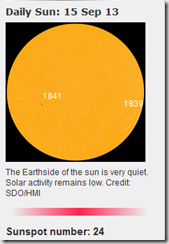
Although the sun remains unusually quiet, scientists believe we should hit the Solar Maximum over the next few months , so I also swing by Spaceweather.com or NOAA’s SPACE WEATHER PREDICTION CENTER for the latest on solar activity. 

image

And last, but not least, I visit the FEMA Blog to see what they are keeping an eye on.

image


During the day and overnight, I rely on NOAA WEATHER RADIO (NWR) and Twitter to follow @FEMA, @NHC_Atlantic, @NOAA and @CraigAtFEMA for real-time emergency alerts.

image

Like having an emergency kit and a first aid kit - having a weather radio is an important part of being prepared.

Of course, just knowing about the threats isn’t enough. You have to make use of that information.


To learn how to prepare as an individual, family, business owner, or community I would invite you to visit the following sites and use THIS LINK to access some of my recent preparedness blogs.


FEMA http://www.fema.gov/index.shtm

READY.GOV http://www.ready.gov/

AMERICAN RED CROSS http://www.redcross.org/


While some people lie awake at night worrying about disasters, I’ve discovered that being prepared is the key to sleeping well.

Preparing is easy.

It’s worrying that’s hard.

Tuesday, September 10, 2013

NPM13: You Don’t Have To Start From Scratch


image 


Note: This is day 10 of National Preparedness Month.  Follow this year’s campaign on Twitter by searching for the #NPM and #NPM13 hash tags.

This month, as part of NPM13, I’ll be rerunning some edited and updated older preparedness essays, along with some new ones.


# 7748


The task of creating emergency & disaster plans for agencies, organizations, communities, and businesses can be a daunting one, particularly now when resources (read: time, money, & personnel) are in short supply.  Fortunately, you don’t have to be a pioneer, since others have gone before you and are willing to share what they’ve learned.


The access them is through the Public Health Practices  project -  a freely accessible repository of public health tools and strategies, sponsored by CIDRAP at the University of Minnesota, in partnership with the Association of State and Territorial Health Officials (ASTHO).


Here you’ll find more than 400 practices gleaned from across the nation, geared to specific emergencies, vendors, and audiences.  .

image


While originally pandemic influenza centric, over the past two years Public Health Practices has broadened its scope to include more than just pandemic response. You’ll find tools and practices that cover a wide range of public health concerns, including chemical, radiological, and natural disasters.


From Bioterrorism to Volcanoes, Public Health Practices has you covered


You’ll find ample resources, including toolkits, outlines, and training modules available.    image


As an example, last month in WHO: Homecare Advice For Mild MERS-CoV Cases  I featured a pandemic influenza home treatment guide from the Santa Clara County Health Department, California which is available on CIDRAP’s Public Health Practices website.

The Home Care Guide provides the public with a comprehensive description of how to care for sick family members at home during a pandemic. It includes lists of emergency supplies, guidelines on how to limit the spread of disease at home, instructions on how to take care of sick household members safely and effectively and basic information about pandemic flu. This guide was created prior to the emergence of novel H1N1 flu virus in 2009. Therefore, the fact sheets located under the attachments tab in the guide contain some generalized information about pandemics, as well as information about avian influenza that may need to be updated. The guide is available in English, Spanish, and Vietnamese.

image


And in June, in PHP: Dealing With Chronic Illness During A Disaster, their June email update – just in time for the Atlantic Hurricane Season – contained links to toolkits designed for people who must deal with chronic illnesses during times of disaster, including emergency responders.


Whether you are looking for a specific solution, or simply looking for muse to inspire your organization’s emergency preparedness efforts, visiting Public Health Practices – and returning often – will likely pay tremendous dividends.


You can also follow Public Health Practices on twitter  at  @PHPractices.

image

Thursday, September 19, 2013

NPM13: Kids & Disaster Preparedness

image

Note: This is day 19 of National Preparedness Month.  Follow this year’s campaign on Twitter by searching for the #NPM or #NPM13 hash tag.

This month, as part of NPM13, I’ll be rerunning some updated  preparedness essays (like this one) , along with some new ones.


# 7790


Disaster preparedness messaging for youngsters has come a long way since I was kid, as evidenced by the Ready.gov/Kids website in the graphic at the top of this page.   In the `bad old days’ of the 1950s and 1960s, preparedness meant `duck & cover’ drills, and a likely futile attempts to survive an atomic attack.


One of the more famous (and least graphic) of these early preparedness PSAs was Bert The Turtle telling kids how to `Duck & Cover’.  


Starker messaging included PSAs like  TARGET YOU, and the equally bleak Survival Under Atomic Attack. If it seems unlikely to you that these sorts of films were routinely presented to school children, I can assure you they were – the fear of imminent nuclear annihilation was rampant back then. 


Today, our concerns are focused on natural disasters, like floods, hurricanes, and earthquakes.  Scenarios that are far more survivable than an all-out nuclear attack, and that can be approached in a more `kid-friendly’ fashion.


But the core message – that disasters happen, and we should all be prepared – hasn’t changed.


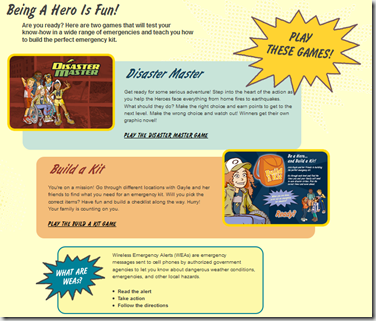
Ready.gov’s kid friendly preparedness page contains games and activities for kids along with  information for parents and educators on how to teach simple, but effective preparedness lessons.  

image


Many states have their own preparedness site for kids, such as Florida Division of Emergency Management’s Kids Get A Plan page, which provides an excellent interactive introduction to preparedness for children. 


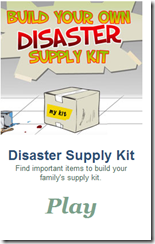
You’ll find audio-stories on topics like lightning safety, wildfires, and hurricanes along with interactive games like the one below, that teaches kids what items are needed for a disaster supply kit.

image

And to go along with these activities for kids, the site provides guides for parents and teachers to help them discuss these issues with kids.


Some of these stories and activities are geared for kids as young as 5 or 6, while others are aimed at slightly older children.


If you’ve got kids, or grandkids – and would like to introduce them to preparedness concepts without inducing undue trauma - this site is very much worth while checking out.


And for even more disaster preparedness for kids, you will also want to check out FEMA/Ready.gov’s  preparedness for kids website which I highlighted last September in NPM12: Preparedness For Kids

image

Thursday, September 05, 2013

NPM13: Those Who Forget Their History . . .

image


Note: This is day 5 of National Preparedness Month.  Follow this year’s campaign on Twitter by searching for the #NPM or #NPM13 hash tag.

This month, as part of NPM13, I’ll be rerunning some updated preparedness essays (like this one) , along with some new ones.


# 7632

. . . .  are condemned to wait longer in triage.


Not where you thought I was going, is it?  But this is an important aspect of personal preparedness.


Knowing, and having immediately available, a  medical history on every member of your family should be part of everyone’s emergency plan.

As a former paramedic - one who has struggled to take thousands of medical histories in the back of a moving vehicle, or at the scene of a medical emergency -  I know how difficult getting an accurate and complete medical history can be.


As you might imagine, when someone is unconscious, or unable to respond to questions, getting a medical history becomes more problematic.


You have to rely on relatives, friends, neighbors . . .and sometimes even snooping in their medicine cabinet.


Often, people don’t even know what medicines they are taking, or why.


If I had a nickel for every time a patient denied taking meds, but under the pressure of additional questioning, admitted to taking `a red one, a blue one and two white ones in the morning . .  and 3 white ones at night’ -  well, I’d have a lot of nickels.


Since I act as a medical advocate for several relatives, I maintain a pretty elaborate medical history on each of them.   When one of them falls ill, a copy goes with them to the doctor or the emergency room.


I never see my doctor without bringing him an updated history.  Sure, he knows me.  But he sees hundreds of patients, and me only every few months.  There is no way he can remember the details of my medical history.

So I provide him with a short, 1 page synopsis that he can scan in about 30 seconds, to make his life, and mine, easier (see A History Lesson to learn how).


Since you can’t always know, in advance, when you might need medical care it is important to carry with you some kind of medical history at all times.  It can tell doctors important information about your history, medications, and allergies when you can’t.


Many hospitals and pharmacies provide – either free, or for a very nominal sum – folding wallet medical history forms with a plastic sleeve to protect them.


I’ve scanned the one offered by one of our local hospitals below. It is rudimentary, but covers the basics.

medhx1

medhx2


In a medical emergency, minutes can make the difference between life and death.  And even in less urgent cases, having all of this information can go a long ways towards speeding your treatment.


You should make it a point, this week, to get medical history forms for every member of your family – regardless of their age – and fill them out.


Except for small children, everyone should find a way to carry it with them at all times.


This is not a one-time, make it and forget, prep.  You need to update it every time you add or change your medications, or your medical history changes.    It only takes a few minutes now.


But it could save a lot of time later.


Note: I’m still away from my desk, and so my blogging schedule will be light until I return on Sunday.  I would invite you to visit Crofsblog, Virology Down Under, and FluTrackers for the latest infection disease news.

Monday, September 09, 2013

NPM13: The Greatest Prep Of All


image

Note: This is day 9 of National Preparedness Month.  Follow this year’s campaign on Twitter by searching for the #NPM and #NPM13 hash tags.

This month, as part of NPM13, I’ll be rerunning some edited and updated older preparedness essays, along with some new ones.


# 7745

One of the ironies of our increasingly connected world is that our closest friends need not live anywhere near us.  Facebook, Twitter, email, and texting have allowed us to interact at a distance as never before.


And during a disaster, that can be both a problem and a blessing.


The blessing is that since many disasters are local, if you are hit by a tornado, or an earthquake, or a flood . . . having friends outside the impact area could be a lifesaver.

The downside, of course, is that increasing distance makes getting direct assistance from a friend during an emergency more difficult.


In 2007 I began to promote the idea of each of us having, and being, `Flu Buddies’.  I fleshed out the idea in a 2008 blog called Lifelines In A Pandemic.


A `Flu Buddy’ is simply someone you can call if you get sick, who will then check on you every day, make sure you have the medicines you need (including fetching Tamiflu if appropriate), help care for you if needed, and who can call for medical help if your condition deteriorates.

Those people who care for others, like single parents, also need to consider who will take care of their dependents if they are sick.


Nearly 1 person in 10 in the United States lives alone.   That’s roughly 27 million people who are particularly vulnerable during an epidemic.


I returned to this theme often during the 2009 pandemic, including Pandemic Solutions: Flu Buddies,  UK: Call To Appoint Swine `Flu Friends’ and Canada Urges People To Find `Flu Buddies’.


After the pandemic receded I reworked the idea into a more generic `Disaster Buddy’ concept in a blog called  In An Emergency, Who Has Your Back?.


While we tend to think of disasters as large scale events, it doesn’t require a pandemic, earthquake, or hurricane to put you in perilous straits.


A house fire, car accident, sudden illness, or some other more limited emergency can overwhelm as well, and having a pre-existing support system makes a lot of sense.


And the best way I know is by arranging to have (and to be) a `Disaster Buddy’.


A `Disaster Buddy’ is simply someone you have prearranged that you can call on during a crisis, and who in turn, can call on you if they need help.

It only works if it is reciprocal.


Frankly, having (and being) a `Disaster Buddy’ to friends, neighbors, and relatives should be part of everyone’s family disaster plan.


No one likes to impose on a friend, of course.


But if you’ve already established a `disaster buddy’ relationship  – one that is fair and reciprocal – it shouldn’t be considered an imposition.


In the parlance of paramedics, cops, firefighters and the military . . .  “you have their back, and in return, they have yours.”


It is a simple concept, but one that needs to be talked out in advance, not simply assumed.


While some people invest in a stockpile of freeze dried food, or buy the latest survival  gadgets, and think themselves prepared   . . .  having friends you can really depend on in an emergency is the greatest prep of all.


It is also worth mentioning that there has never been a better time to volunteer to help with the American Red Cross, The Medical Reserve Corps, CERT, or your Neighborhood watch.


We are truly only prepared as our friends, families, and surrounding community are.  There are roles to play for everyone, including civic organizations, schools, and church. 


Now - before a disaster occurs - is the time to sit down and talk to your friends, family, and neighbors about how you will help one another during a personal or community wide crisis.


For more potentially life saving preparedness information, I invite you to visit:
FEMA http://www.fema.gov/index.shtm

READY.GOV http://www.ready.gov/

AMERICAN RED CROSS http://www.redcross.org/

Friday, September 13, 2013

NPM13: Giving Preparedness A Shot In The Arm

image

Photo Credit PHIL


# 7759


Note: This is day 13  of National Preparedness Month.  Follow this year’s campaign on Twitter by searching for the #NPM  & NPM13 hash tag.

This month, as part of NPM13, I’ll be rerunning some edited and updated older preparedness essays, along with some new ones.


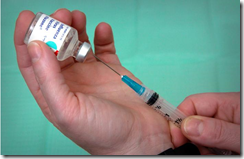
You might not have thought about it, but getting your seasonal flu shot each year should be part of your overall preparedness plan. During a disaster or prolonged emergency you are likely to be tired, stressed, and your immune systems could be weakened.


The last thing you need during a crisis is to be sick with the flu on top of it.


Which is why yesterday I paid a visit to my local CVS pharmacy and got my yearly seasonal flu shot.  The process (and the shot – nice job, Carol) were painless. And as an added bonus, I discovered that this year they were only offering single-dose (preservative-free) vaccines.


According to the CDC, more than 50 million doses of this year’s flu vaccine have already been distributed, so finding a shot should be no trouble.


Seasonal Influenza Vaccine & Total Doses Distributed

  • This table reflects the cumulative weekly total number of seasonal influenza vaccine doses distributed in the US as reported to CDC by influenza vaccine manufacturers and selected distributors.
  • Currently, manufacturers project 135-139 million doses of flu vaccine to be produced this season.

September 9, 2013 9:30 AM ET

image


September might seem a little early to be getting the flu shot, but we are already seeing scattered reports of influenza (see California, South Carolina & Florida) around the country, and it takes a couple of weeks after getting the shot for immunity to kick in. 


While the vaccine can’t promise 100% protection, it – along with practicing good flu hygiene (washing hands, covering coughs, & staying home if sick) – remains your best strategy for avoiding the flu this winter.


Recent studies (see A Comprehensive Flu Vaccine Effectiveness Meta-Analysis) have shown the flu shot to be moderately effective in preventing influenza – at least among healthy adults under the age of 65. As an added incentive, while far from conclusive, we’ve seen mounting evidence that the  Flu Vaccine May Reduce Heart Attack Risk.


For the elderly and for those with immune problems the flu vaccine’s effectiveness is often lower (see Study: Flu Vaccines And The Elderly).


In 2011, NFID - the National Foundation for Infectious Diseases - convened a group of experts to address the issues of influenza and the elderly. From that panel a 5-page brief has emerged, called: Understanding the Challenges and Opportunities in Protecting Older Adults from Influenza.

image


While the elderly generally see less protection from the flu vaccine, they state that older individuals may still mount a robust immune response. Even if the vaccine doesn’t always prevent infection in the elderly, studies suggest that the vaccine may blunt the seriousness of the illness in those over 65.


For those over 65, the option of taking the new high dose flu vaccine is now available (see MMWR On High Dose Flu Vaccine For Seniors). Early reports are encouraging, but we don’t have data yet on how much more effective it is among that cohort.


There is no doubt that we need better flu vaccines – particularly for those at greatest risk from influenza infection; the elderly and those with chronic illnesses (see CIDRAP: The Need For `Game Changing’ Flu Vaccines). But until they can be developed, the vaccines we have can and do help reduce the spread of the virus.


And lastly,  flu vaccines have excellent safety records.


Yes, taking any medicine – including a vaccine – entails some (usually miniscule) degree of risk. But those risks pale when compared to the dangers of catching the diseases they are designed to prevent. After all, Influenza sickens millions, and kills tens of thousands of people, every year in this country.


Ready.gov urges all Americans to follow these 3 steps to better preparedness:

image

GET A KIT

MAKE A PLAN

BE INFORMED


Sage advice. But if you want to be truly prepared, I would add an important 4th step.


Get a shot

Thursday, September 26, 2013

NPM13: Create A Family Communications Plan

image

Note: This is day 25 of National Preparedness Month.  Follow this year’s campaign on Twitter by searching for the #NPM or #NPM13 hash tag.

This month, as part of NPM13, I’ll be rerunning some updated  preparedness essays (like this one) , along with some new ones.


# 7814


Those of us who were living in Florida during the `bad old days’ of the cold war remember well the Cuban Missile Crisis of 1962.


Although it is hard to imagine it today, much of Florida was on a war footing with fears of a nuclear attack that might come at any time, thousands of military streaming into the state, and schools running daily `duck & cover’ and emergency evacuation exercises.


Kids were sent home with civil defense pamphlets on the basics of radiation poisoning and how to build an in-home fallout shelter.


image

As an 8-year-old with a scientific bent, these were exciting times.


What I didn’t full appreciate at the time was my parents were faced with an agonizing dilemma. My twin-brother and I attended a nearby elementary school, while my 17-year old sister attended high school some distance away.


If the alert went up, they realized they might only have time to get to one school to pick up their kids.


Logic dictated that the pick up my brother and I, based on our ages, and the fact that there were two of us. My sister was given instructions to go to the home of one of her high school friends, and our folks would  either contact her or pick her up there.


More than 50 years ago, in the face of a potential crisis, my family cobbled together their own emergency communications plan including an alternate rendezvous point.


While a nuclear attack is (thankfully) far less likely today, the same principles hold true when it comes to having a communications plan, and a meet-up point.


And since a tornado, earthquake, house fire, or some other disaster can strike without warning . . .  these are the sorts of plans every family needs to make now. Before they are needed.


This from Ready.gov.


 MAKE A PLAN

Your family may not be together when a disaster strikes so it is important to plan in advance: how you will get to a safe place; how you will contact one another; how you will get back together; and what you will do in different situations. Read more about Family Communication during an emergency.

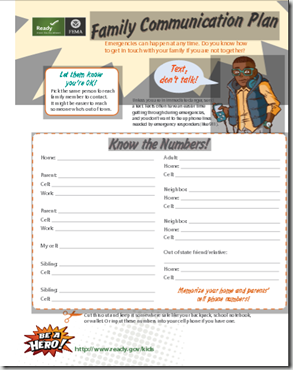
Ready.gov has made it simple for you to make a family emergency plan. Download the Family Communication Plan for Parents and Kids (PDF - 1.2 Mb) and fill out the sections before printing it or emailing it to your family and friends.

You should also inquire about emergency plans at places where your family spends time: work, daycare and school, faith organizations, sports events and commuting. If no plans exist, consider volunteering to help create one. Talk to community leaders, your colleagues, neighbors and members of faith or civic organizations about how you can work together in the event of an emergency. You will be better prepared to safely reunite your family and loved ones during an emergency if you think ahead and communicate with others in advance. Read more about school and workplace plans.


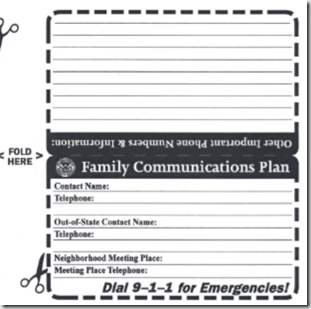
READY.GOV has made things  easier today, as they’ve developed  several Family Emergency Communication Kits geared for both adults and kids, which can be downloaded from the net. With just a few minutes effort, you can have your own emergency communications plan and emergency meeting place set up.


image

While the above version is geared to kids, the version below is more suitable for teenagers and adults.


image

Appendix C of the Are You Ready? Guide (contains blank contact cards and a family communications plan form)


Filling out these cards may seem a small step, but that's what most preparedness involves.


Taking small, organized steps that, when put together, create a fabric of individual and community preparedness.  If you do just one small step each day, in almost no time you’ll find yourself and your family far better prepared to face any emergency.


For more on how to prepare, visit these websites:


FEMA http://www.fema.gov/index.shtm

READY.GOV http://www.ready.gov/

AMERICAN RED CROSS http://www.redcross.org/


And you can use this link to read earlier NPM preparedness posts on this blog.

Saturday, September 21, 2013

NPM13: When Evacuation Is The Better Part Of Valor


image

Colorado Floods 2013 – Credit http://www.nationalservice.gov


Note: This is day 21 of National Preparedness Month.  Follow this year’s campaign on Twitter by searching for the #NPM or #NPM13 hash tag.

This month, as part of NPM13, I’ll be rerunning some updated  preparedness essays (like this one) , along with some new ones.


# 7798


The floods this past week in Colorado are just the latest example of when events can quickly force thousands of people from their homes, often with little or no warning.  According to the Colorado Office of Emergency Management, as of yesterday nearly 6,000 people were under mandatory evacuation, over 16,000 homes had been damaged, and more than 1,800 have been destroyed. 


Last month, in NIFC Raises Wildfire Preparedness Level To 5 (Maximum), we looked at the mandatory evacuation of over 1,800 homes due to the 160-square-mile Beaver Creek Fire in Idaho.  And just two days ago, explosions and a massive fire at a chemical factory in Oklahoma City forced residents living nearby to abruptly leave their homes in the middle of the night.


The first choice for most people in any disaster it to try to shelter-in-place in their own homes. Home is familiar, home is comfortable, and home is where your processions are. So quite understandably, no one wants to leave home during an emergency if they can possibly avoid it. In fact, it can be such a traumatic decision that some people will risk everything to avoid evacuating.


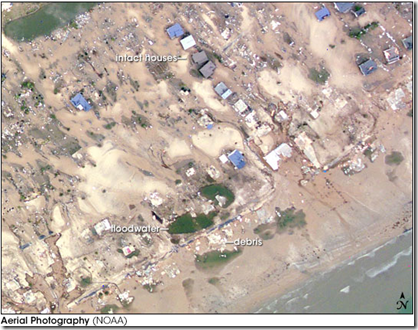
But the following photo taken in Crystal Beach after Hurricane Ike in 2008 proves that staying home in the face of a flood, a hurricane, or other natural disaster can have deadly consequences.

image

Being able to leave in a hurry when an evacuation has been ordered means having a plan, a destination, and an emergency `to go’ kit or `BOB’ already equipped, and standing by.


In the vernacular, a `bug-out bag'  or `BOB’ is a bag of emergency supplies, ideally kept at the ready, that one can grab on the way out the door during an emergency.

bob 001a

My Bug-out-bag, Canteen, & Toiletry kit

Every hurricane season I go through my personal bug out bag, and replace flashlight and radio batteries from last year, and swap out older emergency rations for newer ones.


A BOB isn't supposed to be a survival kit, but rather, is supposed to provide the essentials one might need during the first 72 hours of a forced, and sometimes unexpected, evacuation.


It should contain food, water, any essential prescription medicines, copies of important papers (ID's, insurance, important Phone #s), a first aid kit, portable radio, flashlight, extra batteries, and ideally blankets and extra clothes.


While having to evacuate your home may seem like an unlikely event, every years hundreds of thousands of Americans are forced to do so.  Rivers spill their banks, dams break, brush fires rage out of control, even sudden industrial accidents can force evacuations.


And unlike with a hurricane, you won’t always have advance warning.


Ready.gov has the following advice on how to prepare for an evacuation.

Evacuating Yourself and Your Family

image

There may be conditions under which you will decide to get away or there may be situations when you are ordered to leave. Follow these guidelines for evacuation:

  • Plan places where your family will meet, both within and outside of your immediate neighborhood. Use the Family Emergency Plan to decide these locations before a disaster.
  • If you have a car, keep a full tank of gas in it if an evacuation seems likely. Keep a half tank of gas in it at all times in case of an unexpected need to evacuate. Gas stations may be closed during emergencies and unable to pump gas during power outages. Plan to take one car per family to reduce congestion and delay.
  • Become familiar with alternate routes and other means of transportation out of your area. Choose several destinations in different directions so you have options in an emergency.
  • Leave early enough to avoid being trapped by severe weather.
  • Follow recommended evacuation routes. Do not take shortcuts; they may be blocked.
  • Be alert for road hazards such as washed-out roads or bridges and downed power lines. Do not drive into flooded areas.
  • If you do not have a car, plan how you will leave if you have to. Make arrangements with family, friends or your local government.
  • Take your emergency supply kit unless you have reason to believe it has been contaminated.
  • Listen to a battery-powered radio and follow local evacuation instructions.
  • Take your pets with you, but understand that only service animals may be permitted in public shelters. Plan how you will care for your pets in an emergency.

    Since I live in a hurricane evacuation zone, I have an emergency plan, a pre-arranged place to go, and my evac  kit (see Inside My New Bug Out Bag) packed and ready to go.

    Of course, you’d be hard pressed to put everything for a family of four into one bag.  So each family member should have their own BOB.

    Some items, like the radio, lights, and first aid kit needn’t be duplicated in each bag. 

    I keep my BOB within arm’s reach of my first aid kit, and would hopefully be able to grab both, even in an emergency. 

    image

    On top of this, I keep a spare first aid kit in my car, along with an `overnight bag’, and I have a third duffle bag packed with extra supplies, that I would hopefully be able to throw in the car as well.


    But if I had to, I could easily go 72 hours on just my bug-out bag alone.


    o these things to give me peace of mind and confidence that I’m ready to deal with just about any emergency that comes my way.


    The truth is, preparing is easy.


    It’s worrying that is hard.

    Wednesday, September 18, 2013

    NPM13: Pandemic Planning Assumptions

    image

    Credit - HHS Interim Pre-Pandemic Planning Guidence: Community Strategy For Pandemic Influenza Mitigation In the United States.


    Note: This is day 18 of National Preparedness Month.  Follow this year’s campaign on Twitter by searching for the #NPM or #NPM13 hash tag.

    This month, as part of NPM13, I’ll be rerunning some updated  preparedness essays (like this one) , along with some new ones.


    # 7783


    The declassification this week of a 2009 Northern Command Pandemic Plan (see SciAm story Pandemic Flu Plan Predicts 30% of U.S. Could Fall Ill) has caught the attention of a number of news organizations and websites with its estimates that during a moderately severe pandemic 30% of the population could fall ill, 3 million could require hospitalization, and 2 million Americans could die.


    Although a certain amount of surprise is registered in these media reports, these are roughly the same numbers that were being openly discussed by local, state, and federal agencies during the pandemic planning phase of 2006-2008.


    In fact, in 2008, the HHS outlined their vision of the likely impact in the United States of a severe and a moderate pandemic (see A Tale Of Two Scenarios).   As you’ll see, the numbers of hospitalizations anticipated during a severe pandemic is quite a bit higher than the Northcom plan.


    The HHS defined a severe pandemic as:

      • An attack rate of 30% (90 million Americans sickened)
      • 50% (45 million) requiring outpatient medical care
      • 11% (9.9 million) requiring hospitalization
      • 745,000 requiring mechanical ventilation
      • 1.9 million deaths (2.1% fatality ratio)

    A moderate (1958/68-like) pandemic is described as follows:

      • An attack rate of 30% (90 million Americans sickened)
      • 50% (45 million) requiring outpatient medical care
      • .9% (865,000) requiring hospitalization
      • 64,875 requiring mechanical ventilation
      • 209,200 deaths (.23% fatality ratio)


    In other words, while the number of people affected doesn't change, a severe pandemic is envisioned to be about 10 times worse than a moderate one.


    Pandemics, like hurricanes, are measured on a five point scale, with a CAT 5 pandemic – as bad or worse than 1918 – at the top of the scale.  While there are many similarities between the hurricane and pandemic scales, there is one aspect where they differ greatly.


    With Hurricanes, there are physical limitations that keep the storms from growing much stronger than 200 mph winds. Category 5 storms start at 156 MPH, and these storms are only capable of intensifying about 35% above that wind speed.


    There are no such restraints on a severe pandemic. While a 2% CFR indicates a Cat 5 pandemic, so does a 5% or 10% CFR. Yet, the difference between the impact of these three CFRs would be enormous. Although the 1918 pandemic is often used as a model for the next severe pandemic, doctors and scientists generally admit that the Spanish Flu isn't the worst that nature could throw at us.

    image


    The thing about pandemics is, even after one starts, you never know how bad it is going to be until it is over.   And even then it can take years to sort our just how bad it really was.  Experts continue to wrestle with the toll of the 2009 H1N1 pandemic. 


    A pandemic can start out mild, and over time become more virulent – as did the 1918 H1N1 pandemic -  or it could look really serious at the start, but prove milder than expected (as we saw in 2009). 


    While we can’t know when the next pandemic will arrive, or how bad it may be, we can prepare for a `reasonable-worst-case’ scenario – which  is probably somewhere on the order of the 1918 Spanish Flu.  To that end, the HHS has a number of pandemic planning toolkits available on their Flu.gov website.


    Pandemic Flu 

    The federal government cannot prepare for or respond to the challenge of a flu pandemic alone. Your community can develop strategies that reduce the impact and spread of pandemic flu.

    Faith-Based & Community Organizations Pandemic Influenza Preparedness Checklist (PDF – 68.91 KB)

    Lista de Preparacion para una Pandemia de Gripe Tanto para Organizaciones Comunitarias como Religiosas (PDF – 268 KB)

    Community Strategy for Pandemic Influenza Mitigation (PDF – 10.3 MB)

    Plan Now to Be Ready for the Next Flu Pandemic (PDF – 213.55 KB)

    The Next Flu Pandemic: What to Expect (PDF – 226.83 KB) (excerpts below)

    image

    image

    Their advice (and this is for before a pandemic threat becomes imminent).

    image


    Over the past six months I’ve written a number of pandemic preparedness blogs, including what the United States government is doing to prepare for a possible pandemic.  You can revisit these at the following links:


    The Pandemic Preparedness Messaging Dilemma
    Pandemic Planning For Business
    CDC: Pandemic Planning Tips For Public Health Officials
    H7N9 Preparedness: What The CDC Is Doing


    Admittedly, we may not see another severe pandemic for years, or even decades. But since it is impossible to predict when the next one will occur, it makes sense to incorporate pandemic planning into your family, community or business disaster plans.  


    Ready.gov offers the following basic advice for families and individuals.


    Pandemic

    Inspire others to act by being an example yourself, Pledge to Prepare & tell others about it!

    Pledge to Prepare

    You can prepare for an influenza pandemic now. You should know both the magnitude of what can happen during a pandemic outbreak and what actions you can take to help lessen the impact of an influenza pandemic on you and your family. This checklist will help you gather the information and resources you may need in case of a flu pandemic.

    Plan for a Pandemic

    • Store a two week supply of water and food. During a pandemic, if you cannot get to a store, or if stores are out of supplies, it will be important for you to have extra supplies on hand. This can be useful in other types of emergencies, such as power outages and disasters.
    • Periodically check your regular prescription drugs to ensure a continuous supply in your home.
    • Have any nonprescription drugs and other health supplies on hand, including pain relievers, stomach remedies, cough and cold medicines, fluids with electrolytes, and vitamins.
    • Talk with family members and loved ones about how they would be cared for if they got sick, or what will be needed to care for them in your home.
    • Volunteer with local groups to prepare and assist with emergency response.
    • Get involved in your community as it works to prepare for an influenza pandemic.