Tuesday, August 03, 2010

Study: Mandatory Flu Vaccination Of HCWs


# 4781


Although some HCWs (Health Care Workers) object strenuously to such policies, the idea of mandating yearly flu vaccinations for professional care givers isn’t going away. 


Over the last decade, the percentage of HCWs who voluntarily get the seasonal flu vaccine in the United States and Canada has languished disappointingly between 30% and 40%.


Many infection control organizations (IDSA, APIC, SHEA) support the idea of requiring yearly vaccination of HCWs, and last month the IDSA published an open letter to Thomas Frieden, Director of the CDC, in support of such a mandate.


While strongly advocating HCW influenza vaccination, the CDC has stopped short of mandating them. I blogged on this back on June 23rd in CDC: Proposed Influenza Infection Control Guidance.


Similarly, a UK Department of Health report issued in June called Learning The Lessons From the H1N1 Vaccination Campaign For Healthcare Workers  – while not mandating vaccination – stresses the `professional duty’ of all HCWs to get the vaccine.


New York State attempted to require vaccination as a requirement to work as a HCW in 2009, but legal challenges and vaccine shortages forced them to abandon – at least temporarily – that mandate  (see New York Rescinds Mandatory Flu Shots For HCWs).


I’ve covered HCW’s objections to forced flu shots in the past, including:


HCWs: Refusing To Bare Arms
HCWs: Developing a Different Kind Of Resistance


A handful of large hospitals have managed to implement mandatory flu vaccinations, including Seattle’s Virginia Mason Medical Center and BJC Heathcare of St. Louis, Missouri  which I blogged about here.  


Details on how Virginia Mason Medical Center  implemented mandatory HCW vaccinations can be read in the following  PDF.


image


Over the past 5 years that facility has maintained a 98% vaccination rate, and has vigorously promoted the uptake of flu shots not only in the workplace, but the greater community as well.


We’ve an abstract of a study that appears in the current Infection Control and Hospital Epidemiology journal that concludes that a policy of mandatory HCW vaccination is feasible, sustainable, and effective.


DOI: 10.1086/656210

Mandatory Influenza Vaccination of Healthcare Workers: A 5‐Year Study

Robert M. Rakita, MD; Beverly A. Hagar, BSN, COHNS; Patricia Crome, MN; Joyce K. Lammert, MD, PhD


(EXCERPT)

Results.

In the first year of the program, there were a total of 4,703 HCWs, of whom 4,588 (97.6%) were vaccinated, and influenza vaccination rates of more than 98% were sustained over the subsequent 4 years of our study. Less than 0.7% of HCWs were granted an accommodation for medical or religious reasons and were required to wear a mask at work during influenza season, and less than 0.2% of HCWs refused vaccination and left Virginia Mason Medical Center.


Impressive results. 


And likely to inspire additional facilities to try to follow suit in the future.  


While some HCWs may decry such efforts as a violation of their rights, most infection control experts see this as an important step towards increasing patient and co-worker safety.

Indonesia Announces July H5N1 Fatality


# 4780


Overnight a couple of different newshounds have located, translated, and posted a report from DepkesThe Indonesian Ministry of Health – that seems to announce a previously unknown H5N1 fatality from July.


Arkanoid Legent has the story with Indonesia : Bird Flu Case Statements To July 2010, which has a Google translation of the statement from Indonesia's Ministry of Health.   Crof at Crofsblog picked up the story overnight.


Meanwhile, Alert  on FluTrackers found and posted the same story last night here.


Although it yields roughly the same results, for comparative reasons I’ve run the original article through the ToggleText  translator, excerpts of which are below.


The REPORT on the CASE of SAMPAI BIRD FLU in July 2010 

In July 2010 was gotten by the addition of one positive case of bird flu (H5N1) on behalf of YE (P, 34 years) the resident of the Tangerang regency, Banten. The case was reported positive was infected H5N1 was based on results of the Litbangkes Body inspection on July 12 2010.


YE (P, 34 years) a teacher the Senior Secondary School (the SENIOR HIGH SCHOOL) private enterprise in the Tangerang Regency on July 2 2010 went to the doctor the practice of private enterprise with the sign of the fever, the cough, and was sick the throat. Because of not yet recovering, 2 days afterwards, the sufferer again took medicine back to private enterprise's doctor and direct in referred to the hospital swatsa in the Tangerang city.


While being treated, the sufferer experienced the high fever, had a headache, was sick the throat, the cough, crowded and diarrhoea. While 3 days were treated, the YE condition continued to worsen. Moreover on July 7 2010 crowded him was increasingly heavy. Results x-rayed showed the existence of difficult pneumonia. YE was afterwards treated in ICU space (intensive care the unit) as well as was taken the specimen wiped off the throat and the nose. The sufferer died on that day also around struck 13,34 WIB.


The risk factor still could not be ascertained. But was received by information, ten days before was sick (in June 2010) the sufferer carried out the trip to Banda Lampung.


Although we’ve seen several media reports of suspected bird flu fatalities coming out of Indonesia over the past month, the details of this report do not seem to match any of them.


If confirmed by the WHO, this will be the sixth official H5N1 case for Indonesia in 2010, and the fifth fatality. How representative of reality those numbers really are is anyone’s guess. 


Sporadic human infections with the bird flu virus continue to occur in regions where the virus is endemic. 


Human-to-human transmission remains rare, however, as the virus has not adapted well to humans. 


Last month  the Eurosurveillance Journal gave us an overview of the spread of H5N1 in humans since 2003(see Eurosurveillance: 500 H5N1 Cases After 6 1/2 Years).


The author’s conclusion was that while the number of cases reported has dropped, the overall situation has not improved appreciably since the virus re-emerged in 2003.


That the threat of the virus someday adapting to humans remains.

Monday, August 02, 2010

National Immunization Awareness Month (NIAM)


# 4779


This site, quite frankly, doesn’t attract huge numbers of readers mostly (I suspect) because I don’t churn out anti-vaccine rhetoric or populist conspiracy-theory blather.  


I may not have many readers, you see  . . .but I do have my self respect.


Well . . .most of it, anyway.  But I digress . . .


Vaccines aren’t perfect, of course.  A fact that activists seem to pounce on at every opportunity.


But quite frankly, I can’t think of a drug that is.   All medicines have the potential for side effects, and no medicine is 100% benign.


As with any drug, you have to weigh its potential risks against its likely benefits.   And vaccines have proved, time and again, to be extremely safe and very beneficial to individuals and to society.


So, with that in mind, it behooves me to mention that August is National Immunization Awareness Month (NIAM).


First a little background from the CDC, followed by some links and a CDC PODCAST on Adult and Childhood immunizations.


August is National Immunization Awareness Month

August observation of National Immunization Awareness Month (NIAM) is a great way to rally local organizations in your immunization education efforts. Communities are encouraged to plan local health screenings or fairs, media events and other related immunization outreach efforts during the month of August to promote the benefits of immunization.

Are You Up-To-Date? Vaccinate!

Overview of NIAM

August is recognized as National Immunization Awareness Month (NIAM). The goal of NIAM is to increase awareness about immunizations across the life span, from infants to the elderly.


August is the perfect time to remind family, friends, co-workers, and those in the community to catch up on their vaccinations. Parents are enrolling their children in school, students are entering college, and healthcare workers are preparing for the upcoming flu season.

Why are immunizations important?

Immunization is one of the most significant public health achievements of the 20th century. Vaccines have eradicated smallpox, eliminated wild poliovirus in the United States. and significantly reduced the number of cases of measles, diphtheria, rubella, pertussis and other diseases. But despite these efforts, people in the U.S. still die from these and other vaccine-preventable diseases.


Vaccines offer safe and effective protection from infectious diseases. By staying up-to-date on the recommended vaccines, individuals can protect themselves, their families and friends and their communities from serious, life-threatening infections.

Who should be immunized?

Getting immunized is a lifelong, life-protecting community effort regardless of age, sex, race, ethnic background or country of origin. Recommended vaccinations begin soon after birth and continue throughout life. Being aware of the vaccines that are recommended for infants, children, adolescents, adults of all ages and seniors, and making sure that we receive these immunizations, are critical to protecting ourselves and our communities from disease.

When are immunizations given?

Because children are particularly vulnerable to infection, most vaccines are given during the first five to six years of life. Other immunizations are recommended during adolescent or adult years and, for certain vaccines, booster immunization are recommended throughout life. Vaccines against certain diseases that may be encountered when traveling outside of the U.S. are recommended for travelers to specific regions of the world.


A variety of resources promoting immunization and NIAM can be found at the links below. You may want to consider customizing these tools for use locally.


This podcast is an overview of the Clinician Outreach and Communication Activity (COCA) conference call: Promoting Health and Preventing Disease: Childhood and Adult Vaccine Updates and Recommendations. Dr. Yabo Beysolow discusses recent Advisory Committee on Immunization Practices (ACIP) recommendations, new vaccines and administration schedules, immunization resources, and the promotion of immunizations in provider practices.

COCA Call: CDC Update on Childhood and Adult Vaccines

Listen to the PodcastListen To This Podcast (3:29)

This podcast is an overview of the Clinician Outreach and Communication Activity (COCA) conference call: Promoting Health and Preventing Disease: Childhood and Adult Vaccine Updates and Recommendations. Dr. Yabo Beysolow discusses recent Advisory Committee on Immunization Practices (ACIP) recommendations, new vaccines and administration schedules, immunization resources, and the promotion of immunizations in provider practices.

Created: 7/27/2010 by National Center for Immunization and Respiratory Diseases (NCIRD) and Emergency Communication System (ECS)/Joint Information Center (JIC); Office of Public Health Preparedness and Response (OPHPR).   Date Released: 7/28/2010.

More info on this topic

Puerto Rico Dengue Update


# 4778


Dengue cases in Puerto Rico have been running above the epidemic threshold for all of 2010, but until mid-May were only averaging about 150 suspected cases a week.


Since then we’ve the number of suspected Dengue cases begin to climb like a homesick angel. 

 image

image


As you can see by these latest CDC graphics (above) the number of cases has increased almost 4-fold over the past 5 weeks.


 image


Of the 4 serotypes of Dengue, only DENV-3 has not been reported in 2010.  DENV-1 is the most prevalent strain, followed by DENV-4.


Ten days ago the CDC’s  MMWR came out with a field report on the Dengue situation in Puerto Rico, which you can read about at MMWR: Dengue Epidemic In Puerto Rico.


A week ago, in Dengue Reports From The Caribbean, I blogged about spikes in Dengue in Trinidad and the Dominican Republic as well.


While obviously a serious public health problem for these islands, it is also concerning because millions of tourists visit these destinations every year, and some may be coming home with more than just a T-shirt to show for their vacation.


In June of this year, a CDC report (see MMWR: Travel Associated Dengue Surveillance 2006-2008) stated:


`Clinically recognized cases of travel-associated dengue likely underestimate the risk for importation because many dengue infections are asymptomatic or mildly symptomatic’.


Dengue’s spread has increased dramatically over the past 50 years, and since the 1950s a rare, but far more serious form of the disease – DHF or (Dengue Hemorrhagic Fever) –  has emerged.


Dengue Trends


None of this should dissuade you from making that long anticipated trip to Florida or the Caribbean, of course. The odds of acquiring a mosquito-borne disease while visiting these islands are actually quite small.


But when millions of people make that trek, invariably some small number of tourists may become infected.


And if they return home to a region where the Aedes aegypti or the Aedes Albopictus mosquito (both Dengue vectors) are found, they have at least the potential to introduce the virus to a new area.


Which is probably how Dengue ended up returning to south Florida after an absence of more than 60 years (see Update On The Florida Dengue Cases).


Admittedly, it may take many such introductions over a number of years before the virus can establish a foothold.


And an aggressive mosquito control and education program may well prevent that from happening altogether.


A good reason to support your community’s mosquito control efforts and public health department.


We live in an increasingly interconnected world, and pathogens like Dengue, Chikungunya, Malaria, and yes . . . pandemic influenza . . .  have a much easier time spreading than they used to. 


While we can’t turn back the clock and return to the relatively insular lives that our parents and grandparents led, we can take common sense precautions to prevent the spread of these diseases and we can support public health efforts to control or eradicate them.


Whether it is following the `5 D’s’ advice to protect yourself from mosquito bites, or getting your annual flu shot, there are real and substantive things you can do to help reduce the burden of disease on your community.


Preventing the spread of infectious diseases is, after all, a shared responsibility.

=============================================

To help protect yourself from mosquitoes, remember and follow the `5 D’s’:


Don't go outdoors at DUSK and DAWN when mosquitoes are most active.

DRESS so your skin is covered with clothing

Apply mosquito repellent containing DEET to bare skin and clothing. 

Other effective repellents include picaridin, oil of lemon eucalyptus, and IR3535

Empty containers and DRAIN standing water around your home where mosquitoes can lay eggs.

Sunday, August 01, 2010

August Tropical Climatology


# 4776


Despite predictions of an above-average Atlantic Hurricane season at the start of the 2010 season, the first two months have been decidedly average. 


That, however, doesn’t really tell us what the rest of the season may portend.  While predictions are difficult, the ingredients are still in place to see an active year.


It wasn’t until mid August of 1992 when the first hurricane of that season appeared - the truly unforgettable CAT 5 Andrew that devastated Homestead, Florida.


June and July are often pretty quiet months for tropical activity, with the season really ramping up from mid-August to mid-October.


image


Compare the areas of origin and typical hurricane tracks in these two maps showing July and August, and you will see a considerable amount of difference.


July Hurricane Climatology


image


As the summer progresses the spawning grounds for Hurricanes moves further east into the warming Atlantic ocean.  It isn’t until August and September that the Cape Verde basin begins to produce what often turn into very large and persistent hurricanes.


You can find much more on Hurricane Climatology at NOAA’s  Tropical Cyclone Climatology page.


While it may never develop, or if it does, it may never affect land, right now the National Hurricane Center is watching an area of suspicion the the far Atlantic that they give a 60% chance of developing into a Tropical Cyclone.


image

(Note: Contents of graphic link will change over time)


Although not a threat to land right now, a week or ten days from now may prove a different story.


And lest you believe that Hurricanes are just a Florida and Gulf Coast problem, in my essay The Crossroads Of The Atlantic Storm Season  I pointed out:


There have been cycles within cycles, years where storms have tended to track north along the eastern seaboard instead of south and into the Gulf of Mexico.


New York City, and much of New England, is considered `overdue’ for a major hurricane.


Here is a look at hurricanes that came within 100 miles of Boston, MA over the past 80 years.

image


May was National Hurricane Preparedness week, and during that month this blog devoted considerable time to the subject.  A few of my blogs on the subject included:


A Hurricane Reality Check
National Hurricane Preparedness Week: Day 6
NOAA 2010 Atlantic Hurricane Outlook
The Worst That Could Happen
Hurricanes and Inland Flooding
Why I’ll Be Gone With The Wind
Storm Surge Monday
The Crossroads Of The Atlantic Storm Season
You Don’t Have To Live On The Coast


Some essential hurricane resources to get you started include:


http://www.fema.gov/hazard/hurricane/index.shtm

http://www.ready.gov/america/beinformed/hurricanes.html


You may also wish to revisit my blog entitled Hurricane Resources On The Net for links to storm resources online.

Florida Records 4th EEE Death In July


# 4774


Over the past decade there have been an average of about 7 cases (not deaths) of `Triple E’ (Eastern Equine Encephalitis) in the United States each year (range range: 3—21), which makes EEE an exceedingly rare disease in humans.


What makes EEE such a concern is that it has a high fatality rate (35%), and among the survivors, a high percentage suffer ongoing neurological problems.


Among the mosquito-borne encephalitis viruses, however, it runs a distant third when compared to the number of California serogroup (predominantly La Crosse virus (LACV)) and St. Louis Encephalitis (SLEV) cases.


image

MMWR Domestic Arboviral Diseases 1999-2008


Given its rarity, it is therefore a bit surprising that Florida has just recorded its fourth EEE death for the month of July (My thanks to the reader who alerted me to this latest victim).


LCHD ISSUES MOSQUITO-BORNE ILLNESS ADVISORY

LEON COUNTY HEALTH DEPARTMENT ISSUES MOSQUITO-BORNE ILLNESS ADVISORY


--Medical director urges precautions against mosquitoes--


Tallahassee-- The Leon County Health Department announces that there has been increased mosquito-borne disease activity in Leon County. “We have had a confirmed human death due to Eastern equine encephalitis (EEE),” said Dr. Marjorie Kirsch, medical director, and,“the risk of transmission of mosquito-borne viruses to humans is increased.” A Leon County horse has also been recently diagnosed with EEE.


EEE virus is spread by the bite of an infected mosquito. It isn’t spread person to person. An average of six human cases of EEE are reported each year in the United States.


The Leon County Health Department reminds residents and visitors to avoid being bitten by mosquitoes that may cause disease. Leon County Mosquito Control and the Leon County Health Department continue surveillance and prevention efforts and encourage everyone to take basic precautions to help limit exposure. More Info Available


This update was submitted at 7/31/2010 6:04:43 PM


While obviously a concern, and certainly worthy of public discussion, it is only fair to point out that the odds of contracting EEE from a mosquito in Florida are extremely low. 


And while the spotlight right now is focused on Florida, this isn’t just a problem for the sunshine state. 


The graphic below shows that while Florida leads the pack that over the years Massachusetts, New Jersey, Georgia, and Louisiana have seen their share of cases as well.

image


Given its severity (and the prevalence of other mosquito borne diseases like West Nile, Dengue, SLEV), it makes sense to take steps to protect yourself and your family.


Yesterday I wrote about the Aedes Albopictus or `Asian tiger’ mosquito’s willingness to move in, and breed inside your home (see Making Themselves At Home). 


So today would be a good day to go around and look for likely breeding places in, and around your home. This should become a weekly habit – at least during mosquito season.


I’ve repeated the Florida Department of Health’s mantra that to help protect themselves against mosquito borne diseases people  should practice the "5 D's"

Don't go outdoors at DUSK and DAWN when mosquitoes are most active.

DRESS so your skin is covered with clothing

Apply mosquito repellent containing DEET to bare skin and clothing. 

Other effective repellents include picaridin, oil of lemon eucalyptus, and IR3535

Empty containers and DRAIN standing water around your home where mosquitoes can lay eggs.

Today I’ve got a new resource for you.  


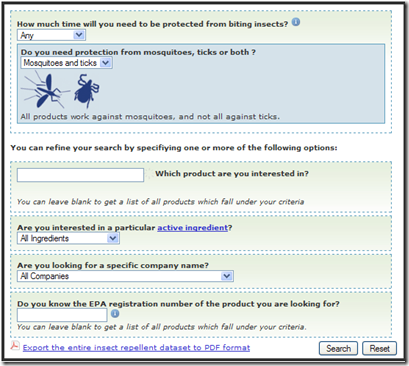
An interactive insect repellant search engine developed by the EPA that will that will allow you to input your needs and it will spit out the best repellants to use.


image

(click image to go to search engine)


Since knowledge is power, and prevention is a far better strategy than trying to cure a disease, here are some some of my earlier blogs on EEE:


Third Florida EEE Death in July
Eastern Equine Encephalitis (EEE)


And here is a list of recent Dengue/Arbovirus posts as well:


ASTMH: Dengue and Insect-Borne EIDs In The US
Update On The Florida Dengue Cases
Dengue Reports From The Caribbean
MMWR: Dengue Epidemic In Puerto Rico
MMWR: Dengue Fever In Key West