Showing posts sorted by relevance for query Honshu. Sort by date Show all posts

Saturday, March 12, 2011

Japan: Foreshocks & Aftershocks


CLICK THIS LINK FOR LATEST/ALL QUAKE UPDATES


# 5482


Over the past 7 days there have been more than 240 earthquakes greater than 2.5 magnitude offshore of Honshu island.  


The 7.2 quake of three days ago is now being looked at as being a foreshock to the 8.9 massive event that occurred yesterday.   


Since that quake, dozens of heavy aftershocks have been recorded, along with a couple of hundred smaller (2.5 or greater) temblors. 


Additional heavy aftershocks are possible for months.


 image

(Click to see updated map)


Over the past 4 hours the USGS shows a dozen magnitude 5 or greater quakes in the region.  The strongest being a 6.1 quake just a couple of hours ago.


You can view an updated list of quakes HERE.


5.7  2011/03/12 11:46:01
NEAR THE EAST COAST OF HONSHU, JAPAN

6.1  2011/03/12 10:53:31
NEAR THE EAST COAST OF HONSHU, JAPAN

5.0  2011/03/12 10:39:12
NEAR THE EAST COAST OF HONSHU, JAPAN

5.3  2011/03/12 10:34:49
OFF THE EAST COAST OF HONSHU, JAPAN

5.5  2011/03/12 10:20:22
OFF THE EAST COAST OF HONSHU, JAPAN

5.0  2011/03/12 10:00:26
NEAR THE EAST COAST OF HONSHU, JAPAN

5.2  2011/03/12 09:51:35
NEW IRELAND REGION, PAPUA NEW GUINEA

5.1  2011/03/12 09:40:44
NEAR THE EAST COAST OF HONSHU, JAPAN

5.0  2011/03/12 09:27:12
OFF THE EAST COAST OF HONSHU, JAPAN

5.4  2011/03/12 09:18:56
OFF THE EAST COAST OF HONSHU, JAPAN

5.2  2011/03/12 09:00:03
OFF THE EAST COAST OF HONSHU, JAPAN

5.0  2011/03/12 08:52:50
OFF THE EAST COAST OF HONSHU, JAPAN


Aside from the considerable emotional toll these aftershocks must be taking on the residents and emergency responders, there is the very real danger of already damaged buildings collapsing in these new shocks. 


For those trapped in the rubble, and for their rescuers, these smaller quakes pose a serious risk of causing additional injury or even death.

Friday, March 25, 2011

USGS: 6.4 Aftershock Rattles Northern Japan


# 5446


The strongest aftershock since Wednesday struck northern Japan a short while ago (8:36 pm local time).


Local reports have listed the quake as a 6.2, but the USGS is currently showing it as a 6.4.  Magnitude readings are often changed as more data comes in.


While strong enough that buildings in Tokyo (nearly 400km to the south) reportedly swayed - no tsunami warning has been issued.


image 

Magnitude 6.4 - NEAR THE EAST COAST OF HONSHU, JAPAN

2011 March 25 11:36:24 UTC

Location 38.763°N, 141.942°E

Depth   39.2 km (24.4 miles)

Region   NEAR THE EAST COAST OF HONSHU, JAPAN

Distances

  • 108 km (67 miles) ENE (58°) from Sendai, Honshu, Japan
  • 127 km (79 miles) SE (146°) from Morioka, Honshu, Japan
  • 172 km (107 miles) NE (48°) from Fukushima, Honshu, Japan
  • 395 km (246 miles) NNE (29°) from TOKYO, Japan

Friday, March 11, 2011

Estimated Tsunami Arrival Times


CLICK THIS LINK FOR LATEST/ALL QUAKE UPDATES


# 5370


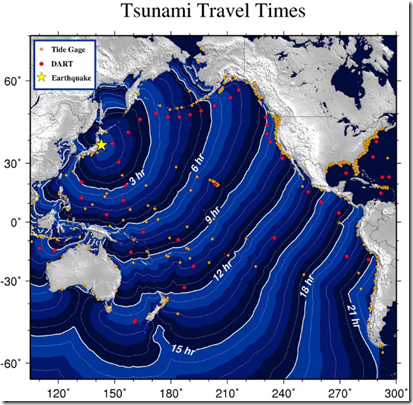
NOAA has produced a map of possible arrival times for the Tsunami believed to be moving across the Pacific as a result of the Honshu earthquake. 


Reports out of Japan indicate that up to an 11 meter (33 ft)  tsunami may have struck the coastline.  Damage is reportedly extensive.


image


Here is the latest advisory from the West Coast and Alaska Tsunami Warning Center.

image


To: U.S. West Coast, Alaska, and British Columbia coastal regions


From: NOAA/NWS/West Coast and Alaska Tsunami Warning Center


Subject: Tsunami Watch and Advisory #3 issued 03/10/2011 at 11:33PM PST


UPDATED MAGNITUDE TO 8.8

The Tsunami Advisory continues in effect for the coastal areas of Alaska from Chignik Bay, Alaska to Attu, Alaska.


The Tsunami Watch continues in effect for the coastal areas of California, Oregon, Washington, British Columbia and Alaska from the California-Mexico border to Chignik Bay, Alaska.

A Tsunami Advisory means that a tsunami capable of producing strong currents or waves dangerous to persons in or very near the water is expected. Significant, widespread inundation is not expected for areas under an advisory. Currents may be hazardous to swimmers, boats, and coastal structures and may continue for several hours after the initial wave arrival.

A Tsunami Watch means that all coastal residents in the watch area should prepare for possible evacuation. A tsunami watch is issued to areas which will not be immediately impacted by the tsunami. Watch areas will either be upgraded to warning or advisory status, or canceled.

At 9:46 PM Pacific Standard Time on March 10, an earthquake with preliminary magnitude 8.8 occurred near the east coast of Honshu, Japan . (Refer to the United States Geological Survey for official earthquake parameters.) This earthquake has generated a tsunami which could cause damage to coastal regions in a warning or advisory. The waves are expected to first reach Shemya, Alaska at 12:13 AM AKST on March 11. Estimated tsunami arrival times and maps along with safety rules and other information can be found on the WCATWC web site.

Monday, March 14, 2011

USGS Upgrades Japan Quake To 9.0 Magnitude


# 5395


Yesterday Japanese seismologists upgraded the March 11th earthquake off the coast of Honshu to a 9.0 magnitude temblor. 


Today - after reviewing the accumulating data - the USGS has followed suit and issued the following statement.


USGS Updates Magnitude of Japan’s 2011 Tohoku Earthquake to 9.0


Released: 3/14/2011 5:35:00 PM

Contact Information:
U.S. Department of the Interior, U.S. Geological Survey
Office of Communication
119 National Center
Reston, VA 20192
Harley Benz
Phone: 303-273-8497
Clarice Nassif Ransom
Phone: 703-648-4299


The USGS has updated the magnitude of the March 11, 2011, Tohoku earthquake in northern Honshu, Japan, to 9.0 from the previous estimate of 8.9. Independently, Japanese seismologists have also updated their estimate of the earthquake’s magnitude to 9.0. This magnitude places the earthquake as the fourth largest in the world since 1900 and the largest in Japan since modern instrumental recordings began 130 years ago.


The USGS often updates an earthquake’s magnitude following the event. Updates occur as more data become available and more time-intensive analysis is performed. There are many methods of calculating the energy release and magnitude of an earthquake. Some methods give approximate values within minutes of the earthquake, and others require more complete data sets and extensive analysis. Due to inherent uncertainties in the modeling of energy and magnitude, the results from different agencies often vary slightly. These magnitude discrepancies arise from the use of different data and techniques. For more information on why magnitudes change, see the Earthquake Hazards Program FAQ website.

Saturday, March 31, 2012

Japan: Quake/Tsunami Risks Greater Than Previously Thought


image

Credit Wikipedia


# 6255


We’ve two seismic studies announced today in Japan - one regarding Tokyo’s vulnerability to a major earthquake and the other on the tsunami risk that would result from an offshore earthquake in the Nankai Trough.


Both substantially escalate the amount of damage that could be expected over previous estimates.


First stop, the Nankai quake scenario, as reported by the Japan Times.


20-meter tsunami projected from Honshu to Kyushu

Nankai quake scenario menaces Pacific coast

Kyodo

Wide swaths of the Pacific coastline stretching from Honshu to Kyushu may be hit by tsunami over 20 meters high if a newly feared megaquake occurs in the Nankai Trough, a Cabinet Office panel warned Saturday.

(Continue . . . )


Kuroshio, Kochi Prefecture could see a tsunami up to 34.4 meters (112 feet, or as high as a 10 story building), while parts of Shizuoka, Kochi and Miyazaki prefectures could see tidal waves of 10 to 20 meters.


Such an earthquake could send tsunami waves towards other Pacific shorelines, as well.


The second announcement comes from Japan’s Ministry of Education, Culture, Sports, Science and Technology (MEXT) which has determined that the fault line lying under Tokyo is shallower than previously thought, and capable of producing more damage than had been earlier estimated.


This report from Reuters:


Major quake impact on Tokyo could be worse than thought-study

31 Mar 2012 09:10

Source: reuters // Reuters

TOKYO, March 31 (Reuters) - The impact on Tokyo from a major quake could be much more devastating than the government has predicted, a new study shows.


The study by the Ministry of Education, Culture, Sports, Science and Technology comes just over a year after one of the biggest tremors on record struck Japan'se northeast coast, triggering a massive tsunami and the world's worst nuclear crisis in 25 years.

(Continue . . .)


You may recall that a couple of months ago (see Academics Debate Odds Of Tokyo Earthquake) we saw a report indicating that some scientists believe that the odds of a major earthquake striking Tokyo (previously estimated at 70% within 30 years) are overly optimistic, and that there is a 70% chance of a major Tokyo quake in the next four years.


And last year, in Divining Japan’s Seismic Future, I wrote about the most widely anticipated seismic event for Japan - the Tokai Earthquake – expected to be an 8+ magnitude, and forecast to occur between the Bay of Suruga and Cape Omasezaki in Shizuoka Prefecture sometime in the near future.


image


Major earthquakes have occurred in this region every 100-150 years, with the most recent recorded in 1498, 1605, 1707 and 1854.


That puts the Tokai region 157 years since their last major quake, and in the estimation of Dr Kiyoo Mogi – Japan’s leading seismologist – well overdue for another.   In 1969, Dr Mogi began warning that the Tokai area was particularly vulnerable, and today the area is monitored continually by the JMA.


Which is why the Prime Minister of Japan called upon Chubu Electric to shut down its No. 4 and No. 5 reactors at the Hamaoka nuclear plant last May, located roughly 200 km south-west of Tokyo.


While all of this is of greatest concern to those living in Japan, a major earthquake in one of the great cities of the world would not only be a horrendous human tragedy, it could cause economic repercussions around the globe.


In two blogs from last year we looked at the possible ripple effects of `Global Shocks’.


Last December in DFID: World Unprepared For Future Shocks  the UK’s DFID (Department for International Development) warned that with global economies in turmoil, and recessionary fears continuing to spread, finding money for many relief, humanitarian, or other worthwhile projects becomes more difficult.


And last July, in (OECD Report: Future Global Shocks), where we looked at a 139 page report  released by the OECD (The Organisation for Economic Co-operation and Development) that warned - as the world becomes more interconnected and interdependent - that `Global Shocks’ to the world economy become more likely.


In the report, they define a Global Shock as: a rapid onset event with severely disruptive consequences covering at least two continents.

image

They write:

Extremely disruptive events, such as earthquakes, volcanoes, financial crises and political revolutions destabilize critical systems of supply, producing economic spillovers that reach far beyond
their geographical point of origin.


While such extreme events have been relatively rare in the past, they seem poised to occur with greater frequency in the future. Global interconnections accompanying economic integration enable some risks to propagate rapidly around the world.


The bottom line here is that the world is now so interconnected – that while most disasters are localized - their economic and societal impacts can be felt thousands of miles away and can persist for months.


Of course Japan doesn’t have the market cornered when it comes to disasters; the United States, Europe, and the rest of the world are all capable of producing equally disruptive global shocks.  


Ultimately, a nation’s resilience in the face of a major crisis –whether it be local or global - comes from the bottom up, not from the top down.


Which is why agencies, like the ones below, urge greater individual, family, and community preparedness.


FEMA http://www.fema.gov/index.shtm

READY.GOV http://www.ready.gov/

AMERICAN RED CROSS http://www.redcross.org/


A few of my preparedness blogs from the past include:


When 72 Hours Isn’t Enough

Planning To Survive

An Appropriate Level Of Preparedness

In An Emergency, Who Has Your Back?

The Gift Of Preparedness: 2011

Friday, March 11, 2011

Pacific Wide Tsunami Warnings


CLICK THIS LINK FOR LATEST QUAKE UPDATE 


# 5369


Pacific wide Tsunami warnings are now being issued across the entire pacific in the wake of the 8.9 earthquake off the coast of Honshu. T


Tsunami waves in excess of 7 meters have now been reported in Northern Japan.


A TSUNAMI WARNING IS IN EFFECT FOR:


JAPAN / RUSSIA / MARCUS IS. / N. MARIANAS / GUAM / WAKE IS. / TAIWAN / YAP / PHILIPPINES / MARSHALL IS. / BELAU / MIDWAY IS. / POHNPEI / CHUUK / KOSRAE / INDONESIA / PAPUA NEW GUINEA / NAURU / JOHNSTON IS. / SOLOMON IS. / KIRIBATI / HOWLAND-BAKER / HAWAII / TUVALU / PALMYRA IS. / VANUATU / TOKELAU / JARVIS IS. / WALLIS-FUTUNA / SAMOA / AMERICAN SAMOA / COOK ISLANDS / NIUE / AUSTRALIA / FIJI / NEW CALEDONIA / TONGA / MEXICO / KERMADEC IS / FR. POLYNESIA / NEW ZEALAND / PITCAIRN / GUATEMALA / EL SALVADOR / COSTA RICA / NICARAGUA / ANTARCTICA / PANAMA / HONDURAS / CHILE / ECUADOR / COLOMBIA / PERU


The following excerpt is from the Tsunami warning issued for Hawaii. 


BULLETIN

TSUNAMI MESSAGE NUMBER   3


NWS PACIFIC TSUNAMI WARNING CENTER EWA BEACH HI


931 PM HST THU MAR 10 2011


TO - CIVIL DEFENSE IN THE STATE OF HAWAII


SUBJECT - TSUNAMI WARNING


A TSUNAMI WARNING IS ISSUED FOR THE STATE OF HAWAII EFFECTIVE AT 931 PM HST.


AN EARTHQUAKE HAS OCCURRED WITH THESE PRELIMINARY PARAMETERS


   ORIGIN TIME - 0746 PM HST 10 MAR 2011


   COORDINATES - 38.2 NORTH  142.5 EAST


   LOCATION    - NEAR EAST COAST OF HONSHU   JAPAN    MAGNITUDE   - 8.8  MOMENT


<SNIP>


A TSUNAMI HAS BEEN GENERATED THAT COULD CAUSE DAMAGE ALONG COASTLINES OF ALL ISLANDS IN THE STATE OF HAWAII. URGENT ACTION SHOULD BE TAKEN TO PROTECT LIVES AND PROPERTY.


A TSUNAMI IS A SERIES OF LONG OCEAN WAVES. EACH INDIVIDUAL WAVE CREST CAN LAST 5 TO 15 MINUTES OR MORE AND EXTENSIVELY FlOOD COASTAL AREAS. THE DANGER CAN CONTINUE FOR MANY HOURS AFTER THE  INITIAL WAVE AS SUBSEQUENT WAVES ARRIVE. TSUNAMI WAVE HEIGHTS CANNOT BE PREDICTED AND THE FIRST WAVE MAY NOT BE THE LARGEST.


TSUNAMI WAVES EFFICIENTLY WRAP AROUND ISLANDS. ALL SHORES ARE AT RISK NO MATTER WHICH DIRECTION THEY FACE. THE TROUGH OF A TSUNAMI WAVE MAY TEMPORARILY EXPOSE THE SEAFLOOR BUT THE AREA WILL QUICKLY FLOOD AGAIN. EXTREMELY STRONG AND UNUSUAL NEARSHORE CURRENTS CAN ACCOMPANY A TSUNAMI. DEBRIS PICKED UP AND CARRIED BY A TSUNAMI AMPLIFIES ITS DESTRUCTIVE POWER. SIMULTANEOUS HIGH TIDES OR HIGH SURF CAN SIGNIFICANTLY INCREASE THE TSUNAMI HAZARD.


THE ESTIMATED ARRIVAL TIME IN HAWAII OF THE FIRST TSUNAMI WAVE IS  0259 AM HST FRI 11 MAR 2011


MESSAGES WILL BE ISSUED HOURLY OR SOONER AS CONDITIONS WARRANT.


For the latest Tsunami warnings go to the Pacific Tsunami Warning Center.

Monday, March 14, 2011

The Ring Of Fire


# 5390


image

(Mashup of original map from USGS)


While the horseshoe shaped belt of seismic and volcanic activity that rings the Pacific ocean has always been a focal point for earthquakes, the past 13 months have seen three high profile seismic events.


In February of 2010 an 8.8 magnitude earthquake – and resultant tsunami (generally less than 2.5 meters) – struck offshore of Chile, leaving roughly 500 people dead and several hundred thousand homes damaged.


In September of 2010, a 7.1 quake struck the Christchurch, New Zealand region causing serious damage, but little loss of life.  Nearly 6 months later, a shallow 6.3 magnitude aftershock struck even closer to Christchurch, causing far more damage, and claiming a significant loss of life.


And most recently, a 9.0 earthquake and massive Tsunami struck off the coast of Honshu, Japan likely claiming thousands of lives (still uncounted) and doing hundreds of billions of dollars worth of damage.


Less noticed globally have been the thousands of smaller earthquakes and volcanic eruptions along this Pacific `Ring of Fire’ over the past year.  


Below you’ll see a graphic showing more than 600 significant earthquakes over the past 7 days, and the vast majority are located along the Pacific Rim. In fact, 90% of the world’s earthquakes occur along these fault lines (cite USGS glossary).


image


Great quakes (8.0+) are rare events, happening on average only once a year.  Very damaging quakes of between 7.0-7.9 happen somewhere in the world, on average, more than once a month.


image

(USGS chart)


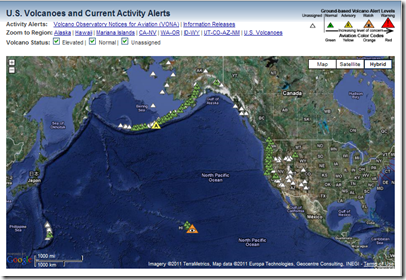
The Ring of Fire is also home to more than 400 active volcanoes, including more than 160 on United States territory.  The USGS has an interactive map where you can explore these volcanoes HERE.


image


All of which means that more seismic activity along the Ring of Fire is 100% guaranteed.  We simply don’t know where, or when, the next big quake or volcanic eruption will occur.


Seismologists do expect another 7.0+ aftershock sometime in the coming days near the site of the Honshu earthquake,and heavy aftershocks are still possible in New Zealand and Chile as well.


While our attentions are glued to the heartbreaking coverage of Japan’s disaster recovery efforts, we should also be mindful of the need to be preparing to deal with the next disaster. 


Tens of millions of people live in high risk zones, and yet, many are unprepared for these all-too-common disasters.  No matter where you live, the images coming out of Japan should serve as a wake-up call to become better prepared.


From the USGS Great Southern California Shakeout website,  we’ve this 4 and 1/2 minute video called Preparedness Now (Streaming | Video) that  “depicts the realistic outcome of a hypothetical, but plausible, magnitude 7.8 earthquake on the San Andreas fault in Southern California.”

image


We live on a violent planet.


One wracked by storms, fires, floods, drought, volcanoes, earthquakes and myriad other natural disasters.  


At a bare minimum, every household should have a disaster plan, a good first aid kit (and the knowledge to use it), and emergency supplies to last a minimum of 72 hours during a disaster.


To become better prepared as an individual, family, business owner, or community to deal with these types of disasters: visit the following preparedness sites.


FEMA http://www.fema.gov/index.shtm

READY.GOV http://www.ready.gov/

AMERICAN RED CROSS http://www.redcross.org/


And for more on emergency preparedness, you may wish to revisit a few of my recent blogs on the subject.


Planning To Survive
In An Emergency, Who Has Your Back?
Inside My Bug Out Bag
Those Who Forget Their History . . .
The Gift Of Preparedness
Red Cross Unveils `Do More Than Cross Your Fingers’ Campaign

Tuesday, March 22, 2011

Japan: 6.6 Magnitude Aftershock


UPDATED  0620 hrs EDT:  Two additional strong aftershocks (6.4 & 6.6) have been reported in the three hours since today’s first strong temblor occurred.


image


# 5429


The strongest aftershock in more than a week struck off the coast of Honshu at 1817 hours local time today, measured by the USGS at magnitude 6.6.


image


No immediate reports of damage have been received, and no tsunami was generated.


Seismologists continue to warn that strong aftershocks, up to and greater than 7.0, are still possible in the Honshu region.

Friday, March 11, 2011

Major Quake Off Japan, Pacific Tsunami Warning/Watch Issued


CLICK THIS LINK FOR LATEST QUAKE UPDATE


# 5367


image


The world is waiting for damage reports, and word of any tsunami generated, in the wake of an extremely powerful earthquake that struck off the coast of Honshu, Japan mid afternoon local time Friday.


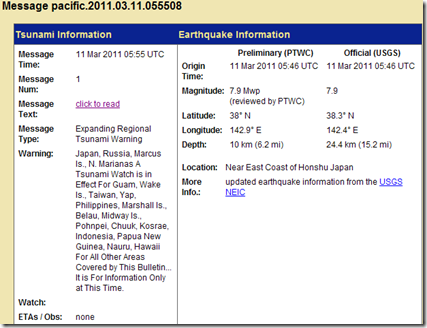
Immediate had estimated the magnitude range at 7.9, but the USGS is now showing it at 8.8 , and the depth at 24.4 km.   Adjustments to magnitudes often occur when more data is received.


image


This is the latest of a series of earthquakes in this region that began less than 48 hours ago with a 7.2 magnitude quake, followed by many aftershocks.


The Pacific Tsunami Warning center has issued the following statement:


image


And from Hawaiinewsnow.com  we get the following story:


Tsunami watch issued after Japan earthquake

Updated: Mar 11, 2011 1:42 AM EST Friday, March 11, 2011 1:42 AM EST

EWA BEACH (HawaiiNewsNow) -- A Tsunami Watch has been issued for the state of Hawaii following an 8.8 magnitude earthquake off the east coast of Honshu, Japan.


Scientists at the Pacific Tsunami Warning Center in Ewa Beach said that based on available data, a tsunami may have been generated by the quake. They said the earliest that tsunami waves could reach Hawaii would be at 2:59 a.m. Friday.


This is obviously a breaking news story, and I’ll have updates as they become available.   I’ll also be looking for online streaming coverage, and will post any links I can find.

Sunday, March 20, 2011

Japan: 6.1 Magnitude Aftershock


# 5423


image


A little more than 24 hours after Japan’s last 6.0+ aftershock, another 6.1 magnitude temblor rattled the east coast of Honshu island at just past 9 pm local time today. 


While there were no immediate reports of additional damage, the quake was reportedly strongly felt as far away as Tokyo several hundred kilometers to the south.


Over the past 24 hours more than 30 aftershocks of 4.5 mag. or greater have been recorded in the region.


Although their frequency and average strength are declining, seismologists continue to warn that another large (7.0+) aftershock is still possible in the region.

Saturday, May 10, 2008

Japan Detects Another Infected Swan


# 1970


More of a reminder than earth shattering news; Japan has discovered another dead swan infected with the H5N1 virus.  


This is not unexpected, as we've seen in other places, where there's one infected will bird, you can expect to find others.


This report from Reuters.


Japan finds new case of bird flu in swan

17:48 AEST Sat May 10 2008

Japan has detected bird flu of the virulent H5N1 strain in another swan, in the third case in the country this year.


The H5N1 strain of bird flu was found in another swan in the northern-most main island of Hokkaido, the prefectural government of Hokkaido said on its website.


The case was confirmed from a dead swan found five days ago near Lake Saroma in eastern Hokkaido. On the same day, local authorities had said the same strain of bird flu was found in another swan found dead on April 24 in another area of the island.


The latest case is the third in Japan this year. In late April, several swans were found with the H5N1 strain on the shores of Lake Towada, close to the northern tip of the main island of Honshu.


The livestock hygiene service centre will issue an order for chicken farms within a 30km radius to disinfect poultry houses, Kyodo news agency said.


No human deaths from the disease have been reported in Japan.

Monday, March 14, 2011

IAEA Update: Evacuation Status & Fukushima Daiichi Reactor


# 5394


Amid fresh reports of more problems (see the report at bottom of this blog entry) at one or more Japanese nuclear reactors in the wake of Friday’s devastating 9.0 magnitude earthquake of the coast of Honshu, we get this latest update from the IAEA (International Atomic Energy Agency).


Japanese Earthquake Update (14 March, 15:35 CET)

by International Atomic Energy Agency (IAEA) on Monday, March 14, 2011 at 10:39am

Fukushima Daiichi Nuclear Power Plant

Japanese authorities have reported to the IAEA that Fukushima Daiichi Unit 2 has experienced decreasing coolant levels in the reactor core.  Officials have begun to inject sea water into the reactor to maintain cooling of the reactor core.


Sea water injections into Units 1 and 3 were interrupted yesterday due to a low level in a sea water supply reservoir, but sea water injections have now been restored at both units.


Evacuation Status

On 12 March, the Japanese Prime Minister ordered the evacuation of residents living within 10 kilometres of the Fukushima Daini nuclear power plant and within 20 kilometres of the Fukushima Daiichi nuclear power plant.  Japan’s Nuclear and Industrial Safety Agency (NISA) has reported that about 185,000 residents had been evacuated from the towns listed below as of 13 March, 17:00 (JST).

Populations of evacuated towns near the affected nuclear power

Hirono-cho                   5,387

Naraha-cho                  7,851

Tomioka-cho              15,786

Okuma-cho                11,186

Futaba-cho                   6,936

Namie-cho                  20,695

Tamura-shi                41,428

Minamisouma-shi      70,975

Kawauchi-mura          2,944

Kuzuo-mura                1,482

Total                         184,670

Iodine Distribution

Japan has distributed 230,000 units of stable iodine to evacuation centres from the area around Fukushima Daiichi and Fukushima Daini nuclear power plants, according to officials. The iodine has not yet been administered to residents; the distribution is a precautionary measure in the event that this is determined to be necessary.


The ingestion of stable iodine can help to prevent the accumulation of radioactive iodine in the thyroid.

Weather forecast

In partnership with the World Meteorological Organization, the IAEA is continuing to monitor weather forecasts and is providing updates to member states.  Since the incident began, winds have been moving away from the Japanese coast to the East, and predictions call for the same patterns to persist for the next three days.


The IAEA continues to liaise with the Japanese authorities and is monitoring the situation as it evolves


Meanwhile, NHK World News is reporting that the fuel rods at the Fukushima #2 reactor are fully exposed, and there are fears that a melt-down may be occurring.


TEPCO:Fuel rods exposed at Fukushima reactor

updated at 13:40 UTC, Mar. 14

Tokyo Electric Power Company is battling to cool a reactor to prevent another explosion at its nuclear power plant in quake-hit Fukushima Prefecture.


The utility firm said on Monday afternoon that fuel rods are exposed at the Number Two reactor of its Fukushima Number One plant after the level of coolant water dropped. At around 6:20pm, the power company began pumping in seawater.


Tokyo Electric says it had to halt the process due to fuel loss for the pumping system, possibly leaving the fuel rods in the reactor exposed. The firm says a core meltdown might have occurred.

(Continue . . .)

Thursday, April 07, 2011

7.4 Mag Aftershock Hits Japan


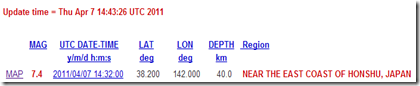
UPDATE #2:  As of 1135 hrs 4/711 -  As often happens, the initial readings on earthquakes can bounce around a bit as more data comes in. 

Right now, the USGS is showing this as a 7.1 Magnitude with a depth of 49km

image

These numbers may well change again before they are finalized.

UPDATE #1: as of 1112hrs 4/7/11 -  The USGS has revised the depth of this earthquake to 25.6 km.

NHK World News is broadcasting live from Tokyo on the situation.


# 5475


Scientists have been warning for a month that another 7+ aftershock could strike northern Japan, and a short time ago one did.


This aftershock registered as being 40 km deep, which is considerably deeper than the massive quake that struck on March 11th.


So far, we’ve received no word on damages.


image

image


While a local Tsunami advisory has been issued, NO PACIFIC WIDE TSUNAMI THREAT is anticipated.


The following statement comes from the Pacific Tsunami Warning Center.


000
WEHW42 PHEB 071442
TIBHWX
HIZ001>003-005>009-012>014-016>021-023>026-071642-
TSUNAMI INFORMATION STATEMENT NUMBER   1
NWS PACIFIC TSUNAMI WARNING CENTER EWA BEACH HI
442 AM HST THU APR 07 2011

TO - CIVIL DEFENSE IN THE STATE OF HAWAII
SUBJECT - TSUNAMI INFORMATION STATEMENT
THIS STATEMENT IS FOR INFORMATION ONLY. NO ACTION REQUIRED.


AN EARTHQUAKE HAS OCCURRED WITH THESE PRELIMINARY PARAMETERS


   ORIGIN TIME - 0432 AM HST 07 APR 2011
   COORDINATES - 38.2 NORTH  142.0 EAST
   LOCATION    - NEAR EAST COAST OF HONSHU  JAPAN
   MAGNITUDE   - 7.4  MOMENT

EVALUATION

BASED ON ALL AVAILABLE DATA A DESTRUCTIVE PACIFIC-WIDE TSUNAMI IS  NOT EXPECTED AND THERE IS NO TSUNAMI THREAT TO HAWAII. REPEAT. A  DESTRUCTIVE PACIFIC-WIDE TSUNAMI IS NOT EXPECTED AND THERE IS NO TSUNAMI THREAT TO HAWAII.

THIS WILL BE THE ONLY STATEMENT ISSUED FOR THIS EVENT UNLESS ADDITIONAL DATA ARE RECEIVED.

Friday, March 11, 2011

Japan: Concerns Over Nuclear Power Plant Shutdowns


 CLICK THIS LINK FOR LATEST/ALL QUAKE UPDATES


SEE UPDATE AT BOTTOM


# 5373


It now appears that the Japanese government has issued a special nuclear emergency declaration due to earthquake damage at one or more of the 6 Fukushima nuclear plants.


image


NHK news just carried a news conference where officials state that there has been no radioactive leakage detected, and that all affected plants have been shut down.


However, emergency cooling systems are reportedly disabled or damaged at one or more locations.


No evacuations, or emergency instructions have been issued, and authorities are working to divert electricity to the damaged plants in order to restore their cooling capacity.


For now, while there are concerns over these problems, authorities insist there is presently no danger to the public.


With communications seriously degraded in the wake of the 8.9 Honshu quake, it may be some time before we get a clear idea of the extent of the damage to these plants.


UPDATED:  

MSNBC is now carrying the following report on the state of emergency that was declared over cooling system problems at one or more power plants in the earthquake zone.


State of emergency is declared at Japanese nuclear plant

Process for cooling reactor 'not going as planned,' administrator says

Saturday, March 12, 2011

Report: Explosion At Fukushima Nuke Plant


CLICK THIS LINK FOR LATEST/ALL QUAKE UPDATES


# 5379


image

(Video of explosion- BBC)


Details are sketchy at this time, but it appears that a major explosion has taken place at reactor #1 at the Fukushima facility on Honshu Island about 4pm local time (2 am EST or 7am GST). 


Radiation levels are rising outside the damaged plant, and the possibility exists that a feared core melt-down may be occurring.


Here is how the Associated Press is reporting the incident:


Japan: Explosion heard at Fukushima nuclear power plant

Associated Press, Updated: March 12, 2011 14:52 IST

Sendai, Japan: An explosion at a nuclear power station tore down the walls of one building Saturday as smoke poured out and Japanese officials said they feared the reactor could melt down following the failure of its cooling system in a powerful earthquake and tsunami.

(Continue . . . )

Meanwhile Reuters is reporting that the IAEA (International Atomic Energy Agency) is urgently trying to get information on the reported explosion.


IAEA 'Urgently' Seeking Info on Japan Blast Report

March 12, 2011

Vienna. The United Nation’s nuclear watchdog said it is aware of media reports of an explosion on Saturday at Japan’s Fukushima No.1 nuclear power plant and is urgently seeking information from the country’s authorities.

(Continue . . .)


This situation is obviously fluid, and serious.  

How serious is something we may not know for hours.


Reuters is now reporting (at 4:50 am EST) that the explosion at Fukushima reactor #1 has been confirmed.


Japan Confirms Explosion, Leakage at Nuclear Plant

March 12, 2011

Tokyo, Japan. Japanese Chief Cabinet Secretary Yukio Edano confirmed on Saturday there has been an explosion and radiation leakage at Tokyo Electric Power Co’s (TEPCO) Fukushima Daiichi nuclear power plant.

(Continue . . .)


Events are moving rapidly.   Stay tuned.

Friday, March 11, 2011

Report: Radiation Levels Rising Inside Fukushima Nuke Plant


CLICK THIS LINK FOR LATEST/ALL QUAKE UPDATES


# 5376


image

Fukushima, Honshu Japan


The latest report via Nikkei News on the earthquake damaged nuclear power plant #1 at Fukushima indicates that radiation levels – and possibly air pressure as well – inside the plant are continuing to rise.


Saturday, March 12, 2011

Radiation Level Rising In Fukushima Nuclear Plant Turbine Building

FUKUSHIMA (Kyodo)--The radiation level is rising in the building housing a turbine of the No. 1 reactor of the Fukushima No. 1 nuclear power plant following Friday's powerful earthquake, the operator Tokyo Electric Power Co. said Saturday.

(Continue. . . )


Another report, this time from Reuters – quoting Jiji News – indicates that TEPCO will take steps to try to reduce the pressure inside the plant. 


TEPCO says pressure rises inside nuclear reactor -Jiji

TOKYO, March 12 (Reuters) - Tokyo Electric Power Co said pressure inside the No.1 reactor at its Fukushima-Daiichi nuclear plant has been rising, with the risk of a radiation leak, Jiji News reported on Saturday.

(Continue. . . )


Local authorities continue to insist, however, that problems are not yet at a critical level, as evidenced by this recent Reuters report.


UPDATE 4-Japan declares emergency at nuke plant, no radiation leak now

03/11/2011

Fri Mar 11, 2011 4:13pm GMT

* Problems not at critical level -local officials quoted

* U.S. Air Force delivers coolant to nuclear plant

Monday, March 14, 2011

Japan: U.S. 7th Fleet Repositions After Low Level Radiation Detected


# 5388


Although positioned more than 100 miles off the coast, the U.S. 7th Fleet has repositioned its ships after discovering very low levels of radiation on helicopters and flight crews returning to the USS Ronald Reagan.


The United States Navy, including assets from the 7th Fleet, are involved in humanitarian and disaster relief operations in the wake of the devastating 9.0 Honshu earthquake on March 11th.


Updates on those operations can be found on the 7th Fleet’s webpage.


Here is the press release on the repositioning of the ships, and decontamination of the flight crews, from the U.S. 7th Fleet Public Affairs office.


Seventh Fleet repositions ships after contamination detected

By U.S. 7th Fleet Public Affairs 
Posted: March 14, 2011

USS BLUE RIDGE, At Sea - The U.S. 7th Fleet has temporarily repositioned its ships and aircraft away from the Fukushima Dai-Ichi Nuclear Power Plant after detecting low level contamination in the air and on its aircraft operating in the area. The source of this airborne radioactivity is a radioactive plume released from the Fukushima Dai-Ichi Nuclear Power Plant.

Click for a closer look.

PACIFIC OCEAN (March 12, 2011) -- USS Ronald Reagan (CVN 76) is currently underway in the 7th Fleet area of responsibility in the Pacific Ocean. Ronald Reagan is enroute toward Japan to render humanitarian assistance and disaster relief as directed. (U.S. Navy photo by Mass Communication Specialist 3rd Class Dylan McCord)


For perspective, the maximum potential radiation dose received by any ship’s force personnel aboard the ship when it passed through the area was less than the radiation exposure received from about one month of exposure to natural background radiation from sources such as rocks, soil, and the sun.


The ship was operating at sea about 100 miles northeast of the power plant at the time.
Using sensitive instruments, precautionary measurements of three helicopter aircrews returning to USS Ronald Reagan after conducting disaster relief missions near Sendai identified low levels of radioactivity on 17 air crew members. The low level radioactivity was easily removed from affected personnel by washing with soap and water. They were subsequently surveyed, and no further contamination was detected.


As a precautionary measure, USS Ronald Reagan and other U.S. 7th Fleet ships conducting disaster response operations in the area have moved out of the downwind direction from the site to assess the situation and determine what appropriate mitigating actions are necessary.


We remain committed to our mission of providing assistance to the people of Japan

Friday, March 11, 2011

Quake/Tsunami Damage Heavy


 CLICK THIS LINK FOR LATEST QUAKE UPDATE


# 5368


Tsunami waves of up to 4 meters reportedly struck the coast shortly after the (now upgraded) 8.9 quake off the coast of Honshu.  Farms and houses are reportedly washed away by the incoming waves, and more than an hour after the quake fresh waves continue to come in.


Quake damage reports are just beginning to come in, but at this point they look to be significant. 


Live streaming video from NHK World with English news commentary is available at:


http://www.nhk.or.jp/nhkworld/


In the hour or so since the major quake, several very strong aftershocks have been reported.


image

Saturday, March 19, 2011

Japan: A Morning Roundup Of Nuke Reports


# 5421


A mixed bag of news this morning, with a few hopeful signs amid more troubling reports on the situation at the Fukushima nuclear facility.


First the good news.


NHK World News now reports that engineers have managed to get two diesel generators that supply power to reactor # 6 operational, and that they are supplying power to the cooling pumps at both reactor #5  &  #6.


Cooling function operable at 2 reactors

Saturday, March 19, 2011 14:07 +0900 (JST)

The government says parts of the cooling systems at 2 of the 6 reactors at the Fukushima Daiichi nuclear power plant have been confirmed to be operable.


The Nuclear and Industrial Safety Agency told a news conference on Saturday that an emergency diesel generator at the No. 6 reactor has resumed operation.


The agency also said that a cooling pump, at the No. 5 reactor, has been confirmed to be usable, and that workers started cooling the spent fuel storage pool there at 5 AM on Saturday.


(Continue . . . )


Efforts are still underway to connect external power to the stricken nuclear power plants, and the cable is reportedly laid and connected to reactor # 2, but the power has not been turned on.


NHK News reports on what the engineers are waiting on:


Efforts under way to reconnect outside power

(EXCERPT)

The company says it will check the status of the motors and pumps that supply cooling water to the reactor, and will start running the equipment, once it has confirmed that there are no abnormalities.

(Continue . . . )


And lastly, Japan’s Defense Minister – speaking at a press conference – revealed that heat measurements taken by a military helicopter flying over the reactors suggest that some of the water spraying attempts have been at least partially successful.


Kitazawa: Reactors surface temperatures below 100C

Japan's Defense Minister says the surface temperatures of the 4 damaged reactors at the Fukushima Daiichi nuclear power plant are lower than 100 degrees Celsius.


Toshimi Kitazawa told a news conference in Tokyo on Saturday that water-spraying proved to be effective.


Admittedly, not a terribly precise report, since actual readings were not revealed.   While not exactly `good news’, this could be filed under `it could be worse’.


Less comforting reports include the discovery of radioactive contamination in the local food supply, although not at levels considered to pose an immediate health hazard.


Again from NHK News:


Radiation detected in milk and spinach

Chief Cabinet Secretary Yukio Edano says the government was informed around 5:30 PM on Friday that higher levels of radiation than the legal standard were detected in fresh milk from cows at a dairy farm in Fukushima Prefecture.


He also said that at 11:00 AM on Saturday, the government received information that six samples of spinach tested at a research institute in Ibaraki Prefecture contained higher levels of radiation than the official standard.


Early on Saturday morning, the health ministry asked Ibaraki Prefecture to determine where the spinach samples came from and their distribution route.

(Continue . . . )


In a similar vein, Kyodo news has recently posted the following flash regarding the detection of radioactive iodine in Tokyo tap water on their website


No details were available at the time of this posting, and I’m always a bit leery of flash reports, so a strong Caveat Lector warning applies.


image


`Traces’ is about as inexact a measurement as you can come up with, and given the sensitivity of modern testing methods, may be so low as to have absolutely no public health impact. 


We’ll have to wait for better data before we can evaluate the significance of this report.


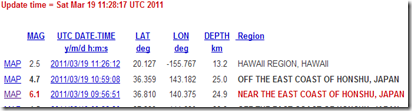
And lastly, the strongest aftershock of the past 48 hours, registering a 6.1, struck at 09:56 UTC near the east coast of Honshu.


There were no immediate reports of damage.


image


Given dearth of good news coming out of Japan over the past 8 days, anything even remotely positive is gratefully received.


And quite obviously, given the levels of despair and deprivation in the worst hit regions of northern Japan, government officials are anxious to emphasize whatever progress is being made.


But regardless of short term victories or defeats, the recovery in Japan is going to be a very long, difficult, and painful process. 


One that will likely take years to accomplish, and that has only just barely begun.

Wednesday, September 12, 2018

UK: DEFRA Outbreak Assessment #1 On Classical Swine Fever In Japan

https://assets.publishing.service.gov.uk/government/uploads/system/uploads/attachment_data/file/739923/poa-csf-japan.pdf


#13,505


Although I tend to concentrate primarily on human and/or zoonotic diseases in the blog, there is no denying that agricultural diseases can still have an impact on the public's health and well being.
We've discussed previously in this blog that food insecurity - whether due to disease, floods, droughts, or other causes - can pose both severe economic, societal, and even political challenges (see Iran: Bird Flu, Food Insecurity & Civil Unrest).
For the past 5+ weeks we've been following the introduction and spread of African Swine Fever (ASF) into China, and last Sunday - in Japan: MAFF Confirms Classical Swine Fever Outbreak - we saw Japan report their first outbreak of a similar disease - CSF - in 26 years.

Japan was just one of 35 (see map below) that has been certified by the OIE as being free of the disease, a status they no longer enjoy (see OIE Statement)

http://www.oie.int/animal-health-in-the-world/official-disease-status/classical-swine-fever/map-of-csf-official-status/

Today the UK's DEFRA has published an assessment of Japan's outbreak, and while the risk of introduction of CSF (from any region) to the UK is considered very low at this time, urges  the `prompt reporting of suspect disease in pigs, and the implementation and maintenance of appropriate biosecurity measures'.

Department for Environment, Food and Rural Affairs
Animal and Plant Health Agency
Advice Services - International Disease Monitoring

Outbreak assessment #1
11 September 2018

Ref: VITT/1200 CSF in Domestic Swine, Japan 2018

Classical Swine Fever in domestic swine in Japan

 
Disease report


Japan has reported an outbreak of Classical Swine Fever, in Gifu province, in a farm of 610 fattening and breeding pigs (OIE, 2018a; see map). On 9 th September, officials reported that CSF had been confirmed by RT-PCR. Culling is now completed on the affected farm, and movement restrictions have been applied within the 3km and 10 km zones. The last occurrence of CSF in Japan was in 1992.


To date, the Japanese Veterinary Services have ruled out the occurrence of African Swine Fever (ASF) in this outbreak or in the country.


Situation assessment


CSF is considered endemic in many countries, including China and other countries in SE Asia, and commercial vaccines are available for CSF control. CSF has not been reported in the EU for several years, and only sporadically in West Russia. The latest outbreak in Russia was reported in July 2018.


The last CSF outbreak in Japan was in 1992 in Kumamoto Prefecture, and in 2007 the use of vaccination was banned, and disease eradication was declared in the country. The OIE disease free status was adopted at the World Assembly of Delegates in May 2015 but this has now been suspended (OIE, 2018b).


At this point, the source of virus introduction is unknown and under investigation. However, the very early detection of this event may be partially due to the increased awareness in Japan in response to the ASF outbreaks in China. Last week the FAO warned that ASF was almost certain to spread from China to other Asian countries (Promed) and this has prompted the heightened awareness.
The Gifu province is not the major area of swine production, and it is located 500 miles from the south region, the area of Japan with the highest pig density, nevertheless, Japanese wild boar are present throughout the island of Honshu and may be a risk factor in the introduction of virus (https://inohoi.com/animal-damage/103).

Exports of pork have been suspended by the Japanese Government until the Japanese Veterinary Services understand the extent of the outbreak, and while epidemiological investigations about possible routes of introduction are undertaken.


Japan is not on the list of approved countries for the imports of pork meat or pig products to the EU.


Conclusions
 
Currently, we consider there to be a negligible likelihood of introduction of CSF virus from Japan to the UK via legal trade as a result of this outbreak. The risk level for the UK is very low for an incursion from any endemic region, because of the potential for infected pig meat or contaminated items to be introduced via passengers or through illegal trade.


We continue to emphasise the importance of prompt reporting of suspect disease in pigs, and the implementation and maintenance of appropriate biosecurity measures, particularly considering the risk of disease spread by fomite transmission and strict compliance with the swill feeding ban.


We will continue to monitor the situation.
 

For a DEFRA assessment on China's recent introduction of African Swine Fever see last week's DEFRA Raises Risk Of Importing ASF To UK To `Medium'.

And for the FAO's analysis, see FAO: African Swine Fever (ASF) `Here to Stay' In Asia