Showing posts with label Airborne. Show all posts

Monday, May 11, 2015

CID Study: Airborne Norovirus In Healthcare Facilities

image


# 10,033


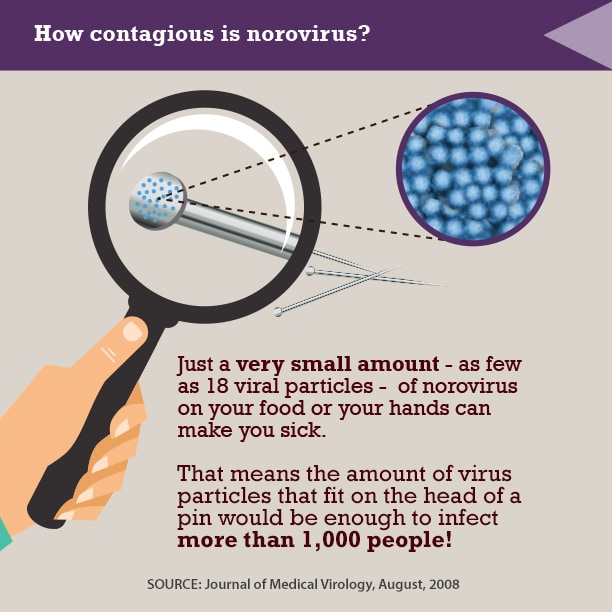
As the CDC graphic above illustrates, when it comes to infectivity, Norovirus is hard to beat.   The `accepted’ mode of transmission has long been the fecal-oral route, but over the past few years we’ve seen evidence supporting an `airborne’ or aerosolized transmission.


Last week, a new study was published in Clinical Infectious Diseases that looked for, and found, norovirus in ambient air samples taken at from 8 hospitals, both  inside and outside of an infected patient’s room.


First a link to the study, and some excerpts from the abstract and press release, after which I’ll return with more:


Detection and quantification of airborne norovirus during outbreaks in healthcare facilities

Laetitia Bonifait1,  Rémi Charlebois1, Allison Vimont2, Nathalie Turgeon1, Marc Veillette1, Yves Longtin3, Julie Jean2,4, and Caroline Duchaine1,5

ABSTRACT

Methods. A total of 48 air samples were collected during norovirus outbreaks in 8 healthcare facilities. Samples were taken 1 m away from each patient, in front of the patient's room and at the nurses' station. The resistance to aerosolization stress of murine norovirus MNV-1 bioaerosols was also tested in vitro using an aerosol chamber.

Results. Norovirus genomes were detected in 6/8 healthcare centers. The concentrations ranged from 1.35x101 to 2.35x10³ genomes per m3 in 47% of air samples. Norovirus MNV-1 preserved its infectivity and integrity during in vitro aerosol studies.

Conclusion. Norovirus genomes are frequently detected in the air of healthcare facilities during outbreaks, even outside patients' rooms. In addition, in vitro models suggest this virus may withstand aerosolization.


An accompanying press release to the CID study states:

According to Professor Duchaine, this previously unknown mode of norovirus propagation could explain why gastroenteritis outbreaks are so hard to contain: "The measures applied in hospital settings are only designed to limit direct contact with infected patients. In light of our results, these rules need to be reviewed to take into account the possibility of airborne transmission of noroviruses. Use of mobile air filtration units or the wearing of respiratory protection around patients with gastroenteritis are measures worth testing."

 
Currently, the recommendations from the CDC on the Healthcare Worker’s use of PPEs (Personal Protective Equipment) when dealing with Norovirus reads:


Personal Protective Equipment

  1. If norovirus infection is suspected, adherence to PPE use according to Contact and Standard Precautions is recommended for individuals entering the patient care area (i.e., gowns and gloves upon entry) to reduce the likelihood of exposure to infectious vomitus or fecal material.    (Category IB)(Key Question 1.C.4) 
  2. Use a surgical or procedure mask and eye protection or a full face shield if there is an anticipated risk of splashes to the face during the care of patients, particularly among those who are vomiting. (Category IB)(Key Question 3.C.2.a)
  3. More research is needed to evaluate the utility of implementing Universal Gloving (e.g., routine use of gloves for all patient care) during norovirus outbreaks. (No recommendation/unresolved issue)


Most of the CDC’s guidance documents for HCWs dealing with Norovirus cases stress patient cohorting and hand hygiene.  Respiratory protection isn’t mentioned in any of the following documents.


Previously, in Vomiting Larry And His Aerosolized Norovirus, we looked at the physics involved in aerosolizing virus particles via projectile vomiting , while in  Norovirus: The Gift That Keeps On Giving, we looked at an incident involving a girl’s soccer team where 17 girls were exposed via a reusable grocery bag, likely contaminated from an airborne route.


Assuming more studies showing the aerosolized spread of noroviruses are published, infection control experts may need to revisit the use of some form of respiratory protection (N95, facemasks, etc.)  for HCWs caring for infected patients.

Saturday, May 09, 2015

CIDRAP: H5N2 Roundup & Detection In Environmental Air Samples

image

54 of Minnesota’s 84 Outbreaks Are Clustered in 3 Counties


# 10,030


Although migratory and wild birds are believed responsible for the delivery of HPAI H5 viruses to North America last fall and the subsequent spread of H5N8, H5N2, and H5N1 to at least 18 states, the clustering of infected farms (particularly in Minnesota and Iowa) has many wondering if there isn’t a second – as yet unidentified - mode of transmission at work.


While Minnesota has recorded 84 outbreaks across 21 counties, more than 1/3rd of those are from one county (Kandiyohi n=32), while the three county nexus of Stearns, Meeker & Kandiyohi account for nearly 65% of all of the cases.


Similarly, in hard hit Iowa, out of 44 farms infected across 12 counties, 2 counties (Buena Vista & Sioux) account for fully half their total.


In the past, human activities – the movement of personnel, or equipment, or poultry related items – has been viewed as the likely source of local `lateral’ transmission between farms, but so far epidemiological investigations have failed to find any solid evidence of such. 


Somehow, despite elaborate biosecurity measures, the virus continues to make its way into scores of farms.   And with the likely return of the virus next fall, figuring this out is a priority.


One idea, increasingly being considered, is the possibility that the virus is being dispersed – at least across short distances - `on the wind’.  Carried on dust particles from one farm to another (see last April’s Bird Flu’s Airborne `Division’ for a discussion of previous studies on this possibility).


Last night CIDRAP carried an update (including the news of 7 new farms presumed infected in Iowa), that contained the first tangible information on the possible airborne spread of H5N2 in Minnesota. 


Follow the link to read:


Signs of airborne H5N2 found; Iowa reports more outbreaks

Robert Roos | News Editor | CIDRAP News

May 08, 2015

Evidence of the H5N2 avian influenza virus has been found in air samples collected in and near infected Minnesota poultry barns, a researcher said today, supporting the suspicion that the virus may go airborne for short distances, while Iowa reported seven new H5 outbreaks involving 4 million chickens and an unknown number of turkeys.

In addition, Wisconsin authorities today reported finding H5N2 in an owl along Green Bay, while hard-hit Minnesota had its second day this week without any new poultry outbreaks.

Air sampling findings

Montse Torremorell, DVM, PhD, of the University of Minnesota said she and three colleagues did a pilot air sampling study at three Minnesota farms with infected poultry.

"Our results indicated that influenza genetic material can be detected in air samples collected inside and immediately outside of infected poultry facilities. We still don't know whether virus was viable or not, and those analyses are in progress," said Torremorell, who holds the Allen D. Leman Chair in swine health and productivity.

"So far we have shown that HPAI [highly pathogenic avian influenza] can be aerosolized from infected facilities," she added. "However, the implications of these findings in terms of understanding the transmission of HPAI between flocks needs further investigation." The study focused on a total of four poultry barns on the three farms.

Torremorell said the study was commissioned by the US Department of Agriculture's Animal and Plant Health Inspection Service (APHIS). The agency's National Veterinary Services Laboratories (NVSL) in Ames, Iowa, are testing the samples to see if they contain any viable virus particles.

(Continue . .. )


Humidity, ambient air temperatures, UV ray exposure levels . . . even the pH of whatever medium the virus clings to as it rides the air currents  . . . are all likely factors affecting the viability (and longevity) of avian flu viruses in the environment.  


While ideal conditions are likely to be short-lived - if you add the right amount of air movement and relatively closely clustered farms – you might have a legitimate route for lateral transmission. 


For earlier blogs on the viability of influenza viruses (avian and human) in the environment, you may wish to revisit:


NIH Study: Climate & Influenza Transmission

PLoS One: High Humidity Reduces Flu’s Infectivity

Influenza Virus Survival At Opposite Ends Of The Humidity Spectrum

Study: (H5N1): Effects Of Physico-Chemical Factors On Its Survival

Thursday, April 23, 2015

Bird Flu’s Airborne `Division’

image

30 of 44 Minnesota Farms Are from 3 Counties


# 9970


With H5N2 reported in 16 states, and 44 farms affected in Minnesota alone, the question over exactly how this virus is moving through so many farms – despite enhanced biosecurity – looms large.  Migratory birds are viewed as having introduced the virus to the local environment, but how they would have infected so many farms is unknown.


Human activity (such as the movement of people, products, or equipment between farms) may factor into some of these outbreaks, but thus far investigators have not announced this to be the case.


One idea under consideration is possibility that the virus could at times become `airborne’, carried by dust and spread by the wind from farm to farm.  While the evidence for this is occurring with bird flu scant right now, this isn’t a new idea, and has been proven to occur with other viruses.  


First an audio snippet from yesterday’s USDA/CDC presser, where USDA Chief Veterinarian John Clifford discusses the possibility:

image


Although there is a good deal of division over whether this actually happens in the real world, we have a fair amount of `supportive’ information suggesting it is possible.  The science of all of this even has a name; aerobiology the study of how bacteria, fungal spores, pollen and even viruses can be passively transported in the air.


Pollen, fungal spores, and even bacteria are usually hardier organisms than viruses, and the ability of the wind to disperse these types of organic particles intact over considerable distances is already well established.  


Viruses, however, are more prone to desiccation, and UV damage – are unable to replicate outside of a suitable host – and are therefore considered more `fragile’.   Despite these limitations we’ve seen some research indicating that avian flu viruses – under the `right conditions’ – can persist in the environment for impressive periods of time.


During the summer of 2010, in a blog called Of Ducks, And Feathers, And H5N1 we looked at a study that determined that the H5N1 virus may persist on the dropped feathers from infected ducks and that they may spread the virus to the environment. 


At 4°C (39F) the virus was detectable for 160 days, while at the higher temperature 20°C (68F), the virus was detected for 15 days.


Also in 2010 (see Viruses Blowin’ In The Wind?)  we saw a report in the journal Environmental Health Perspectives, that suggested that it was possible for H5N1 (or any Influenza A virus) to be transported across long (hundreds of kilometers) distances in the air.


Although researchers demonstrated influenza RNA could be detected in ambient air samplings, they didn’t establish that the virus remained viable over long distances.


In early 2012 we looked at a study published in the journal Influenza and Other Respiratory Viruses that examined environmental samples taken in Cambodia between April 2007 and February 2010 during several bird flu outbreaks (see Environment: a potential source of animal and human infection with influenza A (H5N1) virus Gutiérrez, Buchy et al.)

Out of 246 samples taken around farms with outbreaks, 19% of dust, mud and soil samples showed contamination from the H5N1 virus, although it was not known if those viruses remained viable.


Again, in 2012, in EID Journal: Persistence Of H5N1 In Soil, we looked at a study that found that some types of soil are more conducive to avian flu virus survival than others, with composted soil being particularly effective.


More on point, in December of 2012  (see Barnstorming Avian Flu Viruses?) we looked at a study in the Journal of Infectious Diseases called Genetic data provide evidence for wind-mediated transmission of highly pathogenic avian influenza that found patterns that suggested farm-to-farm spread of the 2003 H7N7 in the Netherlands due to the prevailing wind.


Another study of the same outbreak, Modelling the Wind-Borne Spread of Highly Pathogenic Avian Influenza Virus between Farms (PloS One 2012), found that windborne transmission could have accounted for up to 24% of the transmission over distances up to 25 km


While fascinating, perhaps even compelling, all of these studies are lacking a `smoking gun’ ; proof that viable avian flu viruses have been carried meaningful distances on dust or debris to infect another region.


Nevertheless, we’ve seen numerous instances where the `dust’ (desiccated chicken manure, feathers, etc.) from chicken farms has been strongly suspected as having spread bird flu – at least for a distance of several hundred yards.  For some human bird flu cases in Indonesia and China, the only known exposure has been listed as living near, or simply walking past, a poultry farm or live market.


While scientists are still divided over the `windborne spread’ of avian flu, a couple of pieces of addtiional evidence to consider are that  the USDA/APHIS Overview of the FMD Response Plan: The Red Book lists Foot & Mouth Disease (FMD) as being windborne, stating:


FMDV has also been known to spread through windborne transmission, where the virus infects naïve animals located some miles from known infected animals without any history of contact. The distance of windborne transmission over land surfaces depends on the atmospheric conditions and the amount of virus emitted into the air by the infected animals. Sources suggest FMDV may spread to distances of approximately 60 kilometers over land in favorable conditions and potentially even greater distances over water.


And just last year, in Evidence of infectivity of airborne porcine epidemic diarrhea virus and detection of airborne viral RNA at long distances from infected herds authors Carmen Alonso, Dane P Goede, Robert B Morrison, Peter R Davies, Albert Rovira, Douglas G Marthaler and Montserrat Torremorell wrote:

Results indicated presence of infectious PEDV in the air from experimentally infected pigs and genetic material of PEDV was detected up to 10 miles downwind from naturally infected farms. Airborne transmission should be considered as a potential route for PEDV dissemination.


In 2008, when I first wrote about the possible spread of bird flu long distances on the wind, I was admittedly pretty skeptical of the idea.  Today, with a lot more supportive research available, the idea that avian flu viruses might be transported for tens of miles on the wind doesn’t seem as far fetched.


Proving it, however, isn’t going to be easy task. 


According to a CIDRAP NEWS report last night, however, (see USDA hopes weather will help as H5N2 outbreaks mount) co-authored by Robert Roos and Lisa Schnirring, the USDA is investigating the possibility of commissioning an air sampling study to look for the virus near infected farms.


Hopefully this research will get green-lighted, and will lead to some definitive answers on how these viruses are hop scotching their way across the Midwest farmscape.

Monday, December 01, 2014

CDC: Ebola Is Not Likely To Become Airborne

image
Credit CDC PHIL


# 9393


Earlier this summer there was a good deal of unfounded concern (read: `hysteria’) that the Ebola virus was `airborne, and that it could spread as easily as the flu virus (see  A Look Down The Ebola Rabbit Hole).  In fact, based on the `truth’ offered up by a number of conspiracy sites, we should all be dead by now.


Dr. Ian Mackay and I have both written extensively on why Ebola isn’t an `airborne virus’  (but that under certain circumstances it can be spread via droplets)  in blogs such as It's what falls out of the aerosol that matters.... & Ebola Risk Communications..  


The other widely speculated possibility was that if Ebola isn’t airborne now, it might mutate and become airborne down the road.  While not impossible, many scientists view this as an unlikely outcome (see The WHO Weighs In On The Modes Of Ebola Transmission).


That said, over the years we’ve seen nature throw more than a few biological curveballs, which is why most of us have learned it is better never to say `never’. 


Which, I suspect,  is why the CDC leaves just a little bit of wiggle room in their latest Ebola offering, called Why Ebola Is Not Likely To Become Airborne:


image


Admittedly, I’m not a huge fan of the `it hasn’t happened yet, so it isn’t likely to happen in the future’ school of logic, particularly since we are seeing long chains of human infection – something new with Ebola. But I also accept the CDC’s assessment that seeing an airborne Ebolavirus in the near term is probably highly unlikely.


Right now, I view the risks posed by emerging influenza and coronavirus strains to be of more immediate concern. Which makes the smart move to be pandemic prepared – regardless of the identity of the next pathogen to spark a global crisis.


Because as scary as Ebola is, there are plenty of other nasty viruses out there fully capable of ruining your whole day.


For some recent blogs on Pandemic Preparedness, you may wish to revisit:


MMWR: Updated Preparedness and Response Framework for Influenza Pandemics

It’s Not Just Ebola

NPM14: Because Pandemics Happen

Pandemic Planning For Business

Friday, October 31, 2014

The Return Of The CDC’s `How Ebola Spreads’ Infographic

image

Droplet Spread – Credit CDC


# 9273


Earlier today I mentioned that an infographic showing that Ebola can potentially spread over short distances via droplets had been temporarily pulled by the CDC, just 5 days after first releasing it (see Guidance Gone, But Not Forgotten).   Since this removal was causing such a stir online and in the media, I expressed hopes it would be reinstated soon.


Well, I am very pleased to say that a slightly modified (and not in a bad way) version of the original poster has now been uploaded to the CDC’s website (PDF LINK).


The central messages remain the same.  Ebola isn’t an airborne virus – but it can potentially be spread over short distance via droplets propelled by coughs or sneezes.   Exactly why it was deemed necessary to pull the old version escapes me, but I am happy to see the information back online.


Kudos to the CDC for getting this done.


simage

Friday, September 12, 2014

Mackay On The Prospects (Or Not) Of An Airborne Ebola


# 9070


Earlier today, in Osterholm: What We’re Afraid to Say About Ebola, we looked at an Op-Ed by Dr Osterholm, and an interview of Osterholm by Helen Branswell, which discussed the possibility that – over time – the Ebola virus could pick up mutations that would allow it to transmit more readily among humans. 


As you might imagine, this has caused a bit of a stir this morning, even though the possibility had been briefly mentioned a week ago by the director of the CDC, Dr. Thomas Frieden (see CDC & WHO Press Briefings On Ebola).

image


Viral mutations are  fairly common – particularly among single-stranded RNA viruses - but the vast majority of these mutations won’t significantly affect the virulence or transmissibility of a virus one way or another. Some mutations can even degrade a virus’s ability to replicate, transmit, or cause disease, while a relative few are likely to enhance one of those traits.


Since these are random events, Ebola hitting the right (or for us, the `wrong’) combination of mutations is on par with someone winning the lottery.  It can happen, but it’s a long shot.

Still, if you buy enough tickets . . .

Today, Dr. Ian Mackay takes what he has called `an irreverent look at mutation, thinking viruses & another reason to stop the outbreak’ in his VDU blog entry:


The wind beneath my Ebola virus....

Only a couple of weeks ago the report in Science presented 99 genomes representing some of the thousands of those circulating in Sierra Leone this year.[1] I say thousands because each infected person has a range of subtley different viral variants among the billions of viruses per millilitre of blood that all compete to be the champion. The words "mutant" and "ebolavirus" are now hard to avoid. And of course as soon as you talk mutations, you can only see one endgame - a virus that is easily transmissible and turns us all into zombies. spreads across the world in a pandemic and kills as many as 80% of those it infects.

(Continue . . .)


The bottom line, as succinctly expressed by Ian, is that despite the conventional wisdom of the not-so-distant past, Ebola clearly doesn't "need" to be airborne to spread efficiently.

Tuesday, July 22, 2014

mBio: Airborne Fragments Of MERS-CoV Detected In Saudi Camel Barn

Photo: ©FAO/Ami Vitale

Credit FAO


*** UPDATED with mBIO Link ***


# 8855


A little later today the open access journal mBio will publish a new paper, prepared by researchers from King Abdulaziz University in Saudi Arabia, on  RT-PCR testing of air samples taken from a camel barn during the time of a well studied probable camel-to-human transmission event last November (see CIDRAP: More Evidence for Camel-to-Human MERS-CoV Transmission).


mBio usually posts new articles mid-morning East Coast time every Tuesday, so I’ll update this blog with a link when they do.


Detection of the Middle East Respiratory Syndrome Coronavirus Genome in an Air Sample Originating from a Camel Barn Owned by an Infected Patient

Esam I. Azhar, Anwar M. Hashem, Sherif A. El-Kafrawy, Sayed Sartaj Sohrab, Asad S. Aburizaiza, Suha A. Farraj, Ahmed M. Hassan, Muneera S. Al-Saeed, Ghazi A. Jamjoom and Tariq A. Madani

doi:10.1128/mBio.01450-14


Until that time, we’ve got a press release from the American Society for Microbiology (excerpts below). 


The discovery of fragments of MERS-COV virus in an air sample collected in a camel barn - while an important piece of the the MERS transmission puzzle - is neither totally unexpected nor proof of airborne transmission of the virus.  It only demonstrates a potential route of infection.


First the press release, then I’ll return with more.


Middle East Respiratory Syndrome coronavirus detected in the air of a Saudi Arabian camel barn

Saudi Arabian researchers have detected genetic fragments of Middle East Respiratory Syndrome coronavirus (MERS-CoV) in the air of a barn holding a camel infected with the virus. The work, published this week in mBio®, the online open-access journal of the American Society for Microbiology, indicates that further studies are needed to see if the disease can be transmitted through the air.

<SNIP>

For the study, researchers on three consecutive days last November collected three air samples from a camel barn owned by a 43-year-old male MERS patient who lived south of the town of Jeddah, who later died from the condition. Four of the man's nine camels had shown signs of nasal discharge the week before the patient became ill; he had applied a topical medicine in the nose of one of the ill camels seven days before experiencing symptoms.

Using a laboratory technique called reverse transcription polymerase chain reaction (RT-PCR) to detect gene expression, they found that the first air sample, collected on November 7, contained genetic fragments of MERS-CoV. This was the same day that one of the patient's camels tested positive for the disease. The other samples did not test positive for MERS-CoV, suggesting short or intermittent shedding of the virus into the air surrounding the camels, said lead study author Esam Azhar, PhD, head of the Special Infectious Agents Unit at King Fahd Medical Research Center and associate professor of medical virology at King Abdulaziz University in Jeddah.

Additional experiments confirmed the presence of MERS-CoV-specific genetic sequences in the first air sample and found that these fragments were exactly identical to fragments detected in the camel and its sick owner.

"The clear message here is that detection of airborne MERS-CoV molecules, which were 100% identical with the viral genomic sequence detected from a camel actively shedding the virus in the same barn on the same day, warrants further investigations and measures to prevent possible airborne transmission of this deadly virus," Azhar said.

"This study also underscores the importance of obtaining a detailed clinical history with particular emphasis on any animal exposure for any MERS-CoV case, especially because recent reports suggest higher risk of MERS-CoV infections among people working with camels," he added.

Meanwhile, he said, mounting evidence for camel-to-human transmission of MERS-CoV warrants taking precautionary measures: People who care for camels or who work for slaughterhouses should wear face masks, gloves and protective clothing, and wash their hands frequently. It is also important to avoid contact with animals that are sick or have tested positive for MERS-CoV. Those who visit camel barns, farms or markets should wash hands before and after contact with animals. In addition, pasteurization of camel milk and proper cooking of camel meat are strongly recommended.

(Continue . . . )


Airborne (aerosolized or large droplet) transmission of MERS-CoV in humans is assumed to occur - hence the CDC’s stringent Interim Guidance for Health Professionals   on the use of PPEs – but other routes may be equally important players. 


Last May, in MERS: A Focus On Fomites?  we looked at investigations focusing on the potential  role of inanimate objects and environmental surfaces in the transmission of the virus.


How the virus jumps to man – presumably from camels – and how camels acquire, and spread the virus, is less well mapped out. As Dr. Ian Mackay graphically illustrated last may, there are a lot of options.


Camels at the centre, aerosol all around...

An airborne-centric view of how the camel could be a source of sporadic human infection by MERS-CoV, a virus that is genetically very similar whether found in camels or humans.

The inner ring (orange) is more about droplets and aerosols-if you must differentiate on size. 


These are potential routes by which a human in contact with, or near to, camels might acquire virus from them, when those camels are actively infected.

(Continue . . . )


The detection of fragments of MERS-CoV – using RT-PCR testing – in air samples in a camel barn doesn’t tell us if those fragments were viable, and capable of infecting anyone or anything. 


But this study does show that the opportunity for the virus to spread from camels through the air exists, and thus invites additional research into this plausible route of transmission.


.