Showing posts with label Mutation. Show all posts

Thursday, January 08, 2015

CIDRAP: FAO Reports Mutations In H5N1 Virus From Egyptian Poultry

image


# 9543


Last night CIDRAP published a piece by News Editor Robert Roos which looks at genetic characterizations of H5N1 viruses sampled from Egyptian poultry recently. According to the FAO, this analysis showed signs of several troubling `mammalian adaptations’, although two isolates taken from humans recently reportedly showed no major genetic changes.


First some excerpts from  Robert’s detailed report (but you’ll want to read the whole thing), then I’ll be back with a little more.


FAO notes mutations in H5N1 samples from Egypt's poultry

Robert Roos | News Editor | CIDRAP News

Jan 07, 2015

Amid a flurry of human H5N1 influenza cases in Egypt, scientists have found H5N1 viruses in Egyptian poultry that have two mutations that are usually associated with adaptation to mammals, a United Nations Food and Agriculture Organization (FAO) official reported today.

Juan Lubroth, DVM, PhD, the FAO's chief veterinary officer, told CIDRAP News that the mutations were identified through genetic sequencing of 52 recent isolates from poultry. But he also said a recent analysis of viruses from two human patients in Egypt showed no major genetic changes.

Egypt has had a surge of human H5N1 cases over about the past 7 weeks, after reporting very few during the preceding 2 years. According to media reports based on health ministry statements, the country had 29 cases with 11 deaths in 2014, most of them in November and December. All or nearly all of the patients had contact with poultry, and no signs of human-to-human transmission have been reported, but the cases have prompted some speculation about whether the virus has changed in some way.

In addition, Egypt has had a big increase in reported poultry outbreaks of H5N1 recently, according to the FAO. A graph supplied by Lubroth showed about 70 outbreaks in November (2014) and close to 180 outbreaks in December, compared with fewer than 10 in each of those months in 2013.

(Continue . . . )


The evolutionary path that would take an avian influenza virus – like H5N1 – to the point where it was well-enough adapted to mammals to pose a pandemic threat isn’t well mapped. There are a lot of interactive `moving parts’ inside a virus, and how evolutionary changes (via accrued amino acid substitutions) affect the virus’s behavior are only partially understood.


On a `macro level’, we know that avian viruses bind preferentially to the type of receptor cells (α-2,3) found in the gastrointestinal tract of birds, and that mammalian-adapted viruses would have to evolve to bind preferentially to α-2,6 receptor cells – they type found in the upper respiratory tract of mammals.


We also believe that an adapted virus would have to thrive and replicate in the slightly cooler environment found in their upper respiratory tracts (birds run `hotter’  than mammals by several degrees).


While both are viewed as important, it is likely that there are other – perhaps subtle – changes that must occur before an avian virus can effectively jump to a mammalian host.  Robert’s article cites the following changes:


Genetic sequencing of 52 isolates revealed that the hemagglutinin (H5) genes in the virus continue to evolve but that all the isolates belong to clade 2.2.1, the same as seen in previous years. However, the scientists also identified two "fixed mutations": a "combination of [delta]129 and I151T," and a "T156A causing a loss of glycosylation at receptor binding site."

"Both mutations enhance alpha 2-6 receptor binding (which is associated with mammalian adaptation)," the statement said. It added that the virus is nonetheless still regarded as an avian one.

However, the FAO also reported the emergence in 2014 of a new H5N1 cluster with three other mutations—D54N, R189K, and R474K. It said this cluster also remains within clade 2.2.1, but the significance of the mutations needs to be assessed.


Although we talk about the H5N1 virus as if it were a single entity, the virus has evolved into numerous clades, and sub-clades, around the globe – with a range of  variants within each.  As a result, the H5N1 virus circulating in Egypt is not the same H5N1 virus circulating in Cambodia. 


H5N1 alone has produced more than 20 clades and sub-clades over the years (not all continue to circulate).

image

Diversity of circulating H5N1 Clades – Credit WHO


While these evolutionary variations mostly come about slowly due to antigenic drift, more abrupt changes can come through antigenic `shift’ – or reassortment.  With the recent expansion of the constellation of HPAI H5 viruses expanding around the globe (including H5N1, H5N8, H5N6, H5N2, H5N3), the opportunities for reassortment only increase.


Although concerning, we’ve seen similar pronouncements regarding `mammalian adaptations’  detected in H7N9, H9N2, and even H5N1 virus in recent years (see Study: H5 Clade 2.3.4.6 Receptor Binding & Nature Comms: Host Adaptation Of Avian Influenza Viruses), and yet none of these viruses has managed to make the leap to mammals.


Some scientists suspect there may be some kind of `species barrier’ that will prevent any of these avian viruses from ever making the jump, pointing out that only H1, H2, and H3 influenza viruses have (at least, in the 120 year history we know about) caused significant human illness (see  Are Influenza Pandemic Viruses Members Of An Exclusive Club?).


Other scientists point out that 120 years of influenza observation is hardly enough to base any solid conclusions.  That nature is full of surprises.


So we watch these viruses circulate in the wild, watching for changes both in their genetics and in their behavior, in the hopes that we might get some early warning of a pandemic.  Time enough to make a vaccine, or with a lot of luck, time enough to contain an outbreak.


The biggest problem being - that when you don’t know exactly what any novel pandemic virus will look like - you never really know how close – or how far away -  you are to seeing one emerge.

Friday, September 12, 2014

Mackay On The Prospects (Or Not) Of An Airborne Ebola


# 9070


Earlier today, in Osterholm: What We’re Afraid to Say About Ebola, we looked at an Op-Ed by Dr Osterholm, and an interview of Osterholm by Helen Branswell, which discussed the possibility that – over time – the Ebola virus could pick up mutations that would allow it to transmit more readily among humans. 


As you might imagine, this has caused a bit of a stir this morning, even though the possibility had been briefly mentioned a week ago by the director of the CDC, Dr. Thomas Frieden (see CDC & WHO Press Briefings On Ebola).

image


Viral mutations are  fairly common – particularly among single-stranded RNA viruses - but the vast majority of these mutations won’t significantly affect the virulence or transmissibility of a virus one way or another. Some mutations can even degrade a virus’s ability to replicate, transmit, or cause disease, while a relative few are likely to enhance one of those traits.


Since these are random events, Ebola hitting the right (or for us, the `wrong’) combination of mutations is on par with someone winning the lottery.  It can happen, but it’s a long shot.

Still, if you buy enough tickets . . .

Today, Dr. Ian Mackay takes what he has called `an irreverent look at mutation, thinking viruses & another reason to stop the outbreak’ in his VDU blog entry:


The wind beneath my Ebola virus....

Only a couple of weeks ago the report in Science presented 99 genomes representing some of the thousands of those circulating in Sierra Leone this year.[1] I say thousands because each infected person has a range of subtley different viral variants among the billions of viruses per millilitre of blood that all compete to be the champion. The words "mutant" and "ebolavirus" are now hard to avoid. And of course as soon as you talk mutations, you can only see one endgame - a virus that is easily transmissible and turns us all into zombies. spreads across the world in a pandemic and kills as many as 80% of those it infects.

(Continue . . .)


The bottom line, as succinctly expressed by Ian, is that despite the conventional wisdom of the not-so-distant past, Ebola clearly doesn't "need" to be airborne to spread efficiently.

Tuesday, August 05, 2014

EID Journal: Potential Human Adaptation Mutation of Influenza A(H5N1) Virus, Canada

image

Flu Virus binding to Receptor Cells – Credit CDC


# 8915


A fascinating, albeit technical letter was published in the CDC’s EID Journal yesterday that takes a closer look at the H5N1 virus isolate obtained from the Canadian nurse who died after returning from a trip to China last January (see WHO GAR Update On Canadian H5N1 Fatality).


Given that this patient had no known poultry contacts during her trip (and her illness was complicated by unusual neurological symptoms) the authors sought to determine if there were any changes in the virus’s receptor-binding properties that might help explain the route of infection.


As the picture at the top of the page illustrates, flu viruses must attach themselves first to the outside of a cell before they can enter, and replicate inside, a cell.  Influenza viruses have an  RBS - Receptor Binding Site (an area of its genetic sequence) that – like a key slipping into a padlock -`fit’ the receptor cells of the host it needs to infect.


Avian adapted flu viruses, like the H5N1 virus, bind preferentially to the alpha 2,3 receptor cells found in the gastrointestinal tract of birds, while human adapted influenza viruses  bind preferentially to alpha 2,6 receptor cells which are found in the human upper respiratory system.


While there are some alpha 2,3 cells deep in the lungs of humans, for an influenza to be successful in a human host, most researchers believe it needs to a able to bind to the a 2,6 receptor cell. This host-specific binding explains why humans aren’t usually susceptible to avian , equine flu, or canine flu.


Species that carry both types of receptor cells – such as pigs – are viewed as potentially dangerous `mixing vessels’ as they can be infected by two (or more) influenza viruses simultaneously, which can sometimes swap genetic segments and create a new, hybrid (reassortant) virus.


But specific mutations within the RBS – amino acid substitutions at specific locations – can change the receptor cell affinity of an influenza virus, allowing it to expand its host range.


It is also possible possible to end up with a virus that binds to both alpha 2,3  and alpha 2,6 receptor cells, although the attraction to one is usually much stronger than to the other (see Study: Dual Receptor Binding H5N1 Viruses In China).


These mutations can happen spontaneously in an infected host, and only affect that individual.  Or . . .  if the mutated virus is `biological fit’ and easily transmitted – it may move onto other hosts as well. 


Complicating matters – viruses generally develop multiple amino acid changes – and their combined effects on the virulence, transmission, antiviral resistance, `fitness’, and host range of the virus are far from fully understood.


In today’s study (excerpts below), researchers look at two specific mutations (R193K and G225R) found in the HA sequence that have previously been associated with changes in virulence or receptor binding affinity.


Volume 20, Number 9—September 2014
Letter

Potential Human Adaptation Mutation of Influenza A(H5N1) Virus, Canada

To the Editor: In December 2013, influenza associated with pandemic influenza A H5N1 was reported in Canada in a patient who had traveled to China; the patient died in January 2014. This case leaves unanswered questions.

In the absence of direct poultry contact by the patient, the possible route of transmission and infection, often influenced by receptor-binding properties of the virus, requires special attention. The full genome and phylogenetic analysis by Pabbaraju et al. (1) provides a summary of what can typically be deduced from the sequence.

The authors also mention 2 novel mutations, R189K and G221R, in the hemagglutinin (HA) protein (R193K and G225R in H3 numbering, used hereafter). When mapped to the H5 HA protein structure by using FluSurver in GISAID (http://www.gisaid.org, http://flusurver.bii.a-star.edu.sg), both mutations are found in the immediate receptor-binding pocket, and G225R has been known to change specificity of an H3N2 virus toward human erythrocytes (2).

<SNIP>

These receptor-binding pocket mutations of the virus were not seen in the most closely related Asian H5N1 sequences of clade 2.3.2.1c (1), and no human contacts were known to be affected. From the epidemiologic perspective of this isolated human case, it is possible that that this variant arose in the patient after initial infection and contributed to prolonged and severe infection and to the more unusual spread to brain tissue.

If more avian strains with G225R mutations are found, the example of Q226L in H7N9 indicates that relative receptor-binding changes alone do not necessarily imply immediate mammalian transmissibility (10). It should also be noted that G225R was not among the mutations identified by recent controversial mammalian adaptation studies, (7,8) indicating that there may be more H5N1 host specificity markers than have been identified. Consequently, the functional roles of G225R in avian influenza should be further analyzed by conducting secure experiments and, pending verification, checking closely for its potential as an avian influenza host specificity marker.

Sebastian Maurer-StrohComments to Author , Yan Li, Nathalie Bastien, Vithiagaran Gunalan, Raphael Tze Chuen Lee, Frank Eisenhaber, and Tim F. Booth


I’ve excerpted some of the more technical sections due to space and sanity considerations. Many of my readers, I’m sure, will want to read this letter in its entirety.


These findings are quite preliminary, hence the use of the word `Potential’ in the title.   The role of these two mutations (R193K and G225R) is far from clear, but they have rarely been seen in H5N1 isolates,  and have shown up in a case with unusual presentation. 


The G225R mutation in particular has a bit of a shady past.


It has been linked to increased affinity for binding to human erythrocytes with the H3N2 virus. And the same HA position is associated with the `Norway’ mutation in the 2009 H1N1 virus (see EuroSurveillance: Revisiting The D222G Mutation In A/H1N1pdm09).


Like a suspicious character detained at the scene of a crime – it may not prove guilt – but it does show opportunity.


This study also illustrates how diverse, dynamic, and unpredictable the H5N1 virus continues to be, and how much more we need to learn. 


While the upstart H7N9 and H10N8 viruses have captured most of our avian flu attention over the past year, the venerable H5N1 virus has more than a 10 year head start - and a huge catalog of clades and variants continuing to circulate and evolve in Asia and the Middle East.


Which means that while there is some comfort to be taken from the fact that the H5N1 virus hasn’t successfully adapted to humans in all this time, it is also rolling the genetic dice faster, and in greater numbers, than any of its avian competitors.

Friday, January 18, 2013

EuroSurveillance: Revisiting The D222G Mutation In A/H1N1pdm09


image 

Flu Virus binding to Receptor Cells – Credit CDC 


# 6865


One of the unresolved  mysteries of the 2009 H1N1 pandemic is that while most people saw a relatively mild illness - for a small percentage of the population - the virus proved unusually severe and sometimes deadly. 


We saw the burden of the disease shift to younger adults and adolescents, a cohort that normally endures influenza infection pretty well. In Study: Years Of Life Lost Due To 2009 Pandemic, researchers calculated the mean age of death from the pandemic virus to be half that of seasonal flu, or 37.4 years.


And in September of 2011 we saw research indicating the H1N1pdm virus was more likely to exacerbate an S. pneumoniae co-infection (in mice, anyway) than was seasonal H1N1 (see mBio: Lethal Synergism of H1N1 Pandemic Influenza & Bacterial Pneumonia)


During November of 2009, news of a small change in the novel H1N1 virus came by way of the Norwegian Institute of Public Health (see Norway Reports An H1N1 Mutation) who announced the discovery of a mutation that “could possibly make the virus more prone to infect deeper in the airways and thus cause more severe disease."


The announcement of the `Norway’ or D222G (D225G in influenza H3 Numbering) mutation immediately sent researchers around the world on a hunt for similar changes in the virus, and over the following months several variations on a theme were discovered; D222N, D222E, and D222A.


The D222G mutation involves a single amino acid change in the HA1 gene at position 222 from aspartic acid (D) to glycine (G).


The pdmH1N1 virus carrying this mutation appeared to bind more readily to receptor cells (α2-3) found deep in the lungs, whereas unmutated seasonal flu strains bind preferentially to the (α2-6) receptor cells found in the upper airway.


A virus’s ability to bind to specific cells is controlled by its RBD or Receptor Binding Domain; an area of its genetic code that allows it to attach to, and infect, specific types of host cells.

image

(A Very Simplified Illustration of RBDs)

Like a key into a padlock, the RBD must `fit’ in order to open the cell to infection.

Similarly, D222A changes the HA1 gene at position 222 to Alanine, while D222E changes the gene to Glutamic acid and D222N changes to Asparagine.


This D222G mutation had actually been detected months earlier, and in several other countries, but Norway was the first country to announce a possible link between that mutation and greater virulence.


In January of 2010, the World Health Organization’s  Weekly Epidemiological Record (No. 4, 2010, 85, 21–28) provided a detailed overview of what was then known about this mutation. 


While stating that more study was needed, the WHO pointed out the lack of apparent ongoing transmission of this mutation, and stated that:


`Based on currently available virological, epidemiological and clinical information, the D222G substitution does not appear to pose a major public health issue.’


Later in 2010, in Study: Receptor Binding Changes With H1N1 D222G Mutation, we saw more evidence of preferential binding to deep lung cells by viruses with the D222G mutation.


The debate over the significance (and origins) of the D222G mutation have continued since then. You can revisit some of those studies in the following blogs:


Eurosurveillance: Analysis Of Fatal H1N1 Cases In The UK)

Eurosurveillance: Debating The D222G/N Mutation In H1N1

D222G And Deep Lung Infections


All of which serves as prelude to a new study on the D222G mutation – again from Norwegian Institute of Public Health – that appeared yesterday in the journal Eurosurveillance.


Eurosurveillance, Volume 18, Issue 3, 17 January 2013

Within-patient emergence of the influenza A(H1N1)pdm09 HA1 222G variant and clear association with severe disease, Norway

R Rykkvin, A Kilander, S G Dudman, O Hungnes


Date of submission: 29 December 2012

ABSTRACT (reparagraphed for readability)

The association between a particular mutation in the HA1 subunit of the influenza virus haemagglutinin, D222G, and severe and fatal disease in cases of influenza A(H1N1)pdm09 in Norway during the 2009 pandemic was investigated using pyrosequencing.


The prevalence of the variant among fatal cases was 8/26 and among severe non-fatal cases 5/52. No D222G mutations were found among the 381 mild cases.


This difference could not be attributed to sampling differences, such as body location of sampling, or duration of illness. In cases with mutant virus where clinical specimens from different days of illness were available, transition from wild-type to mutant virus was commonly observed (4/5), indicating that the mutant virus emerged sporadically in individual patients.


In patients with paired samples from both the upper and lower respiratory tract (n=8), the same viral genotypes were detected in both locations. In most of the D222G cases (11/13), the mutant virus was found as a quasispecies.


This a long, and fairly technical report with a lot to digest, and I’m sure many of you will want to read it in its entirety.


But in short the authors present several findings, which they summarize in the discussion portion of the paper:


In the present study, we provide further epidemiological evidence of the association between the D222G mutation in HA1 of influenza A(H1N1)pdm09 virus and severe or fatal clinical course.


Furthermore, we present evidence that the mutated viruses emerge in individual patients after the onset of illness and demonstrate the presence of mutant virus in both the upper and lower respiratory tract. We also address some potential biases that could conceivably confound the analysis.


The Norwegian cases of infection with HA1 222G genotype viruses have occurred sporadically and do not cluster epidemiologically or in phylogenetic analysis.

<SNIP>


The 222G viruses appear to be rare among circulating strains, but are still quite frequent in patients with severe disease, who are not epidemiologically linked. A likely explanation is that the presence of mutant viruses in these particular individuals experiencing severe disease is due to selective upgrowth of mutant genomes during infection.


In other words, this mutation appears to occur spontaneously after a person is infected by the H1N1pdm virus, and then, only rarely. But when that happens, the patient appears more likely to experience a more severe illness.


As previously reported, It does not appear to transmit efficiently in the wild.


The concern here is that viruses can change, and co-mutations could occur that make the D222G mutation more transmissible in the future. 


We’ve seen that happen before.


In 2006 we saw a smattering of oseltamivir (Tamiflu ®) resistant seasonal H1N1 cases, almost always attributed to `spontaneous mutations’ within a patient receiving the drug.  While of concern to the patient afflicted, it appeared to be poorly transmissible.


In the 2006-2007 flu season, laboratories found no resistant strains in Europe or Japan, and in less than 1% of samples from the United States.


This resistance was caused by a mutation called H275Y, where a single amino acid substitution (histidine (H) to tyrosine (Y)) occurs at the neuraminidase position 275.


(Note: some scientists use 'N2 numbering' (H274Y) and some use 'N1 numbering' (H275Y))


The following year, during the 2007-2008 flu season, oseltamivir resistant viruses suddenly took flight, and by the spring of 2008 roughly 25% of European samples tested showed the H275Y mutation (see Increased Tamiflu Resistance In Seasonal Influenza).   


By the end of the year, resistant seasonal H1N1 was pretty much the norm around the world.


Influenza viruses are both unpredictable and constantly changing. So we watch subtle mutations like the D222G carefully, with the knowledge that the limited threat it poses today (due to its poor transmissibility) may not necessarily hold true tomorrow.

Thursday, November 10, 2011

Prof. Peter Doherty On Influenza’s Threat


# 5953


Last August in Professor Peter Doherty On Bird Flu I wrote about an Australian Life Scientist Magazine  interview with world renown 1996 Nobel Prize winning scientist Professor Peter Doherty, who discussed the pandemic potential of the H5N1 avian virus.


Today, The Conversation – which is a combined journalistic effort by a number of Australian Universities – has the first of a two-part article by Professor Doherty on influenza.


Rather than try to excerpt or summarize his views, I’ll simply provide a link so you can read the entire article.


Author

Peter C. Doherty

Peter C. Doherty
Laureate Professor at University of Melbourne

10 November 2011, 2.36pm AEST

Global efforts against flu evolving in the face of continuing threat

Influenza is never off the news agenda for long. If it’s not the flu season (and it always is in one hemisphere) and the attendant calls for vaccinations, it’s news about vaccines causing problems or new ones that will imbue immunity to all variants and mutations of the virus.


In this first of a two-part series on influenza and the future of vaccines for it, Peter Doherty discusses how these viruses mutate and how we monitor them to create effective vaccines.

(Continue . . . )

Tomorrow’s article will look at the feasibility of developing a “universal” flu vaccine.

Monday, October 24, 2011

H5N1: An Increasingly Complex Family Tree


# 5921


My thanks to Crof at Crofsblog for picking up this morning on the publication by the World Health Organization of their:


Updated unified nomenclature system for the highly pathogenic H5N1 avian influenza viruses


While many of you will want to follow the above link to read the report in its entirety, this document basically identifies and updates the known clades of the H5N1 virus that have emerged since the detection of the A/goose/Guangdong/1996 H5N1 virus strain back in the mid 1990s.


`Clades’ are essentially branches on the virus’s family tree. Each new branch has a clearly identifiable lineage from its parental strain, but has mutated far enough away to become a new strain.


The criteria, from the report:


Based on criteria used to distinguish various groups of the H5 hemagglutinin (HA) gene, the system has formally identified 20 distinct clades of the virus since its inception in early 2008 [1-2]. These clades are defined as meeting the following three specific clade definition criteria developed by the WHO/OIE/FAO H5N1 Evolution Working Group:

  • sharing of a common (clade-defining) node in the phylogenetic tree;
  • monophyletic grouping with a bootstrap value of ≥60 at the clade-defining node (after 1000 neighbor-joining bootstrap replicates); and
  • average percentage pairwise nucleotide distances between and within clades of >1.5% and <1.5%, respectively.


All of which means we are not watching just one H5N1 virus strain with pandemic potential, we are watching at least 20 genetically separate clades of the virus, with many minor variants of each clade thrown in the mix.


And over time, it is expected that even more clades will emerge as the virus mutates and/or swaps genetic material with other viruses.


To give you an idea of just how much the virus has diversified over the past 15 years, I’ve reproduced one of the WHO charts from in this report below.


image

(click to load larger image)


In WHO Report : Antigenic & Genetic Characteristics of H5N1 & H9N2 Viruses from last month we looked at some of this viral evolution including the spread of the 2.3.2.1 clade of the virus – which was the subject of an FAO announcement (see FAO Warns On Bird Flu) at the start of September.


Scientists at the WHO must occasionally select candidate viruses for the production of human vaccines. Should a pandemic erupt, having a candidate vaccine already in hand could save weeks in the time it would take to produce and deploy an emergency vaccine.


This `new’ 2.3.2.1 clade differs antigenically from the poultry vaccines currently being used in many Asian countries, and the concern is that a new wave of bird flu may spread through poultry this winter.


While newer 2.3.2.1 clade samples reacted well against a couple of candidate vaccines already selected, the 2.3.4.2 clade out of Bangladesh does not.


Therefore, the development of a new clade 2.3.4.2 candidate vaccine virus is proposed.


For more on the ongoing evolution of avian influenza, you may wish to revisit:


Variations On A Bird Flu Theme

What Goes Around, Comes Around

EID Journal: H5N1 Branching Out

Monday, June 27, 2011

Updating Hong Kong’s Scarlet Fever Outbreak


# 5652


From Hong Kong’s Centre For Health Protection (CHP) this morning, we’ve updated numbers as of mid-day Monday on their Scarlet Fever outbreak.


Over the 72 hours of the weekend, 71 new cases have been reported. The number of fatalities (2) remains unchanged from last week.


image


While accurate numbers have been impossible to come by, local reporting indicates that scarlet fever is spreading on the mainland of China as well.


The number being reported in the media today (9,000 cases) is the same as we heard early last week, suggesting that surveillance and reporting from the mainland is less than robust.


In a long and informative Associated Press report by Margie Mason, we learn some new details regarding the two antibiotic resistant strains circulating in this outbreak.


Mutated scarlet fever fuels Hong Kong outbreak

By MARGIE MASON , 06.27.11, 03:30 AM EDT


The gist being that two mutated strains of group A Streptococcus that are causing this outbreak both show signs of increased resistance to erythromycin and clindamycin, long considered the standard treatment for the illness. 


Fortunately, they remain susceptible to penicillin and some newer drugs of last resort. 


Once a common scourge of children, scarlet fever has been largely controlled by the use of modern antibiotics. What happens should this new strain develop penicillin resistance as well is a major concern of scientists.


According to Kwok-yung Yuen - head of Hong Kong University's microbiology department -  the more dominant of the two strains has undergone a genetic mutation that appears to make it more contagious as well.


image

(Source CDC Scarlet Fever Webpage)

For some background on Scarlet Fever this morning, we’ve a 5 minute CDC Podcast on the illness from last February.


Scarlet Fever

Katherine Fleming-Dutra, pediatrician, discusses scarlet fever, its cause, how to treat it, and how to prevent its spread.

Katherine Fleming-Dutra, pediatrician, discusses scarlet fever, its cause, how to treat it, and how to prevent its spread. Created: 6/9/2011 by National Center for Immunization and Respiratory Diseases (NCIRD). Date Released: 6/9/2011. Series Name: CDC Featured Podcasts.

More info on this topic

image

(click image to load page)

Running time = 5:09

To save the Podcast, right click the "Save this file" link below and select the "Save Target As..." option.

save Save This File (5MB) [right click]


For now, even with the availability of antibiotics, prevention of the disease is the best course of action.  To that end, the CDC recommends:


Preventing Infection: Wash Those Hands

The best way to keep from getting infected is to wash your hands often and avoid sharing eating utensils, linens, towels or other personal items. It is especially important for anyone with a sore throat to wash his or her hands often. There is no vaccine to prevent strep throat or scarlet fever.

Friday, June 10, 2011

Eurosurveillance: A `Mildly’ Resistant Strain of H1N1 Emerges


# 5919


The acquisition of antiviral resistance by influenza strains is a constant worry, given their long history of eventually finding their way around our pharmaceutical defenses. 


Not so long ago Amantadine (an M2 ion channel blocker) was the preferred influenza antiviral.  It was cheap, plentiful, and effective.


But by the mid 2000s Amantadine began to lose its ability to combat the H3N2 seasonal flu virus along with some strains of the H5N1 bird flu.


It has been suggested that the prophylactic use of Amantadine by Chinese poultry farmers (who supposedly included it in their chicken feed for several years) may have contributed to this sudden resistance.


But whatever the cause, by January of 2006 the CDC had issued a warning to doctors not to rely on Amantadine (or Rimantadine) to treat influenza.


Oseltamivir (Tamiflu) – a newer neuraminidase (NA) inhibitor drug  introduced in 1999 - while far more expensive, became the new treatment standard.


But by 2008 seasonal H1N1 began to show growing resistance to Oseltamivir as well (although H3N2 remained sensitive).


By the spring of 2009, - in the space of just about a  year – seasonal H1N1 had gone from almost 100% sensitive to the drug to nearly 100% resistant.


The arrival of the novel 2009 H1N1 pandemic virus was a game changer, in that it – unlike seasonal H1N1 – was still sensitive to oseltamivir (but not Amantadine).


Since then, we’ve been watching to see if – like its seasonal cousin – A/H1N1/2009 learns to evade oseltamivir and/or zanamivir as well.


So far, the news has been generally good.


Only 1%-2% of samples tested have shown the most common mutation known to convey oseltamivir resistance; H275Y, where a single amino acid substitution (histidine (H) to tyrosine (Y)) occurs at the neuraminidase position 275.


(Note: some scientists use 'N2 numbering' (H274Y) and some use 'N1 numbering' (H275Y))


Of course, resistance to antivirals is usually a matter of degree. A virus may become strongly resistant, rendering an antiviral all but useless, or just mildly resistant, which may simply reduce the drugs effectiveness.


We’ve a report appearing in Eurosurveillance this week which looks at the emergence of an H1N1 mutation that is mildly resistant to oseltamivir and zanamivir due to a different sort of  mutation; S247N (serine (S) to asparagine (N)) mutation at the neuraminidase position 247.


This emerging mutation has been appearing with some frequency in Australia, Brunei and Singapore.


Eurosurveillance, Volume 16, Issue 23, 09 June 2011

Rapid communications


Increased detection in Australia and Singapore of a novel influenza A(H1N1)2009 variant with reduced oseltamivir and zanamivir sensitivity due to a S247N neuraminidase mutation


A C Hurt, R T Lee, S K Leang, L Cui, Y M Deng, S P Phuah, N Caldwell, K Freeman, N Komadina, D Smith, D Speers, A Kelso, R T Lin, S Maurer-Stroh, I G Barr


A novel influenza A(H1N1)2009 variant with mildly reduced oseltamivir and zanamivir sensitivity has been detected in more than 10% of community specimens in Singapore and more than 30% of samples from northern Australia during the early months of 2011.


The variant, which has also been detected in other regions of the Asia-Pacific, contains a S247N neuraminidase mutation. When combined with the H275Y mutation, as detected in an oseltamivir-treated patient, the dual S247N+H275Y mutant had extremely high oseltamivir resistance.


In and of itself, this mutation may not be enough to produce clinical resistance to oseltamivir and zanamivir, as the reduction in sensitivity observed was just 6 fold and 3 fold respectively.


But when combined with the better known H275Y mutation, a virus with the S247N mutation proved 10 times more resistant than with the H275Y mutation alone.


The concern is that this mutation, which appears to be biologically fit and easily transmissible, may team up with other mutations known to produce varying degrees of resistance – and together they could prove far more problematic.


While the entire article is well worth reading, the authors conclude with:


If the S247N variant spreads globally, the greatest concern is that other NA mutations which may have previously caused only mild reductions in NAI susceptibility (e.g. mutations at the I223 residue) could instead cumulatively decrease NAI sensitivity to levels that may be clinically significant and affect treatment efficacy.


Laboratories should consider screening currently circulating specimens and isolates for the S247N NA mutation to determine whether the variant is spreading into other regions.


Although our antiviral arsenal remains largely effective against the new H1N1 virus, over time, that could change.


All of which points towards the wisdom of getting a flu shot every year. While not 100% protective, the yearly influenza vaccine can significantly reduce your chances of catching the flu.


After all, it is nearly always better to try to prevent an illness, than to have to treat one.   

Saturday, April 30, 2011

Growing Diversity Of The H1N1 Virus


# 5531


When the 2009 H1N1 virus emerged just over two years ago, the assumption was that it would begin to evolve (or mutate) fairly rapidly.


There were real concerns that it might quickly pick up oseltamivir (Tamiflu) resistance, and even some worries it might hook up (reassort) with the H5N1 avian flu and produce some kind of Frankenswine Virus.


Instead, for the first 12 months or so, we received assurances from the CDC and the World Health Organization (WHO) that the virus was unusually stable.


What few variations that were seen were reportedly antigenically very similar to the A/California/7/2009 H1N1 virus that the vaccine was based upon. 


But of course, some changes, and variations, were observed.


There were a handful of oseltamivir resistant cases reported – most (but not all) appeared to have developed spontaneously in a patient actually taking the drug.


During a 14-month period (April 2009-June 2010) 6,740 H1N1 samples were submitted to US surveillance systems for testing, and of those, only 37 (.5%) proved resistant to oseltamivir.


This kind of resistance is usually caused by a mutation (H275Y) where a single amino acid substitution (histidine (H) to tyrosine (Y)) occurs at neuraminidase position 275.


*          *         *          *           *           *


The D225G `Norway’ mutation made headlines in November of 2009, but it was observed in both mild and severe cases, and so it wasn’t at all clear what the clinical significance was (see Eurosurveillance: Debating The D222G/N Mutation In H1N1).


But with millions of infected hosts (people/birds/pigs) replicating trillions of copies of the virus every day, mutations were inevitable, and viral evolution was bound to take hold.


Many were `flashes in the pan’, and due to inferior biological fitness, failed to propagate well.  But by the middle of 2010, we began to see some subclades of the 2009 H1N1 virus that had exhibited some traction. 


Notably the A/Hong Kong/2213/2010 and the A/Christchurch/16/2010 (highlighted by D222N) subgroups.


In September of 2010, the WHO Influenza Centre in London released an analysis of the evolution of the H1N1 and seasonal viruses to be used in deciding the makeup of the Southern Hemisphere 2011 flu vaccine.  


They acknowledged these new subgroups (and others), but stated (bolding mine):


The A(H1N1) pandemic 2009 viruses propagated at NIMR remain antigenically similar to the vaccine virus A/California/7/2009.  Fewer low reactors have been detected in 2010 than was observed in 2009.


New genetic sub-clades have been detected but they do not appear antigenically distinct from the majority of A(H1N1) pandemic 2009 viruses collected since the start of the pandemic.


Not quite the same thing as saying that all of the viruses collected are antigenically close to the vaccine strain.  But we live in an imperfect world.


Herein lies the dilemma for those who must choose which virus strains to include in a vaccine 6 months before it can be deployed.  


The influenza virus is a constantly moving target.


And unlike a school of fish, that all change direction at  at the same time, flu viruses go their own way.   It’s very messy.   And very difficult to predict.


Worse, it is entirely possible that you can have a field of viruses circulating with enough antigenic diversity that not all of them can be covered by the vaccine.  The best you can hope for is to include the most prevalent strains.


Hence the occasional reports of `vaccine escapes’, and `low reactors’.  


Actually we see a similar situation every year when the vaccine committees choose one of the two B viruses (Yamagata or Victoria strain) to include in the vaccine. Some people who take the flu vaccine will be unlucky enough to catch the strain not included that year. 


Flu vaccines, most years, are pretty good.  But they aren’t perfect.  And some years they miss the mark badly.


As I tell people, if you want a guarantee . . . buy a Craftsman.


By late 2010 another subgroup A/England/142/2010 began to spread widely across Europe.  


By the end of the 2010-2011 flu season (week 16), at least in the European theatre – its prevalence had nearly equaled the number of A/California/7/2009-like isolates detected.


image

Chart based on data from Euroflu Report Week 16 : 18/04/2011-24/04/2011


In other parts of the world, the A/Hong Kong and A/Christchurch strains had much larger shares of the influenza pie.


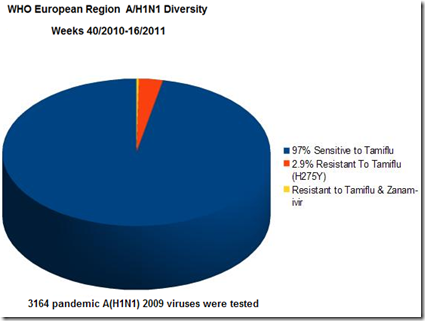
As far as antiviral resistance goes (again from the WHO surveillance of Europe) we find that it is only slowly increasing, with the overwhelming majority of isolates tested still showing sensitivity to Tamiflu. 


image


But as we move further downrange from the emergence of the 2009 H1N1 virus, the odds are that we’ll see more diversity in the subgroups, more `low reactors’, and more antiviral resistance.


If a virus – which leaves behind immunity in the host – fails to evolve into a new antigenically different strain, it will eventually die out due to a lack of susceptible hosts.


Survival demands that the virus evolve. 


And in recent months we’ve seen reports – particularly out of Europe – suggesting that may be happening, as the effectiveness of the seasonal flu vaccine over the 2010-2011 flu season had dropped.  


CIDRAP covered this report in late March.


Preliminary studies show lower flu-shot effectiveness in Europe

Robert Roos * News Editor

Mar 21, 2011 (CIDRAP News) – Preliminary studies suggest that this year's trivalent seasonal flu vaccine used in Europe was less effective against the 2009 H1N1 virus than last year's monovalent H1N1 vaccine was, possibly because of some degree of mutation in the virus, according to recent reports in Eurosurveillance.

(Continue . . . )


Which brings us to an interesting report, mentioned by CIDRAP last night in their news roundup, coming from the US Department of Defense (DoD).


It states that recent outbreaks of H1N1 in Venezuela and Mexico's Chihuahua state need to be monitored because they has been linked to severe infections and deaths, including some patients who had received the vaccine.


Initial analysis are suggesting that the Mexico group (inDRE1945) of H1N1 does not fall into previously characterized  A/England/142/2010, A/Christchurch/16/2010 (highlighted by D222N), or A/Hong Kong/2213/2010 subclades.


image

http://airforcemedicine.afms.mil/idc/groups/public/documents/afms/ctb_152827.pdf


These outbreaks have been well monitored for more than a month by the newshounds on the flu forums, including in this thread on FluTrackers, which has more than 250 entries.  


But what to make of all this is less than clear.


Sub clades of circulating influenza viruses emerge all the time.  Some disappear almost immediately, others linger in the background for awhile, sputter and die. 


A very few take off like a rocket.


It is a case of survival of the fittest. The virus that evades acquired immunity the best, replicates well, and transmits the most efficiently usually wins the race.  


At least for a while.


In the world of influenza viruses, nothing is permanent, the status quo never lasts for long, and the only constant is change.


Obviously, anything that increases the virulence, or moves the virus away from our acquired immunity (through prior infection or vaccines), is of concern.


But whether this suspected branch in H1N1’s evolution in Mexico & Latin America proves to have `legs’, remains to be seen.


It is possible that after a relatively mild second year of A/H1N1/2009, we could see a more severe flu season come the fall due to evolution of the virus.  


It’s happened before.


In 1957, the Asian Flu pandemic seemed to disappear completely for more than a year, only to return in 1959 and again after a two year lull during the 1962-63 flu season.  


image

NEJM 2009


With the Northern Hemisphere’s flu season at an end, we’ll be looking to the events south of the equator over the next six months to give us some hint of what may be in store for next fall.


Stay tuned.

Wednesday, March 09, 2011

PLoS One: A Single Mutation That Enhances H1N1 Transmission


# 5362


By just about any standard, we dodged a bullet with the pandemic of 2009. Despite hundreds of thousands of hospitalizations and tens of thousands of deaths (far more than were officially counted), it could have been far worse.


But we may not be out of the woods just yet.


It isn’t lost on scientists that in 1957, the Asian Flu pandemic seemed to disappear completely for more than a year, only to return in 1959 and again after a two year lull during the 1962-63 flu season.  


image

NEJM 2009


Influenza viruses are – as we’ve said before – unpredictable.


Two things we look for in an emerging virus are its pathogenicity – its ability to cause disease, and its transmissibility in humans – often measured by its R0 (pronounced `R nought’)  or basic reproductive number.


This R0 number describes the average number of new cases caused by one infectious person entering a totally susceptible population If less than 1.0,  outbreaks are likely to sputter and die out. 


With an R0 greater than 1.0, an outbreak has `legs’, and can spread through a community.


Determining the R0 of a virus can only be done in retrospect, and that number may vary considerably from one community to another.  The best researchers can usually come up with is an estimated range.


For the 2009 H1N1 virus, that number has usually been pegged at between 1.4 and 1.6.   Fairly low for a pandemic virus, but sufficient to ensure its survival and spread. 


The 1918 pandemic virus, in comparison, has been estimated to have an R0 between 2.0 and 3.0.  There are some estimates that run even higher.


In order to spread efficiently, a virus must be able to bind to human receptor cells – preferably those found in the upper airway.  While H1N1 does bind to human α2,6 receptor cells, it appears to do so more weakly than do many other flu viruses.


Additionally, in 2009 researchers at MIT and the CDC found that a portion of the PB2 gene – which is normally found in efficiently transmitted influenza viruses – was missing.


From MIT News,  July 3rd 2009.


MIT, CDC find H1N1 flu virus ill-suited for rapid transmission

But researchers say new strain bears watching, could mutate

(EXCERPT)

Recent studies have shown that a viral RNA polymerase known as PB2 is critical for efficient influenza transmissibility. (RNA polymerase controls the viruses' replication once they infect a host.) The new H1N1 strain does not have the version of the PB2 gene necessary for efficient transmission.


While we’ve been relatively fortunate so far, the question becomes, what would it take to make the 2009 pandemic virus more dangerous?


While there is probably more than one answer to that question, once again researchers from MIT and the CDC have been investigating, and have recently presented the results of a laboratory generated single point mutation that confers enhanced transmissibility to the H1N1 virus (at least in ferrets).

Ferrets are often used in influenza studies because their respiratory physiology, and susceptibility to influenza viruses, is close to that of humans.


The study, which appears in the March 2nd edition of Plos One, is called:

A Single Base-Pair Change in 2009 H1N1 Hemagglutinin Increases Human Receptor Affinity and Leads to Efficient Airborne Viral Transmission in Ferrets

Akila Jayaraman, Claudia Pappas, Rahul Raman, Jessica A. Belser, Karthik Viswanathan, Zachary Shriver, Terrence M. Tumpey, Ram Sasisekharan


The 2009 H1N1 influenza A virus continues to circulate among the human population as the predominant H1N1 subtype. Epidemiological studies and airborne transmission studies using the ferret model have shown that the transmission efficiency of 2009 H1N1 viruses is lower than that of previous seasonal strains and the 1918 pandemic H1N1 strain.


We recently correlated this reduced transmission efficiency to the lower binding affinity of the 2009 H1N1 hemagglutinin (HA) to α2→6 sialylated glycan receptors (human receptors). Here we report that a single point mutation (Ile219→Lys; a base pair change) in the glycan receptor-binding site (RBS) of a representative 2009 H1N1 influenza A virus, A/California/04/09 or CA04/09, quantitatively increases its human receptor-binding affinity.


The increased human receptor-affinity is in the same range as that of the HA from highly transmissible seasonal and 1918 pandemic H1N1 viruses. Moreover, a 2009 H1N1 virus carrying this mutation in the RBS (generated using reverse genetics) transmits efficiently in ferrets by respiratory droplets thereby reestablishing our previously observed correlation between human receptor-binding affinity and transmission efficiency. These findings are significant in the context of monitoring the evolution of the currently circulating 2009 H1N1 viruses.


For a less technical take on all of this, MIT News has an article describing the ramifications of this discovery. 


Keeping an eye on H1N1

MIT scientists identify a mutation that could allow the flu virus to spread much more easily.


Despite all of our technology, and an unprecedented two-year focus on the 2009 H1N1 virus, scientists are just beginning to unravel the secrets of the internal workings of flu viruses.


We can readily observe changes to the virus’s structure, but only rarely can we predict what those changes may mean in terms of virulence or transmissibility.


We know, for instance, that the H275Y mutation confers oseltamivir resistance, and although we’ve been watching the D225G `Norway’ mutations around the globe for more than a year, the jury is still out on its clinical significance (see Eurosurveillance: Debating The D222G/N Mutation In H1N1).


It isn’t enough to simply observe mutations occurring in the influenza virus.  


We need to know that they mean.


To that end, this research has identified a potentially dangerous single point mutation that – should it begin appearing in the wild – could signal the start of a new wave of illness. 


While that may not happen with the 2009 H1N1 virus, knowing what to look for gives us a decided advantage when tracking the evolution of this – and any other – influenza virus.

Monday, January 10, 2011

Egyptian MOH:`No Mutation’ Of Flu


# 5217


Invariably, when a new or novel influenza virus makes an appearance on the world stage, the concern is that over time it will mutate to a more formidable viral foe.


Mutating is, after all, what viruses do. 


And influenza viruses are particularly adept at acquiring changes – either through small incremental changes (called `drift’), or via a reassortment or swapping of genetic material with another virus, called `shift’.


And as any virologist will tell you, Shift Happens.


Yet, despite the stigma attached to the word `mutation’, viruses can also mutate into a less dangerous strains. 


Over the past few days we are seeing public reassurances from some public health agencies that the swine flu virus has not `mutated’ into a more virulent strain.


Last week, scientists from the UK’s HPA, writing in Eurosurveillance (see Eurosurveillance: Analysis Of Fatal H1N1 Cases In The UK) stated that: so far no unique mutations have been associated with severe or fatal cases of influenza A(H1N1)2009, but further comprehensive analysis is required.


That isn’t to say that mutations haven’t shown up.  They have, and will no doubt continue to do so.  


But so far, none of these changes is viewed by these HPA researchers as particularly alarming, linked to fatal cases, or indicative of a fundamental change in the H1N1 virus.


Today, similar assurances from the Egyptian Ministry of Health, on both H1N1 and H5N1 `bird flu’.


(Note: I realize there may not be universal agreement over the significance of some of the mutations that have been seen to date. Since I’m not a virologist, I’ll have to leave it to others to debate that issue.)


A double hat tip to Twall and Shiloh on FluTrackers for links to the Arabic and English versions of the following report.


No mutation of the avaian flu with swine flu, says health minister

Minister of Health asks citizens to take flu seriously but denies presence of mixed mutation of avian flu with swine flu

Ahram Online, Monday 10 Jan 2011

Egyptian Minister of Health Hatem El-Gabaly denied the presence of any mixed mutation of avian flu with swine flu (H1N1). He did, however, warn citizens against taking the flu threat lightly.

(Continue . . . )


When a novel flu virus like H5N1 co-circulates with a human-adapted influenza like H1N1 or H3N2, the concern is that the two will infect the same host at the same time, swap genetic material, and produce a new hybrid strain with the worst qualities (virulence and transmissibility) of both parent viruses.


We know reassortments like this can happen, as they has happened in the past. 


But it obviously doesn’t happen often, or easily, else we’d be hip deep in reassorted flu viruses every year.


Of course, it only takes one good hookup between compatible viruses, in the right host at the right time and in the right place to spark another global flu crisis.


In her keynote speech last night at Duke University, Assistant Surgeon General Dr. Anne Schuchat reminded her audience that had the 2009 novel H1N1 virus been detected just a few weeks sooner (it was already circulating), it could have been incorporated into that year’s seasonal flu shot.


That would have saved billions of dollars over the production of a separate pandemic jab, and would have gotten the vaccine into the arms of millions of people months sooner.


A step that would likely have saved many lives and billions more in health care costs.


Which is why surveillance, analysis, and reporting on any changes to influenza viruses circulating in humans and animals around the world remains a high priority.

Thursday, October 21, 2010

Eurosurveillance On Recently Isolated H1N1 Mutations


#4998


That the novel H1N1 virus would begin to show signs of changing over time comes as no surprise.  Indeed, many experts expected to see changes begin last fall and winter in the northern hemisphere, and were surprised at how stable the virus remained.


Small changes were detected, in what appeared to be widely scattered mutations.  


The D22G – or Norway mutation – garnered a good deal of press beginning in November of 2009.   It failed, however, spread widely and in any event, the feared pathogenic changes that came with that mutation were inconsistent. 


Some cases were more severe, while others remained mild.  For more, see:


Study: Receptor Binding Changes With H1N1 D222G Mutation
CIDRAP Report On The H1N1 Mutation Debate
WER Review: D222G Mutation In H1N1


Similarly, a relative handful of H275Y mutations which conveyed Oseltamivir resistance have been reported. But once again, there was little evidence to suggest it was spreading widely.


NIH: Rapid Development Of Antiviral Resistance In Two Cases
WER Review: Oseltamivir Resistance In Pandemic H1N1


So called `low reactor’ viruses – those that appeared to be less well matched to the current pandemic H1N1 component to the flu vaccine – have also been reported in a few scattered instances around the world.  


But overall, the virus has remained antigenically close to the A/California/7/2009-like strain included in the vaccine.


Today Eurosurveillance has a major report on the detection of a growing number of `drifted’ H1N1 virus isolates from Singapore, Australia, and New Zealand over the winter of 2010.


The important points here are that right now, despite some reported vaccine `breakthroughs’ and some reported fatal cases with this mutation, it doesn’t appear that these changes render the existing vaccine ineffective, and pending further information there is scant evidence that they make the virus more dangerous.


A less positive note is that this `mutated’ virus appears to be relatively biologically `fit’, and capable of competing with the original virus, and spreading throughout the human population.


What this does tell us is that the virus is picking up changes, and that it must be closely watched as it slowly evolves during its run in through the northern hemisphere.


Eurosurveillance, Volume 15, Issue 42, 21 October 2010


Barr IG, Cui L, Komadina N, Lee RT, Lin RT, Deng Y, Caldwell N, Shaw R, Maurer-Stroh S. A new pandemic influenza A(H1N1) genetic variant predominated in the winter 2010 influenza season in Australia, New Zealand and Singapore. Euro Surveill. 2010;15(42):pii=19692.

Date of submission: 14 September 2010


Pandemic H1N1 influenza virus is of global health concern and is currently the predominant influenza virus subtype circulating in the southern hemisphere 2010 winter. The virus has changed little since it emerged in 2009, however, in this report we describe several genetically distinct changes in the pandemic H1N1 influenza virus.


These variants were first detected in Singapore in early 2010 and have subsequently spread through Australia and New Zealand.


At this stage, these signature changes in the haemagglutinin and neuraminidase proteins have not resulted in significant antigenic changes which might make the current vaccine less effective, but such adaptive mutations should be carefully monitored as the northern hemisphere approaches its winter influenza season.


The always dependable Maggie Fox, science and health editor of Reuters, has a report on all of this which you can access at:


New strain of swine flu emerges - report

Maggie Fox, Health and Science Editor


The bottom line:  The impact of these mutational changes is unclear at this time, but this reinforces the need to monitor the antigenic changes of this – and any other – circulating flu virus.