Showing posts with label Airports. Show all posts

Friday, December 13, 2013

Science: The Hidden Geometry of Complex, Network-Driven Contagion Phenomena

image

Scheduled airline traffic around the world, circa June 2009 – Credit Wikipedia

# 8067


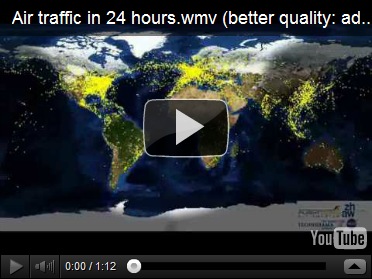
Purely by chance, just weeks before the 2009 H1N1 virus broke out of Mexico and began to wing itself around the globe via international air traffic, I penned a blog called How The Next Pandemic Will Arrive. That blog was inspired by a video (below) made by ZHAW (Zürcher Hochschule für Angewandte Wissenschaften)  showing 24 hours of air traffic around the world compressed into just over a minute.


Since then, we’ve looked at the role of air traffic in the spread of infectious disease a number of times, including a PLoS One  study from MIT: Contagion Dynamics Of International Air Travel that simulated the early spread of a pandemic virus via air travel and ranked U.S. airports based on how much they contributed to the spread of the illness, and a number of studies suggesting that airport screening for infected travelers would likely be ineffective.


Branswell: Limitations Of Airport Disease Screening

Japan: Quarantine At Ports Ineffective Against Pandemic Flu

Fluing The Friendly Skies


Today, in the Journal Science, we get a new look at the simulated spread of a SARS or H1N1-like virus via international air travel from authors  Dirk Brockmann and Dirk Helbing with the innocuous sounding title of:


The Hidden Geometry of Complex, Network-Driven Contagion Phenomena

Dirk Brockmann , Dirk Helbing

Science 13 December 2013:
Vol. 342 no. 6164 pp. 1337-1342
DOI: 10.1126/science.1245200


While the bulk of this study is behind a pay wall, we get a preview of its findings (and a fascinating video) from a press release via Berlin’s Humboldt-Universität.

image

(Click Image to view video)


The Hidden Geometry of Global Contagion

New mathematical theory for the global spread of epidemics

Scientists at Berlin’s Humboldt-Universität, ETH Zurich, Northwestern University and Robert Koch Institute develop a new mathematical theory for the global spread of epidemics. Insights cannot only facilitate finding an outbreak’s origin, but may significantly improve the forecast of global spreading pathways. The results of the study “The hidden geometry of complex, network-driven contagion phenomena” have recently been published in the journal Science.

When an unknown virus emerges at various locations in the world, scientists focus on answering the following questions: Where did the new disease originate? Where are new cases to be expected? When are they expected? And how many people will catch the disease? In order to contain the further spread – and potentially devastating consequences – rapid assessment is essential for the development of efficient mitigation strategies. Highly sophisticated computer simulations are an important tool for forecasting different scenarios: These simulations attempt to predict the likely epidemic time-course and spreading pattern. However, the computer simulations are very demanding in terms of computer time. They also require knowledge of disease-specific parameters that are typically not known for new, emergent infectious diseases.

Theoretical physicist Dirk Brockmann, Professor at Berlin’s Humboldt-Universität, and his fellow scientist Dirk Helbing, Professor at ETH Zurich, now propose a different approach for understanding global disease dynamics:  “Our theory is based on the intuitive notion that in our strongly connected world, conventional geographic distances are no longer the key variable but must be replaced with effective distances,” they explain. “From the perspective of Frankfurt, Germany, other metropolitan areas such as London, New York or Tokyo are effectively not more distant than geographically close German cities such as Bremen, Leipzig or Kiel,” says Brockmann, who developed the ideas for this research at the Northwestern Institute on Complex Systems. In their work, the researchers show that effective distances can be computed from the traffic intensities in the worldwide air-transportation network: “If the flux of passengers from A to B is large, the effective distance is small and vice versa. The only thing we had to do was to find the right mathematical formula for this,” Helbing explains.

(Continue . . . )


While I’ve said it before, it’s worth repeating:


The takeaway from all of this is that we ignore global healthcare and infectious disease outbreaks – even in the remotest areas of the world – at our own peril. Vast oceans and extended travel times no longer offer us protection, and there is no technological shield that we can erect that would keep an emerging pandemic virus out.


The place to try to stop the next pandemic is not at the airport gate, but in the places around the world where they are likely to emerge.


Which makes the funding and support of international public health initiatives, animal health initiatives, and disease surveillance ever so important, no matter where on this globe you happen to live.

Sunday, July 28, 2013

Head ‘Em Off At The Passenger Gate?

image

Scheduled airline traffic around the world, circa June 2009 – Credit Wikipedia


For every complex problem there is an answer that is clear, simple, and wrong. - H. L. Mencken


# 7522


With MERS-CoV (along with H7N9 & H5N1) still making headlines, this week a new poll indicates that at least 80% of respondents supported the screening of inbound airline passengers from affected countries for this emerging virus.


A Reuters story this week (see Support high for travel screening to stem MERS spread: poll) has the details (excerpt below).


More than 80 percent of people questioned in developed countries said inbound travelers from countries with cases of MERS should be screened for the illness. The number rose to 90 percent in less industrialized countries.


Support was highest in China, Indonesia and Saudi Arabia, where the illness has been reported, and Italy, which has also been affected, as well as in Australia, Canada and Argentina.


While an understandable reaction by the public, there is scant evidence to suggest that screening passengers would do much, if anything, to prevent the entry of a viral illness into a country.


It’s not that it hasn’t been tried.  It has. But the success rate has been, well . . .  dismal.


The world’s airlines carry 2.6 billion passengers each year, on more than 17 million flights.  And as the graphic at the top of this post indicates, millions of these are international flights.


With most viral diseases having an incubation period that ranges from a couple of days to a week or longer, someone who is newly infected with a virus could easily change planes and continents several times before ever they ever show signs of illness.


And as we saw during the 2009 H1N1 pandemic – even those who are symptomatic will often go to great lengths to get to their destination (see Vietnam Discovers Passengers Beating Thermal Scanners).


In April of 2012, in EID Journal: Airport Screening For Pandemic Flu In New Zealand, we looked at a study that found the screening methods used at New Zealand’s airport were inadequate to slow the entry of the 2009 pandemic flu into their country, detecting less than 6% of those infected.


Admittedly, New Zealand did not employ thermal scanners.  But countries that did, didn’t fare much better.


image

Thermal Scanner – Credit Wikipedia


In December of 2009, in Travel-Associated H1N1 Influenza in Singapore, we saw a NEJM Journal Watch article on of a new study that had been published, ahead of print, in the CDC’s  EID Journal  entitled:


Epidemiology of travel-associated pandemic (H1N1) 2009 infection in 116 patients, Singapore. Emerg Infect Dis 2010 Jan; [e-pub ahead of print]. Mukherjee P et al

 
Travel-Associated H1N1 Influenza in Singapore

Airport thermal scanners detected only 12% of travel-associated flu cases; many travelers boarded flights despite symptoms.


In Japan: Quarantine At Ports Ineffective Against Pandemic Flu  I wrote about a study that suggests between asymptomatic or mild infections, and a silent incubation period of several days, there wasn’t much chance of long-term success.


For every person identified, and quarantined, by port authorities  - researchers estimate 14 others infected by the virus entered undetected.


This is a topic that Helen Branswell of the Canadian press has written about often, including last April in:


Airport disease screening rarely worthwhile, study suggests

Helen Branswell, The Canadian Press
Published Wednesday, April 10, 2013 10:11AM EDT


Despite little evidence to suggest that passenger screening would be effective, many governments will probably find it difficult not to be seen at least making the attempt.


On a slightly positive note, while they may not stop a virus, passenger screening might provide some interesting surveillance data.


But practically, as way to keep a pandemic virus from entering a country, it has a low probability of success.


The place to try to stop the next pandemic is not at the inbound passenger gate, but in the places around the world where they are likely to emerge.


Which makes the funding and support of international public health initiatives, animal health initiatives, and disease surveillance hugely important, no matter where on this interconnected globe you happen to live.

Monday, July 23, 2012

MIT: Contagion Dynamics Of International Air Travel


# 6446


In 2009, about 6 weeks before news of the outbreak of H1N1 in Mexico was announced, I came across a fascinating video on Youtube which inspired a blog called How The Next Pandemic Will Arrive.


I wrote:


There is a lot we don't currently know about the next pandemic.  We don't know when it will arrive.  We don't know what virus will cause it.  And we don't know how bad it will be.


But there is one thing almost certain.


It will arrive in most countries by airplane.


Not exactly an earth shattering revelation, given that air travel is an obvious mode of viral spread. But my timing was excellent.


By the end of following month the new H1N1 virus was winging its way around the globe in large part due to spring break vacationers returning from Mexico.


While obviously a major factor, the dynamics of disease spread through airports is only partially understood.  


We’ve a new study, appearing in PloS One, that looks at the early spread of a pandemic virus through air travel, and through the use of Monte Carlo simulations, finds some airports contributing more to the spread of a pandemic than the number of travelers passing through it might suggest.


The study, conducted by researchers at MIT, is called:


A Metric of Influential Spreading during Contagion Dynamics through the Air Transportation Network

Christos Nicolaides, Luis Cueto-Felgueroso, Marta C. González, Ruben Juanes

Abstract

The spread of infectious diseases at the global scale is mediated by long-range human travel. Our ability to predict the impact of an outbreak on human health requires understanding the spatiotemporal signature of early-time spreading from a specific location.


Here, we show that network topology, geography, traffic structure and individual mobility patterns are all essential for accurate predictions of disease spreading. Specifically, we study contagion dynamics through the air transportation network by means of a stochastic agent-tracking model that accounts for the spatial distribution of airports, detailed air traffic and the correlated nature of mobility patterns and waiting-time distributions of individual agents.


From the simulation results and the empirical air-travel data, we formulate a metric of influential spreading––the geographic spreading centrality––which accounts for spatial organization and the hierarchical structure of the network traffic, and provides an accurate measure of the early-time spreading power of individual nodes.


I would invite those with a better grasp of statistical analysis than I to read the entire study, but for the rest of us, we have the following report from MIT News.


Monday, July 23

New model of disease contagion ranks U.S. airports in terms of their spreading influence

Airports in New York, Los Angeles and Honolulu are judged likeliest to play a significant role in the growth of a pandemic.

Denise Brehm, Civil and Environmental Engineering

World map shows flight routes from the 40 largest U.S. airports.


Image: Christos Nicolaides, Juanes Research Group

Public health crises of the past decade — such as the 2003 SARS outbreak, which spread to 37 countries and caused about 1,000 deaths, and the 2009 H1N1 flu pandemic that killed about 300,000 people worldwide — have heightened awareness that new viruses or bacteria could spread quickly across the globe, aided by air travel.


<SNIP>


Outsize role for Honolulu


For example, a simplified model using random diffusion might say that half the travelers at the Honolulu airport will go to San Francisco and half to Anchorage, Alaska, taking the disease and spreading it to travelers at those airports, who would randomly travel and continue the contagion.


In fact, while the Honolulu airport gets only 30 percent as much air traffic as New York's Kennedy International Airport, the new model predicts that it is nearly as influential in terms of contagion, because of where it fits in the air transportation network: Its location in the Pacific Ocean and its many connections to distant, large and well-connected hubs gives it a ranking of third in terms of contagion-spreading influence.


Kennedy Airport is ranked first by the model, followed by airports in Los Angeles, Honolulu, San Francisco, Newark, Chicago (O'Hare) and Washington (Dulles). Atlanta's Hartsfield-Jackson International Airport, which is first in number of flights, ranks eighth in contagion influence. Boston's Logan International Airport ranks 15th.

(Continue . . . )


Complicating matters - attempts to identify and quarantine air travelers with fevers, or other signs of illness - have proved notoriously difficult.


Last April, in EID Journal: Airport Screening For Pandemic Flu In New Zealand, we looked at a study that found that the screening methods used at New Zealand’s airport were inadequate to slow the entry of the 2009 pandemic flu into their country, detecting less than 6% of those infected.


Unlike some other countries in 2009, New Zealand did not employ thermal scanners, which look for arriving passengers or crew with elevated temperatures. 

(Thermal Imaging for SARS in 2003)


But even countries that employed thermal scanners and far more strict interdiction techniques during the summer of 2009 failed to keep the flu out.


Just as the pandemic was ramping up, in Vietnam Discovers Passengers Beating Thermal Scanners, we saw evidence of flyers taking fever-reducers to beat the airport scanners in order to get home.


In December of 2009, in Travel-Associated H1N1 Influenza in Singapore, I wrote about a NEJM Journal Watch of a new study that has been published, ahead of print, in the CDC’s  EID Journal  entitled:


Epidemiology of travel-associated pandemic (H1N1) 2009 infection in 116 patients, Singapore. Emerg Infect Dis 2010 Jan; [e-pub ahead of print]. Mukherjee P et al

Travel-Associated H1N1 Influenza in Singapore

Airport thermal scanners detected only 12% of travel-associated flu cases; many travelers boarded flights despite symptoms.

And finally, in June of 2010  CIDRAP carried this piece on a study of thermal scanners in New Zealand in 2008 (before the pandemic) presented at 2010’s ICEID.


Thermal scanners are poor flu predictors

Thermal scanners for screening travelers do moderately well at detecting fever, but do a poor job at flagging influenza, according to researchers from New Zealand who presented their findings today at the International Conference on Emerging Infectious Diseases (ICEID) in Atlanta.


As far as the transmission of the influenza virus aboard an airliner, in May of 2010 we saw a study in the BMJ that looked at that very topic (see BMJ: Flu Transmission Risks On Airplanes)


BMJ 2010;340:c2424

Research

Transmission of pandemic A/H1N1 2009 influenza on passenger aircraft: retrospective cohort study


Conclusions


A low but measurable risk of transmission of pandemic A/H1N1 exists during modern commercial air travel. This risk is concentrated close to infected passengers with symptoms. Follow-up and screening of exposed passengers is slow and difficult once they have left the airport.


Another study, conducted by researchers at UCLA and published in BMC Medicine in late 2009:


Calculating the potential for within-flight transmission of influenza A (H1N1)

Bradley G Wagner, Brian J Coburn and Sally Blower*

Results

The risk of catching H1N1 will essentially be confined to passengers travelling in the same cabin as the source case. Not surprisingly, we find that the longer the flight the greater the number of infections that can be expected. We calculate that H1N1, even during long flights, poses a low to moderate within-flight transmission risk if the source case travels First Class.


(Continue . . .)


While it may prove impossible to halt the spread of a pandemic via airline passengers, knowing which airports are the most likely to contribute to the spread of a new virus could aid in attempts to slow its progress.


Which makes research like what we’ve seen out of MIT today of more than just academic interest.

Sunday, February 12, 2012

A Flu Flew Review


UPDATED 1800hrs EST: The latest news reports out of NZ indicate that unaffected passengers have been allowed off the plane are now going through customs.  As expected, authorities now believe the sick passengers probably contracted seasonal H3N2 influenza while in Japan.


# 6137


While we wait for an update (see update) on the Boeing 777 currently quarantined on the tarmac at Auckland airport with scores of passengers complaining of flu-like symptoms (see New Zealand : Airline Passengers Quarantined) this would seem an opportune time to look back at some of what we’ve learned about airplanes, airports, and influenza over the years.


What follows are excerpts from previous blogs, you can follow the links to read them in their entirety.


As I mentioned in my last blog, New Zealand has a very aggressive influenza pandemic plan, and I wrote about their drills and preparations back in October of 2008.

New Zealand: Testing Pandemic Quarantine Plans


New Zealand, being an island nation, is one of the few countries that believe they have at least the possibility of blocking a pandemic virus from entering their borders.


It is an ambitious goal.


And the odds of carrying it out successfully are pretty long.


How far they will go to try to block a pandemic virus from entering their country hasn't been decided yet by their Ministry of Health (MOH).


In their FAQ on pandemic influenza, the question is answered this way:

Will New Zealand stop travellers from coming into the country in an effort to stop the spread of disease?

Because we are an island nation, active management of the border (i.e. limiting arrivals from affected areas to allow us to impose effective on-arrival measures) needs to be considered among the range of options as we plan our response. Other countries are also considering border management options.


Any final decision on border management will be made by the Government with input from a range of government departments.


The details of how New Zealand might manage its borders are laid out in the National Health Emergency Plan: New Zealand Influenza Pandemic Action Plan 2006.


But whether the goal is to try to stop the virus from entering the country, or to simply slow the introduction while a vaccine is being produced, it takes planning and training. 

The enormity of the job of interdicting infected passengers was the subject of a blog I wrote just one month before the outbreak of the 2009 H1N1 pandemic virus.

 How The Next Pandemic Will Arrive

# 2876

There is a lot we don't currently know about the next pandemic.  We don't know when it will arrive.  We don't know what virus will cause it.  And we don't know how bad it will be.


But there is one thing almost certain.


It will arrive in most countries by airplane.

The video above, which as been making the rounds for several months, was made by ZHAW (Zürcher Hochschule für Angewandte Wissenschaften) or The Zurich University of Applied Sciences.


It is a simulation (using real data) showing 24 hours of air traffic around the world.  Notice how the level of activity follows the daylight.


Every year there are more than 17,000,000 commercial airline flights (data from year 2000 - it's probably higher now) that carry hundreds of millions of passengers each year. 


As far as the transmission of the influenza virus aboard an airliner, in May of 2010 we saw a study in the BMJ that looked at that very topic. And as the fates would have it, this study was done on a plane flight into the same airport in Auckland, New Zealand.

Note: Given the incubation period of most respiratory viruses, those who are symptomatic on today’s flight almost certainly were exposed and infected prior to boarding the flight.


Friday, May 21, 2010

BMJ: Flu Transmission Risks On Airplanes

# 4586

BMJ 2010;340:c2424

Research
Transmission of pandemic A/H1N1 2009 influenza on passenger aircraft: retrospective cohort study

Michael G Baker, associate professor1, Craig N Thornley, medical officer of health2, Clair Mills, senior lecturer3, Sally Roberts, microbiologist4, Shanika Perera, medical officer of health2, Julia Peters, medical officer of health2, Anne Kelso, director5, Ian Barr, deputy director5, Nick Wilson, associate professor1


I’ve reproduced portions of the abstract below.  The entire study is available online at the BMJ.


Objectives To assess the risk of transmission of pandemic A/H1N1 2009 influenza (pandemic A/H1N1) from an infected high school group to other passengers on an airline flight and the effectiveness of screening and follow-up of exposed passengers.

<SNIP>

Setting Auckland, New Zealand, with national and international follow-up of passengers.

Participants Passengers seated in the rear section of a Boeing 747-400 long haul flight that arrived on 25 April 2009, including a group of 24 students and teachers and 97 (out of 102) other passengers in the same section of the plane who agreed to be interviewed.

Conclusions A low but measurable risk of transmission of pandemic A/H1N1 exists during modern commercial air travel. This risk is concentrated close to infected passengers with symptoms. Follow-up and screening of exposed passengers is slow and difficult once they have left the airport.


And lastly, a long hard look at attempts by countries to detect and isolate infected travelers during a pandemic. As countries discovered in 2009, travel restrictions are very difficult to implement, and will likely fail in the long run.


Travel-Associated H1N1 Influenza in Singapore

(Thermal Imaging in 2003)

The idea sounds simple. 

By screening passengers for fever when they arrive via airplane (or boat or train) from another country you can hopefully reduce the number of infected passengers that enter during a pandemic.


In reality, it isn’t simple at all.


Today a summary from NEJM Journal Watch of a new study that has been published, ahead of print, in the CDC’s  EID Journal  entitled:


Epidemiology of travel-associated pandemic (H1N1) 2009 infection in 116 patients, Singapore. Emerg Infect Dis 2010 Jan; [e-pub ahead of print]. Mukherjee P et al

Travel-Associated H1N1 Influenza in Singapore

Airport thermal scanners detected only 12% of travel-associated flu cases; many travelers boarded flights despite symptoms.

Travelers play a key role in spreading many infections, including influenza. Such was the case with the spread of 2009 H1N1 influenza to Singapore, a major travel hub serving 37 million air passengers annually.

(Continue . . .)