Showing posts with label CMAJ. Show all posts

Monday, October 29, 2012

CMAJ On Mandatory Flu Shot For HCWs

image

Photo Credit – CDC PHIL


# 6676


In an editorial today, the CMAJ (Canadian Medical Association Journal) endorsed requiring HCWs (Health Care Workers) to get a seasonal flu shot, thus joining a growing list of medical associations around the world calling for similar policies.


First, the press release followed by a link to the editorial, then I’ll return with more.


Canadian Medical Association Journal

Mandatory flu vaccine for health care workers to protect patients

All health care workers in health care institutions should be vaccinated with the annual influenza vaccine to protect patients, argues an editorial in CMAJ (Canadian Medical Association Journal).


Each season, 20% of health care workers get influenza, and 28% of young healthy adults who get it have asymptomatic or subclinical infections," writes Dr. Ken Flegel, Senior Associate Editor, CMAJ. "Some of them may shed virus up to a day before symptoms appear. It is time that all people who work in a health care institution be vaccinated."


In Canada, there are approximately 20 000 hospital admissions related to influenza and an estimated 4000 to 8000 deaths attributed to the illness. However, 55%% of physicians do not get vaccinated against the flu and are putting patients at risk of illness and death.


Dr. Flegel argues that flu vaccination for health workers must be compulsory, although there could be exemptions for medical or religious reasons. A vaccination rate above 90% is required to prevent outbreaks in hospitals. Mandatory programs for health care workers in many US institutions have resulted in participation rates of about 95%.


"Our schools have shown us the way. During measles outbreaks, access to schools has been successfully denied to nonvaccinated children and staff. The time has come for health care institutions to demand that all health care workers be vaccinated. Our patients' lives depend on this change," Dr. Flegel concludes.


You can read the entire editorial at this link:


EDITORIAL

Health care workers must protect patients from influenza by taking the annual vaccine


October 29, 2012

We know that health care workers import and transmit seasonal influenza to patients. We know that many patients get seriously ill from it and that some die. We know that the annual influenza vaccine can interrupt most of this imposed disease burden. It is time that we act on our knowledge and require all health care workers to be vaccinated. 

Full article


Despite vocal resistance from some HCWs and their unions, calls for mandatory flu vaccination for health care workers have been coming from many professional organizations for several years.


A few earlier blogs on these include:


APIC Calls For Mandatory Flu Vaccination For HCWs
AAP: Recommends Mandatory Flu Vaccinations For HCWs
SHEA: Mandatory Vaccination Of Health Care Workers
IDSA Urges Mandatory Flu Vaccinations For Healthcare Workers


In 2011, the following editorial opinion appeared in The Lancet.


The Lancet, Volume 378, Issue 9788, Pages 310 - 311, 23 July 2011

doi:10.1016/S0140-6736(11)61156-2

Time to mandate influenza vaccination in health-care workers


This perspective was penned by Arthur Caplan, Ph.D., who is director of the Center for Bioethics at the University of Pennsylvania, and addresses the ethics of mandating yearly influenza vaccination for Health Care Workers (HCWs).


Caplan argues that the evidence overwhelmingly shows that vaccinating HCWs helps to protect patients from infection (and possible death), and that the influenza vaccine is both safe and effective.


Citing language common to all oaths sworn by health care professionals (Doctors, Nurses, Techs, etc.), he points out the universal concept that the interests of the patient must come first, and that all HCWs must honor the core medical principal of, “First, do no harm.”


Both tenets, he argued, are violated when HCWs fail to accept a yearly flu vaccination.


While strongly advocating HCW influenza vaccination, the CDC has stopped short of mandating them. I blogged on this back on June 23rd, 2010  in  CDC: Proposed Influenza Infection Control Guidance.


And earlier this month we saw Rhode Island Adopts New Flu Vaccination Requirements For HCPs.


Although many infection control experts see this as a long overdue step in patient and employee protection, compulsory vaccination remains a hugely divisive issue, with many HCWs believing that it is an infringement of their rights to decide what will be injected into their bodies.


I’ve covered some of the HCW’s objections to forced flu shots in the past, including:


HCWs: Refusing To Bare Arms

HCWs: Developing a Different Kind Of Resistance


While their concerns over the vaccine’s safety may be overblown, one of their arguments that does carry some weight is the relative effectiveness of the flu vaccine.


It simply isn’t as good as with other vaccines.


Most years (see CIDRAP: The Need For `Game Changing’ Flu Vaccines), protection from the flu shot runs under 60% for healthy adults, and probably even less for those over 65 or with weakened immune systems.


Having a better flu vaccine would remove at least one of the objections that many HCWs have voiced.


Popular with HCWs or not, hospitals are increasingly looking at this as both a liability and an economic issue. Unless the courts intervene, the momentum increasingly appears to be moving towards mandating yearly flu shots for many Health Care Workers down the road.

Tuesday, September 20, 2011

CMAJ: Childhood Flu Vaccinations Reduced Hospitalizations


image

# 5855


From the CMAJ (Canadian Medical Association Journal) we get the results of a comparative study between the United States – which expanded its recommendations for seasonal influenza vaccination to include healthy children aged 24–59 months in 2006-07, and Canada which did not follow suit.


Using data collected on ER visits by children in two pediatric hospitals  located in Boston, Massachusetts & Montréal, Quebec over a period of 9 years, they were able to compare the rates of influenza-like-illness (ILI) among children both before and after the U.S. vaccine policy change went into effect.


What they found was that relative to Canada, the U.S. saw a 34% reduction in ILI among children aged 2-4 since the new vaccine recommendations were instituted.


The research paper is available on the CMAJ website:


Effect of expanded US recommendations for seasonal influenza vaccination: comparison of two pediatric emergency departments in the United States and Canada

Anne Gatewood Hoen, PhD, David L. Buckeridge, MD PhD, Katia M.L. Charland, PhD, Kenneth D. Mandl, MD MPH, Caroline Quach, MD MSc, John S. Brownstein, PhD


Interpretation: The divergence in influenza rates among children in the US and Canadian sample populations after institution of the US policy to vaccinate children two to four years of age is evidence that the recommendation of the US Advisory Committee on Immunization Practices resulted in a reduction in influenza-related morbidity in the target group and may have indirectly affected other pediatric age groups. Provincial adoption of the 2010 recommendation of the National Advisory Committee on Immunization in Canada to vaccinate children two to four years of age might positively affect influenza morbidity in Canada.


For more details, we get this press release from Children’s Hospital in Boston.


'Natural experiment' documents the population benefit of vaccinating preschoolers against the flu

Flu rates among two- to four-year-olds decline 34 percent following changes in U.S. vaccine policy; study is first to use real time hospital data to evaluate policy change

Boston, Mass. – Recent policies calling for vaccinating preschool-aged children against the flu led to a 34 percent decline in influenza cases in this age group, according to researchers at Children's Hospital Boston and McGill University. The findings, which revealed smaller declines in other age groups as well, arose from a study that used real time surveillance data from pediatric emergency departments (EDs) in the United States and Canada to evaluate the relationship between national flu vaccination policies and rates of flu-like illness.


The research team, led by Anne Gatewood Hoen and John Brownstein of the Children's Hospital Informatics Program (CHIP), reported their findings September 19 in the Canadian Medical Association Journal.


Preschoolers – specifically children aged two to four – play a significant role in community transmission of the flu with each new season. The Advisory Committee on Immunization Practices – the national body that sets vaccination policies in the U.S. – updated its influenza vaccine recommendations in 2006 to include vaccination of this age group. The corresponding Canadian body, the National Advisory Committee on Immunization, did not include these children in its recommendations until 2010.


"The differences in the U.S. and Canadian policies created conditions for a natural experiment for evaluating the effects of U.S. policy change in the target age group," said Brownstein, director of CHIP's Computational Epidemiology Group. "They also gave us an opportunity to test whether we could use hospital-based real time surveillance data to assess the effects of policy changes, and do so more quickly than traditional epidemiologic studies, which are more focused on vaccine uptake than on outcomes."

(Continue . . . )


As always, there were some limitations to this study. First, it was only conducted at two hospitals, which might not accurately reflect national trends.


Second,  that influenza diagnoses were rarely confirmed by lab tests, but were rather based on symptoms of ILIs (influenza-like-Illnesses). The authors state, however, that:


Repeating our analysis with a narrower definition of influenza-like illness resulted in a strengthening of the effect from a 34% reduction to  a 52%  reduction in  emergency department visits for influenza-like illness at Children’s Hospital Boston relative  to  the Montreal Children’s Hospital, which suggests that our broad definition resulted in a conservative  estimate of  the effect.


And third, data on vaccine uptake for each patient was not generally available, and instead the authors relied upon surveys of vaccination rates among children during the years in question.


Still, despite these limitations, this study provides strong evidence to support to the policy of vaccinating young children against seasonal influenza. 


With influenza season soon upon us, the CDC  would like to see just about everyone over the age of 6 months get the flu vaccine. 


For details on this year’s recommendations see:

 
MMWR: ACIP Updated Flu Vaccination Recommendations


The CDC also provides a parent’s guide with information on the danger signs in children, and advice on vaccination.

image

Wednesday, August 10, 2011

CMAJ: Hand Sanitizers May Be `Suboptimal’ For Preventing Norovirus


 image

Photo Credit – CDC


# 5747


While dispensers of alcohol-based hand sanitizers have become ubiquitous in many health care facilities over the past few years, there remain serious questions over just how effective they may be in killing some particularly hearty pathogens.


In recent years it has become apparent that alcohol based hand cleansers are not effective at killing the spores of the Clostridium difficile bacteria, and so the CDC offers this advice:


How can Clostridium difficile infection be prevented in hospitals and other healthcare settings?

  • Use gloves when entering patients’ rooms and during patient care.
  • Perform Hand Hygiene after removing gloves.
  • Because alcohol does not kill Clostridium difficile  spores, use of soap and water is more efficacious than alcohol-based hand rubs. However, early experimental data suggest that, even using soap and water, the removal of C. diffile spores is more challenging than the removal or inactivation of other common pathogens.
  • Preventing contamination of the hands via glove use remains the cornerstone for preventing Clostridium difficile transmission via the hands of healthcare workers; any theoretical benefit from instituting soap and water must be balanced against the potential for decreased compliance resulting from a more complex hand hygiene message.


And more recently, we’ve seen increased evidence that these handy hand sanitizers may be `suboptimal’ at killing some nonenveloped viruses (including norovirus), as well.


In March of this year, the CDC’s MMWR published a lengthy report that called into question the efficacy of alcohol based products against norovirus:


Updated Norovirus Outbreak Management and Disease Prevention Guidelines

(Excerpt)

Overall, studies suggest that proper hand washing with soap and running water for at least 20 seconds is the most effective way to reduce norovirus contamination on the hands, whereas hand sanitizers might serve as an effective adjunct in between proper handwashings but should not be considered a substitute for soap and water handwashing.


Today, the CMAJ has an early release news item that summarizes the findings of a couple of recent studies that showed that health care facilities that relied more heavily on alcohol-based sanitizers were more apt to experience outbreaks of norovirus.


Hand sanitizers may increase norovirus risk

August 10, 2011


Alcohol-based hand sanitizers may not be the panacea for hand hygiene they were once supposed, as mounting research indicates they may not be effective substitutes for soap and water, and in some cases may actually increase the risk for outbreaks of highly contagious viruses in health care settings.


Public health experts, however, say more rigorous investigations will be necessary to trump the convenience of using hand sanitizers, among other benefits, or substantially alter existing recommendations that strongly encourage their use by health care professionals.

(Continue . . . )


You can read the abstract to one of these studies in the May 2011 edition of the  AJIC.


Use of alcohol-based hand sanitizers as a risk factor for norovirus outbreaks in long-term care facilities in northern New England: December 2006 to March 2007


David D. Blaney, MD, MPH , Elizabeth R. Daly, MPH , Kathryn B. Kirkland, MD ,Jon Eric Tongren, PhD, MSPH , Patsy Tassler Kelso, PhD , Elizabeth A. Talbot, MD


Lead author Dr. David Blaney of CDC’s  Epidemic Intelligence Service is quoted in the CMAJ article as saying that alcohol-based hand sanitizers might be, “suboptimal in controlling the spread of noroviruses.”


For now, the efficacy of alcohol based hand sanitizers against norovirus remains controversial at best. More, and better studies will be needed before any firm conclusions can be drawn.


None of this is to suggest that hand sanitizers are without value.


They are fast and easy - which promotes their frequent use - and when used properly they appear effective against a wide variety of bacteria and enveloped viruses, including colds and influenzas.


But when dealing with a norovirus outbreak, for now the best policy appears to be washing your hands thoroughly with soap and water.

Monday, May 30, 2011

CMAJ: Local Acquisition Of NDM-1 In Ontario


# 5585


My thanks to Crof for the head’s up on this study which just appeared in the CMAJ, that looks at two cases of NDM-1 recently detected in Ontario – one of which appears to have been locally acquired.


NDM-1, or New Delhi metallo-ß-lactamase-1, is an  enzyme that can confer resistance to certain gram negative bacteria like E.coli and Klebsiella against a class of antibiotics called carbapenems.


Of particular concern, the gene (blaNDM-1) that encodes this enzyme is carried by a plasmid – a snippet of portable DNA  - that can be horizontally transferred to other types of bacteria (see Study: Adaptation Of Plasmids To New Bacterial Species).


The NDM-1 enzyme made headlines last August when a Lancet Infectious Diseases article was published on its growing prevalence on the Indian sub-continent and its recent importation into the UK, US, and other countries.


In April of 2011, the same researchers published a new study (again in The Lancet) that found the NDM-1 enzyme in 4% of New Delhi’s sampled drinking water sources, and 30 per cent of the sewage tested (see Lancet Study: NDM-1 In New Delhi Water Supply) and perhaps most importantly – identified 11 new species of bacteria carrying the NDM-1 gene, including strains which cause cholera and dysentery.


While there have been scattered instances of NDM-1 bacterial infections detected in the United States and in Canada, practically all of them can be traced back to travel to India or Pakistan.


Today’s report in the Canadian Medical Association Journal highlights two cases of NDM-1 urinary tract colonization in Canada. In each case the patients were asymptomatic, no further spread (in-hospital or to family contacts) was detected, and antibiotics were withheld to avoid giving the bacteria an opportunity to develop further resistance.


One subject had recently traveled to India, while the other had not traveled outside of Ontario for at least 10 years and is believed to be the first documented instance of local acquisition of NDM-1.


Additionally, both cases involved bacterial strains (Morganella & Providencia) not normally associated with NDM-1, and both cases illustrate the difficulties in identifying organisms that produce NDM-1 with current laboratory testing protocols.


You can read the details in:


New Delhi metallo-ß-lactamase-1: local acquisition in Ontario, Canada, and challenges in detection

Julianne V. Kus, Manal Tadros, Andrew Simor, Donald E. Low, Allison J. McGeer, Barbara M. Willey, Cindy Larocque, Karen Pike, Iris-Ann Edwards, Helen Dedier, Roberto Melano, David A. Boyd, Michael R. Mulvey, Lisa Louie, Christopher Okeahialam, Mark Bayley, Cynthia Whitehead, Denyse Richardson, Lesley Carr, Fatema Jinnah and Susan M. Poutanen


Today’s report should not inspire undo public alarm, as the risk to the public is very low. This should, however, serve as a reminder to hospitals and health care facilities that NDM-1 is a growing concern.


Doctors will now have to consider that a history of recent foreign travel, while still the most common route of NDM-1 acquisition in North America, is no longer a firm prerequisite for infection.


And hospitals will have to gear up to deal with the the patient screening and infection control challenges that a new resistant pathogen presents, while laboratories will have to develop new testing protocols.


The NDM-1 enzyme was first identified in a Klebsiella pneumoniae isolate from a native of India, who was then a resident in Sweden, just three years ago. Since then it has been detected in bacteria in India, Pakistan, the United Kingdom, the United States, Canada, Japan and Brazil.


While the end of the antibiotic era is not yet at hand, the fear is we may be drawing closer to that day.  Which is why we watch reports of bacterial resistance with such great interest.


For a far more complete (and eye-opening) discussion of antimicrobial resistance issues, I can think of no better primer than Maryn McKenna’s book SUPERBUG: The Fatal Menace of MRSA.


And Maryn’s SUPERBUG Blog, now part of Wired Science Blogs, continues to provide the best day-to-day coverage of these issues.

Tuesday, December 21, 2010

CMAJ: Infectious Risks In Family Doctor’s Offices


# 5165


I didn’t used to be a germaphobe.


In fact, as a paramedic in the 1970s, I worked without gloves 99% of the time (everyone did) - had my hands in some truly awful messes - and hardly gave it a second thought.  


A vigorous application of Betadine scrub (fingertips up to the elbows) was the universal cure-all after every call.


Of course, this was before HIV, MRSA, and Hepatitis became threats.


Looking back at those days, the lackadaisical attitude over infection control in hospitals, ambulances, and yes . . .  even the morgue  . . .  seems reckless and difficult to fathom now.


Fast forward almost (ahem) 40 years, and I now carry a little bottle of alcohol sanitizer in my car, and often in my pocket, where ever I go.  I cringe at the thought of sitting in a crowded doctor’s waiting room, and I wash my hands at least 10 times a day.


I even keep some surgical masks and exam gloves in a baggie in my car (and in both of my first aid kits), just in case I’m called upon to help out in a car wreck or other emergency.


I admit, I’m somewhat more germ conscious after having read Maryn McKenna’s superb Superbug: The Fatal Menace of MRSA, but I can’t place all the blame on her. Penning over 5,000 blogs on infectious diseases over the past five years has no doubt had an effect, as well.


And for awhile, during the pandemic, it seemed that many in the general public shared my, err . .  fastidiousness (a much nicer word than `mania’) about hand hygiene and cough and sneeze etiquette.


Doctor’s offices routinely handed out surgical masks in the waiting room for those with respiratory symptoms.  Big bottles of hand sanitizer sat on every desk, and signs were everywhere to stay home if you were sick.


But the pandemic is now gone, and so are most of those little bottles of hand sanitizer. 


Many of the hygienic practices taken by the public – and in doctor’s offices – last year, have slowly eroded, or have slipped out of use entirely.


And according to an article that appears in the CMAJ this week, that is a big mistake. 


Follow the link to read:


December 20, 2010


Infectious risks in family doctor’s offices


Although the value of hand washing in the prevention of influenza is debatable (see The Flaw In The Ointment  and Sanitized For Your Protection ) there is no doubt that good hand hygiene and respiratory etiquette can significantly reduce the spread of many illnesses.


Recently a study appeared in  BMC Infectious Diseases, which suggests hand hygiene can be effective even against the `common cold’.


Effectiveness of alcohol-based hand disinfectants in a public administration: Impact on health and work performance related to acute respiratory symptoms and diarrhoea

Nils-Olaf Hubner , Claudia Hubner , Michael Wodny , Gunter Kampf  and Axel Kramer


The bottom line to the CMAJ article is that infection control policies and procedures not only belong in acute care settings - like hospitals and ambulances – they also need to be reinforced, and maintained, in doctor’s offices as well.


Otherwise, we risk letting a lot of preventable illnesses slip through our fingers.

Monday, November 08, 2010

CMAJ: Comparing First And Second Pandemic Waves In Canada


# 5038


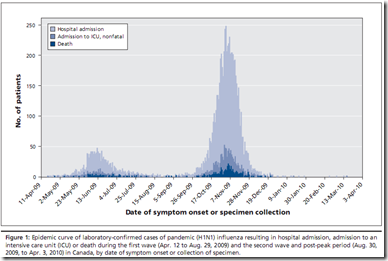
A detailed epidemiological study appears today in the CMAJ that looks at the differences between the first (April-August) and second waves (Sept-April 2010) of the 2009 H1N1 pandemic.


Admittedly, this is a data-heavy report, and the details are probably of most interest to epidemiologists, policy planners, and clinicians.


Incidence of hospital admissions and severe outcomes during the first and second waves of pandemic (H1N1) 2009


Melissa Helferty, Julie Vachon, Jill Tarasuk , Rachel Rodin, John Spika, Louise Pelletier


Abstract  (Excerpts)

Results: A total of 8678 hospital admissions (including 1473 ICU admissions) and 428 deaths related to pandemic (H1N1) influenza were report ed during the pandemic and post-peak period. There were 4.8 times more hospital admissions, 4.0 times more ICU admissions and 4.6 times more deaths in the second pandemic wave than in the first wave. ICU admissions and deaths as a proportion of hospital admissions declined in the second wave; there was a 16% proportional decline in ICU admissions and a 6% proportional decline in deaths compared with the first wave. Compared with patients admitted to hospital in the first wave, those admitted in the second wave were older (median age 30 v. 23 years) and more had underlying conditions (59.7% v. 47.5%). Pregnant women and Aboriginal people accounted for proportionally fewer patients who were admitted to hospital or who died in the second wave than in the first.


Interpretation: The epidemiologic features of the first and second waves of the 2009 pandemic differed. The second wave was substantially larger and, although the patients admitted to hospital were older and more of them had underlying conditions, a smaller proportion had a severe outcome.


image

The full report is available at this link  but some of the highlights include:


  • In terms of the number of cases, the second wave was substantially larger than the first and saw more deaths and more hospitalizations
  • But the percentage of deaths and severe infections among those hospitalized was lower in the second wave
  • While all age groups saw increases in hospitalizations during the second wave, adults aged (45-64) saw the greatest increase, and school aged children (5-19) saw the smallest increase.
  • Pregnant women and aboriginal people were disproportionately affected during the duration of the pandemic, but more so during the first wave than the second.
  • The proportion of patients with underlying medical conditions increased during the second wave.

The authors credit public health measures and clinical interventions implemented between the first and second waves for the reductions in the percentage of severe cases.


For a more general overview, the Vancouver Sun has a report:


2nd wave of H1N1 pandemic led to more hospitalizations, deaths: Report


By Carmen Chai, Postmedia News November 8, 2010 

Wednesday, September 22, 2010

Vaccine/Heart Attack Study Questioned


# 4922


A couple of days ago I posted a blog called CMAJ: Flu Vaccinations Reduce Heart Attack Risk, which gave a brief account of a study that linked the flu vaccine with a 19% reduction in heart attack risk for those over the age of 40.


When I pointed out in my final paragraph, that this `single study will not be the last word on this subject.’,  I had no idea how quickly additional words would begin to appear.


Within 24 hours of its release, criticisms of this study’s methods have been voiced, and its conclusions questioned.


Robert Roos, News Editor for CIDRAP has the details in a piece that appeared on that website last night. This is an excellent review, and details the problems that some researchers see with this study. 


Follow the link to read it in its entirety.


Study on flu shots and heart-attack risk questioned

Robert Roos * News Editor

Sep 21, 2010 (CIDRAP News) – A case-control study using records on tens of thousands of people in the United Kingdom suggests that influenza vaccination reduces the risk of heart attack in people older than 40, but other researchers who have studied the benefits of flu immunization have raised doubts about the findings.


(Continue . . . )


Today’s example shows the folly of cherry-picking studies that support one side of a debate or another (a popular sport on the internet), or immediately accepting the latest study as proven `fact.’


While these criticisms don’t invalidate the results of this study, they do call them into question.


Perfect research projects and studies are impossible to mount, of course. 


There are always going to be limitations or deficits in funding, design, size, demographics, and time – any of which can influence the results.


Which is why no single study can be viewed as the final word on a subject. Absolutes are hard to come by in science, and results are rarely conclusive beyond a shadow of a doubt. 


So we rely on the preponderance of evidence, which requires weighing the results of more than one peer-reviewed study, along with their reception from the scientific community.


Imperfect?  Yes.  And sometimes messy, too.


Over time, peer-reviewed science does work, giving us a clearer picture of our world and how it works.  


But it’s an ongoing process.

Monday, September 20, 2010

CMAJ: Flu Vaccinations Reduce Heart Attack Risk


Note:  This report has an update: see   Vaccine/Heart Attack Study Questioned


# 4917


From the Canadian Medical Association Journal (CMAJ) today we get a study that strongly suggests that those over the age of 40 who get a seasonal flu vaccine each year may reduce their risk of a heart attack by as much as 19%.


The same, alas, could not be said for the pneumococcal (pneumonia) vaccination.


Early vaccination was associated with a lower rate of heart attack than getting the shot after mid-November.


Influenza vaccination, pneumococcal vaccination and risk of acute myocardial infarction: matched case–control study


A. Niroshan Siriwardena PhD FRCGP, Stella M. Gwini MSC, Carol A.C. Coupland CStat PhD
September 20, 2010

Heart attack occurred less frequently in people who had had a recent influenza vaccination than in those who had not, but the same could not be said for pneumococcal vaccination. Siriwardena and colleagues found this association in a case–control study using a large database of general practice patients in the United Kingdom. If influenza vaccination does have the added benefit of reducing heart attacks, then it may be important to vaccinate early in the season, say the authors.

(Continue . . . )


Given the burden that influenza can place on a person’s health – particularly when that person has underlying coronary disease – it makes sense that some number of heart attacks are likely brought on by this illness.


Since yearly flu vaccines reduce the incidence of influenza, by that logic they should also tend to reduce the number of heart attacks as well.


And based on this study at least, that logic appears to hold. 


While a single study will not be the last word on this subject, for those of us over 40, this is a pretty good reason to get that flu shot every year.

Tuesday, July 20, 2010

CMAJ: Seasonal Flu Vax Rates Among Canadian HCWs


# 4738


One of  the ongoing debates among infection control professionals is how to increase the uptake of seasonal (and pandemic) influenza vaccines by Health Care Workers (HCWs).


For years, the percentage of HCWs who voluntarily get the seasonal flu vaccine has languished in Canada and the United States between 30% and 40%.

Attempts to mandate vaccination have elicited numerous objections from HCWs, although many infection control organizations (IDSA, APIC, SHEA) support the idea.


Last week, the IDSA published an open letter to Thomas Frieden, Director of the CDC, in support of such a mandate.


Yesterday a study appeared in the CMAJ that took a retrospective look at programs used to promote the voluntary update of seasonal flu vaccines by HCWs.


First the press release, then the abstract and a link to the entire study.


Canadian Medical Association Journal

Seasonal influenza immunization rates among health-care workers

Campaigns to increase seasonal influenza vaccination rates amongst health care workers in Canada that include a combination of interventions had the greatest effect on increasing vaccine coverage, according to a study published in CMAJ (Canadian Medical Association Journal) 

Seasonal influenza immunization rates among health care workers in Canada remain below 50%, yet it is recommended that all health care workers (at least 90%) should be immunized to protect against the flu virus.

Combined education/promotion and improved access to vaccines resulted in higher increases in vaccination rates amongst long-term care home workers. In one hospital campaign in which staff completed a mandatory electronic form to decline vaccination, immunization coverage increased to 55% compared to the previous nine years where rates ranged from 21% to 38%. When unvaccinated personnel were required to wear masks, rates increased to 52% from 33%.

"This review revealed gaps in the literature about the appropriate components to use to increase influenza immunization among health care personnel," writes Dr. Larry Chambers, Elisabeth Bruyére Research Institute, Ottawa, with coauthors.


The study, a systematic review of 12 studies, did not look at pandemic influenza programs.


The authors conclude that more studies with multiple campaign components are needed to assess the most appropriate influenza vaccination programs.


The abstract follows:


Seasonal influenza vaccination campaigns for health care personnel: systematic review

Po-Po Lam, Larry W. Chambers , Donna M. Pierrynowski MacDougall , Anne E. McCarthy 


Background: In Canada, vaccination coverage for seasonal influenza among health care personnel remains below 50%. The objective of this review was to determine which seasonal influenza vaccination campaign or campaign components in health care settings were significantly associated with increases in influenza vaccination among staff.


Methods: We identified articles in eight electronic databases and included randomized controlled trials, controlled before-and-after studies and studies with interrupted time series designs in our review. Two reviewers independently abstracted the data and assessed the risk of biases. We calculated risk ratios and 95% confidence intervals for randomized controlled trials and controlled before-and-after studies and described interrupted time series studies.


Results: We identified 99 studies evaluating influenza vaccination campaigns for health care workers, but only 12 of the studies were eligible for review. In nonhospital health care settings, including long-term care facilities, campaigns with a greater variety of components (including education or promotion, better access to vaccines, legislation or regulation and/or role models) were associated with higher risk ratios (i.e, favouring the intervention group). Within hospital settings, the results reported for various types of campaigns were mixed. Many of the criteria for assessing risk of bias were not reported.


Interpretation: Campaigns involving only education or promotion resulted in minimal changes in vaccination rates. Further studies are needed to determine the appropriate components and combinations of components in influenza vaccination campaigns for health care personnel.


The link to the entire study is here.


The bottom line is that campaigns utilizing only educational and promotional incentives resulted in minimal improvements in vaccination rates among health care workers.


Certainly nowhere near the compliance goal of 90%.

Thursday, November 19, 2009

CMAJ: Asthma As A Pandemic Risk Factor In Children


# 4045


A study led by Toronto researchers at the the Hospital For Sick Children (Sickkids) has been published today in the CMAJ, the Journal of the Canadian Medical Association, that looks at pediatric hospital admission during the opening months of this pandemic.


The study examine the charts of 58 kids admitted with H1N1 between May 8th and July 22nd, and compared those against roughly 200 admissions for seasonal flu over the past 5 years.   


In an average year, the hospital admits about 40 pediatric influenza patients, so the admission of 58 kids in just 10 weeks alone is illustrative that this year is different.


Among other things, the study found.


  • With seasonal flu, roughly 6% of the patients admitted had a history of asthma, whereas with the novel H1N1 virus, that number was 22% (13 of 58).
  • Almost half of the kids sick enough to be admitted to the ICU had a history of asthma.
  • Additionally, the median age of kids admitted for H1N1 was nearly twice that of kids admitted in previous years for seasonal flu.


The study is available online.


Risk factors and outcomes among children admitted to hospital with pandemic H1N1 influenza

Sean O’Riordan MB BChir PhD, Michelle Barton MBBS DM, Yvonne Yau MD, Stanley E. Read MD PhD, Upton Allen MBBS MSc, Dat Tran MD MSc

Background: Limited data are available on disease characteristics and outcomes of children with 2009 pandemic influenza A(H1N1) virus infection (pandemic H1N1 influenza)who have required hospital admission.


Methods: We reviewed the charts of 58 children with pandemic H1N1 influenza admitted to a large pediatric hospital in Ontario, Canada, between May 8 and July 22, 2009. We compared risk factors, severity indicators and outcomes of these children with those of 200 children admitted with seasonal influenza A during the previous 5 years (2004/05 to 2008/09).


Results: Children with pandemic H1N1 influenza were significantly older than those with seasonal influenza (median age 6.4 years v. 3.3 years). Forty-six (79%) of the children with pandemic H1N1 influenza had underlying medical conditions; of the other 12 who were previously healthy, 42% were under 2 years of age.


Children admitted with pandemic H1N1 influenza were significantly more likely to have asthma than those with seasonal influenza (22% v. 6%). Two children had poorly controlled asthma, and 6 used inhaled medications only intermittently. The median length of stay in hospital was 4 days in both groups of children.


Similar proportions of children required admission to the intensive care unit (21% of those with pandemic H1N1 influenza and 14% of those with seasonal influenza) and mechanical ventilation (12% and 10%respectively). None of the children admitted with pandemic H1N1 influenza died, as compared with 1 (0.4%) of those admitted with seasonal influenza.

Interpretation: Pandemic H1N1 influenza did not appear to cause more severe disease than seasonal influenza A. Asthma appears to be a significant risk factor for severe disease, with no clear relation to severity of asthma. This finding should influence strategies for vaccination and pre-emptive antiviral therapy