Showing posts with label Cambodia. Show all posts

Wednesday, March 26, 2014

Cambodia’s H5N1 Surge & the `M’ Word

image


# 8402


This week officials from Vietnam, Cambodia, and the International community are meeting in Phnom Penh, Cambodia to discuss the dramatic increase in H5N1 cases in that country over the past couple of years, along with other avian flu containment and control issues (see VOA report Vietnamese, Cambodian Officials Meet Over Bird Flu Concerns).


While H5N1 is the immediate concern, the close proximity and spread of the H7N9 virus in China also looms large for these officials (see Vietnam Girds Against H7N9 As H5N1 Spreads).

.

For reasons that are far from clear, the incidence of human infection with the H5N1 virus in Cambodia over the past couple of years far exceeds that seen in neighboring Vietnam, which – in the middle of the last decade – was the world’s hotspot for human cases.

image

Mash up of data from WHO & Cambodia’s MOH


The reporting of nearly 6 times as many human cases over the past 4 years (46 vs. 8) becomes even more dramatic when you factor in the relative populations of the two countries (Vietnam 89 million, Cambodia 15 million).  Making the rate of human infection roughly 36 times higher in Cambodia since 2011.


Overnight the Cambodian Daily carried a report (h/t Crof) intriguingly headlined New Mutation in Bird Flu Virus in Cambodia, which they describe as:


The new virus apparently mutated from two existing viruses. It was discovered around the time Cambodia reported its first human infections of 2013.


This `mutation’ – more properly a new genotype – isn’t well described in this media report, but appears to be one we’ve discussed previously, which was described last September in Cape Town at the Options VIII Control of Influenza Conference, in an abstract entitled:


A new genotype resulting from the reassortment of clade 1.1 and 2.3.2.1 at the origin of the human and animal H5N1 virus cases in Cambodia in 2013


V Duong, S Rith, SV Horm, S Ly, S Sorn, S Chuop, S Buth, R Tsuyuoka, D Laurent, B Richner, H Seng, B Sar, D Holl, P Kitsutani, S Ung, A Tarantola, T Sok , P Buchy

Background: In Cambodia since 2004, A(H5N1) virus has been detected in 39 poultry outbreaks and 32 patients (27 deaths) to May 1, 2013.  Until 2012, all  A(H5N1) strains isolated in Cambodia belonged to clades 1 and 1.1, of which six distinct lineages were identified. Lineage 1 viruses shared the same ancestor with viruses from Thailand, while all the lineages detected since 2005 were closely related to viruses detected in Southern Vietnam.

Materials and Methods: Samples were obtained between January and March 2013. The samples comprised 10 confirmed human cases, 6 poultry outbreak investigations and samples from environmental surveillance of live poultry markets. All samples included in this study tested positive for A(H5N1) virus by real-time RT-PCR. Full genome sequences were generated from 31 strains amplified after inoculation into MDCK cells, embryonated eggs, or directly from the original specimen. Phylogenetic analyses were performed using the maximum likelihood method on all the genes. Antigenic analyses were also performed using reference antisera.

Results: The phylogenetic analysis of 8 genes revealed that the 31 A(H5N1) strains isolated and sequenced in Cambodia in 2013 resulted  from reassortment between clade 1.1 and clade 2.3.2.1 viruses. While the HA and NA genes belong to the clade 1.1, genotype Z, the 6 internal genes are closely related to the viruses of the clade 2.3.2.1 (A/Hubei/1/2011-like). Antigenic analysis demonstrated a significant antigenic drift.

Conclusions: In this study we report the emergence of a new genotype of clade 1.1 A(H5N1) virus in Cambodia associated with a significant antigenic drift. The link between the emergence of this new genotype and the increase in human cases observed in 2013 is yet to be determined. 


Last December the  World Health Organization released their monthly Influenza at the human - animal interface report where they discussed this variant and the uptick in human cases.

(excerpts)

This might be due to improvements in surveillance and physician awareness or to a potential increased circulation of the virus in poultry. The case fatality rate among reported cases, however, has decreased (54% in 2013 compared with 90% over all previous years).

Before 2013, H5N1 viruses from clade 1.1 predominated in Cambodia. Analysis of isolates from human cases and birds from the beginning of 2013 revealed the emergence of a new H5N1 genotype resulting from the reassortment of clade 1.1 and clade 2.3.2.1 viruses.

The link between the emergence of this reassortant virus and the increase in human cases observed in 2013 is yet to be determined.


While the media loves to use the `M’ word (mutation), the reality is influenza viruses are constantly evolving, perpetually producing new genotypes and variants. A few thrive and spread, but most are evolutionary failures, unable to compete against more biologically `fit’ variants.


More than 20 clades and subclades of  the H5N1 virus have been identified since 1996, and more are to be expected. This constant evolution is something we’ve looked at often, including Moving Viral Targets & EID Journal: The Expanding Variants Of H5N1.

image

Evolution of H5N1  -  NOTE: Not all of these clades continue to circulate.


Although this new genotype may be behind the uptick in Cambodian H5N1 cases, there are other possibilities as well, some of which are explored in the following Radio Australia Interview  (h/t Carol@SC on the Flu Wiki).

(Transcript & MP3 Audio at the link below)


Rising number of bird flu cases in Cambodia under scrutiny

Updated 26 March 2014, 13:34 AEST

Cambodia reported 14 deaths last year from the bird flu strain H5N1.

(Credit: ABC)

It was the highest number of human cases in the world and more than the total that Cambodia had recorded, since H5N1 was first detected there a decade ago.

So far this year, another four Cambodians have died from avian influenza.

This week, officials from Cambodia, Vietnam and international agencies have been meeting in Phnom Penh to try to work out why the numbers are higher and what to do about it.

Reporter: Robert Carmichael

Speakers: Dr Dennis Carroll, USAID; Lotfi Allal, FAO; market vendor Ly Mey


While scattered H5N1 outbreaks continue to plague Vietnam, and the recent introduction of clade 2.3.2.1C has created a snag in their vaccination program (see Vietnam Reporting H5N1 Poultry Vaccine `Failures’), eight years ago - through a combination of massive educational and regulatory efforts - they went from being the worst afflicted country in the world to being viewed as the `poster child’ for successful bird flu containment.


Hopefully some of the lessons learned from that experience can be used to do the same for Cambodia.

Monday, March 17, 2014

Cambodia: 9th Confirmed H5N1 Case Of 2014

image

Credit Wikipedia


# 8380


Cambodia’s struggles with the H5N1 virus – whose incidence began to increase significantly in 2011 – continues with the announcement this morning of that country’s 9th confirmed case of 2014.  One other (fatal) case – that of a sibling of a confirmed case in February (see Cambodia: 2 Deaths - 1 Confirmed H5N1, 1 Probable)  – is strongly suspected, but that patient was never tested.


Although the number of cases of H5N1 infection in Cambodia continues to mount, these cases  have been widely scattered, making it likely that these are sporadic transmissions from birds or the environment rather than a sign of increased human-to-human transmission.


Here is the joint statement from the World Health Organization and the Cambodian MOH, as posted on the United Nations In Cambodia Website .


9th New Human Cases of Avian Influenza H5N1 in Cambodia in 2014

Joint Press Release From the Ministry of Health, Kingdom of Cambodia, and the World Health Organization (WHO)

Phnom Penh, 17 March 2014

The Ministry of Health (MoH) of the Kingdom of Cambodia wishes to advise members of the public that one (1) new human case of avian influenza has been confirmed for the H5N1 virus. This is the 9th case this year and the 56th person to become infected with the H5N1 virus in Cambodia. The case is from Kampot province. Of the 56 confirmed cases, 44 were children under 14, and 30 of the 56 were female. In addition, since the first case happened in Cambodia in 2005 there were 19 cases survived.

A 2-year-old girl from Kandal village, Vat Ang Khang Tboung commune, Banteay Meas district, Kampot province, was tested positive by Institut Pasteur du Cambodge on the 14th March 2014. The girl had onset symptom of fever on 8th March 2014. Her parents sought treatment at a private practitioner on the same day (8th March) and on the next day (9th March). The girl was admitted to a private clinic on the 10th March and in Kantha Bopha Hospital on the 13th March. She had symptoms of fever, cough and dyspnea and Tamiflu was administrated on the same day. The girl died on the 14th March.

Beginning of February, chickens started dying in the village and in the house of the case. At the end of February and beginning of March, it is estimated that 90% of poultries of the village died. The girl had direct contact with dead chickens while her relatives prepared them for food and the girl ate them.

The national and local Rapid Response Teams (RRTs) are conducting outbreak investigation and responses following the national protocol.

(Continue . . . )


For now, H5N1 remains poorly adapted to humans - only rarely being passed from one person to another - and is primarily a threat to poultry.


But as with any influenza virus, H5N1 has the capacity to evolve and change behavior over time.  Which is why we watch these cases carefully, looking for any signs that the virus has better adapted to human physiology.

Tuesday, March 11, 2014

Cambodia: Statement On 7th & 8th H5N1 Cases Of 2014

Photo Credit - Ministry of Health of the Kingdom of Cambodia


# 8364


Although it has yet to appear on the Cambodian MOH website, overnight the United Nations in Cambodia posted the following Joint Press Release From the Ministry of Health, Kingdom of Cambodia, and the World Health Organization (WHO) on the two H5N1 cases widely reported in the media Sunday night (see Cambodia: Media Reports Two New H5N1 Cases (1 Fatal)).


7th and 8th New Human Cases of Avian Influenza H5N1 in Cambodia in 2014
 

Joint Press Release From the Ministry of Health, Kingdom of Cambodia, and the World Health Organization (WHO)

Phnom Penh, 11 March 2014

The Ministry of Health (MoH) of the Kingdom of Cambodia wishes to advise members of the public that two (2) new human cases of avian influenza have been confirmed for the H5N1 virus. This is the 7th and 8th cases this year and the 54th and 55th persons to become infected with the H5N1 virus in Cambodia. The cases are from Kandal and Kampong Chnnang provinces. Of the 55 confirmed cases, 43 were children under 14, and 29 of the 55 were female. In addition, since the first case happened in Cambodia in 2005 there were 19 cases survived.

The 7th case, an 8-year-old boy from Spean-Dek village, Prek-TunLoab commune, Leuk-Dek district, Kandal province, was tested positive by Institut Pasteur du Cambodge on the 6th March 2014. The boy had onset symptoms of fever, chill, running nose, sore throat, and cough on 24th February 2014. His parents sought treatment at a private practitioner in the village on the same day. His condition worsened and the boy was admitted to Kantha Bopha Hospital on 4th March. On 4th March, the boy had symptoms of fever, chill, running nose, sore throat, cough, dyspnoea, convulsion and somnolence. The specimen was collected on 5th March and Tamiflu was administered on the same day. The boy is recovering.

Around mid-February, about 90% of poultries died in the village. Chickens died in the case’s house and the family buried them. There is also a poultry slaughter’s house near to the case’s house. The parents reported that the boy had no direct contact but the chickens died in close proximity.

The 8th case, an 11-year-old boy from Toeuk Laak village, Toeuk Haut commune, Rolea Paear district, Kampong Chnnang province, was tested positive by Institut Pasteur du Cambodge on the 6th March 2014. The boy had onset symptoms of fever and headache on 3rd March 2014. His parents sought treatment at a private practitioner next to their house on the same day and on the next day (4th March). His condition worsened and the boy was admitted to Kampong Chnnang Provincial Hospital on 5th March. On 6th March, the boy had symptoms of fever, cough, and shortness of breath and was referred to Kantha Bopha Hospital in the afternoon on the same day. The boy died a few hours after his admission on 6th March.

Beginning of February, chickens started dying in the village and in the case’s house and continued for a month. The boy helped to prepare dead chickens and ducks for food and ate them.

The Ministry of Health’s​ National and local Rapid Response Teams (RRTs) are conducting outbreak investigation and responses following the national protocol.

(Continue . . . )


This statement also includes details on their ongoing public education campaign on H5N1 safety, promoting the messages  - wash hands often with soap and water, before eating and after coming into contact with poultry; keep children away from poultry; keep poultry away from living areas; do not eat dead or sick poultry; and all poultry eaten should be well cooked.

It also updates the MOH’s statement on the dangers of H5N1:

"Avian influenza H5N1 remains a serious threat to the health of all Cambodians and more so for children, who seem to be most vulnerable and are at high risk. There have been 55 cases of H5N1 infection in humans since 2005 and here are the seventh and eight cases of this year. Children often care for domestic poultry by feeding them, cleaning pens and gathering eggs. Children may also have closer contact with poultry as they often treat them as pets and also seem to be most vulnerable and are at high risk because they like to play where poultry are found. I urge parents and guardians to keep children away from sick or dead poultry and prevent them from playing with chickens and ducks. Parents and guardians must also make sure children thoroughly wash their hands with soap and water before eating and after any contact with poultry. Hands may carry the virus that cannot be seen by the naked eye. Soap washes away the virus on hands. If children have fast or difficult breathing, their parents should seek medical attention at the nearest health facility and attending physicians must be made aware of any exposure to sick or dead poultry,” said H.E. Dr. Mam Bunheng, Minister of Health.


Although we’ve seen 45 cases reported in Cambodia since this uptick began three years ago (see 2011’s Cambodia’s Bird Flu Risk "under control" – Experts), they continue to emerge sporadically, and from numerous and widespread provinces across the country. 


We’ve seen a few clusters (see Cambodia: 2 Deaths - 1 Confirmed H5N1, 1 Probable), but no signs of sustained or efficient human-to-human transmission. 


By the same token, the fact that the virus has been acquired (presumably from infected chickens & ducks) across wide swaths of their nation in recent years speaks to how prevalent the virus apparently has become in Cambodia’s poultry. 


While renewed public awareness campaigns have been mounted, that message is likely lost on a population to whom hunger, malaria, dengue, and diarrheal diseases take a much greater toll.  Add in rising food prices and growing food insecurity, and the odds that families follow the government’s advice to `not eat dead or sick poultry’ is probably pretty low.


The good news, so far at least, is that the H5N1 bird flu virus remains primarily an avian-adapted virus.  It only rarely infects humans, and human-to-human transmission is even rarer still.


As with H7N9, H10N8, H9N2 (and a short list of other novel flu viruses)  the concern remains that given enough opportunities, one of these viruses might better adapt to human physiology and someday pose a pandemic threat.

Monday, March 10, 2014

Cambodia: Media Reports Two New H5N1 Cases (1 Fatal)

image

Credit WHO WPRO


# 8362


Although an official statement has yet to appear on the Cambodian Ministry of Health website, or the United Nations in Cambodia website, it is being widely reported in the media this morning that two more children have been found infected with the H5N1 virus in that country, and one has died.  


This comes just 3 days after Cambodia’s last notification (see Cambodia Reports 6th H5N1 Case Of 2014), and if confirmed would raise 2014’s numbers to 8 cases (+ 1 probable) , and 3 deaths.


I’ll update this post with a link to the official statement if and when it becomes available.  In the meantime, we have this report from China’s official news agency, Xinhua.


Cambodia reports two new bird flu cases, one dies

English.news.cn   2014-03-10 11:49:46
 

PHNOM PENH, March 10 (Xinhua) -- Two more new human cases of avian influenza H5N1 have been confirmed in Cambodia, and one of them, an 11-year-old boy died on Friday in Phnom Penh's Kantha Bopha Children Hospital, a hospital representative confirmed Monday.

"An 11-year-old boy from Kampong Chhnang province was admitted to the hospital last week and tested positive for H5N1 virus, " Dr. Denis Laurent, deputy director of Kantha Bopha Children Hospital, the kingdom's largest pediatric hospital, told Xinhua.

"The boy's condition was very serious when he arrived at our hospital and died on Friday," he said.

Another 8-year-old boy from Kandal province has also suffered from the virus last week, but his condition is stable and he is recovering, he said.

The country recorded 8 cases of avian influenza H5N1 so far this year, and there children died.

H5N1 influenza is a flu that normally spreads between sick poultry, but it can sometimes spread from poultry to humans, according to the World Health Organization.

The virus was first identified in Cambodia ten years ago. To date, the country has reported 55 human cases of the virus, and 36 people died of it.


While the rate of H5N1 cases in Cambodia in 2014 is concerning, they are running roughly at the same pace as we saw in 2013, which by the end of February last year had reported 9 cases. Thus far, nearly all of the cases we’ve seen have been widely scattered, sporadic, and not suggestive of sustained human-to-human transmission. 


This assessment from the most recent Influenza At The Human-Animal Interface report (dated Feb 25th) from the World Health Organization.


Overall public health risk assessment for avian influenza A(H5N1) viruses: Whenever influenza viruses are circulating in poultry, sporadic infections or small clusters of human cases are possible, especially in people exposed to infected household poultry or contaminated environments. This influenza A(H5N1) virus does not currently appear to transmit easily among people. As such, the risk of community-level spread of this virus remains low. 


Unknown are how many mild, moderate, or even subclinical H5N1 infections that go undetected, as those who are the sickest are most likely to be hospitalized and tested, particularly in countries with low resources. 


The size of that undetected cohort remains the subject of considerable debate (see The Great CFR Divide), with very little serological evidence supporting a large number.


For now, H5N1 remains poorly adapted to humans, making it primarily a threat to poultry, and those who are in close contact with poultry, in those regions where the virus is endemic.

Friday, February 28, 2014

Cambodian MOH Reports Two New H5N1 Cases

image

Kampong Cham province – Credit Wikipedia


# 8337


Today Cambodia’s MOH is reporting their 4th & 5th confirmed H5N1 cases of 2014, that of two young girls (ages 10 & 11) from Kampong Cham Province (albeit villages in different districts). Unlike most of the H5N1 cases we’ve seen, these girls appear to have suffered relatively mild to moderate illness, and have both recovered.


While this brings the official case count to five for the year, we also had a strongly suspected case – that of a sibling of a confirmed case who died, but was never tested – from Kratie Province earlier this month (see Cambodia: 2 Deaths - 1 Confirmed H5N1, 1 Probable).


First some excerpts from the MOH statement, after which I’ll have a bit more.


4th and 5th New Human Case of Avian Influenza H5N1 in Cambodia in 2014

27 February 2014

The Ministry of Health (MoH) of the Kingdom of Cambodia wishes to advise members of the public that two (2) new human cases of avian influenza have been confirmed for the H5Nl virus. These are the 4th and 5th cases this year and the 51st and 52nd persons to become infected with the H5Nl virus in Cambodia. The cases are from Kampong Cham (newly named Tboung Khmun) province. Of the 52 confirmed cases, 40 were children under 14, and 29 of the 52 were female. In addition, since the first case happened in Cambodia in 2005 there were 18 cases survived.


The 4th case, a 10-year-old girl from Rorveang village, Knor Damborng commune, Cheung Prey district, Kampong Cham (newly named Tboung Khmun) province, was detected by the Naval Medical Research Unit 2 (NAMRU-2) through fever surveillance on 20th February and confirmed positive by Institut Pasteur du Cambodge on 20th February 2014. The girl had onset symptom of fever on 26th January 2014. Her mother bought medicine in the village. From the 27th January, she continued to develop symptoms and had fever, running nose, cough, and abdominal pain. On the 29th January, the health staff of the NAMRU-2 project took samples from the girl. Upon confirmation of H5Nl, she was referred toKampong Cham Provincial Hospital on 20th February and Tamiflu was administered on the same day. Currently, she recovered and had normal activities.The case had direct exposure with dead and sick poultry. Farm ducks in the village started to suddenly die around 15th January 2014.  The mother of the case brought sick/dead ducks on the 25th January and the family prepared them, with the help of the case, for food the same day.


The 5th case, an 11-year-old girl from La Ork Village, Krek Commune, Ponhea Krek district, Kampong Cham (newly named Thoung Khmum) province, was detected by the Naval Medical Research Unit 2 (NAMRU-2) through fever surveillance on 20th February and confirmed positive by Insitut Pasteur du Cambodge on 29th February 2014.  The girl had onset of symptoms of fever and cough on 9th February 2014. The health staff at the NAMRU-2 project took samples from the girl on the 10th February.  Upon confirmation of H5N1, she was referred to Kampong Cham Provincial Hospital on 20th February and Tamiflu was administered on the same day.  Currently, she recovered and had normal activities.

From the 7th to 10th February, all 30 chickens owned by family died around the house.  The relatives reported that the girl had no direct contact, but the chickens died in close proximity to the case.

(Continue. . . .)


NAMRU-2 mentioned above is the Naval Medical Research Unit (#2) which previously had been based in Jakarta for nearly 40 years, but became ensnared in former Indonesian Health Minister Supari’s increasingly absurd political theatre, where she eventually accused the lab of espionage and ordered it closed (see NAMRU-2 Debate Turns Ugly)..


Diplomatic efforts to reopen the lab ultimately failed, and so the lab was temporarily relocated to Pearl Harbor in 2010, and then moved on to Cambodia last year.


Given the sudden uptick of human H5N1 cases in Cambodia over the past 3 years, the presence of NAMRU – which has dealt extensively with avian H5N1 previously in both Indonesia and Egypt (NAMRU-3) – is a decided plus.  You can visit NAMRU’s website at the link below:

image


Despite the dramatic uptick in H5N1 cases reported out of Cambodia over the past couple of years, their sporadic nature and broad geographic distribution show no evidence of sustained or efficient community-level transmission, and the assumption is that the vast majority of these infections came from exposure to infected birds.


The World Health Organization’s most recent public health assessment on the H5N1 virus reads:

Overall public health risk assessment for avian influenza A(H5N1) viruses: Whenever influenza viruses are circulating in poultry, sporadic infections or small clusters of human cases are possible, especially in people exposed to infected household poultry or contaminated environments. This influenza A(H5N1) virus does not currently appear to transmit easily among people. As such, the risk of community-level spread of this virus remains low. 


But viruses can change over time, and so could this assessment.

Wednesday, February 19, 2014

Cambodia Reports 3rd Confirmed H5N1 Case Of 2014

image

Kratie Province – Credit Wikipedia


# 8311


A week ago (see Cambodia: 2 Deaths - 1 Confirmed H5N1, 1 Probable) we learned of the deaths of two siblings (ages 2 & 8) on the same day at a hospital in Kratie Province, Cambodia.   While both children were hospitalized with similar symptoms, and both died within hours of each other, only one was confirmed to have been infected with the H5N1 virus.


No samples were tested from the younger sibling to confirm H5N1, making her a probable, not a confirmed case.


Today Cambodia’s MOH is reporting the detection of another H5N1 infection in a child from the same location (Kbal Trach village, Sre Cha commune, Snourl district) – apparently discovered by the surveillance team sent to the village to investigate the outbreak.  The child – a four-year-old who was hospitalized last Thursday and confirmed H5N1 positive last Friday – is described as being in stable condition with `mild’ symptoms.


First excerpts from the MOH announcement, after which I’ll return with a bit more.


3rd New Human Case of Avian Influenza H5N1 in Cambodia in 2014


Joint Press Release From the Ministry of Health, Kingdom of Cambodia, and the World Health Organization (WHO)

Phnom Penh, 19 February 2014

The Ministry of Health (MoH) of the Kingdom of Cambodia wishes to advise members of the public that one new human case of avian influenza has been confirmed for the H5N1 virus. This is the 3rd case this year and the 50th person to become infected with the H5N1 virus in Cambodia. The case is from Kratie province. Of the 50 confirmed cases, 38 were children under 14, and 27 of the 50 were female. In addition, since the first case happened in Cambodia in 2005 there were only 16 cases survived.


A 4-year-old boy from Kbal Trach village, Sre Cha commune, Snourl district, Kratie province, was ​confirmed positive by Institut Pasteur du Cambodge (IPC), on 14th February 2014. The boy had onset fever and vomiting on 8th February 2014. The boy was detected by the mobile surveillance team during contact tracing of the 2nd confirmed case on 12th February. His symptoms were fever, running nose, vomiting, sore throat and cough. He was admitted to Kratie Provincial Hospital on 13th February and Tamiflu was administered on the same day. The symptoms were mild and the boy is now in good condition.


The case had direct exposure with dead and sick poultry. The boy played and carried dead chicken 6 days before developing symptoms. Around mid-January, a high number of poultry (chicken, ducks and goose) started to die in the village (around 350). Animal Health officers took samples from sick/dead chickens on 9th February and tested negative for H5N1 by National Veterinary Research Institute (NAVRI).

(Continue . . .)


While discovered during contract tracing with that village’s previously confirmed case, this young boy also shared environmental contact with dead or dying birds in the area, making it impossible to say with absolute certainty how he contracted the virus. 


Given the limited history of human transmission of the H5N1 virus, acquisition from infected poultry is the better bet, however.


The described `mild’ presentation of the virus - fever, running nose, vomiting, sore throat and cough – raises concerns that had a the surveillance team not been dispatched, this case might never have been identified.  As with almost any illness, only the `sickest of the sick’ end up hospitalized and positively diagnosed, meaning that the case numbers we have are almost certainly a sub-set of the total disease burden.


While there has been much debate over the `true’ number of H5N1 human infections, and the truth is, nobody really knows.


The limited number of seroprevalence studies that have been done to date have returned mixed results, although most have shown low levels of seropositivity in the general population, and only slightly elevated in poultry workers (see PLoS One: Seroprevalence Of H5N1 Among Bangladeshi Poultry Workers for an overview).


Despite seeing a second (and if you count the untested sibling, third) case from the same village, the sporadic nature and broad geographic distribution of Cambodia’s recent H5N1 cases show no evidence of community-level transmission, and the assumption is that these infections came from exposure to infected birds.


The World Health Organization’s most recent public health assessment on the H5N1 virus reads:


Overall public health risk assessment for avian influenza A(H5N1) viruses: Whenever influenza viruses are circulating in poultry, sporadic infections or small clusters of human cases are possible, especially in people exposed to infected household poultry or contaminated environments. This influenza A(H5N1) virus does not currently appear to transmit easily among people. As such, the risk of community-level spread of this virus remains low. 


Viruses change over time, and so could this assessment.


Which is why we watch these cases carefully, looking for any signs that the virus has better adapted to human physiology. 

Wednesday, February 12, 2014

Cambodia: 2 Deaths - 1 Confirmed H5N1, 1 Probable

image

Kratie Province – Credit Wikipedia


# 8290


Crof picked up the media report overnight (see Cambodia: Two siblings die from H5N1 on the same day), but we now have the Cambodian MOH statement regarding these deaths.  While both children were hospitalized with similar symptoms, and both died within hours of each other, no samples were taken and tested from the younger sibling to confirm H5N1.


First some excerpts from the MOH statement, after which I’ll have a bit more.


2nd New Human Case of Avian Influenza H5N1 in Cambodia in 2014  


12 February 2014

The Ministry of Health (MoH) of the Kingdom of Cambodia wishes to advise members of the public that one new human case of avian influenza has been confirmed for the H5Nl virus. This is the 2nd case this year and the 49th person to become infected with the H5N1 virus in Cambodia. The case is from Kratie province and died on 7th February. Of the 49 confirmed cases, 37 were children under 14, and 27 of the 49 were female. In addition, since the first case happened in Cambodia in 2005 there were only 15 cases survived.

The 2nd case this year, a 8-year-old boy from Kbal Trach village, Sre Cha commune, Snourl district, Kratie province, was tested positive for H5N1 human avian influenza on 8th February 2014 by Institut Pasteur du Cambodge. The boy had onset fever, sore throat and running nose on 31st January 2014, his parents sought treatment at a private clinic in his village. His condition worsened and the boy was admitted to Memot Referral Hospital on 6th February. On 7th February, the boy had symptoms of fever, sore throat, cough, abdominal pain, diarrhea, dyspnea and somnolence, and was transferred to Kampong Cham Hospital at 1: 00 am. Tamiflu was administered on the same day. Despite intensive medical care, the boy died on 7th February (around 6.00 pm).

The cases younger sister, 2 year old, started with similar symptoms on 1st February. Her condition worsened also and she was admitted to ths same hospitals together with her brother.  She had symptoms fever, sore throat, cough, abdominal pain, diarrhea, dsypnea, and somnolence. The girl died around 4:00 a.m. February 7th. Specimens were not collected, therefore could not be tested for H5N1.

(Continue . . . )

Last year Cambodia reported the largest number of human H5N1 infections in the world, with 26 cases (see Cambodian MOH Announces Two New H5N1 Cases) as of mid-November. This was a major increase for that country, which had reported only 21 cases in the previous 7 years.


After a lull lasting a couple of months, last week Cambodia Reported Their 1st H5N1 Case Of 2014, in a 5-year-old boy from Kampong Thom province. 


Last December the World Health Organization released their monthly Influenza at the human - animal interface report, which had this to say regarding Cambodia’s recent surge in H5N1 cases.


Influenza at the human-animal interface


Summary and assessment as of 10 December 2013

(EXCEPT)

In Cambodia, the reported incidence of human cases has increased in 2013 (26 cases in 2013 compared with 21 cases from 2005 through December 2012). This might be due to improvements in surveillance and physician awareness or to a potential increased circulation of the virus in poultry. The case fatality rate among reported cases, however, has decreased (54% in 2013 compared with 90% over all previous years).

Before 2013, H5N1 viruses from clade 1.1 predominated in Cambodia. Analysis of isolates from human cases and birds from the beginning of 2013 revealed the emergence of a new H5N1 genotype resulting from the reassortment of clade 1.1 and clade 2.3.2.1 viruses.

The link between the emergence of this reassortant virus and the increase in human cases observed in 2013 is yet to be determined.


Although the number of cases of H5N1 infection in Cambodia continues to mount, these cases  have been widely scattered, making it likely that these are sporadic transmissions from birds or the environment rather than a sign of increased human-to-human transmission.


For now, H5N1 remains poorly adapted to humans - only rarely being passed from one person to another - and is primarily a threat to poultry.


But when we see upticks in human cases like this one, it is a reminder that emerging influenza viruses are an ongoing threat, and that we need to watch them closely for any signs that they may be becoming better adapted to humans.

Thursday, November 14, 2013

Cambodian MOH Announces Two New H5N1 Cases


image


# 7974


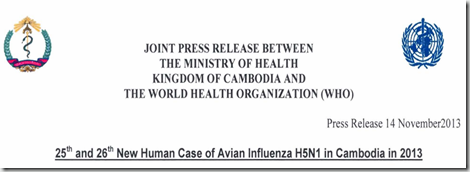
Although we picked up an FAO EMPRES-i report on these cases two days ago (see H5N1: Watching Cambodia Again),  this morning the Cambodian Ministry of Health has posted a joint statement (with the World Health Organization) detailing their 25th and 26th H5N1 case of the year.


image

The Ministry of Health  (MoH) of the Kingdom of Cambodia wishes to advise members of the public that two new  human  cases of avian influenza have been  confirmed for the H5N1  virus. These are the 25th and 26th cases this year and the 46th  and 47th people to become infected with the H5N1 virus  in Cambodia.

Case 25  is  from  Kampong Speu province  and  case 26 was from  Pailin  province. The Kampong  Speu case  is currently  in  a critical condition whereas  the  Pailin  case  has  died. Of  the  47 confirmed  cases, 35  were children under  14, and 27 of  the 47 were female.  In  addition, only  13 cases out of  the 26 cases this year survived.

 
The 25th case,  a 3-year-old boy from Veal Vong village, Sendey commune, Samrong Tang district, Kampong Speu province, was confirmed positive  for H5N1  human  avian influenza on 9"November  2013 by  Institut Pasteur du Cambodge. The boy had onset fever on 5th November  2013, his parents sought treatment at a local private practitioner on  6th November,  but  his condition worsened.The boy was admitted to  KanthaBopha Hospital, Phnom  Penh, on 8th November  2013 with  fever, cough, and dyspnoea. Laboratory samples were taken on 8th November  and Tamiflu administered the same day.

The 26'  case, a 29-year-old male from KaunDemrei village, SteungTrang  commune, Salakrao district, Pailin province, was  confirmed  positive  for H5N1  human  avian  influenza by  Institut Pasteur du  Cambodge on 9th November  2013. The man  had  onset fever,  chills and  headache on 26'  October 2013 where he  sought treatment at the local health centre. Treatment was provided to the case at a private clinic on  1st November until  his condition  continued  to  deteriorate. On  3rd November  the  case  was  admitted  to  Battambang Provincial hospital  with  fever,  chills,  headache,  cough,  chest  pain.  Laboratory  samples were  taken  and Tamiflu was administered on 6th November.  He continued to deteriorate with  further symptoms of diarrhoea, vomiting, and seizures; he died at the hospital on the 6 th November.


Epidemiological investigations by  the RRT and MAFF revealed  that  the case had  direct contact with  sick and dead poultry  one week  prior  to  illness onset. During  the  investigation multiple  influenza like  illness cases were  detected  in  the  village;  laboratory testing  of  those  cases  to  date  indicated  human  influenza A/H1N1.

The Ministry of Health's RRTs and the Ministry of Agriculture, Forestry and Fishery's Animal Health Task Force are working  together closely inboth villages to investigate and implement control measures. The RRTs are trying to  identify the case's  close contacts, any epidemiological linkage among the 26 cases and  initiate preventive treatment as required.The Animal Health Task Force  is  investigating cases of poultry deaths in
the village.

(Continue . . . )


This makes five cases reported out of Cambodia over a period of a little more than two weeks.


Since these cases have all come from different provinces, it makes it likely that these are sporadic transmissions from birds or the environment rather than a sign of increased human-to-human transmission. 


2005 – 4 cases                     2010 – 1 case

2006 – 2 cases                     2011 – 8 cases

2007 – 1 case                       2012 - 3 cases

2008 – 1 case                       2013 – 26 cases

2009 – 1 case           


For now, H5N1 remains poorly adapted to humans - only rarely being passed from one person to another - and is primarily a threat to poultry.


But when we see upticks in human cases like this one, it is a reminder that emerging influenza viruses are an ongoing threat, and that we need to watch them closely for any signs that they may be becoming better adapted to humans.

Tuesday, November 12, 2013

H5N1: Watching Cambodia Again

image


# 7964


Over the past two weeks we’ve seen 3 new H5N1 cases confirmed in Cambodia, bringing the total number of cases this year to 24, with 13 fatalities (see yesterday’s report Cambodian MOH/WHO Joint Statement On Latest H5N1 Case. 


As of today, the Cambodian MOH site has yet to post an update on the latest; 24th case.


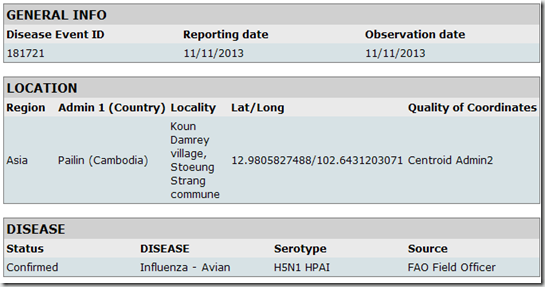
Today, the FAO’s EMPRES-i (Global Animal Disease Information System) is listing two new (apparently human) H5N1 cases in Cambodia.  Details are sparse, with little beyond test confirmation date and locations provided. 


Below is a snapshot from my EMPRES-i RSS Feed.

image


The location of these reported cases do not match any recent confirmed H5N1 reports out of Cambodia, although we have seen previous cases in Kampong Speu.


And from the FAO EMPRES-i Website.

image

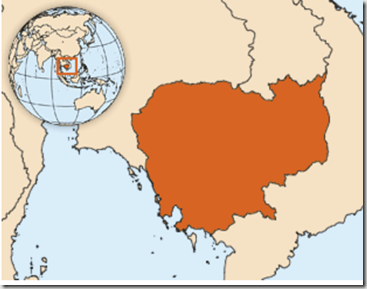
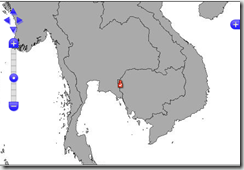
Mash-up of 2 FAO Maps showing case locations

  Screenshots

image

LINK


image

LINK


I would caution that we have to wait for an official confirmation from the Cambodian MOH before we can add these two cases to the list, but in the past these FAO EMPRES-i reports have provided an accurate and early indication of new cases. 


So, for now, consider this just keeping a watchful eye on reports out of a recent H5N1 hotspot.


I would also note that Biological on FluTrackers has picked up these reports (see thread) as well, so you can look for updates either on this blog, or on FluTrackers when more information becomes available.

Monday, November 11, 2013

Cambodian MOH/WHO Joint Statement On Latest H5N1 Case

image


# 7959


It has taken several days to be published online, but the joint statement issued by the World Health Organization and the Cambodian Ministry of health on Friday (see Cambodia: 24th H5N1 Case Of The Year (13th Fatality) has now been posted on the United Nation’s Cambodia webpage. It has yet to show up on the Cambodian MOH website.


This announcement was written on Friday, prior to the announcement of the child’s death.  


The vague mention of the boy’s contact with dead poultry about a month before falling ill is a bit odd, since it is unlikely that an exposure that long ago would have caused his illness. The WHO has this to say about the incubation period of the virus:


The incubation period for H5N1 avian influenza may be longer than that for normal seasonal influenza, which is around two to three days. Current data for H5N1 infection indicate an incubation period ranging from two to eight days and possibly as long as 17 days. WHO currently recommends that an incubation period of seven days be used for field investigations and the monitoring of patient contacts.


While this exposure may not represent his actual point of contact with the virus, it does serve to show that the virus may have been circulating (although no tests were conducted) in his village in the weeks prior to his illness.


24th New Human Case of Avian Influenza H5N1 in Cambodia in 2013


Joint Press Release From the Ministry of Health, Kingdom of Cambodia, and the World Health Organization (WHO)

Phnom Penh, 8 November 2013

The Ministry of Health (MoH) of the Kingdom of Cambodia wishes to advise members of the public that one new human case of avian influenza has been confirmed for the H5N1 virus. This is the 24th case this year and the 45th person to become infected with the H5N1 virus in Cambodia. The case, from Kampot province, is currently in a critical condition. Of the 45 confirmed cases, 34 were children under 14, and 27 of the 45 were female. In addition, only 12 cases out of the 24 cases this year survived.

The 24th case, a 10-year-old boy from Sdok Thlok village, To Tung commune, Dang Tong district in Kampot province, was confirmed positive for H5N1 human avian influenza on 7th November 2013 by Institute Pasteur du Cambodge. The boy developed fever on 28th October 2013. On 29th October 2013, his parents sought treatment at a local private practitioner in the village, but his condition worsened. The boy was admitted to Kantha Bopha Hospital, Phnom Penh, on 7th November 2013 with fever, cough, sore throat, a distended abdomen and dyspnea. Laboratory samples were taken on 7th November 2013 and Tamiflu administered the same day.

Investigations in Sdok Thlok village by the Ministry of Health’s Rapid Response Teams (RRT) and the Ministry of Agriculture, Forestry and Fishery’s Animal Health Task Force revealed that about a month before the 10-year-old boy’s illness, about 30 chickens had died suddenly in his village. The boy helped carry dead chickens for his brother who was preparing a meal from them. The Ministry of Health’s RRTs and the Ministry of Agriculture, Forestry and Fishery’s Animal Health Task Force are working together closely in Sdok Thlok village, in Kampot, to investigate and implement control measures. The RRTs are trying to identify the case’s close contacts, any epidemiological linkage among the 24 cases and initiate preventive treatment as required. The Animal Health Task Force is investigating cases of poultry deaths in the village.

"Avian influenza H5N1 remains a serious threat to the health of all Cambodians and more so for children, who seem to be most vulnerable and are at high risk. There have been 24 cases of H5N1 infection in humans this year. Children often care for domestic poultry by feeding them, cleaning pens and gathering eggs. Children may also have closer contact with poultry as they often treat them as pets and also seem to be most vulnerable and are at high risk because they like to play where poultry are found. I urge parents and guardians to keep children away from sick or dead poultry and prevent them from playing with chickens and ducks. Parents and guardians must also make sure children thoroughly wash their hands with soap and water before eating and after any contact with poultry. Hands may carry the virus that cannot be seen by the naked eye. Soap cleans the virus on hands. If children have fast or difficult breathing, their parents should seek medical attention at the nearest health facility and attending physicians must be made aware of any exposure to sick or dead poultry” said H.E. Dr. Mam Bunheng, Minister of Health.

A nationwide public health education campaign using radio has been launched in early October. Also, public health education campaigns are being conducted in Sdok Thlok village, Kampot province,using information, education and communications materials to inform families on how to protect themselves from contracting avian influenza. The government's message is wash hands often with soap and water, before eating and after coming into contact with poultry; keep children away from poultry; keep poultry away from living areas; do not eat dead or sick poultry; and all poultry eaten should be well cooked.

H5N1 influenza is a flu that normally spreads between sick poultry, but it can sometimes spread from poultry to humans. Human H5N1 avian influenza is a very serious disease that requires hospitalization. Although the virus currently does not easily spread among humans, if the virus changes it could easily be spread like seasonal influenza. Hence, early recognition of cases is important.

The Ministry of Health will continue to keep the public informed of developments via the MoH website www.cdcmoh.gov.kh where relevant health education materials can also be downloaded. 
For more information on human influenza please call the MoH Influenza Hotline numbers: 
115 (free call); 012 488 981 or 089 669 567

Saturday, November 09, 2013

Cambodia: 24th H5N1 Case Of The Year (13th Fatality)

image

Map Credit WHO WPRO


# 7953


Although there was a Xinhua News report yesterday of a 24th H5N1 case in Kampot Province, Cambodia  (see CIDRAP NEWS report), as of this morning the usual official sources (Cambodia UN, Cambodian MOH, WHO WPRO) have yet to publish an update.  


Today, Xinhua is reporting that the 10 year-old victim has died.


Bird flu kills 13 people in Cambodia this year

Xinhua | 2013-11-9 17:50:55


A ten-year-old boy died of bird flu on Saturday, bringing the death toll of the fatal disease to 13 in Cambodia so far this year, a World Health Organization (WHO) official said.

"We regret to announce that the boy passed away in Kantha Bopha Hospital this morning," said Sonny Inbaraj Krishnan, communication and media relations officer at the WHO office in Cambodia.

Only 11 out of the 24 cases this year survived.

The boy was confirmed positive for human H5N1 avian influenza on Thursday after he was admitted to the Kantha Bopha Hospital in Phnom Penh with fever, cough, sore throat, a distended abdomen and dyspnea.

A joint press statement from the Cambodian Health Ministry and the WHO office said the investigation found that a month before the boy fell ill, about 30 chickens had died suddenly in his village in southern Kampot province and the boy helped carry dead chickens for his brother who was preparing a meal from them.

H5N1 influenza usually spreads among poultry, but it can sometimes spread from poultry to human, according to the WHO.


To date, the country has reported 45 human cases of contracting the deadly virus, killing 32 people.


This makes the third case reported out of Cambodia over the past 10 days.


Since these three cases have all come from different provinces, it makes it likely that these are sporadic transmissions from birds or the environment rather than a sign of increased human-to-human transmission. 


2005 – 4 cases                     2010 – 1 case

2006 – 2 cases                     2011 – 8 cases

2007 – 1 case                       2012 - 3 cases

2008 – 1 case                       2013 – 24 cases

2009 – 1 case           


While reporting of cases from other H5N1 endemic nations (notably Indonesia, Egypt & China) has decreased in recent years, the number of cases being reported out of Cambodia has grown markedly.  This year’s tally is now three times greater than Cambodia’s previous record year of 2011  – and we have nearly 2 months left to go.


Exactly what is driving this sudden uptick in cases isn’t clear, although better surveillance and testing for the illness could be a factor.


For now, H5N1 remains poorly adapted to humans - only rarely being passed from one person to another - and is primarily a threat to poultry.


But like its H7N9 cousin (and a handful of other emerging viruses) -  we keep a close eye on its behavior – looking for any signs that it may be becoming better adapted to a human host.

Monday, November 04, 2013

Cambodia MOH Reports 23rd H5N1 Case Of 2013 – Fatal

image

Credit Wikipedia


# 7934


For the second time in a week (see Cambodia MOH Reports 22nd H5N1 Case Of The Year) we learn of a child infected with the H5N1 virus from the Cambodian Ministry of Health. This time, it is a 2 year-old form Pursat Province, who died on October 26th.


Most of Cambodia’s H5N1 activity has been centered this year in the southern provinces (Takeo, Kampong Speu, Kampot, Phnom Penh).  I believe this to be the first case reported from the western province of Pursat, at least over the past several years.


To date, Cambodia has reported 44 cases of H5N1 infection, with 23 of those occurring this year.   This from the Ministry of Health.


23rd New Human Case of Avian Influenza H5N1 in Cambodia in 2013

  
04 November 2013

The Ministry of Health (MoH) of the Kingdom of Cambodia wishes to advise members of the public that one new human case of avian influenza has been confirmed for the H5N1 virus. This is the 23rd case this year and the 44th person to become infected with the H5N1 virus in Cambodia. The 23rd case died on 26th October 2013. Of the 44 confrrmed cases, 33 were children under 14, and 27 of the 44 were female. In addition, only 11 cases out of the 23 cases this year survived.

The 23rd case, a 2-year-old girl from Svay Chrum village, Borng Bort Kandal commune, Bakane district, Pursat province was confirmed positive for H5N1 human avian influenza on 30th October 2013 by Institut Pasteur du Cambodge. The girl developed fever on 17th October 2013. On 19th October 2013, her parents sought treatment for her at a local private practitioner. Her condition worsened and she was admitted to Jayavarman VII Hospital in Siem Reap on 25th October 2013 with fever, running nose, lethargy, dyspnea, cough and breathing difficulties. Laboratory samples were taken the same day, but no Tamifu was administered. The girl died on the 26th October 2013.

(Continue . . . )


While its likely we aren’t getting comprehensive reporting from all of the H5N1 endemic countries around the globe (due to censorship, lack of surveillance, and/or political turmoil), Cambodia – increasingly over the past three years – has grown to become a hotspot for human H5 infection.

2005 – 4 cases                     2010 – 1 case

2006 – 2 cases                     2011 – 8 cases

2007 – 1 case                       2012 - 3 cases

2008 – 1 case                       2013 – 23 cases

2009 – 1 case                      


So far, all of the cases this year appear to be widely scattered and have been linked to direct contact to infected poultry. There are no indications of human-to-human spread of the virus.  


While we have been preoccupied this summer with H7N9, MERS-CoV, and even a new strain of H7N7 (see Nature: Genesis Of The H7N9 Virus) – H5N1 remains a legitimate concern.  For now, however, H5N1 remains poorly adapted to humans, only causing sporadic infections in Southeast Asia and the Middle East, and is primarily a threat to poultry. 


That status could change, of course.


So we watch these cases around the world with great interest, looking for any signs that the virus is evolving, and that it is moving towards becoming a bigger public health threat.

Thursday, October 31, 2013

Cambodia MOH Reports 22nd H5N1 Case Of The Year

image

Credit FAO Empres Report


# 7923


While we continue to watch the emerging H7N9 virus, a fresh reminder this morning that the H5N1 virus is still circulating in poultry, and occasionally sickening and killing humans.  Cambodia today reports their 22nd human infection of the year – that number now eclipsing the aggregate of all previous cases reported between 2005 and the end of 2012.


2005 – 4 cases                     2010 – 1 case

2006 – 2 cases                     2011 – 8 cases

2007 – 1 case                       2012 - 3 cases

2008 – 1 case                       2013 – 22 cases

2009 – 1 case                      


So far, all of the cases this year appear to be widely scattered and have been linked to direct contact to infected poultry. There are no indications of human-to-human spread of the virus.  


22nd New Human Cases of Avian Influenza H5N1 in Cambodia in 2013

 
30 October 2013

The Ministry of Health (MoH) of the Kingdom of Cambodia wishes to advise members of the public that one new human case of avian influenza has been confirmed for the H5N1 virus. This is the 22nd case this year and the 43rd person to become infected with the H5N1 virus in Cambodia. Of the 43 confirmed cases, 32 were children under 14, and 26 of the 43 were female. In addition, only 11 cases out of the 22 cases this year survived.

The 22nd case, a 6-year-old girl from Romdoul village, O Romdoul commune, Phnom Preuk district, Battambang province confirmed positive for human H5N1 human avian influenza on 24th October 2013 by Institut Pasteur du Cambodge. The girl developed fever on 14th October 2013. On 15th October 2013, her parents sought treatment for her in the village. The girl’s condition worsened and the girl was referred to the Jayavarman VII Hospital in Siem Reap. On 19th October 2013 she was admitted to the Jayavarman VII Hospital with fever, cough, abdominal pain, running nose, sore throat and dyspnea. Laboratory samples were taken on 22nd October and Tamiflu administered on 24th October. The girl is currently in a stable condition.

(Continue . . . )


The report goes on to state that chickens and ducks had recently died in the girl’s neighborhood, and they were investigating if she’d had direct contact with any of them.

Human infections with the H5N1 virus – while relatively rare - are always a concern:

  • Because of the high fatality rate among known cases
  • And because each time the virus jumps from its normal (avian) host to a human (or other mammal), it gives it another opportunity to adapt and change.


Despite hundreds (perhaps thousands) of such opportunities to date, the virus remains poorly adapted to human physiology.  It can produce severe illness – even death – but only rarely is transmitted on to another person.


For now, H5N1 is primarily a threat to poultry, and to a lesser extent, those who work with, or come in close contract with, infected poultry.


The concern, of course, is that over time the virus will adapt further and someday pose a pandemic threat to humans.

Tuesday, October 22, 2013

Cambodia Reports 21st H5N1 Case Of 2013

image


# 7885


Although Cambodia recorded its first H5N1 cases in 2005 (n=4) - and has reported cases every year since then - fully half (n=21) of all documented bird flu infections in that country have been recorded since the start of 2013.  After four relatively quiet years (2007-2010), we began to see a significant uptick in the number of cases starting in 2011.


2005 – 4 cases                     2010 – 1 case

2006 – 2 cases                     2011 – 8 cases

2007 – 1 case                       2012 - 3 cases

2008 – 1 case                       2013 – 21 cases

2009 – 1 case                      


While a worrisome trend, so far, all of the cases this year appear to be widely scattered, and are attributed to direct contact to infected poultry. There are no indications of human-to-human spread of the virus.


Below you’ll find excerpts from the joint press release between the Cambodian Ministry of Health and the World Health Organization.

 image

The Ministry of Health (MoH) of the Kingdom of Cambodia wishes to advise members of the public that one new human case of avian influenza has been confirmed for the H5Nl virus. This is the 21st case this year and the 42nd person to become infected with the H5Nl virus in Cambodia. Of the 42 confirmed cases, 31 were children under 14, and 25 of the 42 were female. In addition, only 10 cases out of the 21 cases this year survived.


The 21st case, an 8-year-old girl from 0-Raing village, Pung Ror commune, Baray district in Kampong Thom province confirmed positive for human H5Nl avian influenza on 17th October 2013 by Institut Pasteur du Cambodge. The girl developed fever on 8th October 2013, together with sneezing. On 9th October 2013, her parents sought treatment for her in the village clinic. On 10th October 2013, the girl developed a cough together with fever and vomiting and her parents sought treatment for her outside the village at a private clinic in Taing Kor in Kampong Thom province. On 11th October 2013, the girl's condition worsened and the private clinic referred her to the Jayavamian VII Hospital in Siem Reap.


The girl was admitted to the JayavarmanVII Hospital, on 11th October, with fever, cough, vomiting and dyspnea. Laboratory samples were taken on 11th October and 14th October 2013, and Tamiflu administered on 14th October 2013.  The girl is currently in stable condition.


Investigations by the Ministry of Health’s Rapid Response Teams (RRT) in O-Raing village revealed that the girl had come into direct contact with dead poultry when she helped prepare a meal from chicken that had died earlier.

(Continue . . . )


Xinhua News also has the story:


Cambodia reports 21st bird flu case in 2013

Oct 22,2013

PHNOM PENH, Oct. 22 (Xinhua) -- An eight-year-old girl from Cambodia's eastern Kampong Thom province has been confirmed for the H5N1 virus, bringing the number of the cases to 21 so far this year, a joint statement by the World Health Organization and the Cambodian Health Ministry said Tuesday.

The little girl was confirmed positive for human H5N1 avian influenza last week after she was admitted to the Jayavarman VII Hospital in Siem Reap province with fever, cough, vomiting and dyspnea, the statement said.

"The girl has been treated with Tamiflu and her condition is now stable," it said.

"Investigations revealed that the girl had come into direct contact with dead poultry when she helped prepare a meal from a chicken that had died earlier," it added.

Only 10 out of the 21 cases this year survived.

"Avian influenza H5N1 remains a serious threat to the health of all Cambodians and children seem to be most vulnerable and are at high risk," Health Minister Mam Bunheng said in the statement.

"I urge parents and guardians to keep children away from sick or dead poultry and make sure children wash their hands with soap and water after any contact with poultry," he said.

H5N1 influenza is a flu that normally spreads between sick poultry, but it can sometimes spread from poultry to humans, according to the WHO. It is a very serious disease that requires hospitalization.

Cambodia sees the worst outbreak of the virus this year since it was first identified in 2004. To date, the country has recorded 42 human cases of the virus which has killed 30 people.


For now, H5N1 remains poorly adapted to humans, only causing sporadic infections in Southeast Asia and the Middle East, and is primarily a threat to poultry.


That status could change, of course.


And so we watch H5N1, along with the upstart H7N9 avian flu, MERS-CoV, and a growing list of other emerging infectious diseases carefully, for signs they may be better adapting to humans.