Showing posts with label FAO. Show all posts

Monday, April 20, 2015

FAO Reports 6 More Egyptian H5N1 Cases

image


# 9960


While the Egyptian MOH has pretty much abandoned even mentioning H5N1 on their website, and the local media tries not to stray too far from the `official’ line, we continue to see evidence ongoing human infections, although the rate of new case reports seems to have slowed somewhat over the past few  weeks.


The thoroughness of surveillance, testing, and reporting are issues that plague all disease outbreaks, and so it is impossible to state with certainty just how many people have been – and continue to be – infected with the avian flu virus in Egypt.  


The last `official’ WHO H5N1 Update For Egypt – Thru March 31st listed 125 cases and 33 deaths, but since then we saw an update from the FAO (on 04/08) adding 7 additional cases.


Today the FAO has listed 6 more human cases on their RSS feed.  

  1. Confirmed Influenza - Avian in Behera, for human
  2. Confirmed Influenza - Avian in Behera, for human
  3. Confirmed Influenza - Avian in Behera, for human
  4. Confirmed Influenza - Avian in Damietta, for human
  5. Confirmed Influenza - Avian in Qena, for human
  6. Confirmed Influenza - Avian in Kafr El-Shikh, for human


Doing her best to keep track of all of this is Sharon Sanders at FluTrackers, who curates their Egypt - 2015 WHO/MoH/Provincial Health Depts H5N1 Confirmed Case List.  Based on the information currently available, Sharon conservatively shows 143 cases in Egypt since the 1st of January.


Three times more than Egypt has ever previously reported, and more than double the number that any country has ever reported in a single year.


The recent slowdown in case reports – if indeed, that is the case – would not be totally unexpected, as  avian flu transmission tends to decline as the weather warms. 


But the caveat here is - out of these last 6 cases  - 2 were observed in late March and the newest was observed on April 7th.  With reports running two, three, or even more weeks behind it is too soon to celebrate any decline in case reports.


Although we’ve not seen any evidence of increased or efficient human-to-human transmission of the H5N1 virus in Egypt, it is worrisome that this outbreak has now gone on for five full months, and nearly 180 people have been infected.


To put that into some kind of perspective, Egypt – with a population 1/16th that of China - has racked up nearly as many H5N1 human cases over the past 6 months (180) as has China with H7N9 (200).

Monday, March 30, 2015

OIE/FAO Notifications Of Bird Flu In Italy & Romania

image

A busy avian flu season for Europe (prior to Mar. 13th)  – Credit Defra


# 9884


On Friday, in Media Reports: Bird Flu Detected In Romania & Italy, we looked at two  reported bird flu outbreaks in Europe. The Romanian outbreak – reportedly H5N1 – came on the heels of a similar announcement earlier last week from neighboring Bulgaria.


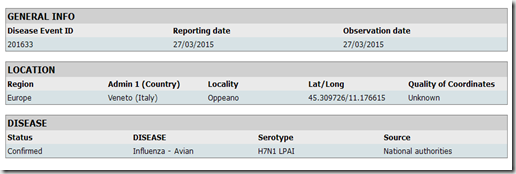
The outbreak in Italy wasn’t immediately identified, but it follows earlier outbreaks of LPAI H7, LPAI H5, and HPAI H5N8 viruses.


Today we’ve confirmation of both of these outbreaks, and of their subtypes, from separate reports issued by the OIE and the FAO.


First stop, Italy – where low path (LPAI) H7N1 has been identified on a farm in the Veneto region in the following FAO report.


image


Of greater concern is an outbreak of HPAI H5N1 in waterfowl around the Danube Delta, as described in the following OIE Report, which describes 64 dead pelicans. 


image

image


Source of the outbreak(s) or origin of infection

  • Unknown or inconclusive

Epidemiological comments


On 25 March, the County Sanitary Veterinary and Food Safety Directorate (CSVFSD) of Tulcea was notified by the Danube Delta Biosphere Reserve Administration (ARBDD) about the identification of 64 carcasses of pelicans in an inhabited area, on Ceaplace island, Sinoe lake. This area is located at the border of Tulcea and Constanta Counties, and no other localities with domestic birds are found on a radius more than 10 km. The entire population of pelicans counted initially more than 250 birds, adults and young. Excluding the dead pelicans (found in different stages of putrefaction), no other birds were observed with clinical signs in the area. Also, in the area were observed other birds species, still unspecified.


After several years of relative quiescence on the bird flu front (at least, outside of China), we are suddenly seeing a remarkable surge in activity, involving several different strains.  


H5N1 is not only on the move in migratory birds – showing up in Eastern Europe, and Nigeria after five years absence – it is also raging in poultry in Egypt, and is spilling over into humans this winter at a record rate (see FAO: Egypt’s H5N1 Case Count Continues To Climb).


Meanwhile, the recently emerged H5N8 virus has not only spread across much of Eastern Asia, and into both Europe and North America, it has spawned a number of `local’ reassortant viruses. `New’ versions of H5N2, H5N3, and H5N1 have appeared in Taiwan, and in North America, and already they have had major impacts on the poultry industry in both regions. 


And while far less worrisome for now, we’ve also seen an unusual number of low path (LPAI) outbreaks (H5s & H7s) in poultry from Italy, to the UK, to Kansas.   


In many ways, the winter of 2014-15 has seen more bird flu activity – over a greater geographic range – than we’ve seen since the great bird flu expansion of 2006, when H5N1 escaped the confines of Asia and barnstormed much of  Europe (see H5N8: A Case Of Deja Flu?).


All of which has brought, once again, the role of migratory and wild birds in the spread of these viruses back to the forefront.  


While there are still a lot of missing pieces to this puzzle – and outbreaks often appear linked to or exacerbated by the movement of poultry products (legal and illicit), equipment, or personnel – this resurgence in bird flu has brought wild and migratory birds under new scrutiny.  


A few recent blogs on the topic include:


Erasmus Study On Role Of Migratory Birds In Spread Of Avian Flu
FAO On The Potential Threat Of HPAI Spread Via Migratory Birds
The North Atlantic Flyway Revisited

FAO: Egypt’s H5N1 Case Count Continues To Climb

image 


# 9883


Although the Egyptian MOH remains largely silent on their H5N1 outbreak, and the Egyptian media continues to publish numbers from some alternate reality (this report today cites only 13 deaths for the year), we’re able to keep some semblance of track via updates from the World Health Organization, releases from the FAO EMPRES website, and the hard work of Sharon Sanders who curates the Egypt - 2015 WHO/MoH/Provincial Health Depts H5N1 Confirmed Case List.


Our last update from the FAO came two weeks ago (see Egypt’s H5N1 Bird Flu Beat Goes On . . . .),  which was followed up a few days later by a WHO EMRO Update On Egypt’s H5N1 Outbreak, which pegged the number of H5N1 cases in Egypt for the year at 116, with 36 deaths (as of March 17th).


While we’ve seen scattered reports in the media of additional cases over the past two weeks, we rarely see a confirmation by Egyptian authorities.  Luckily, they still continue to report to International agencies like the WHO and FAO under the rules established under the IHR (International Health Regulations).


Today the FAO has announced 11 more H5N1 cases, the links you’ll find below:


  1. 30/03/2015: Egypt - Influenza – Avian  Confirmed Influenza - Avian in Assiut, for human
  2. 30/03/2015: Egypt - Influenza – Avian  Confirmed Influenza - Avian in Port Said, for human
  3. 30/03/2015: Egypt - Influenza – Avian  Confirmed Influenza - Avian in Fayoum, for human
  4. 30/03/2015: Egypt - Influenza – Avian  Confirmed Influenza - Avian in Shrkia, for human
  5. 30/03/2015: Egypt - Influenza – Avian  Confirmed Influenza - Avian in Shrkia, for human
  6. 30/03/2015: Egypt - Influenza – Avian  Confirmed Influenza - Avian in Menoufia, for human
  7. 30/03/2015: Egypt - Influenza – Avian  Confirmed Influenza - Avian in Dakahlia, for human
  8. 30/03/2015: Egypt - Influenza – Avian  Confirmed Influenza - Avian in Suhag, for human
  9. 30/03/2015: Egypt - Influenza – Avian  Confirmed Influenza - Avian in Shrkia, for human
  10. 30/03/2015: Egypt - Influenza – Avian  Confirmed Influenza - Avian in Behera, for human
  11. 30/03/2015: Egypt - Influenza – Avian  Confirmed Influenza - Avian in Shrkia, for human

Based on this report, previous reports, and FluTrackers’ 2015 Egypt H5N1 Case List , Egypt is up to 128 cases for the year. Deaths are often reported late (or sometimes not at all), but the WHO’s last tally was 36, and several more appear to have died since then.

While it is not entirely clear what is behind this sudden increase in H5N1 cases, Egypt has reported heavy rates of poultry infections this winter – even among vaccinated flocks (see Egypt H5N1: Poultry Losses Climbing, Prices Up 25% - which calls into question the effectiveness of the vaccines currently being used.


Poorly matched vaccines can often protect poultry against illness – but with increasingly diverse and rapidly evolving avian flu viruses - they cannot always prevent infection. The end result is that healthy looking chickens can harbor undetected infections, that viruses continue to circulate, and new variants or reassortants continue to emerge.


And without the traditional warning signs of sick or dying chickens, people who handle them are not aware of the the danger they pose.


While we’ve not seen any evidence of increased or efficient human-to-human transmission of the H5N1 virus in Egypt, it is worrisome that this outbreak has now gone on for five full months, and that in excess of 150 people have been infected. 


Twice as many human cases as has ever been reported by one country in a single year.  And each human infection provides the virus with another opportunity to better adapt to human physiology.


Although the future threat from H5N1 is unknown, these outbreaks in  Egypt and the rapid emergence and spread of new HPAI H5 reassortants around the globe over the past year recently prompted the World Health Organization to issue a pointed warning (see WHO: H5 Currently The Most Obvious Avian Flu Threat).

Monday, March 16, 2015

Egypt’s H5N1 Bird Flu Beat Goes On . . . .

image

Credit WHO


# 9835


Despite the fact that Egypt is more than 4 months into the worst H5N1 outbreak since the virus emerged in the mid-1990s, with at last count – 115 human cases since November 1st – we get very little day-to-day information about the crisis.  


Unfortunately, no news doesn’t always equal good news.


The Egyptian Ministry of Health stopped reporting publicly on a regular basis in late January (see The Silence Of The Egyptian MOH), and the media’s coverage has been both sparse and confused.


The last `official’ number we received was from the World Health Organization’s March 3rd update, which showed 88 cases and 26 deaths for the year (see below), based on reports provided to them by the Egyptian MOH. 

image

Excerpted from WHO Case Count Table – March 3rd


Exactly how current Egypt’s last notification to the WHO was, and how many cases have been detected since this update, are open questions. Based on media reports, new cases continue to emerge, but details are often absent and the YTD totals remain murky at best.


Sharon Sanders, whose conservatively curated 2015 Egypt H5N1 Case List had  94 cases and 26 deaths as of this morning, but also has several `probable's’ in waiting. 


Today, however, the FAO published notifications of 17 recent human H5N1 cases from Egypt (see below), that appear to be recent enough not to have been included in the last WHO update.  Some of these, Sharon believes she’s already captured on her list, but others appear to be `new’.


As these FAO updates lack identifying details, like age and gender, accurately matching them up to the FluTracker’s list isn’t possible at this time, but it is a pretty good indication that Egypt’s bird flu outbreak continues to steamroll along.


Sharon estimates that perhaps 9 of these cases will end up added to her list, once the WHO publishes a usable line listing. 


All of which puts Egypt’s probable YTD case count something north of 100, and growing.  Shattering Vietnam’s record year (2005) which saw 61 cases and 19 deaths, and Indonesia’s 2006 total of 55 cases and 45 deaths.


The `good news’, as far as we can tell from FAO, WHO, and Egyptian statements is that these human infections appear to be caused by direct contact with infected birds. 


A couple of small `family clusters’ have been mentioned in recent months, but there’s been nothing at this point to indicate the virus is transmitting easily, or efficiently, from person-to-person.


Below you’ll find a listing of today’s FAO notifications:


  1. 16/03/2015: Egypt - Influenza – Avian Confirmed Influenza - Avian in Kafr-el-sheikh, for human
  2. 16/03/2015: Egypt - Influenza – Avian Confirmed Influenza - Avian in Al Jizah (giza), for human
  3. 16/03/2015: Egypt - Influenza – Avian Confirmed Influenza - Avian in Al Daqahliyah (dakahlia), for human
  4. 16/03/2015: Egypt - Influenza – Avian  Confirmed Influenza - Avian in Ash Sharqiyah (sharkia), for human
  5. 16/03/2015: Egypt - Influenza – Avian  Confirmed Influenza - Avian in Al Buhayrah (behera), for human
  6. 16/03/2015: Egypt - Influenza – Avian Confirmed Influenza - Avian in Al Buhayrah (behera), for human
  7. 16/03/2015: Egypt - Influenza – Avian Confirmed Influenza - Avian in Ash Sharqiyah (sharkia), for human
  8. 16/03/2015: Egypt - Influenza – Avian Confirmed Influenza - Avian in Al Minya (menia), for human
  9. 16/03/2015: Egypt - Influenza – Avian Confirmed Influenza - Avian in Qina, for human
  10. 16/03/2015: Egypt - Influenza – Avian Confirmed Influenza - Avian in Qina, for human
  11. 16/03/2015: Egypt - Influenza – Avian Confirmed Influenza - Avian in Al Buhayrah (behera), for human
  12. 16/03/2015: Egypt - Influenza – Avian Confirmed Influenza - Avian in Al Minya (menia), for human
  13. 16/03/2015: Egypt - Influenza – Avian  Confirmed Influenza - Avian in Al Qalyubiyah (kalyoubia), for human
  14. 16/03/2015: Egypt - Influenza – Avian Confirmed Influenza - Avian in Al Qahirah (cairo), for human
  15. 16/03/2015: Egypt - Influenza – Avian Confirmed Influenza - Avian in Al Jizah (giza), for human
  16. 16/03/2015: Egypt - Influenza – Avian  Confirmed Influenza - Avian in Al Buhayrah (behera), for human
  17. 16/03/2015: Egypt - Influenza – Avian  Confirmed Influenza - Avian in Ash Sharqiyah (sharkia), for human

Thursday, January 08, 2015

CIDRAP: FAO Reports Mutations In H5N1 Virus From Egyptian Poultry

image


# 9543


Last night CIDRAP published a piece by News Editor Robert Roos which looks at genetic characterizations of H5N1 viruses sampled from Egyptian poultry recently. According to the FAO, this analysis showed signs of several troubling `mammalian adaptations’, although two isolates taken from humans recently reportedly showed no major genetic changes.


First some excerpts from  Robert’s detailed report (but you’ll want to read the whole thing), then I’ll be back with a little more.


FAO notes mutations in H5N1 samples from Egypt's poultry

Robert Roos | News Editor | CIDRAP News

Jan 07, 2015

Amid a flurry of human H5N1 influenza cases in Egypt, scientists have found H5N1 viruses in Egyptian poultry that have two mutations that are usually associated with adaptation to mammals, a United Nations Food and Agriculture Organization (FAO) official reported today.

Juan Lubroth, DVM, PhD, the FAO's chief veterinary officer, told CIDRAP News that the mutations were identified through genetic sequencing of 52 recent isolates from poultry. But he also said a recent analysis of viruses from two human patients in Egypt showed no major genetic changes.

Egypt has had a surge of human H5N1 cases over about the past 7 weeks, after reporting very few during the preceding 2 years. According to media reports based on health ministry statements, the country had 29 cases with 11 deaths in 2014, most of them in November and December. All or nearly all of the patients had contact with poultry, and no signs of human-to-human transmission have been reported, but the cases have prompted some speculation about whether the virus has changed in some way.

In addition, Egypt has had a big increase in reported poultry outbreaks of H5N1 recently, according to the FAO. A graph supplied by Lubroth showed about 70 outbreaks in November (2014) and close to 180 outbreaks in December, compared with fewer than 10 in each of those months in 2013.

(Continue . . . )


The evolutionary path that would take an avian influenza virus – like H5N1 – to the point where it was well-enough adapted to mammals to pose a pandemic threat isn’t well mapped. There are a lot of interactive `moving parts’ inside a virus, and how evolutionary changes (via accrued amino acid substitutions) affect the virus’s behavior are only partially understood.


On a `macro level’, we know that avian viruses bind preferentially to the type of receptor cells (α-2,3) found in the gastrointestinal tract of birds, and that mammalian-adapted viruses would have to evolve to bind preferentially to α-2,6 receptor cells – they type found in the upper respiratory tract of mammals.


We also believe that an adapted virus would have to thrive and replicate in the slightly cooler environment found in their upper respiratory tracts (birds run `hotter’  than mammals by several degrees).


While both are viewed as important, it is likely that there are other – perhaps subtle – changes that must occur before an avian virus can effectively jump to a mammalian host.  Robert’s article cites the following changes:


Genetic sequencing of 52 isolates revealed that the hemagglutinin (H5) genes in the virus continue to evolve but that all the isolates belong to clade 2.2.1, the same as seen in previous years. However, the scientists also identified two "fixed mutations": a "combination of [delta]129 and I151T," and a "T156A causing a loss of glycosylation at receptor binding site."

"Both mutations enhance alpha 2-6 receptor binding (which is associated with mammalian adaptation)," the statement said. It added that the virus is nonetheless still regarded as an avian one.

However, the FAO also reported the emergence in 2014 of a new H5N1 cluster with three other mutations—D54N, R189K, and R474K. It said this cluster also remains within clade 2.2.1, but the significance of the mutations needs to be assessed.


Although we talk about the H5N1 virus as if it were a single entity, the virus has evolved into numerous clades, and sub-clades, around the globe – with a range of  variants within each.  As a result, the H5N1 virus circulating in Egypt is not the same H5N1 virus circulating in Cambodia. 


H5N1 alone has produced more than 20 clades and sub-clades over the years (not all continue to circulate).

image

Diversity of circulating H5N1 Clades – Credit WHO


While these evolutionary variations mostly come about slowly due to antigenic drift, more abrupt changes can come through antigenic `shift’ – or reassortment.  With the recent expansion of the constellation of HPAI H5 viruses expanding around the globe (including H5N1, H5N8, H5N6, H5N2, H5N3), the opportunities for reassortment only increase.


Although concerning, we’ve seen similar pronouncements regarding `mammalian adaptations’  detected in H7N9, H9N2, and even H5N1 virus in recent years (see Study: H5 Clade 2.3.4.6 Receptor Binding & Nature Comms: Host Adaptation Of Avian Influenza Viruses), and yet none of these viruses has managed to make the leap to mammals.


Some scientists suspect there may be some kind of `species barrier’ that will prevent any of these avian viruses from ever making the jump, pointing out that only H1, H2, and H3 influenza viruses have (at least, in the 120 year history we know about) caused significant human illness (see  Are Influenza Pandemic Viruses Members Of An Exclusive Club?).


Other scientists point out that 120 years of influenza observation is hardly enough to base any solid conclusions.  That nature is full of surprises.


So we watch these viruses circulate in the wild, watching for changes both in their genetics and in their behavior, in the hopes that we might get some early warning of a pandemic.  Time enough to make a vaccine, or with a lot of luck, time enough to contain an outbreak.


The biggest problem being - that when you don’t know exactly what any novel pandemic virus will look like - you never really know how close – or how far away -  you are to seeing one emerge.

Monday, November 24, 2014

FAO Warns On H5N8’s Spread

image

H5N8 Branching Out To Europe & Japan


# 9367


The past couple of weeks have been marked by the rapid geographic expansion of the avian H5N8 virus – first seen less than a year ago on the Korean Peninsula.   Highly pathogenic in poultry – this virus has not yet been seen to infect humans – although it is a close cousin to the H5N1 virus which certainly can.


For now, the big threat is to agriculture, not public health. 


As we saw in 2006 (see H5N8: A Case Of Deja Flu?), newly emerging avian flu viruses can sometimes travel very rapidly across large distances – often aided and abetted by migratory birds and the poultry trade.  We saw the number of countries infected with avian H5N1 jump from 16 at the end of 2004 to 56 by the end of 2006.


With H5N8 now showing up in Germany, the UK, and the Netherlands, today the FAO has issued a warning to all nations to be alert and to be prepared to deal with this new bird flu threat.


New avian influenza’s rapid spread to Europe threatens poultry sector especially in low-resourced countries

FAO and OIE urge at-risk countries to step-up prevention efforts through increased bio-security

Photo: ©Scott Nelson/WPN for FAO

Surveillance systems to detect virus outbreaks include laboratory testing.

24 November 2014, Rome/Paris - A new bird flu strain detected in Europe which is similar to strains reported to be circulating in 2014 in Asia poses a significant threat to the poultry sector, especially in low-resourced countries situated along the Black Sea and East Atlantic migratory routes of wild birds, FAO and the World Organisation for Animal Health (OIE) warned today.

Germany, the Netherlands and the United Kingdom have confirmed the new avian influenza virus strain H5N8 on poultry farms, and German authorities have also found the virus in a wild bird.

Earlier this year, the People's Republic of China, Japan and the Republic of Korea reported outbreaks of H5N8 in poultry as well as findings in migratory birds and waterfowl. The fact that the virus has now been found within a very short time interval in three European countries, both in a wild bird and in three very different poultry production systems, suggests that wild birds may have played a role in spreading the virus, FAO and OIE experts said.

H5N8 has so far not been confirmed to infect people. However, it is highly pathogenic for domestic poultry, causing significant mortality in chickens and turkeys. The virus can also infect wild birds, which show little signs of illness. It is known from other influenza viruses that wild birds are able to carry the virus long distances.
Should poultry systems with low-biosecurity conditions become infected in countries with limited veterinary preparedness, the virus could spread through farms with devastating effects, both on vulnerable livelihoods as well as on country economies and trade. The best way for countries to safeguard against these impacts is to encourage better biosecurity and to maintain surveillance systems that detect outbreaks early and enable veterinary services to respond rapidly.

The new virus strain provides a stark reminder to the world that avian influenza viruses continue to evolve and emerge with potential threats to public health, food security and nutrition, to the livelihoods of vulnerable poultry farmers, as well as to trade and national economies. Therefore extreme vigilance is strongly recommended while progressive control efforts must be sustained and financed.

In particular, to protect poultry-related livelihoods and trade, FAO and OIE are recommending at-risk countries to:

  • increase surveillance efforts for the early detection of H5N8 and other influenza viruses;
  • maintain and further strengthen rapid response capacities of veterinary services;
  • reinforce biosecurity measures, with particular emphasis on minimizing contact between domestic poultry and wild birds;
  • raise awareness of hunters and other individuals who may come into contact with wildlife in order to provide early information on sick or dead wild birds.

The new strain of avian influenza has not resulted in human cases. Nevertheless it is related to the H5N1 virus, which is known to have spread from Asia into Europe and Africa in 2005-2006. The H5N1 epidemic, in which wild birds have also been implicated, has caused the deaths of nearly 400 people and hundreds of millions of poultry to date. Therefore prudent and precautionary interventions at the animal level are warranted.

Sunday, November 16, 2014

FAO On The Potential Threat Of HPAI Spread Via Migratory Birds

image


# 9330


Although it may sound so very 2006, once again we appear to be faced with a westward expansion of one or more novel avian flu strains out of Asia.  Readers with good memories will recall the scramble in middle of the last decade to prevent the spread, and entrenchment, of H5N1 into Europe (see 2007’s Germany Reports More Infected Poultry & UK: Bird Flu Cull Complete).


Between a strict culling policy, and enhanced biosecurity measures, Europe managed to keep H5N1 from becoming endemic in poultry, despite repeated introductions of the virus.


China, which has relied predominantly on a vaccination policy, has managed to protect their poultry flocks from excess mortality and morbidity, but – as we discussed last week (see EID Journal: Subclinical HPAI In Vaccinated Poultry – China – now finds itself with multiple clades and subtypes of HPAI in circulation and a roster of poultry vaccines that are slowly losing their effectiveness.


While HPAI has proven to be primarily a threat to poultry operations, we have seen hundreds of human infections with both H5N1 and H7N9 (including many fatalities) over the past decade, and scientists worry that either could – over time – adapt better to human physiology and present a pandemic threat. 


While H5N1 has a ten-year head start, H7N9 has caused far larger outbreaks over the past couple of years, and is currently viewed as the bigger public health threat.  Upstart viruses such as H5N6, H5N8, and H10N8 are too new to effectively gauge their threat potential, but bear watching (see China: H5 AI Rising).


The arrival of H5N8 in Germany last week, and its detection in wild bird feces in Japan this week, along with today’s  report Netherlands: `Severe’ HPAI Outbreak In Poultry, is a reminder that nature’s laboratory is open, and operating 24/7, and that it continues to serve up new disease threats.


The role of migratory birds in spreading HPAI has been a controversial one (see Bird Flu Spread: The Flyway Or The Highway?), with wildlife enthusiasts quick to blame the poultry industry, citing poor biosecurity, overcrowded factory farms, and smuggling.  


When infected migratory birds land in Japan, or HPAI shows up thousands of miles away from home, it is difficult to ignore the potential role of birds in AI spread.


On Friday the FAO published the following report on the potential movement of avian flu viruses out of Asia, and into Europe, via migratory birds.


Avian influenza A(H5N8) detected in Europe… a journey to the West?

Germany has become the first European country to report an outbreak of highly pathogenic avian influenza caused by an A(H5N8) virus genetically similar to one spreading in the Republic of Korea since January. The virus causes high mortality in poultry. The route of introduction into Germany remains unclear, but the long-distance spread from Asia to Europe indicates that wild birds may play a role. FAO is emphasizing the need for continued vigilance worldwide and heightened efforts on farms to prevent contact between poultry and wild birds.

What we know

The Federal Republic of Germany officially reported the outbreak on 6 November 2014 to the World Organisation for Animal Health (OIE) and the European Union. German authorities have since contained the outbreak, which occurred on a turkey farm. The Government is working to clarify the source of infection through ongoing epidemiological investigations while also searching for any additional cases through targeted surveillance in the surrounding areas. Genetic information released immediately by the Friedrich Loeffler Institute, the National Reference Laboratory for avian influenza in Germany, shows that this H5N8 is very similar to viruses detected in China, the Republic of Korea and Japan this year.

Akin to the highly pathogenic avian influenza H5N6 virus that emerged in southern China around the same time (see FAO press release, 22 September 2014 and EMPRES Watch, November 2014) this H5N8 originated from various reassortment events involving, among others, HPAI H5N1 viruses circulating in Southeast Asia.
Outbreak data from the Republic of Korea and Germany shows that H5N8 causes high mortalities in chickens and turkeys. Experimental studies with the Korean virus, on the other hand, suggest no associated severe mortality in domestic or wild ducks. However, ducks can shed high amounts of virus (
reference).

A role for wild birds?

Much still needs to be clarified about this virus, including how it found its way to Germany. The fact that the virus is genetically close to a virus from the Republic of Korea and that wild ducks may be affected without dying could suggest a role for wild birds in the spread of the virus over long distances and further onward transmission to poultry.

Wild birds were linked previously to the spread of H5N1 HPAI virus from Asia to Europe and Africa from 2005 onwards. With regard to H5N8, experts hypothesize that the virus may have travelled during the spring season from eastern Asia into the breeding grounds of migratory birds in Central Asia. These migratory birds may now be carrying the virus with them as they migrate into more moderate climates.

What this means

The detection of H5N8 in Europe is a reminder that avian influenza viruses still represent a global threat to animal health and the international poultry industry. FAO is calling for worldwide vigilance and targeted surveillance as well as optimized biosecurity measures on farms. Avian influenza spreads most easily from infected farms to uninfected farms through common processes involved in the poultry industry and where biosecurity is low. Reducing direct and indirect contact between poultry and wild birds is an important part of good biosecurity, especially in light of various virus strains that may be carried by wild birds.

Experimental infections with H5N8 demonstrate the Republic of Korea show that certain aquatic wild bird species, like mallards, may not exhibit overt signs of disease or mortality. Likewise, the virus may not cause high mortality in domestic ducks. Therefore, active surveillance is important for early detection both in aquatic wild birds and in poultry.

What FAO suggests
  • Any significant increase in mortality, neurological signs or reductions in food intake or egg production in ducks and chickens should be immediately reported and investigated.
  • Any unexplained excess mortality in wild birds, especially aquatic species, should be fully reported and investigated.
  • Poultry should be kept indoors with good standard biosecurity measures implemented on farms aiming at minimizing contact with wild birds as well as between poultry farms.
  • Hunters should properly dispose of any remains from hunted wild birds. Hunters should also avoid contact with domestic poultry during or directly after hunting.

Monday, November 10, 2014

FAO-EMPRES Report On The Emergence And Threat Of H5N6

image


# 9305


For many years Southeast Asia has been considered `the cradle of influenza’, an area of the world where both human and animal influenza viruses circulate more-or-less year round, and where humans and farm animals often live in close proximity with one another.


In March of 2013, in EID Journal: Predicting Hotspots for Influenza Virus Reassortment, we looked at a study that selected East-Central China a one of the top hotspots in the world for the creation of zoonotic influenza viruses – those that can jump from animals to man. 


And then, almost on cue, two weeks later we saw the first reports of a new avian flu virus that had jumped to humans in Shanghai; H7N9.  


In a matter of less than 60 days, more than 130 human cases were diagnosed.  The following year -  another 320+ cases were tallied, and over the summer we saw the following assessment appear in Eurosurveillance: Genetic Tuning Of Avian H7N9 During Interspecies Transmission.

Overall, due to the genetic tuning procedure, the potential pandemic risk posed by the novel avian influenza A(H7N9) viruses is greater than that of any other known avian influenza viruses.


As if that weren’t enough,  in rapid succession over the past 12 months we’ve seen 3 more subtypes appear:


Suddenly, we’ve gone from having 1 worrisome bird flu virus (H5N1), to having at least 5 (H5N1, H7N9, H10N8, H5N8, H5N6).  All are the product of reassortment – the swapping of gene segments between two flu viruses - to produce a new hybrid.


Although categorized by their two surface proteins (HA & NA) Influenza A viruses have 8 gene segments (PB2, PB1, PA, HA, NP, NA, M1, M2, NS1, NS2).

image

Shift, or reassortment, happens when two different influenza viruses co-infect the same host swap genetic material.  New hybrid viruses may be the result of multiple reassortments, with gene contributions coming from several parental viruses.


Interestingly, while their HA and NA genes may differ – almost all of these new viral interlopers carry the internal genes from the avian H9N2 virus (see The Lancet: H9N2’s Role In Evolution Of Novel Avian Influenzas). 


And while we are talking about 5 main subtypes (for now, anyway), we’ve seen evidence of dozens of variants or clades bubbling up within these subtypes  - with new, updated versions emerging at a tremendous rate.


And new subtypes continue to emerge, as is evidenced by the announcement last month that an H5N3 virus was detected in a live bird market in Changsha, Hunan. 


The more subtypes in circulation, the more `interchangeable parts’  that are available for building new viruses. No one should be overly shocked if this list of newly emergent avian viruses continues to grow this winter. 


All of which brings us to a new 5-page FAO EMPRES report published today, excerpts which I’ve posted below.  By all means, download the entire PDF, as it is chock full of good information and covers the genesis – and possible interaction with – other avian influenza viruses in the region (i.e. H7N9, H10N8, H5N8, etc.).


Avian influenza A(H5N6): the latest addition to emerging zoonotic avian influenza threat In East and Southeast Asia

VOL 30 — NOVEMBER 2014 EMPRES-ANIMALHEALTH@FAO.ORG | WWW.FAO.ORG/AG/EMPRES.HTML

image


<BIG SNIP>

Perspectives and recommendations
The epidemiological and genetic analysis described above show that the virus is still more adapted to avian-type than  human-type respiratory receptors. However, with winter season approaching in eastern Asia, the prevalence of the virus in poultry is expected to rise, increasing both chances for human exposure and opportunities for mutation or reassortment, especially considering the location of circulation of this virus: in endemic regions with H5N1, H9N2 and H7N9 for China. The latter could change the viruses’ transmissibility to humans. H5N6 therefore remains a public health threat, which requires close monitoring in the same way as for H5N1 HPAI and H7N9.


The possibility exists that wild birds could become infected and spread these viruses to other countries or continents. Migratory birds, which have played a key role in the introduction of H5N1 to Europe and Africa [Kilpatrick et al, 2006] and of H5N8 to the Republic of Korea [Jeong et al, 2014], could spread the viruses to other countries or continents. Research is required to better understand the role migratory birds play in the epidemiology of these novel viruses and related risks.

(Continue . . . .)


For those who may have missed it, coincidentally I wrote about concerns over the spread of H5N6, H7N9, H5N8 and other avian flu viruses this morning in Bird Flu Spread: The Flyway Or The Highway?

Monday, September 22, 2014

FAO Warns On H5N6

image

Photo Credit – FAO


#9099


Last April a new strain of HPAI H5N6 appeared in poultry, killing one person in Nanchong City (see Sichuan China: 1st Known Human Infection With H5N6 Avian Flu).  Once the threat was identified, local poultry was culled, and we heard nothing more for several months.


While Low Pathogenic H5N6 had been identified previously in wild birds  in Taiwan, Germany, Sweden and the United States this new strain was classified as highly pathogenic. 


And like the H5N8 virus which emerged last January and ravaged South Korea’s poultry industry throughout the spring, this new virus was a reassortant of the H5N1 avian flu virus (see Whole-Genome Sequence Of Reassortant H5N6 Avian Virus).


All was quiet on the H5N6 front until early August, when the virus showed up in widely separated outbreaks in central and northern Vietnam (see OIE: Two Outbreaks Of H5N6 In Vietnamese Poultry).


In short order we began to see additional outbreaks in Vietnam (see Vietnam Gears Up To Detect, Fight Avian H5N6) and two thousand miles away in northern China (see China: H5N6 Outbreak In Heilongjiang Poultry).


Last week, the central Vietnamese Quang Ngai province reported their fourth outbreak in just over a month, and over the weekend Vietnamese media have reported that a massive cull is underway (see A/H5N6 flu virus: Quang Nam culls 800,000 ducks).


While its threat to humans is uncertain, the threat to the poultry industry – and to the the food security and meager incomes of households that raise subsistence poultry – could be dire. 


After a decade of losses due to H5N1, and the recent introduction of the stealthy H7N9 virus, the last thing anyone wanted to see in that part of the world is another avian flu threat.  As if that weren’t enough, South Korea’s H5N8 virus – which briefly made it to Japan last spring – could also make further inroads across Asia this fall and winter.


Today the FAO released the following news article on their website.  Excerpts follow, and I’ll have  a bit more when you return.


Increased concern over latest strain of avian influenza in Southeast Asia

FAO urges continued vigilance to safeguard poultry and livelihoods

22 September 2014, Rome - A recently-emerged strain of avian influenza virus in poultry in Southeast Asia known as A(H5N6) represents a new threat to animal health and livelihoods and must be closely monitored, FAO said today.
Chinese authorities first reported the influenza A(H5N6) virus in poultry in April 2014. Since then, the Lao People's Democratic Republic and Viet Nam have also detected the H5N6 virus in poultry.


"Influenza viruses are constantly mixing and recombining to form new threats," said FAO's Chief Veterinary Officer, Juan Lubroth. "However, H5N6 is particularly worrisome, since it has been detected in several places so far from one another, and because it is so highly pathogenic, meaning infected poultry quickly become sick and, within 72 hours, death rates are very high."


The fact that the virus is highly virulent in chickens and geese and potentially spread across a large part of Southeast Asia translates into a real threat to poultry-related livelihoods. Poultry contributes to the incomes of hundreds of millions of people throughout the subregion.


The World Organisation for Animal Health (OIE), which works together with FAO and the World Health Organization (WHO) to support countries' responses to animal and human disease threats, is also monitoring the situation closely.


"An effective surveillance and an early detection of animal disease at source are two main keys to reduce the risk of dissemination and to ensure safe trade. The OIE calls on its 180 member countries to respect their commitment and to immediately notify on WAHIS any outbreak detected on their territory," said OIE Director-General Bernard Vallat.

Limited threat to human health

Only one case of H5N6 has been reported in humans after contact with exposure to poultry shortly after its detection in China. The person later died. There have been no other human cases.  Though the scientific community is still in the process of understanding the dynamics of this new strain, it is unlikely that H5N6 represents an immediate and significant threat to human health.

"Current evidence suggests H5N6 poses a limited threat to human health at this stage," said WHO epidemiologist Elizabeth Mumford. "It's been detected in multiple places in poultry, yet we only have one human infection reported. This suggests that the virus does not easily jump from animals to humans. Of course, we still need to remain vigilant, because prevalence in poultry and therefore human exposure could increase during the winter."


Even if the public health risks posed by H5N6 currently appears to be low, other pathogens, including other subtypes of influenza viruses such as H5N1 and H7N9, still can present cause for concern. FAO and WHO recommend consumers follow appropriate hygiene, food preparation and food safety guidelines. These include: washing hands often, cleaning utensils and surfaces used during food preparation, and eating only well-cooked poultry meat products. People should also avoid handling sick birds or those that have died of illness.


FAO and WHO are stressing that at this time it is critical for countries in Southeast and East Asia -- especially those with links to poultry production and trade -- to ramp up efforts to detect and report influenza viruses in poultry and monitor for any human infections.


(Continue . . . )


Although Southeast Asia has long been known as the `cradle of influenza’ -  an area of the world where both human and animal influenza viruses circulate in close proximity more-or-less year round and can occasionally serve up hybrids – the past couple of years has seen a remarkable number of reassortants appear.


H7N9, H5N6, H5N8, H10N8, H6N1 . . . .  all with a increasing number of clades, as well.


Of these, H7N9 has provoked the most concern by far, as it has sparked two sizable human waves of infection, and is expected to return when temperatures cool this fall and winter.  But H10N8 is no slouch, having killed three people in China last winter, while the others are too new to really evaluate their public health impact.


The good news is that reassortant viruses with genuine pandemic potential only appear very rarely. 


The bad news is that nature’s laboratory is open 24/7, and it is constantly trying to produce the next `successful’ virus.  And the more subtypes it has to play with, the greater the odds are it will come up with something we really don’t want to have to deal with.


All of which highlights the need for continual and enhanced surveillance of humans, livestock, and wild birds for emerging viral threats. Because it isn’t a question of if another pandemic will emerge.


It’s really just a matter of when.

Tuesday, September 02, 2014

FAO Alert: Ebola Outbreak Threatens Food Security In West Africa

image 


# 9027


One of the scenarios we’ve looked at previously surrounding severe epidemics or pandemics involves disruptions in the supply and/or production chain, leading to shortages, price hikes, and severe economic downturns. All of which can lead to even greater misery and loss of life. 


We’ve discussed this cascade effect a number of times, including in the Supply Chain Of Fools, and in the CIDRAP Coal Report, which looked at crucial preparedness gaps in the United States that could lead to disruptions in the electrical grid during a severe pandemic.


The Ebola virus in West Africa has infected fewer than 10,000 people (official counts are 3,500 but are likely low) -  a small fraction of a single percent of the population – but the impact of the outbreak is literally being felt by millions.


Quarantines and checkpoints are limiting movement of people and goods, many residents are afraid to leave their homes, the affected countries are increasingly isolated from international travel and trade, and as a result many shops and other businesses are closed.


In many ways we are seeing on a small scale some of the types of social and economic impacts the world might face during a particularly severe pandemic. 


With crucial  harvests of rice, maize, millet & sorghum set to begin shortly, and the logistic nightmare imposed by the epidemic, the FAO today is warning that a major food crisis may lay ahead for the region:


Special Alert on Ebola in West Africa - FAO's Global Information and Early Warning System (GIEWS)

. image
(Continue . . .)


Here is the news release from the FAO on this alert:


West Africa: Ebola outbreak puts harvests at risk, sends food prices shooting up

Agriculture in affected countries under significant strain, says new FAO special alert

Photo: ©Zoom Dosso/AFP

An empty street market in Monrovia's West Point district, 20 August 2014.

2 September 2014, Rome - Disruptions in food trade and marketing in the three West African countries most affected by Ebola have made food increasingly expensive and hard to come by, while labor shortages are putting the upcoming harvest season at serious risk, FAO warned today.


In Guinea, Liberia, and Sierra Leone, quarantine zones and restrictions on people's movement aimed at combating the spread of the virus, although necessary, have seriously curtailed the movement and marketing of food. This has lead to panic buying, food shortages and significant food price hikes on some commodities, especially in urban centers, according to a special alert issued today by FAO's Global Information and Early Warning System (GIEWS).


At the same time, the main harvest season for two key crops - rice and maize - is just weeks away. Labor shortages on farms due to movement restrictions and migration to other areas will seriously impact farm production, jeopardizing the food security of large numbers of people, the alert says.


Generally adequate rains during the 2014 cropping season had previously pointed to likely favorable harvests in the main Ebola-affected countries. But now food production - the areas most affected by the outbreak are among the most productive in Sierra Leone and Liberia - stands to be seriously scaled back.


Likewise, production of cash crops like palm oil, cocoa and rubber - on which the livelihoods and food purchasing power of many families depend - is expected to be seriously affected.


"Access to food has become a pressing concern for many people in the three affected countries and their neighbors," said Bukar Tijani, FAO Regional Representative for Africa. "With the main harvest now at risk and trade and movements of goods severely restricted, food insecurity is poised to intensify in the weeks and months to come. The situation will have long-lasting impacts on farmers' livelihoods and rural economies," he added.


Major spikes in food prices

Guinea, Liberia and Sierra Leone are all net cereal importers, with Liberia being the most reliant on external supplies. The closure of some border crossings and the isolation of border areas where the three countries intersect - as well as reduced trade from seaports, the main conduit for large-scale commercial imports - are resulting in tighter supplies and sharply increasing food prices.


In Monrovia, Liberia, a recently conducted rapid market assessment indicates that prices of some food items have increased rapidly - for example, in Monrovia's Redlight Market the price of cassava went up 150 percent within the first weeks of August.


"Even prior to the Ebola outbreak, households in some of the affected areas were spending up to 80 percent of their incomes on food," said Vincent Martin, Head of FAO's Dakar-based Resilience Hub, which is coordinating the agency's response. "Now these latest price spikes are effectively putting food completely out of their reach. This situation may have social repercussions that could lead to subsequent impact on the disease containment."


The depreciation of national currencies in Sierra Leone and Liberia in recent months is expected to exert further upward price pressure on imported food commodities.

Response efforts

To meet short-term food relief needs, the UN World Food Programme (WFP) has launched a regional emergency operation targeting some 65,000 tonnes of food to 1.3 million people.

At the same time, FAO's special alert says that "rapid assessments are required to identify the type of measures that are feasible to mitigate the impact of labour shortages during the harvesting period and for related post-harvest activities."
And measures to revive internal trade are essential to ease supply constraints and mitigate further food price increases, it notes.

Preventing further loss of human life and stopping the spread of the virus remain the top priorities at this time. FAO has joined the coordinated UN effort to support affected countries, is in daily communication with WHO and other key actors, and has personnel in West Africa aiding technical and logistical efforts.

It is critical that rural communities understand which practices pose the highest risks of human-to-human transmission as well as the potential spill-over from wildlife. Toward that end, FAO has activated its networks of local animal health clubs, community animal health workers, producer organizations, forestry contacts and agriculture extension and rural radio services to help UNICEF and WHO communicate risk to affected populations.

Friday, May 23, 2014

FAO: `Stepped Up’ Investigations Into Role Of Camels In MERS-CoV

Photo: ©FAO/Ami Vitale

Credit FAO


# 8658


For many who live in and around the Middle East, it is extremely difficult to get their head around the idea that camels might be one of the sources of human MERS coronavirus infection.  Camels are not only the most identifiable symbol of the region, they played an immense role in making it possible to people to settle and thrive in an arid and often inhospitable environment.


Essential beasts of burden, givers of milk and meat, and the literal savior  of uncounted people who’ve trekked the desert, camels have been considered beloved life-givers for thousands of years . . . not threats to health. 


Camels are also a mainstay of the local economy (milk, meat, camel rides for tourists, etc.), and their sacrifice (and the distribution of their meat to the poor) during the Hajj or Umrah plays an important part in their religion.   All of which – understandably - makes it difficult for many to accept that this new MERS coronavirus could be coming from camels.


Although we’ve seen some signs of slow acceptance of the idea in recent weeks (see Saudi Ministry Of Agriculture Issues Warnings On Camels), a day hardly goes by without an article appearing in the Arabic press casting doubt on any suspected MERS-camel link.


All of which means that broad based local surveillance, and research, into the role that camels – and other animals – might play in the spread of MERS has been slow to get off the ground.


Today the FAO released the following report, where experts at a regional technical consultation meeting in Oman are urging researchers and the appropriate Ministries to step up surveillance and research into any animal-MERS link (including camels), and to increase public awareness of the disease threat.    


MERS Coronavirus: Stepped up research into role of camels and other animals urged

Expert meeting in Oman leads to guidance on investigating transmission routes and stemming spread of the disease

23 May 2014, Muscat, Oman/Rome - Health experts and veterinarians are among those calling for stepped up monitoring, investigations, and immediate reporting of cases of the potentially fatal Middle East Respiratory Syndrome (MERS), an infection that has caused numerous human illnesses and deaths, but whose origins may be linked to animals.

A declaration at a regional technical consultation meeting, convened by FAO in the Sultanate of Oman, warned countries in the region and beyond of the need for public health and veterinary authorities to carry out coordinated investigations, and share information and results.

Participants noted the "recent upsurge in human cases in the Arabian Peninsula and the suspected zoonotic transmission involving, in particular, dromedary camels." They agreed on a list of specific recommendations to increase knowledge about the transmission of the virus to humans and to minimize its impact on animal and human health, as well as agriculture and livestock-related livelihoods.

"It is vitally important for the international community to increase our understanding of ‘where' and ‘how' the virus is transmitted, ‘who' the source is - whether animal or human - and 'when' and ‘why' certain people are spreading the virus," said Juan Lubroth, Chief Veterinary Officer at FAO.

<SNIP>

Recommendations

The recommendations are focused on the potential link with camels or other animal sources. Priorities should be given to:

1.   raising public awareness of MERS-CoV

2.   urgent investment in research and surveillance of animals;

3.   the systematic search for potential sources of human infection from animal sources or the environment;

4.   joint efforts and coordination among public health authorities.

Concerted action is also called for in the areas of:

  • good practices in heightening biosecurity measures at farms or at border crossings;
  • underscoring the importance of personal hygiene practiced by people who work around livestock, slaughterhouses and racing animals -- such as frequent hand-washing after touching animals, protective clothing and washing of soiled clothing, shoes and other items;
  • greater region-wide information sharing and closer coordination to manage risks posed by the movement and trade of livestock;
  • possible introduction of animal passports/certificates for racing camels;
  • engagement of the private sector (such as racing associations, breeding enterprises and meat packing operations).

The guidance emerging from the consultation reflected discussions during the 20-21 May consultation, which was opened by the Minister of Agriculture and Fisheries of Oman, Dr Fuad Jaffer al Sajwani. Participants included the World Organisation for Animal Health (OIE), the World Health Organization (WHO), the Gulf Cooperation Council and renowned experts who are currently collaborating with researchers and authorities of the region.

The meeting also drew public health and veterinary authorities and other specialists from eleven countries: Ethiopia, Egypt, Bahrain, Jordan, Kuwait, Qatar, Oman, Palestine, Saudi Arabia, Sudan, United Arab Emirates, and Yemen.


Camels and MERS

Several studies have reported high proportions of camels with antibodies against MERS-CoV or that of a closely-related virus, both in countries where human cases were detected and also in countries with no reported cases.

Some of these studies have shown that MERS-CoV has been circulating in camels in Saudi Arabia since at least 1992. Genetic evidence of MERS-CoV infection was found in tests of camel samples from a farm in Qatar and in other studies in Egypt and Saudi Arabia.

Coronaviruses are widespread in animal species and they can infect livestock and a wide range of wild species, including bats, rodents and wild birds.


Wednesday, February 19, 2014

FAO: No Evidence Of Human To Animal H7N9 Transmission

image

Photo Credit – FAO


# 8312


With the recent imported case of H7N9 to Malaysia – and the prospect that we could see other such cases around the world - there are natural concerns that this might lead to the introduction of the virus to local poultry or livestock outside of Mainland China.


Today the FAO has published a reassuring news story with – in my humble opinion - a badly phrased headline.  


While we’ve not seen any evidence of humans transmitting the H7N9 virus to other animal species – as Carl Sagan put it in Cosmos - “The absence of evidence is not the evidence of absence.”


So the headline below - stating that the possibility has been `ruled out’  - seems more than just a reach.


The body of the story, I would note, is slightly less adamant, stating that there is no evidence that humans can `transmit the virus to animals, including birds’  and “The highest risk of virus introduction is uncontrolled live poultry trade between affected and unaffected areas”.

First some excerpts, after which I’ll return with a bit more.


FAO rules out human-to-animal transmission of influenza A(H7N9)

After the first case of A(H7N9) outside China, FAO says there is no evidence that infected people could transmit the virus to poultry

Photo: ©FAO/John Edwards

Uncontrolled live poultry trade poses the highest risk of A(H7N9) introduction.

19 February 2014, Rome – FAO says there is no evidence that human patients infected with influenza A(H7N9), a low pathogenic virus in poultry, can transmit the virus to animals, including birds.


FAO referred to the first human case of A(H7N9) outside China, which was recently detected in Malaysia.
The patient, originally from Guangdong Province in China, where she is thought to have contracted the infection, was visiting Malaysia as a tourist and has now been hospitalized there. Guangdong is one of the Chinese provinces most affected by the A(H7N9) virus in 2014.


“This case does not come as a surprise and should not be a cause for increased concern, but should remind the world to remain vigilant," said FAO Chief Veterinary Officer Juan Lubroth.


“Humans that become ill with influenza A(H7N9) constitute no threat to poultry populations,” Lubroth underlined.


“In fact, we have no evidence that affected people could transmit the virus to other species, including birds. The highest risk of virus introduction is uncontrolled live poultry trade between affected and unaffected areas.”


People, on the other hand, become infected following close contact with infected live poultry, mostly in live bird markets or when slaughtering birds at home.


WHO risk assessments show that should infected people from affected areas travel internationally, community level spread is unlikely since the virus does not have the ability to transmit easily among humans.


Lubroth observed that "Such 'imported’ human cases, like the one reported in Malaysia last week, have been found in the past in previously unaffected areas of China, like Guizhou, Taiwan Province of China and Hong Kong SAR, and we will likely continue to see this in the not too distant future again. To date the virus has not been found in poultry populations outside affected areas in China."


Birds that have contracted A(H7N9) do not show clinical signs, which renders early detection of the virus in poultry populations more difficult. FAO therefore urges countries to adapt their surveillance programmes to include this recently emerged virus.

(Continue . . . )


While no evidence of human-to-animal transmission of the virus has been established - that last paragraph, stating that birds that contract A(H7N9) remain asymptomatic (rendering the detection of the virus more difficult) – highlights the difficulties in making absolute statements like the one in the headline above.


Unless and until comprehensive post-human-exposure seroprevalence studies can be done on poultry, birds, and other livestock (and using all of the reassortant versions of the virus in circulation), I don’t see how we can `rule out’  the possibility.


Is it unlikely?  Perhaps. But we won’t really know until we look.


We’ve discussed reverse zoonosis – the passing of an infection from a human to another species  before, including Companion Animals & Reverse Zoonosis.  While it doesn’t get much attention, it probably happens more often than we know.


During the 2009 H1N1 pandemic, the virus – which evolved in pigs – jumped to humans and spread rapidly. But humans also passed it on to new swine herds around the world, and to other animals as well.  We saw reports of dogs, cats, turkeys, cheetahs, and pet ferrets falling ill with the virus (see  US: Dog Tests Positive For H1N1, USDA Listing Of Animals With H1N1).


It is one of the reasons why people who work with, or raise swine are urged to get the seasonal flu vaccine each year, to prevent infecting pig herds with humanized flu strains – a possible route to creating a new reassortant flu virus.   The following comes from the CDC.


Influenza Vaccination of Swine Workers

(Excerpt)

However, influenza vaccination of swine workers – regardless of whether or not they have a high risk condition – is important to reduce the risk of transmitting seasonal influenza viruses from ill people to pigs. Seasonal influenza vaccination of workers might also decrease the potential for people or pigs to become co-infected with both human and swine influenza viruses. Such dual infections could result in genetic reassortment of the two different influenza A viruses and lead to a new influenza A virus that has a different combination of genes, and which could pose significant public health concern. Employers should consider providing swine workers with access to annual seasonal influenza vaccination that follow the recommendations for the general public for Preventing Seasonal Flu With Vaccination.


For now, based on the evidence to date, I think its reasonable to say that the odds of humans transmitting the virus to other species is pretty low.   But influenza viruses are notorious for not playing by the `rules’.


Often making absolute statements about their behavior subject to future revision.