Showing posts with label China. Show all posts

Thursday, May 14, 2015

WHO: A Very Brief H7N9 Update – China

 image


# 10,052


As we’ve seen with increasing frequency over the past year, the quality and quantity of disease outbreak information being provided to the World Health Organization -  and by extension to the public and the international scientific community - by  Saudi Arabia, Egypt & China continues to decline. 


Today the WHO has posted an H7N9 update – based on information provided to them by China on May 9th – that is current only through April 12th. 


When you can describe the epidemiological details of six H7N9 cases in 100 words or less (as is done below), you know you’ve reached a new level of parsimony in disease outbreak reporting.


These are all likely cases that we’ve picked up on, and reported previously. But matching them up to those vague reports based on the information provided here won’t be easy. 


Human infection with avian influenza A(H7N9) virus – China

Disease outbreak news
14 May 2015

On 9 May 2015, the National Health and Family Planning Commission (NHFPC) of China notified WHO of 6 additional laboratory-confirmed cases of human infection with avian influenza A (H7N9) virus, including 2 deaths.

Onset dates ranged from 26 March to 12 April 2015. Cases ranged in age from 3 to 67 years with a mean age of 36 years. Of these 6 cases, 4 (67%) were male. Four cases (67%) reported exposure to poultry related environment and 2 cases (33%) had unknown exposure. No clusters were reported. Cases were reported from five provinces and municipalities: Anhui (1), Fujian (1), Jiangsu (1), Shanghai (1), and Zhejiang (2).

The Chinese Government has taken the following surveillance and control measures
  • Strengthen outbreak surveillance and situation analysis;
  • Reinforce case management and medical treatment;
  • Conduct risk communication with the public and dissemination information.

WHO is assessing the epidemiological situation and conducting further risk assessment based on the latest information. Overall, the public health risk from avian influenza A(H7N9) viruses has not changed.

Comparing with previous two months, the infection case number is decreasing. Further sporadic human cases of avian influenza A(H7N9) infection are expected in affected and possibly neighboring areas. Should human cases from affected areas travel internationally, their infection may be detected in another country during or after arrival. If this were to occur, community level spread is considered unlikely as the virus does not have the ability to transmit easily among humans.

(Continue . . . )

Tuesday, May 05, 2015

EID Journal: Seropositivity For H6 Influenza Viruses In China

image

Flu Virus binding to Receptor Cells – Credit CDC


# 10,011


In the summer of 2013 Taiwan reported the first known human infection with an avian H6N1 virus, in a a 20-year-old female who was hospitalized with mild pneumonia on the May 8th, treated with oseltamivir (Tamiflu ®), and released from the hospital on the 11th.


Were it not for the enhanced surveillance for H7N9, which had only recently broken out in Mainland China, there is a pretty good chance this novel flu infection would have gone unnoticed.


And that’s why we really don’t have a good handle on just how often these novel flu viruses jump to humans. Often, these infections present just like any other flu or respiratory infection, and only rarely are the right tests done to determine the cause.


Over the years we’ve seen heated debates and scientific `guesstimates’ that have attempted to quantify the number of people who have been infected with novel H5N1 (see The Great CFR Divide), H3N2v (see CID Journal: Estimates Of Human Infection From H3N2v (Jul 2011-Apr 2012), and H7N9 (see Lancet: Clinical Severity Of Human H7N9 Infection) with varying results.


Although difficult to mount, expensive, and subject to some limitations – serological testing of a large cohort of individuals is undoubtedly the best way to determine what the level of exposure to a particular virus a community has experienced.  Infections – even mild or asymptomatic ones – generally leave behind strain-specific antibodies which may be detectable months or even years later.


Assuming your test is sensitive enough to detect the right antibodies, and specific enough not to produce false positives, you can get a pretty good idea how many people in a community have had a previous exposure.  


Categorize your test subjects by age, gender, location, and occupation – and you can not only get an idea how common infection with this novel virus is across a population, you can begin to tease out some interesting information about relative exposure risks.


Which is exactly what researchers in China have done, looking for evidence of previous H6 influenza exposure among a cross section of people from both Northern and Southern China.  Yesterday, the EID Journal published the following letter, which describes a small, but significant number of people in their serological study who tested positive for H6 influenza antibodies (indicating previous exposure).


While the overall number of positives was low (298 by HI, 63 by MN) out of 15,689 samples, not unexpectedly, people with frequent exposure to poultry and/or live birds were more likely to test positive. 


Seroprevalence was noticeably higher in the southern provinces than in the north.  Interestingly, this same study found a far lower seropositivity for H5N1 (only 2 positive results), but a much greater seropositivity for H9N2 (3.4% positive).


Follow the link below to read this letter, and view its data, in its entirety:


Volume 21, Number 7—July 2015
Letter

Seropositivity for Avian Influenza H6 Virus among Humans, China

Li Xin, Tian Bai, Jian Fang Zhou, Yong Kun Chen, Xiao Dan Li, Wen Fei Zhu, Yan Li, Jing Tang, Tao Chen, Kun Qin, Jing Hong Shi, Rong Bao Gao, Da Yan Wang, Ji Ming Chen, and Yue Long Shu

To the Editor: Influenza virus subtype H6 was first isolated from a turkey in 1965 in the United States (1) and was subsequently found in other parts of the world (2). Over the past several decades, the prevalence of H6 virus has dramatically increased in wild and domestic birds (24). In China, highly pathogenic influenza A(H5N1), low pathogenicity influenza (H9N2), and H6 are the most prevalent avian influenza viruses among poultry (5). Although only 1 case of H6 virus infection in a human has been reported worldwide (6), several biological characteristics of H6 viruses indicate that they are highly infectious to mammals. Approximately 34% of H6 viruses circulating in China have enhanced affinity to human-like receptors (ɑ-2,6 NeuAcGal) (2). H6 viruses can also infect mice without prior adaptation (2,7), and some H6 viruses can be transmitted efficiently among guinea pigs (2). To evaluate the potential threat of H6 viruses to human health, we conducted a systematic serologic study in populations occupationally exposed to H6 viruses.

During 2009–2011, a total of 15,689 serum samples were collected from live poultry market workers, backyard poultry farmers, large-scale poultry farmers, poultry-slaughter factory workers, and wild bird habitat workers in 22 provinces in mainland China. A/chicken/Y94/Guangdong/2011 (H6N2), a representative isolate of predominant H6 viruses in mainland China, was used for the serologic testing (Technical Appendix[PDF - 155 KB - 4 pages] Table 1). Hemagglutination inhibition (HI) assay was performed for all serum samples, and samples with an HI titer ≥20 were verified by a microneutralization (MN) assay, as indicated by World Health Organization guidelines (8). An MN result of ≥20 was considered positive.

The HI result was ≥20 for H6N2 virus in 298 of the 15,689 specimens, and the MN result was positive in 63 of the 298 specimens (overall seropositivity range 20–320, mean 32.7, 0.4%) (Technical Appendix[PDF - 155 KB - 4 pages] Table 2). The proportion of group members who were seropositive differed significantly according to occupational exposure (p = 0.0125). Seropositivity was highest among workers in live poultry markets, backyard poultry farmers, and workers in wild bird habitats (s0.66%, 0.42%, and 0.51%, respectively) (Table). According to χ2 test results, seropositivity among workers in live poultry markets was significantly higher than that among large-scale poultry farmers (p = 0.0015, adjusted ɑ = 0.005. Analysis by unconditional logistic regression model showed that exposure to live poultry markets was a risk factor for human infection with avian influenza H6 virus (odds ratio 2.1, 95% CI 1.27–3.47).

Seropositivity did not differ significantly among male and female persons tested (p = 0.08) (Table). No children were positive for the H6N2 virus. For other age groups, seropositivity ranged from 0.25% to 0.45%, but differences were not significant (p>0.05) (Table).

Of the 22 provinces from which serum specimens were collected, 11 were northern provinces and 11 were southern provinces. Positive specimens were detected in all southern provinces. In northern China, no seropositive results were detected in Henan, Liaoning, or Jilin Provinces. According to χ2 test results, seropositivity in southern China was significantly higher than seropositivity in northern China (p = 0.0375) (Table).

Human infection with influenza H6 virus in mainland China has not been reported, but 63 serum specimens tested in our study were positive for the H6 virus. This level of seropositivity is much higher than that for highly pathogenic avian influenza A(H5N1) virus, for which only 2 of the serum specimens we tested were positive (data not shown), but much lower than the seropositivity level for low pathogenicity avian influenza A(H9N2) virus; 3.4% of the samples tested were positive for A/Chicken/Hong Kong/G9/1997(H9N2)–like virus (data not shown). A previous US study has reported H6N2-positive antibodies in veterinarians (9). Our results and the veterinarian study indicate that the H6N2 virus could infect humans.

In our study, positive samples were detected in 19 of 22 provinces and in all tested worker populations, suggesting that the H6 virus has been broadly circulating in birds in China. Live poultry market exposure is the major risk factor for human infection with avian influenza H6 virus. The limitation of this study is that antigen selection may not accurately detect neutralization antibodies for different subtypes of H6 viruses. Surveillance of the H6 virus in birds and occupationally exposed populations should be strengthened for pandemic preparedness.

(Continue . . . )


Sunday, April 05, 2015

Media Report: 2 H5N6 Cases In Nghe An Province (Updated)

image


UPDATED:  Apparently my initial concerns with this story were warranted, as media reports this morning now indicate that the 2 patients suspected of H5N6 infection have tested positive for seasonal influenza instead (see report at bottom).


# 9903


With the caveat that we are dealing with a media report, and I’ve yet to locate an official source, today several Vietnamese news sites are carrying a report of two people infected with the recently emerged A/H5N6 avian virus in Nghe An Province.


Giving at least some credence to this report is the fact that just over two weeks ago we saw the virus reported in the adjacent province to the north (see H5N6 Reported In Thanh Hóa Poultry).


First the report, then I’ll be back with a bit more.


Nghe An: Detecting 2 patients infected with influenza A / H5N6

TPO - An outbreak of avian influenza A / H5N6 outbreak in Quy Hop district, Nghe An infection caused two people. Local Veterinary Authority has issued 11,000 doses of vaccine prevention, control the outbreak.

The source of the Pioneer said, outbreaks of avian influenza outbreaks in the neighborhood Dinh Xuan Nghia, Quy Hop district, Nghe An, near the tip. Place of concentrated populated, located on Highway 48A. Following 2 people infected with bird flu.

Talking to reporters dimension 5/4, Director DARD Nghe An Ho Ngoc Sy confirm the source said, adding, after the outbreak, the veterinary authorities in collaboration with the district of Nghe An advanced Quy Hop emergency measures to enclosure, control and extinguish the outbreak.

"There are families raising chickens, 150 children in infected chickens. The province has mobilized 11,000 doses of vaccine against the disease and conduct quarantine, disinfection whole barn area with bird flu. Temporarily banned the sale of poultry in the affected area, "said Ho Ngoc Sy said.

Director of Health Services of Long Bui Dinh Nghe An, said two patients infected with avian influenza A / H5N6 was transferred to Hanoi treatment. The patient was his wife Tr.K.Ch, LTTh. Housing neighbor Dinh Xuan Nghia, Quy Hop district, he Ch. poultry husbandry; His wife has just joined the women in the neighborhood classifieds market has traded Palace.


One of the `new crop’ of HPAI H5 viruses to appear over the past 18 months – H5N6 –  unlike H5N8 and H5N2, has shown an ability to infect and seriously sicken humans.


We first saw it appear, infecting poultry and killing one person, last April in Nanchong City (see Sichuan China: 1st Known Human Infection With H5N6 Avian Flu). Since then, two more human cases have been reported in China, of which only one survived.


In early August of 2014 the virus suddenly popped up in widely separated outbreaks in central and northern Vietnam (see OIE: Two Outbreaks Of H5N6 In Vietnamese Poultry), hundreds of kilometers south of its original emergence.  Since then there have been at least a half dozen additional reports of outbreaks in Vietnamese poultry.


Over the past few months China has reported more than 2 dozen outbreaks around the country (see OIE Follow-up report No.7) , and two days ago FluTrackers picked up an unconfirmed report from China - Farmer suspected H5N6 bird flu case after outbreak in geese - April 3, 2015.

image


Although it has not spread as far, or as famously, as H5N8 and H5N2 – H5N6 is viewed with extra caution because it has already demonstrated the ability to infect humans (see FAO Warns on H5N6).


Hopefully we’ll get clarification on both of these incidents in the next couple of days.


UPDATE:

This morning several Vietnamese news outlets are carrying reports indicating that both cases tested positive for regular flu, not H5N6. This from Vietnamplus.


Nghe An confirmed no patients infected with influenza A/H5N6

Dr. Phan Van Cong, head of communicable disease control, biological vaccines, preventive health center of Nghe An province, confirmed the province doesn't have any patients infected influenza A/H5N6 as the communication media has brought.

In mid March, 2015, an outbreak of influenza A/H5N6 were erupting on chickens at communal Sense Spring (district of Nghe An, Where your knees). General Tran Kim's family and her sister Lü BU in A Phoenix neighborhood, civil Sense Spring chickens and there have been dozens of chickens infected and die.

On March 3, Mr Chan Kim Chung caught a cold, high fever. To 31/3, sister Lü BU Thuy (his wife Chung) also have a cold, high fever. Fear before public health situation with the flu have occurred on the adoptive family's chickens, relatives have taken the couple Mr. and Mrs. Chung, Cards out at the Oph parasite Virus, a tropical hospital Central.

After doing tests, the hospital reported two patients with influenza A is common sense. A central tropical hospital has been treating patients with antibiotics, the pill provides reproductive. After six days of treatment at a hospital on the Central Lowland, both Public Health and the patient has stabilized, recovered. Expected in the afternoon of 6/4, British couple, the Cards will be discharged from hospital.

Friday, April 03, 2015

China Reports 3rd H5N1 Case From Yunnan Province

image

Credit Wikipedia


# 9898


Twice last week (see HERE and HERE) we were informed of recent H5N1 infections in Kunming – the capital and largest city (pop. 3 million) in Yunnan province.  


Today we are informed of a 3rd case – this time from Chuxiong – roughly 180 km west of Kunming , involving a 6 year-old boy who has recovered.


This makes the 5th H5N1 case reported by Mainland China in 2015, the largest number reported since 2009, when China reported 7 cases and 4 deaths.


This from Hong Kong’s CHP.


3 April 2015

CHP notified by NHFPC of one human case of avian influenza A(H5N1) in Yunnan 

The Centre for Health Protection (CHP) of the Department of Health (DH) today (April 3) received notification from the National Health and Family Planning Commission (NHFPC) of a human case of avian influenza A(H5N1) affecting a boy aged six in Yunnan.

According to the information provided by NHFPC, the patient lives in Chuxiong and has presented with fever on March 23. He attended a local hospital on March 25 and has currently recovered after treatment. His specimen, which was tested by the relevant authority, was positive for avian influenza A(H5N1).

"Locally, we will remain vigilant and work closely with the World Health Organization and relevant health authorities to monitor the latest developments," a spokesman for the DH said.

(Continue . . .)

Sunday, March 29, 2015

More Than One Way to `Contain An Outbreak’

image

Credit WHO


# 9879


Until the middle of January, Egypt’s Ministry of Health got good marks in reporting this winter’s surge in H5N1 cases, publishing frequent updates that included YTD numbers for cases, deaths, hospitalizations, and recoveries. 


That streak ended on January 22nd, when Egypt’s MOH Confirms their 21st H5N1 Case of 2015.


Since then, as has been noted often (see The Silence Of The Egyptian MOHMedia: WHO H5N1 Mission To Egypt), the Egyptian MOH has ceased to report most cases on their website and the YTD numbers attributed to MOH spokesmen in the Egyptian media have been `fanciful’ at best.


As a result, we continue to see reports like the one below – published today - which cherry picks a single recent H5N1 case, while at the same dramatically downsizing the YTD impact of this year’s H5N1 outbreak.  


While never directly mentioning 2015’s YTD numbers, by admitting to 16 deaths and referring to a CFR of 37.4%, the reader is left with the idea that there have been perhaps 43 or 44 cases this year.  


A far cry from the latest World Health Organization numbers (as of March 17th) of 116 cases and 36 deaths for the year (see Avian influenza A (H5N1) in Egypt update, 21 March 2015).


Egypt bird flu death toll at 16 in 2015

Sun, 29/03/2015 - 11:43

A 27-year old woman who raised birds in her home in the Sohag governorate, died of bird flu on Sunday.

Tahta Fevers Hospital received the victim, who was suffering from bird flu symptoms, before she was transferred to Assiut Fevers Hospital upon the request of her family, according to a medical source at Tahta hospital.

A medical team inspected the woman's house in Tahta and conducted tests on those who were in contact with the woman as a preventive measure.

(Continue . . .)

Although local media reports are sporadic, and are unlikely to represent the true burden of this year’s outbreak,  FluTracker’s conservatively curated Egypt - 2015 WHO/MoH/Provincial Health Depts H5N1 Confirmed Case List  continues to add cases, with at least 120 cases logged for the year.


Fortunately,  Egypt continues to report cases to the World Health Organization under the IHR (International Health Regulations) - which requires countries to develop mandated surveillance and testing systems, and to report certain disease outbreaks and public health events to WHO – so we are not completely in the dark regarding this H5N1 outbreak.


While we don’t have a recent WHO update to compare it to, China’s recent silence on H7N9 is also suspect, with no new cases reported now for 20 days (see last week’s HK CHP Avian Flu Report: 2 Weeks Without An H7N9 Case Report and  H7N9: No News Is . . . . Curious).  


This dramatic halt in reporting comes – perhaps coincidentally – at the same time we saw a major study appear in the Journal Nature  (see Dissemination, Divergence & Establishment of H7N9 In China) warning that the H7N9 virus was evolving rapidly, and that it posed a growing pandemic threat.


A search on Xinhua’s English language news site for the term `H7N9’ returns their last article on March 12th of this year, which (again, perhaps coincidentally) dealt with the Nature study above (see Scientists call for effective measures amid H7N9 mutation Xinhuanet 2015-03-12 14:13).


image


The Chinese language IFENG search engine does return more recent `H7N9’ articles, but they all refer to cases in February and/or steps local and national health officials are taking to prevent new cases.  


But if there have been any H7N9 cases detected since early March, they aren’t being reported in the media, or on provincial MOH websites.


It is certainly possible that fewer infections are being recorded this winter, and interventions such as the closing of live poultry markets have dramatically reduced transmission.  That all cases should halt abruptly, this early in the year, and across the entire region would be remarkable, however. 


We’ll have more to go on when the next WHO update on China is released.


Since China and Egypt are both dealing with high-profile infectious disease outbreaks, their `management’ of the news understandably draws a good deal of attention, but they are far from being the only nations who indulge in `creative disease reporting’.  


All governments have an aversion to mobs bearing pitchforks and torches, and therefore want to project the image that they are competent, in control, and (most importantly) vitally important to the people they supposedly serve. 


Even in this country I see a number of state and local health and agricultural department websites which seem far more concerned with extolling their services and achievements, than they are in addressing local problems.  Of course, none of them are dealing with a deadly avian flu outbreak, so direct comparisons are hard to make.


While it may seem an odd bit of logic, as long as governments can control the message - as we are seeing in Egypt – it is a pretty good sign that avian flu infections remain sporadic and that efficient transmission of the virus is not happening.   


So, in a sense, no news can be `good news’ – at least in the short run. 


The problem is, the less we know about the early trajectory of an outbreak, the less lead time we’ll have to prepare - if and when something does start to change.

Monday, March 23, 2015

HK Notified Of Human H5N1 Case In Yunnan

image

Credit Wikipedia


# 9853


Although China has been strangely silent on H7N9 cases for the past two weeks (see H7N9: No News Is . . . . Curious, Hong Kong has been notified this morning of their third H5N1 case for 2015. 


CHP notified by NHFPC of one human case of avian influenza A(H5N1) in Yunnan


The Centre for Health Protection (CHP) of the Department of Health (DH) today (March 23) received notification from the National Health and Family Planning Commission (NHFPC) of a human case of avian influenza A(H5N1) affecting a man aged 34 in Yunnan.


According to the information provided by NHFPC, the patient lives in Kunming and had been exposed to poultry. He developed a fever on March 13 and attended a local hospital on March 15. He is currently hospitalised for treatment and is in a serious condition. His specimen, which was tested by the relevant authority, was positive for avian influenza A(H5N1).


"Locally, we will remain vigilant and work closely with the World Health Organization and relevant health authorities to monitor the latest developments," a spokesman for the DH said.


Health surveillance measures have been implemented at all boundary control points. Thermal imaging systems are in place for body temperature checks on inbound travellers and the DH also conducts temperature checks by handheld devices. Suspected cases will be immediately referred to public hospitals for follow-up.


Regarding health education for travellers, the display of posters and broadcasting of health messages in departure and arrival halls, environmental health inspection and provision of regular updates to the travel industry and other stakeholders are ongoing.

Travellers, especially those returning from avian influenza-affected areas with fever or respiratory symptoms, should immediately wear masks, seek medical attention and reveal their travel history to doctors. Health-care professionals should pay special attention to patients who might have had contact with poultry, birds or their droppings in affected areas.

(Continue. . . )

Thursday, March 19, 2015

H7N9: No News Is . . . . Curious

image

Credit WHO – January 2015


# 9846


During the first two waves of H7N9 in China we saw cases run from early winter until early May, with the peak numbers falling between February and March. So it is curious that the last official H7N9 notification to be published by Hong Kong’s CHP came 10 days ago, on March 9th (see CHP notified of additional human cases of avian influenza A(H7N9) in Mainland).


Since then, we’ve seen one notification of an H5N1 case in Sichuan, but on the H7N9 front – nothing but silence.


Guangdong Province, China’s hotspot for reporting this winter (35 cases in February), hasn’t publically announced a new case since March 7th (see HK CHP Notified Of 2 More H7N9 Cases In Guangdong Province).


Unlike during the first two waves, this year we’ve seen less robust and timely reporting out of China, with some provinces now only releasing data in monthly epidemiological reports.  Most of the reports we get are summations without any standard epidemiological details (age, gender, onset date, locations, exposures, etc.).


As a result, we don’t have a very good sense of how this year’s outbreak compares with the first two years.


It is certainly possible that fewer infections are being recorded this winter, and that the season is ending early. Perhaps due to more aggressive closing of live bird markets or an earlier arrival of spring. But the irregular reporting out of China this year makes it impossible to tell. 


It is possible that provinces like Guangdong - that were reporting on a daily basis -  have switched to monthly reports, and we’ll get `caught up’  at some point.  


China is, of course, required to notify the World Health Organization of new H7N9 cases under the terms of the IHR, but how and when they choose to publically disclose case information is pretty much up to them.  


As a final note - while it may be entirely coincidental - this sudden drop in reported cases began at roughly the same time that a high profile study appeared in the Journal Nature  (see Dissemination, Divergence & Establishment of H7N9 In China) warning that the H7N9 virus was evolving rapidly, and that it posed a growing pandemic threat.


Whatever is behind this recent drop in case reporting – be it a genuine slowdown in cases or simply `strategic’ reporting -  this sudden lack of information coming out of China is more than a little curious.

Monday, March 16, 2015

Study: Co-Circulating H5, H9, H10 Avian Flu Subtypes In Nanchang, China LBMs

image

How viruses shuffle their genes (reassort)


# 9833


When it comes to the source for the next novel flu virus, nature has a lot of options. 


Last month, in Virology J: Human-like H3N2 Influenza Viruses In Dogs - Guangxi, China, we looked at canine hosted flu viruses and their potential threat to humans, while last year in Keeping Our Eyes On The Prize Pig we looked at the array of swine variant flu viruses (H1N1v, H1N2v, H3N2v) that have sporadically jumped to humans over the past few years. 


In Eurosurveillance: Avian H10N7 Influenza In Harbor Seals and mBio: A Mammalian Adapted H3N8 In Seals, we even looked at the potential for seeing a human flu arise from a marine mammal host.


Cats and bats and horses . . . even camels (see Equine H3N8 In Mongolian Bactrian Camel) . . .  are susceptible to various types of flu viruses – a testament to influenza’s promiscuity and adaptability – and while pretty far down our suspect list, all probably have some possibility of spawning the next novel flu.  


But influenza is first and foremost of avian origin, and has its greatest diversity and incidence in birds - both wild and domesticated – putting them at the top of our watch list.


Over the past several years we’ve watched an explosion in the diversity of highly pathogenic avian flu viruses around the world.  While some of this shift may be due to better testing, surveillance, and reporting  - there seems little doubt that we are seeing a increase in the incidence, variety, and virulence of avian flu viruses.


Of the avian flu viruses we are currently watching with the greatest  concern – H5N1, H5N2, H5N3, H5N6, H5N8, H7N9, H10N8 -  all  share several important features (see Study: Sequence & Phylogenetic Analysis Of Emerging H9N2 influenza Viruses In China):

    • They all first appeared in  Mainland China
    • They all  have come about through viral reassortment in poultry
    • And most telling of all, while their HA and NA genes differ - they all carry the internal genes from the avian H9N2 virus

Today we’ve a study, appearing in the Japanese Journal of Infectious Diseases, that looks at the incidence of avian flu in live bird markets (LBMs) in Nanchang, China in late 2013 and early 2014, immediately following the first human H10N8 case reported in that city (see EID Dispatch: Human Infection with Influenza Virus A(H10N8) From LPMs).

.


Although hampered by a lack of sequencing, and limited to HA testing, this study turned up high levels of infection by H9, H10, and H5 viruses – with a surprisingly high rate of multiple flu infections among poultry. 


First the link, abstract, and some excerpts – after which I’ll return with a bit more:


Coexistence of Avian Influenza Virus H10 and H9 Subtypes among Chickens in Live Poultry Markets during an Outbreak of Human Infection with Novel H10N8 Virus in Nanchang, China

Maohong Hu1), Xiaodan Li2), Xiansheng Ni1), Jingwen Wu1), Rongbao Gao2), Wen Xia1), Dayan Wang2), Fenglan He1), Shengen Chen1), Yangqing Liu1), Shuangli Guo1), Hui Li1), Yuelong Shu2), Jeffrey W. Bethel3), Mingbin Liu1), Justin B. Moore4), Haiying Chen1)

[Advance Publication] Released 2015/03/13

 Full Text PDF [1739K]

Human infections with the novel H10N8 virus have raised concerns about pandemic potential worldwide. We report the results of a cross sectional study on avian influenza virus (AIV) in live poultry markets (LPMs) in Nanchang, China after the first patient case with H10N8 virus was reported in the city. A total of 201 specimens tested positive for AIVs of the 618 samples collected from 24 LPMs in Nanchang from December 2013 to January 2014.

We found that the LPMs were heavily contaminated by AIVs, with H9, H10 and H5 being the predominant subtypes and more than half of the LPMs providing samples positive for H10 subtype. Moreover, the coexistence of different subtypes was common in LPMs. Of the 201 positive samples, 20.9% (42/201) were mixed infections of different HA subtypes of AIVs.

Of the 42 mixed infections, 50% (21/42) were coexistence of H9 and H10 subtypes with or without H5, and were from chicken samples. This indicated that H10N8 virus probably originated from the segment reassortment of H9 and H10 subtypes during the period of emerging of the H10N8 virus.


The entire study is available online. One striking aspect is the shift in the subtypes of viruses detected over what was reported in the same region a decade ago.  This from the study:


A previous study conducted in Nanchang approximately 10 years ago showed that H2, H3, H4 and H9 subtypes, were isolated most frequently from chickens and ducks in LPMs, but no H7 or H10 subtype was isolated (13). The difference of the subtypes revealed the variation of AIVs over time while H9 was continuous existing in the LPMs in Nanchang


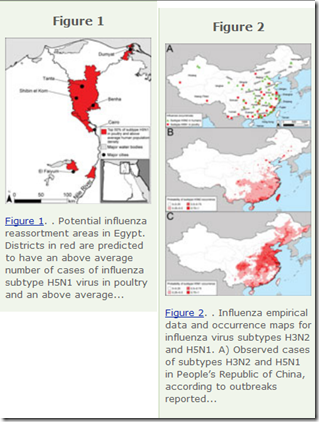
Two years ago – coincidentally, just  two weeks before we learned of the emergence of H7N9 in Eastern China – we looked at a study in the EID Journal: Predicting Hotspots for Influenza Virus Reassortment that found Eastern China to be one of the worlds best breeding grounds for novel flu viruses.


Potential geographic foci of reassortment include the northern plains of India, coastal and central provinces of China, the western Korean Peninsula and southwestern Japan in Asia, and the Nile Delta in Egypt.
image


Interestingly, two of the biggest concerns cited – China and Egypt – are the prime focus of our current bird flu watches, and H5N8 first came to our attention on the western Korean Peninsula just over a year ago.


While it is true that most of this new crop of avian influenza viruses have yet to demonstrate the ability to infect and sicken humans, their growing diversity provides essential viral building blocks from which new, possibility more dangerous, viruses can be constructed. 


You can view a short (3 minute) video from NIAID on reassortment here.


And even viral subtypes that currently don’t easily infect humans can, over time, acquire genetic changes that might eventually change their behavior – either through further reassortment or antigenic drift.  It is this continual evolutionary process - highlighted by the Journal Nature last week (see Nature: Dissemination, Divergence & Establishment of H7N9 In China) – that places H7N9 at or near the top of our pandemic threats list.


While we can’t predict when, from where, or through what HA-NA subtype the next pandemic will arise, what is clear is that we live in an increasingly viral-threat-rich environment, with new flu subtypes emerging over the past couple of years at an accelerated rate.


Which no doubt influenced the World Health Organization  last month when they issued  a statement called Warning signals from the volatile world of influenza viruses  where they cautioned:


Warning: be prepared for surprises


Indeed.

Friday, March 13, 2015

China Reports 2nd H5N1 Case of 2015

image


# 9819


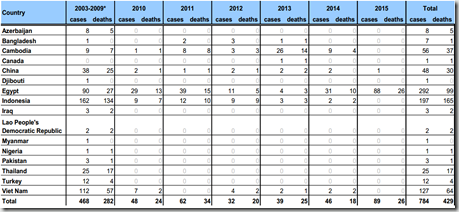
Despite being the probable birthplace of H5N1, and having both the world’s largest population and the greatest number of poultry – for reasons that are less than clear – China remains only 5th on the list of countries with the most reported human H5N1 cases, trailing well behind Egypt, Indonesia, Vietnam and Cambodia.


This disparity is even greater when you factor in the differences in population, making the incidence of H5N1 in Egypt more than 90 times higher (per capita) than reported in China.


Why this should be so isn’t known, although some of the theories offered include:

  • Differences in H5N1 clades in circulation (China is predominantly 2.3.2 & 2.3.4 while Egypt is 2.2.1)
  • Differences in how poultry are kept and raised between the two countries
  • Suspected weaknesses or deficits in surveillance and reporting from within China


Whatever the reason, over the past 5 years China has only reported an average of 2 human H5N1 cases a year.

image 
Credit WHO – March 3rd Table


All of which makes the following notification of China’s second H5N1 case of the year to Hong Kong’s CHP newsworthy.

13 March 2015

CHP notified by NHFPC of one human case of avian influenza A(H5N1) in Sichuan 

The Centre for Health Protection (CHP) of the Department of Health (DH) today (March 13) received notification from the National Health and Family Planning Commission (NHFPC) of a human case of avian influenza A(H5N1) affecting a man aged 46 in Sichuan.

According to the information provided by NHFPC, the patient is a poultry worker who lived in Suining. He developed a cough and chest discomfort on February 18. He attended a local hospital on February 21 and passed away on February 27. His specimen, which was tested by the relevant authority, was positive for avian influenza A(H5N1).

"Locally, we will remain vigilant and work closely with the World Health Organization and relevant health authorities to monitor the latest developments," a spokesman for the DH said.

Health surveillance measures have been implemented at all boundary control points. Thermal imaging systems are in place for body temperature checks on inbound travellers and the DH also conducts temperature checks by handheld devices. Suspected cases will be immediately referred to public hospitals for follow-up.

Regarding health education for travellers, the display of posters and broadcasting of health messages in departure and arrival halls, environmental health inspection and provision of regular updates to the travel industry and other stakeholders are ongoing.

Travellers, especially those returning from avian influenza-affected areas with fever or respiratory symptoms, should immediately wear masks, seek medical attention and reveal their travel history to doctors. Health-care professionals should pay special attention to patients who might have had contact with poultry, birds or their droppings in affected areas.

The public should remain vigilant and take heed of the advice against avian influenza below:

(Continue . . .)


China’s first H5N1 case of 2015 was reported in the latest WHO Influenza at the human-animal interface summary dated March 3rd.


China reported a human infection with an avian influenza A(H5N1) virus in a 37-year-old woman from Jiangsu province. She developed symptoms on 14 January 2015, was admitted to hospital on 20 January. The patient had a history of exposure to poultry. No further cases among contacts were reported.


Although it has been nearly 2 months since China filed an H5N1 OIE update (see Follow-up report No. 2), the last report showed 18 poultry and/or wild bird outbreaks recorded in December and early January (see OIE map below).

image

Saturday, February 21, 2015

HK CHP Notified Of Another H7N9 Case In Guangdong

image


# 9736


While the size of this winter’s wave of H7N9 cases across most of  Mainland China remains a mystery, Guangdong Province reports another case to Hong Kong’s CHP.


CHP notified of additional human case of avian influenza A(H7N9) in Guangdong

The Centre for Health Protection (CHP) of the Department of Health (DH) is today (February 21) closely monitoring an additional human case of avian influenza A(H7N9) notified by the Health and Family Planning Commission of Guangdong Province (GDHFPC), and again urged the public to maintain strict personal, food and environmental hygiene both locally and during travel.


According to the GDHFPC, the patient is a 48-year-old woman who lives in Shantou. She is currently hospitalised for treatment in critical condition.


To date, 577 human cases of avian influenza A(H7N9) have been reported by the Mainland health authorities, respectively in Guangdong (166 cases), Zhejiang (156 cases), Jiangsu (70 cases), Fujian (58 cases), Shanghai (45 cases), Hunan (24 cases), Anhui (17 cases), Xinjiang (10 cases), Jiangxi (nine cases), Shandong (six cases), Beijing (five cases), Henan (four cases), Guangxi (three cases), Jilin (two cases), Guizhou (one case) and Hebei (one case).

(Continue . . .)

Monday, February 09, 2015

WHO H7N9 Update – China

image


# 9689


The World Health Organization has published a DON (Disease Outbreak News) report on China’s winter outbreak of H7N9, acknowledging 83 recent cases (most appear to be cases we’ve heard about previously), but devoid of the kind of detailed case information we’ve grown accustomed to seeing over the first two waves.


Previous updates, from both the Chinese MOH and the WHO, have included useful epidemiological details, such as the following case report from the WHO January 19th update:

A 52-year-old female from Fuzhou City, Fujian Province who developed symptoms on 11 December. The patient was admitted to hospital on 16 December and is now in critical condition. The patient had history of exposure to live poultry.


Along with sporadic - and often delayed - reporting of H7N9 cases out of China this winter, we’ve also seen a paucity of individual case data being released.  Hopes that WHO updates would be able to continue to fill in the missing pieces appear dashed at this point.


Human infection with avian influenza A(H7N9) virus – China

Disease outbreak news
8 February 2015

On 4 February 2015, the National Health and Family Planning Commission (NHFPC) of China notified WHO of 83 additional laboratory-confirmed cases of human infection with avian influenza A(H7N9) virus. Onset dates ranged from 20 December 2014 to 27 January 2015. Below is a breakdown of the 83 cases included in this notification by epidemiological week of symptom onset:

  • On 20 December 2014: 2 cases
  • Week 52 (22 – 28 December 2014): 8 cases
  • Week 1 (29 December 2014 – 4 January 2015): 16 cases
  • Week 2 (5 - 11 January 2015): 21 cases
  • Week 3 (12 – 18 January 2015): 20 cases
  • Week 4 (19 – 25 January 2015): 13 cases
  • 26 - 27 January 2015: 3 cases

Cases ranged in age from 1 to 88 years with a median age of 56 years. Of the 83 cases, there were 19 deaths reported, ranged in age from 7 to 78 years with a mean age of 50 years. 60 of these 83 cases were male. The majority (78 cases, 93%) reported exposure to live poultry or live poultry markets; the exposure history of 4 cases is unknown.

Three family clusters were reported, each comprised of 2 cases; all had exposure to live poultry or live poultry markets. Cases were reported from 8 provinces: Fujian (30), Guangdong (30), Jiangsu (7), Jiangxi (1), Shandong (1), Shanghai (2), Xinjiang (1), and Zhejiang (11).

The Chinese Government has taken the following surveillance and control measures
  • Strengthen surveillance and situation analysis.
  • Reinforce case management and medical treatment.
  • Conduct risk communication with the public and release information.

WHO, in close collaboration with China, is monitoring the epidemiological situation and conducting further risk assessment based on the latest information.

Further sporadic human cases of avian influenza A(H7N9) infection are expected in affected and possibly neighbouring areas. Should human cases from affected areas travel internationally, their infection may be detected in another country during or after arrival. If this were to occur, community level spread is considered unlikely as the virus does not appear to have the ability to transmit easily among humans.

(Continue . . .)


Of note, of the 16 provinces that have reported H7N9 cases over the first two waves, only 8 have reported cases this year.


While it may seem a small thing, the absence of individual case information effectively prevents us from matching up media reports, and local MOH announcements, to these bulk data dumps.  Epidemiological line listings – like the one maintained by FluTrackers – have become an important resource in recent years, but are badly diminished by this lack of patient data.


The same can be said for Dr. Ian Mackay’s excellent charts, graphs, and maps.


Sadly, this trend isn’t limited to China.   Egypt’s MOH has become far less communicative on H5N1 (see Regarding The Silence Of The Egyptian MOH), and after more than 18 months, the world is still waiting for a case-control study on MERS from Saudi Arabia.  


There are plenty other `dead zones’ for disease information around the world; areas that simply can’t due to a lack of resources, or don’t for political and economic reasons, report disease outbreaks until or unless they get completely out of hand. 


It is hard not to feel we are moving backwards in terms of disease surveillance and reporting around the world.  A dangerous trend for a world so globally interconnected, and one that could easily see us blindsided by the outbreak of a novel pathogen flying stealthily beneath our radar.

Wednesday, January 28, 2015

HK CHP Notified Of H5N1 Case In Jiangsu Province

image

Credit Wikipedia


# 9638


Although likely undercounted, China has only reported 9 H5N1 cases to the World Health Organization over the past five years.  H5N1 outbreaks are occasionally reported in China’s poultry, but H7N9, H10N8, and the upstart H5N6 virus have been viewed with more urgency the past couple of years.


As illustrated by its sudden resurgence in Egypt this winter, H5N1 remains a legitimate threat, and one should never ignore its ability to stage a comeback. 


While one case is far cry from signaling a trend, today Jiangsu Province has notified Hong Kong’s CHP of a recent H5N1 case.


CHP notified by NHFPC of one human case of avian influenza A(H5N1) in Jiangsu 

The Centre for Health Protection (CHP) of the Department of Health (DH) today (January 28) received notification from the National Health and Family Planning Commission (NHFPC) of a human case of avian influenza A(H5N1) affecting a woman aged 37 in Jiangsu.

According to the information provided by NHFPC, the patient lived in Suzhou with poultry exposure history. She developed fever and cough on January 14, and attended a local hospital on January 15. She is currently in critical condition. Her specimen, which was tested by the relevant authority, was positive to avian influenza A(H5N1).

"Locally, we will remain vigilant and work closely with the World Health Organization and relevant health authorities to monitor the latest developments," a spokesman for the DH said.

All boundary control points have implemented health surveillance measures. Thermal imaging systems are in place for body temperature checks on inbound travellers. Suspected cases will be immediately referred to public hospitals for follow-up. The DH's Port Health Office has enhanced body temperature checks by handheld devices.

Regarding health education for travellers, the display of posters and broadcasting of health messages in departure and arrival halls, environmental health inspection and provision of regular updates to the travel industry and other stakeholders will be enhanced.

Travellers, especially those returning from avian influenza-affected areas with fever or respiratory symptoms, should immediately wear masks, seek medical attention and reveal their travel history to doctors. Healthcare professionals should pay special attention to patients who might have had contact with poultry, birds or their droppings in affected areas.

(Continue . . .)

Monday, January 26, 2015

China MOA: H5N6 Outbreak In Hunan Province Poultry

image


# 9629


Although HPAI H5N8 and H5N2 have garnered most of the headlines this fall with their extensive spread out of Asia into Europe and the Pacific Northwest, another freshman virus has been on our radar since last May as well; the H5N6 virus.


Unlike H5N8 and H5N2, this emerging virus has already shown some ability to infect humans, with tragic results. We are aware of at least two human cases last year, both fatal (see WHO GAR Update – H5N6 In China).


In November of 2014 in FAO-EMPRES Report On The Emergence And Threat Of H5N6, we looked at an analysis of H5N6, and other recently emerged avian flu viruses in China. The previous month, in China: H5 AI Rising, we looked at 24 recent detections of H5N6 across China.

image


Other than the Guangdong infection in December, we really haven’t heard much since October of last year. Over the weekend, however, China’s MOH announced another outbreak, which occurred about 12 days ago in Hunan Province.


Loudi Xinhua County occurred in poultry of highly pathogenic avian influenza

 2015-01-23 17:36:55

Source: Ministry of Agriculture

The Information Office of the Ministry of Agriculture issued January 23, Xinhua County of Loudi City, Hunan Province occurred in poultry of highly pathogenic avian influenza.

January 14, Loudi City, Xinhua County quail farms of suspected bird flu symptoms, onset 5400, died 1200. January 16, animal disease prevention and control center in Hunan diagnosed as suspected bird flu. January 23, by the National Avian Influenza Reference Laboratory confirmed that outbreaks of highly pathogenic avian influenza subtype H5N6 outbreak.

After the outbreak, according to the relevant local plans and control technical specifications, earnestly epidemic disposal work. Have for all 44,160 local poultry were culled and safe disposal. Currently, the outbreaks had been effectively controlled. (Source: Ministry of Agriculture Information Office)

Today, because of this announcement, Hong Kong has announced a ban on imports of poultry and poultry products from the affected area.


Import of poultry and poultry products from Xinhua County, Loudi City in Hunan Province, suspended

The Centre for Food Safety (CFS) of the Food and Environmental Hygiene Department announced today (January 26) that in view of a notification from the Ministry of Agriculture about a confirmed case of highly pathogenic H5N6 sub-type avian influenza in Xinhua County, Loudi City, Hunan Province, it has followed the existing approach for control of highly pathogenic avian influenza and taken the recommendations from the World Organisation for Animal Health into account to ban the import of poultry and poultry products, including poultry eggs, from the area within a radius of 3 kilometres from the said place for a period of 90 days and from the area within a radius of 13km for 21 days with immediate effect for protection of public health in Hong Kong.


A spokesman for the CFS said that, according to the information from the General Administration of Quality Supervision, Inspection and Quarantine, the outbreak does not affect any registered Mainland poultry farms for export to Hong Kong. No registered poultry meat or poultry egg processing plants are currently situated within the import restriction zone concerned either. According to records, no poultry or poultry products were imported from Hunan Province into Hong Kong between January and November last year.


The Centre will closely monitor the latest developments of the avian flu case in the province and take appropriate follow-up action as necessary.

Ends/Monday, January 26, 2015
Issued at HKT 18:38


While not apparently spreading as fast, or as far, as the high-flying H5N8 virus, H5N6 continues to erupt across central China, and like H7N9, poses the risk of future expansion outside of China.

Friday, January 23, 2015

Guangdong, Zhejiang & Shanghai Report H7N9 Cases

image


# 9617

We continue to see sporadic reports of H7N9 coming out of the Chinese Mainland, with four cases reported today from three separate provinces.  


First stop, a notice from  Guangdong province – which has now reported 18 cases during this third H7N9 season – that informs us of two new cases.


Shantou, Zhaoqing City, one case of H7N9 cases were reported

2015-01-23 16:59:29   Ministry of Health and Family Planning  |      Health and Family Planning Commission of Guangdong Province January 23 briefing, Shantou, Zhaoqing were reported one case of H7N9 cases. 

Case 1 Humou, male, 68 years old, currently living Shantou area. January 23 diagnosed cases of H7N9, sicker patients currently in Shantou City, admitted to inpatient hospitals.


Case 2 Leimou, male, 4 years old, now living in Zhaoqing Sihui City, January 22 H7N9 cases diagnosed, the patient's condition is currently stable, in Zhaoqing City hospitals admitted to hospital.


For the second time this week Shanghai is reporting a new case as well.


Shanghai reported one new confirmed cases of human infection with H7N9 virus

Published: 2015-1-22

Shanghai Health and Family Planning Commission on January 22 briefing, Shanghai reported confirmed cases of the new H7N9 virus one case of human infection.

Patients, Chen, female, 75 years old, the city residence. Confirmed on January 22, patients in critical condition, is now in active treatment.


And lastly, Hong Kong’s CHP reports a `new’ case from Zhejiang Province.   Whether this case belongs to the group reported earlier this week by Xinhua News (see Zhejiang province has seen 14 cases this winter) or is a fresh case, is impossible to tell from the information provided.   Despite the Xinhua report, Hong Kong is only showing 8 new cases this winter in Zhejiang. 


CHP closely monitors four additional human cases of avian influenza A(H7N9) in Mainland

The Centre for Health Protection (CHP) of the Department of Health (DH) is today (January 23) closely monitoring four additional human cases of avian influenza A(H7N9) in the Mainland, and again urged the public to maintain strict personal, food and environmental hygiene both locally and during travel.


According to the notification of the Health and Family Planning Commission of Guangdong Province, the two cases involved a 68-year-old man in Shantou who was hospitalised for treatment in serious condition, and a 4-year-old boy in Zhaoqing who is in stable condition.


According to the Shanghai Municipal Commission of Health and Family Planning, the patient in Shanghai is a woman aged 75 who was under treatment in critical condition. In addition, according to the Health and Family Planning Commission of Yiwu Municipality, the patient in Yiwu, Zhejiang, is a man aged 45 who was under isolation and treatment.


To date, 489 human cases of avian influenza A(H7N9) have been reported by the Mainland health authorities, respectively in Zhejiang (146 cases), Guangdong (127 cases), Jiangsu (63 cases), Shanghai (44 cases), Fujian (28 cases), Hunan (24 cases), Anhui (17 cases), Jiangxi (nine cases), Xinjiang (nine cases), Shandong (six cases), Beijing (five cases), Henan (four cases), Guangxi (three cases), Jilin (two cases), Guizhou (one case) and Hebei (one case).

(Continue . . .)


The above listing showing 489 human cases represents only those cases hospitalized, tested, and diagnosed with the H7N9 virus and likely represents only a portion of the total number of cases. There are likely a number of mild, or even asymptomatic infections that go unnoticed, as well as serious or even fatal cases that are simply never diagnosed.


In 2013, a study appearing in  The Lancet (see Lancet: Clinical Severity Of Human H7N9 Infection) attempted to quantify that number - at a time when the `official count’ hovered around 130 cases -estimating `that between 1500 and 27 000 symptomatic infections with avian influenza A H7N9 virus might have occurred as of May 28, 2013’.


The accuracy of these estimates is unknown, but it is very likely that the official case counts under-represent the real burden of H7N9, perhaps by a sizable margin.


And this winter, the reporting of cases out of China seems more inconsistent than during previous H7N9 epidemic waves, with less detailed information provided, all of which adds a bit more `fog’ to obscure our view of this year’s outbreak.

Saturday, January 17, 2015

H5N1 Detected In Swan Die Off In Henan Province

image


# 9589


With H7N9 causing most of China’s human avian flu infections over the past two years, and a plethora of recently emerged viruses (H5N8, H5N6, H5N2, H5N3) taking their toll on poultry, we don’t hear much about H5N1 out of  China these days.


The latest OIE report filed by China - Reference OIE : 16933, Report Date : 09/01/2015, Country : China (People's Rep. of) – lists 17 separate poultry outbreaks, mostly from Nov- December, spread across a wide swath of the country.

image

Credit OIE


While it rarely captures headlines, H5N1 remains endemic in Chinese birds, and is likely severely under reported in Chinese poultry – in large part due to the use of ineffective vaccines that dampen down symptoms, but don’t necessarily prevent infection (see EID Journal: Subclinical HPAI In Vaccinated Poultry – China).


The arrival of H5N1 in India this fall (see India: HPAI Behind Massive Duck Die Off In Kerala) - likely carried in by migratory birds arriving from spending their summer in  China, Russia, and Mongolia – provides another hint at China’s largely hidden H5N1 problem.


While surveillance and reporting on H5N1 is often limited  - particularly from China’s interior provinces - today Xinhua News is reporting on an H5N1-related die off of swans at the Sanmenxia reservoir in Henan province.


Swan deaths caused by bird flu: experts

Source: Xinhua | January 17, 2015, Saturday | 

BIRD flu has caused swans to die in a reservoir area of the Yellow River, the country's second longest, authorities confirmed on Saturday.

According to the National Bird Flu Reference Laboratory, the H5N1 virus, a highly contagious strain of bird flu, has caused deaths among swans and other wild ducks in the Sanmenxia Reservoir Area in Sanmenxia City, central China's Henan Province.

The Ministry of Forestry said on Thursday that 93 wild birds had died in the area as of January 14.

In Pinglu Wetland in the neighboring Pinglu County, north China's Shanxi Province, a total of 22 swans, as well as 25 other wild birds, have been found dead on wetland property since Jan. 4, according to local authorities.

The Pinglu Wetland, which forms part of the Sanmenxia Reservoir Area, is a major winter habitat for swans that migrate from Siberia in Russia. More than 10,000 swans flocked to the wetland every winter.

A group of experts have arrived in Sanmenxia City to provide technical support in protecting the precious birds.

The local governments in Sanmenxia City and Pinggu County have taken a variety of measures to prevent a possible spread of the virus, including blocking the entrance and examining people who had close contact with the birds.

No human infection has been reported so far.

Tuesday, January 13, 2015

Guangdong Province Reports 2 More H7N9 Cases

image


# 9568


For the second day in a row (see yesterday’s report Guangdong Reports 2 New H7N9 Cases)  Hong Kong’s CHP is reporting their notification of   two H7N9 cases from Shenzhen in neighboring Guangdong Province.  I’ve not yet found any statements on the Shenzhen CDC and Guangdong Health & Family Planning websites.


13 January 2015

CHP notified of two human cases of avian influenza A(H7N9) in Shenzhen 

The Centre for Health Protection (CHP) of the Department of Health (DH) is today (January 13) closely monitoring two additional human cases of avian influenza A(H7N9) in Shenzhen notified by the Health and Family Planning Commission of Guangdong Province (GDHFPC), and again urged the public to maintain strict personal, food and environmental hygiene both locally and during travel.


According to the GDHFPC, the two patients involved a 57-year-old woman who is currently hospitalised for treatment in critical condition, and a 41-year-old man who is now hospitalised for treatment in stable condition.


To date, 462 human cases of avian influenza A(H7N9) have been reported by the Mainland health authorities, respectively in Zhejiang (141 cases), Guangdong (119 cases), Jiangsu (59 cases), Shanghai (42 cases), Hunan (24 cases), Fujian (23 cases), Anhui (17 cases), Jiangxi (eight cases), Xinjiang Uyghur Autonomous Region (eight cases), Beijing (five cases), Shandong (five cases), Henan (four cases), Guangxi (three cases), Jilin (two cases), Guizhou (one case) and Hebei (one case).

(Continue. . . )


I would also note that there are media reports today of (5) additional cases in Fujian Province this morning, including a fatality in a 12 year old boy, but I’ve been unable to find anything `official’ posted anywhere. It isn’t entirely clear whether these are all new cases, or if some may have been included in last week’s report (see Fujian Province Reports 6 H7N9 Cases In December).


In the early going, frustratingly the reporting of cases out of some of China’s provinces appears as if it may not be as robust or timely as we came to expect during the first two H7N9 waves.