Showing posts with label Emergency Management. Show all posts

Thursday, September 27, 2012

Japan’s Earthquake: Learning from Megadisasters


# 6588


We are a little more than 18 months since the Great Japan Earthquake and Tsunami of 2011 - and while much progress has been made - much work still remains ahead to safely secure the damaged nuclear reactors, and to rebuild shattered lives and communities.


The events of March 11th, 2011 were far more complex and devastating than any emergency plan had previously considered;  A 9.0 earthquake spawning a massive tsunami, that would not only demolish coastal towns killing thousands, but would heavily damage nuclear power facilities as well.


While the term megadisaster is often bandied about, in this instance, it is an appropriate description. 


Via Reliefweb, we’ve the first phase of a joint project by the GFDRR, the Government of Japan, and the World Bank that should be of particular interest to emergency management officials and planners around the world:


The Great East Japan Earthquake: Learning from Megadisasters

image

Report

Download PDF (661.78 KB) Knowledge Notes Executive Summary

Download PDF (374.64 KB) Brochure

<EXCERPT>

Learning from Megadisasters, a knowledge-sharing project sponsored by the Government of Japan and the World Bank, is collecting and analyzing information, data, and evaluations performed by academic and research institutions, nongovernmental organizations, government agencies, and the private sector—all with the objective of sharing Japan’s knowledge on disaster risk management (DRM) and postdisaster reconstruction with countries vulnerable to disasters.  The World Bank and the Japanese government hope that these findings will encourage countries to mainstream DRM in their development policies and planning.

(Continue . . . )

Tuesday, August 09, 2011

NOAAWatch: Your Daily All-Hazards Briefing


# 5742


One of the most important aspect of preparedness is being aware of the threats and hazards that surround you. It’s known as situational awareness, and without it, you can be forced to make snap decisions instead of carefully considering your options.


In today’s society, perhaps the most basic example is checking the morning weather forecast before deciding whether to carry an umbrella that day.


But there are far more hazards out there than just a chance of rain.  And NOAA, the National Oceanic and Atmospheric Administration has a terrific all Hazards Monitor page for anyone wanting a heads up on what threats to be cognizant of.

 image


While the home page provides links to dozens of resources ranging from the NWS, EPA and USGS  to the World Meteorological Organization, the DAILY BRIEFING PAGE nicely compiles the most important information on a single page.


image


Now, getting a daily all-threats briefing can be as easy as clicking a single link.


Another important resource is NOAA WEATHER RADIO (NWR).


image


Once thought of as mainly a source of local weather information, NWR has now become an `All-Hazards' alert system as well.  Working with Working with the FCC’s Emergency Alert System , NWR provides warning and post-event information for natural disasters, man-made disasters, and local public safety information.


Broadcasts from many of these stations may be heard online as explained by the following from NWR.


NOAA Weather Radio All Hazards broadcasts are available online as live streaming audio. These streams are hosted by third parties such as universities, private companies and individuals, not by NWS. While we broadcast the audio used by these streams, we have no control over interruptions or discontinuation of these streaming audio services. You can find links to the majority of these streams at Weather Underground.


But relying on your internet connection staying up during a weather emergency or other disaster isn’t a good plan. Power outages or ISP problems could leave you in the dark, so it is essential that you have a battery operated weather radio.


image


In order to receive these broadcasts over the air, you need a specialized receiver.  Many of these radios have a special `Tone Alert', and will begin playing once they receive a special alert signal from the broadcaster.


Like having an emergency kit and a first aid kit - having a weather radio is an important part of being prepared. 


While the above resources are U.S. centric, for a more global perspective, NOAAWatch provides external links to:


image


image


image


The astounding amount of information available today - online and for free -can help you make long and short term decisions that can assist you, your family, or your business prepare for the next emergency.


Of course, just knowing about the threats isn’t enough. You have to make use of that information.  And NOAAWatch provides some links for that as well:


· Ready America - DHS
·
Plan Ahead - FEMA
·
Preparedness for    People With Disabilities
·
HHS - Disasters &    Emergencies
·
American Red Cross
·
DisasterAssistance.gov


And lastly, another reminder that September is National Preparedness Month, and you are encouraged to join the NPM coalition.


image

Saturday, March 12, 2011

Japanese Govt. Urges Calm, Extends Nuke Evacuation Zone


CLICK THIS LINK FOR LATEST/ALL QUAKE UPDATES


# 5381


I’m currently monitoring the English language news broadcasts from NHK World available at:


http://www3.nhk.or.jp/nhkworld/


Guests and reporters are openly discussing the possibility of a core melt occurring at Fukushima reactor #1, and have very recently announced the extension of the evacuation zone around reactor #1 to 20 km.


The evacuation radius around reactor #2 remains at 10 Km (the two reactors are roughly 10 km apart).


Two recent reports from the Voice of America.


Fear of potential invisible killer near Japanese nuclear site

Nuclear reactor at Fukushima may be near meltdown

Steve Herman | Fukushima, Japan  March 12, 2011

An aerial view shows the quake-damaged Fukushima nuclear power plant in the Japanese town of Futaba, Fukushima prefecture, Japan, run by Tokyo Electric Power, March 12, 2011

Photo: AFP

An aerial view shows the quake-damaged Fukushima nuclear power plant in the Japanese town of Futaba, Fukushima prefecture, Japan, run by Tokyo Electric Power, March 12, 2011

An eerie silence has descended over this northeastern Japanese city. Tens of thousands have evacuated their homes a day after one of the worst-ever recorded earthquakes and subsequent tsunami, which swallowed coastal villages.


The greatest fear here, right now, stems not from the continuing aftershocks and the ongoing tsunami warnings, but rather a silent and invisible potential killer.


One or more nuclear reactors in Fukushima may be close to, or have suffered a meltdown.  A reactor wall has apparently collapsed at one reactor, injuring four people there Saturday afternoon.

(Continue . . .)


Japanese Government Urges Calm Following Explosion at Nuclear Plant

Saturday, March 12th, 2011 at 10:35 am UTC

A Japanese government spokesman has called for calm following an explosion at one of two nuclear plants damaged in Friday's massive earthquake.


Japanese Chief Cabinet Secretary Yukio Edano says authorities are monitoring radiation levels at Fukushima, where smoke could be seen billowing out of the nuclear plant complex. Japanese media say radiation levels are more than eight times normal outside the plant.


Authorities have expanded the evacuation zone around the plant to 20 kilometers.

(Continue . . .)


It is now roughly 30 hours since the 8.9 magnitude quake struck off the coast of Honshu.  Since then, the region has been struck by dozens of strong aftershocks.

Thursday, November 25, 2010

The EM Daily


# 5089


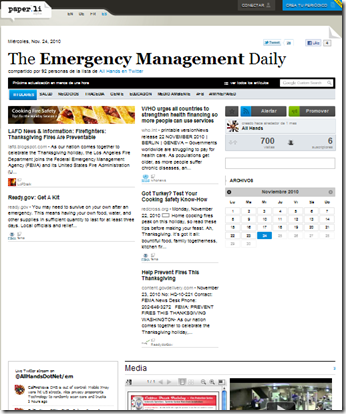
A relatively new resource some of you may not yet be familiar with is the Emergency Management (EM) Daily, a `twitter newspaper created using paper.li.


The EM Daily contains recent posts from dozens of emergency management, homeland security, and public health bloggers and displays them in newspaper format.


It is put together by @AllHandsDotNet, which is the twitter  account for http://www.all-hands.net. They bill themselves as:


The All Hands Network is a unique community of emergency management, homeland security, and continuity professionals who come together via a web-based community.


This is a clever and convenient way to tap into the wealth of emergency management/public safety related material being published each day on the web. 


The Daily is divided into sections, including Headlines, Health, Business, Education, Environment, etc. You may even come across some of my efforts there from time to time. 


But don’t let that dissuade you from checking it out.


image