Showing posts with label OIE Notification. Show all posts

Monday, May 04, 2015

OIE: H5N1 Confirmed In Kastamonu Province, Turkey

image


# 10,007


On Sunday, in Media Reports: Bird Flu (H5N1?) In Turkish Poultry, we saw reports (later confirmed by the FAO) of an unidentified HPAI outbreak in the Bandırma district of the province of Balıkesir (bullseye on the map above).  While HPAI is strongly suspsected, we’ve not seen an official lab report as yet.

Today, however, the OIE has confirmed an outbreak of HPAI H5N1 in a small backyard flock in Kastamonu Province several hundred kilometers further east.


We’ve recently seen HPAI H5N1 showing up in countries in Eastern Europe, including Russia, Bulgaria, and Hungary after an absence of several years.   This becomes Turkey’s first official H5N1 outbreak since 2008.


image

image


Source of the outbreak(s) or origin of infection

  • Unknown or inconclusive

Epidemiological comments
Highly pathogenic avian influenza H5N1 was detected as a result of analysis. Protection and surveillance zones have been established in the area surrounding the outbreak. 92 backyard poultry were destroyed in a 3 km radius area. All holdings containing backyard poultry were cleaned and disinfected after destruction process. Monitoring activities continue in the 10 km radius surveillance zone surrounding the 3 km radius protection zone
.


For reasons that are not entirely clear, H5N1 is on the move again in 2015 after several years of relative quiescence.  It has been reported in at number of countries that have not seen it in five years or longer (Nigeria, Niger, Burkina Faso, Bulgaria, Hungary, Romania, Russia, Turkey) and it continues to cause the largest, and most sustained, human outbreak of the virus we’ve seen to date in Egypt.

Thursday, April 02, 2015

OIE Notification: H5N1 Outbreaks In Burkina Faso

image


# 9894


For more than a week there have been reports of poultry die offs in the African nation of Burkina Faso, and that samples had been sent to a reference lab in Italy for analysis.   Overnight the media reported that results came back as H5N1, and now we have the official OIE Notification to that effect.


Burkina Faso was one of several west African nations hit by H5N1 during the great H5N1 diaspora of 2006 (others included Niger, Cameroon, Côte d'Ivoire, and  Nigeria). 


Unlike Nigeria, which has sporadically reported H5N1 outbreaks since then, Burkina Faso has not reported an outbreak since 2006.  This year, however, we’ve seen a resurgence of HPAI H5 viruses – including H5N1 – with recent reports coming from Nigeria, Hungary, Romania, and Bulgaria. 


Here is the OIE notification for four outbreaks in Burkina Faso.


image 


image

Epidemiology

Source of the outbreak(s) or origin of infection

  • Unknown or inconclusive

Epidemiological comments
- Orders at province level declaring the infection. - Identification of farms in the outbreak area. - Disinfection of premises. - Movement restrictions. - Strengthening epidemiological surveillance. - Sampling for detection of highly pathogenic avian influenza virus.

Control measures

Measures applied

  • Movement control inside the country
  • Disinfection of infected premises/establishment(s)
  • Modified stamping out
  • No vaccination
  • No treatment of affected animals

Measures to be applied

  • No other measures

Wednesday, March 18, 2015

OIE Notification: LPAI H7N3 At California Turkey Farm

image

Merced County - Credit Wikipedia


# 9842


This news was telegraphed several hours ago when we saw the announcement that  Hong Kong bans import of poultry meat and products from Merced County, California, US, but we now have an OIE notification with preliminary details of this low path H7N3 outbreak.


In it’s HPAI form, H7N3 has caused major losses and disruptions in the poultry industry, including in the 2005 Fraser Valley (B.C.) outbreak in 2004 that required the culling of 17 million birds, and Mexico’s prolonged running battle with the virus in 2012-13   (see Mexico Declares National H7N3 Animal Health Emergency).


Additionally, HPAI H7N3 has been associated with minor human illnesses (see MMWR: Mild H7N3 Infections In Two Poultry Workers - Jalisco, Mexico).


Low Path (LPAI) strains are viewed as being much less dangerous – and often only cause minor illness in birds – but need to be quickly contained because LPAI H7 and H5 viruses have the potential to evolve into HPAI strains.


Given the recent emphasis, and ramping up of poultry operations biosecurity for HPAI H5 viruses in California and most Western states, it will be interesting to see what the `comprehensive epidemiological investigation’ of this outbreak turns up.


Here is the OIE Notification.


image


Source of the outbreak(s) or origin of infection

  • Unknown or inconclusive

Epidemiological comments


The USDA Animal Plant Health Inspection Service (APHIS) and the California Department of Food and Agriculture (CDFA) are conducting a comprehensive epidemiological investigation of this event. Epidemiological summary of the event as of 17 March 2015: • A commercial tom turkey flock exhibited coughing with a slight increase in mortality. Samples were submitted for laboratory testing and were confirmed positive for influenza A virus (IAV) H7N3 LPAI. • North American H7N3 LPAI based upon partial HA and NA sequence obtained directly from swab specimen; virus isolation pending. • The infected premises was placed under quarantine following preliminary findings and an epidemiological investigation was initiated. • Follow-up surveillance and testing on 10 epidemiologically associated farms was negative for IAV. The epidemiological investigation and response to the event are continuing.

Control measures

Measures applied

  • Quarantine
  • Movement control inside the country
  • Zoning
  • Vaccination prohibited
  • No treatment of affected animals

Measures to be applied

  • No other measures

Friday, March 13, 2015

OIE Notification: LPAI H7N7 In Netherlands

image

credit Rijksoverheid.nl


# 9823


We’ve confirmation from the OIE of yesterday’s report (see Netherlands: (Probably) Mild Bird Flu In Barneveld) that this latest outbreak is of the far less dangerous LPAI H7N7 virus. 


First the OIE notification – which states : A 1 km restriction zone has been established on 12 March 2015. There are 17 other premises in the 1 km zone. All these premises are screened.


After which,  I’ll return with a bit more about this type of avian flu.


image

image


Starting a roughly a decade ago, the OIE began requiring  that all  H5 and H7 infections in birds be reported, and that steps be made to control and eradicate outbreaks.


LPAI (Low Pathogenic Avian Influenza) – which normally does little harm to flocks or humans – has the potential to evolve to HPAI (Highly Pathogenic Avian Influenza) if not controlled, particularly when introduced into a crowded farming environment.


Up until two years ago, human infection with H7 avian viruses were both rare, and almost inevitably mild.  Often little more than mild `flu-like’ symptoms and/or conjunctivitis. 


The one notable exception occurred in 2003 in the Netherlands,  when the largest known outbreak of H7N7 infected 89 people, one of whom died (see Eurosurveillance Journal Human-to-human transmission of avian influenza A/H7N7, The Netherlands, 2003).

But when H7N9 showed up in China two years ago - benign in birds but sporting an impressive morbidity and mortality rate in humans - suddenly H7 avian viruses were afforded with a lot more respect.   . 


In early February of this year the UK saw a similar outbreak of H7N7 in Hampshire, prompting the ECDC to publish a Rapid Risk Assessment On LPAI H7N7.  From that document, we get the following advice:


There is a low risk of zoonotic transmission to people who are directly exposed to infected birds during the culling and destruction process when there are outbreaks in poultry farms. The risk can be minimised if the exercise is performed under the safety measures recommended in Directive 2005/94/EC. Persons with direct contact to infected poultry before or during culling and disposal should be monitored for symptoms, and postexposure antiviral prophylaxis should be considered.

The risk for zoonotic transmission to the general public in EU/EEA countries is considered to be extremely low.

Wednesday, February 25, 2015

OIE Notification Of H5N8 On Hungarian Duck Farm

image

Credit NÉBIH


# 9754


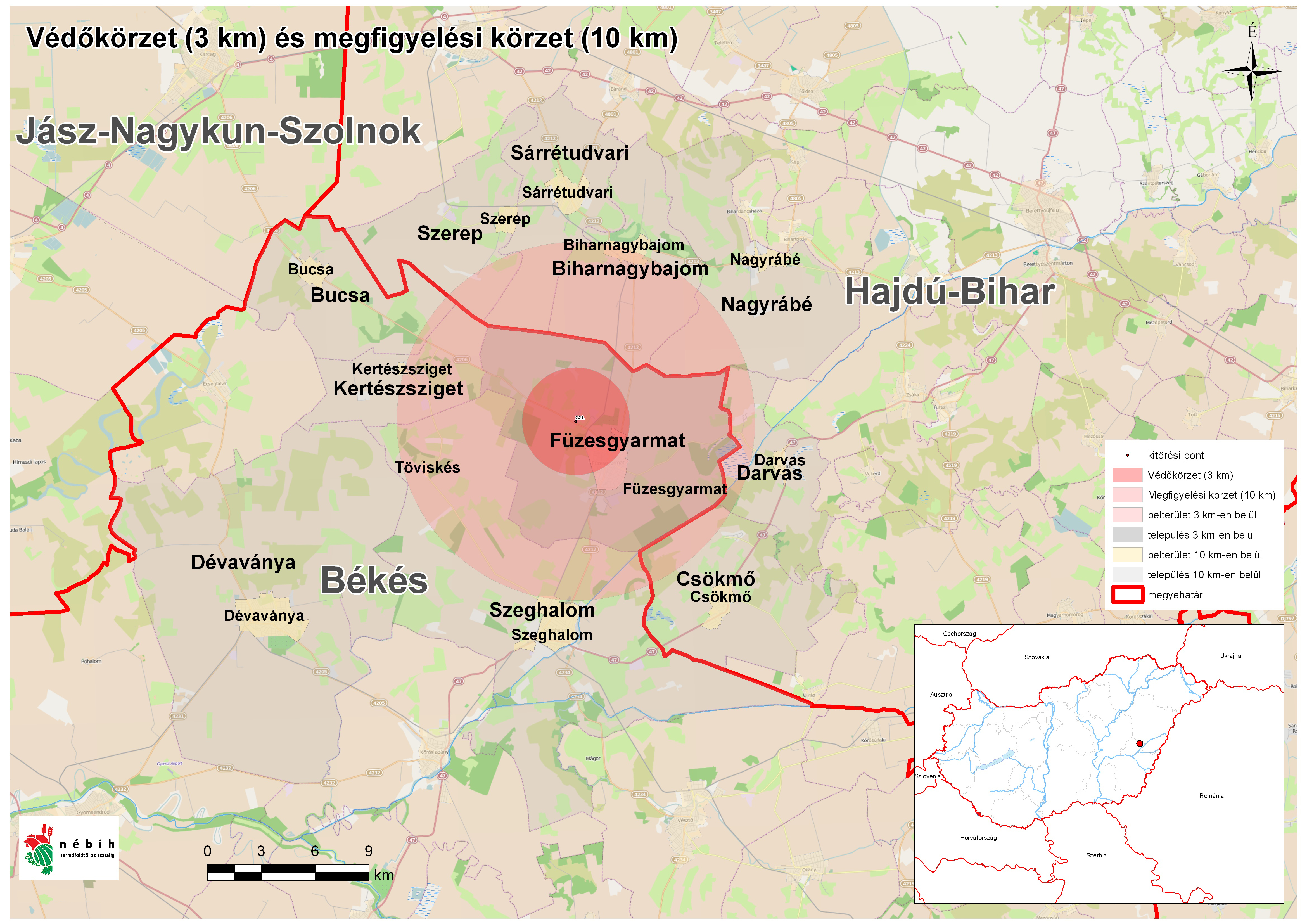
Yesterday, in HPAI Reported At Hungarian Duck Farm, I blogged about a preliminary report of what appeared to be HPAI H5 on a duck farm in Füzesgyarmati (see map above), in the southeastern part of Hungary (see map above).   Today we have confirmation via the following OIE report.


image

image

Affected population


On 23 February 2015, a suspicion of avian influenza was reported to the National Food Chain Safety Office. The local authority immediately visited the affected holding, which is located in Füzesgyarmat, in Békés County. 22,000 fattening ducks are kept in the holding. Neurological signs, nasal discharge and increased mortality were observed. Official samples were taken on the same day. On 24 February, the National Reference Laboratory confirmed avian influenza H5N8 strain. In the neighborhood of the affected holding, there are three contact holdings. All the birds kept in the affected and in the contact holdings will be killed and destroyed.

Epidemiological Comments

On 24 February, the National Reference Laboratory confirmed avian influenza virus H5N8 by RT-PCR and, on the next day, by sequencing partial HA and NA sequence fragments. The amino acid sequence at the hemagglutinin cleavage site is consistent with highly pathogenic avian influenza (HPAI). Preliminary results suggest that the sequences are very closely related to the Asian and also to the four European H5N8 HPAI virus sequences reported so far. Whole genome sequencing is in progress.

 Measures Applied

  • Control of wildlife reservoirs
  • Stamping out
  • Quarantine
  • Movement control inside the country
  • Screening
  • Zoning
  • Disinfection of infected premises/establishment(s)
  • Vaccination prohibited
  • No treatment of affected animals


Of the Highly Pathogenic Avian Influenza (HPAI) viruses that have emerged to date, H5N8 seems particularly well suited for long-distance traveling, having spread from Northeastern Asia to Europe, Japan, Taiwan, the Pacific Northwest, and into at least six western states in the US in less than a year.


Hungary lies within the NE/SW oriented Black Sea / Mediterranean Flyway, which runs from northern Russia to western and central Africa.  This flyway crosses south central Europe where H5N8 has recently been reported (Bulgaria & Italy), and across the Middle East and down to Nigeria – both regions having a history of H5N1.

image

Hungary’s location in the Flyway


You’ll notice that while these migratory bird flyways run essentially north to south – they overlap – which can allow for the lateral (east-west) movement of avian viruses over time as well.  Viruses that are endemic in the East Asia Australian Flyway could conceivably seep into the Central Asian Flyway, and from there move further west into the East African or Black Sea flyways.


We’ve looked at the role of migratory and wild birds in spreading influenza viruses many times, including several weeks ago in Erasmus Study On Role Of Migratory Birds In Spread Of Avian Flu,  and last fall in FAO Warns On H5N8’s Spread.


Although highly pathogenic in poultry, H5N8 has never been known to infect or cause illness in humans.  But as this virus is related to several H5 avian viruses (H5N1, H5N6) that are known infect humans, the CDC maintains a cautious attitude (see CDC Interim Guidance For Testing For Novel Flu).

Monday, February 09, 2015

OIE Notification On Canadian H5N1 Detection

image


# 9692


Although we discussed it at some length yesterday (see H5N1 Detected In B.C. Backyard Flock), we now have the OIE Notification which includes some additional epidemiological and sequencing information that indicates this H5N1 is very similar to the H5N1 virus detected last month in a green-winged teal in Whatcom County, Washington (see OIE: New Reassortant HPAI H5N1 In North America)

image

image


Source of the outbreak(s) or origin of infection

  • Unknown or inconclusive
  • Contact with wild species

Epidemiological comments
This new outbreak was detected in a backyard poultry flock in the Avian Influenza Primary Control Zone (PCZ) in the province of British Columbia (BC), in the same area as the previous outbreaks of HPAI H5N2 reported in December 2014. All susceptible animals on site were humanely destroyed. The National Centre for Foreign Animal Disease (CFIA - Winnipeg) reported NAI H5 RRT-PCR positive results on 4 February 2015 and partial sequencing of H5 and N1 segments on 5 February.

The virus involved is a HPAI H5N1 virus with the H5 gene segment derived from the Eurasian lineage, and N1 derived from North American lineage based on partial sequence. The H5 gene segment is very similar to the reassortant H5N2 in BC and the H5 in the H5N1 reassortant virus detected in a wild green-winged teal just south of the border in Washington State, USA. In addition, the N1 gene segment is very similar to North American wild bird viruses and nearly identical, over the very small fragment sequenced this far, to the N1 in the H5N1 virus detected in a green-winged teal mentioned above.

Based on the limited partial sequence of the H5 and N1 gene segments obtained this far, it appears very likely that this is the same or a very similar virus to the recent reassortant H5N1 virus in Washington State but more sequencing will be needed to make a final conclusion. This virus has NOT been reported in any commercial poultry flock in Canada. It is important to note this HPAI H5N1 virus is different from the strain circulating in Asia. It is a reassortant virus with the N1 from a North American wild bird virus. The Canadian Food Inspection Agency (CFIA) continues to monitor the situation and implement strict movement restrictions in the PCZ. Ongoing surveillance is in place in all of Canada. All provinces, with the exception of the PCZ in British Columbia, remain free of Notifiable Avian Influenza in poultry.


As I pointed out yesterday, this is a new reassortment, not the same H5N1 that has plagued China, Southeast Asia, and the Middle East over the past decade. 


While carrying the same HA/NA designations as its more infamous Asian cousin -  this subtype is comprised of gene segments from the Eurasian (EA) H5N8 virus, along with genetic contributions from North American (AM) avian viruses.


Our knowledge of how this new reassortant virus will behave in poultry, and in humans, is very limited at this time. Other reassortants carrying this H5 gene segment (H5N8, H5N2) have not yet been shown to pose a health risk to humans.  


Whether that holds true with this virus remains to be seen.


For now the CDC is taking a cautious approach to all of of these recently arrived HPAI viruses, and has issued guidance for the testing, and prophylactic treatment of those exposed. 


CDC Interim Guidance For Testing For Novel Flu
CDC Interim Guidance On Antiviral Chemoprophylaxis For Persons With Exposure To Avian Flu

Wednesday, January 28, 2015

OIE Notification Of H5N1 In Bulgaria

image

Bulgaria Lies beneath Black Sea / Mediterranean Flyway


*** UPDATED at Bottom ***


# 9639


Yesterday, in Media Reports: Bird Flu In Bulgaria, we looked at reports of the first detection of H5N1 in Bulgaria since January of 2010 when they reported One fallen common buzzard (Buteo buteo) in Varna (see 2010 OIE report).   Prior to that, you have to go back to the great H5N1 expansion of 2006 to find a report in that part of Europe.


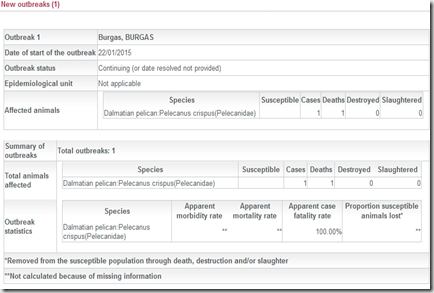
Today the OIE has published this latest incident’s notification, excerpts which you’ll find below:


image

image

Epidemiology

Source of the outbreak(s) or origin of infection

  • Contact with wild species

Epidemiological comments
Dalmatian pelican (Pelecanus crispus) real-time PCR positive for HPAI subtype H5N1 was found dead on 22 January in Poda protected area. The samples will be tested for confirmation by inoculation of chicken embryos. The pelican was found dead together with a black-headed gull (Chroicocephalus ridibundus) in the framework of the passive surveillance under the national avian influenza surveillance and control program approved by European Commission. The black-headed gull was tested with negative result for avian influenza.


While rarely reported in this region of Europe, the detection of HPAI H5N1 in wild birds isn’t completely unexpected, as migratory birds, who nest in northern Russia and China during the summer, pass through this area on their overwintering trek south.


This year, in addition to seeing the robust spread of HPAI H5N8 (and H5N2) via migratory birds, we’ve also seen a strong resurgence of H5N1 in the Middle East, India and Africa. 


While the threat to humans is relatively small right now, with a growing roster of HPAI viruses emerging out of China  – including H5N8, H5N6, H5N3, H7N9, and H10N8 - biosecurity measures for both backyard flocks and commercial poultry operations will need to be strictly followed.


Even in areas like North America, that have been relatively immune to such avian viruses in the past.

.
*** UPDATE ***


Meanwhile -  just after I posted this blog - there is this new media report of dead birds being tested in Stara Zargora, about 160 km west of Burgas where the first bird was found. This may be just a case of post-Burgas jitters, but we’ll keep an eye on it.


Suspected bird flu in Stara Zagora

Report dead bird in Stara Zagora up emotions and raise doubts about a new case of bird flu after Burgas. The signal was received on the "green" phone in Stara Zagora environmental inspectorate of duty in Radnevo municipality around noon on Wednesday. Immediately after it was informed the Regional Directorate for Food Safety and health inspectors have harvested bird.


Monday, January 19, 2015

OIE Report: H5N1 In Israel

image

Credit OIE


# 9598


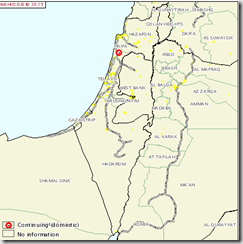
On Saturday, in Media Reporting Unspecified `Bird Flu’ Outbreak at Israeli Farm, we saw early reports of what appeared to be a return of HPAI H5N1 to Israel after an absence of several years.  Today the OIE has published a filing, indicating that preliminary testing found H5N1 at a turkey farm in northern Israel.


image

image

Epidemiology

Source of the outbreak(s) or origin of infection

  • Unknown or inconclusive

Epidemiological comments

The epidemiological investigation is ongoing. The first time H5N1 occurred in Israel was in March 2006 revealing 9 outbreaks. Since then, all the outbreaks that occurred in commercial flocks were also in March (2011, 2012) except one outbreak that took place in January 2010, in the same region of the present outbreak (distance of 8 kilometers). The disease had been also diagnosed in a kindergarden’s minizoo at the end of December 2007, 3 kilometers from the present outbreak. This area has numerous water ponds with water birds wintering in them. The culling of all the flocks is ongoing. Backyard birds in the village will also be culled.

Tuesday, January 13, 2015

OIE Notification On Taiwan’s `New’ HPAI H5N2

image


# 9570


With more than 20 farms confirmed as having avian flu (apparently a hodgepodge of H5N2, H5N8, and a new H5N2), and with more than 40 farms under investigation (see Taiwan’s Avian Flu Outbreak Spreads To More Farms) this OIE notification of 5 outbreaks of HPAI H5N2 among geese and ducks across two counties will likely expand over the next few days.


We do get a description, via the Epidemiological notes,  that this `new’ H5N2 virus is apparently a mixture of the Korean H5N8 and a strain of H5N2  previously seen in China.


Being a new reassortant of H5N2, we’ll have to watch it carefully to see if it presents any greater threat to poultry, or humans, than have the other HPAI H5N2 subtypes that have been encountered.


image

Epidemiology

Source of the outbreak(s) or origin of infection

  • Unknown or inconclusive

Epidemiological comments

Abnormal mortalities in 4 goose farms in Yun-Lin County and an acute egg drop syndrome in a layer duck farm in Ping-Tung County were noticed early January 2015. Local disease control center staff went to these farms to conduct movement restrictions and clinical inspection and then sent dead geese and layer ducks samples to the National Laboratory for diagnosis.

Specific RNA product of avian influenza virus was detected and subtyped as H5N2 by RT-PCR. Highly pathogenic avian influenza strain was confirmed by the National Laboratory based on sequencing analysis of HA0 cleavage site. It is worth noting that H and N genes of these isolates are different from the H5N2 strains previously isolated in Taiwan.

The homology of H5 between the isolates from these infected farms and the South Korea 2014 H5N8 strain is near 99%. The homology of N2 between the isolates from these infected farms and the China 2011 H5N2 strain is 96%. This H5N2 strain is obviously novel to Taiwan.

All the geese and ducks on the infected farm will be culled. The actual number of culled geese and ducks will be available when stamping out will finish and be reported in the next follow-up report. Thorough cleaning and disinfection will be conducted after stamping out operation. Surrounding poultry farms within a 3 km radius of the infected farm are under intensified surveillance for 3 months.

Control measures

Measures applied

  • Stamping out
  • Quarantine
  • Movement control inside the country
  • Screening
  • Zoning
  • Disinfection of infected premises/establishment(s)
  • Vaccination prohibited
  • No treatment of affected animals

Measures to be applied

  • No other measures

Saturday, January 10, 2015

OIE Report: H5 In Nigerian Poultry

image


# 9556


Note: I was called away unexpectedly in the middle of editing this post and should have clarified that the exact subtype has not been firmly established. The assumption of H5N1 is probable based on history, but with the recent arrival of H5N8 in Europe, that isn’t necessary a given. - MPC


Unless you’ve been following avian influenza for a very long time, Nigeria probably seems an unlikely place to find the H5N1 virus. But during the great H5N1 diaspora of 2005-2006 - when the virus moved from being essentially a problem for a a handful of Southeast Asian nations to a Eurasia-wide threat (see H5N8: A Case Of Deja Flu?) – Nigeria was an important hub of activity.


For a look at some of the reports, and problems with reporting, of avian flu in Nigeria from back in 2007, you may wish to revisit The Nigerian Paradox and Nigeria Confirms Human Bird Flu Case.


When you look at a map of the migratory bird flyways (see below), you see that Nigeria sits at the southern intersection of no fewer than three migratory flyways – routes that begin in the northern climes of Russia, Mongolia, and China where H5N1 is known to circulate in wild birds – and that cross both  Europe and the Middle East.

image


One of the reasons we don’t hear much regarding H5N1 out of Nigeria anymore is that there is precious little disease surveillance and reporting available outside of the larger cities that are controlled by the central government, and many of the northern rural regions are under the control of the militant Islamist movement Boko Harum. 


Some excerpts from yesterday’s OIE notification on HPAI H5 detected in a backyard flock in the Kano district of northern Nigeria:

image 

image


Given the civil and religious strife – particularly in the north of Nigeria (there was another huge massacre reported yesterday) – it is somewhat remarkable that we have even this lone report.  


As to how prevalent H5N1 really is in Nigerian poultry  – or in any of the their neighboring countries –  that is something that we simply don’t have the surveillance tools in place to calculate.


We do have this study, published in 2014, that found among a small group of Nigerian poultry workers surveyed, that a small percentage have antibodies to the H5N1 virus.  Suggesting, at least, previous exposure and (likely) subclinical infection with the virus.


Evidence for subclinical H5N1 avian influenza infections among Nigerian poultry workers.

Okoye JO1, Eze DC, Krueger WS, Heil GL, White SK, Merrill HR, Gray GC.

Author information
Abstract

In recent years Nigeria has experienced sporadic incursions of highly pathogenic H5N1 avian influenza among poultry. In 2008, 316 poultry-exposed agricultural workers, and 54 age-group matched non-poultry exposed adults living in the Enugu or Ebonyi States of Nigeria were enrolled and then contacted monthly for 24 months to identify acute influenza-like-illnesses.

Annual follow-up sera and questionnaire data were collected at 12 and 24 months. Participants reporting influenza-like illness completed additional questionnaires, and provided nasal and pharyngeal swabs and acute and convalescent sera. Swab and sera specimens were studied for evidence of influenza A virus infection. Sera were examined for elevated antibodies against 12 avian influenza viruses by microneutralization and 3 human viruses by hemagglutination inhibition.

Four (3.2%) of the 124 acute influenza-like-illness investigations yielded molecular evidence of influenza, but virus could not be cultured. Serial serum samples from five poultry-exposed subjects had a ≥4-fold change in microneutralization titers against A/CK/Nigeria/07/1132123(H5N1), with three of those having titers ≥1:80 (maximum 1:1,280). Three of the five subjects (60%) reported a preceding influenza-like illness. Hemagglutination inhibition titers were ≥4-fold increases against one of the human viruses in 260 participants.

While cross-reactivity from antibodies against other influenza viruses cannot be ruled out as a partial confounder, over the course of the 2-year follow-up, at least 3 of 316 (0.9%) poultry-exposed subjects had evidence for subclinical HPAI H5N1 infections. If these data represent true infections, it seems imperative to increase monitoring for avian influenza among Nigeria's poultry and poultry workers.

Tuesday, August 12, 2014

OIE: Two Outbreaks Of H5N6 In Vietnamese Poultry

image

Location of Outbreaks – Source OIE


# 8947


Last May the H5N6 virus made headlines (see Sichuan China: 1st Known Human Infection With H5N6 Avian Flu) when it was detected in samples taken from a 49 year-old man who had been exposed to dead chickens and died of pneumonia.


Subsequently the China’s Ministry of Agriculture and Veterinary Bureau filed an OIE report on the local outbreak in poultry, where more than 1300 birds were culled.


Although Low Pathogenic H5N6 had been identified previously in wild birds  in Taiwan, Germany, Sweden and the United States this new strain was classified as highly pathogenic.  And like the H5N8 virus which emerged last January in South Korea, this new virus appeared to be a reassortant of the H5N1 avian flu virus.


Today the OIE has published a notification of two – widely separated – H5N6 outbreaks in Vietnamese poultry.  The first, located near the border with China, had an onset in April – and began at roughly the same time as China’s previously mentioned outbreak (albeit several hundred miles distant). 


The second outbreak, several hundred kilometers further south, began in June. The delays in reporting these outbreaks are attributed to the time it has taken to determine the identity of this new strain of avian influenza. 


Although apparently not spreading as rapidly or as widely as the H5N8 virus did in South Korea last winter, this virus only appeared on the radar at the end of spring, traditionally when avian flu outbreaks in poultry are on the decline.  Obviously there will be a lot of eyes watching for its possible return this fall. 


And unlike H5N8, this strain has a track record of having infected, and killed, at least one person.


image

  image

image

Thursday, July 24, 2014

OIE: Foot & Mouth Disease In South Korea

image


# 8863


Foot & Mouth Disease (FMD) is a highly contagious viral disease that primarily afflicts cloven-hoofed animals (including cattle, sheep, goats, pigs, deer, etc.) and poses a serious threat to agricultural interests around the world. It is caused by a picornavirus, and has no relation to HFMD, which is a childhood disease in humans caused by a number of non-polio enteroviruses.


There are seven known types and more than 60 subtypes of the FMD virus, and different types are to be found in different parts of the world. 


Overnight South Korea has reported their first case of FMD in 3 years, at a pig farm in Uiseong, North Gyeongsang Province (see Korea Herald report S. Korea reports first outbreak of foot-and-mouth disease).   The OIE report (see below) lists the serotype as O (PanAsia Strain), which raised international concern between 1998-2011 when it spread rapidly across Asia, Africa, & parts of Europe (cite). 

image


At this point, only one farm is known to be affected, and the following control measures are being implemented.

image


This return of FMD comes just months after S. Korea began a prolonged battled against the H5N8 avian flu virus in poultry, which resulted in the culling of millions of chickens and ducks. 


Both Japan and Korea detected FMD in the spring of 2010, and after the destruction of 290,000 head of livestock, Japan declared their FMD crisis over in August. In South Korea, however, the outbreaks continued into 2011, with 155 outbreaks reported.

image

2010-2011 FMD – Credit OIE


FMD is endemic in many parts of the world (Africa, Asia, South America, some parts of Europe), but has been eradicated in many others.  The last outbreak of FMD in the United States was in 1929 – but vigilance is maintained to prevent its return.


image

OIE Disease Outbreak Map – Current FMD


Although South Korea hasn’t reported FMD in over three years, neighboring North Korea has reportedly been doing battle with the disease for several years (see Xinhua News: Extensive H5N1 Outbreaks In North Korean Poultry).


We’ll have to wait to see if this latest outbreak is limited to just one farm, or has already spread.

Monday, August 05, 2013

Taiwan Reports LPAI H5N3

image

H5N3 location - Map Credit OIE


# 7541


When we talk about `bird flu’ outbreaks in poultry we tend to think of H5N1, H5N2, H9N2 or the newly emerging H7N9 virus. Occasionally we’ll see outbreaks of the less common H7, H10, and H11 subtypes.


But in truth, there are many other HA/NA influenza combinations – particularly circulating among wild birds – and they occasionally find their way into domesticated poultry.


Other than H5N1 and H7N9, these viruses are believed to pose only a minor threat to human health.


Taiwan has been battling repeated outbreaks of H5N2 for years, but today we are learning that they have discovered the H5N3 virus on the island for the first time.


Two stops, the OIE report and a brief item from Taiwan Focus, after which I’ll be back with more on the history of H5N3.


Information received on 02/08/2013 from Dr Ping-Cheng Yang, Director, Animal Technology Institute Taïwan, Council of Agriculture, Taïwan, Chinese Taipei

image


During the first round surveillance conducted on the poultry farms around the H5N2 infected duck farm detected in Hua-Lien County, the H5N3 avian influenza virus was isolated from swabs taken from a meat-type duck farm on 16 July 2013.


Movement restriction was conducted on this infected farm. The result of clinical investigation showed that the duck were in healthy condition without clinical signs and abnormal mortality. Subsequently, the national laboratory confirmed this H5N3 case as LPAI by virological tests and pathogenicity test on 2 August 2013.


The surveillance of poultry farms around the H5N3 affected farm are in progress. Note by the OIE Animal Health Information Department: H5 and H7 avian influenza in its low pathogenic form in poultry is a notifiable disease as per Chapter 10.4. on avian influenza of the Terrestrial Animal Health Code (2012).

image


From Focus Taiwan:


Taiwan reports first occurrence of H5N3 bird flu

2013/08/05 15:14:48

Taipei, Aug. 5 (CNA) An outbreak of low pathogenic H5N3 avian influenza has been detected on a duck farm in the eastern county of Hualien, the first occurrence of the virus strain in Taiwan.


The virus was isolated from swabs taken from the farm July 16 and confirmed by the national laboratory Aug. 2, according to a report submitted by the Council of Agriculture to the World Organization of Animal Health (OIE) that same day.
Twenty of the 13,400 ducks on the farm tested positive for the virus, the report said.


The results of a clinical investigation showed that the ducks were healthy and without clinical signs or abnormal mortality, it said, adding that surveillance of poultry farms around the H5N3- affected farm is being conducted.


(By Lung Jui-yun and Y.F. Low)
ENDITEM/J


While perhaps not at the top of our avian flu hit parade, H5N3 holds the distinction of being one of the first flu strains isolated in wild birds, over 50 years ago. This from the Journal of Wildlife Diseases, July 2007.


VIROLOGY OF AVIAN INFLUENZA IN RELATION TO WILD BIRDS

Ron A. M. Fouchier, Vincent J. Munster, Juthatip Keawcharoen, Albert D. M. E. Osterhaus and Thijs Kuiken

(Excerpt)

The first recorded isolation of influenza virus from wild birds was from a common tern (Sterna hirundu) in 1961. This HPAI H5N3 virus was responsible for an outbreak in South Africa where at least 1,600 of these birds died (Alexander, 2000).


Readers with good memories will recall we saw an outbreak of H5N3 in Germany back in 2008 (see Low Pathogenic Bird Flu In Germany). Before that, H5N3 was reported in both Quebec and Sweden in 2005.


More recently, in January of 2012 the H5N3 virus was detected in Victoria, Australia (see DAFF Biosecurity Bulletin - March 2012), and again in February of 2013, H5N3 showed up in a backyard duck in Henley Brook, Western Australia (OIE link).


Currently, all H5 and H7 avian flu subtypes (regardless of pathogenicity) are required to be reported to the OIE due to their ability to mutate from a low pathogenic virus to highly pathogenic virus.


Up until March of this year, H7 avian flu strains were considered to pose only a minor threat to human health. Then the H7N9 virus arrived in China, and changed the rules.


Which is why we pay attention to outbreaks such as this one in Taiwan, even though it appears to have low public health implications.


With influenza, the only real constant is change.  And what we believe to be true about a strain today, can’t be guaranteed to remain true tomorrow.

Friday, July 13, 2012

Updating Mexico’s H7N3 Outbreak


image

Photo Credit SENASICA


# 6432


Just over three weeks ago the OIE was notified by Mexico’s Director General of Animal Health Dr Hugo Sanchez Fragoso of an outbreak of highly pathogenic H7N3 avian influenza among poultry in the state of Jalisco (see Mexico: High Path H7 In Jalisco). 


A week later, Mexico’s Agricultural Ministry (Secretaría de Agricultura, Ganadería, Desarrollo Rural, Pesca y Alimentación; SAGARPA) Declared a National H7N3 Animal Health Emergency as the H7N3 virus continued to spread.


image

Map Credit OIE


Since humans have only rarely been reported to have been infected by this strain of avian flu, the big concern right now is for poultry operations. Cesar de Anda, vice chairman of the International Egg Commission, was quoted by EFE news yesterday as stating:


"The industry will fail to produce $50 million, not only from the cost of the (dead) birds, but also from the intrinsic value of production, the generation of wealth and of indirect jobs in other fields."


According to Anda, if this outbreak is not brought under control, as many as 32,000 jobs could be at risk.


To date, 2.5 million poultry have either died, or been destroyed because of this virus, and according to a press release from SENASICA (Mexico’s Food Safety agency) as many as 17 million birds in the region may be at risk.


The latest OIE Filing (Follow-up report No. 3 ) states the source or origin of the virus remains unknown, and provides brief summaries of 31 separate outbreaks. 


Under Epidemiological comments, they list:


  • During the epidemiological surveillance carried out in response to the event, the National Food Quality, Food Safety and Health Service (SENASICA) has taken samples in the outbreaks and around the outbreaks in 148 poultry farms.
  • 31 farms were identified by viral isolation, diagnosis is ongoing in other 83 and 34 have tested negative to H7N3 highly pathogenic virus.
  • The population at risk in these 148 farms amounts to about 17 million birds, of which 86.1% of layers, 6.9% of broilers and 7% of breeders.
  • As part of the measures taken to reduce the risk, the buffer zone has been extended to 60 km around the index outbreak and includes 161 poultry farms at risk with a population of 25.8 million of birds.
  • Control measures on birds and their products movements have been strengthened in the quarantine area and eight check points have been established with the support of 26 health technicians with 9 vehicles that monitor the quarantine zone.
  • Epidemiological surveillance activities continue in the outbreaks, around the outbreaks and in the buffer zone. As a measure to reduce the risk, sampling will be carried out in neighbouring States and in poultry farms at risk outside the buffer zone.


In the first six months of 2012, 14 countries have reported outbreaks of high path avian flu with strains ranging from H5N1 and H5N2 to H7N3. Surveillance and reporting around the world is spotty at best, and so it is likely that we don’t hear about all of the outbreaks.


For now, however, these viruses are primarily a threat to the poultry industry, and to a far lesser extent, people working in direct contact with infected fowl.  While H7 viruses have been known to infect humans on rare occasions, most of the reported cases have produced only mild to moderate illness.


  • In 2003 an outbreak of H7N7 at a poultry farm in the Netherlands went on to infect at least 89 people. Most of the victims were only mildly affected, but one person died.
  • In 2004 two people in British Columbia tested positive for H7N3 (see Health Canada Report) during an outbreak that resulted in the culling of 19 million birds.
  • In 2006 and 2007 there were a small number of human infections in Great Britain caused by H7N3 (n=1)  and H7N2 (n=4), again producing mild symptoms.


For now, H7 avian influenzas are presumed to pose a low public health threat.  But H7s, like all influenza viruses, are constantly mutating and evolving.


In 2008 we saw a study in  PNAS that suggested the H7 virus might just be inching towards adapting to humans. For more details on that study, you may wish to revisit H7's Coming Out Party and H7 Study Available Online At PNAS.


So, while the H7 virus poses a minimal risk to human health at this time, it pays to keep an eye on outbreaks such as the one in Jalisco.


Influenza viruses are constantly changing, and evolving, always seeking an evolutionary advantage. So, what was true about a specific flu virus yesterday, may not hold true tomorrow.

Monday, July 02, 2012

China: H5N1 Reported In Poultry


image

Map Credit – FAO


# 6415


The OIE received notification today from China’s Ministry of Agriculture of an outbreak of highly pathogenic H5N1 among poultry in their northwestern Xinjiang Uygur autonomous region.  


While doubts exist that all outbreaks of bird flu in China are officially reported, based on the last follow-up report to the OIE (06/06/12 Follow-up report No. 5), this would be the sixth state-recognized outbreak of 2012.


OIE H5N1 Reports China (People's Rep. of) 2012


First the story as reported by Xinhua News, then a link to the OIE report.


China confirms H5N1 bird flu outbreak in Xinjiang

English.news.cn   2012-07-02 21:37:30

BEIJING, July 2 (Xinhua) -- China's northwestern Xinjiang Uygur autonomous region has reported an outbreak of H5N1 in poultry, the Ministry of Agriculture (MOA) announced Monday.


The disease has killed 1,600 chickens raised by the Xinjiang Production and Construction Corps (XPCC), a unique economic and semi-military government organization of about 2.5 million people.


A total of 5,500 XPCC-farmed chickens showed symptoms of suspected avian flu on June 20, according to the MOA.


The National Avian Influenza Reference Laboratory Monday confirmed the epidemic was H5N1 bird flu after testing samples collected at the farm, the MOA said.


Local authorities have sealed off and sterilized the infected area, where a total of 156,439 chickens have been culled and safely disposed of to prevent the disease from spreading, according to the MOA.


Bird flu, or avian influenza, is a contagious disease of animal origin caused by viruses that normally infect only birds and, less commonly, pigs. It can be fatal to humans.

The OIE report appears in the FAO’s EMPRES-i database.

image

Thursday, March 15, 2012

Israel: Cats Infected With H5N1


UPDATED:  The Jerusalem Post is now carrying this story with advice to their readers to avoid contract with stray cats in the area.


Three stray cats die of avian flu in Eilat

By JUDY SIEGEL-ITZKOVICH

LAST UPDATED: 03/15/2012 18:58

Three stray cats found by the Veterinary Service and Health Ministry inspectors at Shalva and Holit in southwest Israel were confirmed as having died from eating poultry infected with avian flu.


 # 6225


Last week Israel reported to the OIE a couple of bird flu outbreaks (H5N1) in turkeys in Hadarom.  Israel has seen limited outbreaks in poultry in the past, and so this was not exactly a huge story. 


But today the story takes a bit of a turn as we learn from a fresh OIE report that several cats have died after ingesting infected turkey carcasses (a hat tip goes to Giuseppe Michieli on FluTrackers for posting this report.)


While we’ve seen reports of cats infected with the H5N1 virus in the past, it is a fairly uncommon occurrence, particularly over the past few years.


First some details from today’s report, then I’ll return with more.


 image

H5N1 was diagnosed in turkeys on 8 March 2012. On 9 March 2012, just before the culling of the birds, cats were seen eating carcasses. On 14 March 2012, 4 cats were found dead around the affected pen and some showed clinical signs such as respiratory signs and weakness. On 15 March 2012, the authorities succeeded to catch 16 cats roaming around the infected pen and euthanized them.


We’ve a number of reports over the years of cats infected with the H5N1 virus after consuming infected meat, the most famous being the deaths of scores of tigers kept in zoos in Thailand.


The following comes from a World Health Organization GAR report from 2006.


H5N1 avian influenza in domestic cats

28 February 2006

(EXCERPTS)

Several published studies have demonstrated H5N1 infection in large cats kept in captivity. In December 2003, two tigers and two leopards, fed on fresh chicken carcasses, died unexpectedly at a zoo in Thailand. Subsequent investigation identified H5N1 in tissue samples.


In February 2004, the virus was detected in a clouded leopard that died at a zoo near Bangkok. A white tiger died from infection with the virus at the same zoo in March 2004.


In October 2004, captive tigers fed on fresh chicken carcasses began dying in large numbers at a zoo in Thailand. Altogether 147 tigers out of 441 died of infection or were euthanized. Subsequent investigation determined that at least some tiger-to-tiger transmission of the virus occurred.


In 2006, Dr. C.A. Nidom demonstrated that of 500 cats he tested in and around Jakarta, 20% had antibodies for the bird flu virus.  


In 2007 the FAO warned that:


Avian influenza in cats should be closely monitored

So far no sustained virus transmission in cats or from cats to humans


For an overview of a number of other cases involving cats, see Apparently They Didn't Get The Memo.  But reports such as these have become less common over the past couple of years.


Last November we saw a study in the Journal of Virology that looked at an unusual route of infection  - and resultant pathogenesis – of the H5N1 virus in cats.


The study is called:

Marked endotheliotropism of highly pathogenic avian influenza virus H5N1 following intestinal inoculation in cats.

November 2011, doi: 10.1128/​JVI.06375-11

Reperant LA, van de Bildt MW, van Amerongen G, Leijten LM, Watson S, Palser A, Kellam P, Eissens AC, Frijlink HW, Osterhaus AD, Kuiken T.


Endotheliotropism is simply a 12-dollar word meaning an affinity for endothelial cells which are the cells that line the interior surface of blood vessels throughout the body.


From the abstract (the entire study is behind a pay wall), we learn that researchers gave cats enteric coated capsules containing H5N1 infected chicken liver in order to deliver the virus directly to the intestine.


(EXCERPT)

Intestinal inoculation of HPAIV H5N1 resulted in fatal systemic disease. The spread of HPAIV H5N1 from the lumen of the intestine to other organs took place via the blood and lymphatic vascular systems but not via neuronal transmission.


Remarkably, the systemic spread of the virus via the vascular system was associated with massive infection of endothelial and lymphendothelial cells, resulting in widespread hemorrhages.


As the abstract points out, this resulted in a disease process similar to what is seen in terrestrial poultry, and differs greatly from the pathogenesis normally seen from respiratory tract infection.


The authors conclude that:


The marked endotheliotropism of the virus following intestinal inoculation indicates that the pathogenesis of systemic influenza virus infection in mammals may differ according to the portal of entry.


The surprise here isn’t that cats (and other mammals) can acquire the H5N1 virus via a non-respiratory route (we’ve known that for some time), it is the discovery of the manner in which the virus spread systemically; via massive infection of endothelial and lymph endothelial cells.


Another example of how H5N1 behaves in unexpected ways, and further evidence that we are just scratching the surface in our exploration and understanding of this remarkable virus.