Showing posts with label Mexico. Show all posts

Friday, May 08, 2015

Mexico: H7 Reported In Chiapas Nature Preserve, Nearby Zoo Closed

image


# 10,023


While the United States and Canadian poultry industry has been busy fighting HPAI H5 avian flu viruses, in Mexico the concern (thus far) has been for outbreaks of HPAI H7. 


Just shy of a month ago, we learned of two southern Mexican states – Oaxaca & Pueblo - recently hit by the H7N3 virus (see OIE: Mexico Reports HPAI H7N3 In Two States) – an avian strain which forced the culling of more than 22 million Mexican birds between 2012-13.


Beyond the tremendous economic damage to the Mexican economy, we also saw a couple of mild human infections with the virus back in 2012 (see MMWR: Mild H7N3 Infections In Two Poultry Workers - Jalisco, Mexico), resulting in conjunctivitis without fever or respiratory symptoms.


Although H7 avian viruses have had only a limited track record of causing human infection - until the H7N9 virus appeared in China just over two years ago (causing 200+ deaths) – H7 viruses were viewed as capable of only causing mild illness. 


Except for China’s unusual H7N9 virus, most H7 avian viruses are considered really only threat to the poultry industry.


That said, H7 flu strains - like all influenza viruses - are constantly mutating and evolving.  What is mild, or relatively benign today in humans, may not always remain so.


      All of which brings us to a pair of media reports (hat tip Gert Van der Hoek  on FluTrackers) indicating that roughly 30 grouse at a Chiapas Nature preserve have been found to be infected with H7 avian flu, and that a nearby zoo has been abruptly closed for `remodeling’ and over `animal health’ concerns.


      I’ve checked both the SENASICA and SAGARPA websites, and thus far have not found any official statement on this outbreak.  Similarly SENASICA’s Twitter feed has yet to mention it either.   


      Nevertheless, this story is being carried by multiple new agencies, and hopefully we’ll get a clarification from the Mexican authorities, or an OIE notification, in the next day or so. 


      Bird flu detected in 30 wild birds in Chiapas

      SENASICA confirms that birds were eradicated Zoo near Tuxtla Gutierrez area and calls on farms extreme caution.

      Source Beatriz Gonzalez May 7, 2015 15:58 pm

      Bird flu detected in 30 wild birds in Chiapas

      Vigilance against bird flu (Image: SENASICA).

      Mexico, DF.-In Chiapas , some 30 birds of origin wild , were eradicated by personnel of the National Health Service, Food Safety and Quality (SENASICA), because they were infected with the virus of bird flu .

      The authorities indicated that there is an outbreak, since this did not occur in a farm, but birds known as "grouse" were in a large nature reserve, near the Zoo Tuxtla Gutierrez. 

      SENASICA said that a fence a 10 kilometer radius of the reserve was established, and nearby farms were asked extreme security measures to prevent the spread of the virus.

      Meanwhile, Tuxtla Gutierrez Zoo closed its doors as a measure of protection to species.


        Burying the lede somewhat – as it doesn’t mention the H7 outbreak until the middle of the third paragraph – is this report from SDPNoticias.com.

        Regional zoo in Chiapas closed for renovations and maintenance

        Writing SDPnoticias.com Thu 07 May 2015 17:02

        Tuxtla Gutierrez, Chiapas.- Authorities regional zoo "Miguel Alvarez del Toro" (ZooMAT) in Chiapas, announced that from 12 to 25 May this year, the space is closed to the public for reasons of remodeling, major maintenance and animal health actions.

        Through a statement, the authorities unveiled that "ZooMAT is subject to a gradual transformation to optimize quality service to the public and provide greater comfort to the species housed in each of its campuses. However, work has intensified, implying the need to temporarily close its facilities not involve the safety of visitors ".

        It was also reported that birds found in total freedom inside the reserve, specifically chachalacas a detected outbreak of influenza H7, so the measures of health security will be strengthened to prevent birds sheltered in enclosures exhibition at risk of being infected.

         (Continue . . . )


        Although Mexico has been spared from dealing with the HPAI H5 virus currently affecting the United States, they may be at increased risk of seeing it next fall when the migratory birds now nestled in their northern breeding grounds head south.


        That said, there is nothing that says H7 viruses couldn’t hitch a ride on a northbound bird as well.

        Thursday, April 09, 2015

        OIE: Mexico Reports HPAI H7N3 In Two States

        image


        # 9922


        During late June of 2012 we saw the first report in nearly 2 decades of an HPAI in Mexico (see Mexico: High Path H7 In Jalisco), an outbreak that quickly spread among neighboring poultry farms, leading Mexico To Declare a National H7N3 Animal Health Emergency in early July.


        During the next few months 22 million birds either died from the virus, or were culled to prevent its spread. Sporadic outbreaks continued well into the summer of  2013 (see OIE report Follow-up report No. 11).


        Beyond the massive economic damage to the poultry industry, we also saw a couple of mild human infections with the virus (see MMWR: Mild H7N3 Infections In Two Poultry Workers - Jalisco, Mexico), resulting in conjunctivitis without fever or respiratory symptoms.


        At that time – and this was before the emergence of H7N9 in China – H7 viruses were regarded as a big problem for the poultry industry, but not really much of a threat to human health.  We’d seen a handful of H7 infections (H7N7, H7N2, H7N3) in humans over the years, but almost always with mild symptoms:

        • In 2003 a large outbreak of H7N7 (89 confirmed, 1 fatality) in the Netherlands – with  nearly all  reported cases having  very mild (often just conjunctivitis) symptoms.
        • The Fraser Valley H7N3 outbreak of 2004 resulted in at least two human infections, as reported in this EID Journal report: Human Illness from Avian Influenza H7N3, British Columbia
        • In 2006 1 person in the UK was confirmed to have contracted H7N3, and the following year, 4 people tested positive for H7N2 – both following local outbreaks in poultry.


        The emergence of a highly pathogenic (in people, not birds) H7N9 has put H7 viruses back in the limelight, but for now there are no indications that any of the other H7 strains pose a serious human health risk.   That said, viruses continue to evolve and change, and what we can say about a particular subtype today may not hold true forever.


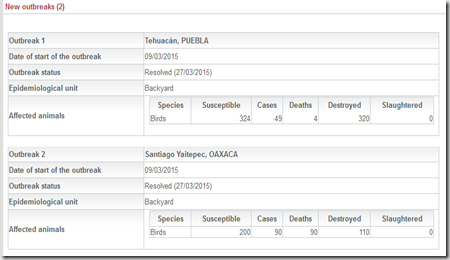
        All of which serves as prelude for an OIE Notification today out of Mexico of two H7N3 outbreaks in backyard flocks in the southern states of Oaxaca and of Puebla.  There is no known epidemiological link between these two sites at this time, and the good news is both detections were in small backyard holdings, not in large commercial operations. 


         image


        image 


        Source of the outbreak(s) or origin of infection

        • Unknown or inconclusive

        Epidemiological comments

        Following the notification by the owners of an increase in sudden death in birds at two backyards located in the States of Oaxaca and of Puebla, animals showing clinical signs suggestive of avian influenza were identified in both outbreaks. The official veterinary services launched the necessary epidemiological investigation and the presence of highly pathogenic avian influenza virus subtype H7N3 was confirmed. Control measures implemented immediately are, among others: quarantine, movement restrictions, stamping out and sampling in the focal and perifocal areas. Both outbreaks were confirmed as positive for avian influenza on 9 March and later by determining the intravenous pathogenicity index. So far, no epidemiological link has been identified between them.


        While seemingly a minor incident - in this year of rapidly expanding avian flu – it is worth taking note of all H5 and H7 outbreaks, regardless of their size.

        Monday, October 28, 2013

        WHO Update: Cholera Outbreak In Mexico

        image

        Cholera In The Americas 10/12 – 10/13 - Credit PAHO


        # 7910


        A follow up to a couple of posts earlier this month (see ECDC: Epidemiological Update On Cholera In Mexico & WHO GAR Update: Cholera In Mexico) the World Health Organization has issued a new update on the Cholera situation in Mexico. 


        The good news here is, the rate of new cases being reported has decreased significantly in recent weeks.


        Cholera in Mexico – update

        Disease outbreak news

        28 October 2013 - The Ministry of Health in Mexico has reported an additional five cases of infection with Vibrio cholerae O1 Ogawa toxigenic.

        The five cases occurred in the geographic zone of la Huasteca, an area where urbanization, availability of drinking water and basic sanitation services are limited.

        From 9 September to 25 October 2013, a total of 176 confirmed cases, including one death, of infection with Vibrio cholerae O1 Ogawa toxigenic has been reported in the country. Of these, two are from the Federal District, 157 cases from the state of Hidalgo, nine from the state of Mexico, two from the state of San Luis Potosi and six from the state of Veracruz. Eighty-nine of the total confirmed cases are women and 87 are men. Fifty-seven cases have been hospitalized.

        An antimicrobial susceptibility test for Vibrio cholerae O1 Ogawa toxigenic was conducted by the Institute of Epidemiological Diagnostics and Reference (InDRE) which demonstrated that the bacterium was susceptible to the medicines doxycycline and chloramphenicol, with reduced susceptibility to ciprofloxacin and resistance to trimethoprim/sulfamethoxazole.

        The health authorities of Mexico continue to strengthen outbreak investigation and surveillance at the national level and continue to ensure the availability and quality of care in medical units. Health professionals at different levels of the health care system are being trained in prevention, treatment and control of the disease. Measures are being implemented to ensure access to drinking water and basic sanitation at the community level. Awareness campaigns, particularly around safe water and food consumption are being carried out in Spanish and indigenous languages.

        This is the first local transmission of cholera recorded since the 1991-2001 cholera epidemic in Mexico. The genetic profile of the bacterium obtained from patients in Mexico presents high similarity (95%) with the strain that is currently circulating in three Caribbean countries (Haiti, Dominican Republic and Cuba), and is different from the strain that had been circulating in Mexico during 1991-2001 epidemic.

        WHO does not recommend that any travel or trade restrictions be applied to Mexico with respect to this event.

        Saturday, October 19, 2013

        WHO GAR Update: Cholera In Mexico

        image

        Cholera In The Americas 10/12 – 10/13 - Credit PAHO


        # 7875


        Following up a report from a little over a week ago (see ECDC: Epidemiological Update On Cholera In Mexico),  this morning the World Health Organization has posted a GAR (Global Alert & Response) update on the expanding Cholera outbreak in central Mexico.   


        Cholera in Mexico - 19 October 2013


        19/10/2013

        The Ministry of Health in Mexico has reported 171 confirmed cases, including one death,  of infection with Vibrio cholerae O1 Ogawa toxigenic between 9 September to 18 October 2013.

        In the second week of September 2013, Mexico was affected simultaneously by a hurricane and tropical storm which caused  heavy rains, floods, landslides and internal displacement of populations, thus increasing the risk of diarrhoeal diseases.

        Of the 171 confirmed cases, two are from the Federal District, 157 cases from the state of Hidalgo, nine from the state of Mexico, one from the state of San Luis Potosi and two from the state of Veracruz.

        Eighty-six of the total confirmed cases are women and 85 are men with ages ranging from three months to 88 years old.  Of these, thirty-nine cases were hospitalised.

        The health authorities of Mexico continue to strengthen the outbreak investigation and surveillance at the national level and ensure the availability and quality care in medical units.  Health professionals at different levels of the health care system are being trained about prevention, treatment and control of the disease.  Measures are implemented to ensure access to drinking water and basic sanitation at the community level.  Awareness campaigns, particularly around safe water and food consumption is being carried out in Spanish and indigenous languages.

        This is the first local transmission of cholera recorded since the 1991-2001 cholera epidemic in Mexico.  The genetic profile of the bacterium obtained from patients in Mexico presents high similarity (95 percent) with the strain that is currently circulating in three Caribbean countries (Haiti, Dominican Republic and Cuba), and is different from the strain that had been circulating in Mexico during 1991-2001 epidemic.

        WHO does not recommend that any travel or trade restrictions be applied to Mexico with respect to this event.

        Related links:


        Although endemic in many developing countries, due to our modern water and sewage treatment infrastructure, cholera is a rarely reported illness in the United States.  However, when there are outbreaks of Cholera around the world, the number of imported cases to the United States (and other developed countries) usually goes up.


        During the 1991-1994 Cholera epidemic in Peru, which infected roughly a million people (killing 10,000), the number of imported cases to the United States jumped nearly 10-fold (n=53/yr). 


        Similarly, in the first six months following the 2010 outbreak of Cholera in Haiti, the number of imported cases jumped from an average of 6/yr to 22 (see EID: Cholera In The U.S. Associated With Hispaniola Epidemic).


        According to that EID report, no secondary transmission of Cholera was reported in the United States from the cases imported from Haiti.


        On October 15th, the CDC updated their Health Information for Travelers headed to Mexico, urging the diligent use of standard precautions (drinking safe water, handwashing, using proper sanitation facilities, safe cooking procedures)  to avoid infection (see CDC Travel Notice – Cholera In Mexico).


        For more on Cholera, and travel, you may wish to refer to the CDC’s Yellow Book, which is freely available online, or as a PDF download.   The section dealing with Cholera is available at this link.

        Thursday, October 10, 2013

        ECDC: Epidemiological Update On Cholera In Mexico

        image

        Cholera In The Americas 10/12 – 10/13 - Credit PAHO 


        # 7848


        According to a recent epidemiological alert, issued on October 1st, PAHO (the Pan American Health Organization) lists four nations in the Americas reporting cholera over the past 12 months. Of these, three have been battling this disease for some time; Cuba, Haiti, The Dominican Republic. While the fourth – Mexico – has only recently begun reporting locally acquired  cases. 

        They write:


        In  Mexico, the International Health Regulations (IHR) National Focal Point of Mexico reported 36 new confirmed cases of autochthonous infection with Vibrio cholerae O:1 Ogawa toxigenic in the state of Hidalgo. With the additional confirmed cholera cases, the national total is now 46, including one death; with two of the cases in the Federal District and 44 in the
        state of Hidalgo. 


        The cases are 24 women and 22 men with ages ranging from 2 to 82 years old. 

        The Mexico health authorities continue to: strengthen epidemiological activities at the national level; ensure the availability of inputs and quality of care in medical units; implement actions to ensure access to drinking water and basic sanitation at the community level; and monitor and check the chlorine levels.


        On October 5th, the CDC’s Traveler’s Health website posted a low-level advisory regarding the situation in Mexico (See Cholera in Mexico : Watch - Level 1, Practice Usual Precautions).


        Today, the ECDC has posted an epidemiological update on the situation.


        Epidemiological update: Cholera in Mexico

        10 Oct 2013

        ​On 1 October, 46 confirmed cases of cholera, including one death, were reported by the Pan American Health Organization (PAHO) in Mexico. Of those, two were identified in the Federal District and 44 in the state of Hidalgo. However, media reports mention up to 81 confirmed cases: 77 in the state of Hidalgo, two in the state of Mexico and two in the Federal District, which is the most populated area of Mexico.


        Of the cases where information was available, 44% are male and 56% are female, age ranging from two to 82 years old; 30% have been hospitalized.


        This is the first sustained autochthonous transmission of cholera recorded since the 1991-2001 endemic period. These infections are caused by Vibrio cholerae O:1 Ogawa toxigenic. The strain is different from the one that circulated in Mexico during the 1991-2001. Genetic testing suggests this strain to be similar to the strain currently circulating in Haiti, Dominican Republic and Cuba.


        Travellers to Mexico should be aware of preventive hygiene measures and seek advice from travel medicine clinics prior to their departure, to assess their personal risk. In addition, physicians in the European Union should consider the diagnosis of cholera in returning travellers from Mexico presenting with compatible symptoms. Upon diagnosis, notification to the relevant public health authorities is essential.


        In Cuba, according to the same update, 678 confirmed cholera cases, including 3 deaths, have been reported from July 2012 through August 2013. The affected provinces are Camaguey, Granma, Guantanamo, Havana, and Santiago de Cuba. Twelve of the confirmed cases had travelled to Cuba from other countries (two from Chile, two from Germany, three from Italy, one from the Netherlands, two from Spain, and two from Venezuela). The overall risk for travellers is still considered low.


        ECDC Rapid Risk Assessment: Outbreak of cholera in Cuba, potential risk for European travellers; 12 July 2012


        Updated ECDC Risk assessment: Outbreak of cholera in Cuba, potential risk for European travelers, 17 January 2013


        PAHO Epidemiological alert on 1 October 2013


        Sunday, July 07, 2013

        Popocatepetl Webcam


        # 7456


        Popocatepetl – one of Mexico’s most active volcanoes, and located just 43 miles to the Southeast of Mexico City - has been rumbling ominously for several days, prompting authorities to raise their Volcano alert level to Yellow or Phase III.


        Steam can be seen rising from the crater in the Webcam shot below.  New images  may be viewed about once a minute, at this link.


        image


        The last major eruption was in 1947, but over the past 20 years there have been significant events in 1994, 2000, 2005, 2012, and again starting in May of this year.


        Mexico's National Center for Prevention of Disasters (Centro Nacional de Prevención de Desastres or CENEPRED) Volcano Monitoring site has posted the following statement regarding Popocatepetl’s recent activity:


        CENEPRED MONITOREO VOLANICO

        In the last 24 hours monitoring system of Popocatepetl volcano has registerde a persistent episode of low-frequency tremor that fluctuates between low and high amplitude accompanied by almost continuous emission of steam, gas and ash that heads northwest.

        Additionally, yesterday at 19:28 hours the monitoring system registered an explosion that was followed by an episode of high-amplitude harmonic tremor that lasted four hours.

        There have also been isolated episodes of lower amplitude harmonic tremor lasting 50 minutes and some exhalations with explosive component, generating a slight increase in the emission of gases and ash. One of the most important could be seen today at 08:24 when there was partial visibility to the volcano (see Figure 1) , (see seismogram) .

        Climatic conditions in the area had not allow visibility during most of the time.

         
        The
        Volcanic Alert Level is at Yellow, Phase 3.

        Boletin 177 SEGOB


        CENAPRED places particular emphasis in the following recommendations:


        1. Access is restricted within a radius of 12 km from the crater. Permanence in this area is not allowed.
        2. The road between Santiago Xalitzintla (Puebla) and San Pedro Nexapa (Mexico State), including Paso de Cortes, is open only to controlled traffic.
        3. To the authorities of Civil Protection, maintain preventive procedures, according to operative plans.
        4. To the population, be aware of the official information emmited.
        Popocatepetl Volcano is monitored continuously 24 hours a day.


        It may surprise some Americans to learn that the United States has 169 `active’ volcanoes within its borders – and while most are located in Hawaii and Alaska – there are about 40 in the `lower 48’ states.


        image

        U.S. Volcanoes and Current Activity Alerts


        Major volcanic eruptions on the U.S. mainland are rare events, but they have the potential to be extremely disruptive when they do occur.


        For that reason, emergency planners urge:


        Before a volcanic eruption:

        • Plan ahead. Have emergency supplies, food and water stored. 
        • Plan an evacuation route away from rivers or streams that may carry lahars.
        • Keep a battery-operated radio available at all times.
        • If there is an eruption predicted, monitor the radio or TV for information. Follow the advice given by authorities.

        Note: Lahars are debris or mud flows from a volcano, and can be particularly dangerous. 


        May is  Volcano Awareness Month in Washington State, which has five major volcanoes in the Cascade Range; Mount Baker, Glacier Peak, Mount Rainier, Mount St. Helens and Mount Adams.


        image


        For more on Volcano hazards, and preparedness, you may wish to visit the State Of Washington’s Volcano Information and Preparedness webpage.

        Monday, February 18, 2013

        More On Mexico’s H7N3 Outbreak

        image

        Photo Credit – FAO


        # 6946


        Yesterday, in my Sunday Morning Avian Flu Roundup, I briefly mentioned the reappearance of H7N3 in central Mexico. 


        This morning, we have an official statement posted on SAGARPA’s (Mexico’s Ministry of Agriculture, Livestock, Rural Development, Fisheries and Food) newsroom that provides details on the extent of the outbreak, and the plans in place to contain it.


        SENASICA, mentioned below, is a sector agency of SAGARPA.  The following is a machine translation from the original Spanish text, after which I’ll return with a little more.


        SENASICA Strengthen epidemiological surveillance and control of the movement of poultry products in Guanajuato by the outbreak of Avian Influenza AH7N3

        image

        Mexico City, February 17, 2013

        PDF
        PHOTOS

        • The owner of SAGARPA, Enrique Martinez y Martinez, instructed the chief director of SENASICA, Enrique Sanchez Cruz, reinforcing diagnostic activities and narrow the movement controls on poultry products affected area.
        • In the surrounding area without the presence of virus, vaccination is enhanced, in order to prevent the occurrence of this disease.

        Upon completion of laboratory studies to determine the sequencing of the virus affecting poultry farms in Guanajuato Bachoco company, the National Health Service, Food Safety and Quality (SENASICA) confirmed that this is a virus of Avian Influenza AH7N3 high pathogenicity, equal to that had arisen in the states of Jalisco and Aguascalientes, so did the notification regarding the World Organization for Animal Health (OIE).


        The decentralized body of the Ministry of Agriculture, Livestock, Rural Development, Fisheries and Food (SAGARPA), reported that due to the anti-epidemic actions among these epidemiological surveillance, we have located five more affected farms, which have 12 production units with the virus, of which ten of these farms are of broiler chickens (laying eggs for broiler production) and two commercial laying (birds producing eggs for human consumption).


        It was further reported that nine are in Dolores Hidalgo, a Juventino Rosas in another in San Felipe Torres Mochas and one in San Luis de la Paz, which have a combined population of about one million birds, all owned by the Bachoco company.


        According to the instructions of the owner of SAGARPA, Enrique Martinez y Martinez, were reinforced and diagnostic activities narrowed the movement controls, and in areas that have not been affected has intensified preventive vaccination, in order to avoid in poultry virus effects.


        Also began laundering activities, cleaning and disinfection of facilities and equipment of each of the farms affected farms, which were quarantined and protocols as established in international health, applies the depopulation. It should be mentioned that the number of birds that could be killed, be determined with specific diagnoses that reveal the presence of influenza AH7N3.


        In coordination with technical staff of the state government, and with the support of the military and federal and state public safety, are enabling 13 internal checkpoints on the main road routes, in order to control the movement of birds products and byproducts. Additionally, we conducted verification of egg hatchery for broiler birds.


        The SENASICA reiterated that this virus is unique to birds, so there is no risk to public health, also urged poultry farmers in the area to provide timely notice and reinforce biosecurity measures on their farms.


        Although a considerable threat to the poultry industry, H7 viruses are viewed as posing far less of a public health threat.  Human infections have rarely been reported, and most have been mild.


        The most recent report of human H7 infection comes from last summer’s Jalisco, Mexico outbreak, and the details were reported in MMWR: Mild H7N3 Infections In Two Poultry Workers - Jalisco, Mexico.


        While global surveillance and reporting on novel avian viruses in humans is spotty at best, some known H7 cases include:

        image

          Chart lifted and edited from CIDRAP’s excellent overview Avian Influenza (Bird Flu): Implications for Human Disease  showing known H7 avian flu infections in humans over the two decades.


          One H7N7 fatality was reported a decade ago in the Netherlands. Generally the H7 viruses usually only produce mild symptoms in humans. Of course – H7s - like all influenza viruses, are constantly mutating and evolving.


          What is mild, or relatively benign today, may not always remain so. In 2008 we saw a study in  PNAS that suggested the H7 virus might just be inching its way towards better adaptation to humans.


          Our knowledge of influenza A viruses that circulated in humans before the the 20th century is extremely limited, but since that time we only know of HA (hemagglutinin) types H1, H2, and H3 causing human epidemics.


          In the past some scientists have questioned whether any of the other HA subtypes are even capable of sparking a human pandemic. An excellent discussion of this topic can be found in the 2008 paper:


          The Next Influenza Pandemic: Can It Be Predicted?

          Jeffery K. Taubenberger, MD, PhD, David M. Morens, MD, and Anthony S. Fauci, MD

          (EXCERPT – but read the whole thing)

          It is currently impossible to predict the emergence of a future pandemic other than to strongly suspect that one will eventually occur, or to predict when or where a future pandemic will occur, what subtype it will be, and what degree of morbidity and mortality it will produce. Even though concern over the emergence of an H5N1 pandemic is clearly warranted, if for no other reason than its current high case–fatality rate, experts must also anticipate and plan for many other possibilities for pandemic emergence.


          The argument for the pandemic threat posed by HA subtypes other than H1, H2, and H3 gained traction a year ago when virologists Ron Fouchier and Yoshihiro Kawaoka each independently demonstrated genetic changes to the H5N1 virus that would make it more transmissible in mammals.


          See Science Publishes The Fouchier Ferret Study and Nature Publishes The Kawaoka H5N1 Study for details.


          The fact that we haven’t seen an H5 or H7 pandemic virus emerge in the past 150 years is, admittedly, reassuring. But it serves as no guarantee that it can’t happen sometime in the future.


          So we watch outbreaks of avian influenzas, even those with relatively low public health risks today, for any signs of change.

          Sunday, February 17, 2013

          Sunday Morning Avian Flu Roundup

          image

          Source WHO Influenza At The Human-Animal Interface


          # 6945


          Avian flu infections in humans, and outbreaks among poultry, generally reach their peak during the winter and spring months. This is a pattern we see nicely illustrated by the chart above.


          So it is of little surprise that we have multiple reports of H5N1 and H7 avian flu activity from around the globe this weekend.


          Rather than devote separate blogs to each of these reports, this morning we’ll roll them all up into one.


          On Friday (Feb 15th), the World Health Organization  released their monthly H5N1 update, indicating 10 new human infections (Cambodia = 7, Egypt= 1, China = 2) since their last report on January 15th.


          (EXCERPT)


          Since 16 January, Cambodia reported seven new human cases with influenza A(H5N1) virus infection
          including six fatal cases. These cases come from four provinces all located in southern Cambodia. These cases do not seem to be linked epidemiologically, and most had contact with sick poultry in the village.


          Enhanced surveillance has been put in place and did not detect additional cases linked to these cases.
          Current evidence does not support human-to-human transmission. It has been suggested that the A(H5N1) virus is endemic in poultry in Cambodia1, and that there is more poultry and human movement around   the Lunar New Year. As such, additional sporadic human cases might be expected.


          Egypt has reported one new human case with influenza A(H5N1) virus infection in Behera Governorate. The A(H5N1) virus is also endemic in poultry in some areas of Egypt, and additional sporadic human cases are possible.


          On 10 February 2013, China reported 2 new human cases of influenza A(H5N1) virus infection. Both
          remain in critical condition. The cases come from the same province but do not seem to be
          epidemiologically linked. Neither had documented contact with sick or dead poultry. Contact tracing and follow up is on-going but no additional cases have been identified. The last official report of A(H5N1) in poultry in mainland China was from Guangdong Province in September 2012


          Since the return of H5N1 in 2003, there have been 620 lab confirmed human infections, of which 367 have proved fatal.


          While these numbers suggest a mortality rate of 59%, the debate over the true number of cases, and the existence of `mild, undiagnosed’ infections, continues (see The Great CFR Divide).


          This morning, some follow up stories, and reports of fresh outbreaks in poultry around the world. 


          First stop, a report from China indicating that more than 100 close contacts of the two cases reported above have been released from quarantine after developing no sign of infection. 


          110 released from bird flu quarantine

          February 17, 2013

          A total of 110 people who had close contact with two patients contracted avian influenza H5N1 in southwest China's Guizhou Province earlier this month have been released from quarantine, local health authorities announced on Sunday.


          Two residents of the provincial capital of Guiyang were reported to have contracted the H5N1 virus on Feb. 8. The health authority put 110 people who had close contact with the two patients under quarantine, according to the provincial government's emergency response office.


          They were released as no abnormal symptoms were discovered.


          One patient, a 21-year-old woman, died of multiple organ failure on Wednesday. The other patient, a 31-year-old man, is still receiving medical treatment.

          (Continue. . . )


          Next stop Mexico, where authorities and poultry farmers have been engaged in a running battle with highly pathogenic H7N3 avian flu since early last summer (see Mexico Declares National H7N3 Animal Health Emergency).


          While H7 is not considered as dangerous as H5N1, the OIE requires their notification (and containment steps taken) whenever H5 or H7 strains are identified because these strains have a history of evolving from LPAI into more pathogenic strains.


          The original outbreak in Jalisco was quelled last fall (after culling 20 million birds), but the virus continues to pop up around the country (see Mexico: Fresh Outbreaks Of Avian H7N3).


          This weekend, once again poultry farmers are faced with culling hundreds of thousands of birds, as reported from this New Zealand news story.


          Mexican bird flu outbreak hits 582,000 chickens


          Sat, 16 Feb 2013 2:30p.m.


          Mexico's animal health agency says a bird flu outbreak at seven farms in central Mexico has affected as many as 582,000 chickens.

          (Continue . . .)


          Germany, too, is reporting an outbreak of avian flu in poultry, although there are conflicting reports on the test results. Assuming it is confirmed, this would make the first appearance of H5N1 in Germany in three years.


          Bird flu found at German farm

          February 16 2013 at 04:08pm 

          Berlin - About 14 000 ducks at a German farm are being slaughtered following a bird flu outbreak.


          (Continue . . . )


          Along with these outbreaks, we continue to see reports of multiple outbreaks in poultry from countries where the virus is well entrenched, particularly Egypt, Indonesia, Nepal, and Bangladesh.


          We are now a decade since the H5N1 virus reappeared in Vietnam, and subsequently spread out of Asia to parts of Europe and the Middle East. 


          Despite many opportunities to do so, the virus has not managed to adapt well enough to humans to pose a pandemic threat.  Nevertheless, the potential for this status quo to change exists, and so the WHO provides this risk assessment:


          Public health risk assessment of avian influenza A(H5N1) viruses:

          Any time influenza viruses are circulating in poultry, sporadic infections or small clusters of human cases are possible especially in people exposed to infected poultry kept in households.

          However, currently, this H5N1 virus does not appear to transmit easily among people and therefore the risk of community level spread of this virus remains low. Therefore, the public health risk associated with this virus remains unchanged.

          Thursday, September 13, 2012

          MMWR: Mild H7N3 Infections In Two Poultry Workers - Jalisco, Mexico


          image

          Photo Credit SENASICA


          # 6554


          Roughly 10 weeks ago (June 27th) we learned of an outbreak of Highly Pathogenic H7N3 avian influenza among poultry in Jalisco, Mexico; the first such outbreak in that country since an outbreak of H5N2 in the early 1990s.


          Since that time, more than 22 million birds have either died from the disease, or have been culled, and Mexico’s poultry industry has taken a terrible beating.


          The good news - according to a report yesterday in MeatPoultry.com - is no new infections have been reported in the past 3 weeks, and restocking of birds is set to begin (see Mexico tallies birds culled, restocking to begin).


          While there are a number of avian flu viruses circulating in the wild, the OIE only requires that H5s and H7s be reported due to their known ability to mutate from a low pathogenic virus to highly pathogenic virus.


          Among the avian influenzas, H5N1 virus gets the bulk of the headlines, and rightfully so. While a matter of some controversy (see Revisiting The H5N1 CFR Debate), among known human cases, the mortality rate has been a staggering 60%.


          Other strains that have demonstrated at least some ability to infect humans include H7, H9, H10, and H11. Fortunately, most of the time these rare infections have produced only mild flu symptoms (sometimes only conjunctivitis).


          For now, these viruses are primarily a threat to the poultry industry, and to a lesser extent, people working in direct contact with infected fowl.


          Although global surveillance and reporting on novel avian viruses in humans is spotty at best, some known H7 cases include:

          image

            Chart lifted and edited from CIDRAP’s excellent overview Avian Influenza (Bird Flu): Implications for Human Disease  showing known H7 avian flu infections in humans over the two decades.


            To this short list of human cases we can now add two more (admittedly, very mild) cases, as is detailed in today’s MMWR.


            Notes from the Field: Highly Pathogenic Avian Influenza A (H7N3) Virus Infection in Two Poultry Workers — Jalisco, Mexico, July 2012

            Weekly

            September 14, 2012 / 61(36);726-727

            During June–August 2012, Mexico's National Service for Health, Safety, and Food Quality reported outbreaks of highly pathogenic avian influenza (HPAI) A (H7N3) virus in poultry on farms throughout the state of Jalisco (1,2). This report describes two cases of conjunctivitis without fever or respiratory symptoms caused by HPAI A (H7N3) virus infection in humans associated with exposure to infected poultry.


            Patient 1. On July 7, a poultry worker aged 32 years complaining of pruritus in her left eye was examined at a clinic in Jalisco. Physical findings included redness, swelling, and tearing. Conjunctivitis was diagnosed; the patient was treated symptomatically and recovered fully. Because the patient had collected eggs in a farm where HPAI A (H7N3) virus was detected, the Institute for Epidemiological Diagnosis and Reference, Mexico, tested ocular swabs from both of her eyes for influenza A (H7) by real-time reverse transcription–polymerase chain reaction (rRT-PCR), and embryonated chicken eggs were inoculated for viral isolation. The swab material was positive for influenza A (H7) virus by rRT-PCR and virus was isolated from each eye. These findings were reported to the World Health Organization on July 19, and full genome sequences (CY125725–32) were uploaded to GenBank. The virus was closely related by nucleotide sequence to previously reported HPAI A (H7N3) viruses collected during poultry outbreaks in Jalisco with sequences available in GenBank (JX397993, JX317626).


            Patient 2. A man aged 52 years, who was a relative of patient 1 and worked on the same farm, developed symptoms consistent with conjunctivitis on July 10 and sought care at a local clinic on July 13. He was treated symptomatically and recovered without sequelae. When public health authorities became aware of this patient, they obtained eye swabs, which were tested by rRT-PCR, revealing influenza A (H7).


            Mexico has continued its efforts to contain poultry outbreaks in affected areas in Jalisco. Those efforts include quarantining affected farms, culling infected birds, vaccinating uninfected birds, and disinfecting contaminated areas. Government agencies also have provided personal protective equipment to farm personnel and are conducting active surveillance for influenza-like illness (ILI) and severe acute respiratory illness at two sentinel sites near the outbreak.


            Avian influenza A viruses are designated as HPAI or low pathogenicity avian influenza (LPAI) based on molecular characteristics of the virus and the ability of the virus to cause disease and mortality in birds (3). To date, only influenza A (H5) and (H7) subtypes have been described as HPAI. Influenza A (H7) subtype viruses have been detected in wild birds in many parts of the world and can cause outbreaks in poultry. Influenza A (H7) infection in humans is uncommon, but can occur after direct contact with infected birds, especially during outbreaks of influenza A (H7) virus among poultry (4). Illness can include conjunctivitis without fever, upper respiratory tract symptoms, or both (4,5), and severity can range from mild to fatal (4). In the United States, avian influenza outbreaks in poultry are rare, but they are detected and reported sporadically. In the United States, only two cases of illness with LPAI A (H7) virus infection are known to have occurred in humans, both of whom recovered (6,7).


            The conjunctivitis cases in Jalisco most likely represent HPAI A (H7N3) virus transmission from infected poultry to humans through direct contact. United States agricultural, public health, and clinical personnel should be aware of these poultry outbreaks with transmission to humans in a neighboring country. Persons working with poultry known or suspected to be infected with influenza A viruses should use appropriate personal protective equipment, including face masks, gloves and eye protection (e.g., goggles). Clinicians and epidemiologists should consider avian influenza A virus infection in patients who have conjunctivitis or ILI and have contact with poultry in areas with known avian influenza outbreaks. Clinicians who suspect avian influenza A virus infections in humans should obtain a conjunctival or respiratory specimen, or both, depending on signs and symptoms, and submit samples to a national, regional, or state public health laboratory to enable specific influenza testing. Clinicians also should consider early empiric antiviral treatment of suspected cases with a neuraminidase inhibitor (8,9). Public health officials should survey family members and contacts of infected persons to find cases of human-to-human transmission.


            Since the H7 viruses usually only produce mild symptoms in humans, you may be wondering why all the concern over a couple of H7 infections?


            The answer is simple.  H7s, like all influenza viruses, are constantly mutating and evolving.


            What is mild, or relatively benign today, may not always remain so.


            And in 2008 we saw a study in  PNAS that suggested the H7 virus might just be inching its way towards better adaptation to humans.


            So we watch, with considerable interest, anytime a novel flu virus manages to jump to humans.  Even if only in a very limited fashion.


            For more details on that study, and some more posts on the H7 constellation of flu viruses, you may wish to revisit:


            H7's Coming Out Party

            H7 Study Available Online At PNAS


            When Flu Strains Collide

            Friday, July 13, 2012

            Updating Mexico’s H7N3 Outbreak


            image

            Photo Credit SENASICA


            # 6432


            Just over three weeks ago the OIE was notified by Mexico’s Director General of Animal Health Dr Hugo Sanchez Fragoso of an outbreak of highly pathogenic H7N3 avian influenza among poultry in the state of Jalisco (see Mexico: High Path H7 In Jalisco). 


            A week later, Mexico’s Agricultural Ministry (Secretaría de Agricultura, Ganadería, Desarrollo Rural, Pesca y Alimentación; SAGARPA) Declared a National H7N3 Animal Health Emergency as the H7N3 virus continued to spread.


            image

            Map Credit OIE


            Since humans have only rarely been reported to have been infected by this strain of avian flu, the big concern right now is for poultry operations. Cesar de Anda, vice chairman of the International Egg Commission, was quoted by EFE news yesterday as stating:


            "The industry will fail to produce $50 million, not only from the cost of the (dead) birds, but also from the intrinsic value of production, the generation of wealth and of indirect jobs in other fields."


            According to Anda, if this outbreak is not brought under control, as many as 32,000 jobs could be at risk.


            To date, 2.5 million poultry have either died, or been destroyed because of this virus, and according to a press release from SENASICA (Mexico’s Food Safety agency) as many as 17 million birds in the region may be at risk.


            The latest OIE Filing (Follow-up report No. 3 ) states the source or origin of the virus remains unknown, and provides brief summaries of 31 separate outbreaks. 


            Under Epidemiological comments, they list:


            • During the epidemiological surveillance carried out in response to the event, the National Food Quality, Food Safety and Health Service (SENASICA) has taken samples in the outbreaks and around the outbreaks in 148 poultry farms.
            • 31 farms were identified by viral isolation, diagnosis is ongoing in other 83 and 34 have tested negative to H7N3 highly pathogenic virus.
            • The population at risk in these 148 farms amounts to about 17 million birds, of which 86.1% of layers, 6.9% of broilers and 7% of breeders.
            • As part of the measures taken to reduce the risk, the buffer zone has been extended to 60 km around the index outbreak and includes 161 poultry farms at risk with a population of 25.8 million of birds.
            • Control measures on birds and their products movements have been strengthened in the quarantine area and eight check points have been established with the support of 26 health technicians with 9 vehicles that monitor the quarantine zone.
            • Epidemiological surveillance activities continue in the outbreaks, around the outbreaks and in the buffer zone. As a measure to reduce the risk, sampling will be carried out in neighbouring States and in poultry farms at risk outside the buffer zone.


            In the first six months of 2012, 14 countries have reported outbreaks of high path avian flu with strains ranging from H5N1 and H5N2 to H7N3. Surveillance and reporting around the world is spotty at best, and so it is likely that we don’t hear about all of the outbreaks.


            For now, however, these viruses are primarily a threat to the poultry industry, and to a far lesser extent, people working in direct contact with infected fowl.  While H7 viruses have been known to infect humans on rare occasions, most of the reported cases have produced only mild to moderate illness.


            • In 2003 an outbreak of H7N7 at a poultry farm in the Netherlands went on to infect at least 89 people. Most of the victims were only mildly affected, but one person died.
            • In 2004 two people in British Columbia tested positive for H7N3 (see Health Canada Report) during an outbreak that resulted in the culling of 19 million birds.
            • In 2006 and 2007 there were a small number of human infections in Great Britain caused by H7N3 (n=1)  and H7N2 (n=4), again producing mild symptoms.


            For now, H7 avian influenzas are presumed to pose a low public health threat.  But H7s, like all influenza viruses, are constantly mutating and evolving.


            In 2008 we saw a study in  PNAS that suggested the H7 virus might just be inching towards adapting to humans. For more details on that study, you may wish to revisit H7's Coming Out Party and H7 Study Available Online At PNAS.


            So, while the H7 virus poses a minimal risk to human health at this time, it pays to keep an eye on outbreaks such as the one in Jalisco.


            Influenza viruses are constantly changing, and evolving, always seeking an evolutionary advantage. So, what was true about a specific flu virus yesterday, may not hold true tomorrow.

            Monday, July 02, 2012

            Mexico Declares National H7N3 Animal Health Emergency


            # 6417


            Mexico’s Agricultural Ministry (Secretaría de Agricultura, Ganadería, Desarrollo Rural, Pesca y Alimentación; SAGARPA) today announced a national animal health emergency as the H7N3 outbreak that made headlines last week (see Mexico: High Path H7 In Jalisco) has reportedly now affected more than 1.7 million birds.


            ChannelNewsAsia has an AFP report Mexico declares bird flu emergency, but a short version of the announcement can be found on the SENASICA (National Health Service, Food Safety and Food Quality) website:


            Avian Influenza

            Avian Influenza 10

            Avian Influenza type A, subtype H7N3 does not affect humans, only birds, according to Organization Animal Health (OIE).


            See Frequently Asked Questions
            Audio News

            Press release

            Was published today in the Official Journal of the Federation agreement that activates, integrates and operates the National Emergency Animal Health, pursuant to Article 78 of the Federal Animal Health Law, to diagnose, prevent , control and eradicate avian influenza virus type A, subtype H7N3, actions taken since last week in coordination with the farming.


            While H7N3 is not considered to represent a high human health risk, the statement that it does not affect humans is not strictly true. As I wrote last week, there have been a handful of (generally mild) human infections detected with this subtype of avian flu.


            The following is a machine translation of a more detailed press release (including information on the quarantine, slaughter, vaccination, and the destruction of infected poultry), which is available from the SARGAPA website. 


            SENASICA published in the Official Gazette of the National Emergency Animal Health

            Mexico City, July 2, 2012

            Was published today in the Official Journal of the Federation agreement that activates, integrates and operates the National Emergency Animal Health, pursuant to Article 78 of the Federal Animal Health Law, to diagnose, prevent, control and eradicate avian influenza virus type A, subtype H7N3, actions taken since last week in coordination with the farming.

            The agreement is issued under the June 20, 2012 the National Health Service, Food Safety and Food Quality (SENASICA) confirmed the presence of a virus highly pathogenic avian influenza exotic for Mexico in two municipalities of Jalisco and considers that requires immediate attention for its control and eventual eradication, to prevent severe damage to the poultry industry.

            The coordination of the National Emergency Animal Health will be in charge of SENASICA through the Directorate General of Animal Health (DGSA), which will be supported by the Mexico - United States for the Prevention of FMD and other diseases Exotic Animals (CPA).


            Although the virus is focused on municipalities and Acatic Tepatitlan, Jalisco, the operation will be activated throughout the country, in order to prevent the spread of the disease, for which the country is divided into eight regions emergency .


            The eight regions will be regulated and directed by SENASICA through the DGSA, with the support of the CPA and actions will be executed in each region under the supervision of the Coordinators responsible for compliance to the Agreement will have the Groups State Animal Health Emergency (GEESA), led by the coordinators of the CPA.


            The agreement also establishes the animal health measures and coordinated urgent application to the diagnosis, prevention, control and eradication of Avian Influenza virus type A subtype among which are: animal health education on avian influenza to poultry and people and legal entities related to the poultry industry.


            Under the transmission of the virus highly pathogenic avian influenza in birds occurs by direct or indirect animal products and byproducts from infected birds exposed and sets the control of the movement of poultry and their products and products as well as other animal species regulated by the Animal Health Act and provisions thereunder, which may represent a risk to poultry.


            They also provide animal health and ordering cords retention and disposition of poultry products and byproducts, as well as biological, chemical, pharmaceutical and food for use or consumption by these birds that could cause an outbreak of Avian Influenza.


            As animal health measures include diagnostic work and identification of avian influenza virus, quarantine and isolation for affected farms and the work you reinforce surveillance and epidemiological research.


            To avoid transmission of avian influenza virus type A subtype H7N3 is ordered sanitation practices, disinfection, disinfestation, sterilization, using germicides and pesticides in animals, premises and transport.


            SENASICA further instructs the culling sick or exposed to avian influenza and disposal of poultry products and byproducts in the manner specified in the body.


            Similarly, immunization will be permitted upon express authorization of SENASICA, to protect and prevent the spread of the disease.


            SENASICA establish mechanisms of coordination with other agencies of the Federal Government, the Governments of the States, the National Technical Advisory Council for Animal Health, the National Union of Poultry Farmers, as well as poultry producers and individuals linked to activities related to poultry, which are required to provide the SENASICA all the support and technical and administrative cooperation, as well as the epidemiological data and production is required to diagnose, prevent, control and eradicate avian influenza virus type A subtype H7N3 of the country.


            Finally, the agreement indicates that the Ministry of Agriculture, Livestock, Rural Development, Fisheries and Food, through the National Health Service, Food Safety and Food Quality, assess the health status of the areas recognized as being of low prevalence, in control, and eradication or free of notifiable avian influence, in order to determine the measures necessary for the proper implementation of the Agreement.


            And the actual declaration may be found HERE.


            While public health authorities will no doubt be keeping their eyes on this situation, this is primarily a concern to agricultural interests


            An H7N3 outbreak in 2004, highly pathogenic H7N3 outbreaks in British Columbia's Fraser Valley back in 2004 led to the culling of 19 million birds.

            Wednesday, June 27, 2012

            Mexico: High Path H7 In Jalisco

            image

            Photo Credit – FAO


            # 6506


            Last night Lisa Schnirring writing for CIDRAP NEWS  brought us details on the first highly pathogenic bird flu outbreak in Mexico in nearly two decades.  The last time was during the mid-1990s, and the virus was H5N2.


            This time, the culprit it is H7N3.


            Follow the link below to read  Lisa’s excellent report, after which I’ll return with a bit more.


            Tests reveal high-path H7N3 in Mexican poultry farm outbreaks

            Lisa Schnirring * Staff Writer

            Jun 26, 2012 (CIDRAP News) – Mexican veterinary authorities are intensifying avian influenza control efforts in a region that houses several large commercial farms after further tests determined that the strain responsible for more than 200,000 bird deaths at three farms is the highly pathogenic H7N3 subtype.

            (Continue . . . )


            While there are a number of avian flu viruses circulating in the wild, the OIE only requires that H5s and H7s be reported due to their known ability to mutate from a low pathogenic virus to highly pathogenic virus.


            When it comes to avian influenzas, the H5N1 virus gets the bulk of the headlines, and rightfully so. While a matter of some controversy (see Revisiting The H5N1 CFR Debate), among known human cases, the mortality rate has been a staggering 60%.


            Other strains that have demonstrated at least some ability to infect humans include H7, H9, H10, and H11. Fortunately, most of the time these rare infections have produced only mild flu symptoms (sometimes only localized conjunctivitis).


            Last April, in EID Journal: Human Infection With H10N7 Avian Influenza we looked at some recent H10 infections, and in 2011 we explored A Little Background On H11 Avian Influenzas.


            For now, however, these viruses are primarily a threat to the poultry industry, and to a lesser extent, people working in direct contact with infected fowl.


            Although global surveillance and reporting on novel avian viruses in humans is spotty at best, some known H7 cases include:


            • In 2003 an outbreak of H7N7 at a poultry farm in the Netherlands went on to infect at least 89 people. Most of the victims were only mildly affected, but one person died.
            • In 2004 two people in British Columbia tested positive for H7N3 (see Health Canada Report) during an outbreak that resulted in the culling of 19 million birds.
            • In 2006 and 2007 there were a small number of human infections in Great Britain caused by H7N3 (n=1)  and H7N2 (n=4), again producing mild symptoms.


            For now, H7 avian influenzas are presumed to pose a low public health threat, which may leave you wondering why all this fuss over this outbreak of H7N3?


            The H7s, like all influenza viruses, are constantly mutating and evolving.  


            While considered mild today, there are no guarantees that the virus won’t pick up virulence over time, or reassort with another virus and increase its affinity for humans.


            Four years ago, we saw a study in PNAS that indicated that the H7 virus might just be moving more towards adapting to humans.


            Contemporary North American influenza H7 viruses possess human receptor specificity: Implications for virus transmissibility

            You can read more about this in a couple of blogs from 2008, H7's Coming Out Party and H7 Study Available Online At PNAS.


            The last pandemic, you will recall,  came out of left field; from a region of the world (North America), host species (swine), and influenza strain (H1N1) all considered unlikely to spark a global epidemic.


            Which is why we pay attention whenever there is an outbreak of a novel flu virus for which mankind may have little or no immunity.