Showing posts with label Philippines. Show all posts

Monday, February 23, 2015

Philippine DOH Statement On Suspected Imported Avian Flu Case

image

# 9741


We’ve a strange story out of the Philippines today, where their DOH has announced the death – and quick cremation – of an Overseas Filipino Worker (OFW) recently returned from a six-year-stint in China who displayed symptoms consistent with bird flu.  


This patient’s contacts are being provided prophylactic Tamiflu ®, and remain under surveillance.


Somewhat bizarrely, the DOH never actually confirmed the diagnosis, and opted instead for a quick cremation to `end the threat’.  In a press conference today (see Sun-Star report DOH: Philippines still bird flu-free) the acting head secretary of the DOH is quoted as saying:


“The Philippines remains to be bird flu-free. We cannot even consider this case confirmed,” said Acting Health Secretary Janette Garin in a press conference Monday.

The health chief also said they made no more efforts to confirm if the death was indeed caused by Highly Pathogenic Avian Influenza (H5N1) or bird flu over fears that an autopsy could place others at risk.

“We chose to contain the patient. The body was cremated eventually, hence this case has been declared closed,” she said.


As most of my readers already know, an autopsy isn’t required in order to diagnose H5N1 (or H7N9), and in fact, rarely occurs in Asia or the Middle East due to social and religious reasons.  Instead, respiratory tract samples(nasopharyngeal swab, nasal aspirate or wash, or an endotracheal aspirate/ bronchoalveolar lavage) are collected and PCR tested for the virus.


Equally curious is the fact that we are only just now hearing about this now – nine days after this patient died. It worth noting that this case arrived at roughly the same time as another OFW returned from Saudi Arabia with MERS (see Philippines: 10 MERS Contacts Negative – 1 HCW Under Investigation).


Because of its relatively close proximity to Indonesia, Taiwan, and Vietnam, and China – areas where avian flu has hit hard in the past – the Philippines have always been sensitive to any suggestions that bird flu had reached their country.


As this case was never properly tested, and the case is  officially closed, for now their coveted `bird flu free’ status remains intact. 


DOH STATEMENT ON SUSPECTED BIRD FLU IN PHL (23 February 2015)

February 23, 2015

Last week, we should have people who returned from China. He's six years I worked there, felt the weakness of body and she decided to return to her desire to be with family in feel.

February 9 came the patient. February 10 was the beginning she cough, fever, and occasionally joins the tyan. February 11, consultation but worsen the situation until the unexpected has died last February 14.

Because the symptoms displayed alongside the rapid progression of the disease plus the history of travel from China coupled with a history of being exposed to live poultry, the patient was considered a possible case of Avian Flu or Bird Flu.

This patient was initially referred to as a possible case of MERS. However, upon review of his case profile, Avian Flu was a more proximate consideration.

Prophylaxis of close contacts using Tamiflu has been done. Experts from Hong Kong closely monitored and guided our experts here. Biopsy was done by trained personnel protected by personal protective equipments.

Initial result revealed pulmonary findings but inconclusive. The body was cremated hence this case has been declared 'closed'.

If indeed this patient contracted bird flu, his death has ended other possibility of transmission. 

(Continue . . . )


Sunday, February 15, 2015

Philippines: 10 MERS Contacts Negative – 1 HCW Under Investigation

image


# 9715


As expected on Friday (see Philippines: 11 Contacts Of MERS Case Symptomatic, Undergoing Tests) most of the close contacts of the MERS infected Filipino nurse recently returned from Saudi Arabia have tested negative for the virus, although they will be required to stay under home quarantine with daily monitoring for another nine days.


One contact – a HCW at the hospital where the index patient was admitted – is showing symptoms and has changes on her lung x-rays that are suggestive of MERS, and is being described by the press as a either a  `probable’ case, or more accurately, a PUI or Patient Under Investigation.


Two media reports.


Laguna health worker seen as 'probable' Mers-CoV case

MANILA -- One of the 11 individuals who had close contact with the Filipina nurse afflicted with Middle East Respiratory Syndrome – Coronavirus (Mers-CoV) may have been infected, the Department of Health (DOH) said Sunday.

The female health worker of the Evangelista Medical Specialty Hospital in San Pedro, Laguna will remain at the Research Institute for Tropical Medicine (RITM) in Muntinlupa City until further tests show otherwise, Acting Health Secretary Janette Garin said in a press conference.


(Continue . . .)


Only two patients in RITM are under MERS-CoV monitoring – DOH

February 15, 2015 2:34 pm

The Department of Health (DOH) said on Sunday that only two patients are now under close watch for possible Middle East Respiratory Syndrome-Corona Virus MERS-CoV) at the Research Institute for Tropical Medicine (RITM) in Alabang, Muntinlupa City.

“We are glad to announce that only two patients are actually staying in the RITM, including the index case patient (the 32-year-old Filipina nurse who was first confirmed positive with MERSCoV),” acting DOH Secretary Janette L. Garin said in a press briefing held at the DOH Media Relations Unit in Tayuman, Sta. Cruz, Manila.

She said the other patient was classified as “patient under investigation” (PUI) wherein symptoms of MERS-CoV were identified but not considered as very severe case and, upon careful discretion of RITM experts, recommended to be isolated for further evaluation and monitoring.

(Continue . . .)

Friday, February 13, 2015

Philippines: 11 Contacts Of MERS Case Symptomatic, Undergoing Tests

image


# 9708


With the strong caveat that this time of year respiratory symptoms are rampant,  Xinhua and Reuters are both reporting that 11 contacts of the Filipino nurse who returned from KSA with MERS are under quarantine and  are `symptomatic’.


At this time, none have tested positive for the coronavirus. 


That said, here are both reports.


Eleven people linked to Philippines MERS case show symptoms: WHO

By Tom Miles

GENEVA Fri Feb 13, 2015 8:16am EST

(Reuters) - Eleven people who had contact with the Philippines' first confirmed case of Middle East Respiratory Syndrome coronavirus (MERS-CoV) are also showing symptoms, the World Health Organisation said on Friday.

"Eleven contacts are symptomatic. It's a mix of family contacts and hospital contacts, the doctors and nurses who attended the case before she was tested and found positive," said Peter Ben Embarek, a scientist at the WHO's department of food safety and zoonoses.

(Continue . . .)


11 under quarantine after showing MERS-CoV symptoms in Philippines

(philstar.com) | Updated February 13, 2015 - 7:00pm


MANILA, Philippines (Xinhua) - The Philippine government said Friday that 11 of 56 people who have close contacts of the nurse who tested positive for Middle East Respiratory Syndrome-Corona Virus (MERS-CoV) have manifested symptoms of the disease.

They are undergoing quarantine at the Research Institute for Tropical Medicine (RITM), according to the Department of Health ( DoH).

The 11 individuals include the nurse's husband, who came home with her via Saudi Airlines Flight SV860 on Feb. 1. The rest are health workers at the Evangelista Medical Specialty Hospital in San Pedro, Laguna where she first sought medical consultation on Feb. 2.

The nurse's mother-in-law and house helpers are also undergoing quarantine at RITM although they showed no symptoms at the moment, Sadie Janette Garin, DoH acting secretary, said in the press briefing.

"All 56 people yielded a negative result in the first round of tests using nose and throat swab samples. However, the 11 symptomatic patients will undergo another round of tests using sputum and rectal swab samples," she said.

Garin clarified that the nurse had 220 co-passengers on the flight she took. Ninety two of them have been located and agreed to be tested.


With the amount of influenza currently circulating, some (or all) of these symptomatic cases could easily have something other than MERS.   When a second round of tests are announced, I’ll update this story.

Wednesday, February 11, 2015

Philippine Dept Of Health Statement On Imported MERS Case – ex KSA

image

KSA - The International hub of MERS – Credit ECDC 


# 9698


The statement by the Saudi MOH on Monday that so far in 2015, there had been no nosocomial transmission of MERS in the Kingdom may prove to have been premature, as we have news overnight of a 32-year-old Filipino nurse, recently returned from Saudi Arabia, testing positive for MERS in Manila. 


First the (translated) statement from the MOH, followed by a Xinhua report, after which I’ll return with a bit more.


PRESS STATEMENT on MERSCOV CASE IN PH (11 Feb. 2015)

February 11, 2015

During this time, prevent the spread of emerging infectious diseases such ngMERSCOV. Important, continued vigilance of our health workers to spread it and immediately remediate every Filipino infect MERSCOV.

Last day, a patient was admitted to the Research Institute for Tropical Medicine (RITM). A 32 year old nurse from Saudi Arabia felt fever, body aches, cough and difficulty breathing - symptoms compatible with a patient MERSCOV.

Testing was done on the patient and yielded positive results. The patient is currently confined in a negative pressure room at RITM. Patuloy syang sinusubaybayan ng ating mga doctors at health workers.

Sa ngayon, the patient is in stable condition. Contact tracing of other passengers is also being done. Experts, however, say that the possibility of other passengers on the plane being infected is low.

Re-call the Department of Health to the public to collaborate on the lookout to spread beyond the country's emerging infectious diseases such as MERSCOV. Shows flu-like symptoms, and usually gets in the Middle East Region.

Prepared for the government to treat the sick, but early magpapakonsulta great help if anyone feels the same symptoms, especially if saMiddle from East Region.

Philippine gov't takes measures to prevent spread of MERS-CoV

English.news.cn   

MANILA, Feb. 11 (Xinhua) -- Philippine President Benigno Aquino III has ordered Acting Health Secretary Janette Garin to ensure that all necessary preventive measures are being taken following a confirmed case of Middle East respiratory syndrome coronavirus ( MERS-CoV) in the country, a senior government official said Wednesday.

Presidential Communications Operations Office Secretary Herminio Coloma Jr. said that contact tracing is being done to locate fellow passengers of the patient who traveled from Saudi Arabia to Manila last week.

Citing a report of the Department of Health (DOH), he said that a 32-year-old Filipino nurse from Saudi Arabia was tested positive of MERS-CoV after experiencing symptoms related to a patient with such illness.

The patient is currently being treated at state-run Research Institute for Tropical Medicine (RITM).

The DOH said that the patient is currently in stable condition.

The government called on the public to cooperate to ensure that emerging infectious diseases, such as MERS-CoV would not spread in the country.


While MERS is only believed endemic on the Arabian peninsula, cases have been exported to at least 13 countries outside of the Middle East.  All of these exported cases have had a recent travel history to the region or contact with a case that had travelled from there.

image

Credit ECDC RRA January 2015


On Monday,  in WHO Summary & Risk Assessment On MERS-CoV,  the World Health Organization had this to say (emphasis mine) about the likelihood of seeing additional exported MERS cases in the months ahead.


Can we expect additional cases of MERS-CoV infection in the Middle East? And can we expect additional cases exported to other countries?

WHO expects that additional cases of MERS-CoV infection will be reported from the Middle East, and it is likely that cases will continue to be exported to other countries by tourists, travellers, migrant workers or pilgrims who might acquire infection after exposure to an animal (for example, while visiting farms or markets) or human source (possibly in a health care setting). Until more is understood about mode of transmission and risk factors for infection, cases resulting from zoonotic transmission will continue to occur, and will eventually lead to limited community transmission within households and possibly significant hospital-associated outbreaks. Among the recently exported cases who reported performing Umrah in SAU, investigation into their activities while in SAU revealed that they had either visited a healthcare facility or had come into contact with camels or raw camel products while in SAU.


Given the lengthy (up to 14 day) incubation period, there is plenty of time for someone to become infected, and travel extensively around the globe, before any symptoms appear.  


Today’s announcement will no doubt revive calls for additional airport screening. Politically, and in terms of reassuring the public, the screening of passenger arriving at airports and other points of entry probably has some merit.  And it may provide valuable surveillance information as well. 


But practically, as an effective way to keep an emerging virus out of a country, studies continue to show just how unlikely that outcome really is (see MERS: The Limitations Of Airport Screening).


Making it desirable that – whenever possible – outbreaks of emerging viruses are quashed as quickly as possible at the source, before they can board an airplane and spread inexorably around the globe.

Wednesday, September 03, 2014

Philippines: Imported Case Of MERS-CoV In a HCW

image

Source : Philippines DOH Facebook page


# 9033


Based on the drop in the number of MERS cases reported by the Saudi MOH over the the summer, it is a bit surprising this morning to discover that a Philippine nurse, just returned from working in KSA, has tested positive for the virus and is now in isolation at Southern Philippines Medical Center in Davao City. 


This makes the second imported case of MERS for the Philippines.


First this this report from Xinhua News, then I’ll be back with a bit more. 


Philippine gov't confirms Filipina nurse infected with MERS-CoV

English.news.cn   2014-09-03 16:53:46
 

MANILA, Sept. 3 (Xinhua) -- The Philippine Department of Health (DOH) confirmed on Wednesday that a Filipina nurse who returned to the country from Saudi Arabia tested positive for the dreaded Middle East Respiratory Syndrome-Corona Virus (MERS-CoV).

Health Secretary Enrique Ona said the Filipina nurse came home last Friday via Saudia Airlines Flight SV 870. She then took Cebu Pacific Flight SJ 997 going home to General Santos City in southern Philippines.

"The (infected) nurse stayed with the other Filipina nurse in ( the northern Philippine province of) Bulacan until her scheduled flight to General Santos City on August 31," said Ona in a press briefing on Wednesday.

He said the two Filipina nurses returned to the Philippines together. They were tested for MERS-CoV in Saudi Arabia but did not wait for the results.

"The two were working in the same hospital in Dammam and they were tested there. Yesterday, they were informed by their supervisor that one of them was positive (for MERS-CoV)," said Ona.

The infected nurse, whose identity was not disclosed by Ona, was brought to the Southern Philippines Medical Center to be isolated. Throat swab samples collected from her will be analyzed. Results of the analysis are expected to come out on Wednesday night.

Ona said the DOH is now contacting other passengers of the Saudia Airlines and Cebu Pacific flights taken by the Filipina nurse to monitor their condition.

MERS-CoV is a highly fatal respiratory illness presenting an influenza-like illness characterized by fever, cough, and often with diarrhea.

Despite the entry of the infected Filipina nurse in the country, Ona said the Philippines remains free from MERS-CoV since no one has yet acquired the virus locally.

Last week KSA reported a pair of MERS cases at a hospital in Dammam (see  27 August MOH: '1 New Confirmed Corona Case Recorded' & 26 August MOH: '1 New Confirmed Corona Case Recorded'), a symptomatic female (age 52) and a symptomatic male (age 69).  Neither were described as being health care workers.

Today’s report is a reminder that the MERS coronavirus continues to circulate in the Middle East, and that with the Hajj now just 30 days away, it continues to represent a serious public health concern.


This confluence of  a couple of million into a confined space, coming from all over the world, provides a perfect `mixing bowl’  for viruses and bacteria, and has the real potential to seed them to new regions of the globe when the pilgrims leave. 


Last July, in EID Journal: Respiratory Viruses & Bacteria Among Pilgrims During The 2013 Hajj, we looked at the extraordinarily high percentage of Hajjis (approx. 80%)  who either acquire or leave with some type of respiratory infection while doing this pilgrimage.


While the vast majority will have rhinoviruses or influenza, differentiating those from something more serious will be a major public health undertaking – both while in Saudi Arabia, and  later, when these pilgrims return to their home countries.


For those contemplating making the Hajj this year, the CDC provides specific travel advice , including required and recommended vaccinations.

image


Thursday, July 03, 2014

Philippines Urges Muslims To Postpone Hajj Until Next Year

image

Credit Wikipedia


# 8802


While a good deal of public relations efforts have been directed towards convincing religious pilgrims of the safety of making the Hajj this year (see Tabung Haji Assures Pilgrims Not To Worry About MERS-CoV),  Saudi Arabia continues to advise that children, the elderly, pregnant women, and anyone with chronic medical conditions postpone their Hajj journey due to concerns over MERS.


Today, however, the media is reporting that the Philippine Department of Health is urging all potential Hajjis to postpone their trip until next year – when, presumably – MERS will be under better control.


Philippines urges its Muslims to abort Hajj due to MERS

July 3, 2014 2:40 pm


The Philippines urged its large Muslim minority on Thursday to reconsider plans to join pilgrimages to Saudi Arabia this year due to a deadly virus outbreak there.

About 6,500 Filipinos who are set to join the annual Hajj pilgrimage in October are being urged to go next year instead, when the Middle East respiratory syndrome (MERS) is expected to be under control, health department spokesman Lyndon Lee Suy said.

“We know it’s a religious custom, but it is also our duty to provide health advisories,” Lee Suy told AFP.

“It’s an appeal for them to delay the trip if possible due to the MERS virus…. If possible, they should go next year.”

(Continue . . . )


Last month Morocco's health minister, Lahoucine Louardi, also reportedly advised Muslims in his country not to go on pilgrimage to Saudi Arabia this year (see CIDRAP NEWS With MERS threat, Morocco advises against Hajj).  Most nations – including the United States – are simply urging travelers to practice enhanced precautions (see CDC Updated Travel Advice For Umrah & Hajj).

image


All able bodied Muslims are required to make at least one major pilgrimage to Mecca during their lifetime, at the time of the hajj. This is known as the fifth pillar of Islam, and is one of the duties incumbent upon all Muslims.


The faithful may also make `lesser pilgrimages’, called  omra (or Umrah), at other times of the year. These minor pilgrimages don’t absolve the faithful of making the hajj journey unless they take place during Ramadan (ongoing now, through the end of July).


As a result, the Kingdom of Saudi Arabia (KSA) receives more than 7 million visitors each year, with most of them arriving during the month of Ramadan and during the Hajj in October.


The waiting list for obtaining a Hajj visa can exceed a decade in some countries, making any decision to postpone a pilgrimage an extraordinarily difficult one.

Wednesday, April 16, 2014

Philippines Quarantines Imported Asymptomatic MERS Case & Contacts

 image


# 8481


The past two hours a report has been circulating on twitter regarding an (asymptomatic) imported case of MERS-CoV in the Philippines – that of a colleague of the paramedic who died last week in the UAE (see UAE Ministry Of Interior Announces 6 MERS-CoV Cases (1 Fatality)). 


This cluster has reportedly since grown to at least 10 cases (see UAE Announces 3 More MERS-CoV Cases).


The story has now broken in multiple media outlets.  Here are excerpts from the Gulf News.


Manila quarantines Filipino nurse from UAE after testing positive for Mers

Nurse who flew from UAE was quarantined along with family members in Manila

Published: 13:52 April 16, 2014

A Filipino nurse was quarantine along with his family after testing positive for the Middle East Respiratory Syndrome (Mers) virus upon arrival at the Manila international airport, making him the first confirmed case in the Philippine, Health Secretary Enrique Ona announced Wednesday.

In a press conference, the official said the patient, whose name was not disclosed, had been quarantined in a government hospital along with nine members of his family who were exposed to the virus, the GMA news website reported.

The nurse was taken directly to a government hospital upon landing at the Ninoy Aquino International Airport (Naia). Tagalog-language Tweets made by GMA from the press conference stated that Ona said passengers on the plane seated next to the nurse with Mers-CoV symptoms will also be quarantined.

The nurse is a friend of the Filipino hospital employee who died last week in the UAE for the same illness, Ona told reporters.

(Continue . . )

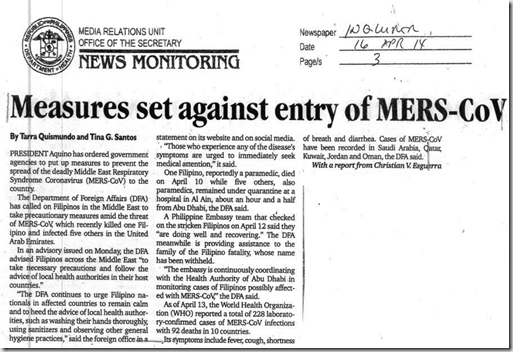
While a statement has yet to appear on the Philippines Ministry of Health website, in the past few hours they have announced renewed 04/16/2014 Measures set against entry of MERS-CoV.   A PDF File that contains the following image:

image

Another report from Gulf News fleshes these safeguards out a bit:


Aquino moves to stop MERS-CoV from spreading in the Philippines

Surveillance system reactivated at airport terminals to screen incoming passengers

  • By Barbara Mae Dacanay, Bureau Chief
  • Published: 13:25 April 16, 2014

(EXCERPT)

The Bureau of Quarantine has reactivated, at the three terminals of the Ninoy Aquino International Airport (NAIA) in suburban Pasay City, a surveillance system that the health department started using to monitor incoming passengers for bird flu and influenza virus (H7N9 and H1N1) in 2003, the health department said in a statement.

Hospitals have been ordered to report to authorities cases of patients with severe respiratory illnesses, the statement said, adding that passengers coming from the Middle East should watch out for symptoms of respiratory ailments within 10 days of arrival.

(Continue . . .)


Although often the first, and most visible line of defense mounted against a viral threat like bird flu or MERS,  airport surveillance has a less-than-sterling history of success in keeping infected passengers from coming into a country. A topic we’ve discussed before (and likely will again soon):

Monday, November 11, 2013

WHO Declares Grade 3 Emergency In The Philippines

image

Source OCHA Situation Report – Nov. 10th


# 7960


Many relief organizations (including, but not limited to the American Military, USAID, the Red Cross, CARE, and Save The Children) around the globe are pouring supplies and resources into the Philippines following its devastating hit by Typhoon Haiyan on Friday.   Crof has been providing exemplary coverage of this ongoing tragedy on his blog for the past several days.


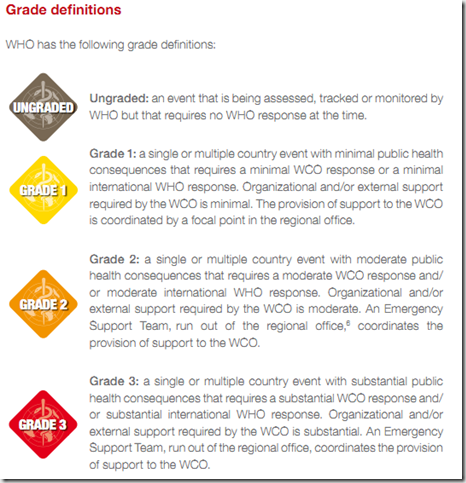
Today the World Health Organization has announced their determination of a GRADE 3 Emergency – and their immediate relief response - in a brief news item and followed up by an emailed press release.

image

WHO Emergency Response Framework


As you can see, a Grade 3 Emergency is the top of the scale.  First, the brief announcement from the WHO, followed by their emailed press release.


Haiyan (Yolanda) 2013

11 November 2013 -- IRINNEWS reports that aid agencies are bracing for the worst after Typhoon Haiyan slammed into the Philippines in the early hours of 8 November, triggering landslides, heavy flooding and affecting tens of millions of people. The category five super typhoon, locally known as Yolanda, struck the central island of Samar before moving west. Heavy rain flooded many areas but the full extent of the damage remains unknown. The Director-General of WHO has declared the crisis a Grade 3 emergency. WHO is resolving to put Organization-wide resources at the disposal of the WHO Head of Office for the Philippines and the Emergency Support Team that the Western Pacific Regional Office is establishing to support this operation.


And this from the emailed press release:


WHO RESPONDING TO HEALTH NEEDS CAUSED BY  TYPHOON HAIYAN (“YOLANDA”)

MANILA, Philippines ¦ 11 November 2013 – The World Health Organization (WHO) has activated an organization-wide mobilization to work closely with the Department of Health, Philippines (DoH) to organize relief efforts for the survivors of Typhoon Haiyan.

The typhoon—locally known as Yolanda—ravaged the central part of the archipelago Friday morning with winds reaching speeds of more than 250 km per hour causing storm surges of up to 5 metres. Many people living in these affected areas were injured and the devastating effects of this typhoon left already vulnerable health facilities damaged or completely destroyed. As a result of the breadth and severity of the storm, health services in the worst affected areas no longer exist or are severely stretched, with medical supplies in very short supply.

“We are working closely with the Philippine Government and local authorities to assess and rapidly address the life-saving needs of the people affected by this typhoon,” says Dr Julie Hall, WHO Representative to the Philippines. “WHO has an assessment team on the ground in Bohol, and we are sending teams to Cebu and Tacloban with the United Nations Disaster Assessment and Coordination (UNDAC) teams in support of national response efforts. WHO is flying in more than two dozen health emergency relief experts and emergency health kits for the initial response.”

The Government estimates that some 4.5 million people have been affected in the Central Philippines. WHO is mobilizing supplies to assist the government in providing a coordinated, effective and rapid response: 

  • An initial shipment of four emergency kits with medicines and supplies to cover basic health needs of 120 000 persons during one month and supplies to perform 400 surgical interventions are being deployed. Four diarrhoeal disease kits with medicines and supplies to treat 3000 cases of acute diarrhoea are also being sent.
  • WHO is also supporting the Department of Health (DoH) in strengthening its early warning alert and response network (EWARN) to rapidly detect disease outbreaks and other public health threats related to food and environmental hazards.
  • The Government is receiving international assistance such as field hospitals and medical teams, and WHO is working closely with the Government to ensure those supplies and teams go where they are needed most.
  • Medical storage spaces have also been damaged, and  WHO is working to re-establish logistics bases for new supplies that are arriving.


In the aftermath of the typhoon, reaching the affected areas and people has proven to be a sizeable logistical challenge. The true extent of the death and destruction has yet to be quantified. The super typhoon ripped roofs off houses and uprooted trees, interrupting telecommunications and electricity supplies. Many air- and sea-ports in the affected areas are closed. Until roads are cleared, movement will be difficult in these areas, posing significant logistical challenges to emergency relief operations.


Adding to the complexity of this response, another tropical storm is expected to hit the Philippines later this week. Foreign governments and international aid agencies have already pledged support in the form of air transportation and equipment, but more help is urgently needed to save the lives of the survivors.
WHO’s rapid deployment of health experts and supplies to the Philippines has been possible thanks to the financial support for surge capacity provided by numerous international partners, including the European Commission. Due to the magnitude of the disaster, WHO is seeking immediate financial contributions to cover initial response operations. A joint appeal by United Nations and non-governmental organizations will be issued in the coming days.

Tuesday, September 17, 2013

Philippines DFA: Filipino Nurse Died Of MERS in Saudi Arabia

image


# 7779


The story is all over the Filipino press this morning (see here, here & here), all stemming from a press briefing provided today (Sept 17th) by Department of Foreign Affairs (DFA) spokesperson Raul Hernandez, where he announced the death of a Filipino nurse – working in Saudi Arabia – from the MERS coronavirus. 


Hernandez also cites another Filipino as being hospitalized with the virus (reportedly acquired in the hospital while receiving dialysis), although a quick check of the DFA website turns up no printed announcement.


Trying to match these cases to the barebones reports we get from the Saudi MOH can be risky, but this may well be FluTrackers case #114 - Age 41, health care worker, Riyadh - Saudi Arabia Death reported on September 5th.  As the age of the second Filipino is not provided, I’m unable to hazard a guess as to whether she has been previously reported.


Although it may not be connected, you may recall that last week  Prince Sultan Military Medical City in Riyadh issued strenuous denials that a `Saudi nurse’  had died of MERS in their facility (see KUNA: Saudi Hospital Issues MERS Denial).  Since the name of the hospital where these cases occurred is not provided, we’ll have to wait to see if they are one and the same.


Here is the coverage of this story from GMA News.


DFA confirms first Pinay coronavirus death in Saudi

By MICHAELA DEL CALLAR September 17, 2013 5:48pm

A 41-year-old female Filipino nurse died of MERS coronavirus in Saudi Arabia last month, the Department of Foreign Affairs (DFA) said on Tuesday.

The Filipino, whose identity was not disclosed, is the first reported fatality from the Philippines. She died at a hospital in Riyadh last August 29.

A medical report obtained by the Philippine Embassy says the deceased “tested positive for the coronavirus before her death,” Foreign Affairs spokesman Raul Hernandez told a press briefing.

The hospital’s VIP ward supervisor said prior to her death, the Filipina went to the United States for a vacation on July 13. She returned to Riyadh on July 19 and reported for work on July 21.

In mid-August, she complained of fever and coughing and developed respiratory distress. She was put on a ventilator on Aug. 22.

Two days later, she was diagnosed with severe pneumonia and had to be transferred to the hospital’s Intensive Care Unit.

(Continue . . . )

Friday, August 31, 2012

Hawaii & Japan Tsunami Advisories


**** UPDATEUSGS lowers Magnitude to 7.6 ****

**** UPDATE: Tsunami Watch For Hawaii Cancelled ****

BULLETIN
TSUNAMI MESSAGE NUMBER   2
NWS PACIFIC TSUNAMI WARNING CENTER EWA BEACH HI
331 AM HST FRI AUG 31 2012

TO - CIVIL DEFENSE IN THE STATE OF HAWAII

SUBJECT - TSUNAMI WATCH CANCELLATION

THE EARTHQUAKE MAGNITUDE IS REDUCED.

THE TSUNAMI WATCH IS CANCELLED FOR THE STATE OF HAWAII EFFECTIVE
AT 0331 AM HST.

image

USGS Shake map


# 6528


Although it is not yet known whether a tsunami was generated by the 7.9 earthquake that occurred within the last hour east of the Philippines, Japan has issued a tsunami advisory, and Hawaii is under a tsunami watch.


This from the Pacific Tsunami Warning Center.


TO - CIVIL DEFENSE IN THE STATE OF HAWAII

SUBJECT - TSUNAMI WATCH

A TSUNAMI WATCH IS ISSUED FOR THE STATE OF HAWAII EFFECTIVE AT 0257 AM HST.

AN EARTHQUAKE HAS OCCURRED WITH THESE PRELIMINARY PARAMETERS

   ORIGIN TIME - 0248 AM HST 31 AUG 2012
   COORDINATES - 10.9 NORTH  127.1 EAST
   LOCATION    - PHILIPPINE ISLANDS REGION
   MAGNITUDE   - 7.9  MOMENT

EVALUATION

BASED ON ALL AVAILABLE DATA A TSUNAMI MAY HAVE BEEN GENERATED BY THIS EARTHQUAKE THAT COULD BE DESTRUCTIVE ON COASTAL AREAS EVEN
FAR FROM THE EPICENTER. AN INVESTIGATION IS UNDERWAY TO DETERMINE IF THERE IS A TSUNAMI THREAT TO HAWAII.

IF TSUNAMI WAVES IMPACT HAWAII THE ESTIMATED EARLIEST ARRIVAL OF THE FIRST TSUNAMI WAVE IS

                     1228 PM HST FRI 31 AUG 2012

MESSAGES WILL BE ISSUED HOURLY OR SOONER AS CONDITIONS WARRANT


Meanwhile, Japan’s Meteorological Agency has issued a Tsunami advisory for what may be a .5 meter tidal wave.

image

**********About Tsunami Forecast************
<Tsunami Advisory>
Tsunami height is expected to be about 0.5 meters. Attention advised.

******* Earthquake Information ********

Occurred at 
21:48 JST 31 Aug 2012

Region name 
PHILIPPINES AND ITS VICINITY

Latitude 10.9N

Longitude 127.1E

Depth Unknown

Magnitude  7.9


UPDATE:  No Destructive Tsunami Expected Along West Coast


To: U.S. West Coast, Alaska, and British Columbia coastal regions


From: NOAA/NWS/West Coast and Alaska Tsunami Warning Center


Subject: Tsunami Information Statement #2 issued 08/31/2012 at 6:36AM PDT


This message is updated with REVISED MAGNITUDE OF 7.6.


A strong earthquake has occurred, but a tsunami IS NOT expected along the California, Oregon, Washington, British Columbia, or Alaska coast. NO tsunami warning, watch or advisory is in effect for these areas.


A damaging tsunami IS NOT expected along the California, Oregon, Washington, British Columbia, and Alaska coasts although some of these areas may experience non-damaging sea level changes.

At 5:48 AM Pacific Daylight Time on August 31, an earthquake with preliminary magnitude 7.6 occurred in the Philippine Islands region . (Refer to the United States Geological Survey for official earthquake parameters.)


Pacific coastal regions outside California, Oregon, Washington, British Columbia, and Alaska should refer to the Pacific Tsunami Warning Center messages for information on the event.


This will be the final statement issued for this event by the West Coast/Alaska Tsunami Warning Center unless conditions warrant. See the WCATWC web site for basic tsunami information, safety rules, and a tsunami travel time map. (NOTE: Travel time maps indicate forecasted times only, not that a wave was generated.)

Philippines: 7.9 Quake & Tsunami Warning

****  UPDATE:  USGS lowers Magnitude to 7.6 ****

**** UPDATE: Tsunami Watch For Hawaii Cancelled ****

image

USGS Earthquake Map


# 6527


Preliminary reports indicate that a 7.9 magnitude quake has struck east of the Philippines, and a Tsunami warning and watch have been issued by the Pacific Tsunami Warning Center.


TSUNAMI BULLETIN NUMBER 001


PACIFIC TSUNAMI WARNING CENTER/NOAA/NWS
ISSUED AT 1255Z 31 AUG 2012

THIS BULLETIN APPLIES TO AREAS WITHIN AND BORDERING THE PACIFIC OCEAN AND ADJACENT SEAS...EXCEPT ALASKA...BRITISH COLUMBIA...
WASHINGTON...OREGON AND CALIFORNIA.

... A TSUNAMI WARNING AND WATCH ARE IN EFFECT ...

A TSUNAMI WARNING IS IN EFFECT FOR   INDONESIA / PHILIPPINES / BELAU / YAP / TAIWAN / JAPAN / GUAM / N. MARIANAS / PAPUA NEW GUINEA

A TSUNAMI WATCH IS IN EFFECT FOR   CHUUK / MARCUS IS. / KOSRAE / POHNPEI / MARSHALL IS. /
WAKE IS. / SOLOMON IS. / RUSSIA / NAURU

FOR ALL OTHER AREAS COVERED BY THIS BULLETIN... IT IS FOR INFORMATION ONLY AT THIS TIME.


At this time, we’ve no reports of damage, and we do not know whether a tsunami was generated, only that one is possible.


image

Tuesday, July 17, 2012

The Emerging Threat Of EV71


Photo Credit University of Iowa


# 6439

Although only recently making headlines in the mainstream media, Enterovirus 71 has been known for decades, and has been responsible for a number of severe disease outbreaks in small children, particularly across southeast Asia.


For some earlier blogs on this virus and some of the outbreaks it has caused, you may wish to revisit:

China: A Recombinant EV-71
China Sounds Alert Over EV-71 Virus
China: EV71 Claims 28th Victim, Authorities Warn of Possible `Mass Outbreak'
HFMD Outbreak In China Spreads To 25,000 Children


But it has been the recent outbreak in Cambodia (see Updating The Cambodian EV71 Story) that has helped to propel this virus into the public’s consciousness, and we are now seeing reports in the media on practically a daily basis.


Today, several reports, including one from the Philippines where Assistant Health Secretary Eric Tayag ominously warns that even as the world seeks to eradicate polio from the last four countries, that the EV71 virus may soon become `the new polio’.


EV-71 is the 'new polio,' health experts warn

by Rappler.com

Updated 07/17/2012 7:33 PM

MANILA, Philippines - Two children in the Philippines have been tested positive for "human enterovirus," but the strain is not similar to the EV-71 that has killed kids in Cambodia, the Department of Health said Tuesday, July 17.

(Continue . . .)


A bit premature perhaps, given that the numbers of severe EV71 infections currently pale in comparison to the horrific spread of Polio during the first half of the 20th century.


But there are some valid comparisons between the two viruses.  Both are highly contagious, and both strike predominantly in young children and can cause serious – even fatal – neurological damage. 


From The Lancet, we’ve this 2008 report that makes a similar comparison.


Enterovirus 71 infection: a new threat to global public health?

The Asia-Pacific region has seen more frequent and widespread outbreaks of enterovirus 71 infections in the past decade. Clinicians and researchers are calling for a better understanding of the evolution of such epidemics and for more proactive international public health polices. Jane Qiu reports.

Enterovirus 71 (EV71), a single-stranded RNA virus that belongs to the same category as poliovirus, has made another comeback in many parts of Asia. The reported frequency of EV71 infections are rising on a weekly basis: in Hong Kong, the number of cases reached 79 by late August, the highest in a decade. In some cases, EV71 infections cause hand—foot—mouth disease (HFMD), a common, contagious disease that usually affects children and that is characterised by flu-like symptoms; rash on hands, feet, and buttocks; mouth ulcers; poor appetite; and vomiting and diarrhoea.


However, HFMD can be life threatening, particularly if the virus causes inflammation of the brain stem, which can progress to heart failure and pulmonary oedema.


(Continue . . .)


With no vaccine, and no specific antiviral treatments available, the focus is on stopping the spread of the virus through good hygiene, and when needed, school closures.


Today, from Thailand’s The Nation, we get this report indicating that a number of schools are being closed due to HFMD.


29 Bangkok schools suspend classes following HFMD outbreak

July 17, 2012 6:46 pm


At least 29 schools in Bangkok have suspended some of their classes or shut down their whole facilities in the wake of the hand, foot, and mouth disease or HFMD outbreak.


"In Bangkok, most patients are young children aged not over four years old," Dr Wongwat Liewlak said Tuesday as the head of Bangkok Metropolitan Administration (BMA) Communicable Diseases Control Division.

According to the Public Health Ministry, 12,581 people have come down with the HMFD in Thailand between January 1 and July 9 this year. There is no report of casualties.


Another report out of Thailand, carried by Xinhua News, indicates:


Top Bangkok primary school closes due to hand, foot and mouth disease

Updated: 2012-07-17 15:46:00
(Xinhua)

BANGKOK, July 17 (Xinhua) -- Bangkok's top-rated Chulalongkorn University Demonstration Elementary School suspended classes from Tuesday through Friday after a number of students were infected with hand, foot and mouth disease, Thai News Agency reported.


Chalermpol Daoruang, the school's deputy director, said that the temporary closure came after an unspecified number of Grade 1 and 2 students were diagnosed with hand, foot and mouth disease ( HFMD).

(Continue . . .)


And yet another report, out of Taiwan today, CDC reports six new enterovirus cases. The good news: all but one of these cases have already been released from the hospital.


Whether EV71 turns out to be 2012’s disease-du-jour, or ends up becoming a pervasive public health problem remains to be seen.


It has the potential, but it may not have the `legs’.


Encouragingly, there does appear to be work going on to create a vaccine against EV71.  In the meantime, like everyone else, we’ll continue to watch the virus for signs of spread, or changes in its behavior.

Tuesday, July 10, 2012

EV71: Cambodia’s Prime Suspect


Photo Credit University of Iowa


# 6427


Although normally a mild childhood disease, HFMD (Hand, Foot, & Mouth Disease) has taken center stage in the media these past few days as one of the viruses (EV71) associated with that illness has been tentatively linked to dozens of deaths of Cambodian children over the past three months.


The epidemiological investigation is ongoing, with researchers looking for any possible complicating factors (or changes to the virus) that might explain the unusually high mortality rate being reported with this outbreak. 


We should know more in a few days, but as you’ll see, the EV71 virus doesn’t need any help to be deadly. 


HFMD can be caused by a variety of viruses, and most of the time, it is mild and only rarely requires medical attention.


The most common cause of the illness is the Coxsackie A16 virus, and more rarely the Coxsackie A10 virus. In recent years, we’ve also seen the emergence of the Coxsackie A6 virus which has been linked to somewhat more severe HFMD cases (see MMWR: Coxsackievirus A6 Notes From The Field).


But it is Enterovirus 71 that has been linked to the most severe cases of HFMD – particularly across Asia - with serious outbreaks recorded over the past dozen years in places like China, Taiwan, Malaysia, Hong Kong and most recently, Vietnam.


In addition to the classic HFMD symptoms, this virus has been known to produce serious neurological illness, including life threatening encephalitis. 


You can find more details on HFMD, and EV71, in the World Health Organization’s Hand, Foot and Mouth Disease Information Sheet, from which I’ve excerpted the following:


  • HFMD is usually a mild disease, and nearly all patients recover in 7 to 10 days without medical treatment and complications are uncommon.
    • Dehydration is the most common complication of HFMD infection caused by coxsackieviruses; it can occur if intake of liquids is limited due to painful sores in the mouth.
    • Rarely, patients develop "aseptic" or viral meningitis, in which the person has fever, headache, stiff neck, or back pain, and may need to be hospitalized for a few days.
  • HFMD caused by EV71 has been associated with meningitis and encephalitis, and on occasion can cause severe complications, including neurological, cardiovascular and respiratory problems. Cases of fatal EV71 encephalitis have occurred during outbreaks.


While the recent outbreak in Cambodia has raised alarms around the world, deadly outbreaks of EV71 are nothing new.  Last May, in CDC Issues HFMD Travel Notice For Vietnam, we looked at an outbreak that had claimed more than 20 lives.


In the News
Hand, Foot, and Mouth Disease in Vietnam

Released: May 25, 2012

What Is the Current Situation?

As of April 29, 2012, the Vietnam Ministry of Health has confirmed nearly 40,000 cases of hand, foot, and mouth disease (HFMD) since the beginning of 2012. Cases have occurred in 63 provinces, and 20 deaths (all in children under 5) have occurred in 10 provinces.

(Continue . . .)


The CDC also provides several  multimedia products related to hand, foot, and mouth disease.


Similarly, we’ve seen reports this week indicating that Hand, foot, mouth disease kills 240 in China.


We are seeing reaction to the Cambodian outbreak from several health departments across Asia, including Hong Kong, Thailand, and the Philippines.


First, Hong Kong’s CHP (Centre for Health Protection) which sent out this Update on An Unknown Disease in Cambodia letter to doctors in the region on July 9th, which asks that doctors notify the CHP of any suspected cases with recent travel history to Cambodia.


Possibly related, the CHP is reporting on Two cases of severe paediatric enterovirus infection, although the causative virus is not indentified.


In Thailand, The Nation newspaper is reporting that the MOH has instructed schools to close if an unusual number of HFMD cases are reported.


Disease warning for schools

The Nation July 10, 2012 5:47 pm

The Public Health Ministry on Tuesday instructed schools and nurseries nationwide to close if they find that students in five classes or more have contracted hand, foot and mouth disease.

(Continue . . . )


And perhaps the most proactive of all is the Philippines, where the Department of Health has ordered increased surveillance at airports, and has declared  EV-71 to be a notifiable disease. 


Here is the official press release:


DOH MAKES ENTEROVIRUS-71 INFECTION AS A NOTIFIABLE DISEASE

July 10, 2012

(Press Release – 10 July 2012)

Health Secretary Enrique T. Ona instructed today the Department of Health (DOH) National Epidemiology Center to include Enterovirus-71 (EV-71) infection as a notifiable disease in the country. This will compel all health providers especially physicians to report individual cases or even outbreaks.


“Mandatory notification will improve monitoring of EV-71 infections and ensure that necessary measures are in place to guarantee that the Philippines is free from the highly fatal severe form of EV-71 infections that have claimed the lives of at least 60 children in Cambodia since April this year,” Ona said.


Also, the DOH and the World Health Organization (WHO) clarified today that the Cambodian EV-71 was of the encephalitis type and not hand foot and mouth disease (HFMD) as earlier reported. Affected Cambodian children generally presented with fever followed by rapid respiratory deterioration and impaired consciousness. Death occurred 24 hours from hospital confinement.


EV-71 causes different diseases of varying intensity. These include the often mild hand, foot and mouth disease (HFMD), acute respiratory disease, acute flaccid paralysis (polio-like) and the deadly brainstem encephalitis. HFMD is characterized as a self-limiting illness presenting with fever and accompanied by skin lesions or rashes.


EV-71 infections do occur in the country but are reported with irregularity. Fatal EV-71 infection is still very rare in the Philippines.


Proper disposal of baby diapers or human waste, strict personal hygiene and regular hand washing prevent viral spread. The virus is known to be excreted in the feces since it is found in human intestines.


The DOH urges parents and day-care personnel to clean and disinfect toys and teaching tools that are easily shared with other children. This can prevent EV-71 infections, as there are no known effective drugs or vaccines.


‘There is still no travel restriction to and from Cambodia and incoming passengers will be subjected to thermal screening upon arrival in all international airports as a routine quarantine procedure,” the health chief concluded.


The statement above, that the `(WHO) clarified today that the Cambodian EV-71 was of the encephalitis type and not hand foot and mouth disease (HFMD)’ is something I’ve not been able to locate on the WHO site yet.  


And last, but certainly not least, Lisa Schnirring of CIDRAP NEWS wrote a detailed report last night on the Cambodian outbreak, which you can read at:


Enterovirus 71 cited in puzzling Cambodian infections

Lisa Schnirring * Staff Writer

Jul 9, 2012 (CIDRAP New) – Lab analysis in the mysterious recent illnesses and deaths of dozens of Cambodian children pointed to enterovirus 71 (EV-71), a virus that causes hand, foot, and mouth disease (HFMD) and can lead to severe complications in some patients, the World Health Organization (WHO) announced today.

(Continue . . .)


The peak season for HFMD is summer and fall, which suggests that we will be hearing about outbreaks of EV71, and other HFMD viruses, for months to come.