Showing posts with label Planning. Show all posts

Thursday, February 26, 2015

Do You Still Have A CPO?

image

125 Years of Pandemics – Credit ECDC 


# 9756


Although the next pandemic may not arrive for years, or even decades, the next big global health crisis could just as easily emerge this year or next. While many think we’ve `already had our pandemic’,  there is no mandated minimum `time out’ period between these global events.


We’ve seen 6 influenza pandemics over the past 120 years (plus several `close calls’ in 1951, 1975, 1976 see  Pseudo Pandemics And Viral Interlopers), and in recent years we’ve seen a sharp increase in the number of viral threats in circulation (Influenzas, coronaviruses, etc.). 


Last year, the Director of the CDCDr Thomas Frieden – weighed in on the pandemic threat in a special piece he penned for CNN News (see CDC Director Frieden: On Preventing A Pandemic).  He wrote:

While it is impossible to know when another pandemic will occur, few scientists doubt that it will happen again.  Pandemics have swept the globe for centuries, and show no signs of abating despite our modern medical advances.


According to respected anthropologist and researcher George Armelagos of Emory University, we have entered the age of re-emerging infectious diseases which he has dubbed The Third Epidemiological TransitionDr. Armelagos describes this trend in his 2010 paper The Changing Disease-Scape in the Third Epidemiological Transition.


It is characterized by the continued prominence of chronic, non-infectious disease now augmented by the re-emergence of infectious diseases. Many of these infections were once thought to be under control but are now antibiotic resistant, while a number of “new” diseases are also rapidly emerging. The existence of pathogens that are resistant to multiple antibiotics, some of which are virtually untreatable, portends the possibility that we are living in the dusk of the antibiotic era. During our lifetime, it is possible that many pathogens that are resistant to all antibiotics will appear. Finally, the third epidemiological transition is characterized by a transportation system that results in rapid and extensive pathogen transmission.


In other words, the emergence of MERS-CoV, H5N1, Nipah, Hendra, Lyme Disease, H7N9, H5N6, H10N8, NDM-1, CRE, etc. are not temporary aberrations. They are the new norm, and we should get used to seeing more like these appear in the coming years.


In December of 2012 the U.S. National Intelligence Council released a report called  "Global Trends 2030: Alternative Worlds" that tries to anticipate the global shifts that will likely occur over the next two decades (see Black Swan Events). Number one on their hit parade?

Global Trends 2030's potential Black Swans

1. Severe Pandemic

"No one can predict which pathogen will be the next to start spreading to humans, or when or where such a development will occur," the report says. "Such an outbreak could result in millions of people suffering and dying in every corner of the world in less than six months."

The threat of another influenza pandemic is consistently ranked higher by most governments than a major cyber/terrorist attack, solar flare, or nuclear/WMD war – and is considered all but inevitable by many experts.


A decade ago, we saw a massive global push for pandemic preparedness, and many groups selected a CPO; a Chief Pandemic Officer.  Someone in their business, organization, or family - whose job it was to coordinate their pandemic plan  (see Quick! Who's Your CPO?)..


Unfortunately, since the 2009 pandemic was perceived by many as being mild and the next event thought years away, many corporate, organizational, or agency pandemic plans haven’t been updated – or in many cases even looked at – in years.


While it may sit on the back-burner for most people, Ready.gov and FEMA continue to urge pandemic preparedness.  This from Ready.gov:


Pandemic

Inspire others to act by being an example yourself, Pledge to Prepare & tell others about it!

Pledge to Prepare

You can prepare for an influenza pandemic now. You should know both the magnitude of what can happen during a pandemic outbreak and what actions you can take to help lessen the impact of an influenza pandemic on you and your family. This checklist will help you gather the information and resources you may need in case of a flu pandemic.

Plan for a Pandemic

  • Store a two week supply of water and food. During a pandemic, if you cannot get to a store, or if stores are out of supplies, it will be important for you to have extra supplies on hand. This can be useful in other types of emergencies, such as power outages and disasters.
  • Periodically check your regular prescription drugs to ensure a continuous supply in your home.
  • Have any nonprescription drugs and other health supplies on hand, including pain relievers, stomach remedies, cough and cold medicines, fluids with electrolytes, and vitamins.
  • Get copies and maintain electronic versions of health records from doctors, hospitals, pharmacies and other sources and store them, for personal reference. HHS provides an online tool intended to help people locate and access their electronic health records from a variety of sources. http://healthit.gov/bluebutton
  • Talk with family members and loved ones about how they would be cared for if they got sick, or what will be needed to care for them in your home.
  • Volunteer with local groups to prepare and assist with emergency response.
  • Get involved in your community as it works to prepare for an influenza pandemic.


If you are an employer, you should know that OSHA considers it your responsibility to provide a safe workplace and has produced specific guidance on preparing workplaces for an Influenza Pandemic  along with Guidance for Protecting Employees Against Avian Flu

image


Meanwhile, Flu.gov – the government’s influenza pandemic portal – has these (and other) documents available for business pandemic preparedness:


 They also say in their community preparedness section:


Pandemic Flu 

The federal government cannot prepare for or respond to the challenge of a flu pandemic alone. Your community can develop strategies that reduce the impact and spread of pandemic flu.

Faith-Based & Community Organizations Pandemic Influenza Preparedness Checklist (PDF – 68.91 KB)

Lista de Preparacion para una Pandemia de Gripe Tanto para Organizaciones Comunitarias como Religiosas (PDF – 268 KB)

Community Strategy for Pandemic Influenza Mitigation (PDF – 10.3 MB)

Plan Now to Be Ready for the Next Flu Pandemic (PDF – 213.55 KB)

The Next Flu Pandemic: What to Expect (PDF – 226.83 KB)


image

image

Their advice (and this is for before a pandemic threat becomes imminent).

image


And if you follow only one link from this blog post, I’d recommend the following 20 minute video produced by Public Health - Seattle & King County -  called Business Not As Usual .

image

If you’ve not seen this movie, or haven’t seen it recently, it is well worth taking the time to watch it.


If preparing for a pandemic seems like a lot of work, you’re right. 


This it isn’t something you want to start doing after a pandemic threat has already appeared. Pandemic planning should be part of your (company, agency, even family) overall disaster & recovery plan, and if you haven’t updated that recently, you (or your CPO) have a fair amount of work to do.  


For more information on pandemic planning, you may want to revisit:

Pandemic Planning For Business
NPM13: Pandemic Planning Assumptions
The Pandemic Preparedness Messaging Dilemma

Tuesday, October 28, 2014

Sandman & Lanard On Ebola & Failures Of Imagination

image
Credit CDC PHIL


# 9258


Yesterday author, blogger, and scary disease girl extraordinaire Maryn McKenna featured a long-read by risk communications experts Dr. Peter Sandman & Dr. Jody Lanard (see her wired blog The Grim Future if Ebola Goes Global) on the conversation that no one in authority seems willing to have right now: 


What happens if Ebola is not contained in West Africa?


First, a strong recommendation to read the analysis by Sandman & Lanard in its entirety if you haven’t already, after which I’ll have a bit more.


Ebola: Failures of Imagination

by Jody Lanard and Peter M. Sandman

The alleged U.S. over-reaction to the first three domestic Ebola cases in the United States – what Maryn McKenna calls Ebolanoia – is matched only by the world’s true under-reaction to the risks posed by Ebola in Liberia, Sierra Leone, and Guinea. We are not referring to the current humanitarian catastrophe there, although the world has long been under-reacting to that.

We will speculate about reasons for this under-reaction in a minute. At first we thought it was mostly a risk communication problem we call “fear of fear,” but now we think it is much more complicated.

(Continue . . . )

 
Highly recommended.


Admittedly, I too have found it hard to paint a bleak picture of where this Ebola epidemic could lead – partially, I think as a subconscious pushback against the over-the-top fear mongering that is all too rampant online, and partially due to my deep-seated ex-paramedic mindset of `No matter how bad things get, don’t get rattled, just carry on.’


And to be very clear, while my crystal ball is cracked and fogged up badly, my `bleak picture’ isn’t one of massive Ebola epidemics sweeping across the nation, or mass graves in the developed world.  


While there are respiratory pathogens out there capable of such carnage, I don’t believe Ebola (in its present incarnation, anyway) to be one of them.

NOTE: The `weasel wording’ in the previous sentence is 100%  intentional, as I think it is important to push back against the absolute assurances constantly being uttered by nervous officials.  

Previously, in An Appropriate Level Of Concern Over Ebola In The US,  I wrote:


That is not to say we won’t see impacts from this epidemic.  We already have – in Dallas – and I quite expect we will again.  We could certainly see limited spread here, and even small clusters of cases.  And while it won’t be pretty, and the response may not be perfect,  I have enough faith in our public health infrastructure to believe they would be able to control it.

Now, if Ebola ever finds a way to spread through the mega-cities of Africa, India, Pakistan, or some other high-population, low resource region of the world – the economic, societal, and political destabilization that could occur might change both the nature, and degree, of this epidemic’s threat to the developed world. 


A veiled vision, cloaked in ambiguity, that only tentatively hints at what failure to contain the virus in Africa could mean to the rest of the world.  Hindered, no doubt, by my own personal `failure of imagination’, and by the difficulties of accurately projecting the impact of a slow-motion strain wreck. 


An epidemic that spreads inexorably – not over weeks or months – but potentially over years.


Spreading more like HIV, TB, or Hepatitis than what we might expect from an emerging pandemic virus. Unlike those scourges, however, Ebola kills very quickly – in a matter of days – which increases its immediate impact.


How that might play out on the global stage six months or a year from now is very tough to envision, but in a world already roiled in crises, its impact can’t be ignored.


Over the years we’ve looked at the real possibility of seeing a Black Swan Event – a  world-changing incident that few, if anyone, had predicted. The phrase was coined by Nassim Nicholas Taleb in his 2004 book Fooled By Randomness, and expanded upon in his 2007 book The Black Swan.


Black swan events can arise in a lot of different ways, and various national security documents over the years have analyzed, and warned about, many possible scenarios. 


  • A Pandemic
  • A Cyber Attack
  • A Financial Crisis
  • A Geomagnetic Storm
  • Social Unrest/Revolution


It is no coincidence that a severe pandemic ranks at the top of almost every list of highly disruptive national security threats (see 2011 OECD Report: Future Global ShocksUK: Civil Threat Risk Assessment, Influenza Pandemic As A National Security Threat).   


Is Ebola a black swan event?   I honestly don’t know. But it could be if it isn’t contained.


And right now, despite the upbeat messaging that `we know how to stop Ebola’, there are too many unknowns to be overly confident in the outcome.  Some may say that `failure is not an option’, but the truth is, history is replete with failures.  


We just tend to call them something else in the history books.


When my wife and I moved aboard our cruising sailboat in 1986, we immediately purchased a combination inflatable dingy/life raft.  We didn’t plan on sinking, but we also knew the ocean might have other plans for us. So with the kind of fatalism only longtime liveaboard sailors can muster, we christened it  `Plan B’.  


I’m happy to report it was never used for anything more desperate than rowing ashore to pick up another case of beer.   But it was there, equipped and ready, for any emergency.


While I hope we don’t ever need it, we need to be thinking about what our collective Plan B will be, if Ebola isn’t contained in West Africa. And that means thinking about, publicly talking about, and planning for the kind of disruptions that might occur if the virus makes its way to the mega-cities of Africa,  India, China, or South America.


Eight years ago the governments of the world urged agencies, organizations, businesses, and individuals to take a good hard look at their daily operations, and plan on how they would cope during a severe influenza pandemic. Since the relatively mild pandemic of 2009, the idea of pandemic planning has largely fallen to neglect.


Now might be a very good time to dust off your old pandemic plans, update them as necessary, and encourage others to do so.


Because, if Ebola doesn’t turn out to be the next great global public health crisis, there are plenty of other contenders waiting in the wings that could.

Tuesday, September 09, 2014

NPM14: Because Pandemics Happen

image

Credit ECDC – 125 years of  Pandemic  History


Note: This is one of a continuing series of preparedness blogs for this year’s National Preparedness Month.  You can search for NPM14 (or last year’s NPM13) to find additional entries.


# 9058


While the timing, source, or severity of the next pandemic is unknowable, history tells us that influenza pandemics come along several times each century, making it very likely we will see another one sometime in the not-to-distant future.


Although a novel strain of influenza is considered the most likely contender, we’ve seen evidence over the past decade that non-influenza viruses – like SARS and MERS – have pandemic potential, as well.


Last February, in Influenza Pandemic As A National Security Threat,  we looked at a threats assessment by the Director Of National Intelligence that included:

Worldwide Threats Assessment – published January 29th, 2014,

(Excerpt)

Health security threats arise unpredictably from at least five sources: 

  • the emergence and spread of new or reemerging microbes;
  • the globalization of travel and the food supply;
  • the rise of drug-resistant pathogens;
  • the acceleration of biological science capabilities and the risk that these capabilities might cause inadvertent or intentional release of pathogens; and
  • adversaries’ acquisition, development, and use of weaponized agents. 


In December of 2012 the U.S. National Intelligence Council released a report called  "Global Trends 2030: Alternative Worlds" that tries to anticipate the global shifts that will likely occur over the next two decades (see Black Swan Events). Number one on their hit parade?

Global Trends 2030's potential Black Swans

1. Severe Pandemic

"No one can predict which pathogen will be the next to start spreading to humans, or when or where such a development will occur," the report says. "Such an outbreak could result in millions of people suffering and dying in every corner of the world in less than six months."

The threat of another influenza pandemic is consistently ranked higher by most governments than a major cyber/terrorist attack, solar flare, or nuclear/WMD war – and is considered all but inevitable by many experts.


Despite the known risks, pandemic preparedness over the past few years has largely fallen by the wayside.


The declassification last year of a 2009 Northern Command Pandemic Plan (see SciAm story Pandemic Flu Plan Predicts 30% of U.S. Could Fall Ill) briefly caught the attention of a number of news organizations and websites with its estimates that during a moderately severe pandemic 30% of the population could fall ill, 3 million could require hospitalization, and 2 million Americans could die.

Although a certain amount of surprise was registered in these media reports, these are roughly the same numbers that were being openly discussed by local, state, and federal agencies during the pandemic planning phase of 2006-2008.

image 

Credit - HHS Interim Pre-Pandemic Planning Guidence: Community Strategy For Pandemic Influenza Mitigation In the United States.

In fact, in 2008, the HHS outlined their vision of the likely impact in the United States of a severe and a moderate pandemic (see A Tale Of Two Scenarios).   As you’ll see, the numbers of hospitalizations anticipated during a severe pandemic is quite a bit higher than the Northcom plan.

The HHS defined a severe pandemic as:

    • An attack rate of 30% (90 million Americans sickened)
    • 50% (45 million) requiring outpatient medical care
    • 11% (9.9 million) requiring hospitalization
    • 745,000 requiring mechanical ventilation
    • 1.9 million deaths (2.1% fatality ratio)

A moderate (1958/68-like) pandemic is described as follows:

    • An attack rate of 30% (90 million Americans sickened)
    • 50% (45 million) requiring outpatient medical care
    • .9% (865,000) requiring hospitalization
    • 64,875 requiring mechanical ventilation
    • 209,200 deaths (.23% fatality ratio)

In other words, while the number of people affected doesn't change, a severe pandemic is envisioned to be about 10 times worse than a moderate one.


Pandemics, like hurricanes, are measured on a five point scale, with a CAT 5 pandemic – as bad or worse than 1918 – at the top of the scale.  While there are many similarities between the hurricane and pandemic scales, there is one aspect where they differ greatly.


With Hurricanes, there are physical limitations that keep the storms from growing much stronger than 200 mph winds. Category 5 storms start at 156 MPH, and these storms are only capable of intensifying about 35% above that wind speed.


There are no such restraints on a severe pandemic. While a 2% CFR indicates a Cat 5 pandemic, so does a 5% or 10% CFR. Yet, the difference between the impact of these three CFRs would be enormous. Although the 1918 pandemic is often used as a model for the next severe pandemic, doctors and scientists generally admit that the Spanish Flu isn't the worst that nature could throw at us.

image


The thing about pandemics is, even after one starts, you never know how bad it is going to be until it is over.   And even then it can take years to sort our just how bad it really was.  Experts continue to wrestle with the toll of the 2009 H1N1 pandemic. 


A pandemic can start out mild, and over time become more virulent – as did the 1918 H1N1 pandemic -  or it could look really serious at the start, but prove milder than expected (as we saw in 2009). 


While we can’t know when the next pandemic will arrive, or how bad it may be, we can prepare for a `reasonable-worst-case’ scenario – which  is probably somewhere on the order of the 1918 Spanish Flu.  To that end, the HHS has a number of pandemic planning toolkits available on their Flu.gov website.


Pandemic Flu

The federal government cannot prepare for or respond to the challenge of a flu pandemic alone. Your community can develop strategies that reduce the impact and spread of pandemic flu.

Faith-Based & Community Organizations Pandemic Influenza Preparedness Checklist (PDF – 68.91 KB)

Lista de Preparacion para una Pandemia de Gripe Tanto para Organizaciones Comunitarias como Religiosas (PDF – 268 KB)

Community Strategy for Pandemic Influenza Mitigation (PDF – 10.3 MB)

Plan Now to Be Ready for the Next Flu Pandemic (PDF – 213.55 KB)

The Next Flu Pandemic: What to Expect (PDF – 226.83 KB) (excerpts below)

image

image

Their advice (and this is for before a pandemic threat becomes imminent).

image

Over the past 18 months I’ve written a number of pandemic preparedness blogs, including what the United States government is doing to prepare for a possible pandemic.  You can revisit these at the following links:


The Pandemic Preparedness Messaging Dilemma
Pandemic Planning For Business
CDC: Pandemic Planning Tips For Public Health Officials
H7N9 Preparedness: What The CDC Is Doing


Admittedly, we may not see another severe pandemic for years, or even decades. But we are entering the winter respiratory season in the Northern hemisphere, and we have a full plate of novel influenza viruses we are watching for development – including H7N9, H5N1, H10N8, and H5N6.


Since it is impossible to predict when the next pandemic will occur, it makes sense to incorporate pandemic planning into your family, community or business disaster plans now, and in the future.  


Sunday, August 17, 2014

UK: Updated Pandemic Response Plan & Exercise Cygnus

image

Credit ECDC – 125 years of  Pandemic  History


# 8963


Although it is not often front and center in the news, or in the daily threats messaging from most governments, an influenza pandemic is considered among the most likely high-impact global threats that we could face in the foreseeable future. 


Earlier this year, in Influenza Pandemic As A National Security Threat,  we looked at a threats assessment by the Director Of National Intelligence that included:


Worldwide Threats Assessment – published January 29th, 2014,

(Excerpt)

Health security threats arise unpredictably from at least five sources: 

  • the emergence and spread of new or reemerging microbes;
  • the globalization of travel and the food supply;
  • the rise of drug-resistant pathogens;
  • the acceleration of biological science capabilities and the risk that these capabilities might cause inadvertent or intentional release of pathogens; and
  • adversaries’ acquisition, development, and use of weaponized agents. 


In December of 2012 the U.S. National Intelligence Council released a report called  "Global Trends 2030: Alternative Worlds" that tries to anticipate the global shifts that will likely occur over the next two decades (see Black Swan Events).  Number one on their hit parade?


Global Trends 2030's potential Black Swans

1. Severe Pandemic

"No one can predict which pathogen will be the next to start spreading to humans, or when or where such a development will occur," the report says. "Such an outbreak could result in millions of people suffering and dying in every corner of the world in less than six months."


Similarly, last year the UK’s National Risk Registry of Civil Emergencies listed Influenza at their nation’s #1 threat.

The highest priority risks


2.2 The following are considered by the Government to be the highest priority risks of emergency, taking both likelihood and impact into account:


Pandemic influenza – This remains the most significant civil emergency risk. The outbreak of H1N1 influenza in 2009 (‘swine flu’) did not match the severity of the scenario that we plan for and is not necessarily indicative of future pandemic influenzas; the three influenza pandemics of the 20th century (1918–19, 1957–58 and 1968–69) all had differing levels of severity. The 2009 H1N1 pandemic does not change the risk of another pandemic emerging (such as an H5N1 (‘avian flu’) pandemic) or mean that the severity of any future pandemics will be the same as the 2009 H1N1 outbreak.


The threat of another influenza pandemic consistently ranks higher than that of a major cyber/terrorist attack, solar flare, or nuclear/WMD war – and is considered all but inevitable by many experts (although the timing & severity are unknown).


Yet for the public it remains a distant and rarely considered threat.


In the middle part of the last decade there was a big push to prepare for a pandemic, by both the public and private sector.  The fear back then was the H5N1 `bird flu’, but instead we were blindsided by a much milder H1N1 pandemic in 2009.


While not a walk in the park, the 2009 pandemic failed to live up to the early hype, and given these tough economic times - and the false perception that modern pandemics are unlikely to be severe - many businesses have now put pandemic planning on the back burner.


Ironically, the risk of a severe influenza pandemic today is arguably much greater than it was in 2006. 


Back then, we were essentially worried about the H5N1 avian flu virus, that had infected (at that time) only about 300 people, killing roughly 60% of them.  Over the past two or three years we’ve seen an explosion of novel flu & respiratory viruses jumping to humans including: 

  • H7N9
  • MERS-CoV
  • H10N8
  • H5N6
  • H6N1
  • H9N2
  • Swine Variant H3N2v, H1N1v, H1N2v


And, as we discussed in the past (see H2N2: What Went Around, Could Come Around Again), close relatives of older pandemic strains still circulate in the wild as well,  and could return someday.


And of course, there’s always VIRUS X . . the one we don’t know about, yet.


On Friday Public Health England released an updated  Pandemic influenza response plan, which can be downloaded in the two PDF files below.


This PHE plan describes the staff roles for all directorates during the 5 pandemic phases: detection, assessment, treatment, escalation and recovery (DATER).

Documents

Pandemic influenza response plan

PDF, 1.01MB, 88 pages

Pandemic influenza strategic framework

PDF, 299KB, 19 pages

Detail

This plan and the learning from the national multiagency pandemic influenza Exercise Cygnus in late 2014, will inform the further development of comprehensive and integrated plans in delivering an effective and sustainable response across the organisation.

This system of cross-organisational working will deliver the resources, science and leadership required during the pandemic in order to support the staff and organisational response from local and national centres, and laboratories.


Mentioned above is Exercise Cygnus, which in October will test over three days the readiness of the UK to respond to a serious pandemic threat.  Some excerpts from an overview of the exercise follow:


image


image

image


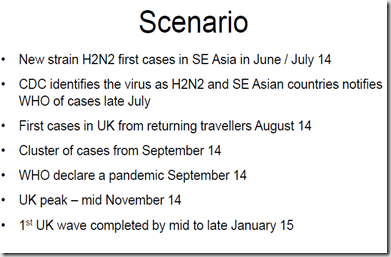
Interestingly, they have chosen to revive the H2N2 virus which last emerged in 1957 as a pandemic, and disappeared (in humans) in 1968 when it was supplanted by the H3N2 virus.  Anyone born after 1968 would have little or no immunity to this virus.  


As we’ve discussed previously (see Are Influenza Pandemic Viruses Members Of An Exclusive Club?) – while we worry about the H5 & H7 avian flu strains – only H1, H2, and H3 viruses have been known to cause pandemics in the past 125 years.


In 2006 and 2007 a lot of businesses and organizations invested considerable time and money into creating comprehensive pandemic plans.  Most of those have probably not been updated – or even looked at – since the 2009 pandemic, and many are woefully in need of updating.  


Businesses change, people move on, supplies are used up and not replaced. That dust covered plan buried in your bottom drawer may not be as relevant or useful today as it was when it was first created. 


And of course, there are many new companies and entities that weren’t around 8 years ago, and plenty more that never created a plan in the first place.


While no one can predict when, how severe, or what virus will spark the next pandemic -  the risks of seeing a severe pandemic have not diminished.  Which is why everyone – not just government agencies, and healthcare facilities – should give some thought as to how they would deal with a large scale epidemic or even a pandemic.

image

Credit CDC 

Last October, in Pandemic Preparedness: Taking Our Cue From The Experts, I wrote about personal and business pandemic preparedness, which included numerous links to governmental guidance documents, and an excellent 20 minute video produced by Public Health - Seattle & King County -  called Business Not As Usual .

If you’ve not seen this movie, or haven’t seen it recently, it is well worth taking the time to watch it.

image

You’ll also find a long list of preparedness resources available on this page as well:


Another good resource comes from the Trust for America’s Health.

image

Credit TFAH It's Not Flu As Usual Brochure


Having a good pandemic/disaster plan could easily spell the difference between a business weathering a pandemic or going out of business.  Making this a good time to drag your plan out, and make sure that it is adequate to the task.


For more information on pandemic planning, you may want to revisit:


Pandemic Planning For Business
NPM13: Pandemic Planning Assumptions
The Pandemic Preparedness Messaging Dilemma

Wednesday, September 18, 2013

NPM13: Pandemic Planning Assumptions

image

Credit - HHS Interim Pre-Pandemic Planning Guidence: Community Strategy For Pandemic Influenza Mitigation In the United States.


Note: This is day 18 of National Preparedness Month.  Follow this year’s campaign on Twitter by searching for the #NPM or #NPM13 hash tag.

This month, as part of NPM13, I’ll be rerunning some updated  preparedness essays (like this one) , along with some new ones.


# 7783


The declassification this week of a 2009 Northern Command Pandemic Plan (see SciAm story Pandemic Flu Plan Predicts 30% of U.S. Could Fall Ill) has caught the attention of a number of news organizations and websites with its estimates that during a moderately severe pandemic 30% of the population could fall ill, 3 million could require hospitalization, and 2 million Americans could die.


Although a certain amount of surprise is registered in these media reports, these are roughly the same numbers that were being openly discussed by local, state, and federal agencies during the pandemic planning phase of 2006-2008.


In fact, in 2008, the HHS outlined their vision of the likely impact in the United States of a severe and a moderate pandemic (see A Tale Of Two Scenarios).   As you’ll see, the numbers of hospitalizations anticipated during a severe pandemic is quite a bit higher than the Northcom plan.


The HHS defined a severe pandemic as:

    • An attack rate of 30% (90 million Americans sickened)
    • 50% (45 million) requiring outpatient medical care
    • 11% (9.9 million) requiring hospitalization
    • 745,000 requiring mechanical ventilation
    • 1.9 million deaths (2.1% fatality ratio)

A moderate (1958/68-like) pandemic is described as follows:

    • An attack rate of 30% (90 million Americans sickened)
    • 50% (45 million) requiring outpatient medical care
    • .9% (865,000) requiring hospitalization
    • 64,875 requiring mechanical ventilation
    • 209,200 deaths (.23% fatality ratio)


In other words, while the number of people affected doesn't change, a severe pandemic is envisioned to be about 10 times worse than a moderate one.


Pandemics, like hurricanes, are measured on a five point scale, with a CAT 5 pandemic – as bad or worse than 1918 – at the top of the scale.  While there are many similarities between the hurricane and pandemic scales, there is one aspect where they differ greatly.


With Hurricanes, there are physical limitations that keep the storms from growing much stronger than 200 mph winds. Category 5 storms start at 156 MPH, and these storms are only capable of intensifying about 35% above that wind speed.


There are no such restraints on a severe pandemic. While a 2% CFR indicates a Cat 5 pandemic, so does a 5% or 10% CFR. Yet, the difference between the impact of these three CFRs would be enormous. Although the 1918 pandemic is often used as a model for the next severe pandemic, doctors and scientists generally admit that the Spanish Flu isn't the worst that nature could throw at us.

image


The thing about pandemics is, even after one starts, you never know how bad it is going to be until it is over.   And even then it can take years to sort our just how bad it really was.  Experts continue to wrestle with the toll of the 2009 H1N1 pandemic. 


A pandemic can start out mild, and over time become more virulent – as did the 1918 H1N1 pandemic -  or it could look really serious at the start, but prove milder than expected (as we saw in 2009). 


While we can’t know when the next pandemic will arrive, or how bad it may be, we can prepare for a `reasonable-worst-case’ scenario – which  is probably somewhere on the order of the 1918 Spanish Flu.  To that end, the HHS has a number of pandemic planning toolkits available on their Flu.gov website.


Pandemic Flu 

The federal government cannot prepare for or respond to the challenge of a flu pandemic alone. Your community can develop strategies that reduce the impact and spread of pandemic flu.

Faith-Based & Community Organizations Pandemic Influenza Preparedness Checklist (PDF – 68.91 KB)

Lista de Preparacion para una Pandemia de Gripe Tanto para Organizaciones Comunitarias como Religiosas (PDF – 268 KB)

Community Strategy for Pandemic Influenza Mitigation (PDF – 10.3 MB)

Plan Now to Be Ready for the Next Flu Pandemic (PDF – 213.55 KB)

The Next Flu Pandemic: What to Expect (PDF – 226.83 KB) (excerpts below)

image

image

Their advice (and this is for before a pandemic threat becomes imminent).

image


Over the past six months I’ve written a number of pandemic preparedness blogs, including what the United States government is doing to prepare for a possible pandemic.  You can revisit these at the following links:


The Pandemic Preparedness Messaging Dilemma
Pandemic Planning For Business
CDC: Pandemic Planning Tips For Public Health Officials
H7N9 Preparedness: What The CDC Is Doing


Admittedly, we may not see another severe pandemic for years, or even decades. But since it is impossible to predict when the next one will occur, it makes sense to incorporate pandemic planning into your family, community or business disaster plans.  


Ready.gov offers the following basic advice for families and individuals.


Pandemic

Inspire others to act by being an example yourself, Pledge to Prepare & tell others about it!

Pledge to Prepare

You can prepare for an influenza pandemic now. You should know both the magnitude of what can happen during a pandemic outbreak and what actions you can take to help lessen the impact of an influenza pandemic on you and your family. This checklist will help you gather the information and resources you may need in case of a flu pandemic.

Plan for a Pandemic

  • Store a two week supply of water and food. During a pandemic, if you cannot get to a store, or if stores are out of supplies, it will be important for you to have extra supplies on hand. This can be useful in other types of emergencies, such as power outages and disasters.
  • Periodically check your regular prescription drugs to ensure a continuous supply in your home.
  • Have any nonprescription drugs and other health supplies on hand, including pain relievers, stomach remedies, cough and cold medicines, fluids with electrolytes, and vitamins.
  • Talk with family members and loved ones about how they would be cared for if they got sick, or what will be needed to care for them in your home.
  • Volunteer with local groups to prepare and assist with emergency response.
  • Get involved in your community as it works to prepare for an influenza pandemic.

Sunday, July 07, 2013

Pandemic Planning For Business

image

Credit TFAH It's Not Flu As Usual Brochure


# 7455


Six years ago, before the H1N1 pandemic emerged in 2009, we were carefully monitoring the H5N1 threat while governments, agencies, and businesses actively prepared for a severe pandemic.


As States and Federal agencies drilled and prepared, the HHS released guidance to local governments, individuals and businesses on how to prepare for `the next pandemic’.


A small sampling includes:

 
Guidance for Employers


When the pandemic finally arrived, it turned out to due to a less severe strain of Swine flu; H1N1.   We got `lucky’ in that we ended up with a `Cat 1’ pandemic, not the feared Category 5 event that most plans had envisioned.


image


Since the end of 2009 - between the prolonged economic downturn and the belief that we’d seen `our pandemic’, and another would not likely occur for decades – pandemic preparedness for many businesses has been put on the back burner. 


Many of the carefully prepared pandemic plans drafted in 2006 or 2007 are now gathering dust in some desk drawer, and have not been reviewed or updated for years.


No one can predict when, how severe, or what virus will spark the next pandemic.  But the risks of seeing a severe pandemic have not diminished. With three legitimate pandemic `worries’ out there (H5N1, H7N9, MERS-CoV) – if anything, they’ve escalated


Making this an opportune time to drag out, dust off, and take a hard look at your old pandemic plans (or create a new one if need be).


One of the nation’s leaders in pandemic and disaster planning is Public Health - Seattle & King County.  In 2008 they produced a 20 minute film called Business Not As Usual, designed to help introduce businesses to the core concepts of pandemic planning.


Frankly, this video should be required viewing for every businesses owner, manager, and employee.

image


You’ll also find a long list of preparedness resources available on this page as well:

General resources:

Business and government preparedness:

Community Based Organization (CBO) preparedness:

Personal preparedness:


While another pandemic may not come for years, if you and your business are well prepared to deal with a Cat 4 or 5 pandemic, you are pretty much ready to deal with any disaster.


And as bitter experience has shown, earthquakes, floods, tornadoes, hurricanes, industrial accidents, and even terrorist attacks can, and do happen with some frequency.


Often, the difference between a business surviving a disaster – or going bankrupt - boils down to how well their emergency and recovery plans were designed and implemented.


For more on  disaster preparedness, I would invite you to visit Ready.gov, FEMA,  or revisit these blogs:


In An Emergency, Who Has Your Back?

When 72 Hours Isn’t Enough

The Gift of Preparedness 2012

Wednesday, April 24, 2013

H7N9: Japan Prepares A Public Health Response


image


# 7185


Even before this morning’s announcement that Taiwan Confirms First Imported Case Of H7N9, health experts around the globe have been fully expecting that cases would eventually show up outside of mainland China.


Last week, in a Q&A on the virus, the CDC matter-of-factly stated:


Is it possible that human cases of H7N9 flu will be found in the United States?

Yes. The most likely scenario for this right now would be H7N9 infection in a traveler from China. Many people travel between China and the United States. CDC issued a health alert for public health officials and clinicians in the United States to be on the look-out for flu symptoms in travelers who are returning from countries with bird flu. CDC has issued guidance for isolating, testing, and treating such patients.


However, since this virus does not seem to be spreading easily from person-to-person, a few cases in the United States with travel links to China would not change the risk of infection for the general public in the United States.


As long as the virus is difficult to transmit from human-to-human, then small importations of the virus would not be terribly alarming, and could likely be handled.  


But health experts also recognize that this virus could mutate and gain more transmissibility, and pose a greater threat. Which is why in Japan they are strengthening their ability to respond to a public health crisis with new legislation.


The Japan Times is reporting this morning on a variety of measures Japan’s government plans to implement to allow them to combat any potential pandemic threat, including designating H7N9 as a quarantinable infectious disease.


Based on the reporting in this article, when the government `strongly advises’ its citizens to stay home if they are sick, they apparently mean it.


First a link to the story, then I’ll be back with a little more.


H7N9 defense measures prepared

Kyodo, JIJI Apr 24, 2013

To defend against the H7N9 strain of bird flu rapidly spreading in China, governors will be authorized to “strongly advise” people who are sick or suspected of being infected with the disease to be hospitalized and to restrict their employment, according to countermeasures compiled Wednesday by a health ministry panel.


Those who ignore the orders will face punishment.


Health, Labor and Welfare Ministry officials said ordinances under the Infectious Disease Law and the Quarantine Law will be revised early next month.

(Continue . . . )


While this may seem a bit premature, given the lack of sustained human-to-human transmission of the H7N9 virus, Japan is no stranger to taking a proactive stance against potential pandemic threats.


Six years ago, when the H5N1 virus was on everyone’s threat radar, Japan produced a vaccine, generated a comprehensive pandemic plan, and conducted numerous drills.  


With populous and densely packed cities, Japan recognized just how vulnerable they would be in a pandemic.


In early 2009, before the H1N1 pandemic broke out, we saw some of their concerns addressed in Japan Runs The Numbers.


In a study conducted by Japan's National Institute of Infectious Diseases, they considered the interventions that would be needed in order to reduce the impact of a severe pandemic.


Out of a population of roughly 34 million (just in Tokyo), they theorized half could become infected with a novel pandemic strain if no efforts were made to reduce human contact.


The higher the attack rate, the greater of an impact a pandemic would have on society, health care providers, and the economy.  And of course, the greater the human toll as well.


By closing all schools, and reducing commuter traffic by 40%, they believed they could reduce the attack rate to a more manageable 25%


Another drill, conducted in 2008, tested the feasibility of running limited rail service (essential in Japan) during a pandemic.


Flu epidemic measures tested on train riders

Kyodo News

Dec 23, 2008

A research institute for the transport ministry conducted a test Monday on how far apart passengers should be while riding on commuter trains in the event of a new type of influenza outbreak.

Safe distance: In a test of passenger control steps to be taken during a possible flu epidemic, officials from a labor ministry research institute measure the distance between mask-wearing subjects in Adachi Ward, Tokyo, on Monday. KYODO PHOTO


While it is far too soon to know if they will be needed, now wouldn’t be such a bad time for all governments, organizations, and businesses to dust off, and update, their pandemic plans. 


Just in case.