Showing posts with label Risk Communications. Show all posts

Tuesday, December 09, 2014

CIDRAP Commentary: Sandman & Lanard On Ebola Crisis Communications Lessons

image
Credit CDC PHIL


# 9426


When it comes to clear-eyed, coherent risk communications, Dr. Peter Sandman & Dr. Jody Lanard are about as good as it gets – which is why their services have been used by corporations, organizations, and agencies around the globe – often in the midst of a crisis.


I’ve quite happily featured their writings several times since the Ebola crisis began, including:

Sandman & Lanard On Ebola & Failures Of Imagination

NPR: Jody Lanard On Addressing Ebola Fears

Sandman & Lanard: Ebola Risk Communications


Today they’ve written a long, and valuable commentary for CIDRAP on the communications lessons (hopefully) learned from America’s brush with Ebola this fall – and lessons that could be applied the next time a `scary’ public health event takes place. 


Without further ado, I invite you to follow the link below to read:


COMMENTARY: When the next shoe drops — Ebola crisis communication lessons from October

Peter M. Sandman, PhD, and Jody Lanard, MD

Dec 09, 2014

Lessons learned this fall: (1) don't over-reassure, (2) acknowledge uncertainty, (3) don't overemphasize panic, and (4) don't ridicule overreactions.

(Continue . . .)


For further reading, the Peter Sandman Risk Communications website is an invaluable repository of risk management advice, that quite frankly, should be second home for anyone involved in public relations or risk communications.

Peter Sandman Website logo

Friday, October 31, 2014

Guidance Gone, But Not Forgotten

image


Updated:  The new version of this poster has now been uploaded to the CDC site (see The Return Of The CDC’s `How Ebola Spreads’ Infographic).

# 9269


Generally speaking, I’m very supportive of the CDC in this blog. Like most Americans, I recognize that they have a tough job to do, and have consistently viewed them more favorably than any other Federal agency.


While I’ve occasionally been critical of their messaging, I’ve always tried to convey my concerns with respect – not scorn.  

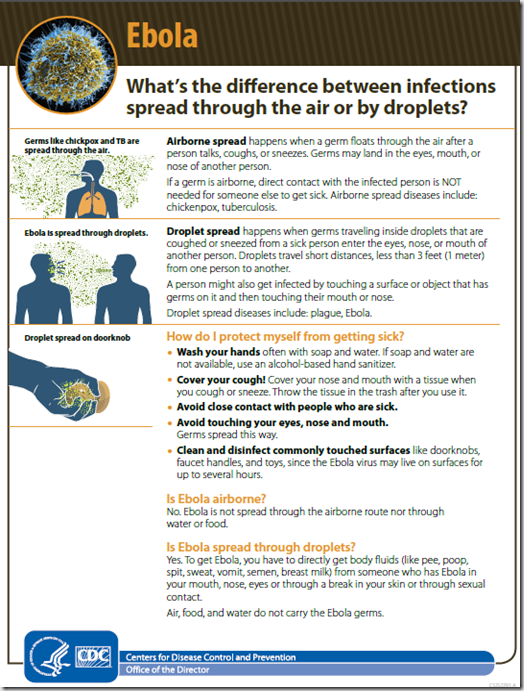
Last Saturday, when the CDC released the following infographic (see CDC: Ebola May Be Spread By Droplets, But Is Not Airborne), I praised them for replacing the tired (and less than entirely believable) `You can’t get Ebola Through Air’  meme, for something far more reasonable.

image


The idea that large droplets from coughs or sneezes pose a potential Ebola infection risk isn’t a new admission, but it has been largely downplayed by the CDC over the past few months.  This new poster was, in my opinion, a major step forward in improving the messaging. 


Inevitably,some in the media used this infographic to beat the CDC up over their earlier messaging.  A not unexpected reaction, and one I believe would likely have blown over in a couple of days. 


Regrettably, late yesterday this infographic was abruptly removed from the CDC website. Overnight the Daily Mail, Huffington Post, and others have been having a field day, as now when you hit the link you get this message:


The What’s the difference between infections spread through air or by droplets? Fact sheet is being updated and is currently unavailable. Please visit cdc.gov/Ebola for up-to-date information on Ebola.


Frankly, if you were looking for the best way to re-energize the conspiracy theorists, nut cases, and agency haters out there – I can’t envision a more successful ploy.  Even those of us who aren’t completely certifiable are likely to see this action and go, `hmmmm’.


I can only hope someone will do a minor edit (free suggestion: change `pee & poop’ to `urine and feces’) and have it uploaded back onto your site in short order. 


Whether they have `poster’s regret’  over putting this infographic out or not (and they shouldn’t, it is the best one they’ve produced on Ebola transmission to date), pulling it off  their site after 5 days just makes the CDC look indecisive …  or worse.

Tuesday, October 28, 2014

Sandman & Lanard On Ebola & Failures Of Imagination

image
Credit CDC PHIL


# 9258


Yesterday author, blogger, and scary disease girl extraordinaire Maryn McKenna featured a long-read by risk communications experts Dr. Peter Sandman & Dr. Jody Lanard (see her wired blog The Grim Future if Ebola Goes Global) on the conversation that no one in authority seems willing to have right now: 


What happens if Ebola is not contained in West Africa?


First, a strong recommendation to read the analysis by Sandman & Lanard in its entirety if you haven’t already, after which I’ll have a bit more.


Ebola: Failures of Imagination

by Jody Lanard and Peter M. Sandman

The alleged U.S. over-reaction to the first three domestic Ebola cases in the United States – what Maryn McKenna calls Ebolanoia – is matched only by the world’s true under-reaction to the risks posed by Ebola in Liberia, Sierra Leone, and Guinea. We are not referring to the current humanitarian catastrophe there, although the world has long been under-reacting to that.

We will speculate about reasons for this under-reaction in a minute. At first we thought it was mostly a risk communication problem we call “fear of fear,” but now we think it is much more complicated.

(Continue . . . )

 
Highly recommended.


Admittedly, I too have found it hard to paint a bleak picture of where this Ebola epidemic could lead – partially, I think as a subconscious pushback against the over-the-top fear mongering that is all too rampant online, and partially due to my deep-seated ex-paramedic mindset of `No matter how bad things get, don’t get rattled, just carry on.’


And to be very clear, while my crystal ball is cracked and fogged up badly, my `bleak picture’ isn’t one of massive Ebola epidemics sweeping across the nation, or mass graves in the developed world.  


While there are respiratory pathogens out there capable of such carnage, I don’t believe Ebola (in its present incarnation, anyway) to be one of them.

NOTE: The `weasel wording’ in the previous sentence is 100%  intentional, as I think it is important to push back against the absolute assurances constantly being uttered by nervous officials.  

Previously, in An Appropriate Level Of Concern Over Ebola In The US,  I wrote:


That is not to say we won’t see impacts from this epidemic.  We already have – in Dallas – and I quite expect we will again.  We could certainly see limited spread here, and even small clusters of cases.  And while it won’t be pretty, and the response may not be perfect,  I have enough faith in our public health infrastructure to believe they would be able to control it.

Now, if Ebola ever finds a way to spread through the mega-cities of Africa, India, Pakistan, or some other high-population, low resource region of the world – the economic, societal, and political destabilization that could occur might change both the nature, and degree, of this epidemic’s threat to the developed world. 


A veiled vision, cloaked in ambiguity, that only tentatively hints at what failure to contain the virus in Africa could mean to the rest of the world.  Hindered, no doubt, by my own personal `failure of imagination’, and by the difficulties of accurately projecting the impact of a slow-motion strain wreck. 


An epidemic that spreads inexorably – not over weeks or months – but potentially over years.


Spreading more like HIV, TB, or Hepatitis than what we might expect from an emerging pandemic virus. Unlike those scourges, however, Ebola kills very quickly – in a matter of days – which increases its immediate impact.


How that might play out on the global stage six months or a year from now is very tough to envision, but in a world already roiled in crises, its impact can’t be ignored.


Over the years we’ve looked at the real possibility of seeing a Black Swan Event – a  world-changing incident that few, if anyone, had predicted. The phrase was coined by Nassim Nicholas Taleb in his 2004 book Fooled By Randomness, and expanded upon in his 2007 book The Black Swan.


Black swan events can arise in a lot of different ways, and various national security documents over the years have analyzed, and warned about, many possible scenarios. 


  • A Pandemic
  • A Cyber Attack
  • A Financial Crisis
  • A Geomagnetic Storm
  • Social Unrest/Revolution


It is no coincidence that a severe pandemic ranks at the top of almost every list of highly disruptive national security threats (see 2011 OECD Report: Future Global Shocks,  UK: Civil Threat Risk Assessment, Influenza Pandemic As A National Security Threat).   


Is Ebola a black swan event?   I honestly don’t know. But it could be if it isn’t contained.


And right now, despite the upbeat messaging that `we know how to stop Ebola’, there are too many unknowns to be overly confident in the outcome.  Some may say that `failure is not an option’, but the truth is, history is replete with failures.  


We just tend to call them something else in the history books.


When my wife and I moved aboard our cruising sailboat in 1986, we immediately purchased a combination inflatable dingy/life raft.  We didn’t plan on sinking, but we also knew the ocean might have other plans for us. So with the kind of fatalism only longtime liveaboard sailors can muster, we christened it  `Plan B’.  


I’m happy to report it was never used for anything more desperate than rowing ashore to pick up another case of beer.   But it was there, equipped and ready, for any emergency.


While I hope we don’t ever need it, we need to be thinking about what our collective Plan B will be, if Ebola isn’t contained in West Africa. And that means thinking about, publicly talking about, and planning for the kind of disruptions that might occur if the virus makes its way to the mega-cities of Africa,  India, China, or South America.


Eight years ago the governments of the world urged agencies, organizations, businesses, and individuals to take a good hard look at their daily operations, and plan on how they would cope during a severe influenza pandemic. Since the relatively mild pandemic of 2009, the idea of pandemic planning has largely fallen to neglect.


Now might be a very good time to dust off your old pandemic plans, update them as necessary, and encourage others to do so.


Because, if Ebola doesn’t turn out to be the next great global public health crisis, there are plenty of other contenders waiting in the wings that could.

Thursday, October 16, 2014

Risky Communications

image
Credit CDC PHIL


# 9201


One of the reasons I try to leave my opinions out when reporting inflammatory stories in this blog – even if they often leave me initially appalled - is I know at some point more information may come out to either substantiate, or discredit, early reports. 


And unlike many in the media, I actually care that you can’t un-ring a bell. 


People’s lives, and careers are often at stake, and sitting on the sidelines we can’t always know all of the factors that went into their decision making, particularly based on early reporting.  


Case in point, yesterday’s revelation that the second nurse diagnosed with Ebola flew home last Monday.  


In his telebriefing yesterday afternoon,  CDC director Thomas Frieden stated:


The second health care worker reported no symptoms and no fever. However, because at that point she was in a group of individuals known to have exposure to Ebola, she should not have travelled on a commercial airline. The CDC guidance in this setting outlines the need for what is called controlled movement. That can include a charter plane, a car, but it does not include public transport. We will from this moment forward ensure that no other individual who is being monitored for exposure undergoes travel in any way other than controlled movement.

<snip>

The health care worker number two, who traveled from Ohio on the 13th of October, Monday, should not have traveled, should not have been allowed to travel by plane or any public transport by virtue because of the fact that she was in an exposed group. And although she did not report any symptoms, and she did not meet the fever threshold of 100.4, she did report at that time that she took her temperature and found it to be 99.5.


Although he never actually said it, a lot of people assumed by Dr. Frieden’s statement that this nurse decided fly home despite her  fever and known exposure to Mr. Duncan.


That immediately gave rise to a number of quick-to-condemn commentaries in the news and on social media that a `nurse should have known better’, and that she selfishly put `others at risk’.


But based on this CBS news report (below), and reports from other news media overnight, it now appears this nurse did the right thing. 


She called the CDC while still in Ohio – reported her fever – and was told it was okay to fly since it wasn’t 100.4 or greater.  A depth of detail not included in the CDC’s original statement.


In the case of Amber Vinson, the Dallas nurse who flew commercially as she was becoming ill with Ebola, one health official said "somebody dropped the ball."

The Centers for Disease Control and Prevention said that Vinson called the agency several times before flying, saying that she had a fever with a temperature of 99.5 degrees. But because her fever wasn't 100.4 degrees or higher, she didn't officially fall into the group of "high risk" and was allowed to fly.


This clarification (assuming the CBS news report is accurate) should absolve this nurse of responsibility for flying home, suggests the CDC missed another opportunity to control this virus, and should have been made far clearer in Dr. Frieden’s remarks.


I only have the highest respect for the technical skills of CDC, but this is the kind of omission that – once revealed –  serves to undermine the public’s confidence in what they are being told. 


The CDC’s over reliance on `talking points’  - where reporter’s questions are often not answered, but are simply used as an opportunity to repeat `reassuring messages’ -  and an apparent unwillingness to work `off script’ are problems I’ve discussed before (see Ebola Risk Communications).  


And it really isn’t necessary.


Americans know that with Ebola, we are in uncharted territory.  They don’t expect perfection on the part of the CDC, local public health agencies, or local hospitals. They can accept that mistakes will be made, and they can handle – even embrace – a degree of uncertainty.


But to engender that kind of public confidence, the CDC would be better served to speak in a `natural voice’ – one that admits mistakes when they happen, discusses both the challenges and areas of uncertainties that lie ahead, and one that doesn’t sound like their daily message was pre-approved by a committee of lawyers.

Tuesday, October 07, 2014

Sandman & Lanard: Ebola Risk Communications


# 9159


When it comes to risk communications, Dr. Peter Sandman & Dr. Jody Lanard are both highly sought out experts, and over the years I’ve highlighted their work a number of times (you’ll find a small sampling here, here, here & here) . During a crisis, they not only know what needs to be said, they aren’t afraid to say it.


Their website is an invaluable repository of risk management advice, that quite frankly, should be second home for anyone involved in public relations or risk communications.

Peter Sandman Website logo


Today (h/t Crof) they’ve posted three long email responses to reporters on Ebola Risk communications that are a `must read’.   Rather than try to pick and choose excerpts, I’ll simply invite you to go to their website to read:


Ebola Risk Communication: Talking about Ebola in Dallas, West Africa, and the World

by Peter M. Sandman and Jody Lanard

Saturday, October 04, 2014

Ebola Risk Communications


# 9046


The debate over what is meant by Ebola not being `airborne’ and what constitutes `direct contact’  continues, with a growing chorus of discontent in the media, and online, as to how the CDC describes the risks of transmission to the general public. 


Last night, a clearly frustrated Dr. Ian Mackay wrote What words would you use to separate influenza spread from Ebola virus disease spread?    Thoughtful and Highly recommended.


Let me be clear here. Like Dr. Mackay (and most scientists out there), I firmly believe that Ebola is not an airborne virus.  If it were, we’d be digging mass graves all over the world right now.  But there is some risk from large droplet transmission, which can travel a short distance (1 meter or so) through the air. 


And therein lies the difficulty.  How to explain the difference to the public.


Admittedly, finding a simple, coherent, and accurate way to convey risks to the public – particularly when the topic is likely to alarm – has always been a challenge. The tendency of officials  has generally been to carefully parse these messages in order to deliver a 10 second sound bite that is A) defendably true and B) as non-inflammatory as possible.


The problem being, the public knows that you can’t possibly explain a complex set of risks in a 10-second sound byte, and so any attempt to do so is doomed from the beginning.


The CDC’s oft repeated message that -  `You can’t get Ebola through air’ -  while technically true, fails to account for the potential for large-droplet-close-quarters transmission.  What I’ve dubbed as being within `spittle range’ from a cough or sneeze. (Note: CDC Interim guidance does acknowledge this possibility).

image


This glaring omission has led to hundreds – if not thousands – of `media voices’ (yes, I use that term very loosely) on TV, in newspapers, on Youtube, Facebook & Twitter to openly question the validity of both the message and the messenger. Add in the growing distrust of governments in general, and any gaps or inconsistencies in the message just add more blood to the water.


The public messaging tactics that worked when we had three TV networks, and no internet, are as dead today as film photography.  With Google, all facts are checkable.


Which makes both the accuracy and completeness of the messaging coming from the CDC, HHS, WHO, and others on the Ebola outbreak paramount.  A half answer – no matter how true or well intentioned it may be – comes off as being evasive . . .or worse.


As it is, with an increasingly skeptical mainstream press and the proliferation of conspiracy sites online, the CDC and the HHS are in serious danger of losing the battle for the hearts and minds of the American public on this Ebola threat – and whatever comes down the pike next. 


And while that would be bad for those agencies, it would be even worse for the people they are trying so hard to protect.


If I could be bold enough to offer some advice to the CDC, it would be to take a page from the press briefings provided by Dr  Anne Schuchat - director of the National Center for Immunization and Respiratory Diseases, and Assistant Surgeon General of the United States – whom many regarded as being the best communicator at the CDC during the 2009 pandemic.


She managed to calmly convey rapidly changing and unscripted information clearly and concisely – while acknowledging the things about the virus that were still unknown – in almost daily briefings during the opening  months of the outbreak.


By ditching the all-too-obvious `talking points’, by being willing to deviate from the `script’  when needed, and by trusting that the vast majority of the American public can handle a certain degree of uncertainty - even when talking about something as scary as Ebola - you can engender far more confidence in your agencies, defuse the critics, and vastly improve the way your messages are received.


And that is the sort of gravitas your agencies are going to need if they are going to deal successfully with Ebola, and whatever else comes next.

Monday, August 04, 2014

The Ebola Sound Bite & The Fury

image 

Credit CDC Ebola Website


# 8911


Amid the hype and hoopla in the tabloids, on social media, and (regrettably) even the mainstream news over the risks of Ebola spreading widely or becoming a global pandemic, one obvious fact seems glaringly absent.


If Ebola were anywhere near as contagious as the fear mongers would have us believe - after more than five months of spread - we’d be talking about hundreds of thousands of deaths in West Africa . . . not hundreds.


Even assuming that the case counts we have badly understate the scope of the outbreak, and it is triple that which has been reported, the numbers still don’t suggest an easily transmissible disease.  By comparison, five months after the relatively mild 2009 H1N1 virus appeared, millions had been infected around the world and tens of thousands had died.  


Fortunately, to help offset this hysteria, there’s been some excellent reporting by the likes of Maggie Fox at NBC news, Helen Branswell of the Canadian Press, Declan Butler of Nature, and Dr. Richard Besser of ABC News. Bloggers like Dr. Tara C. Smith have produced excellent, reasoned, posts as well (see Are we *sure* Ebola isn’t airborne?  & Ebola is already in the United States).


But I’m also seeing a backlash by some in public health communications - born, I would suspect, out of growing frustration of dealing with those who see doomsday or some kind of government conspiracy at every turn – to dismiss as unreasonable the public’s fears of the disease.


While perhaps not firmly rooted in science, or even logic, the public’s apprehension is certainly understandable.


For more than a decade, governments in the US and around the world have warned the public about an imminent `bio-terror’  threat, and about exotic emerging infectious diseases like `Bird Flu’ and SARS. Movies and novels  like Contagion and The Stand have painted a stark vision of the next pandemic, while Ebola has been used as the viral villain in a number of thrillers ranging from Tom Clancy’s Executive Orders to The Hot Zone by Richard Preston.


Now, suddenly, the government finds itself trying to dial back some of these concerns, and frankly, that isn’t going to be easy.


While it is important to be very clear that the Ebola outbreak in West Africa poses a negligible risk to residents of the United States, I worry that the reassurance pendulum may be swinging too far in the simplistic, `don’t worry, be happy’ direction.


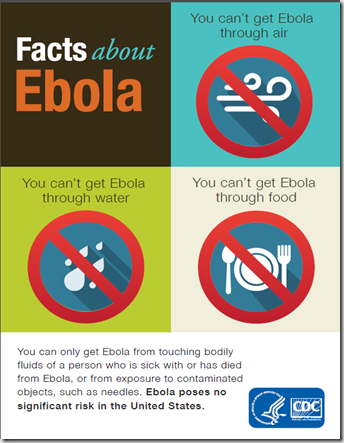
Exhibit A, posted yesterday, by the CDC follows:

image


I know, I know.   Ebola isn’t considered an airborne  virus, and you aren’t going to get it through your tap water, or food here in the United States. And it’s true, Ebola really isn’t likely to pose a significant threat here.  


But I worry do that anyone who sees this infographic – and compares it to the Ebola Infection Control Guidance or to pictures of `moon-suited’ healthcare workers working with Ebola cases  – is going to come away feeling they are being placated like an overly protective parent would an anxious child. 


Sometimes the perception is as important as the message.


While miniscule – the risks of infection if you are in close proximity to an Ebola patient (which is highly unlikely, BTW) are probably a tad more complex and nuanced than this infographic suggests. One need only look at the CDC’s  guidance Management of ill people on aircraft if Ebola virus is suspected to get a slightly different perspective:


Crew members on a flight with a passenger or other crew member who is ill with a fever, jaundice, or bleeding and who is traveling from or has recently been in a risk area should follow these precautions:

  • Keep the sick person separated from others as much as possible.
  • Provide the sick person with a surgical mask (if the sick person can tolerate wearing one) to reduce the number of droplets expelled into the air by talking, sneezing, or coughing.
  • Give tissues to a sick person who cannot tolerate a mask. Provide a plastic bag for disposing of used tissues.
  • Wear impermeable disposable gloves for direct contact with blood or other body fluids.


Anyone reading the above recommendations, and viewing the infographic, must surely wonder if they are about the same virus.  While simple declarative sound bites are usually best when trying to convey any message to the public, sometimes they can be too simple, and too reassuring for their own good.


I get it.  I really do. Finding the right message isn’t easy.  And no, I don’t have a great solution.


The fact that the lunatic fringe have taken over much of the media and internet make it almost impossible for public health officials to engage in serious public discussions about risks without every word being blown out of proportion.  Suggest even the possibility of an untoward event, and you’ve written the next tabloid headline and guaranteed the next 24 hour news cycle. 


The sobering part of all of this is that the next global health threat – whether it be from  H7N9, MERS-CoV, H5N1, or Virus X – could pose a far greater threat to our national security and public health than a virus like Ebola ever could.


Yet the same problems of risk communications – amid the sound and fury of  the mainstream and social media – will persist, and likely only grow worse with time.  Making it all it all the more important that the CDC retain the public’s trust during this disease threat, if they hope to carry it through the next one.

Monday, April 14, 2014

Saudi Govt. Prohibits `Unauthorized’ Media Coverage Of MERS

image


# 8474


Earlier today in The Battle To Control Online MERS Messaging, I wrote about attempts by the Saudi and UAE governments to control the flow of information in the media, and on twitter, regarding their MERS outbreaks.


It now appears that the Saudi Government has decided to impose even more restrictions on media coverage, by restricting the media to only publishing `official’ statements from the MOH.


Two reports.  First from the Saudi Press Agency:


15:59 LOCAL TIME 12:59 GMT

 Crown Prince Chairs Cabinet's Session 2 Riyadh

The cabinet was also briefed on a report by the Minister of Health on the status of the virus Corona and the efforts made by the ministry in this regard. The Council of Ministers was reassured on the health situation in general and the situation of the province of Jeddah after the inspection tour of the Minister of Health of a number of hospitals of the ministry in Jeddah province, stressing that the situation concerning the virus Coruna is reassuring.


The Council stresses on the media to adhere to all of the issued instructions not to publish any news concerning this virus or any epidemic disease except through the approved official department at the Ministry of Health.


And the story is also carried by http://www.okazalyoum.com/news/ with the headline:

image

LINK

Spa, Riyadh

Council of Ministers under the chairmanship of his Royal Highness Prince Salman bin Abdulaziz, Deputy Premier and Defense Minister, on Monday, the media all abide by the instructions not to publish any news regarding this virus or any epidemic disease, but by the official of the Ministry of health.

<SNIP>

And briefed the Council on the report of the Minister of health on the development of the corona virus and the efforts of the Ministry, and was assured of the overall health status and setting of Jeddah after an inspection tour of health for a number of hospitals in the governorate of Jeddah, adding that the situation for coronavirus reassuring.


The Council stresses the media all abide by the instructions not to publish any news regarding this virus or any epidemic disease only through the official at the Ministry of health


As you might expect, this announcement is making quite a stir on the twitter feed from Saudi Arabia, with many people clearly not pleased with this edict.

Sunday, February 09, 2014

Sandman & Lanard On China’s H7N9 Risk Communications

Photo: ©FAO/Tariq Tinazay

Credit FAO


# 8278


After the debacle of the SARS cover up in 2002-2003, and a decade of less-than-forthcoming admissions regarding their H5N1 problems, Chinese health officials have earned a good deal of rare, but well-deserved praise for their apparent openness on the emerging H7N9 virus. 


Over the past week, however, we’ve seen disturbing reports that the Chinese MOA (Ministry of Agriculture) and poultry industry leaders – tired of the stigma and declining poultry sales – are down playing the dangers (see China’s MOA Disputes Poultry As Source Of H7N9 Infections) and are seeking to curb public disclosure of cases, while demanding a name change  from `bird flu’ to simply `flu’.


Over the past 24 hours China’s official news agency –  Xinhua - has also begun publishing a series of reassuring `forward-looking’ articles heralding the creation of an H7N9 vaccine,  without mentioning the long road still ahead to test, produce, and (perhaps someday) distribute the vaccine in any useful quantity.


H7N9 vaccine to undergo clinical testing Xinhuanet 2014-02-09 18:39

H7N9 vaccine proves effective on lab mice Xinhuanet 2014-02-09 10:05

Vaccine development progresses as China reports more H7N9 ca... Xinhuanet 2014-02-08 22:50

Vaccine developed as China reports more H7N9 cases Xinhuanet 2014-02-08 20:42


While we continue to see case reports coming out of affected provinces – with this apparent move to try to downplay the threat – one has to wonder just how accurate these daily counts are going to be going forward. China’s MOA carries great sway, perhaps even more than the Ministry of Health, and as we’ve discussed in the past (see Food Insecurity, Economics, And The Control Of H7N9), their agendas don’t always mesh.


All of which serves as prelude to a brilliant piece by our favorite Risk Communications experts,  Dr. Peter Sandman and Dr. Jody Lanard,  published on the The Peter M. Sandman Risk Communication Website, a repository of invaluable risk management advice, that quite frankly should be second home for anyone involved in public relations or risk communications.


Peter Sandman Website logo

I’ve highlighted their work often in the past,including Sandman & Lanard: WHO, Pandemic Phases & Public Preparedness,  Sandman: A Tale Of Two CDCs, Lanard: China’s Risk Communication On H7N9, and Referral: Sandman On The H5N1 Moratorium.


Follow the link below to read:


Forgoing Trust, China’s Poultry Industry Lobbies for an H7N9 Cover-Up

by Jody Lanard and Peter M. Sandman

(a February 6, 2014 email to Lisa Schnirring of CIDRAP News)
Lisa Schnirring’s
February 6, 2014 article drew from this email.

According to the South China Morning Post and other sources, China’s poultry industry wants China’s public health agencies to stop reporting individual cases of H7N9, to “avoid excessively detailed reports” of H7N9 infections, and to call this novel bird flu virus “H7N9 flu” or “H7N9 virus” rather than “H7N9 bird flu.” The industry’s goal is to reduce consumer concern about shopping for, purchasing, cooking, and eating poultry.

This has two main problems.

First, the industry’s goal is inappropriate. Consumer concern is justified, at least about contact with live poultry, and particularly about environmental exposure at live animal markets. (There isn’t any evidence that eating well-cooked or even poorly-cooked poultry is dangerous; the H7N9 virus is mostly found in the respiratory tract of infected poultry, unlike the more systemic distribution of the H5N1 virus in infected poultry.) The number of human cases of H7N9 in China, though not huge, is growing faster than last year and far faster than H5N1. And the available evidence strongly suggests that most victims are catching the virus from poultry or poultry environments (such as live animal markets), and at most only occasionally from other people. The U.S. government, among others, advises visitors to China to avoid contact with live poultry and live animal markets. It is not foolish for Chinese consumers to try to be as cautious as their food-purchasing and food-consumption patterns permit. This is especially true in the face of massive expert uncertainty about how this new virus behaves.

More importantly, the industry’s recommendations are bound to backfire. It is a fundamental principle of risk communication that mistrust arouses outrage. In other words, people become much more concerned about a health risk when they discover that they are not being told the whole truth about that risk. When sources cannot be trusted, small risks look big and big risks look bigger.

(Continue . . . )


As long as the information coming out of China has been perceived as being reasonably reliable, it has been fairly easy to accept their assurances that there are no signs of sustained human-to-human transmission of the virus. 

Should that flow of information stop (or appear manipulated) – due to political or economic interests trumping those of public health – those assurances will quickly ring hollow, regardless of the actual situation on the ground.


Friday, May 17, 2013

Sandman On H7N9 Risk Communications: Candor, but No Push to Prepare

A CDC scientist uses a pipette to transfer H7N9 virus into vials for sharing with partner laboratories for public health research purposes.

A CDC scientist uses a pipette to transfer H7N9 virus into vials for sharing with partner laboratories for public health research purposes.


# 7283


Dr. Peter Sandman, and his wife and colleague Dr. Jody Lanard, together run The Peter M. Sandman Risk Communication Website. They provide consulting services to individuals, organizations, companies, and even governments – often during their worst public relations nightmares.


Their website contains a wealth of invaluable risk management advice, which quite frankly should be second home for anyone involved in public relations or risk communications.


Peter Sandman Website logo


I’ve highlighted their work often in the past, most recently in Sandman: A Tale Of Two CDCs, Lanard: China’s Risk Communication On H7N9, and Referral: Sandman On The H5N1 Moratorium.


Today Peter takes a long, and detailed look at the messaging coming out of the CDC and the World Health Organization on the emerging H7N9 virus (and MERS-CoV).  


While he finds their candor over the threat posed by these emerging pathogens praiseworthy, he finds their preparedness messaging to the public to be seriously lacking. 


There is simply too much good stuff here to even begin to excerpt it here. Instead, I will strongly urge you to read this exceptional opinion piece in its entirety.


When you return, I’ll have a bit more.


H7N9 Risk Communication: Candor but No Push to Prepare

by Peter M. Sandman


The lack of individual (or even corporate) preparedness messaging coming from the CDC and FEMA on these potential pandemic threats is a mystery to me, although I suspect it has much to do with the hammering they took after the worst case scenarios failed to materialize with the 2009 pandemic.


Many pundits and critics, most with the benefit of perfect hindsight, accused them of `crying wolf’.


But as any epidemiologist will tell you.  If you’ve seen one flu pandemic . . . you’ve seen one flu pandemic.


There’s simply no way to know, in advance, how severe any influenza (or MERS) pandemic might be. In many respects, the world got off very easy the last time.


Later today I’ll be posting a follow up blog on pandemic preparedness resources.

Tuesday, April 09, 2013

Sandman: A Tale Of Two CDCs


# 7203


Regular readers (and anyone familiar with the world of risk communication issues) already know of Dr. Peter Sandman, and his wife and colleague Dr. Jody Lanard, who together run The Peter M. Sandman Risk Communication Website.


Peter Sandman Website logo


Over the years they’ve provided many corporations, agencies, and governments invaluable assistance on handling media relations during a crisis. I’ve highlighted Peter and Jody’s work often in the past, including:


Peter Sandman On the CCIVI Vaccine Report
Peter Sandman: Swine Flu For Grownups
Experts: `Mild’ Is A Misleading Term For This Pandemic
Peter Sandman On Pandemic Risk Communication

Today they have a lengthy analysis on the messaging and communication strategies being employed by China’s CDC and our own CDC on the emerging H7N9 virus that builds upon an earlier post I linked to on Saturday (see Lanard: China’s Risk Communication On H7N9).


The post (wherein Peter very kindly mentions this blog), is called:


Posted: April 8, 2013


H7N9: A Tale of Two CDCs


This post, along with the rest of their website, is a treasure trove of great advice and information of interest to anyone who is, or may someday become, a spokesperson during a crisis.


Highly recommended.

Saturday, April 06, 2013

Lanard: China’s Risk Communication On H7N9


# 7087


My thanks to Helen Branswell for tweeting a link to the following essay by Jody Lanard, which is posted on their Peter Sandman and Jody Lanard Risk Communication  weblog.


Dr. Lanard sees encouraging signs with the way China has handled their risk communications on the H7N9 outbreak in their country, although she cautions that some `mega-overconfident over-promising’ has begun to creep into the messaging.


Follow the link to read Jody’s essay in its entirety.


China's risk communication to date about H7N9

by Jody Lanard

April 6 2013

In its communications about the H7N9 outbreak in humans, China has so far been remarkably candid, timely, and not over-reassuring, compared with past Chinese communication during alarming situations. (These notes were written between April 2 and April 6, 2013.)

Unless we learn otherwise, China seems to have reported very early. I hope this means they have learned a tough lesson from past cover-ups and delayed reporting, and are determined to do it right this time.

(Continue . . . )


Whether this new openness extends to all levels of China’s government and their ongoing response to this outbreak, isn’t clear.


On Wednesday the Chinese Minister of Agriculture very quickly denied that poultry might be carrying the H7N9 virus (see Crofsblog China: No H7N9 influenza infections in animals), a position that was reversed 24 hours later.


I suspect some well-ingrained bureaucratic habits are going to be very hard to break


But compared to the `the bad old days’, China does appear to have been far more forthcoming over this past week, and less cumbersome in their messaging.


A welcome trend, worth encouraging, that we really need to see continue.

Tuesday, February 21, 2012

Peter Sandman On H5N1 Research Risk Communications


# 6162


I’m a bit chagrinned to admit that I hadn’t checked Peter Sandman’s terrific risk communications website over the weekend in the wake of last Friday’s decision from the Technical consultation on H5N1  held in Geneva.


Had I, I would have found a long and thoughtful essay on the need for respectful dialog . . . not `education’ or one sided advocacy in ongoing H5N1 discussions.


While not experts in virology, or influenza, Dr. Peter Sandman and his wife and colleague  Dr. Jody Lanard, are often consulted on pandemic communication issues and are internationally recognized experts in all manner of risk communications.


Their website, quite frankly,  should be required reading for anyone who’s job it is to deal with the public during a crisis.


The Peter M. Sandman Risk Communication Website

Peter M. Sandman website


Last Friday Dr. Sandman sent Lisa Schnirring of CIDRAP news  a long email with his thoughts on the press releases coming out of the Geneva meeting (see WHO News Release On Geneva H5N1 Technical Meeting).


Lisa subsequently incorporated some of his comments in her article on the meeting Friday night (see WHO H5N1 study group extends moratorium, calls for full publication).


Rather than delay further, I’ll simply invite you to visit Dr. Sandman’s site to read:


The H5N1 Debate Needs Respectful Dialogue, Not  “Education” or One-Sided Advocacy

by Peter M. Sandman

(a February 17, 2012 email to Lisa Schnirring of CIDRAP News )


Highly recommended.

Tuesday, October 25, 2011

Jody Lanard: Risk Communication & Flu Vaccine Effectiveness


# 5923


My thanks to Crof for picking up on a short posting by Dr. Jody Lanard on the CDC’s recent unveiling of flu vaccine efficacy numbers.


As most of my readers know, flu vaccine effectiveness studies have been all over the map in recent years, with some showing remarkably high levels of protection while others have returned less encouraging numbers. 


For years the CDC’s mantra has been for healthy adults under the age of 65, in years when the vaccine is a good match to circulating strains, effectiveness ranges from 70%-90%.

Of course, if you don’t fall into this `ideal’ cohort, or if the virus drifts away from the vaccine strain, your mileage may vary. 


Sometimes, considerably.


Which is something we’ve addressed numerous times in this space, including:


Study: Obesity, Influenza & Immunity

Study: Flu Vaccines And The Elderly

Flu Shots For The Elderly May Have Limited Benefits


Recently the CDC updated their FAQ on Flu Vaccine effectiveness, and as part of a much longer detailed posting, lowered the estimate of the inactivated flu shot’s effectiveness to read:


. . . recent RCTs of inactivated influenza vaccine among adults under 65 years of age have estimated 50-70% vaccine efficacy during seasons in which the vaccines' influenza A components were well matched to circulating influenza A viruses.


Dr. Jody Lanard, who along with her husband Peter Sandman, are considered among the most authoritative in the world on the subject of risk communications, has posted a brief commentary on the way this revised information has been rolled out by the CDC.


Highly recommended.


Follow the link to read:


Brief analysis of a risk communication error:

The CDC reports its newest estimate of influenza vaccine efficacy: 50-70% in healthy adults under 65


By Jody Lanard M.D. (posted on October 25 2011, 1:30 pm EDT)


Between Sandman and Lanard, they produce a wealth of invaluable risk management advice freely available on their website:


Peter Sandman Website logo


For anyone even remotely involved as a spokesperson for an agency, organization, or company during a crisis, this site should be viewed as essential reading. 


Over the years I’ve been happy to feature their writings a number of times, including here, here, and here.  


For more, simply do a blog search on `Sandman’.

Wednesday, October 12, 2011

IDDR: Stepping Up For Disaster Risk Reduction


image

# 5893


The second Wednesday of October has been designated International Day For Disaster Reduction (IDDR) by the United Nations.  This year, the focus is on Making Children & Youth Partners in Disaster Risk Reduction.


Secretary-General Ban Ki-moon’s message for this year’s IDDR states:


"Vulnerability to disaster is growing faster than resilience.[...] Disaster risk reduction should be an everyday concern for everybody. Let us all invest today for a safer tomorrow."


According to United Nations report dated 12-Aug-2011 called Implementation of the International Strategy for Disaster Reduction:

  • The increasing financial, social and political cost of disasters is evident. Mortality risk associated with weather-related hazards is declining at the global
    level, while economic losses continue to  increase across all regions.

  • Economic loss risk is growing faster in higher-income countries. Since 1980, economic loss related to tropical cyclones increased by 262 per cent in high-income countries, compared to 155 per cent in low-income countries.

  • In the period 1970-2010, the world population increased by 87 per cent. During the same period, the population growth in flood-prone river basins increased by 114 per cent, and in cyclone-prone coastlines by 195 per cent.

  • Half of humanity is now living in cities. By 2050, urbanization will rise to 70 per cent and urban risk will continue to increase.

As the world’s population expands, there are simply more of us in harm’s way.  Earthquakes, tsunamis, droughts, cyclones, and other natural disasters have the potential to affect a greater number of people every year.


The UN News Centre published the following report yesterday focusing on Europe’s vulnerability to disaster.+

Europe’s vulnerability to natural disasters quickly rising – UN agency

11 October 2011 –

The number of natural hazards taking place in Europe increased significantly last year, the United Nations disaster risk reduction agency says, warning that the region’s governments need to implement prevention platforms to significantly reduce the danger they pose to their populations.


“In 2010, Europe saw the biggest increase in disaster events – plus 18.2 per cent – compared to the decade’s averages,” chief of the UN International Strategy for Disaster Reduction (UNISDR) Margareta Wahlström told participants at a forum yesterday in Skopje, the capital of the former Yugoslav Republic of Macedonia.


“In terms of economic damages, it accounted for 14.3 per cent of reported global disaster losses in 2010, with most of the damages caused by climatological and hydro meteorological events.”

(Continue . . . )


Earlier this year, in UNDP: Supercities At Seismic Risk I wrote about a warning that half of the world’s supercities (urban areas with 2 million – 15 million inhabitants) were at high risk of seismic activity.


Geohazards International, a non-profit organization that for the past 20 years has been dedicated to reducing the loss of life and suffering around the world in communities most vulnerable to earthquakes, has a good deal of information on at-risk cities as well.


The following comes from their Vulnerable Communities page.


image


And last August, in Weathering Heights: Billion-Dollar-Plus Weather Disasters I outlined the 9 (now 10) billion-dollar-plus weather disasters in the United States in 2011.


When you add the the earthquake and Tsunami in Japan, the horrendous Port-au-Prince earthquake of 2010, the floods in Pakistan, and the heat-wave & fires in Russian last year, and scores of other disasters over the past 24 months, you can see just how vulnerable our population really is.


While community resilience requires action by local, national, and international authorities, there are also steps that individuals and businesses can take.


  • Having a family or business disaster plan, and being properly prepared for a variety of emergencies, can contribute to your community’s resilience.
  • Making your homes, and businesses, safer during an earthquake or other disaster can save lives, and reduce costs and downtime.
  • Participating in local emergency drills, such as the upcoming Shakeout earthquake drills (see A Whole Lotta Shakeouts Goin' On), or local IDDR events helps promote community resilience.
  • And learning basic first aid skills, and CPR, can mean you can help provide immediate assistance during a disaster.


For more ideas, visit the IDDR archives page, where you’ll find resources on earlier campaigns.


Earthquakes, like Hurricanes, Tornados, Floods, and yes . . . even pandemics . . .  are hazards everyone should be aware of, and prepared to deal with.


Everyone should have a disaster plan.  Everyone should have a good first aid kit, a `bug-out bag’, and sufficient emergency supplies to last a bare minimum of 72 hours.


For more on  disaster preparedness, I would invite you to visit:


In An Emergency, Who Has Your Back?

When 72 Hours Isn’t Enough

The L. A. County Emergency Survival Guide

An Appropriate Level Of Preparedness

Wednesday, September 21, 2011

NOAA: Lessons From The Joplin Tornado


# 5857


The spring of 2011 saw three record-breaking and deadly tornadic outbreaks across the United States.


First, over three days in mid-April (14th-16th), a severe storm system produced 179 confirmed tornadoes across 16 southern states, resulting in 43 fatalities and more than a half billion dollars in damage.


Two weeks later (Apr. 25th-28th), an even larger outbreak – now dubbed the 2011 Super Outbreak - spawned at least 336 tornadoes across 21 states. More than 300 people died, with the largest number of deaths (249) occurring in Alabama. 


Damage estimates for this outbreak exceeded 10 billion dollars.


After a remarkably quiet first three weeks of May, another severe storm system swept across the Midwest spawning at least 180 tornadoes over 5 days (May 21st-26th).


The worst of these was the massive F-5 tornado that struck Joplin, Missouri on May 22nd, killing 159 and injuring more than 1,000.
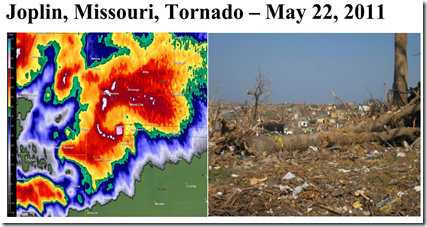
 

image

Photo Credit – NOAA 

Given the scale of destruction in Joplin, it is a wonder that more people weren’t killed. Fortunately, the city had at least a 20 minute warning via emergency sirens, NWS warnings, and local broadcasters.


Since this was a `warned event’ - yet yielded a high number of fatalities - the National Weather Service launched an investigation over the summer. More than 100 interviews were conducted in Joplin with tornado survivors, local business owners, EMS personnel, the media, and city officials.
 

image

PDF Download Link


Among their findings, many of Joplin’s residents did not act immediately when the tornado sirens sounded.  An excerpt from the executive summary explains:


The vast majority of Joplin residents did not immediately take protective action upon receiving a first indication of risk (usually via the local siren system), regardless of the source of the warning.  Most chose to further assess their risk by waiting for, actively seeking, and filtering additional information.


The reasons for doing so were quite varied, but largely depended on an individual‘s ― worldview, formed  mostly by previous experience with severe weather.


Most importantly, the perceived frequency of siren activation in Joplin led the majority of survey participants to become desensitized or complacent to this method of warning.  This suggests that initial siren activations in Joplin (and severe weather warnings in general) have lost a degree of credibility for most residents – one of the most valued characteristics for successful risk communication.  


Instead, the majority of Joplin residents did not take protective action until processing additional credible confirmation of the threat and its magnitude from a non-routine, extraordinary risk trigger.  This was generally achieved in different ways, including  physical observation of the tornado, seeing or hearing confirmation, and urgency of the threat on radio or television, and/or hearing a second, non-routine siren alert.


Having lived in Tornado Alley for a decade, I’m well acquainted with tornado warning fatigue.  Sirens go off with some frequency, and severe weather boxes appear in the corner of your local TV broadcast, but often nothing comes of it.


Nationally, the NWS says that 76% of all tornado warnings end up being false alarms. And even if a tornado is spawned, warnings go out across a broad area when only a small number of people are ultimately impacted.


The result is . . .  people stop responding to every alert.


Again from the report:


This report suggests that in order to improve warning response and mitigate user complacency, the NWS should explore evolving the warning system to better support effective decision making.


This evolution should utilize a simple, impact-based, tiered information structure that promotes warning credibility and empowers individuals to quickly make appropriate decisions in the face of adverse conditions.  Such a system should:  


a. provide a non-routine warning mechanism that prompts people to take immediate life-saving
action in extreme events like strong and violent tornadoes


b. be impact-based more than phenomenon-based for clarity on risk assessment


c. be compatible with NWS technological, scientific, and operational capabilities


d. be compatible with external local warning systems and emerging mobile communications
technology


e. be easily understood and calibrated by the public to facilitate decision making


f. maintain existing ―probability of detection‖ for severe weather events


g. diminish the perception of false alarms and their impacts on credibility


A tall order.


And one that is complicated by the sheer volume of `threat warnings’ we get on a daily basis. Everything from weather alerts, to elevated terrorism levels, to warnings that almost everything you eat, drink, or touch is either contaminated or will give you cancer.


After awhile, these warnings tend to fuzz out, blend in, and lose their impact.


While it is tempting to suggest scaling back these warnings, there are 7 scientists on trial in Italy right now – charged with manslaughter - over their failure to predict, and warn the public about an earthquake in 2009.


Charges levied, even though we don’t currently have the technology to accurately predict earthquakes .


Despite the daily clutter of warnings we receive – many of which never materialize - a failure of agencies to warn about known or suspected threats would not be well tolerated by the public.


For the NWS, the challenge will be to create an easily identifiable `immediate threat’ warning to elevate it above the `background noise’ of more generic or broad-based warnings.


As to the myriad other threats out there, they are all the more reason to incorporate an `all threats’ preparedness plan, instead of focusing on one type of scenario.


If you are well prepared for an earthquake, you are also well equipped to handle a hurricane, a pandemic, or any other type of disaster.


In order to promote this idea, FEMA, Ready.gov, and other agencies are promoting September as National Preparedness Month.  Follow this year’s campaign on Twitter by searching for the #NPM11 hash tag.


image

Thursday, March 17, 2011

Sandman & Lanard On Worst-Case Crisis Communications


# 5411


When it comes to risk communications during a crisis, you’d have to go a long way to beat the advice of Dr. Peter Sandman and his wife Dr. Jody Lanard. 


Both are highly regarded consultants in the field, and have been called upon by entities both public and private during times of crisis. Between the two of them, they produce a wealth of invaluable risk management advice freely available on their website:


Peter Sandman Website logo


For anyone even remotely involved as a spokesperson for an agency, organization, or company during a crisis, this site should be viewed as essential reading. 


Over the years I’ve featured their writings a number of times, including here, here, and here.   For more, simply do a blog search on `Sandman’.


Last night Sandman and Lanard responded to an anonymous journalist’s question regarding the open discussion of `worst-case’ scenarios in Japan. 


You’ll find an excerpt below, but follow the link to read it in its entirety (and follow the links as well!).


Japan’s nuclear crisis: The need to talk more candidly about worst case scenarios

name:Anonymous

field:Newspaper reporter

date: March 16, 2011

location:Canada

comment:

I’m a reporter working on a story that takes a look at the rhetoric/fear-mongering surrounding the disaster in Japan. I figured you’d have some awesome insights based on your field of work.

The story is pegged to these comments, from Europe’s Energy Commissioner Guenther Oettinger, on Tuesday:

  • “There is talk of an apocalypse and I think the word is particularly well chosen. Practically everything is out of control. I cannot exclude the worst in the hours and days to come.” [from: www.telegraph.co.uk]
  • “The site is effectively out of control. In the coming hours there could be further catastrophic events which could pose a threat to the lives of people on the island.” [from: msnbc.tumblr.com]

Do you have any reactions?

peter responds:

Note: My wife and colleague Jody Lanard collaborated on this response.

Oettinger’s statements are at the upper end of dramatic. “Practically everything” isn’t out of control.


Statements like his result from the failure of officials to follow two crucial precepts of crisis communication.

  • Be incredibly respectful of and empathic about normal people’s fears and fantasies.
  • Get out in front of worst-case-scenario speculation by sharing the worst case scenarios that officials consider possible and worth planning for.

The main communication problem results from the public’s inability to know how much of the situation is under how much control, and what might happen if things get worse. Japanese officials have not helped us to understand that. Worse, they have not communicated in ways that encourage us both to trust that they are telling us everything they know and everything they’re worried about, and to trust that they know what they are doing.


What are the worst cases their experts are worried about and working to prevent? The world has a right to know that, and the world has a right to judge them harshly for not revealing that. More importantly, the world has no choice but to try to figure out on its own what the worst case scenarios might be that officials are either too irresponsible to consider or too cowardly to reveal.


Under such conditions, outside speculation about worst case scenarios justifiably gains traction – especially since the trajectory of the story has been to keep getting worse in the face of official assurances that things were not likely to get worse.


Ideally, officials would have preempted much outside speculation by sharing their worst fears publicly. Our crisis communication advice is always that officials should try to recreate in the public the same level of concern that they themselves are experiencing, and should focus about equally on the two most important questions about the short-term future:

  1. What do you think is most likely to happen?
  2. What’s the worst outcome that you haven’t dismissed as too unlikely to be worth worrying about?

Since officials have avoided answering the second question, speculation has taken off.

(Continue . . . )


Great stuff, so go read it all.