Showing posts with label Spanish Flu. Show all posts

Thursday, October 18, 2012

University of Michigan: Influenza Encyclopedia 1918-1919

image

The Motor Corps of St. Louis chapter of the American Red Cross on ambulance duty during the influenza epidemic, October 1918. Photo Credit – UM Influenza Encyclopedia Image Gallery


# 6641


I confess to being a major medical history buff, a predilection that began nearly a half century ago when I read James Leasor’s account of two pivotal years in the history of London (1665-1666) - which began with the Great plague, and ended with the Fire of London.


image


In the 1970s, after the Swine Flu scare of 1976 (see my account of that event in Deja Flu, All Over Again.), I often asked my patients (who had been teenagers or young adults in 1918) about their memories of the 1918 Spanish Flu.


And I’m currently reading (a gift from a friend: thanks, John)  Infectio., a fascinating history of infectious diseases and their early treatments, by Werner Schreiber and Friedrich Karl Mathys.


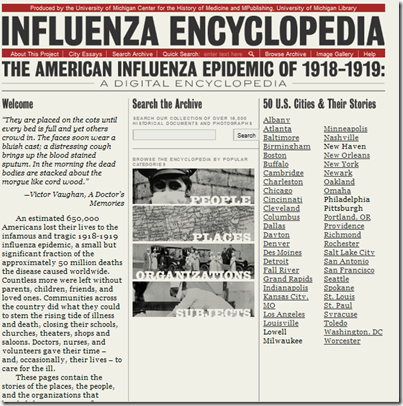
So I was particularly pleased to get a head’s up overnight from Eric Starbuck that the University of Michigan’s Center for the History Of Medicine has published their impressive digital encyclopedia (containing more than 18,000 historical documents) of the 1918 Spanish Flu Pandemic.


image


I’m just beginning to explore this site, but I’m very impressed with what I’ve seen so far.  Not only as a chronicle of the great pandemic, but also as a glimpse back at life in the United States nearly 95 years ago.


With this much to explore, I fear I won’t get much work done today.  But nevertheless . . .


Highly recommended.

Monday, October 08, 2012

Diary From The HMNZ Tahiti During The 1918 Pandemic

image

Troop Ship Tahiti in Wellington Harbor, circa 1918-19  Unknown Photographer


# 6617


For years historians, epidemiologists, and virologists have been attempting to peel back the cobwebs of time in order to analyze the deadliest pandemic in human history; the 1918 Spanish Flu Pandemic.


John Barry’s The Great Influenza: The Epic Story of the Greatest Plague in History, has probably done more to reawaken memories of that awful time than any other source, but many gaps in our knowledge remain.


Jeffrey  K. Taubenberger and David Morens - both researchers at NIAID – have added considerably to our understanding of the H1N1 virus and the events surrounding its emergence. Taubenberger was the first to sequence the the genome of the 1918 Spanish Flu virus while David Morens is a prominent medical historian.


See Morens & Taubenberger on Influenza’s History for a fascinating look back at influenza through the ages. Highly recommended.


Spanish Flu broke out in the spring and summer of 1918, while WWI was still underway. It so devastated troops on both sides of the conflict that historians believed it helped to hasten the end of the war.


Soldiers and sailors – living in cramped and often unhygienic quarters – bore the early brunt of the pandemic, while troop trains and ships helped to spread it around the globe.


While there are many horrific accounts from the pandemic – including some small villages in Alaska entirely wiped out – some of the best documented events occurred onboard troop ships. 


One of the most famous was the HMNZ Troop Carrier Tahiti, which during August-September of 1918 carried 1217 troops and crew (almost double what the ship was rated to carry) from New Zealand to Plymouth, England with provisioning stops at Cape Town and Sierra Leone. 


Since fever was reported in Sierra Leone, no crew or passengers reportedly went ashore , but locals came aboard to coal the ship.  Within a few days of leaving port, half the men on the ship were sick, and in a matter of days, more than 80 would perish.


The University of Otago has an well done 1-page synopsis of the investigation, which you can access here.


image


The detailed report, on which this exhibit is based, appeared in the CDC’s EID Journal in December of 2010.

Historical Review

Mortality Risk Factors for Pandemic Influenza on New Zealand Troop Ship, 1918

Jennifer A. SummersComments to Author , Nick Wilson, Michael G. Baker, and G. Dennis Shanks


Adding another dimension to this story, Jennifer A. Summers returns to the October, 2012 edition of the EID Journal with excerpts from a recently uncovered diary, kept by one of the troops aboard that ship.


Pandemic Influenza Outbreak on Troop Ship—Diary of a Soldier in 1918

Jennifer A. Summers
Abstract

A newly identified diary from a soldier in 1918 describes aspects of a troop ship outbreak of pandemic influenza. This diary is the only known document that describes this outbreak and provides information not officially documented concerning possible risk factors such as overcrowding and the suboptimal outbreak response by military leaders. It also presents an independent personal perspective of this overwhelming experience.

(Continue . . . )


The diary entries make fascinating reading, as does the commentary provided by the author. Well worth following the link and to read in its entirety.


For more on the history and impact of the 1918 Spanish flu, you may wish to pay a visit to Flu.gov’s Pandemic history page, with offerings such as:


Thursday, April 28, 2011

Study: Urban vs Rural Mortality From Spanish Flu


# 5528


The last `Great’ Influenza pandemic occurred in 1918-19, and while estimates vary widely, it may have claimed as many as 100 million lives.  A new strain of H1N1, it was known at the time as `Spanish Flu’.


The impact of this pandemic, however, varied greatly. In 2006, in a Lancet journal (doi:10.1016/S0140- 6736(06) 69895-4) article cited as much as a 30-fold difference in mortality rates around the world:


Estimation of potential global pandemic influenza mortality on the basis of vital registry data from the 1918—20 pandemic: a quantitative analysis

Christopher JL Murray , Alan D Lopez , Brian Chin , Dennis Feehan , Kenneth H Hill

Excess mortality ranged from 0·2% in Denmark to 4·4% in India. Since there was some under-registration of mortality in India, total pandemic mortality could have been even higher.


Indeed, in some the more remote regions of the world – such as among the Maori of New Zealand or the Eskimos of Alaska – the mortality rates were even higher.


The following account comes from Alaska’s pandemic history on http://1918.pandemicflu.gov/


In some areas, influenza decimated whole villages. A schoolteacher reported that in her immediate area “three [villages were] wiped out entirely, others average 85% deaths...Total number of deaths reported 750, probably 25% [of] this number froze to death before help arrived.”


One of the other striking features of the 1918 pandemic – aside from the high death toll – was the sparing of those over the age of 65 in the United States.


image

The infamous `W shaped curve’ of the 1918 pandemic clearly shows that the death rates among those in their teens, 20s, and 30s was much higher than was normally seen in previous influenza years.


This wide disparity in mortality rates – much of it based on anecdotal accounts – has long intrigued researchers.  Today we’ve a new study from the Norwegian Institute of Public Health that attempts to answer some of these questions.


What they found was that the mortality rate varied nearly 100 fold between remote, rural regions and urban populations, and that in the more remote areas, older persons were just as susceptible to the virus as those who were younger.


First excerpts from the Press release, then a link to the study.   I’ll return with some comments.


Large differences in mortality between urban and isolated rural areas

Published 27.04.2011 , updated: 27.04.2011, 12:30
Stikkord:


In urban communities, less than 1 in 100 inhabitants died from Spanish flu in 1918, but in isolated communities up to 9 out of 10 died. An important explanation for the differences is due to different exposure to influenza in the decades before the Spanish flu came. Those living in urban communities probably had a higher degree of pre-existing immunity that protected against illness and death in 1918 than those living in very isolated rural areas. This is shown in a new study from the Norwegian Institute of Public Health.


Previous studies have suggested that an important reason for the large regional differences in mortality must be that people living in cities were more frequently exposed to similar viruses to the one that caused the Spanish flu earlier in life than those living in rural and extremely isolated areas.


“It is not inconceivable that there was a different geographical spread of the virus in the 1800s and early 1900s, at a time when intercontinental communication networks were less developed" said Svenn-Erik Mamelund, a senior adviser in the Division of Infectious Disease Control at the Norwegian Institute of Public Health.


“No one knows exactly which influenza viruses circulated before 1918. But a leading theory is that there were H1-like viruses circulating in the period before the last major pandemic, the Russian pandemic of 1889-90. Some viruses circulating prior to 1889 may therefore have been related to the virus that caused the Spanish flu in 1918, A (H1N1). This would mean that some people who were older than 28-30 years in 1918 may have had some protection against severe infection and death from Spanish flu because of previous exposure to similar viruses," he said.

(Continue . . . )


This study appears in the Journal Epidemics.


Geography May Explain Adult Mortality from the 1918–20 Influenza Pandemic

Original Research Article
Pages 46-60
Svenn-Erik Mamelund


The theory that a similar H1 virus circulated prior to 1890 – and that provided some immunity to those over the age of 30 – is bolstered by this study.


Young people, and those older people living in isolation during the 1880s had not been exposed, and were therefore more vulnerable to the 1918 virus.


But as the author points out, that alone is not likely to have accounted for the huge difference in mortality.  From the abstract, the author writes:


Low exposure to H1-like viruses in adults could not alone explain the high total mortality in remote populations (up to 90%). A high concurrent disease load, crowding, low genetic variability, a lack of basic care, and infrequent exposure to other forms of influenza virus 1890–1917 may have played a role as well.


This form of immunological cross-protection from previous exposure to A-type influenza viruses other than H1N1 can only be explained as a consequence of cellular immunity against internal proteins that show less inter-strain variation than the surface proteins.


Our most recent pandemic experience, once again at the hands of the H1N1 virus, proved milder than feared probably for the same reasons.


As populations intermingle - we trade more viruses - and over time build up a certain level of immunity.  And part of that immunity may be generic cellular immunity, as opposed to antibodies to specific pathogens.


And in this highly mobile world, that may bode well for the next pandemic – assuming it comes from a relative of a virus that we’ve seen in the recent past; an H1, H2, or H3 strain.


There are no guarantees, of course.


Should a less familiar strain emerge, however, no one knows how severe an impact it might have.


The H5N1 virus has – thus far – killed about 50% of its known victims.  Far worse than the Spanish flu of 1918.  The H7 and H9 avian strains, however, have produced generally mild illness and few fatalities in humans.


So there is obviously more to the influenza mortality and morbidity story than just being immunologically naive to a virus. 


While today’s paper may not provide definitive answers to the questions surrounding the 1918 pandemic, it does give us more data to ponder and a plausible explanation for its divergent impact around the world.

Monday, July 05, 2010

Study: Impact Of 1918 Pandemic In Mexico


# 4698


The 1918 Spanish Flu was the worst pandemic in modern history, killing (estimates vary) between 40 million and 100 million people worldwide in a matter of 18 months.


The course and impact of the pandemic was reasonably well documented in places like the United States, England, and parts of Europe . . . but for much of the world the death toll can only be approximated.


Earlier studies have suggested a wide variation in the CFR (Case Fatality Ratio) of this pandemic among various countries and regions of the world.


In 2006, in a Lancet journal (doi:10.1016/S0140- 6736(06) 69895-4) article cited as much as a 30-fold difference in mortality rates around the world:


Estimation of potential global pandemic influenza mortality on the basis of vital registry data from the 1918—20 pandemic: a quantitative analysis


Christopher JL Murray , Alan D Lopez , Brian Chin , Dennis Feehan , Kenneth H Hill


Excess mortality ranged from 0·2% in Denmark to 4·4% in India. Since there was some under-registration of mortality in India, total pandemic mortality could have been even higher.


One of the striking features of the 1918 pandemic – aside from the high death toll – was the sparing of those over the age of 65 in the United States.


image

The infamous `W shaped curve’ of the 1918 pandemic clearly shows that the death rates among those in their teens, 20s, and 30s was much higher than was normally seen in previous influenza years.


Those over the age of 65, however, saw a reduction in mortality during the pandemic.


A situation not unlike what we saw last year with few over the age of 60 contracting the 2009 H1N1 pandemic virus.


We’ve a new study, appearing in the Journal of Infectious Diseases that suggests that the course of the 1918 pandemic was different in Mexico than in its immediate neighbor to the north.  


That unlike in the United States, those over 65 experienced an increased mortality rate, raising interesting questions regarding geographic differences in pre-existing immunity to the virus.


Since the full article is behind a pay wall, I’ve not read the entire paper. The abstract is available, however. 


Hopefully we’ll get a more in depth summary of this paper from another source in the next couple of days.  If so, I’ll update this post with a link.


Mortality Patterns Associated with the 1918 Influenza Pandemic in Mexico: Evidence for a Spring Herald Wave and Lack of Preexisting Immunity in Older Populations

Gerardo Chowell, Cécile Viboud, Lone Simonsen, Mark A. Miller, and Rodolfo Acuna‐Soto

Background. Although the mortality burden of the devastating 1918 influenza pandemic has been carefully quantified in the United States, Japan, and European countries, little is known about the pandemic experience elsewhere. Here, we compiled extensive archival records to quantify the pandemic mortality patterns in 2 Mexican cities, Mexico City and Toluca.


Methods. We applied seasonal excess mortality models to age‐specific respiratory mortality rates for 1915–1920 and quantified the reproduction number from daily data.


Results. We identified 3 pandemic waves in Mexico City in spring 1918, autumn 1918, and winter 1920, which were characterized by unusual excess mortality among people 25–44 years old. Toluca experienced 2‐fold higher excess mortality rates than Mexico City but did not experience a substantial third wave. All age groups, including that of people >65 years old, experienced excess mortality during 1918–1920. Reproduction number estimates were <2.5, assuming a 3‐d generation interval.


Conclusion. Mexico experienced a herald pandemic wave with elevated young adult mortality in spring 1918, similar to the United States and Europe. In contrast to the United States and Europe, there was no mortality sparing among Mexican seniors > 65 years old, highlighting potential geographical differences in preexisting immunity to the 1918 virus. We discuss the relevance of our findings to the 2009 pandemic mortality patterns.