Showing posts with label 1918. Show all posts

Tuesday, June 24, 2014

Cognitive Inertia, Preparedness & The 1918 Pandemic Flu

 image

The Great pandemic website – Credit HHS


# 8776


Cognitive Inertia – the tendency for beliefs or opinions to endure once formed – is a double-edged sword.  It can help bring stability and a sense of permanence to our lives and relationships, while at the same time, it can blind us to changing, and sometimes hazardous, situations.


A fairly recent example was the overwhelming belief that the levees protecting New Orleans would hold during Hurricane Katrina. An assumption which no doubt contributed to the failure of some to evacuate – or even to prepare - for the arrival of that deadly storm. 


The levees had, after all, always held before. The city had successfully faced bigger storms in the past, and in recent decades, the storms had always seemed to veer away at the last moment. Many people were simply convinced – by their past experiences with hurricanes - that Katrina would turn out to be an overblown threat. 


Indeed, despite dozens of disasters across the nation each year, and yearly reminders to the American public by FEMA and Ready.gov of the importance of having a disaster plan, a first aid kit, and some basic supplies in their homes, roughly half of all households still haven’t made even basic preparations for a disaster.


image


Similar cognitive inertia can be seen in the refusal of many poultry farmers in Asia to believe that their birds could be carrying a deadly avian flu virus, or more recently, in Saudi Arabia, accepting that camels might pose infection risk from the MERS coronavirus. 


After all, generations of their ancestors raised these animals without falling ill.


Our perception of risks is based primarily on our previous experiences.  Those who live in relatively stable environments are less likely to anticipate or appreciate the effects of abrupt, and sometimes hazardous, changes.


While we like to think that our great-grandparents were a lot smarter in this regard (and better prepared to deal with emergencies and disasters), a new study that appears in the Journal  History of Medicine & Allied Science suggests that cognitive inertia was alive and well 95 years ago during the lead up to the 1918 pandemic.


To be fair, there was a good deal of wartime censorship of pandemic flu reports – particularly during the spring and summer of 1918 – that may have led to some complacency.  But despite the downplaying of the threat, most people were aware that a pandemic was coming, and few did anything to prepare for its arrival.


Waiting for the Flu: Cognitive Inertia and the Spanish Influenza Pandemic of 1918–19

Tom Dicke

Department of History, Missouri State University, Springfield, Missouri.

Email: tomdicke@missouristate.edu

Abstract

This study looks at public awareness and understanding of the Spanish flu in the United States between June 1918, when the flu became “Spanish,” and the end of September when the deadly second wave reached the majority of the country.

Based on an extensive reading of local newspapers, it finds a near universal lack of preparation or panic or other signs of personal concern among those in the unaffected areas, despite extensive and potentially worrying coverage of the flu's progress. The normal reaction to news of the inexorable approach of a pandemic of uncertain virulence is anxiety and action. The Spanish flu produced neither in the uninfected areas for a month.

The most likely reason appears to be cognitive inertia—the tendency of existing beliefs or habits of thought to blind people to changed realities. This inertia grew out of the widespread understanding of flu as a seasonal visitor that while frequently unpleasant almost never killed the strong and otherwise healthy. This view of the flu was powerful enough that it blinded many in the unaffected regions to the threat for weeks even in the face of daily or near daily coverage of the pandemic's spread.


None of this is to suggest that we live our lives in a constant state of fear or hyper-awareness, only that we not lull ourselves into believing everything will be alright when the evidence suggests that preparing, or evacuating, or taking some kind of action is the smart thing to do.


My personal bent towards preparedness undoubtedly stems from my past experiences. 

  • I grew up in Florida during the 1950s and 1960s at a time of heightened hurricane activity
  • I experienced the Cuban Missile Crisis up close and personal
  • I became an EMT, and then a Paramedic, in the early 1970s
  • I spent 15 years of my life living aboard boats, and cruising the waters of Florida.
  • And I spent 10 years going `back to the land’ in rural Missouri


All great teachers of impermanence of life and property, the unpredictability of future events, and the importance of being prepared to deal with whatever comes down the pike (see The Making Of A Prepper).


Over the years - whether at sea, in the backwoods, or in the back of my ambulance -  I’ve enjoyed the peace of mind that comes from knowing I was reasonably prepared to deal with just about anything.


Over six decades I’ve learned one overriding lesson; Preparing is easy.   It’s worrying that’s hard


Lest you think this is simply my message, I would invite you  to visit:


FEMA http://www.fema.gov/index.shtm

READY.GOV http://www.ready.gov/

AMERICAN RED CROSS http://www.redcross.org/


And some of my preparedness blogs, including:


When 72 Hours Isn’t Enough

The Gift Of Preparedness: 2013

In An Emergency, Who Has Your Back?

Thursday, October 18, 2012

University of Michigan: Influenza Encyclopedia 1918-1919

image

The Motor Corps of St. Louis chapter of the American Red Cross on ambulance duty during the influenza epidemic, October 1918. Photo Credit – UM Influenza Encyclopedia Image Gallery


# 6641


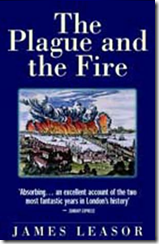
I confess to being a major medical history buff, a predilection that began nearly a half century ago when I read James Leasor’s account of two pivotal years in the history of London (1665-1666) - which began with the Great plague, and ended with the Fire of London.


image


In the 1970s, after the Swine Flu scare of 1976 (see my account of that event in Deja Flu, All Over Again.), I often asked my patients (who had been teenagers or young adults in 1918) about their memories of the 1918 Spanish Flu.


And I’m currently reading (a gift from a friend: thanks, John)  Infectio., a fascinating history of infectious diseases and their early treatments, by Werner Schreiber and Friedrich Karl Mathys.


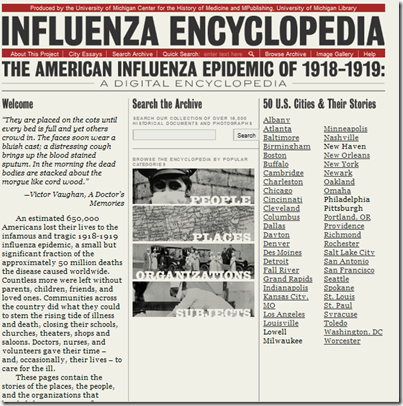
So I was particularly pleased to get a head’s up overnight from Eric Starbuck that the University of Michigan’s Center for the History Of Medicine has published their impressive digital encyclopedia (containing more than 18,000 historical documents) of the 1918 Spanish Flu Pandemic.


image


I’m just beginning to explore this site, but I’m very impressed with what I’ve seen so far.  Not only as a chronicle of the great pandemic, but also as a glimpse back at life in the United States nearly 95 years ago.


With this much to explore, I fear I won’t get much work done today.  But nevertheless . . .


Highly recommended.

Monday, October 08, 2012

Diary From The HMNZ Tahiti During The 1918 Pandemic

image

Troop Ship Tahiti in Wellington Harbor, circa 1918-19  Unknown Photographer


# 6617


For years historians, epidemiologists, and virologists have been attempting to peel back the cobwebs of time in order to analyze the deadliest pandemic in human history; the 1918 Spanish Flu Pandemic.


John Barry’s The Great Influenza: The Epic Story of the Greatest Plague in History, has probably done more to reawaken memories of that awful time than any other source, but many gaps in our knowledge remain.


Jeffrey  K. Taubenberger and David Morens - both researchers at NIAID – have added considerably to our understanding of the H1N1 virus and the events surrounding its emergence. Taubenberger was the first to sequence the the genome of the 1918 Spanish Flu virus while David Morens is a prominent medical historian.


See Morens & Taubenberger on Influenza’s History for a fascinating look back at influenza through the ages. Highly recommended.


Spanish Flu broke out in the spring and summer of 1918, while WWI was still underway. It so devastated troops on both sides of the conflict that historians believed it helped to hasten the end of the war.


Soldiers and sailors – living in cramped and often unhygienic quarters – bore the early brunt of the pandemic, while troop trains and ships helped to spread it around the globe.


While there are many horrific accounts from the pandemic – including some small villages in Alaska entirely wiped out – some of the best documented events occurred onboard troop ships. 


One of the most famous was the HMNZ Troop Carrier Tahiti, which during August-September of 1918 carried 1217 troops and crew (almost double what the ship was rated to carry) from New Zealand to Plymouth, England with provisioning stops at Cape Town and Sierra Leone. 


Since fever was reported in Sierra Leone, no crew or passengers reportedly went ashore , but locals came aboard to coal the ship.  Within a few days of leaving port, half the men on the ship were sick, and in a matter of days, more than 80 would perish.


The University of Otago has an well done 1-page synopsis of the investigation, which you can access here.


image


The detailed report, on which this exhibit is based, appeared in the CDC’s EID Journal in December of 2010.

Historical Review

Mortality Risk Factors for Pandemic Influenza on New Zealand Troop Ship, 1918

Jennifer A. SummersComments to Author , Nick Wilson, Michael G. Baker, and G. Dennis Shanks


Adding another dimension to this story, Jennifer A. Summers returns to the October, 2012 edition of the EID Journal with excerpts from a recently uncovered diary, kept by one of the troops aboard that ship.


Pandemic Influenza Outbreak on Troop Ship—Diary of a Soldier in 1918

Jennifer A. Summers
Abstract

A newly identified diary from a soldier in 1918 describes aspects of a troop ship outbreak of pandemic influenza. This diary is the only known document that describes this outbreak and provides information not officially documented concerning possible risk factors such as overcrowding and the suboptimal outbreak response by military leaders. It also presents an independent personal perspective of this overwhelming experience.

(Continue . . . )


The diary entries make fascinating reading, as does the commentary provided by the author. Well worth following the link and to read in its entirety.


For more on the history and impact of the 1918 Spanish flu, you may wish to pay a visit to Flu.gov’s Pandemic history page, with offerings such as:


Saturday, October 01, 2011

CIDRAP: Conflicting Theories On the 1918 Pandemic


# 5875


The largest die-off of humans in modern history took place between 1918 and 1919 during the great influenza pandemic. Estimates vary, but most scholars put the number of deaths between 40 million and 100 million worldwide.


More than 90 years later, there is still great disagreement and controversy over exactly what happened.


We know that there was a `herald wave’ in the spring of 1918, with apparently very low mortality.  The flu arrived again in late summer, but this time was far deadlier. This 2nd wave lasted throughout the fall and was followed, in the spring of 1918, by a less severe 3rd wave.


image

Source CDC EID

Almost a century later, many questions abound. 

Was the mild spring wave caused by the same virus as the deadlier wave that appeared in the fall?


If so, why was it so much deadlier in the 2nd wave?


Did catching the milder flu in the spring protect against catching the deadlier fall flu?


As Robert Roos of CIDRAP explains, recent attempts to resolve these questions have returned diverse and conflicting answers. 


At this point I’ll just step out of the way, and invite you to read his terrific report:


Study suggests 1918 flu waves were caused by 'distinct' viruses


The 1951 flu season mentioned by John Barry in this article, where the seasonal flu inexplicably turned deadly across England and parts of eastern Canada for about 6 weeks, remains one of the great medical mysteries of the 20th century.


I’ve written about this event several times (see UK: Revisiting An Earlier Flu Epidemic and  Sometimes . . . Out Of The Blue), but briefly:


During an otherwise unremarkable and mild influenza season, for about six weeks a highly virulent influenza erupted in Liverpool, England and then spread across the UK and to Canada – that for a time was as deadly as the 1918 pandemic.


image

This startling graphic comes from the March 16th, 1951 Proceedings of The Royal Society of Medicine – page 19 – and shows in detail the tremendous spike in influenza deaths in early 1951 over the (admittedly, unusually mild) 1948 flu season. 


The CDC's EID Journal  has a stellar account of this 1951 event, and is very much worth reading.


Viboud C, Tam T, Fleming D, Miller MA, Simonsen L. 1951 influenza epidemic, England and Wales, Canada, and the United States. Emerg Infect Dis [serial on the Internet]. 2006 Apr [date cited].


This aberrant strain never spread much beyond the UK and eastern Canada and died out as the flu season came to a close. Thankfully, and for reasons that remain a mystery,  it did not return the following year.


What made it so virulent remains unknown, but it serves as a stark reminder that influenza can be unpredictable, and that even a mild season can turn deadly without warning.


For those who like their science neat and tidy, devoid of ambiguity, and rock solid . . .  dueling studies such as the ones described above are no doubt more than a little disconcerting.


And we’ve seen similar (unresolved) debates over the efficacy of Tamiflu, the value of surgical masks in preventing respiratory infections, and the effectiveness of flu vaccines.


A few previous blogs on these uncertainties include:


RCTs: All That’s Gold Standard Doesn’t Glitter

When Studies Collide (Revisited)

When Studies Collide


None of this is intended to suggest that scientific research is useless, or fundamentally flawed.


Only that gaining scientific knowledge is a process . . . one that evolves over time and rarely proceeds in a linear fashion . . . and that scientific certainty is an elusive, sometimes unobtainable goal.


So the next time you see a study cited here (or any place else for that matter), keep in mind that while it may be useful . . . and it might even be correct . . .  


You can’t count on it being the last word on the subject.

Monday, July 05, 2010

Study: Impact Of 1918 Pandemic In Mexico


# 4698


The 1918 Spanish Flu was the worst pandemic in modern history, killing (estimates vary) between 40 million and 100 million people worldwide in a matter of 18 months.


The course and impact of the pandemic was reasonably well documented in places like the United States, England, and parts of Europe . . . but for much of the world the death toll can only be approximated.


Earlier studies have suggested a wide variation in the CFR (Case Fatality Ratio) of this pandemic among various countries and regions of the world.


In 2006, in a Lancet journal (doi:10.1016/S0140- 6736(06) 69895-4) article cited as much as a 30-fold difference in mortality rates around the world:


Estimation of potential global pandemic influenza mortality on the basis of vital registry data from the 1918—20 pandemic: a quantitative analysis


Christopher JL Murray , Alan D Lopez , Brian Chin , Dennis Feehan , Kenneth H Hill


Excess mortality ranged from 0·2% in Denmark to 4·4% in India. Since there was some under-registration of mortality in India, total pandemic mortality could have been even higher.


One of the striking features of the 1918 pandemic – aside from the high death toll – was the sparing of those over the age of 65 in the United States.


image

The infamous `W shaped curve’ of the 1918 pandemic clearly shows that the death rates among those in their teens, 20s, and 30s was much higher than was normally seen in previous influenza years.


Those over the age of 65, however, saw a reduction in mortality during the pandemic.


A situation not unlike what we saw last year with few over the age of 60 contracting the 2009 H1N1 pandemic virus.


We’ve a new study, appearing in the Journal of Infectious Diseases that suggests that the course of the 1918 pandemic was different in Mexico than in its immediate neighbor to the north.  


That unlike in the United States, those over 65 experienced an increased mortality rate, raising interesting questions regarding geographic differences in pre-existing immunity to the virus.


Since the full article is behind a pay wall, I’ve not read the entire paper. The abstract is available, however. 


Hopefully we’ll get a more in depth summary of this paper from another source in the next couple of days.  If so, I’ll update this post with a link.


Mortality Patterns Associated with the 1918 Influenza Pandemic in Mexico: Evidence for a Spring Herald Wave and Lack of Preexisting Immunity in Older Populations

Gerardo Chowell, Cécile Viboud, Lone Simonsen, Mark A. Miller, and Rodolfo Acuna‐Soto

Background. Although the mortality burden of the devastating 1918 influenza pandemic has been carefully quantified in the United States, Japan, and European countries, little is known about the pandemic experience elsewhere. Here, we compiled extensive archival records to quantify the pandemic mortality patterns in 2 Mexican cities, Mexico City and Toluca.


Methods. We applied seasonal excess mortality models to age‐specific respiratory mortality rates for 1915–1920 and quantified the reproduction number from daily data.


Results. We identified 3 pandemic waves in Mexico City in spring 1918, autumn 1918, and winter 1920, which were characterized by unusual excess mortality among people 25–44 years old. Toluca experienced 2‐fold higher excess mortality rates than Mexico City but did not experience a substantial third wave. All age groups, including that of people >65 years old, experienced excess mortality during 1918–1920. Reproduction number estimates were <2.5, assuming a 3‐d generation interval.


Conclusion. Mexico experienced a herald pandemic wave with elevated young adult mortality in spring 1918, similar to the United States and Europe. In contrast to the United States and Europe, there was no mortality sparing among Mexican seniors > 65 years old, highlighting potential geographical differences in preexisting immunity to the 1918 virus. We discuss the relevance of our findings to the 2009 pandemic mortality patterns.

Thursday, March 25, 2010

The 1918 – 2009 H1N1 Connection


# 4460


Maryn McKenna writing for CIDRAP News has the details of two studies released yesterday that show the similarities between the novel H1N1 virus of 2009 and the pandemic virus of 1918.


While sharing the same classification (H1N1) as one of the two seasonal influenza `A’ strains that have been in circulation for decades, novel H1N1 was genetically different enough that those under the age of about 50 had little or no immunity.


Now, scientists are beginning to fathom why that is so.


This from CIDRAP News.


Study shows 1918 and 2009 pandemic viruses share key feature

Maryn McKenna * Contributing Writer

Mar 24, 2010 (CIDRAP News) – Structural similarities between the pandemic flu viruses of 1918 and 2009 may explain older adults' apparent immunity to the newer virus, two scientific teams report today in two journals. Their results may also explain how pandemic viruses evolve into seasonal viruses, and could point the way toward development of future pandemic vaccines.


Writing in Science Express, the online ahead-of-print arm of the journal Science, Ian Wilson and Rui Xu of the Scripps Research Institute and colleagues from Vanderbilt University and Mount Sinai School of Medicine say that the 1918 and 2009 pandemic viruses are antigenically close, with hemagglutinin proteins that share similar crystalline structures. In contrast, the hemagglutinins in 24 seasonal flu strains dating from the 1930s through the 1950s, and 9 seasonal-vaccine strains from 1977 through 2007, differed from the pandemic strains by 30% to 58% of their amino-acid sequences.


The similarity between the two pandemic viruses is unusual, not only because they are separated by so many years, but also because genetic evidence has shown that the 2009 pandemic virus was not brand-new, but had already been circulating in humans—two circumstances that would have been expected to cause the viruses to diversify as they adapted.

(Continue . . . )


Helen Branswell, writing for the Canadian Press, also has terrific coverage of this story.  Both reports are well worth reading in their entirety.


H1N1 virus more like 1918 flu than modern cousins; explains infection patterns


Provided by: Canadian Press
Written by: Helen Branswell, Medical Reporter, THE CANADIAN PRESS
Mar. 24, 2010

TORONTO - The pandemic H1N1 virus more closely resembles the 1918 Spanish flu virus than more modern cousins in the same flu family, new research shows - a finding which helps explain the age pattern of H1N1 infections.


Like the Spanish flu virus, the pandemic H1N1 lacks two sugar coats seen on contemporary viruses from the same family, the work reveals.


The two studies, released Wednesday, confirm that antibodies which protect against the pandemic virus also fight the virus that caused the 1918 pandemic. But they are not able to neutralize seasonal H1N1 viruses, nor are 2009 H1N1 viruses stopped by antibodies generated in response to those recent viruses.

(Continue . . .)

Monday, October 05, 2009

John Barry Discusses The Pandemic Of 2009


# 3802


John Barry, whose seminal work The Great Influenza: The Epic Story of the Greatest Plague in History has probably done more to spark pandemic awareness around the world than anything else, speaks today at the Massachusetts Institute of Technology about the swine flu pandemic of 2009.

image


Boston.com has a brief interview with Barry today, where he discusses the differences between the 1918 and the 2009 pandemics.


The ‘Great flu’ vs. today’s

John Barry on swine flu: “This is clearly a serious disease, even though the death total ... does not look like it will approach the enormous numbers people have been afraid of.’’

John Barry on swine flu: “This is clearly a serious disease, even though the death total ... does not look like it will approach the enormous numbers people have been afraid of.’’ (Chris Greenberg/Getty Images/File 2005)

October 5, 2009

Until John Barry’s spellbinding tome emerged in 2004, the influenza pandemic of 1918 was largely a footnote in the annals of sprawling human tragedies. Which, in retrospect, is hard to believe. The viral tsunami that swept the planet killed at least 50 million and, potentially, twice that. Other books had chronicled the crisis, but it was Barry’s, “The Great Influenza: The Epic Story of the Deadliest Plague in History,’’ that resonated most with readers and policy makers. Now, Barry is living through the swine flu pandemic of 2009, which he will discuss today at the Massachusetts Institute of Technology. (The 2 p.m. event is open to the public in the EG&G Education Center, 50 Vassar St., Cambridge, in Grier Room B.) We spoke with Barry by phone.

STEPHEN SMITH

Q. What’s similar and what’s different about the two pandemics?

(Continue . . . )


For more conversations with John Barry, you can download a recent interview he gave to Sharon Sanders of FluTrackers from the Radio Sandy Springs  Infectious Disease Show archive.


08/10/09 Guest Author John Barry

Sharon Sanders interviews Author John Barry


You’ll also find an hour-long conversation with John Barry, speaking at MIT in October of 2007, on the MIT World Website.


image