Showing posts with label USAID. Show all posts

Wednesday, December 21, 2011

Promoting Pandemic Preparedness In Resource Poor Nations


# 6027


With the release yesterday of the 2011 TFAH  report (see TFAH: 2011 Ready or Not Report) we are reminded of just how complex the problems are in protecting a nation during a natural disaster, pandemic, or bioterrorism attack.


Although total preparedness for a severe pandemic eludes even the richest of countries, there are many places in the world where pandemic preparedness barely exists at all.


In many regions antivirals, vaccines, antibiotics and professional medical care are scarce or unavailable altogether, and even the lack of soap and clean water can complicate the most basic of advice given during a pandemic; to wash your hands.


History has shown that resource poor nations are apt to suffer greater losses during a pandemic, although a lack of good record keeping has obscured the full impact.


While the overall fatality rate during the 1918 pandemic in the United States was estimated to be about 2.5% (and less than 1% in some northern European countries), in places like India and Asia some anecdotal reporting suggests as many as 10% of those infected died.


Agencies like the World Health Organization, USAID, and NGO’s like CARE and Save The Children are engaged in a daily battle against disease and poverty around the world. The already have to contend with the death and suffering caused by poverty, cholera, malaria, TB, HIV, and scores of other diseases. 


Adding a pandemic into this mix, even a `mild’ one, would undoubtedly stretch their resources even thinner  - and despite their best efforts – could potentially claim hundreds of thousands of lives around the world.


This reality has inspired agencies and NGOs to create initiatives like the H2P project – a three-year effort which ran from October 2007 through September 2010 - geared towards promoting community & district-level pandemic flu preparedness and response in developing countries.


That project came through the hard work of a number of NGO’s and partner organizations, including USAID, IFRC, CORE Group (including American Red Cross, CARE, & Save the Children), AED, InterAction, & several UN agencies, including WHO, WFP, & UN OCHA:


Recently, Rudolph von Bernuth, Director of Programmes at Save the Children International, addressed a UN/USAID conference in Rome where he warned of the dangers and challenges of inadequate pandemic preparedness in resource-poor populations.


You can read his entire speech at this link on Save the Children’s Avian & Pandemic Flu Updates & Guidelines webpage, but I’ve excerpted a small portion below:


We believe that it is important to look at preparedness from the perspective of the resource-poor districts and communities in which we work around the world, and ask:


What kind of actions is it realistic to hope that these communities and districts should be able take in response to a severe wave of pandemic flu?


What kind of support will these communities and districts need to take these actions?


Are developing country governments and organizations around the world prepared today to provide this kind of support?


We believe, that in a severe pandemic scenario, when all countries around the world, and all organizations responding to the pandemic, are themselves struck or preparing to be struck, that it is not realistic to hope that most resource-poor communities will receive substantial quantities of additional supplies like vaccine, anti-virals, or antibiotics.


In the face of these likely deficits in pharmacological supplies and assistance from outside sources, Save the Children is advocating:


. . .  the most important guidance includes that on non-pharmaceutical interventions (NPIs) to reduce flu transmission at household and community levels, along with guidance on home-based care of the ill.


Basic, but potentially lifesaving, interventions. 


Promoting pandemic preparedness in many resource poor nations has not been easy, or entirely successful, as internal resistance and donor constraints have limited what they can do.


But the threat of a severe pandemic has not diminished, and when one comes - ready or not – the world will have to deal with it.


And in many places around the world, much of that burden will be shouldered by NGOs.


As this is the time of year when many people give thought to making gifts or donations to worthy causes, I hope you’ll indulge my mentioning that agencies like the Red Cross, Red Crescent, CARE, Save The Children, UNICEF, and others are working around the world to combat poverty and disease, and are on the front lines every day.

They could use your support.

These NGO’s do a great deal with very little, and even small donations can help make a difference.   You can find their websites and blogs in my sidebar.

Monday, September 12, 2011

Beyond Pandemics: A Whole-of-Society Approach to Disaster Preparedness


# 5835


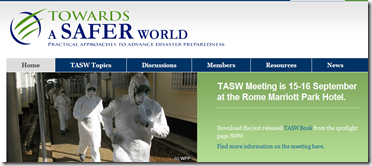
The United Nations and USAID – along with other partners that include WFP, WHO, UNWTO , and the FAO has joined together to create the Towards A Safer World (TASW) initiative, which seeks to `capture the lessons that were learned from preparing for an influenza pandemic, and inspire leaders to apply those lessons and best practices to continuing and emerging threats.’

Later this week (Sept 15 &16th) representatives of various governments, United Nations officials, along with representatives from civil society, the military and the private sector will all take part in a 2-day  TASW conference on pandemic preparedness and approaches to disaster preparedness.


In conjunction with this meeting, TASW has released a 176-page book (available as a PDF download), with a forward by David Nabarro, that brings together the experiences of whole-society engagement in pandemic and disaster preparedness.


image


I’ve only just had time to glance at this publication, but wanted to pass along the information. The TASW has provided more details in a press statement released today.


Towards a Safer World Calls for Inclusive, Whole-of-Society Approach to Disaster Management

New book introduced today spotlights benefits of creating strong linkages between partners from different sectors for future disaster planning and response

ROME, Sept. 12, 2011 /PRNewswire/ -- In a new book released today, government, military, civil society, and private sector leaders are challenged to help unify experiences and resources in order to successfully manage and mitigate the impact of future global disasters by learning from recent pandemic response efforts.


"Beyond Pandemics: A Whole-of-Society Approach to Disaster Preparedness" outlines the human, economic and societal benefit of increasing collaboration, planning and dialogue across the whole of society. This can include partners in travel, animal health, business, global health and civil-military response teams.


"Most authorities agree that the world is not ready for a severe influenza pandemic. The best way to prepare is to engage multiple sectors in order to ensure an effective and timely response," said UN Senior Coordinator for Avian and Human Influenza and author, David Nabarro. "The countries that have done best involve many government departments, a broad range of businesses, and civil society in preparedness planning: their challenge, now, is to sustain this approach for all health-related crises through sustainable, holistic and adequately funded systems."


Nabarro continued, "To the best of my knowledge this is the first time that these multiple experiences have been brought together - and analyzed - in one document: it is sure to be useful  to all involved in 'whole-of-society' crisis preparedness."

(Continue . . . )


You’ll find more details on this initiative at the TASW website.

image

Tuesday, February 08, 2011

PREDICT: A Global Healthmap Of Zoonotic Disease


# 5297


Readers of this blog are no doubt familiar with Healthmap.org’s continually updated maps of disease outbreaks around the world.


I’ve used them often in my research, and have written about them numerous times, including (Healthmap.org: Charting Dengue’s Progress, Study: Unstructured Event-Based Global Infectious Disease Surveillance Systems and HealthMap On The Web.)


Via DONALD G. McNEIL Jr. of the New York Times, we learn of a new offshoot of the healthmap project (hat tip Tetano on FluTrackers) that focuses on zoonotic outbreaks of disease around the globe.


Outbreaks: A Tool to Track Animal Diseases May Help to Protect Humans

VIENNA — A new online mapping tool will enable scientists and the public to track outbreaks of animal diseases that might jump to humans.

(Continue . . .)


From the PREDICT Home page of the UC Davis School of Veterinary Medicine, we get this description.


PREDICT: Building a global early warning system for emerging diseases that move between wildlife and people.

In order to predict, respond to, and prevent the emergence of novel infectious diseases in humans, pathogens must be identified at their source. Explosive human population growth and environmental changes have resulted in increased numbers of people living in close contact with animals. Unfortunately the resulting increase in contact, together with changes in land use, has altered the inherent ecological balance between pathogens and their human and animal hosts.


<SNIP>

PREDICT project objectives:

  • Assess local surveillance capacity;
  • Implement targeted and adaptive wildlife disease surveillance systems;
  • Develop and deliver new technologies to improve efforts close to the source;
  • Use cutting-edge information management and communication tools to bring the world closer to realizing an integrated, global approach to emerging zoonotic diseases.

image


A screen shot of the PREDICT map shows global areas  currently of concern.


image


By zooming in, one can take a closer look at any region of the globe.  Here is a close up of South East Asia.


image

By clicking the `pins’, once can pull up a detailed (linked) list of outbreak information.


This looks to be an invaluable resource for the world of emerging infectious diseases, one that I’m sure we will avail ourselves of often.