Showing posts with label United Nations. Show all posts

Friday, October 03, 2014

Statement From The UN Mission For Ebola Emergency Response Regarding Transmission Of Ebola

image

Credit WHO


# 9145


In a sane world, an official could at least raise the possibility of low probability-high impact event without it being blown all out of proportion by the press, the internet, and through osmosis -  the public. 


But measured, rational discussions don’t sell papers, drive web traffic, or grab cable news viewers. 


And so any acknowledgement of an infinitesimal risk – such as an asteroid strike,  a Yellowstone eruption, or `airborne Ebola-  becomes instant fodder for the media and pure manna for conspiratorialists worldwide.


Exhibit A – yesterday’s headlines (see Ebola 'could become airborne' in nightmare scenario, UN mission chief warns).


This,  is why we can’t have adult discussions anymore.  At least not in public.


Admittedly, Banbury should have known better than to go there. He had to have known how this would have been played in the press, and he (hopefully) knows just how low the risk of that sort of outcome really is. Not zero, but pretty darn close.


Yes, in a rational universe, we should be able to discuss all possibilities – no matter how remote.


But we don’t live in one of those.   So officials have to watch what they say very carefully.  Too carefully, in my opinion.  


Today the UN Mission for Ebola Emergency Response has issued the following clarification.


UN Mission for Ebola Emergency Response statement for clarification: No threat that Ebola is airborne 

ACCRA, GHANA, 3 October 2014

Following recent media reports, the UN Mission for Ebola Emergency Response (UNMEER) seeks to clarify that Ebola is not an airborne disease. At this point in time we have no evidence and do not anticipate that the Ebola virus is mutating to become airborne.


However, there are real risks and concerns with this outbreak: every day more people are becoming infected and more are dying because they cannot get the care they need. Energy needs to be focused on swiftly addressing the real needs and gaps in communities affected by this disease.


The Ebola virus only spreads through contact with bodily fluids. The World Health Organization (WHO) monitors the virus closely. Viruses do mutate but it is a complex process that takes time. Right now, as advised by WHO, the safest thing anyone can do is avoid direct contact with bodily fluids of people who have Ebola, and with surfaces and materials (e.g. bedding, clothing) contaminated with fluids.


Media contacts:
Currently with the UNMEER delegation in Sierra Leone
Christy Feig,
feigc@who.int, +41.79.251.7055
Jon Greenway,
greenway@un.org, +1.917.209.3956
Margaret Harris,
mharrisenator@gmail.com, harrism@who.int, (use both emails when sending a request),  +232 78 335 660

Wednesday, January 23, 2013

Global Mercury Ban Exempts Thimerosol Preservatives


image


# 6875


In December of last year (see AAP Endorses SAGE Recommendations Keeping Thimerosal In Vaccines) I wrote on the debate over allowing the continued use of thimerosol in childhood vaccines used in many countries around the globe.


Thimerosol – which contains ethyl mercury - has strong antiseptic and antifungal properties and has used as a preservative to prevent contamination of multi-dose vials of vaccines for many decades.


Thimerosol use in the United States has been largely curtailed since 1999, when in the face of growing public concern - despite credible scientific evidence of harm – thimerosol was removed from most childhood vaccines.


Doing so has required the move to single-dose vaccines, a step that would prove both difficult and prohibitively expensive for many developing countries.


Over the past several years a global agreement banning the use of mercury has been in the works, and last week a treaty was approved. 


This from the UNEP.


Minamata Convention Agreed by Nations Sat, Jan 19, 2013

Global Mercury Agreement to Lift Health Threats from Lives of Millions World-Wide

Geneva/Nairobi, 19 January 2013 - International effort to address mercury-a notorious heavy metal with significant  health and environmental effects-was today delivered a significant boost with governments agreeing to a global, legally-binding treaty to prevent emissions and releases.


The Minamata Convention on Mercury-named after a city in Japan where serious health damage occurred as a result of mercury pollution in the mid-20th Century-provides controls and reductions across a range of products, processes and industries where mercury is used, released or emitted.


These range from medical equipment such as thermometers and energy-saving light bulbs to the mining, cement and coal-fired power sectors.


The treaty, which has been four years in negotiation and which will be open for signature at a special meeting in Japan in October, also addresses the direct mining of mercury, export and import of the metal and safe storage of waste mercury.

(Continue . . .)


Two medical exemptions were provided for in this treaty:


  • Vaccines where mercury is used as a preservative have been excluded from the treaty as have products used in religious or traditional activities
  • Delegates agreed to a phase-down of the use of dental fillings using mercury amalgam.


In a perfect world every vaccine would come in a single-dose vial or syringe, and there would be no need to add preservatives like thimerosol.


But in the world in which we live, the choice is either to use a preservative, or accept that far fewer children will receive potentially life-saving vaccines. 

Monday, May 14, 2012

Building Disaster Resilient Cities


# 6326


Around the globe cities are increasingly where jobs are to be found, and where goods and services are most likely to be available. And so not surprisingly, today, half the world’s population – some 3.5 billion people – now live in urban areas.


With the clustering of millions of people into relatively small areas, we’ve created a scores of `target-rich environments’ for natural disasters such as earthquakes, floods, and severe storms. 


The equation is pretty simple. More people in a small space = more potential casualties.


And the more densely populated a region is, the more economic impact a disaster will have as well.


Last year, in UNDP: Supercities At Seismic Risk, we looked at the concerns that half of the world’s supercities  (urban areas with 2 million – 15 million inhabitants) are at risk of significant seismic activity.


Last December, in WHO e-Atlas Of Natural Disaster Risks To Europe, we looked at some of the disaster threats facing Europe, and in January of this year I blogged that a UN Agency Warns On Global Seismic Risks.


In 2010, more than 200,000 inhabitants in and around Port-au-Prince, Haiti died during their 7.0 magnitude earthquake. Much of that death toll can be attributed to the poor construction standards in that region that led to tens of thousands of building collapses.


While we can’t stop earthquakes from striking, or hurricanes from making landfall, we can design our cities to be more resilient for when they do.  Not only can this reduce the death toll and human suffering, it can reduce the economic impact as well.


Which brings us to a new publication from the United Nations International Strategy For Disaster Reduction (ISDR).


How to make cities more resilient: a handbook for local government leaders

A contribution to the global campaign 2010-2015 Making Cities Resilient – 'My City is Getting Ready!':


This handbook provides mayors, governors, councillors and other local government leaders with a generic framework for risk reduction and points to good practices and tools that are already being applied in different cities for that purpose. It discusses why building disaster resilience is beneficial; what kind of strategies and actions are required; and how to go about the task. It offers practical guidance to understand and take action on the "Ten Essentials for Making Cities Resilient" as set out in the global campaign "Making Cities Resilient: My City is Getting Ready!".


A web-based information platform, where cities and local governments can share their own tools, plans, regulations and practices, complements the Handbook and will be available through the Campaign website.

While billed as a handbook primarily for city officials, citizens and residents of these urban areas have a deep seated interest in seeing that the proper steps are taken to mitigate potential disaster losses.


I’m a firm believer that true resilience is built from the bottom up, not the top down.  And so it behooves everyone – no matter where they live, or what position in their community they may hold – to look at their surroundings and do a basic threat assessment. 


And then take whatever prudent steps they can to to reduce those risks, and to encourage those around them to do the same.


No matter where you live in the world, the resources of the FEMA, and READY.GOV websites can be used to help make you and your community better prepared to deal with disasters.


While designed specifically for the threats facing southern California, the The L. A. County Emergency Survival Guide provides an excellent starting place for any family doing `all threats’ emergency planning.


image


Most importantly, everyone needs an appropriate disaster plan, just as everyone should have a good first aid kit, a `bug-out bag’, and sufficient emergency supplies to last a bare minimum of 72 hours.


For more on  disaster preparedness, I would invite you revisit these blogs:


When 72 Hours Isn’t Enough

In An Emergency, Who Has Your Back?

An Appropriate Level Of Preparedness

The Gift Of Preparedness 2011

Wednesday, January 18, 2012

UN Agency Warns On Global Seismic Risks


image

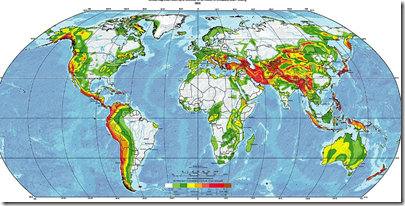
Seismically active areas of the world

# 6081


While major earthquakes are normally associated with the Pacific rim, or parts of Asia and the middle-east, in truth many other regions of the world are at some risk of serious seismic activity.


Last December, in WHO e-Atlas Of Natural Disaster Risks To Europe, we looked at some of the seismic risks to Europe, and in April of 2011 (see UNDP: Supercities At Seismic Risk) we saw a report that stated that half of the world’s supercities (urban areas with 2 million – 15 million inhabitants) are at high risk for seismic activity.


According to the Centre Sismologique Euro- Méditerranéen (CSEM) there have been nearly 750 (mostly minor) Euro-Med earthquakes recorded over the past two weeks. 


image


While large earthquakes are rare in central, western, or northern Europe, they are not unheard of.


In 1356, on the evening October 18th - the Feast day of Saint Luke the Evangelist – perhaps the strongest quake in central Europe’s history struck in the evening, destroying the Swiss town of Basel and leveling practically every major structure within 30 kilometers of the city.


The quake was preceded by a foreshock between 7 and 8 pm, with the main quake striking around 10pm.  It was felt as far away as  Zürich, Konstanz and even in Île-de-France.


While seismographs were not invented 650 years ago, estimates put this quake at between 6.2 and 6.5 on the modern Richter scale.


image

Le tremblement de terre qu a eu lieu en 1356. - Karl Jauslin (1842–1904)


In 1755, on November 1st (All Saint’s Day), what would prove to be one of the deadliest earthquakes to ever strike Europe literally destroyed Lisbon, Portugal along with dozens of fishing villages along the coast, and sent Tsunami waves crashing into the UK, Northern Africa, and the Caribbean.


The quake, which occurred a couple of hundred kilometers offshore, was estimated to have been 8.2 or greater on the Richter scale.


Tremendous tsunamis (20+ meters) were reported in Northern Africa, and smaller waves washed ashore in the Caribbean and the Atlantic Coast of the New World many hours later. 


Lest anyone think this is simply `ancient history’ -  never to be repeated - a somewhat smaller quake (7.8 magnitude) struck in roughly the same area in 1969.


While damage was moderate, and only a minor (1+ meter) tsunami was generated, 13 people were killed and many more injured. 


The bottom line is that earthquakes (and tsunamis) can and do occur even in places that are not considered seismically active.  And while rare, they can produce catastrophic results.


All of which serves as prelude to a Press release issued today from the United Nations International Strategy For Disaster Reduction (UNIDSR.Org) warning against ignoring seismic threats.


UNISDR warns against ignoring seismic threats as quakes wreak havoc for second year

 302 human impact disasters claimed 29,782 lives; affected 206 million and inflicted record economic damages of $366 billion in 2011


Geneva, 18 January 2012 – For two consecutive years the long-term disasters trend has been bucked by major earthquakes which claimed thousands of lives and affected millions in both 2010 and 2011, according to new statistics published today by CRED and the UN office for disaster risk reduction, UNISDR.


UNISDR Chief, Margareta Wahlström, said today: “The Great East Japan Earthquake and the accompanying tsunami is a reminder to us all that we cannot afford to ignore the lessons of history no matter how forgotten. The many major cities located in seismic zones need to take seriously the probability of return events even if many years have passed since the last seismic event of major magnitude.


“In 2010 we saw this phenomenon as well when over 220,000 people died in Haiti which had not been hit by an earthquake of such strength for almost 200 years. Unless we prepare for the worst then many earthquake-prone urban areas around the world are destined to see even greater loss of life in the future as more and more people move to cities.”


Figures released today by the Centre for Research on the Epidemiology of Disasters (CRED) at a UNISDR-hosted press conference in Geneva showed that 20,943 people lost their lives in earthquakes last year out of a total of 29,782 people directly killed by 302 disasters. The earthquake fatalities included 19,846 who died in Japan while the remainder were largely accounted for by the October earthquake in Turkey.


(Continue . . . )


The EM-DAT Project is supported by USAID.

Date: 18 Jan 2012
Sources: United Nations International Strategy for Disaster Reduction Secretariat (UNISDR)


While we can’t predict where the next earthquake will occur, or do anything to stop it, we can prepare to deal with one when it happens.


For good, solid information on how prepare for `the big one’ (even if you live someplace other than Los Angeles), I would recommend you download, read, and implement the advice provided by the The L. A. County Emergency Survival Guide.

image


While US-centric, FEMA has an earthquake hazard webpage with a lot of resources that would be of use to just about anyone, including the following preparedness information.


Earthquake Information for Individuals and Families

Below are links to earthquake-related information of use to individuals and families. There are many things that you can do to reduce the chances that you or members of your family will be injured, or that your property will be damaged, by earthquakes. Use the following resources to help make your family, your home, and your community more resistant to the potentially dangerous and damaging effects of earthquakes.

  • What to Do During an Earthquake
    Everyone living in or visiting seismically active regions needs to learn—and practice—how to protect themselves in an earthquake. This fundamental seismic safety information can save lives and reduce injuries.
  • Earthquake Preparedness at Home
    Learn about what to do at home before, during, and after earthquakes. Topics include how to strengthen your home, secure its contents, and prepare yourself and your family to react safely, take cover, survive on your own, stay in contact, and care for people, pets, and property.
  • Earthquake Publications and Tools—Individuals and Families
    Browse and access FEMA publications that provide in-depth guidance on protecting residential structures, their contents, and their occupants from earthquake hazards. All can be downloaded online, and most can be ordered in print or on compact disc.
  • Earthquake Contacts
    Find individuals and organizations that you can go to for more information about earthquake risk-reduction activities in your state, in your region, or at FEMA.


Emergencies happen every day.  Disasters, admittedly, less often.


But in either event, preparedness is key.


At a bare minimum, every household should have a disaster plan, a good first aid kit (and the knowledge to use it), and emergency supplies to last a minimum of 72 hours during a disaster.


Personally, I’d be uncomfortable with anything less than a week.


To become better prepared as an individual, family, business owner, or community to deal with these types of disasters: visit the following preparedness sites.


FEMA http://www.fema.gov/index.shtm

READY.GOV http://www.ready.gov/

AMERICAN RED CROSS http://www.redcross.org/

Wednesday, October 12, 2011

IDDR: Stepping Up For Disaster Risk Reduction


image

# 5893


The second Wednesday of October has been designated International Day For Disaster Reduction (IDDR) by the United Nations.  This year, the focus is on Making Children & Youth Partners in Disaster Risk Reduction.


Secretary-General Ban Ki-moon’s message for this year’s IDDR states:


"Vulnerability to disaster is growing faster than resilience.[...] Disaster risk reduction should be an everyday concern for everybody. Let us all invest today for a safer tomorrow."


According to United Nations report dated 12-Aug-2011 called Implementation of the International Strategy for Disaster Reduction:

  • The increasing financial, social and political cost of disasters is evident. Mortality risk associated with weather-related hazards is declining at the global
    level, while economic losses continue to  increase across all regions.

  • Economic loss risk is growing faster in higher-income countries. Since 1980, economic loss related to tropical cyclones increased by 262 per cent in high-income countries, compared to 155 per cent in low-income countries.

  • In the period 1970-2010, the world population increased by 87 per cent. During the same period, the population growth in flood-prone river basins increased by 114 per cent, and in cyclone-prone coastlines by 195 per cent.

  • Half of humanity is now living in cities. By 2050, urbanization will rise to 70 per cent and urban risk will continue to increase.

As the world’s population expands, there are simply more of us in harm’s way.  Earthquakes, tsunamis, droughts, cyclones, and other natural disasters have the potential to affect a greater number of people every year.


The UN News Centre published the following report yesterday focusing on Europe’s vulnerability to disaster.+

Europe’s vulnerability to natural disasters quickly rising – UN agency

11 October 2011 –

The number of natural hazards taking place in Europe increased significantly last year, the United Nations disaster risk reduction agency says, warning that the region’s governments need to implement prevention platforms to significantly reduce the danger they pose to their populations.


“In 2010, Europe saw the biggest increase in disaster events – plus 18.2 per cent – compared to the decade’s averages,” chief of the UN International Strategy for Disaster Reduction (UNISDR) Margareta Wahlström told participants at a forum yesterday in Skopje, the capital of the former Yugoslav Republic of Macedonia.


“In terms of economic damages, it accounted for 14.3 per cent of reported global disaster losses in 2010, with most of the damages caused by climatological and hydro meteorological events.”

(Continue . . . )


Earlier this year, in UNDP: Supercities At Seismic Risk I wrote about a warning that half of the world’s supercities (urban areas with 2 million – 15 million inhabitants) were at high risk of seismic activity.


Geohazards International, a non-profit organization that for the past 20 years has been dedicated to reducing the loss of life and suffering around the world in communities most vulnerable to earthquakes, has a good deal of information on at-risk cities as well.


The following comes from their Vulnerable Communities page.


image


And last August, in Weathering Heights: Billion-Dollar-Plus Weather Disasters I outlined the 9 (now 10) billion-dollar-plus weather disasters in the United States in 2011.


When you add the the earthquake and Tsunami in Japan, the horrendous Port-au-Prince earthquake of 2010, the floods in Pakistan, and the heat-wave & fires in Russian last year, and scores of other disasters over the past 24 months, you can see just how vulnerable our population really is.


While community resilience requires action by local, national, and international authorities, there are also steps that individuals and businesses can take.


  • Having a family or business disaster plan, and being properly prepared for a variety of emergencies, can contribute to your community’s resilience.
  • Making your homes, and businesses, safer during an earthquake or other disaster can save lives, and reduce costs and downtime.
  • Participating in local emergency drills, such as the upcoming Shakeout earthquake drills (see A Whole Lotta Shakeouts Goin' On), or local IDDR events helps promote community resilience.
  • And learning basic first aid skills, and CPR, can mean you can help provide immediate assistance during a disaster.


For more ideas, visit the IDDR archives page, where you’ll find resources on earlier campaigns.


Earthquakes, like Hurricanes, Tornados, Floods, and yes . . . even pandemics . . .  are hazards everyone should be aware of, and prepared to deal with.


Everyone should have a disaster plan.  Everyone should have a good first aid kit, a `bug-out bag’, and sufficient emergency supplies to last a bare minimum of 72 hours.


For more on  disaster preparedness, I would invite you to visit:


In An Emergency, Who Has Your Back?

When 72 Hours Isn’t Enough

The L. A. County Emergency Survival Guide

An Appropriate Level Of Preparedness

Monday, September 12, 2011

Beyond Pandemics: A Whole-of-Society Approach to Disaster Preparedness


# 5835


The United Nations and USAID – along with other partners that include WFP, WHO, UNWTO , and the FAO has joined together to create the Towards A Safer World (TASW) initiative, which seeks to `capture the lessons that were learned from preparing for an influenza pandemic, and inspire leaders to apply those lessons and best practices to continuing and emerging threats.’

Later this week (Sept 15 &16th) representatives of various governments, United Nations officials, along with representatives from civil society, the military and the private sector will all take part in a 2-day  TASW conference on pandemic preparedness and approaches to disaster preparedness.


In conjunction with this meeting, TASW has released a 176-page book (available as a PDF download), with a forward by David Nabarro, that brings together the experiences of whole-society engagement in pandemic and disaster preparedness.


image


I’ve only just had time to glance at this publication, but wanted to pass along the information. The TASW has provided more details in a press statement released today.


Towards a Safer World Calls for Inclusive, Whole-of-Society Approach to Disaster Management

New book introduced today spotlights benefits of creating strong linkages between partners from different sectors for future disaster planning and response

ROME, Sept. 12, 2011 /PRNewswire/ -- In a new book released today, government, military, civil society, and private sector leaders are challenged to help unify experiences and resources in order to successfully manage and mitigate the impact of future global disasters by learning from recent pandemic response efforts.


"Beyond Pandemics: A Whole-of-Society Approach to Disaster Preparedness" outlines the human, economic and societal benefit of increasing collaboration, planning and dialogue across the whole of society. This can include partners in travel, animal health, business, global health and civil-military response teams.


"Most authorities agree that the world is not ready for a severe influenza pandemic. The best way to prepare is to engage multiple sectors in order to ensure an effective and timely response," said UN Senior Coordinator for Avian and Human Influenza and author, David Nabarro. "The countries that have done best involve many government departments, a broad range of businesses, and civil society in preparedness planning: their challenge, now, is to sustain this approach for all health-related crises through sustainable, holistic and adequately funded systems."


Nabarro continued, "To the best of my knowledge this is the first time that these multiple experiences have been brought together - and analyzed - in one document: it is sure to be useful  to all involved in 'whole-of-society' crisis preparedness."

(Continue . . . )


You’ll find more details on this initiative at the TASW website.

image

Saturday, May 07, 2011

EID Journal: Understanding Haiti’s Cholera Outbreak


# 5543


There’s an old story about a guy who fears his wife may be cheating on him, so he he hires a private detective to follow her.


A couple of days later the detective brings him pictures of her meeting with a strange man in a bar, driving together to a sleazy motel, and the two of them going into a rented room and pulling the shades.


The husband sighs and says, “Always that element of doubt . . . ”


Which pretty much sums up the recent UN report on the origins of Haiti’s Cholera outbreak, which has killed nearly 5,000 individuals (a story well reported by Crof) and sickened a quarter of a million.


image

SourceOCHA as of April 25th, 2011


The report acknowledged:


  • Haiti had been free of cholera for decades
  • The strain that showed up in October was closely matched to the strains found in Southeast Asia, including Nepal
  • That Nepali peacekeepers (MINUSTAH) arrived in Mirebalais shortly before the outbreak began
  • The sanitation conditions at the Mirebalais MINUSTAH camp were not sufficient to prevent contamination of the Meye Tributary System with human fecal waste.


The report further admits that Cholera was undoubtedly introduced by someone visiting from Southeast Asia.


The evidence does not support the hypotheses suggesting that the current outbreak is of a natural
environmental source. In particular, the outbreak is not due to the Gulf of Mexico strain of Vibrio cholerae, nor is it due to a pathogenic mutation of a strain indigenously originating from the Haitian environment.


Instead, the evidence overwhelmingly supports the conclusion that the source of the Haiti cholera
outbreak was due to contamination of the Meye Tributary of the Artibonite River with a pathogenic
strain of current South Asian type Vibrio cholerae as a result of human activity. 


They conclude, however by saying that:


The precise country from where the Haiti isolate of Vibrio cholerae O1 arrived is debatable.


Preliminary genetic analysis using MLVA profiles and cholera toxin B subunit mutations indicate that the strains isolated during the cholera outbreak in Haiti and those circulating in South Asia, including Nepal, at the same time in 2009-2010 are similar. 


Always that element of doubt.


The UN report goes on to reference 9 factors that contributed to the outbreak – mostly relating to poor sanitary conditions in Haiti, a lack of immunity, and the virulence of the strain – and then states:


The Independent Panel concludes that the Haiti cholera outbreak was caused by the confluence of circumstances as described above, and was not the fault of, or deliberate action of, a group or individual.


The source of cholera in Haiti is no longer relevant to controlling the outbreak. What are needed at this time are measures to prevent the disease from becoming endemic.


Incongruously, while painting a picture that strongly suggests the Nepali troops were a likely source of the outbreak, this UN report goes to great lengths not to state it as actual fact.


In fairness, it is probably impossible to know – with absolute certainty – whether the Nepali peacekeepers brought cholera into Haiti. The evidence may be strong, but it is circumstantial.


Which, frankly, describes the data from most epidemiological investigations.  


Obviously this is a diplomatic hot potato, and this UN report does what it can to try to move forward, rather than assign blame.


And one can certainly sympathize with the MINUSTAH troops – there to do humanitarian work in a difficult environment with primitive sanitary facilities  – who may have inadvertently (and unknowingly) introduced cholera into the country.


As the saying goes, `No good deed goes unpunished’.


This week we’ve a another report (published online ahead of print) from the CDC’s EID Journal which is a bit more direct in its assessments.


Piarroux R, Barrais R, Faucher B, Haus R, Piarroux M,
Gaudart J, et al. Understanding the cholera epidemic, Haiti. Emerg Infect Dis. 2011 Jul; [Epub ahead of print]


Abstract (Excerpts)

After onset of the cholera epidemic in Haiti in mid-October 2010, a team of researchers from France and Haiti implemented field investigations and built a database of daily cases to facilitate identification of communes most affected.


Several models were used to identify spatio-temporal clusters, assess relative risk associated with the epidemic’s spread, and investigate causes of its rapid expansion in Artibonite Department.


<SNIP>


Our findings strongly suggest that contamination of the Artibonite and 1 of its tributaries downstream from a military camp triggered the epidemic.


You’ll find a detailed analysis of the outbreak and its spread in this paper, along with arguments that asymptomatic carriers of cholera would have been unlikely to shed enough V. cholerae in their stools to have sparked the outbreak.


They believe that at some point, `symptomatic cases occurred inside the MINUSTAH camp’. A point that, to my knowledge, has never been conceded by the Nepali contingent.


From the Discussion section the authors give their rationale for the importance of determining the origin of the outbreak:


Determining the origin and the means of spread of the cholera epidemic in Haiti was necessary to direct the cholera response, including lasting control of an indigenous bacterium and the fight for elimination of an accidentally imported disease, even if we acknowledge that the latter might secondarily become endemic.


Putting an end to the controversy over the cholera
origin could ease prevention and treatment by decreasing the distrust associated with the widespread suspicions of a cover-up of a deliberate importation of cholera (15,16).


Demonstrating an imported origin would additionally compel international organizations to reappraise their procedures. Furthermore, it could help to contain disproportionate fear toward rice culture in the future, a phenomenon responsible for important crop losses this year (17).


Notably, recent publications supporting an imported origin (7) did not worsen social unrest, contrary to what some dreaded (18–20).

 
Our epidemiologic study provides several additional arguments confirming an importation of cholera in Haiti.


There was an exact correlation in time and places between the arrival of a Nepalese battalion from an area experiencing a cholera outbreak and the appearance of the first cases in Meille a few days after.


The remoteness of Meille in central Haiti and the absence of report of other incomers make it unlikely that a cholera strain might have been
brought there another way.


An accompanying editorial appears (Dowell SF, Braden CR. Implications of the introduction of cholera to Haiti. Emerg Infect Dis. 2011 Jul; [Epub ahead of print]))


It states, in part:


For Haiti, the future course of the cholera epidemic is difficult to predict, especially given the chronic degradation of water and sanitation infrastructure over many years and the acute disruption from the earthquake in Haiti in January 2010 (6).


Improving water and sanitation infrastructure is clearly the most effective and lasting approach to prevent the spread of cholera in countries where it is endemic as well as in those that are currently cholera-free.


Simple enough sounding solutions, but terribly difficult to implement in an impoverished, earthquake wracked, and dysfunctional nation like Haiti.

Saturday, April 16, 2011

The Wide World Of Reports


# 5497


It’s a busy world out there, with literally scores of disease outbreaks, disasters, and other significant events taking place every week.


Keeping track, and detecting trends, can be a full time job.


Luckily we’ve several handy disaster, crisis, and disease mapping websites that do a remarkable job in this regard. 


Today, a brief review of four of them.


For versatility, and volume of reports, it’s hard to beat Healthmap.org’s  Healthmap.  

image


You can easily define the parameters to display, including disease types, locations, and information sources.  You can view the world in either map or satellite view, and of course you can drill down and examine individual reports.


You’ll also find quick views of recent outbreaks or crises.  Right now Japan, Antibiotic resistance, and Cholera in Haiti, and Measles are featured.


Healthmap began in 2006, and is fully interactive.  I first wrote about HealthMap in July of 2008 (see HealthMap On The Web)


A relative newcomer that I profiled last February is the PREDICT MAP, an offshoot from the Healthmap (above), that focuses on zoonotic outbreaks of disease around the globe


A screen shot of the PREDICT map shows global areas  currently of concern.


image


From the PREDICT Home page of the UC Davis School of Veterinary Medicine, we get this description.

PREDICT: Building a global early warning system for emerging diseases that move between wildlife and people.

In order to predict, respond to, and prevent the emergence of novel infectious diseases in humans, pathogens must be identified at their source. Explosive human population growth and environmental changes have resulted in increased numbers of people living in close contact with animals. Unfortunately the resulting increase in contact, together with changes in land use, has altered the inherent ecological balance between pathogens and their human and animal hosts.


A relatively new entry is the HEWS (Humanitarian Early Warning Service) developed by the United Nation’s WFP World Food Programme.  The focus here are on disasters that can affect food security, including floods, storms, locusts, volcanoes, and earthquakes.


image


And lastly, a disease specific map that I visit often. Dengue Watch tracks this rapidly spreading arbovirus around the world.


image


I hit each one of these maps at least once a day, trolling for stories for this blog, or simply to keep up-to-date on events around the world.


Since many of these reports are culled from newspaper and media reports, and those sometimes are less than completely accurate, maintaining a level of Caveat Lector is recommended.


But if taken with that understanding, these maps can be extremely useful and illuminating tools.


And let’s face it.  Getting real time updates from all around the world is pretty cool.

Thursday, November 18, 2010

Cholera Outbreak Map Of Haiti


# 5069


Although Crofsblog  is doing most of the heavy lifting when it comes to blogging about the cholera outbreak in Haiti (and if you aren’t following him, why not?) – I ran across this map published by ReliefWeb today, and thought it would help put things in better perspective.


Follow the links to download larger versions of this graphic.


HAITI: Cholera Outbreak (as of 17 Nov 2010) - Location Map

Map of 'HAITI%3A%20Cholera%20Outbreak%20(as%20of%2017%20Nov%202010)%20-%20Location%20Map'


Thursday, April 22, 2010

IMCAPI Conference Closes


# 4516


IMCAPI, the International Ministerial Conference On Animal and Pandemic Influenza being attended by representatives from more than 70 nations has ended with the members adopting what is called the `Hanoi Declaration’, which is promised to be uploaded to their website shortly.


The UN Press Release, issued overnight, gives some of the details.


Hanoi Declaration Sets Global Framework for Avian Influenza, Pandemic Readiness,

Proposes National Steps to Detect Animal-Human Transmission, Control Outbreaks

Drawing on the lessons of responses to H5N1 avian influenza and H1N1 pandemic influenza, ministers and senior officials from more than 70 countries today agreed on the way forward in responding to avian influenza, preparing for pandemics and tackling newly emerging infectious diseases.


The Hanoi Declaration proposes a multisector array of national measures to keep a look out for new diseases that may cross from animals to humans and to deploy public health measures promptly against outbreaks.  It calls for focused action at the interface between human, animal and environmental health systems, as well as continued efforts to reduce the extent of H5N1 and H1N1.


Countries and international agencies are urged to “remain vigilant with respect to emerging threats such as H5N1, pandemic H1N1, and other influenza viruses”.


The Declaration recognizes the necessity for continuing and strengthening international and regional cooperation against diseases for which there may be no human immunity and which can cross borders in a matter of days.  It emphasizes the need for effective communication between professionals and public, community engagement, and for strengthened public health and veterinary systems.


(Continue . . . )


The IMCAPI documents page is already populated with a number of items, with a promise of more to come.  So you may wish to check back over the next few days.

image

Documents

The Hanoi Declaration at the 7th International Ministerial Conference on "Animal and Pandemic Influenza: the way forward" - to be uploaded for download very soon
This is the final version of the Hanoi Declaration, which was adopted by all the delegates at the IMCAPI Hanoi 2010.


AVIAN AND PANDEMIC INFLUENZA: VIETNAM'S EXPERIENCE

This report have been jointly prepared by the Ministry of Agriculture and Rural Development (MARD) and the Ministry of Health (MOH) of the Government of Vietnam. It provides information on the actions taken by the Vietnam Government, supported by international agencies and donors and the private sector, in tackling H5N1 avian influenza viruses in poultry. It also includes our experiences in preparing for and managing human influenza pandemics.


Please click the following links to get the soft version of the report:
Avian and pandemic influenza: Vietnam's Experience: Full report
Avian and pandemic influenza: Vietnam's Experience: Report in brief

2010 ANIMAL AND PANDEMIC INFLUENZA GLOBAL REPORT
The UN-World Bank ‘Responses to Animal Influenza and State of Pandemic Readiness, April 2010 Global Report’ is currently being written and will be finalized following inputs of relevant results from IMCAPI.

The documents below will be presented to participants to IMCAPI for their discussion and feedback. Please note that the documents are presented in draft format and will be replaced by finalized documents when these are available.

 
1.
‘Animal and Pandemic Influenza: A Framework for Sustaining Momentum – Synopsis’ document (Draft)
-
Synopsis in Arabic
-
Synopsis in Chinese
- Synopsis in French
- Synopsis in Spanish
-
Synopsis in Russian
2.
‘Animal and Pandemic Influenza: A Framework for Sustaining Momentum’ document (Draft)
3.
‘International Financial and Technical Assistance’ document (Draft)

- Resource paper 1
-
Resource paper 2
- Resource paper 3
- Resource paper 4
-
Methodology, Acronyms, Glossary

European Commission - Directorate General External Relations - Avian Influenza External Response Coordination
Study on the Gender Aspects of the Avian Influenza Crisis in Southeast Asia: Final Report - June 2008

European Commission / Regional Programme Asia - Cross-border Co-operation in Animal and Human Health
Outcome and Impact Assessment of the Global Response to the Avian Influenza Crisis: Draft Report -April 2010

One Health for One World:A Compendium of Case Studies
This publication was prepared by Veterinarians without Borders / Vétérinaires sans Frontières - Canada with support from the Public Health Agency of Canada - April 2010 -
PDF for download

Press Release and Media Advisory - Click here

Announcement of the national organizing committee
Any organizations interested in having publications on animal and pandemic influenza displayed in the conference exhibition area, please click
here.

Background Information

  • Contact details of the Ministries and Ministerial-level agencies of the Government of Vietnam - download

  • Vietnam and Hanoi in brief - download

  • Press Release and Media Advisory - click here

  • The role of partners organizations in preparation for IMCAPI Hanoi 2010 - download

  • Background document of IMCAPI - download

  • Vietnam Integrated National Plan for AHI Preparedness and Response - Red Book - download

  • Integrated National Operational Programme for Avian and Human Influenza - Green Book - download

  • The Monitoring and Evaluation (M&E) Framework for the Green Book - download

  • More to be updated later

Wednesday, April 14, 2010

UN: Global Report on Animal and Pandemic Influenza (Draft)


# 4499


Later this month public health officials from more than 80 countries will meet in Hanoi for the 7th annual International Ministerial Conference on Animal and Pandemic Influenza.  


Today we get an early look at the draft Global Report (to be amended and revised after the conference), along with an number of resource documents.


image


April 2010 Global Report on Animal and Pandemic Influenza
April 2010


From the United Nations News Centre, we get this overview including comments by David Nabarro, the UN’s Senior System Coordinator for Avian and Human Influenza. 


The dangers from H5N1, and other zoonotic diseases, has not gone away and the UN urges continued momentum to combat these threats.


New UN study urges sustained momentum to tackle human, animal influenza threats

David Nabarro, Senior UN System Coordinator for Avian and Human Influenza

14 April 2010 – While there has been substantial global progress towards pandemic preparedness in recent years, it is vital to maintain that momentum to respond effectively to existing and possible future threats, according to a new study by the United Nations and the World Bank.


“Continued global vigilance for infectious disease outbreaks and pandemics is of critical importance for health security and well-being,” says the report, entitled “Animal and pandemic influenza: a framework for sustaining momentum.”


The report notes that an estimated 75 per cent of new human diseases originate in animals and an average of two new animal diseases with cross-over capabilities emerge every year.


The emergence of three major epidemiological events into the first decade of the new century – SARS, H5N1 avian influenza and H1N1 pandemic influenza – is an indication of the rate at which threats may continue to arise, it adds.


“Sustaining momentum,” states the report, “will require a strategic use of resources and a move away from emergency response-driven projects and special, single-focus initiatives, to long-term capacity-building.”


The report will be taken up by delegates from over 80 countries when they meet at the International Ministerial Conference on Animal and Pandemic Influenza, which will be held in Hanoi, Viet Nam, from 20 to 21 April.


“This is a really significant conference,” David Nabarro, Senior UN System Influenza Coordinator, told reporters in New York, noting that the gathering will take stock of where the world is with regard to bird flu and the H1N1 virus, review preparedness and consider lessons learned from countries with successful control efforts.


The threats from bird flu and H1N1 are not over yet, he noted, stressing the need for further measures to ensure an effective global response.


“We have to find ways to put the work on bird flu and on pandemics more into the routine business of ministries of health and ministries of agriculture, into the routine work of disaster preparedness units in countries,” he stated. “And so an important element of the discussions in Hanoi will be the way forward.”


Part of the work in Hanoi, he added, will be to consider whether or not extra preparedness is necessary to ensure that those who look after animal health and those that look after human health are working together well enough to prepare for disease threats that come from animals.


A key question, he noted, is: “Are we well enough organized as a world to be prepared for diseases that can jump from the animal kingdom and lead to sickness and possibly quite widespread suffering among humans?”