Showing posts with label arkansas. Show all posts

Tuesday, March 10, 2015

HPAI Bird Flu Suspected In Arkansas Poultry

image

Testing poultry in Arkansas.


# 9807


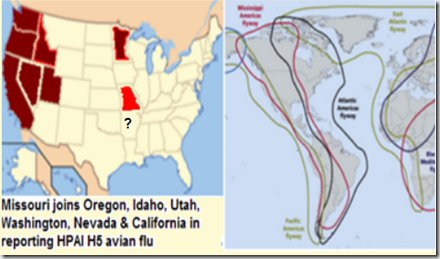
Ever since HPAI H5 viruses arrived in the Pacific Northwest last fall we’ve seen it continue to spread both south, and east, carried by wild and migratory birds. Six days ago the HPAI H5 virus was reported at a Minnesota turkey farm, and just two days ago it turned up at two Missouri poultry farms.


We’ve now a news report this evening suggesting that it may have been detected at a poultry farm in Arkansas.  


As I wrote yesterday in Missouri Dept. Ag. Statement On Avian Flu At Missouri Turkey Farm, the arrival of HPAI to Missouri is particularly troubling as that state, and several adjacent states (most notably Arkansas), are among the biggest producers of poultry in the nation.


At this point, it is just a suspicion, and we’ll have to wait for test results.  Details are scant, but here is the report from Reuters.


UPDATE 1-Suspected bird flu in Arkansas poultry threatens exports

Tue Mar 10, 2015 7:29pm EDT (Updates with details on discovery, comments)

By Tom Polansek and P.J. Huffstutter

(Reuters) - A suspected case of avian influenza has been identified in poultry in Arkansas, the third-largest U.S. turkey producer and home to Tyson Foods Inc , the nation's biggest chicken company, the U.S. Department of Agriculture said on Tuesday.

The infection, if confirmed, threatens to widen trading bans from countries such as Taiwan, Singapore and Nicaragua that have already restricted U.S. poultry exports due to bird flu outbreaks in states ranging from Minnesota and Missouri to California.

"There is a suspect case in Arkansas, but testing is ongoing," USDA spokeswoman Lyndsay Cole said.

(Continue . . . )


Meanwhile, earlier this afternoon the USDA posted the following confirmation of the second Missouri Farm’s infection with H5N2.


USDA Confirms Highly Pathogenic H5N2 Avian Influenza in Commercial Turkey Flocks in Missouri


CDC considers the risk to people from these HPAI H5 infections in wild birds, backyard flocks
and commercial poultry, to be low


WASHINGTON, March 10, 2015 -- The United States Department of Agriculture’s (USDA) Animal and Plant Health Inspection Service (APHIS) has confirmed the presence of highly pathogenic H5N2 avian influenza (HPAI) in two separate commercial turkey flocks in Missouri. The flocks are located in Jasper County and Moniteau County, within the Mississippi flyway where this strain of avian influenza has previously been identified. CDC considers the risk to people from these HPAI H5 infections in wild birds, backyard flocks and commercial poultry,  to be low.


Samples from the turkey flocks, which experienced increased mortality, were tested at the Missouri Department of Agriculture Veterinary Diagnostic Laboratory and the APHIS National Veterinary Services Laboratories in Ames, Iowa confirmed the findings. APHIS is working closely with the Missouri Department of Agriculture on a joint incident response.

State officials quarantined the affected premises and the remaining birds on the properties will be depopulated to prevent the spread of the disease. Birds from the involved flocks will not enter the food system. No human infections with these viruses have been detected at this time. The Missouri Department of Agriculture is working directly with poultry workers at the affected facility to ensure that they are taking the proper precautions.

As a reminder, the proper handling and cooking of poultry and eggs to an internal temperature of 165 ˚F kills bacteria and viruses. As part of existing avian influenza response plans, Federal and State partners are working jointly on additional surveillance and testing in the nearby area. The United States has the  strongest AI surveillance program in the world, and USDA is working with its partners to actively look for the disease in commercial poultry operations, live bird markets and in migratory wild bird populations.


USDA will be informing the World Organization for Animal Health (OIE) as well as international trading partners of this finding. USDA also continues to communicate with trading partners to encourage adherence to OIE standards and minimize trade impacts. OIE trade guidelines call on countries to base trade restrictions on sound science and, whenever possible, limit restrictions to those animals and animal products within a defined region that pose a risk of spreading disease of concern.

These virus strains can travel in wild birds without them appearing sick. People should avoid contact with sick/dead poultry or wildlife. If contact occurs, wash your hands with soap and water and change clothing before having any contact with healthy domestic poultry and birds.

(Continue . . . )


For more on the migratory expansion of these highly pathogenic H5 avian viruses, you may wish to revisit a blog I posted earlier today, called:


J. Virol: Spread & Persistence Of Avian Flu Viruses In The Mississippi Flyway

Saturday, July 27, 2013

Arkansas: Naegleria fowleri Shuts Water Park

image

Photo  Credit Florida DOH


# 7519


While extraordinarily rare, each summer we usually hear about one or more cases of infection with Naegleria fowleri,  dubbed the `brain eating amoeba’ by the media.


Yesterday the Arkansas Department of Health (ADH) confirmed earlier local media reports of a case of PAM (primary amebic meningoencephalitis) due to this parasite in a 12 year-old girl who recently swam in the Willow Springs water park in Little Rock.


First stop, the ADH announcements (2), after which I’ll have more:


Friday, Jul 26, 2013

ADH Confirms Case of Parasitic Meningitis

Little Rock -- The Arkansas Department of Health (ADH) has confirmed a case of a rare form of parasitic meningitis. A case of primary amebic meningoencephalitis (PAM) -- a very rare form of meningitis caused by an ameba associated with warm rivers, lakes and streams -- was confirmed with the assistance of the Centers for Disease Control and Prevention.


Based on our ongoing investigation, the most likely source of infection is the Willow Springs Water Park. There was another case of PAM possibly connected with Willow Springs in 2010. Based on the occurrence of two cases of this rare infection in association with the same body of water and the unique features of the park, the ADH has asked the owner of Willow Springs to voluntarily close the water park to ensure the health and safety of the public.


The organism that causes PAM is known as Naegleria fowleri. It is commonly found in warm freshwater and soil all over the world and can cause a rare but severe brain infection that is usually fatal. Naegleria cannot be passed from person-to-person. The organism typically infects people by entering the body through the nose as they are swimming and diving. Individuals cannot be infected with Naegleria by swimming in properly cleaned, maintained and disinfected swimming pools.


While infection with Naegleria can occur anywhere, it usually occurs in the warm southern U.S. From 2003-2012, there have only been 31 reported infections in the U.S. This case is only the sixth case in Arkansas in 40 years.

(Continue . . . )


Friday, Jul 26, 2013

ADH Offers Further Guidance on Naegleria

Little Rock -- The Arkansas Department of Health (ADH) would like to remind the public that infection from naegleria fowleri, or parasitic meningitis, is very rare. If you swam at Willow Springs Water Park more than 8 days ago, you are NOT at risk for the infection. Even if you swam at Willow Springs in the past week, your risk of infection is exceedingly low.


“If you do not have symptoms, there is no test or preventive antibiotic or treatment needed,” said Dirk Haselow, MD, State Epidemiologist at ADH.


Persons with infection will develop symptoms such as fever, vomiting, stiff neck, headache, light sensitivity, irritability, sleepiness, confusion, or mental status changes within 7 days. If you develop two or more of these symptoms, please contact your doctor.


The Arkansas Department of Health (ADH) has confirmed a rare case of primary amebic meningoencephalitis (PAM) caused by an ameba associated with warm rivers, lakes and streams. The organism that causes PAM is known as Naegleria fowleri. It is commonly found in warm freshwater and soil all over the world and can cause a rare but severe brain infection that is usually fatal.


Naegleria cannot be passed from person-to-person. The organism typically infects people by entering the body through the nose as they are swimming and diving. Individuals cannot be infected with Naegleria by swimming in properly cleaned, maintained and disinfected swimming pools.
For more information visit: LINK


Local media describes this girl’s condition as `stable’, and that she in a medically induced coma. Historically, the prognosis with this type of infection has been very poor, with only 1 patient out of 128 diagnosed in the United States surviving (cite) over the past 50 years.


Although the primary route of infection is from swimming in shallow, warm, (usually stagnant) fresh-water lakes and streams, in 2011 we saw a couple of cases in Louisiana related to the use of Neti Pots for nasal irrigation (see FDA Advice On Safe Use Of Neti Pots).

Is Rinsing Your Sinuses Safe? - (JPG)

Photo Credit FDA


Daily nasal irrigation is also practiced by many in the Muslim community, and that has led to dozens of deaths in recent years in Karachi, Pakistan where tap water standards are suspect. The most recent report I can find comes from late June:


Another man dies due to naegleria fowleri


KARACHI: The deadly waterborne infection, which is caused by an amoeba Naegleria fowleri claimed another life in the city on Saturday. With this case, the death toll, caused by this fatal infection, is now three since January 2013.


Last year, we saw Pakistan: Naegleria Fowleri Blamed For 10 Deaths, while in 2011, the CDC’s EID journal carried the following dispatch on a much bigger outbreak:


Primary Amebic Meningoencephalitis Caused by Naegleria fowleri, Karachi, Pakistan
Sadia Shakoor, Mohammad Asim Beg, Syed Faisal MahmoodComments to Author , Rebecca Bandea, Rama Sriram, Fatima Noman, Farheen Ali, Govinda S. Visvesvara, and Afia Zafar
Abstract

We report 13 cases of Naegleria fowleri primary amebic meningoencephalitis in persons in Karachi, Pakistan, who had no history of aquatic activities. Infection likely occurred through ablution with tap water. An increase in primary amebic meningoencephalitis cases may be attributed to rising temperatures, reduced levels of chlorine in potable water, or deteriorating water distribution systems.


Since millions of people swim in waters where this amoeba naturally occur (or practice nasal irrigation) and only a small handful of infections result, the odds of acquiring this infection are exceedingly low.  


Still, as this infection is almost always fatal, is largely avoidable, and often involves kids - the state of Florida - which has had its share of cases over the years, takes the threat seriously.


The following short video comes from from the Volusia County Health Department.


The Florida Department of Health offers some common sense safety advice on how to avoid this parasite.


image

Photo Credit – Florida DOH

For more information on the Naegleria parasite, you can visit the CDC’s Naegleria webpage.

Wednesday, June 19, 2013

Arkansas: Scott County Chicken Positive for H7N7 Avian Flu

image


# 7409


According to the Poultry Federation, Arkansas is the only state that ranks in the top 10 for Broiler Chicken, Turkey, and Egg production. The state is second only to Georgia in producing broiler chickens, and third in the nation in the raising of turkeys.


Combined, the value of poultry operations in Arkansas (in 2009) exceeded $3 billion dollars.  Neighboring Oklahoma (Scott county is on the border) produces more than 1/2 billion dollars in poultry each year.


All of which makes the discovery yesterday of H7N7 avian flu on a farm in Scott County, a serious economic concern.


First, the announcement from Arkansas.gov, then I’ll return with a bit more about this particular strain of avian flu.


Scott County Chicken Tests Positive for Avian Flu


LITTLE ROCK - The Arkansas Livestock and Poultry Commission received confirmation Tuesday evening that a chicken in a Scott County, Arkansas, chicken house has tested positive for H7N7 Low Pathogenic Avian Influenza.


Thirty Livestock and Poultry personnel have quarantined all poultry within a 6.2-mile radius of the growing operation where the infected bird was located. They are coordinating their response and additional testing with the U.S. Department of Agriculture. Only the USDA can officially confirm avian flu cases.


Chickens tend to contract avian flu via infected waterfowl or water contaminated by waterfowl. Livestock and Poultry officials believe the recent flooding in Scott County contributed to this transmission.


Leaders at the Arkansas Department of Health say the positive test poses no public-health threat.
Avian flu cannot be transmitted to people through the consumption of properly prepared poultry.


Reassurances that H7N7 `poses no public health threat’ are perhaps a bit overstated, although the threat to the public is likely extremely low. We have seen sporadic human infection from various H7 strains of avian influenza – including H7N7 – in the past. 


The most famous (and most recent) being the H7N9 virus in China, but other – far more common -  H7 strains have been known to infect humans as well.


The largest known cluster of H7N7 human infection (89 confirmed, 1 fatality) was reported in the Netherlands a decade ago. Details are available in this report from the December 2005 issue of the Eurosurveillance Journal.


Human-to-human transmission of avian influenza A/H7N7, The Netherlands, 2003

M Du Ry van Beest Holle, A Meijer, M Koopmans3 CM de Jager, EEHM van de Kamp, B Wilbrink, MAE. Conyn-van Spaendonck, A Bosman

An outbreak of highly pathogenic avian influenza A virus subtype H7N7 began in poultry farms in the Netherlands in 2003. Virus infection was detected by RT-PCR in 86 poultry workers and three household contacts of PCR-positive poultry workers, mainly associated with conjunctivitis.


While nearly all of these cases were mild, the impact on the poultry industry was major. More than 30 million birds residing on more than 1,000 farms were culled to control the outbreak.


Before the middle of the last decade, there were no uniform requirements to report or  track LPAI (Low Pathogenic Avian Influenza) infections.  That changed in 2006 when the OIE made reporting of LPAI H5 & H7 viruses mandatory.


In 2008 we saw a study in  PNAS that suggested the H7 virus might just be inching towards adapting to humans. For more details on that study, you may wish to revisit H7's Coming Out Party and H7 Study Available Online At PNAS.

Last summer in Mexico we saw two mild human cases of H7N3 (see MMWR: Mild H7N3 Infections In Two Poultry Workers - Jalisco, Mexico).


But for now, these LPAI viruses are primarily a threat to the poultry industry, and to a far lesser extent, people working in direct contact with infected fowl.


Thus far, this Arkansas outbreak is reportedly limited to one poultry farm.  We’ll have to wait to see if testing reveals that this virus has managed to spread beyond this one location.

Monday, February 28, 2011

Arkansas Earthquake Swarm: 4.7 Magnitude Overnight


# 5343


Nine days ago I wrote about the ongoing swarm of earthquakes occurring in and around Guy, Arkansas in a blog called USGS: The Arkansas Earthquake Swarm. Since then the temblors have continued, with the latest being a 4.7 and a 3.8 magnitude quake overnight.


 image

Note: The two latest shocks (depicted by the blue boxes) are obscuring an additional 52 smaller quakes in the past 7 days in this graphic.


While a bit unnerving for local residents, based on the USGS produced shake map for last night’s shallow 4.7 magnitude event, the quake was likely to be only moderately felt north of Little Rock, and damage – if any – should be `very light’.


image


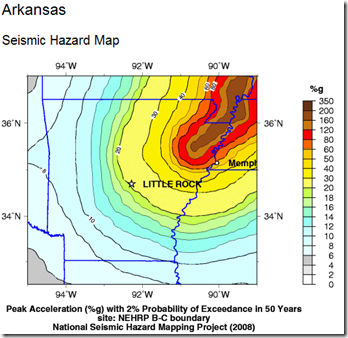
Arkansas is no stranger to seismic events, although the main quake dangers are focused more in the northeast corner of the state, and associated with the New Madrid fault line.


image


Strong – even damaging quakes – have occurred outside of the New Madrid region in Arkansas over recorded history.  On the University of Arkansas’s (Little Rock) earthquake history page you’ll find descriptions of a number of quakes over the past 200 years.


One of the largest in recent memory occurred on New Year’s Day, 1969, and is briefly described:


On January 1, 1969, a tremor centered about 19 miles northwest of Little Rock and caused much commotion in the area. In Little Rock, plaster cracked, and furniture was moved about in some homes; and trees and utility wires swayed and shook throughout a wide area. The shock was also noted by residents in southern Missouri and western Tennessee.


In 1982 and again in 2001 a prolonged series of temblors struck very near the same region as we are seeing activity today, in what was called the Enola Earthquake Swarms. 


Enola is located only 20 miles or so to the south-east of this current area of activity. The Arkansas Geological Survey website gives a nice accounting of this swarm. 


A small excerpt follows:


The Enola swarm was initiated by a magnitude 1.2 earthquake recorded on January 12, 1982 near the town of Enola in Faulkner County, Arkansas. Since then, over 40,000 seismic events have been recorded in the Enola area. Most of the recorded seismic events are microquakes, but at least 93 earthquakes have been felt in the local area by at least one person during the first year of seismic activity. Earthquake magnitudes have not exceeded a 4.5, which occurred on Jan. 21, 1982. No structural damage has ever occurred, although there have been reports of broken china.


As far as whether these latest shocks are a harbinger of bigger things to come?   The USGS has this to say about earthquake swarms east of the Rockies.


Earthquake swarms are common east of the Rocky Mountains; although none of the others have involved so many small earthquakes as the central Arkansas swarms. Scientists don't know why swarms start, why they stop, or how long to expect them to last.

The possibility of a larger earthquake cannot be discounted but none of the other swarms have given us any reason to expect an earthquake large enough to cause significant damage in central Arkansas in the near future.

Most of North America east of the Rocky Mountains has infrequent earthquakes that can strike anywhere at irregular intervals. The causes of earthquakes are not understood well enough for us to predict earthquakes reliably.


Since earthquakes are unpredictable, the only rational response if you live in a seismically active area is to be prepared to deal with one if it happens.


In Because It Can Happen Here, I provided a long list of preparedness links, which I would encourage you to follow.


FEMA, READY.GOV and the American Red Cross all strongly encourage you to be prepared to deal with a wide range of emergencies, including earthquakes, fires, tornadoes, floods, or hurricanes.


They know that during a major crisis, they may not be able to provide assistance to everyone during the first crucial 72 hours.  


You and your family need to be capable of fending for yourselves, and hopefully helping your neighbors, until help can arrive and services are restored.


As Ready.gov reminds us:

image

Do it today.