Showing posts with label H7N7. Show all posts

Friday, March 13, 2015

OIE Notification: LPAI H7N7 In Netherlands

image

credit Rijksoverheid.nl


# 9823


We’ve confirmation from the OIE of yesterday’s report (see Netherlands: (Probably) Mild Bird Flu In Barneveld) that this latest outbreak is of the far less dangerous LPAI H7N7 virus. 


First the OIE notification – which states : A 1 km restriction zone has been established on 12 March 2015. There are 17 other premises in the 1 km zone. All these premises are screened.


After which,  I’ll return with a bit more about this type of avian flu.


image

image


Starting a roughly a decade ago, the OIE began requiring  that all  H5 and H7 infections in birds be reported, and that steps be made to control and eradicate outbreaks.


LPAI (Low Pathogenic Avian Influenza) – which normally does little harm to flocks or humans – has the potential to evolve to HPAI (Highly Pathogenic Avian Influenza) if not controlled, particularly when introduced into a crowded farming environment.


Up until two years ago, human infection with H7 avian viruses were both rare, and almost inevitably mild.  Often little more than mild `flu-like’ symptoms and/or conjunctivitis. 


The one notable exception occurred in 2003 in the Netherlands,  when the largest known outbreak of H7N7 infected 89 people, one of whom died (see Eurosurveillance Journal Human-to-human transmission of avian influenza A/H7N7, The Netherlands, 2003).

But when H7N9 showed up in China two years ago - benign in birds but sporting an impressive morbidity and mortality rate in humans - suddenly H7 avian viruses were afforded with a lot more respect.   . 


In early February of this year the UK saw a similar outbreak of H7N7 in Hampshire, prompting the ECDC to publish a Rapid Risk Assessment On LPAI H7N7.  From that document, we get the following advice:


There is a low risk of zoonotic transmission to people who are directly exposed to infected birds during the culling and destruction process when there are outbreaks in poultry farms. The risk can be minimised if the exercise is performed under the safety measures recommended in Directive 2005/94/EC. Persons with direct contact to infected poultry before or during culling and disposal should be monitored for symptoms, and postexposure antiviral prophylaxis should be considered.

The risk for zoonotic transmission to the general public in EU/EEA countries is considered to be extremely low.

Monday, February 02, 2015

Defra: Avian H7 Virus Found In Hampshire Poultry

image


# 9664


Stressing that this is supposedly a less worrisome (albeit, not fully identified) subtype of avian flu, DEFRA today has announced the detection of what they suspect is H7N7 at a chicken farm southern County of Hampshire, England.


A low severity case of avian flu has been confirmed in chickens at a farm in Hampshire.

Chickens

A low severity case of avian flu has been confirmed in chickens at a farm in Hampshire and robust action is being taken to prevent any spread of the disease, which poses very low risk to human health.

Tests have confirmed the outbreak as a low severity H7 strain of the disease, a much less severe form than the H5N8 strain found at a Yorkshire duck farm in November. There are no links between the two cases.

A 1km poultry movement restriction zone has been imposed and the birds at the commercial chicken breeding farm are to be culled as part of our tried and tested procedures for responding swiftly and thoroughly when an outbreak occurs.

The advice from Public Health England is that the risk to public health is very low, and the Food Standards Agency has said there is no food safety risk for consumers.

Chief Vet Nigel Gibbens said:

We have taken immediate action to contain this outbreak as part of our robust procedures for dealing swiftly with avian flu. This is a low severity form of the virus and we are taking action to ensure that the disease does not spread or develop into a more severe form. We are investigating the possible sources of the outbreak.

I would urge poultry keepers in the surrounding area to be vigilant for any signs of disease and to ensure they are maintaining good biosecurity on their premises.

Nick Phin, Director for Centre for Infectious Disease Surveillance and Control said:

Based on what we know about this strain of avian influenza and the actions that have been taken, the risk to human health in this case is considered very low. Public Health England continues to work closely with Defra throughout this investigation.

A spokesperson for the Food Standards Agency said:

On the basis of current scientific evidence, Food Standards Agency advice is that avian (bird) flu does not pose a food safety risk for UK consumers.

Laboratory investigations on the outbreak indicate that it is the N7 sub-type of H7 but this will need to be confirmed in further testing.


Although characterizing this as a `low severity’ virus, it isn’t at all clear whether this is a LPAI or HPAI virus.  Hopefully we’ll get more information once additional testing is completed, and  the OIE report is filed.


Although the UK had dealt with other H7 strains (H7N2, H7N3) in the past, it wasn’t until 2008 that England reported an H7N7 outbreak to the OIE (see UK: Outbreak Identified As H7N7).


Until H7N9 turned up (amazingly, less than 2 years ago), H7 avian viruses didn’t get a lot of respect as a human health threat.   Human infections were uncommon, and when they were detected, they tended to be mild. 


Often little more than sniffles and conjunctivitis.


The `exception’ occurred in 2003, in the Netherlands, where an outbreak of H7N7 infected at least 89 people, killing one. Details on that cluster were reported in the December 2005 issue of the Eurosurveillance Journal.

Human-to-human transmission of avian influenza A/H7N7, The Netherlands, 2003

M Du Ry van Beest Holle, A Meijer, M Koopmans3 CM de Jager, EEHM van de Kamp, B Wilbrink, MAE. Conyn-van Spaendonck, A Bosman

An outbreak of highly pathogenic avian influenza A virus subtype H7N7 began in poultry farms in the Netherlands in 2003. Virus infection was detected by RT-PCR in 86 poultry workers and three household contacts of PCR-positive poultry workers, mainly associated with conjunctivitis.


Roughly 30 million birds residing on more than 1,000 farms were culled to control the outbreak. One person - a veterinarian who visited an infected farm – died a week later of respiratory failure.


More recently (and more typically), in 2013, we saw three poultry workers in Italy infected with H7N7 (see ECDC Update & Assessment: Human Infection By Avian H7N7 In Italy).  All three experienced mild symptoms (primarily conjunctivitis), although one did report muscle aches and chills.


While normally credited with producing mild symptoms in humans – H7N7 - like all influenza viruses, is constantly mutating and evolving.


But for now, H7N7 is believed to pose only a minimal risk to human health.   For more on H7 viruses, you may wish to revisit  Brief History Of H7 Avian Flu Infections.

Monday, September 02, 2013

Italy: MOH Reports Human H7N7 Infection

image 

Modified OIE map showing location of Outbreak


UPDATED:  Although we’ve no confirmation from the Italian MOH website, media sources are now reporting on a second suspected case, whose lab results are expected tomorrow.  


This from La Republica.


Avian influenza, a positive operator Emilia, I suspect the latter case

The National Institute of Health has reported one case in a person occupationally exposed to sick birds belonging to the establishment of the company Mordano Eurovo. He is now in his home on antibiotics. And at this time came the news of another probable human infection

<SNIP>


This second employee works on the farm of Valentonia and have experienced symptoms of conjunctivitis. The analysis of the specialized laboratory of St. Ursula will arrive in the evening and in the case, tomorrow will be asked to confirm the institute of Health. To explain is Alba Carola Finarelli, responsible for infectious diseases of public health service in the region Emilia-Romagna.

(Continue . . . )


# 7627


On August 15th Italy notified the OIE of an outbreak of highly pathogenic H7 avian influenza in poultry, in and around the municipality of Ostellato, in the Italian region of Emilia-Romagna. 


According to an overview printed on Friday by The Poultry Site, more than 850,000 commercially raised birds have been affected in these first few weeks.


H7 avian influenzas (with the exception of China’s recently emerged H7N9) have mostly been viewed as a threat to poultry, as it is only rarely reported in humans and usually produces mild symptoms. 


This afternoon (h/t Ironorehopper on FluTrackers) we learn that the Italian Ministry of Health has announced a rare human infection. The entire release may be read at this link, but I’ve reproduced the pertinent part below (machine translated).


The National Institute of Health had recorded a positive for the H7N7 avian influenza virus in a person suffering from conjunctivitis and occupationally exposed to sick birds belonging to the farms in the region of Emilia Romagna, in which it was found to have such viral infection. The H7N7 virus is not easily transmitted to humans, which can become infected only if it is to be situated in direct contact with a sick or dead animal.


Unlike other avian viruses (such as H7N9 or H5N1), H7N7 tends to give the man a mild disease (such as conjunctivitis), as already observed in a human outbreak occurred years ago in the Netherlands. Being rare transmission from person to person, the human outbreaks tend to self-restraint, so the risk of community is extremely low or even negligible.


The Emilia Romagna Region, in cooperation with the Ministry of Health, having readily identified outbreaks animals, has taken all the necessary procedures to bring the infection under control.


Ten years ago, a large cluster (n=89) of human H7 infection associated with poultry exposure was recorded in the Netherlands. Out of these cases, one person died, while the remainder saw relatively mild symptoms.


Details were reported in the December 2005 issue of the Eurosurveillance Journal Human-to-human transmission of avian influenza A/H7N7, The Netherlands, 2003.


More recently, in Mexico we saw two mild human cases last summer (see see MMWR: Mild H7N3 Infections In Two Poultry Workers - Jalisco, Mexico).  The World Health Organization published this Summary and assessment as of 10 September 2012.

Sporadic human cases of influenza A(H7N3) virus infection linked with outbreaks in poultry have been reported previously in Canada, Italy and the UK, with H7N2 in US and the UK, and with H7N7 in the UK and the Netherlands. Most H7 infections in humans have been mild with the exception of one fatal case in the Netherlands, in a veterinarian who had close contact


Of course, the emergence of a highly pathogenic (in people) H7N9 virus in China last spring has researchers giving H7 viruses a bit more respect than they have commanded in the past.


Still . . . it is likely that - as we’ve seen with human H7 infections in Mexico, the UK, Canada and the Netherlands in years past - that this H7N7 virus poses little public health risk.


But H7 flu strains - like all influenza viruses - are constantly mutating and evolving. What is mild, or relatively benign today, may not always remain so.


They are deserving of our attention, and our respect.


For more on the history of H7 viruses, you may wish to revisit A Brief History Of H7 Avian Flu Infections.

Saturday, August 24, 2013

You Say You Want An Evolution?

image

Credit NIAID 


# 7598


This week we’ve seen further evidence that nature’s laboratory is open 24/7, and that when it comes to viral evolution, nature is never really satisfied with the status quo.


We learned on Wednesday (see Nature: Genesis Of The H7N9 Virus) that while our attentions were focused on the H7N9 virus that infected 130+ people in China last spring, another H7 virus   – H7N7 – developed in parallel with it and spread quietly among poultry.


Early experiments suggest this H7N7 virus can infect ferrets, and might have the ability jump species as has H7N9.


Also this week, the CDC’s EID journal published a paper on the H9N2 virus (which is widespread in Asian poultry and contributed genes to the emergent H7N9 and H7N7 viruses in China), looking at its genetic evolution in recent years. 


Not surprisingly, they too found signs that it may be better adapting to mammals.


Antigenic and Molecular Characterization of Avian Influenza A(H9N2) Viruses, Bangladesh

Abstract

Human infection with avian influenza A(H9N2) virus was identified in Bangladesh in 2011. Surveillance for influenza viruses in apparently healthy poultry in live-bird markets in Bangladesh during 2008–2011 showed that subtype H9N2 viruses are isolated year-round, whereas highly pathogenic subtype H5N1 viruses are co-isolated with subtype H9N2 primarily during the winter months. Phylogenetic analysis of the subtype H9N2 viruses showed that they are reassortants possessing 3 gene segments related to subtype H7N3; the remaining gene segments were from the subtype H9N2 G1 clade. We detected no reassortment with subtype H5N1 viruses.


Serologic analyses of subtype H9N2 viruses from chickens revealed antigenic conservation, whereas analyses of viruses from quail showed antigenic drift. Molecular analysis showed that multiple mammalian-specific mutations have become fixed in the subtype H9N2 viruses, including changes in the hemagglutinin, matrix, and polymerase proteins.

Our results indicate that these viruses could mutate to be transmissible from birds to mammals, including humans.


It was just over 5 years ago when researchers warned that H7 viruses were becoming better adapted to human hosts (see Contemporary North American influenza H7 viruses possess human receptor specificity: Implications for virus transmissibility).


And out of left field, last year in mBio: A Mammalian Adapted H3N8 In Seals, we looked at an avian H3N8 virus – never before seen in mammals – had infected and killed harbor seals in New England.


This report found that unlike the H3N8 strain found in birds, this virus had acquired important mammalian adaptations including the ability to bind to alpha-2,6 receptor cells.


Regular readers of this blog are aware that avian influenza strains bind preferentially to the kind of receptor cells commonly found in the digestive and respiratory tracts of birds; alpha 2,3 receptor cells.


Human (and mammalian adapted) influenzas – on the other hand - bind to the kind of receptor cells that line the surfaces of the human upper respiratory system; alpha 2,6 receptor cells.


A press release from Columbia University's Mailman School of Public Health, titled An avian flu that jumps from birds to mammals is killing New England's baby seals cautioned:


Based on full genome sequencing and phylogenetic analysis, seal H3N8 descended from an avian strain that has been circulating in North American waterfowl since 2002, which implies recent transmission from wild birds to seals.


Accordingly, seal H3N8 has acquired the ability to bind sialic acid receptors that are commonly found in the mammalian respiratory tract. Mutations in the HA and PB2 genes – required for cell entry and replication, respectively – suggest enhanced virulence and transmission in mammals, but these putative attributes require further investigation. Given these findings along with the long history of the spread of avian influenza to humans—most notably H1N1 and H5N1—seal H3N8 could pose a threat to public health.


With H5N1, H7N9, and MERS-CoV at the forefront, and H9N2, H7N7, H3N2v, H3N8 (and many others) in the wings, it becomes a numbers game.


Millions of hosts (primarily avian and porcine), generating hundreds of trillions of viral copies every day, some percentage of which invariably carry mutations.


By far, the vast majority of these are evolutionary failures, but every so often, a more `biologically fit’ virus will emerge.


And very rarely, we’ll see one that has the ability to not only infect humans, but can out-spread and out-replicate its competitors.


That’s what happened with H1N1 in 2009, and it is what will undoubtedly happen again someday in the future as these viruses evolve and spread.


While no one can predict when or from what direction the next pandemic will come, the number of perceived threats and the level of concern in scientific circles has grown considerably over the past year.


All of which ought to make pandemic planning an important part of your overall disaster planning and preparedness effort, alongside readiness for earthquakes, hurricanes, and floods.  


Accordingly, next month, during National Preparedness Month, we’ll be looking at how your pandemic plans should be evolving, to hopefully give you, your family, and your community a Darwinian advantage over the next pandemic virus that comes down the pike.

Wednesday, August 21, 2013

Nature: Genesis Of The H7N9 Virus

reshuffle

Reassorted viruses can result when two different flu strains inhabit the same host (human, swine, avian, or otherwise) at the same time. Under the right conditions, they can swap one or more gene segments and produce a hybrid virus.


# 7589


It’s certainly been a busy day in Flublogia.


Out next stop is a study in the Journal Nature, off embargo about an hour ago (1pm EDT), that looks at the genesis of the H7N9 avian influenza virus in China, and along the way finds a previously unrecognized lineage of the H7N7 virus circulating in poultry as well.


Both the H7N9 and H7N7 viruses appear to be reassortants with the H9N2 virus, which is widespread in poultry throughout Asia. 


Preliminary experiments with this newly discovered H7N7 strain show that this virus has the ability to infect, and replicate reasonably well, in ferrets – raising concerns that we may need to be watching more than just the H7N9 virus.


First a link to the Nature Article (alas, behind a pay wall), then a press release from the NIH which helped to fund this research, after which I’ll be back with more on H7 viruses.


   Nature | Letter

The genesis and source of the H7N9 influenza viruses causing human infections in China

Tommy Tsan-Yuk Lam, Jia Wang, Yongyi Shen, Boping Zhou, Lian Duan, Chung-Lam Cheung, Chi Ma, Samantha J. Lycett, Connie Yin-Hung Leung,  Xinchun Chen, Lifeng Li, Wenshan Hong,  Yujuan Chai, Linlin Zhou, Huyi Liang, Zhihua  Ou, Yongmei Liu, Amber Farooqui, David J. Kelvin,  Leo L. M. Poon, David K. Smith, Oliver G. Pybus, Gabriel M. Leung, Yuelong Shu, Robert G. Webster et al.

ABSTRACT (EXCERPT)

The H7N9 outbreak lineage has spread over a large geographic region and is prevalent in chickens at live poultry markets, which are thought to be the immediate source of human infections. Whether the H7N9 outbreak lineage has, or will, become enzootic in China and neighbouring regions requires further investigation.


The discovery here of a related H7N7 influenza virus in chickens that has the ability to infect mammals experimentally, suggests that H7 viruses may pose threats beyond the current outbreak. The continuing prevalence of H7 viruses in poultry could lead to the generation of highly pathogenic variants and further sporadic human infections, with a continued risk of the virus acquiring human-to-human transmissibility.


From NIAID, we get the following press release.


NIH-Funded Scientists Describe Genesis, Evolution of H7N9 Influenza Virus

WHAT

:
An international team of influenza researchers in China, the United Kingdom and the United States has used genetic sequencing to trace the source and evolution of the avian H7N9 influenza virus that emerged in humans in China earlier this year. The study, published today in Nature, was supported by the National Institute of Allergy and Infectious Diseases (NIAID), a component of the National Institutes of Health, and other organizations.


Working in three Chinese provinces, researchers led by Yi Guan, Ph.D., of the University of Hong Kong collected samples from the throats and digestive tracts of chickens, ducks, geese, pigeons and quail. Fecal and water samples from live poultry markets and the natural environment were also collected. From these samples, the researchers isolated several influenza viruses and genetically sequenced those of the H7N9 subtype as well as related H7N7 and H9N2 viruses. These sequences were compared with archived sequences of the same subtypes isolated in southern China between 2000 and 2013. The researchers compared the differences between the two sets of sequences to reconstruct how the H7N9 virus evolved through various species of birds and to determine the origin of genes.


According to their analysis, domestic ducks and chickens played distinct roles in the genesis of the H7N9 virus infecting humans today. Within ducks, and later within chickens, various strains of avian H7N9, H7N7 and H9N2 influenza exchanged genes with one another in different combinations. The resulting H7N9 virus began causing outbreaks among chickens in live poultry markets, from which many humans became infected. Given these results, the authors write, continued surveillance of influenza viruses in birds remains essential.


While we’ve been watching the H5N1 virus with great care for more than a dozen years, scientists have also kept one eye on the H7 lineage of viruses (along with H9N2) as possible avian flu pandemic contenders.


We’ve been somewhat reassured because – at least until the H7N9 virus emerged this past spring –  other H7 strains that have infected humans have typically only caused mild illness; often little more than sniffles and conjunctivitis. 


Ten years ago, the largest known H7 cluster was recorded in the Netherlands. In that outbreak, the culprit was H7N7 (albeit from a different lineage than the H7N7 virus described in this Nature Journal letter).


Details on that cluster were reported in the December 2005 issue of the Eurosurveillance Journal.


Human-to-human transmission of avian influenza A/H7N7, The Netherlands, 2003

M Du Ry van Beest Holle, A Meijer, M Koopmans3 CM de Jager, EEHM van de Kamp, B Wilbrink, MAE. Conyn-van Spaendonck, A Bosman


An outbreak of highly pathogenic avian influenza A virus subtype H7N7 began in poultry farms in the Netherlands in 2003. Virus infection was detected by RT-PCR in 86 poultry workers and three household contacts of PCR-positive poultry workers, mainly associated with conjunctivitis.


Roughly 30 million birds residing on more than 1,000 farms were culled to control the outbreak. One person - a veterinarian who visited an infected farm – died a week later of respiratory failure.


The rest of the symptomatic cases were relatively mild.


The Fraser Valley H7N3 outbreak of 2004 resulted in at least two human infections, as reported in this EID Journal report:


Human Illness from Avian Influenza H7N3, British Columbia
Abstract

Avian influenza that infects poultry in close proximity to humans is a concern because of its pandemic potential. In 2004, an outbreak of highly pathogenic avian influenza H7N3 occurred in poultry in British Columbia, Canada. Surveillance identified two persons with confirmed avian influenza infection. Symptoms included conjunctivitis and mild influenza like illness.


More recently, in Mexico we saw two mild human cases last summer (see see MMWR: Mild H7N3 Infections In Two Poultry Workers - Jalisco, Mexico).  The World Health Organization published this Summary and assessment as of 10 September 2012.


Sporadic human cases of influenza A(H7N3) virus infection linked with outbreaks in poultry have been reported previously in Canada, Italy and the UK, with H7N2 in US and the UK, and with H7N7 in the UK and the Netherlands. Most H7 infections in humans have been mild with the exception of one fatal case in the Netherlands, in a veterinarian who had close contact with infected birds.


Of course – H7 flu strains - like all influenza viruses, are constantly mutating and evolving. What is mild, or relatively benign today, may not always remain so.


In 2008 we saw a study in  PNAS that suggested the H7 virus might just be inching its way towards better adaptation to humans (see Contemporary North American influenza H7 viruses possess human receptor specificity: Implications for virus transmissibility).


You can read more about this in a couple of blogs from 2008, H7's Coming Out Party and H7 Study Available Online At PNAS.


The discovery of another H7 reassortant virus sharing some of the same parentage as H7N9 circulating in China isn’t terribly surprising, given the multitude of opportunities that flu viruses have to co-mingle among Chinese livestock.


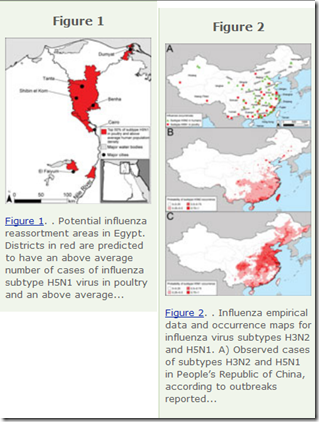
Last March, in EID Journal: Predicting Hotspots for Influenza Virus Reassortment, Eastern China was highlighted as one of the most favored areas in the world for seeing new influenza reassortants.


The study cited:

Potential geographic foci of reassortment include the northern plains of India, coastal and central provinces of China, the western Korean Peninsula and southwestern Japan in Asia, and the Nile Delta in Egypt.
image


All of which highlights the need for comprehensive and continual surveillance of farmed animals and wild birds, particularly in those regions of the world where these sorts of reassortments are most likely to occur.

Wednesday, June 19, 2013

Arkansas: Scott County Chicken Positive for H7N7 Avian Flu

image


# 7409


According to the Poultry Federation, Arkansas is the only state that ranks in the top 10 for Broiler Chicken, Turkey, and Egg production. The state is second only to Georgia in producing broiler chickens, and third in the nation in the raising of turkeys.


Combined, the value of poultry operations in Arkansas (in 2009) exceeded $3 billion dollars.  Neighboring Oklahoma (Scott county is on the border) produces more than 1/2 billion dollars in poultry each year.


All of which makes the discovery yesterday of H7N7 avian flu on a farm in Scott County, a serious economic concern.


First, the announcement from Arkansas.gov, then I’ll return with a bit more about this particular strain of avian flu.


Scott County Chicken Tests Positive for Avian Flu


LITTLE ROCK - The Arkansas Livestock and Poultry Commission received confirmation Tuesday evening that a chicken in a Scott County, Arkansas, chicken house has tested positive for H7N7 Low Pathogenic Avian Influenza.


Thirty Livestock and Poultry personnel have quarantined all poultry within a 6.2-mile radius of the growing operation where the infected bird was located. They are coordinating their response and additional testing with the U.S. Department of Agriculture. Only the USDA can officially confirm avian flu cases.


Chickens tend to contract avian flu via infected waterfowl or water contaminated by waterfowl. Livestock and Poultry officials believe the recent flooding in Scott County contributed to this transmission.


Leaders at the Arkansas Department of Health say the positive test poses no public-health threat.
Avian flu cannot be transmitted to people through the consumption of properly prepared poultry.


Reassurances that H7N7 `poses no public health threat’ are perhaps a bit overstated, although the threat to the public is likely extremely low. We have seen sporadic human infection from various H7 strains of avian influenza – including H7N7 – in the past. 


The most famous (and most recent) being the H7N9 virus in China, but other – far more common -  H7 strains have been known to infect humans as well.


The largest known cluster of H7N7 human infection (89 confirmed, 1 fatality) was reported in the Netherlands a decade ago. Details are available in this report from the December 2005 issue of the Eurosurveillance Journal.


Human-to-human transmission of avian influenza A/H7N7, The Netherlands, 2003

M Du Ry van Beest Holle, A Meijer, M Koopmans3 CM de Jager, EEHM van de Kamp, B Wilbrink, MAE. Conyn-van Spaendonck, A Bosman

An outbreak of highly pathogenic avian influenza A virus subtype H7N7 began in poultry farms in the Netherlands in 2003. Virus infection was detected by RT-PCR in 86 poultry workers and three household contacts of PCR-positive poultry workers, mainly associated with conjunctivitis.


While nearly all of these cases were mild, the impact on the poultry industry was major. More than 30 million birds residing on more than 1,000 farms were culled to control the outbreak.


Before the middle of the last decade, there were no uniform requirements to report or  track LPAI (Low Pathogenic Avian Influenza) infections.  That changed in 2006 when the OIE made reporting of LPAI H5 & H7 viruses mandatory.


In 2008 we saw a study in  PNAS that suggested the H7 virus might just be inching towards adapting to humans. For more details on that study, you may wish to revisit H7's Coming Out Party and H7 Study Available Online At PNAS.

Last summer in Mexico we saw two mild human cases of H7N3 (see MMWR: Mild H7N3 Infections In Two Poultry Workers - Jalisco, Mexico).


But for now, these LPAI viruses are primarily a threat to the poultry industry, and to a far lesser extent, people working in direct contact with infected fowl.


Thus far, this Arkansas outbreak is reportedly limited to one poultry farm.  We’ll have to wait to see if testing reveals that this virus has managed to spread beyond this one location.