Showing posts with label Canine H3N2. Show all posts

Wednesday, April 29, 2015

Two CDC Updates: HPAI H5 & H3N2 Canine Flu

image

CDC HPAI Risk Assessment


# 9992


Although neither of these viruses have shown the ability to infect humans, they are nevertheless newly arrived pathogens in North America, are spreading with impressive speed, and are capable of further evolution.  


All of which means that – while they currently pose little threat to human health -  they need to be carefully watched.


The CDC has updated their HPAI H5 webpage, and has published an announcement on the sequencing of the canine H3N2 virus, which they say shows no overt signs of being better able to infect humans than the H3N8 canine flu.


H5 Viruses in the United States

Page last updated: April 29, 2015

Highly pathogenic avian influenza (HPAI) H5 infections have been reported in U.S. domestic poultry (backyard and commercial flocks), captive wild birds, and wild birds. HPAI H5 detections began in December 2014 and have continued into April 2015. USDA is reporting that H5 viruses have been detected in birds in 18 U.S. states; 13 states have experienced outbreaks in poultry flocks and 5 states have detected H5 in wild birds.

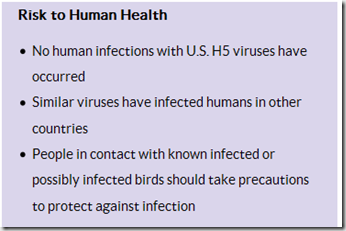
No human infections with these viruses have been detected at this time, however similar viruses have infected people in other countries and caused serious illness and death in some cases. Human infections with other avian influenza viruses have occurred after close and prolonged contact with infected birds or the excretions/secretions of infected birds (e.g., droppings, oral fluids).

While the health risk posed to the general public by these domestic HPAI outbreaks is low at this time, it is possible that human infections with these viruses may occur. CDC has guidance for clinicians and public health professionals in the United States on appropriate follow-up, preventive treatment, testing, specimen collection and processing of samples from patients who may be infected with H5 viruses and has been in close contact with state health departments from all 16 states that have detected H5 in birds.

CDC Recommendations for the Public
  • As a general precaution, people should avoid wild birds and observe them only from a distance; avoid contact with domestic birds (poultry) that appear ill or have died; and avoid contact with surfaces that appear to be contaminated with feces from wild or domestic birds.
  • People who have had contact with infected bird(s) should monitor their own health for possible symptoms (for example, conjunctivitis, or flu-like symptoms).
  • People who have had contact with infected birds may also be given influenza antiviral drugs preventatively.
  • Health care providers evaluating patients with possible HPAI H5 infection should notify their local or state health departments which in turn should notify CDC. CDC is providing case-by-case guidance at this time.
  • There is no evidence that any human cases of avian influenza have ever been acquired by eating properly cooked poultry products.
  • CDC will update the public as new information becomes available.


Update on H3N2 Canine Influenza (Dog Flu) Virus

April 28, 2015 – Experts from CDC’s Influenza Division have analyzed genetic sequences of the H3N2 canine influenza A virus recently detected in the United States and found no evidence suggesting an increased potential for this virus to infect humans or cause severe disease in humans. Therefore, the risk to humans posed by this virus continues to be low and is equivalent to that associated with previously circulating H3N8 canine influenza viruses.

CDC conducts year-round surveillance and genetic analysis on circulating human and novel influenza A viruses in order to assess human health risk and prepare for vaccine virus selection. This work is based in part on an informal inventory of genetic mutations that are associated with viral characteristics like increased transmissibility or severity. While genetic analysis of the H3N2 canine flu virus did not show any of these markers, the agency will continue to analyze this virus and watch the field situation closely.

H3N2 canine flu virus is responsible for an outbreak of dog flu reported in the Chicago area according to a press release issued by Cornell University, home to the New York State Animal Diagnostic Laboratory. Dog flu is a contagious respiratory disease in dogs. Two canine influenza viruses have been identified worldwide: an influenza A H3N8 virus and an influenza A H3N2 virus. No human infections with either of these canine influenza viruses have ever been reported.

Previously, canine influenza A H3N8 viruses have been identified in U.S. dog populations. However, testing at the New York State Animal Diagnostic Laboratory and the Wisconsin Veterinary Diagnostic Laboratory showed that the dog flu virus responsible for the current outbreak in dogs is an H3N2 virus. This virus is similar to H3N2 dog flu viruses that have been detected in dogs in parts of Asia since 2007.

Updates on ongoing antigenic and phenotypic analyses will be shared when they are available. For more information on canine influenza (dog flu), please visit Key Facts about Canine Influenza.

Saturday, April 25, 2015

CDC’s Key Facts On The New H3N2 Canine Flu

image

Credit CDC - Healthy Pets Healthy People


# 9979


Two weeks ago, in Midwest Canine Influenza Outbreak Due To `New’ Korean H3N2 Virus, we learned that an outbreak of canine influenza which began a month or so ago around Chicago was due to an Asian H3N2 canine flu subtype which emerged in 2007 (see Transmission of Avian Influenza Virus (H3N2) to Dogs). 


How this emerging influenza subtype managed to jump from Korea (or perhaps China) to the United States is unclear. But now that it is here, it appears to be spreading rapidly through an immunologically naive dog population. 


Unlike our domestic canine H3N8 - which jumped from horses to dogs in 2004, and has circulated in North America sporadically since then - this subtype has also been shown capable of infecting cats as well (see Korea: Interspecies Transmission of Canine H3N2). 


Adding yet another wrinkle, this H3N2 virus appears to be of avian origin. The HA and NA of the A/canine/Korea/01/2007 (H3N2) isolate was closely related to those identified from South Korean chickens and doves in 2003.


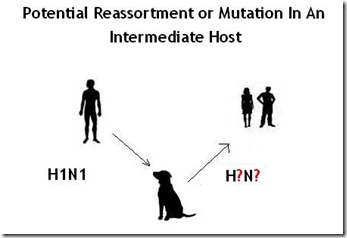
As with the existing equine and canine strains of H3N8, we’ve not seen any evidence of human infection with this canine H3N2 virus. But like all influenza viruses, canine H3N2 is a continually moving target.  It can not only evolve via antigenic drift, it can also pick up entire gene segments from other flu viruses via antigenic shift (aka reassortment).

image


And while rare, as any virologist will tell you – shift happens.


Last summer we saw evidence of just such an event, in a report appearing in the journal Epidemiology & Infection, that  found a new reassortment of the canine H3N2 virus – one that had picked up the M (matrix) gene from the 2009 H1N1 pandemic virus (see Canine H3N2 Reassortant With pH1N1 Matrix Gene) – in china.


When found in reassorted swine variant viruses, The CDC has speculated that `This M gene may confer increased transmissibility to and among humans, compared to other variant influenza viruses.’ – CDC HAN 2012


But so far, we’ve seen no evidence that this canine H3N2 can infect humans.


This week the CDC published a new updated FAQ file on Canine influenza, specifically addressing this newly arrived subtype, including whether it has the potential to jump to humans.  I’ve excerpted the first two segments, so follow the link to read it in its entirety.


Key Facts about Canine Influenza (Dog Flu)

What is canine influenza (dog flu)?

Canine influenza (also known as dog flu) is a contagious respiratory disease in dogs caused by specific Type A influenza viruses known to infect dogs. These are called "canine influenza viruses." Dog flu is a disease of dogs. No human infections with canine influenza have ever been reported. There are two different influenza A dog flu viruses: one is an H3N8 virus and the other is an H3N2 virus.

Can canine influenza viruses infect humans?

To date, there is no evidence of transmission of canine influenza viruses from dogs to people and there has not been a single reported case of human infection with a canine influenza virus.

However, influenza viruses are constantly changing and it is possible for a virus to change so that it could infect humans and spread easily between humans. Human infections with new influenza viruses (against which the human population has little immunity) are concerning when they occur. Such viruses could present pandemic influenza threats. For this reason, CDC and its partners are monitoring the canine influenza H3N8 and H3N2 viruses (as well as other animal influenza viruses) closely. In general, canine influenza viruses are considered to pose a low threat to humans.

  • Where did canine influenza viruses come from and how long has it been around?
  • What are signs of canine influenza infection in dogs?
  • How serious is canine influenza infection in dogs?
  • How is canine influenza spread?
  • Is there a test for canine influenza?
  • Is there a vaccine for canine influenza?
  • My dog has a cough. What should I do?
  • Where can I find more information on canine influenza virus?
  • Thursday, April 02, 2015

    Seroprevalence Of Influenza Viruses In Cats - China

    image


    # 9893


    Up until a dozen years ago, most veterinarians would have told you that cats (and dogs) are not generally susceptible to human influenza viruses.  That notion began to change in 2004, when we saw  two unrelated events; the jump of equine H3N8 influenza from horses to Florida greyhounds, and the infection of more than 100 tigers by avian H5N1 in Thailand.


    Just six weeks ago we saw history repeat itself, with the announcement from the Guangxi Zoo: Reports 2 Tiger Deaths Due To H5N1.


    Although poultry and pigs get most of our attention, over the past decade we’ve a growing body of evidence confirming a wide spectrum of influenza carriage by both dogs and cats.  A few examples include:


    In late 2012, in China: Avian-Origin Canine H3N2 Prevalence In Farmed Dogs, we saw a study that found more than 12% of farmed dogs tested in Guangdong province carried a strain of canine H3N2 similar to that seen in Korea.  The authors cautioned:

    As H3N2 outbreaks among dogs continue in the Guangdong province (located very close to Hong Kong), the areas where is densely populated and with frequent animal trade, there is a continued risk for pets H3N2 CIV infections and for mutations or genetic reassortment leading to new virus strains with increased transmissibility among dogs.

    Further in-depth study is required as the H3N2 CIV has been established in different dog populations and posed potential threat to public health.


    Today, in a similar vein, we’ve a study out of China that looks at the seroprevalence of (avian origin) canine H3N2, along with two seasonal human flu viruses, in cats in Northern China.


    Serological survey of canine H3N2, pandemic H1N1/09, and human seasonal H3N2 influenza viruses in cats in northern China, 2010–2014

    Xuxiao Zhang, Ye Shen, Lijie Du, Ran Wang, Bo Jiang, Honglei Sun, Juan Pu, Degui Lin, Ming Wang, Jinhua Liu and Yipeng Sun*

    Virology Journal 2015, 12:50  doi:10.1186/s12985-015-0285-5

    Published: 1 April 2015

    Abstract (provisional)

    Background The close contact between cats and humans poses a threat to public health because of the potential zoonotic transmission of influenza viruses to humans. Therefore, we examined the seroprevalence of pandemic H1N1/09, canine H3N2, and human H3N2 viruses in pet cats in northern China from 2010 to 2014.

    Finding Of 1794 serum samples, the seropositivity rates for H1N1/09, canine H3N2, and human H3N2 were 5.7%, 0.7%, and 0.4%, respectively. The seropositivity rate for H1N1/09 in cats was highest in 2010 (8.3%), and then declined continuously thereafter. Cats older than 10 years were most commonly seropositive for the H1N1/09 virus.

    Conclusions Our findings emphasize the need for continuous surveillance of influenza viruses in cats in China.

    (EXCERPT)

    Different subtypes of influenza viruses are reported to be naturally transmitted to cats from other species worldwide, including avian viruses (H5N1), canine viruses (H3N2), and human viruses (pandemic H1N1/09, seasonal H1N1, and H3N2) [1-3]. The close contact between cats and humans possesses a threat to public health because of the potential zoonotic transmission of influenza viruses to humans. In China, the canine H3N2 and H1N1/09 influenza viruses circulate in dogs [4], and the seasonal H3N2 and H1N1/09 viruses are prevalent in humans [5,6], any of which might be transmitted to cats. Therefore, we examined the seroprevalence of the pandemic H1N1/09, canine H3N2, and human seasonal H3N2 influenza viruses in cats in northern China from January 2010 to June 2014.

    The complete article is available as a provisional PDF. The fully formatted PDF and HTML versions are in production.


    For a virus, successfully jumping to a new species is akin to hitting the lottery. A fresh supply of hosts not only increases its odds of long-term survival, it may also provide new opportunities for evolution and/or reassortment with other viruses.


    Last summer, in Canine H3N2 Reassortant With pH1N1 Matrix Gene, we looked at exactly that scenario, in a report appearing in the journal Epidemiology & Infection, that found a new reassortment of the canine H3N2 virus – one that has picked up the M (matrix) gene from the 2009 H1N1 pandemic virus.


    If this sounds vaguely familiar, it is because we’ve seen this same M gene showing up regularly in all three North American swine variant viruses (H1N1v, H1N2v, H3N2v), which caused more than 300 human infections to be reported in 2012. The CDC has speculated that:

    `This M gene may confer increased transmissibility to and among humans, compared to other variant influenza viruses.’ – CDC HAN 2012


    Whether any of this means that canine H3N2 is on the fast track towards `humanization’ is anyone’s guess, but this does illustrate just how intertwined avian, canine, and human influenza viruses really are.


    Something that the American Society for Microbiology warned about last summer, in a press release on a study of canine influenza viruses:

    Evolution of Equine Influenza Led to Canine Offshoot Which Could Mix With Human Influenza

    CONTACT:  Jim Sliwa
    jsliwa@asmusa.org

    WASHINGTON, DC – June 19, 2014 – Equine influenza viruses from the early 2000s can easily infect the respiratory tracts of dogs, while those from the 1960s are only barely able to, according to research published ahead of print in the Journal of Virology. The research also suggests that canine and human influenza viruses can mix, and generate new influenza viruses.

    (Continue . . . )


    All of which highlights the importance of continued surveillance – and not just of pigs and poultry – for emerging novel influenza viruses all over the world.

    Wednesday, July 02, 2014

    Canine H3N2 Reassortant With pH1N1 Matrix Gene


    image


    # 8800


    When we think about `mixing vessels’ for influenza reassortment, our thoughts first go to avian or swine hosts, since both have a long track record of producing new hybrid strains of influenza.


    The H5N1, H5N8, H7N9 and H10N8 avian viruses are all products of avian reassortment, while the 2009 H1N1 pandemic virus emerged from swine after years of `fine tuning’ as it passed through generations of pigs.


    But practically any species that can host two or more influenza strains is capable of producing a reassortant virus, including humans (see 2011 Webinar: pH1N1 – H3N2 A Novel Influenza Reassortment for an example).


    In the past we’ve looked at a number of species with at least theoretical potential to act as mixing vessels, including Mixing Vessels For Influenza, A Host Of Reservoirs & The (Swine) Influenza Reassortment Puzzle.  Luckily for us, most reassortant viruses are evolutionary dead ends, unable to compete effectively against existing strains.


    Host species that frequently come in contact with humans are viewed as being more likely to pick up, reassort, and spread flu viruses than those that live remotely in the wild.  Poultry and swine fall into that category, particularly in Asia, where the human-animal interface is particularly close (see EID Journal: Predicting Hotspots for Influenza Virus Reassortment).


    While generally regarded as being less susceptible to influenza than either birds or pigs, companion animals like dogs and cats are increasingly being viewed as potential `mixing vessels’ as well (see Study: Dogs As Potential `Mixing Vessels’ For Influenza).


    In July of 2011, in a blog called Korea: Interspecies Transmission of Canine H3N2, I wrote about a study that reported on a recently emerged canine H3N2 influenza virus that had been observed to infect and sicken domestic cats at an animal shelter in South Korea.


    This emerging canine H3N2 was of a different lineage than human H3N2 which appeared in the 1968 pandemic. It first appeared in Korea in 2007 – and unlike the other canine flu (H3N8)  -which jumped from equines to dogs, this strain appears to have emerged directly from an avian source.


    A year later, in Interspecies Transmission Of Canine H3N2 In The Laboratory, we saw another study that showed that cats (and to a far lesser degree, ferrets) were susceptible to this canine H3N2. 


    Thus far, these new canine viruses haven’t shown the ability to infect humans.


    In late 2012, in China: Avian-Origin Canine H3N2 Prevalence In Farmed Dogs, we saw a study that found more than 12% of farmed dogs tested in Guangdong province carried a strain of canine H3N2 similar to that seen in Korea.  The authors cautioned:


    As H3N2 outbreaks among dogs continue in the Guangdong province (located very close to Hong Kong), the areas where is densely populated and with frequent animal trade, there is a continued risk for pets H3N2 CIV infections and for mutations or genetic reassortment leading to new virus strains with increased transmissibility among dogs.

    Further in-depth study is required as the H3N2 CIV has been established in different dog populations and posed potential threat to public health.


    Today we’ve a new study, that appears in the journal Epidemiology & Infection, that finds a new reassortment of the canine H3N2 virus – one that has picked up the M (matrix) gene from the 2009 H1N1 pandemic virus.  First the link, and an excerpt from the abstract, then I’ll be back with a little more:


    H3N2 canine influenza virus with the matrix gene from the pandemic A/H1N1 virus: infection dynamics in dogs and ferrets

    H. MOONa1 , M. HONGa2a6 , J. K. KIMa3 , B. SEONa1, W. NAa2a6, S. J. PARKa2, D. J. ANa4, H. Y. JEOUNGa4, D. J. KIMa2, J. M. KIMa1, S. H. KIMa2, R. J. WEBBYa5, R. G. WEBSTERa5, B. K. KANGa1 c1 and D. SONGa2a6 c2

    SUMMARY

    After an outbreak of pandemic influenza A/H1N1 (pH1N1) virus, we had previously reported the emergence of a recombinant canine influenza virus (CIV) between the pH1N1 virus and the classic H3N2 CIV. Our ongoing routine surveillance isolated another reassortant H3N2 CIV carrying the matrix gene of the pH1N1 virus from 2012. The infection dynamics of this H3N2 CIV variant (CIV/H3N2mv) were investigated in dogs and ferrets via experimental infection and transmission.

    The CIV/H3N2mv-infected dogs and ferrets produced typical symptoms of respiratory disease, virus shedding, seroconversion, and direct-contact transmissions. Although indirect exposure was not presented for ferrets, CIV/H3N2mv presented higher viral replication in MDCK cells and more efficient transmission was observed in ferrets compared to classic CIV H3N2. This study demonstrates the effect of reassortment of the M gene of pH1N1 in CIV H3N2.


    The acquisition of the M gene from a  `humanized’  pH1N1 virus appears to have increased the biological fitness of this canine influenza – at least in ferrets – which are often used as a surrogate for humans in influenza research.  


    That said, we haven’t seen any signs that this virus has acquired the ability to infect humans.


    Regular readers will recall that in 2011 (see MMWR: Swine-Origin Influenza A (H3N2) Virus Infection in Two Children) we saw a similar reassortment of swine-origin influenza A (H3N2) virus and the 2009 influenza A (H1N1) virus, producing a swine variant H3N2v with the M gene from pH1N1.


    Since then, this M gene has been showing up regularly in all three swine variant viruses (H1N1v, H1N2v, H3N2v), with more than 300 human infections reported in 2012. The CDC has speculated that:


    `This M gene may confer increased transmissibility to and among humans, compared to other variant influenza viruses.’CDC HAN 2012


    Whether any of this means that canine H3N2 is on the fast track towards `humanization’ is anyone’s guess, but this does illustrate just how intertwined avian, canine, and human influenza viruses really are.


    As H3N2 CIV spreads geographically it will likely encounter more human, avian, canine (and even swine and equine)  flu viruses with which to play `mix and match’ with their gene segments.


    Something that the American Society for Microbiology warned about just last month, in a press release on a study of canine influenza viruses:


    Evolution of Equine Influenza Led to Canine Offshoot Which Could Mix With Human Influenza

    CONTACT:  Jim Sliwa
    jsliwa@asmusa.org

    WASHINGTON, DC – June 19, 2014 – Equine influenza viruses from the early 2000s can easily infect the respiratory tracts of dogs, while those from the 1960s are only barely able to, according to research published ahead of print in the Journal of Virology. The research also suggests that canine and human influenza viruses can mix, and generate new influenza viruses.

    (Continue . . . )


    Influenza reassortments happen all the time and mostly outside the view of scientists. Most will end up as viral flashes in the pan, unable to compete with more biologically fit flu viruses, and will quickly disappear into the evolutionary dustbin.


    But given enough throws in the influenza reassortment craps game, nature will eventually roll a natural.


    Making it not  a question of if another pandemic will emerge. Only a matter of when.

    Friday, June 20, 2014

    Study: Dogs As Potential `Mixing Vessels’ For Influenza

    reassortment in a host


    # 8766


    Although influenza A viruses are believed to have originated in avian species (primarily waterfowl), over time they’ve managed to infect, and adapt to, a wide variety of mammals.  Humans, obviously, and swine . . .  but we’ve also seen `human’  flu viruses documented in  turkeys, skunks, ferrets, cats, elephant seals and dogs.


    In That Touch Of Mink Flu I wrote about 11 farms in Holstebro, Denmark that were reported to be infected with a variant of the human H3N2 virus.


    Less commonly reported - camels, whales and seals have all been shown to be susceptible to influenza viruses (cite Evolution and ecology of influenza A viruses R.G. Webster et al.)  In  2012, an avian flu strain was identified in New England seals (see mBio: A Mammalian Adapted H3N8 In Seals).


    While influenza viruses are generally categorized as being avian, swine, human, or equine – their host range is far greater than that. 


    And about a decade ago, we saw that host range formally expand to canines as well.


    In 2004, the H3N8 equine influenza – a strain that has been around nearly a half century – suddenly jumped, and adapted to dogs, creating a new dog-specific (canine) lineage of H3N8.  Since then, H3N8 has continued to spread  among dogs, although it has never been known to infect humans.


    But, as noted above, on rare occasions humanized influenza viruses have been shown to infect dogs as well, along with avian flu strains like H5N1 and H5N8 (see Korea Finds More Dogs With H5N8 Antibodies). 


    This ability to be infected by more than one type of influenza virus opens the door to the possibility that dogs could serve as a `mixing vessel’ for influenza viruses, through a process called Reassortment. 

    image 

    Reassortment, or `Shift’ occurs when a single host is simultaneously infected with two different influenza viruses.   When that happens, it is possible for viruses to swap parts of their genetic sequence, and create a new, hybrid virus.


    While most of the time, this leads to an evolutionary failure, every once in awhile this process produces a viable, even highly competitive, new flu strain. 


    It was a series of reassortments in swine, over a period of years, that led to the creation of the 2009 H1N1 pandemic virus, and the recent outbreak of H7N9 in China, and the H5N8 outbreaks in Korea, are apparently due to viral reassortment in avian species.


    We normally think of birds, or swine, as prime `mixing vessels’ for influenza, but the truth is, any host that can support dual infection has the potential to produce a `hybrid’ flu virus. 


    In the past we’ve looked at a number of species with at least theoretical potential to act as mixing vessels.


    Mixing Vessels For Influenza
    A Host Of Reservoirs
    Virology Journal: Receptor Cells In Minor Poultry Species
    The (Swine) Influenza Reassortment Puzzle


    All of which serves as prelude to a new study, which appears ahead of print in the Journal of Virology, that looks at the ability of different influenza strains to infect, and replicate in, canine tracheal tissues.  


    First a link to the study (PDF), a link to the abstract, followed by excerpts from a press release from the American Society for Microbiology, and then some closing comments.


    Infection and pathogenesis of canine, equine and human influenza viruses in canine tracheas.

    Gaelle Gonzaleza, John F. Marshallb, Joanna Morrella, David Robbc, John W. McCauleyd, Daniel R. Pereze, Colin R. Parrishf and Pablo R. Murciaa#

    ABSTRACT

    Influenza A viruses (IAVs) can jump species barriers and occasionally cause epidemics, epizootics, pandemics and panzootics. Characterizing the infection dynamics at the target tissues of natural hosts is central to understanding the mechanisms that control host range, tropism and virulence. Canine influenza virus (CIV, H3N8) originated after the transfer of an equine influenza virus (EIV) into dogs. Thus comparing CIV and EIV isolates provides an opportunity to study the determinants of influenza emergence.


    Here we characterize the replication of canine, equine and human IAVs in the trachea of the dog, a species to which humans are heavily exposed.


    We defined a phenotype of infection for CIV, which is characterized by high levels of virus replication and extensive tissue damage. CIV was compared to evolutionary distinct EIVs, and the early EIV isolates showed an impaired ability to infect dog tracheas, while EIVs that circulated near the time of CIV emergence exhibited a CIV-like infection phenotype. Inoculating dog tracheas with various human IAVs (hIAVs) showed that those infected the tracheal epithelium with various efficiencies depending on the virus tested. Finally, we show that reassortant viruses carrying gene segments of CIV and hIAV are viable and that addition of the hemagglutinin (HA) and neuraminidase (NA) of CIV to the 2009 human pandemic virus results in a virus that replicates at high levels and causes significant lesions. This provides important insights into the role of evolution on viral emergence and on the role of HA and NA as determinants of pathogenicity.

    (Continue . . . )

    This from the American Society for Microbiology.

    Evolution of Equine Influenza Led to Canine Offshoot Which Could Mix With Human Influenza

    CONTACT:  Jim Sliwa
    jsliwa@asmusa.org

    WASHINGTON, DC – June 19, 2014 – Equine influenza viruses from the early 2000s can easily infect the respiratory tracts of dogs, while those from the 1960s are only barely able to, according to research published ahead of print in the Journal of Virology. The research also suggests that canine and human influenza viruses can mix, and generate new influenza viruses.

    Canine influenza is a relatively new disease.  The first appearance is believed to be in 2003, as a result of direct transfer of a single equine influenza virus to dogs in a large greyhound training facility and was subsequently carried to many states by the infected greyhound, say the researchers.  Similar transfers have occurred among foxhounds in the UK, and in dogs kept near infected horses during a 2007 outbreak in Australia, they report.  

    In the study, investigators from the United States and the United Kingdom infected dog tracheal explant cultures—essentially pieces of trachea cultured in the laboratory to mimic the cellular complexity and the host physiology of the host—with canine influenza virus, equine influenza virus, and human influenza viruses. (The use of explants has increased in recent years, and they have been shown to be useful for studies of viral pathogenesis.) They then compared the growth of the viruses, and the damage they wrought.

    (Continue . . .)


    Worthy of note, in Korea a different canine influenza virus emerged in 2007.  Unlike the canine H3N8 virus seen in the United States, this canine H3N2 appears to have jumped directly from an avian source.  In 2008 the CDC’s EID Journal carried the following report on this newly emerging canine flu: 


    Transmission of Avian Influenza Virus (H3N2) to Dogs


    In 2011, we saw the plot thicken yet again, when it was announced that this canine H3N2 had jumped to cats (see Korea: Interspecies Transmission of Canine H3N2).  In their abstract, the authors wrote:


    Our study for the first time shows that cats are susceptible to canine influenza H3N2 infection, suggesting that cats may play an intermediate host role in transmitting the H3N2 virus among feline and canine species, which could lead to the endemic establishment of the virus in companion animals.

    Such a scenario raises a public health concern, as the possibility of the emergence of new recombinant feline or canine influenza viruses in companion animals with the potential to act as zoonotic infection cannot be excluded.


    While pigs and birds may be far better `mixing vessels’ for influenza than dogs or cats will ever be, companion animals are of particular concern because of how closely humans interact with them.  


    All of this just shows how remarkable influenza viruses are at adapting to new hosts, and re-inventing themselves. 


    And why we ignore their progress in the wild at our own peril.

    Thursday, May 24, 2012

    Interspecies Transmission Of Canine H3N2 In The Laboratory


    image


    # 6343


    Readers with good memories may recall that in July of 2011, in a blog called Korea: Interspecies Transmission of Canine H3N2, I wrote about a study that reported on a recently emerged canine H3N2 influenza virus that had been observed to infect and sicken domestic cats at an animal shelter in South Korea.


    This canine H3N2 was of a different lineage than the human H3N2 we have been dealing with since the late 1960s. It first appeared in Korea in 2007 – and unlike the other canine flu (H3N8)  -which jumped from equines to dogs, this strain appears to have emerged directly from an avian source.


    In 2008 the CDC’s EID Journal carried the following report on this newly emerging canine flu.


    Transmission of Avian Influenza Virus (H3N2) to Dogs

    Daesub Song, Bokyu Kang, Chulseung Lee, Kwonil Jung, Gunwoo Ha, Dongseok Kang, Seongjun Park, Bongkyun Park, and Jinsik Oh

    Abstract

    In South Korea, where avian influenza virus subtypes H3N2, H5N1, H6N1, and H9N2 circulate or have been detected, 3 genetically similar canine influenza virus (H3N2) strains of avian origin (A/canine/Korea/01/2007, A/canine/Korea/02/2007, and A/canine/Korea/03/2007) were isolated from dogs exhibiting severe respiratory disease.


    To determine whether the novel canine influenza virus of avian origin was transmitted among dogs, we experimentally infected beagles with this influenza virus (H3N2) isolate. The beagles shed virus through nasal excretion, seroconverted, and became ill with severe necrotizing tracheobronchitis and bronchioalveolitis with accompanying clinical signs (e.g., high fever).


    Consistent with histologic observation of lung lesions, large amounts of avian influenza virus binding receptor (SAα 2,3-gal) were identified in canine tracheal, bronchial, and bronchiolar epithelial cells, which suggests potential for direct transmission of avian influenza virus (H3N2) from poultry to dogs.


    Our data provide evidence that dogs may play a role in interspecies transmission and spread of influenza virus.


    Which brings us today to a new study by the same group of researchers that reported on the initial species jump to cats, that looks at laboratory transmission of the canine H3N2 virus to cats, and to ferrets.


    Inter- and intraspecies transmission of canine influenza virus (H3N2) in dogs, cats, and ferrets

    Hyekwon Kim, Daesub Song, Hyoungjoon Moon, Minjoo Yeom, Seongjun Park, Minki Hong, Woonseong Na, Richard J. Webby, Robert G. Webster, Bongkyun Park, Jeong-Ki Kim, Bokyu Kang

    Article first published online: 23 MAY 2012

    DOI: 10.1111/j.1750-2659.2012.00379.x

    ABSTRACT (excerpts)

    Results The interspecies transmission of CIV H3N2 via airborne was only observed from dogs to cats and not from dogs to ferrets. However, direct intranasal infection of either cats or ferrets with CIV could induce influenza-like clinical signs, viral shedding, and serological responses. Additionally, naïve cats and ferrets could be infected by CIV via direct contact with infected animals of the same species.


    Conclusion Cats appear to be another susceptible host of CIV H3N2, whereas ferrets are not likely natural hosts. The molecular-based mechanism of interspecies and intraspecies transmission of CIV H3N2 should be further studied.

    (Continue . . . )


    CIDRAP NEWS published some details not available in the abstract above in their flu news roundup last night.


    Follow the link to read:

    Study: Canine influenza H3N2 can spread to cats


    In a laboratory study, the canine influenza virus (CIV) H3N2 spread from dogs to cats via respiratory droplets, suggesting that cats could be another host for the virus, according to a report published today in Influenza and Other Respiratory Viruses.


    <SNIP details of experiment>


    "These data suggest that cats, in addition to dogs, can be another susceptible host of CIV H3N2; ferrets may not be susceptible host but may be susceptible after viral adaptation," the researchers write. They say the transmission of the virus between dogs and cats "underscores the concern that these same viruses might also be able to infect humans who come in contact with the animals."


    May 23 Influenza Other Respi Viruses

    abstract


    Many of the common illnesses we think of as `human’ diseases actually began in other species, and only later adapted and migrated to humans.


    • The scourge of Tuberculosis, which now infects 1/3rd of humanity, probably jumped to humans when man began to corral and raise its traditional hosts; goats and cattle.
    • Measles appears to have evolved from canine distemper and/or the Rinderpest virus of cattle.  
    • Influenza, as most of you know, is native to aquatic birds – but jumped species thousands of years ago and many strains have adapted to humans, pigs, and other species.


    The list of zoonotic diseases (those shared between humans and animals) is long and continually expanding, and includes: SARS, Babesiosis, Borrelia (Lyme), Nipah, Hendra, Malaria, Hantavirus, Ebola, Bartonella, Leptospirosis, Q-Fever, bird flu and many, many others.


    So understandably, anytime we see a virus – particularly a flu virus – jump species, it gets our attention.


    The good news is that so far, these new canine viruses haven’t shown the ability to infect humans


    But as the author’s of the 2008 EID study pointed out:


    Transmission of avian influenza A virus to a new mammalian species is of great concern, because it potentially allows the virus to adapt to a new mammalian host, cross new species barriers, and acquire pandemic potential.


    And when they infect companion animals, such as dogs and cats, it becomes of even greater concern because of how closely we humans interact with them. 

    Sunday, July 03, 2011

    Korea: Interspecies Transmission of Canine H3N2


    # 5669


    Many of the common illnesses we think of as `human’ diseases actually began in other species, and only later migrated to humans. The age of emerging infectious diseases in humans really began in earnest about 10,000 years ago when man began to domesticate – and live in close proximity to – other animals.   


    • The scourge of Tuberculosis, which now infects 1/3rd of humanity, probably jumped to humans when man began to coral and raise its traditional hosts; goats and cattle.
    • Measles appears to have evolved from canine distemper and/or the Rinderpest virus of cattle.  
    • Influenza, as most of you know, is native to aquatic birds – but jumped species thousands of years ago and many strains have adapted to humans, pigs, and other species.


    The list of zoonotic diseases (those shared between humans and animals) is long and continually expanding, and includes: SARS, Babesiosis, Borrelia (Lyme), Nipah, Hendra, Malaria, Hantavirus, Ebola, Bartonella, Leptospirosis, Q-Fever, bird flu and many, many others.


    Yet despite these disease overlaps, viruses generally adapt to a fairly narrow range of species. 


    Horse viruses generally attack equines, and not say, cats and dogs.   Cat viruses tend to attack felines, and not birds.  Bird viruses usually only infect avian species.


    The species that a virus will infect is known as its host range.  And while usually limited, it isn't always the case.


    Rabies is a good example of a virus that can infect an extraordinarily wide range of species.


    Zoonotic Jump


    We know that every once in awhile, viruses will suddenly jump to a new species. A couple of recent examples include:


    The H5N1 bird flu virus, which has been unusually promiscuous: showing up in cats (including tigers), dogs, martens, civets, and of course humans. Researchers have successfully infected cattle with the H5N1 virus, along with ferrets and mice for testing.


    H3N8 Canine influenza, which only showed up in dogs in 2004, had been known to infect horses for the past 40 years.


    All of which serves as prelude to a report that appears in the latest edition of the Journal of General Virology, that finds a recently emerged canine H3N2 influenza virus common in Korea has now adapted to infect domestic cats.


    Interspecies transmission of the canine influenza H3N2 virus to domestic cats in South Korea, 2010

    D.S. Song, D.J. An, H.J. Moon, M.J. Yeom, H.Y. Jung, W.S. Jung, S.J. Park, H.K. Kim, S.Y. Han, J.S. Oh, B.K. Park, J.K. Kim, H. Poo, R.G. Webster, K. Jung and B.K. Kang

    Abstract

    In the last 4 years, incidences of endemic or epidemic respiratory diseases associated with canine influenza H3N2 virus in Asian dogs have been reported in countries such as South Korea and China. Canine species were considered to be the new natural hosts for this virus.

    However, at the beginning of 2010, influenza-like respiratory signs, such as dyspnea, were also observed among cats as well as in dogs in an animal shelter located at Seoul, South Korea. The affected cats showed 100% morbidity and 40% mortality.

    We were able to isolate a virus from the lung specimen of a dead cat that had suffered from the respiratory disease, in embryonated chicken eggs. The 8 viral genes isolated were almost identical to those of the canine influenza H3N2 virus suggesting interspecies transmission of canine influenza H3N2 virus to the cat.

    Moreover, 3 domestic cats infected with intranasal canine/Korea/GCVP01/07 (H3N2) all showed elevated rectal temperatures, nasal virus shedding, and severe pulmonary lesions, such as suppurative bronchopneumonia.

    Our study for the first time shows that cats are susceptible to canine influenza H3N2 infection, suggesting that cats may play an intermediate host role in transmitting the H3N2 virus among feline and canine species, which could lead to the endemic establishment of the virus in companion animals.

    Such a scenario raises a public health concern, as the possibility of the emergence of new recombinant feline or canine influenza viruses in companion animals with the potential to act as zoonotic infection cannot be excluded.


    The canine H3N2 virus only just appeared in Korea in 2007, and unlike the canine H3N8 virus seen in the United States, appears to have jumped directly from an avian source.


    In 2008 the CDC’s EID Journal carried the following report on this newly emerging canine flu.


    Transmission of Avian Influenza Virus (H3N2) to Dogs

    Daesub Song, Bokyu Kang, Chulseung Lee, Kwonil Jung, Gunwoo Ha, Dongseok Kang, Seongjun Park, Bongkyun Park, and Jinsik Oh

    Abstract


    In South Korea, where avian influenza virus subtypes H3N2, H5N1, H6N1, and H9N2 circulate or have been detected, 3 genetically similar canine influenza virus (H3N2) strains of avian origin (A/canine/Korea/01/2007, A/canine/Korea/02/2007, and A/canine/Korea/03/2007) were isolated from dogs exhibiting severe respiratory disease.


    To determine whether the novel canine influenza virus of avian origin was transmitted among dogs, we experimentally infected beagles with this influenza virus (H3N2) isolate. The beagles shed virus through nasal excretion, seroconverted, and became ill with severe necrotizing tracheobronchitis and bronchioalveolitis with accompanying clinical signs (e.g., high fever).

    Consistent with histologic observation of lung lesions, large amounts of avian influenza virus binding receptor (SAα 2,3-gal) were identified in canine tracheal, bronchial, and bronchiolar epithelial cells, which suggests potential for direct transmission of avian influenza virus (H3N2) from poultry to dogs.

    Our data provide evidence that dogs may play a role in interspecies transmission and spread of influenza virus.


    The good news is that so far, these new canine viruses haven’t shown the ability to infect humans. 


    But as the author’s of the EID study above point out:


    Transmission of avian influenza A virus to a new mammalian species is of great concern, because it potentially allows the virus to adapt to a new mammalian host, cross new species barriers, and acquire pandemic potential.


    Companion animals, such as dogs and cats, are of particular concern because of how closely humans interact with them.


    While pigs might be biologically better suited as a `mixing vessel’ for influenza (see The (Swine) Influenza Reassortment Puzzle), there are far more opportunities for transmission between humans and their pets.


    In terms of their potential to spread rapidly among humans, and cause significant morbidity and mortality, few viruses can compete with influenza. As we saw in 2009, a new influenza virus can jump species and spread around the globe in a matter of months.


    A recurring theme in this blog is that nature’s bio lab is open 24/7, and that it is constantly trying out new genetic combinations looking for an evolutionary advantage. 


    And for a virus, jumping to a new, immunologically naive species is like hitting the jackpot; a fresh supply of hosts and an opportunity to adapt further.


    Which is why we watch these species jumps with more than a passing interest.