Showing posts with label Transmission. Show all posts

Monday, April 06, 2015

Referral: Mackay On Lesser Ebola Transmission Risks

image

Credit CDC PHIL


# 9904


Making news last week was the story Liberia Recommends Ebola Survivors Practice Safe Sex Indefinitely, which came after an Ebola patient died the previous week with just one known risk factor: her boyfriend had been successfully treated for Ebola last September.


You may recall that last  August, Dr. Ian Mackay writing on his VDU Blog, posted Ebola virus in semen is the real deal...., which he followed up 10 days later with  Ebola: Blood, sweat and tears, where Ian described the (somewhat limited) research to date on the level of EBOV detection in other body fluids – like tears, sweat and saliva.


A couple of months later Ian and Dr. Katherine Arden followed up with a piece for The Lancet (see Mackay & Arden On Ebola In Semen Of Convalescent Men), where they wrote:


A clear need exists to ensure that men convalescing after Ebola virus disease are made very plainly aware that they will need to conduct themselves with care to minimise the infectious potential of their seminal fluid. This careful conduct should include the patient maintaining careful personal hygiene after masturbation, practicing safe sex, or abstaining from sexual contact altogether for a suitable period of time.


Yesterday Ian weighed in on another not-so-obvious route of potential convalescent Ebola transmission; urine.  I’ve only excerpted one paragraph, follow the link to read:


Ebola - the lesser transmission risks are still risks...

(EXCERPT)

Another possible, albeit also unproven, transmission route is urine. This fluid seems to me to be a far more likely source of trouble. One cannot abstain from urination. So why worry about urine as a risk for transmission of Ebola virus? An EVD case study last year showed very nicely that infectious Ebola virus could be cultured from urine for about 12 days longer than it could be from blood.[1] Viral RNA has also been found in urine for four weeks.[1,2]


(Continue . . . )

Wednesday, February 04, 2015

WHO MERS Update & The Community Transmission Mystery

The figure is an epidemiologic curve showing the number of cases of Middle East respiratory syndrome (MERS) coronavirus infection reported by the World Health Organization, by month and year of illness onset, worldwide during 2012-2015. The majority (504) of the 956 MERS cases were reported to have occurred during March-May 2014.

CDC MMWR - Number of cases of MERS infections reported by the World Health Organization,* by month of illness onset — worldwide, 2012–2015


# 9669


It’s been nearly three years since the first known cases of MERS in the Middle East, where an outbreak at a Jordanian hospital infected at least 9 people (see Serological Testing Of 2012 Jordanian MERS Outbreak), killing two. At the time, and for about the next six months, the cause of that outbreak was a mystery.


In the summer of 2012 a letter posted in ProMed Mail (NOVEL CORONAVIRUS - SAUDI ARABIA: HUMAN ISOLATE) by Dr. Ali Mohamed Zaki - an Egyptian Virologist working In Saudi Arabia – announced the discovery of a new coronavirus in a Saudi Patient.


Retrospective testing later that year revealed the Jordanian cluster to have been caused by the MERS-CoV as well.


We saw a slow increase in cases in 2013, and an explosion of cases in the spring of 2014, with more than 500 cases in a three month period.  The majority of these cases were male, elderly, and many had co-morbidities. For many, the source of infection was fairly obvious. 

  • A few appear to have acquired the virus from a zoonotic source, primarily camels. 
  • Many were exposed in healthcare settings, including HCWs
  • Others were family members or close contacts of known cases


But for a lot of cases, the mode of exposure wasn’t at all obvious.  


No recent history of animal contact, or direct contact with a known case in a healthcare or community setting.  While still predominantly male, elderly, and many with co-morbidities, exactly how and where they contracted the virus was a mystery.


One of the tools epidemiologist’s use to figure these things out is a case-control study, where they compare laboratory-confirmed cases to a large number of controls, matched for age, sex, and by neighborhood. 


By examining their respective exposures against their outcomes, patterns of risk are often revealed.


In CDC: Risk Factors Involved With H7N9 Infection, we looked at a case-control study that was begun in China literally weeks after the first cases of H7N9 infection were identified, that  quickly nailed down live bird markets as the primary source of infection.


At roughly the same time (summer of 2013) the World Health Organization published a framework for just such a project on MERS (see case-control study protocol), and entreated the Saudi Ministry of Health to conduct, and publish, the study. 


While repeated promises have been made (see KSA Announces Start To Long-Awaited MERS Case Control Study), for whatever reason, we’ve yet to see the results.


Another epidemiological tool is broad based community seroprevalence studies, which would give us some idea of the incidence of infection across the population. But if this has been done, the results have not been published. 


And so 18 months later we continue to see WHO updates, like the one published yesterday, where the source of infection for many cases remains a mystery.  In this latest report, while three of nine cases had some (often fleeting) exposure to health care facilities, none was known to have had contact with a MERS case or camels.


First the WHO GAR report (bolding mine), then I’ll return with a bit more.


Middle East respiratory syndrome coronavirus (MERS-CoV) – Saudi Arabia

Disease outbreak news
3 February 2015

Between 14 and 22 January 2015, the IHR National Focal Point for the Kingdom of Saudi Arabia (SAU) notified WHO of 9 additional cases of Middle East respiratory syndrome coronavirus (MERS-CoV) infection, including 4 deaths. Cases are listed by date of reporting, with the most recent case listed first.

Details of the cases are as follows:
  • An 84-year-old female from Riyadh city developed symptoms on 19 January and was admitted to a private hospital on 20 January. The patient has comorbidities but no history of exposure to any known risk factors in the 14 days prior to the onset of symptoms. The patient was in ICU in critical condition. Since then, she recovered and was discharged on 27 January.
  • A 77-year-old male from Riyadh city developed symptoms on 18 January and was admitted to a private hospital on 21 January. The patient has comorbidities but no history of exposure to any known risk factors in the 14 days prior to the onset of symptoms. The patient was in ICU in critical condition. Since then, he recovered and was discharged on 28 January.
  • An 80-year-old male from Riyadh city developed symptoms on 26 December and was admitted to hospital on the same day. The patient had comorbidities. On 26 December, he was in an emergency room where two previously reported MERS-CoV cases had been treated, although the patient had no direct contact with either case. He had no history of exposure to other known risk factors in the 14 days prior to the onset of initial symptoms. The patient was in ICU and passed away on 23 January.
  • A 38-year-old male from Riyadh city developed symptoms on 14 January. The patient, who has comorbidities, was initially admitted to hospital on 1 January for a surgical procedure. On 7 January, during his admission, he went out on a day-release where he visited his family in Aldawadmi city. On 12 January, the patient underwent surgery in a hospital where a laboratory confirmed MERS-CoV case had also been treated, although there is no history of contact between the patient and the case. He has no history of exposure to other known risk factors in the 14 days prior to the onset of symptoms. Currently, the patient is in stable condition and remains in isolation.
  • A 76-year-old male from Riyadh city developed symptoms on 12 January. The patient, who had comorbidities, was initially admitted to hospital for an unrelated medical condition on 3 November. He received care in a hospital where a laboratory confirmed MERS-CoV case had also been treated. The patient had no history of exposure to other known risk factors in the 14 days prior to the onset of symptoms. He was in critical condition and passed away on 18 January.
  • A 67-year-old male from Riyadh city developed symptoms on 12 January and was admitted to hospital on 16 January. The patient has comorbidities. He frequently visited a health-care facility in Riyadh to treat his unrelated medical condition but has no history of contact with patients with respiratory symptoms. The facility is not associated with previous known MERS-CoV cases. There is no history of exposure to any known risk factors in the 14 days prior to the onset of symptoms. Currently, the patient is in stable condition and remains in an isolation ward.
  • A 62-year-old male from Riyadh city developed symptoms on 14 January and was admitted to hospital on 16 January. The patient has comorbidities. He has no history of exposure to any known risk factors in the 14 days prior to the onset of symptoms. Currently, the patient is in stable condition and remains in an isolation ward.
  • A 67-year-old male from Taif city developed symptoms on 5 January and was admitted to hospital on 9 January. The patient had comorbidities. He had no history of direct contact with camels or consumption of camel products but lived in an area with heavy presence of camels. The patient had no history of exposure to other known risk factors in the 14 days prior to the onset of symptoms. He was in critical condition and passed away on 21 January.
  • A 93-year-old male from Riyadh city developed symptoms on 11 January. The patient, who had comorbidities, was initially admitted to hospital for an acute injury on 28 December. At that time, the hospital was treating a laboratory confirmed MERS-CoV case. The patient had no history of exposure to other known risk factors in the 14 days prior to the onset of symptoms. The patient was in critical condition in ICU and passed away on 15 January.

Contact tracing of household contacts and healthcare contacts is ongoing for these cases.

The IHR National Focal Point for the Kingdom of Saudi Arabia also notified WHO of the death of 2 previously reported MERS-CoV cases. The cases were reported in previous DONs on 5 January (Case n. 2) and on 15 January (Case n. 3).

Globally, WHO has been notified of 965 laboratory-confirmed cases of infection with MERS-CoV, including at least 357 related deaths.

(Continue . .. )


We know the  MERS coronavirus can produce a wide spectrum of disease in humans.  Among diagnosed cases - roughly 50% are severe or life threatening while roughly 20% are described as being mild or even asymptomatic.


The question of `asymptomatic’  transmission of the virus has yet to be answered, although we’ve seen hints that it may be a factor (see Study: Possible Transmission From Asymptomatic MERS-CoV Case).


As with any infectious disease, there are probably more cases in the community than we know.  Surveillance isn’t perfect, and only those sick enough to be hospitalized (or picked up as a close contact of a hospitalized patient) are likely to be detected.  


Those with mild illness may well think they have nothing more than a cold, or the flu.


In November of 2013, we looked at a study published in The Lancet Infectious Diseases, that attempted to quantify the likely extent of transmission of the MERS virus in the Middle East. (Middle East respiratory syndrome coronavirus: quantification of the extent of the epidemic, surveillance biases, and transmissibility).


They calculated  that for every case identified, there are likely 5 to 10 that go undetected.


While only an estimate, this is in line with studies of other novel viruses that seek to estimate uncounted cases.  And if true, would provide a plausible answer as to how hundreds of people – without obvious exposures – continue to contract the virus in the community.


Or there could be another explanation entirely.  


But we won’t know that until the proper studies are completed and published.

Monday, December 01, 2014

CDC: Ebola Is Not Likely To Become Airborne

image
Credit CDC PHIL


# 9393


Earlier this summer there was a good deal of unfounded concern (read: `hysteria’) that the Ebola virus was `airborne, and that it could spread as easily as the flu virus (see  A Look Down The Ebola Rabbit Hole).  In fact, based on the `truth’ offered up by a number of conspiracy sites, we should all be dead by now.


Dr. Ian Mackay and I have both written extensively on why Ebola isn’t an `airborne virus’  (but that under certain circumstances it can be spread via droplets)  in blogs such as It's what falls out of the aerosol that matters.... & Ebola Risk Communications..  


The other widely speculated possibility was that if Ebola isn’t airborne now, it might mutate and become airborne down the road.  While not impossible, many scientists view this as an unlikely outcome (see The WHO Weighs In On The Modes Of Ebola Transmission).


That said, over the years we’ve seen nature throw more than a few biological curveballs, which is why most of us have learned it is better never to say `never’. 


Which, I suspect,  is why the CDC leaves just a little bit of wiggle room in their latest Ebola offering, called Why Ebola Is Not Likely To Become Airborne:


image


Admittedly, I’m not a huge fan of the `it hasn’t happened yet, so it isn’t likely to happen in the future’ school of logic, particularly since we are seeing long chains of human infection – something new with Ebola. But I also accept the CDC’s assessment that seeing an airborne Ebolavirus in the near term is probably highly unlikely.


Right now, I view the risks posed by emerging influenza and coronavirus strains to be of more immediate concern. Which makes the smart move to be pandemic prepared – regardless of the identity of the next pathogen to spark a global crisis.


Because as scary as Ebola is, there are plenty of other nasty viruses out there fully capable of ruining your whole day.


For some recent blogs on Pandemic Preparedness, you may wish to revisit:


MMWR: Updated Preparedness and Response Framework for Influenza Pandemics

It’s Not Just Ebola

NPM14: Because Pandemics Happen

Pandemic Planning For Business

Saturday, October 25, 2014

CDC: Ebola May Be Spread By Droplets, But Is Not Airborne

image


# 9250


Over the past few months Dr. Ian Mackay and others (including this humble blogger) have taken pains to explain that Ebola is not an `airborne virus’, but that it can be spread over short distances via large droplets that might be coughed, sneezed, or otherwise propelled from an infectious patient.   


Some of Ian’s efforts include:

It's what falls out of the aerosol that matters....

The wind beneath my Ebola virus....


What I’ve often referred to as being within `spittle range’  (see Ebola Risk Communications & Ebola: Parsing The CDC’s Low Risk vs High Risk Exposures).  

image


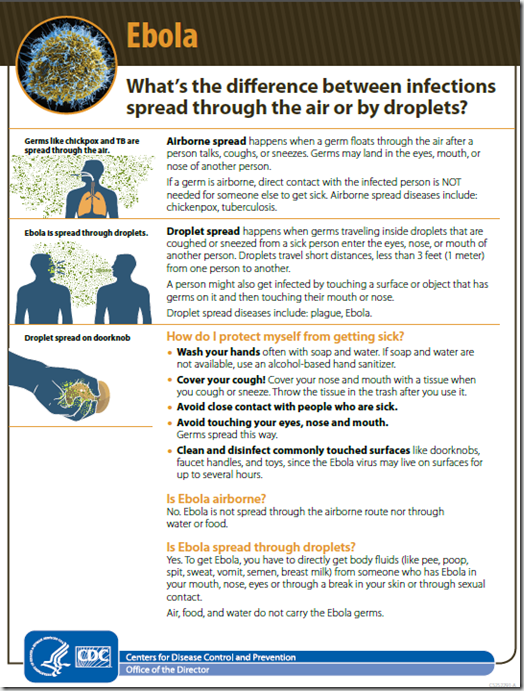
The CDC’s initial meme (see above) – that `You can’t get Ebola through Air’ – while technically true –  I felt was lacking in that it never quite spelled out the potential risks of droplet transmission. 


Which is why I’m very pleased to see the following, far more informative graphic appear on the CDC’s Ebola website yesterday.


image

Sunday, October 12, 2014

Dallas Ebola Press Conference & Hospital Statement

image


# 9181


A clearly subdued Dallas County Judge (highest ranking county official in the state of Texas) Clay Jenkins, in a press conference this morning at Texas Health Presbyterian Hospital, provided additional details on the first nosocomial transmission of Ebola in the United States.


What we know (some details are being withheld to protect the family, and observe HIPAA regulations), is that a healthcare provider at Texas Presbyterian Hospital – who was involved in Eric Duncan’s care after he was admitted on the 28th -  was in isolation last night with a mild fever. 


This particular HCW was considered a `low risk’ contact of Mr. Duncan. This patient’s initial tests came back positive around midnight last night.


According to Dr. Varga, head of clinical care at Texas Presbyterian, this HCW was following all CDC recommended infection control procedures (Gloves, gown, facemask & eye shield), but a review is underway to understand what happened. 


Here is a statement from Dr. Dan Varga, released at the same time as the press conference was begun:


Statement from Dr. Dan Varga, Oct. 12, 7:30 a.m. CDT

10/12/2014

Ebola Virus 

Statement from Dr. Dan Varga, Chief Clinical Officer, Senior Executive Vice President

Late Saturday, a preliminary blood test on a care-giver at Texas Health Presbyterian Hospital Dallas showed positive for Ebola. The healthcare worker had been under the self-monitoring regimen prescribed by the CDC, based on involvement in caring for patient Thomas Eric Duncan during his inpatient care that started on September 28.

Individuals being monitored are required to take their temperature twice daily. As a result of that procedure, the care-giver notified the hospital of imminent arrival and was immediately admitted to the hospital in isolation. The entire process, from the patient’s self-monitoring to the admission into isolation, took less than 90 minutes. The patient’s condition is stable. A close contact has also been proactively placed in isolation. The care-giver and the family have requested total privacy, so we can’t discuss any further details of the situation.

We have known that further cases of Ebola are a possibility among those who were in contact with Mr. Duncan before he passed away last week. The system of monitoring, quarantine and isolation was established to protect those who cared for Mr. Duncan as well as the community at large by identifying any potential ebola cases as early as possible and getting those individuals into treatment immediately.

Finally, we have put the ED on “diversion” until further notice because of limitations in staffed capacity — meaning ambulances are not currently bringing patients to our emergency department. While we are on diversion we are also using this time to further expand the margin of safety by triple-checking our full compliance with updated CDC guidelines. We are also continuing to monitor all staff who had some relation to Mr. Duncan’s care even if they are not assumed to be at significant risk of infection.

All of these steps are being taken so the public and our own employees can have complete confidence in the safety and integrity of our facilities and the care we provide.


Meanwhile, the city of Dallas has sealed off this new patient’s apartment, decontaminated the common areas in the apartment complex, sealed and decontaminated the patient’s car, and has canvassed the neighborhood – knocking on doors – checking on everyone and providing information to nearby residents.


A close contact of this patient is also in isolation as precaution – but is not currently symptomatic.  There is also reportedly a pet in the apartment, and efforts will be made later today to check on, and provide for, this animal.


We will probably  be hearing later today from the CDC, the State of Texas, and Dallas County Department of Health.


While obviously a setback, this was not unexpected.  


Despite all of the reassurances over the level of precautions being taken, there is no way to reduce the risk of treating an Ebola patient to zero.  As Zach Thomas, head of Dallas County Health Department – in a TV interview (WFAA) right after the press conference – warned `Don’t be shocked if we see another case’.


Stay tuned.

Monday, October 06, 2014

The WHO Weighs In On The Modes Of Ebola Transmission

image 

Credit Dr. Ian Mackay’s  VDU Blog 


# 9151


A topic we’ve revisited often over the past couple of months are the ways that Ebola might be transmitted among humans.   While clearly not an airborne virus in the classic sense – else we’d have seen this virus already spread to every continent – there are potential routes of infection that do not involve actual direct physical contact with an infected, symptomatic individual.


Dr. Ian Mackay, in his blogs What words would you use to separate influenza spread from Ebola virus disease spread?, It's what falls out of the aerosol that matters.... & The wind beneath my Ebola virus.... ) has explored the potential role of large droplets – which could be coughed, sneezed, expressed or otherwise propelled a short distance onto another person by an infected individual.


What I’ve dubbed being within `spittle range’  (see Ebola Risk Communications & Ebola: Parsing The CDC’s Low Risk vs High Risk Exposures) – a risk that is more theoretical than documented - but one that cannot be ignored. 


Hence the call for PPEs (including facemasks and eye protection) when in close proximity to an infected, symptomatic case.


Today the World Health Organization  - who appears to have been listening and watching this online debate – has come out with an Ebola situation assessment that addresses these concerns.  


While their answer won’t fit neatly into a 10 second sound bite, it does acknowledge the potential for transmission to occur through `. . . virus-laden heavy droplets are directly propelled, by coughing or sneezing (which does not mean airborne transmission) onto the mucus membranes or skin with cuts or abrasions of another person.’


The WHO also addresses speculation that the Ebola virus might mutate into a more transmissible pathogen over time.


What we know about transmission of the Ebola virus among humans

Ebola situation assessment - 6 October 2014

The Ebola virus is transmitted among humans through close and direct physical contact with infected bodily fluids, the most infectious being blood, faeces and vomit.

The Ebola virus has also been detected in breast milk, urine and semen. In a convalescent male, the virus can persist in semen for at least 70 days; one study suggests persistence for more than 90 days.

Saliva and tears may also carry some risk. However, the studies implicating these additional bodily fluids were extremely limited in sample size and the science is inconclusive. In studies of saliva, the virus was found most frequently in patients at a severe stage of illness. The whole live virus has never been isolated from sweat.

The Ebola virus can also be transmitted indirectly, by contact with previously contaminated surfaces and objects. The risk of transmission from these surfaces is low and can be reduced even further by appropriate cleaning and disinfection procedures.

Not an airborne virus

Ebola virus disease is not an airborne infection. Airborne spread among humans implies inhalation of an infectious dose of virus from a suspended cloud of small dried droplets.

This mode of transmission has not been observed during extensive studies of the Ebola virus over several decades.

Common sense and observation tell us that spread of the virus via coughing or sneezing is rare, if it happens at all. Epidemiological data emerging from the outbreak are not consistent with the pattern of spread seen with airborne viruses, like those that cause measles and chickenpox, or the airborne bacterium that causes tuberculosis.

Theoretically, wet and bigger droplets from a heavily infected individual, who has respiratory symptoms caused by other conditions or who vomits violently, could transmit the virus – over a short distance – to another nearby person.

This could happen when virus-laden heavy droplets are directly propelled, by coughing or sneezing (which does not mean airborne transmission) onto the mucus membranes or skin with cuts or abrasions of another person.

WHO is not aware of any studies that actually document this mode of transmission. On the contrary, good quality studies from previous Ebola outbreaks show that all cases were infected by direct close contact with symptomatic patients.

No evidence that viral diseases change their mode of transmission

Moreover, scientists are unaware of any virus that has dramatically changed its mode of transmission. For example, the H5N1 avian influenza virus, which has caused sporadic human cases since 1997, is now endemic in chickens and ducks in large parts of Asia.

That virus has probably circulated through many billions of birds for at least two decades. Its mode of transmission remains basically unchanged.

Speculation that Ebola virus disease might mutate into a form that could easily spread among humans through the air is just that: speculation, unsubstantiated by any evidence.

This kind of speculation is unfounded but understandable as health officials race to catch up with this fast-moving and rapidly evolving outbreak.

To stop this outbreak, more needs to be done to implement – on a much larger scale – well-known protective and preventive measures. Abundant evidence has documented their effectiveness.


Thursday, October 02, 2014

Mackay On Ebola `Direct Contact’ & Droplet Transmission

image


# 9142


Dr. Ian Mackay once again takes on the subtleties of Ebola transmission on his excellent VDU blog today, and brings a new level of clarity.   As he and I have discussed before (see VDU Blog: Droplets vs Airborne - Demystifying Ebola Transmission), Ebola isn’t an `airborne’ virus – but you can be infected via droplets emanating from an infected individual.


What I’ve dubbed `spittle range’ where large droplets of mucus, blood, sweat, or other bodily fluids could potentially be coughed, sneezed, or otherwise propelled or flung onto another person.  


Last Month, in Ebola: Parsing The CDC’s Low Risk vs High Risk Exposures, we looked at CDC guidance that acknowledged the (low) risks of casual contact; defined as spending a prolonged period of time in the same room with, or within 1 meter, of an infected patient – even without direct physical contact.


image

In the light of all of this, the heavily parsed and highly promoted meme -  that `You can’t get Ebola through air’  -  tends to cause more confusion than reassurance.


To the rescue today comes Dr. Mackay, who explains what `direct contact’  really means.  I’ve only included a snippet, follow the link to read:


It's what falls out of the aerosol that matters....

(Excerpt)

Direct contact.

When we talk about "direct contact" and Ebola virus transmission, we do include the bigger wetter heavier droplets that might be propelled from of a sick person during vomiting, or coughing as a risk for transmitting virus.

Even though that is not physical direct contact, and even though the droplets travel across a gap between people - through the air - it is still a direct line from person A (red in the graphic below) to B (blue). If B is too far away, then those droplets fall to the ground before they hit B. The droplets may remain infectious on the ground. That depends on temperature, humidity, surface type and the type and amount of virus.

(continue . . . .)

Thursday, September 18, 2014

CIDRAP Commentary: Health workers need optimal respiratory protection for Ebola

image

Credit CIDRAP


# 9090


Last night CIDRAP published what I suspect will become a highly controversial commentary, which urges a higher standard of PPE (Personal Protective Equipment) for Healthcare Workers (HCWs) dealing with suspected or confirmed Ebola cases.  


In doing so, they also revive the `airborne’ transmission debate.


As things stand now, contact (gloves, gown) and droplet protection (surgical masks, eye protection) are recommended, but not respirators (ie. PAPR, N95) for patient care not involving aerosol generating procedures (AGPs).

image

http://www.cdc.gov/vhf/ebola/hcp/infection-prevention-and-control-recommendations.html


The commentary, by Dr Lisa Brosseau and Dr  Rachel Jones , both from School of Public Health, Division of Environmental and Occupational Health Sciences, at the University of Illinois at Chicago is both lengthy and detailed, and should be read in its entirety, but the gist can be found in the following excerpt:


COMMENTARY: Health workers need optimal respiratory protection for Ebola

Lisa M Brosseau, ScD, and Rachael Jones, PhD

Sep 17, 2014

Healthcare workers play a very important role in the successful containment of outbreaks of infectious diseases like Ebola. The correct type and level of personal protective equipment (PPE) ensures that healthcare workers remain healthy throughout an outbreak—and with the current rapidly expanding Ebola outbreak in West Africa, it's imperative to favor more conservative measures.

The precautionary principle—that any action designed to reduce risk should not await scientific certainty—compels the use of respiratory protection for a pathogen like Ebola virus that has:

  • No proven pre- or post-exposure treatment modalities
  • A high case-fatality rate
  • Unclear modes of transmission

We believe there is scientific and epidemiologic evidence that Ebola virus has the potential to be transmitted via infectious aerosol particles both near and at a distance from infected patients, which means that healthcare workers should be wearing respirators, not facemasks.1

(Continue . . . )


Two weeks ago we saw a much different recommendation appear in The Lancet, where authors Jose M Martin-Moreno, Gilberto Llinás, Juan Martínez Hernández argued against the use of respiratory protection (see Is respiratory protection appropriate in the Ebola response?) for routine (non-AGP) care.


Part and parcel to this debate is the definition of `airborne transmission’.  


For now, there is no evidence that Ebola is `airborne’ in the classical – influenza, measles, chickenpox -  highly efficient – long duration aerosolized sort of way. But short distance droplet transmission appears likely. 


Dr Ian Mackay & company delved into this debate last month in their highly recommended VDU blog : Ebola virus may be spread by droplets, but not by an airborne route: what that means


Given that after decades of research there remain many open questions in the dynamics of influenza transmission and the relative effectiveness of different types of PPEs (see Influenza Transmission, PPEs & `Super Emitters’), one shouldn’t be terribly surprised to find ambiguity and disagreement over the transmissibility of Ebola.


Caught in the middle of this controversy are healthcare workers – both in the United States and Europe where extra PPEs are available, and in Africa where basic PPEs are often in short supply – who are uncertain as to just how big a risk they are taking when treating an Ebola patient.


While it may be some time before the risks of Ebola transmission are fully understood and quantified, there is perhaps some degree of comfort to be taken from MSF’s record of protecting their volunteers treating Ebola patients in the field using basic PPEs. 


While they did report their first infection from an International volunteer yesterday (see MSF: French Volunteer Infected With Ebola, Will Be Evacuated), the circumstances behind this incident are unknown, and it comes after literally tens of thousands of HCW – Ebola patient contacts over the past few months.


(Update:  According to the APSix local staff have been infected, three of whom died, though it was not clear that they had become sick at work and may have contracted the virus from the communities where they lived.)


That said - and being a `belt and suspenders’ kind of guy - I fully understand the desire that many HCWs who will have direct contact with Ebola patients will want to have the maximum protection they can be practically afforded – even if current evidence suggests that a lesser degree of protection is probably adequate.


The bottom line is pretty simple, and has little to do with the `best evidence’. 


If you expect HCWs to step up and put themselves in harm’s way, they need to know you’ll go the extra mile to protect them. 

Sunday, August 31, 2014

Mackay On Ebola: Blood, Sweat & Tears

image

Credit CDC PHIL


# 9022


Ian Mackay, in a follow up to his seminal post on Ebola ten days ago, writes today on the level of EBOV detection (often via RNA, or Antigens) in various human body fluids. 


While the blood of  viremic patients is infamously teeming with the virus, Ian describes the (somewhat limited) research to date on the level of EBOV detection in other body fluids – like tears, sweat and saliva.


Although the level of EBOV detection in these fluids have been far lower –and  often even undetectable -  given the believed low infectious dose for contracting viral hemorrhagic fevers and the likely variability of virus shedding across numerous cases, any hint of the virus in these body fluids is deserving of our attention and respect.


Follow the link to read.


Sunday, 31 August 2014

Ebola: Blood, sweat and tears...

This post follows up the recent one on convalescent semen being able to harbour infectious Ebola virus (EBOV; although I am not aware of any infection resulting from this route of transmission there has been at least one report for Marburg virus [4]).


I thought I'd give the same treatment to tears and sweat which are also fluids intermittently listed as possible sources of EBOV infection for humans. Some examples of the scientific literature which support the risk messaging, follow.

(Continue . . .)

Thursday, August 28, 2014

Mackay On The NEJM MERS-CoV Transmission Study

image

Coronavirus – Credit CDC PHIL


# 9010


Last night the NEJM published a study looking at the transmission of the MERS coronavirus to secondary contacts within a household, penned by such notables as Dr. Christian Drosten and Dr. Ziad Memish. The study focused on 26 index cases and their 280 household contacts, and found a relatively low (12 cases, 4%) incidence of household transmission.


Additionally, of the 26 index cases, only 6 (23%) appeared to have passed the infection on to other household members. Of those infections, only 7 were detected using RT-PRC testing, while 5 were detected though serology.


Transmission of MERS-Coronavirus in Household Contacts

Christian Drosten, M.D., Benjamin Meyer, M.Sc., Marcel A. Müller, Ph.D., Victor M. Corman, M.D., Malak Al-Masri, R.N., Raheela Hossain, M.D., Hosam Madani, M.Sc., Andrea Sieberg, B.Sc., Berend Jan Bosch, Ph.D., Erik Lattwein, Ph.D., Raafat F. Alhakeem, M.D., Abdullah M. Assiri, M.D., Waleed Hajomar, M.Sc., Ali M. Albarrak, M.D., Jaffar A. Al-Tawfiq, M.D., Alimuddin I. Zumla, M.D., and Ziad A. Memish, M.D.

(Continue . . . )


This morning Dr. Ian Mackay takes a look at this study on his VDU Blog. Follow the link to read:


Thursday, 28 August 2014

MERS-CoV around the house-yes, it does transmit at home

Click on graph to enlarge.

Some Middle East respiratory syndrome coronavirus (MERS-CoV) questions remain stubbornly unanswered even after two and a half years.


Today comes a study from Prof Christian Drosten and colleagues, including Prof Ziad Memish, released by the New England Journal of Medicine.[1] This study takes a look at MERS-CoV infection among the contacts of MERS cases.

(Continue . . .)


While a 4% transmission rate in these households is reassuring, it stands in sharp contrast to the much higher transmission rates observed in healthcare facilities.


To date we’ve seen more than 800 confirmed cases - and it is assumed that additionally, some unknown (but likely significant) number of cases have gone undetected. 


As only a handful of those cases have been attributed to animal-to-human transmission, it is obvious that under some conditions and settings the MERS coronavirus transmits more efficiently.


Today’s study adds to our knowledge of the virus, but there still remain a lot of unanswered questions including the role of mild or asymptomatic transmission. And of course the obvious concern, that the longer the virus circulates in people, the greater the chances that it will better adapt to human physiology. 

Sunday, August 17, 2014

Mackay On Ebola, Pigs, Primates and People


image
Credit CDC PHIL


# 8964


Yesterday Dr. Ian Mackay et al. produced a terrific overview called Ebola virus may be spread by droplets, but not by an airborne route: what that means which I blogged about here.  


Today Ian is back with another in-depth look at Ebola transmission, this time taking on the much-discussed laboratory experiments that some online pundits have claimed `proves’ airborne transmission.


Ian quite adeptly goes over what we know – and more importantly, what we don’t know – about Ebola transmission.  Both in the lab, and in the wild.  And along the way provides a lesson in critical thinking.


At this point, I’m going to do the smart thing and step out of the way and invite you to read:


Ebola, pigs, primates and people

This is a companion piece to my collaborative article, Ebola virus may be spread by droplets, but not by an airborne route: what that means, posted a couple of days ago. I suggest you read the both together.


In this post, I'd like to make sure we all understand that an airborne route of Ebola virus infection has been used to deliberately infect non-human primates (NHPs). It is possible and it can be done. Okay? I'm not covering up any secret knowledge or trying to conceal facts that only we few evil-society-of-science types know. I don't secretly work for an agency aiming to delude you dear readers into feeling falsely safe about the risks associated with being near an Ebola virus infected person (which most reading this will likely never be). Frankly, I'm learning this as I go.

(Continue . . . )

Saturday, August 16, 2014

VDU Blog: Droplets vs Airborne - Demystifying Ebola Transmission

image

Except from CDC Infographic


# 8962


Almost two weeks ago the CDC released a reassuring infographic (see above) that - among other things - stated that `You can’t get Ebola through Air’, which immediately set off an internet firestorm of disbelief and derision. I considered it a communications misstep at the time, and blogged about it in The Ebola Sound Bite & The Fury.


While I understand the need to reassure the public, and the desire to try to defuse some of more egregious tabloid-style reporting, sometimes reassurance can be overdone.


When people see moon-suited doctors ferrying Ebola patients into Emory University Hospital, and compare that to the CDC’s blanket assurance that `You can’t get Ebola through the Air’  – they rightfully come away confused, and perhaps even a bit suspicious.


Last week, in Ebola: Parsing The CDC’s Low Risk vs High Risk Exposures, we looked at CDC guidance that acknowledged the (low) risks of casual contact; defined as spending a prolonged period of time in the same room with, or within 1 meter, of an infected patient – even without direct physical contact. 


What I dubbed `spittle range’  where large droplets of mucus, blood, sweat, or other bodily fluids could potentially be coughed, sneezed, or otherwise propelled or flung onto another person.  


Today, I’m very pleased to report that Dr. Ian Mackay (along with three other researchers) – all far more qualified to weigh in on this subject than I  – have penned a detailed essay on what we know about Ebola transmission, which will hopefully clear up some of the confusion.  


Follow the link to read:


Ebola virus may be spread by droplets, but not by an airborne route: what that means

An article collaboratively written by (alphabetically)..

Dr. Katherine Arden
A postdoctoral researcher with interests in the detection, culture, characterization and epidemiology of respiratory viruses.

Dr Graham Johnson
A post-doctoral scientist with extensive experience investigating respiratory bioaerosol production and transport during breathing, speech and coughing and determining the physical characteristics of these aerosols.

Dr. Luke Knibbs
A Lecturer in Environmental Health at the University of Queensland. He is interested in airborne pathogen transmission and holds an NHMRC Early Career Fellowship in this area.

A. Prof Ian Mackay
A virologist with interest in everything viral but especially respiratory, gastrointestinal and central nervous system viruses of humans.

________________________

The flight of the aerosol

Understanding what we mean when we discuss airborne virus infection risk


A variant Ebola virus belonging to Zaire ebolavirus (EBOV) is active in four West African countries right now. Much is being said and written about it, and much of that revolves around our movie-influenced idea of an easily spread, airborne horror virus. Many people worry about their risks of catching EBOV, particularly since it hopped on a plane to Nigeria. However, all evidence suggests that this variant is not airborne. The most frequent routes to acquire an EBOV infection involve direct contact with the blood, vomit, sweat or stool of a person with advanced Ebola virus disease (EVD). But what is direct contact? What is an “airborne” route? For that matter what is an aerosol and what role do aerosols play in spreading EVD? How is an aerosol different from a droplet spray? Can droplets carry EBOV through the air?

Direct contact includes physical touch but also contact with infectious droplets; the contact is directly from one human to the next, rather than indirectly via an intermediate object or a lingering cloud of infectious particles. You cannot catch EVD by an airborne route, but you may from droplet sprays. Wait, what?? This is where a simple definition becomes really important.

(Continue . . . )

Monday, August 11, 2014

Nigeria: 10th Ebola Case Confirmed

image


# 8937


The tragedy of healthcare workers exposed to Ebola continues to evolve in Nigeria as that country reports their 10th positive case – all apparently as a result of  contact with the index case, a Liberian named Patrick Sawyer who fell ill while flying to Lagos 22 days ago. 


Media reports suggest he told HCWs he had malaria, and became both erratic and combative when he was told he might have Ebola, thereby exposing more to the virus. 


Whatever the circumstances (and Caveat Lector should be the rule when dealing with media reports) – the end result has been the infection of at least 9 additional people – with more either suspected or under observation. First a brief update from Reuters, then I’ll have a bit more.


Nigeria's Lagos now has 10 Ebola cases: health minister

ABUJA Mon Aug 11, 2014 3:18pm IST

(Reuters) - Nigeria's Lagos has 10 confirmed cases of Ebola, up from seven at the last count, although only two so far have died, including the Liberian who brought the virus in, the health minister said on Monday.

All were people who had had primary contact with Patrick Sawyer, who collapsed on arrival at Lagos airport on July 25th and later died, Health Minister Onyebuchi Chukwu told a news conference.


For those wondering why the number is now 10, when the World Health Organization and the media were reporting 13 cases on Friday – the answer is simple;  Friday’s number was a combination of suspected, probable, and confirmed cases.

image

From WHO GAR update August 8th


While there are many who were alarmed last week by the deliberate importation to a high containment facility at Emory University Hospital of two Ebola positive patients, the events in Nigeria show the bigger risk to health care workers comes from having direct contact with someone they don’t know is infected.


Previously, the R0 or Basic Reproductive Number for Ebola has been calculated as being under 2.0. Essentially, the number of new cases in a susceptible population likely to arise from a single infection.


The basic reproductive number of Ebola and the effects of public health measures: the cases of Congo and Uganda.

Chowell G1, Hengartner NW, Castillo-Chavez C, Fenimore PW, Hyman JM.

Abstract

Despite improved control measures, Ebola remains a serious public health risk in African regions where recurrent outbreaks have been observed since the initial epidemic in 1976. Using epidemic modeling and data from two well-documented Ebola outbreaks (Congo 1995 and Uganda 2000), we estimate the number of secondary cases generated by an index case in the absence of control interventions R0. Our estimate of R0 is 1.83 (SD 0.06) for Congo (1995) and 1.34 (SD 0.03) for Uganda (2000).


Making the number of secondary cases reported in Nigeria from a single case unusually high, although you cannot extrapolate the R0 off a single  transmission event.  


Each link in the chain of transmission is different, and the R0 is only an `average’ over time.


During the SARS outbreak of 2003 (a much more contagious respiratory virus), studies found most infected persons would only infect 1 or perhaps 2 additional people, and sometimes none.  But a small percentage of those infected were far more efficient in spreading the disease, with some responsible for 10 or more secondary infections.


This super spreader phenomenon gave rise to the 20/80 rule, that 20% of the cases were responsible for 80% of the transmission of the virus (see 2011 IJID study Super-spreaders in infectious diseases).


While it might be tempting to ascribe the aggressive spread to HCWs in Nigeria to Sawyer being a `super spreader’, that isn’t the only credible explanation.


As any healthcare worker will tell you, trying to restrain or `take down’ a combative – sometimes irrational  - patient is one of the most dreaded, and dangerous things they may be called upon to do.


The risk of physical injury to the HCW, and to the patient, is greatly increased, as are the risks of exposure to blood or other body fluids.  Protective gear – if worn – can be quickly damaged or compromised .


And since Healthcare workers are limited as to how much force they can ethically use to restrain a patient – a constraint not usually honored by the  patient – it often requires 3, 4, 5 or even more people to subdue someone without injuring them.


This may help explain, at least in part, how so many HCWs have become infected from exposure to a single Ebola case. 


I would note that there are media reports (see Nigerians beg Obama to give Lagos nurse vaccine) that at least one of the Nigerian nurses infected did not participate in restraining Sawyer, but did perform routine nursing duties (taking vitals, feeding the patient, etc.) and touched some of the same surfaces as the patient.


What PPEs she may have employed while performing these duties, and the veracity of these media reports, isn’t abundantly clear. 


A detailed epidemiological investigation into the chain of transmission in Nigeria ought to give us a better idea of exactly what happened there. Where infection control procedures broke down, whether Sawyer was a `super-spreader’, or if the staff was simply blindsided by combination of bad luck and timing.


Hopefully that investigation is underway, and the results will be forthcoming sooner rather than later.

Monday, May 05, 2014

Majumder: An Asymptomatic MERS Transmission Scenario

image

Interactive MERS map – Source Maia Majumder


# 8568


Several days ago on twitter Maia Majumder posited a unique method by which mild or asymptomatic carriers of the MERS virus might transmit the virus to others – particularly in a Middle Eastern hospital situation.  I confess, ever since hearing her idea, I’ve been intrigued.  


Maia characterizes her idea as a SWAG, meaning she has no proof – just a hunch, but believes that the scenario deserves investigation.  


Today I’m happy to say, she has fleshed out her ideas and has presented them on her blog Mens et Manus.   Follow the link to read:


Asymptomatic MERS + Ablution = Transmission?

Asymptomatic MERS has been a hot topic lately.

Since the onset of the current outbreak, 22% of all reported diagnoses – 60 of 279 total – have been asymptomatic. Of those 60, over half of them have been healthcare workers (HCW) [1].

In fact, the data thus far indicates that healthcare workers are far more likely to have asymptomatic MERS than members of the general public. 32 of the 69 healthcare workers that have been diagnosed since March 20th have been asymptomatic [1].

(Continue . . . )


While you are at Mens et Manus, take the time to look at Maia’s other offerings, including her interactive MERS map at and her tumblr account http://maiamajumder.tumblr.com/.

Sunday, August 04, 2013

Study: Possible Transmission From Asymptomatic MERS-CoV Case

Middle East respiratory syndrome coronavirus (MERS-CoV)

Photo Credit WHO


# 7539


Overnight Crof carried a report on a study appearing in the International Journal of Infectious Diseases, that suggests a 51 year old man who become infected with the MERS coronavirus during a hospital stay last February in Saudi Arabia probably contracted it from an asymptomatic or unrecognized mild case.

Over the past month, with better testing methods now available, Saudi and UAE health officials have reported on roughly a dozen asymptomatic  or `mild’ infections (see ECDC: 6th MERS-CoV Rapid Risk Assessment).


While mild cases provide a welcomed lowering of the mortality rate of this virus, they also open the possibility of unrecognized spread of the virus in the community. 


Until now, we’ve not seen any credible evidence of forward transmission from an asymptomatic patient, which has fostered the hope that asymptomatic cases might not be very contagious, and are more apt to turn out to be a`dead-end’ for the virus.


In today’s study, we learn of a man who – while hospitalized in a Saudi facility that reported  no other MERS infections – fell ill with the virus 14 days after admission.


With a presumed incubation period of less than 14 days, this suggests he was infected during his hospital stay – and likely from an unrecognized mild or asymptomatic patient, visitor, or staff member.


The other possibility is that the incubation period can sometimes be longer than 14 days. But we can only go with the evidence we have at the time.


First the abstract, then I’ll return with more.


A family cluster of Middle East Respiratory Syndrome Coronavirus infections related to a likely unrecognized asymptomatic or mild case

Original Research Article
In Press, Corrected Proof,

Available online 2 August 2013

Ali S. Omrani, Mohammad Abdul Matin, Qais Haddad, Daifullah Al-Nakhli, Ziad A. Memish, Ali M. Albarrak

Background
Ninety confirmed cases of Middle East Respiratory Syndrome Coronavirus (MERS-CoV) have been reported to the World Health Organization. We report the details of a second family cluster of MERS-CoV infections from Riyadh, Saudi Arabia.
Methods

We present the clinical, laboratory and epidemiological details of 3 patients from a family cluster of MERS-CoV infections.

Results

The first patient developed respiratory symptoms and fever 14 days after admission to hospital for an unrelated reason. He died 11 days later with multi-organ failure. Two of his brothers presented later to another hospital with respiratory symptoms and fever. MERS-CoV infection in the latter 2 patients was confirmed by reverse transcriptase polymerase chain reaction testing. All 3 patients had fever, cough, shortness of breath, bilateral infiltrates on chest x-ray, thrombocytopenia, lymphopenia and rises in serum creatinine kinase and alanine transaminase. No hospital or other social contacts are known to have acquired the infection. It appears that the index patient in this cluster acquired MERS-CoV infection whilst in hospital from an unrecognized mild or asymptomatic case.

Conclusion

MERS-CoV acquisition from unrecognized mild or asymptomatic cases may be a more important contributor to ongoing transmission than previously appreciated.


Asymptomatic, subclinical, or extremely mild symptoms with viral infections are quite common, and with some viruses are the norm rather than the exception.


A classic example being polio, where 95% of those infected remain asymptomatic, yet they are still capable of spreading the virus.

image


Last year, in The Very Common Cold, we looked at a study of college students that found asymptomatic Rhinovirus infections led symptomatic infections by a whopping factor of 4 to 1.


Those with asymptomatic infections showed lower viral loads than those displaying cold symptoms - suggesting that they may be less efficient spreaders of the virus – but we don’t have enough data to know how much of a viral load it takes to spread the virus.


Also last year, in  PLoS One: Influenza Viral Shedding & Asymptomatic Infections, we saw a small study that found 21% of adult secondary influenza cases were asymptomatic or subclinical, yet they shed roughly the same quantity of virus as those showing clinical signs of illness.


While there are few studies looking at asymptomatic SARS cases (another coronavirus) from 2003, we’ve a serology study that found a small, but significant percentage of asymptomatic cases (EID journal  2005 Asymptomatic SARS Coronavirus Infection among Healthcare Workers, Singapore).


In this study, the incidence of severe disease among those seropositive for the SARS virus was 82%. Only 4% displayed milder symptoms, while surprisingly, 13% were asymptomatic


Admittedly, MERS-Cov isn’t SARS, but it's the closest analogue we have right now.


Transmission of SARS – even among those who were seriously ill – varied widely. A few patients were `super-spreaders’ - infecting multiple contacts - while a great many did not appear to transmit the virus forward at all (cite MMWR Severe Acute Respiratory Syndrome --- Singapore, 2003).


The role (if any) of asymptomatic transmission during the SARS outbreak a decade ago remains poorly understood.


Although we’ve only one report of probable viral acquisition from a mild or asymptomatic source, there are other cases out there that  may well have been infected in a similar fashion.  


While sporadic community cases occurring across the middle east over the past 18 months have been assumed to be the result of a repeated spillovers from an (as yet, unknown) animal host, some could also be the result of transmission from a mild or asymptomatic case.


The only way to get a handle on the true incidence of this virus is through extensive testing – not only of those showing symptoms – but of the general population as well (serology studies).


A topic that Dr. Ian Mackay writes at length on this morning in his excellent Virology Down Under blog. Follow the link to read:


MERS-CoV: Family cluster, untested case, delayed reporting, missing data

Saturday, June 29, 2013

CID Journal: Estimates Of Human Infection From H3N2v (Jul 2011-Apr 2012)

 image

Credit CDC


# 7435


In my last post (see CID Journal: Lessons From The `First Wave’ Of H3N2v) I recounted the history of the `first wave’ of the H3N2v swine variant virus (July 2011-Apr 2012) as part of a lead up to a series of articles just published in a supplement to the journal Clinical Infectious Diseases.


While only 13 human infections were detected during this 9 month time span, it is considered more than probable that a significant number of cases went undetected.


We know with practically every infectious disease you can name, that surveillance and testing only picks up a fraction of the total number of cases.  The proverbial `tip of the iceberg’ or in the case of the graphic below, the `top of the pyramid’


surveillance

Credit CDC 


As an example, last year the CDC was notified of 5,674 cases of West Nile virus disease in people, including 286 deaths. But the actual number of WNV infections (including mild & asymptomatic cases) may have been well over 100,000.


Similarly, we don’t actually know how many people contract, or even die from, influenza each year in the United States. With all of these diseases, the number of cases each year must be estimated, based on available surveillance and testing and mathematical modeling.


Which brings us to a study that attempts to extrapolate - using models developed during the opening months of the 2009 H1N1 pandemic - how many undetected cases of H3N2v may have occurred during this first wave (July 2011 – April 2012) when only 13 cases were confirmed.


Their results – that more than 2,000 human infections from H3N2v may have occurred during this time -  I suspect, will surprise a lot of people.


Estimates of the Number of Human Infections With Influenza A(H3N2) Variant Virus, United States, August 2011–April 2012

Matthew Biggerstaff, Carrie Reed, Scott Epperson, Michael A. Jhung, Manoj Gambhir, Joseph S. Bresee, Daniel B. Jernigan, David L. Swerdlow, and Lyn Finelli

Background. Thirteen human infections with an influenza A(H3N2) variant (H3N2v) virus containing a combination of gene segments not previously associated with human illness were identified in the United States from August 2011 to April 2012. Because laboratory confirmation of influenza virus infection is only performed for a minority of ill persons and routine clinical tests may not identify H3N2v virus, the count of laboratory-confirmed H3N2v virus infections underestimates the true burden of illness.


<SNIP  Methods>

Results. We estimate that the median multiplier for children was 200 (90% range, 115–369) and for adults was 255 (90% range, 152–479) and that 2055 (90% range, 1187–3800) illnesses from H3N2v virus infections may have occurred from August 2011 to April 2012, suggesting that the new virus was more widespread than previously thought.


Their estimates range from just under 1,200 cases to nearly 4,000 for this `first wave’. 

The `second wave’ began in late June 2012, and ran well into the fall, resulted in more than 300 confirmed cases. This study strongly suggests that those represented but a tiny fraction of the `true’ number of infections last summer.


Granted, the surveillance picture during the second wave – once the news broke that scores of people attending county & state fairs had contracted the virus – likely changed from during the first wave.


My guess is that these multipliers may need a bit of tweaking for use with the second wave, to account for more robust surveillance and testing that was put into place. 


But even so, the number of undetected cases last summer was likely many-fold greater than the 300 confirmed infections turned up by surveillance.


This past week, we learned of four new cases (see CDC FluView Update On H3N2v Cases) linked to attendance at a county fair in Indiana.


Given the prevalence of the H3N2v virus in swine, and the increased potential for exposure over county & state fair season (running from June-November), it seems likely we’ll be hearing a good deal more about this variant flu virus in the coming months.


Despite these numbers, and apparent limited human-to-human transmission of this virus, this strain has not yet managed to spread efficiently in the community.


The CDC maintains an H3N2v and You FAQ page, and offers the following advice for fairgoers and exhibitors.


Preventive Actions

CDC Recommendations For People At High Risk:

  • If you are at high risk of serious flu complications and are going to a fair where pigs will be present, avoid pigs and swine barns at the fair this year. This includes children younger than 5 years, people 65 years and older, pregnant women, and people with certain long-term health conditions (like asthma, diabetes, heart disease, weakened immune systems, and neurological or neurodevelopmental conditions).

If you are not at high risk, take these precautions:

  • Don’t take food or drink into pig areas; don’t eat, drink or put anything in your mouth in pig areas.
  • Don’t take toys, pacifiers, cups, baby bottles, strollers, or similar items into pig areas.
  • Wash your hands often with soap and running water before and after exposure to pigs. If soap and water are not available, use an alcohol-based hand rub.
  • Avoid close contact with pigs that look or act ill.
  • Take protective measures if you must come in contact with pigs that are known or suspected to be sick. This includes minimizing contact with pigs and wearing personal protective equipment like protective clothing, gloves and masks that cover your mouth and nose when contact is required.
  • To further reduce the risk of infection, minimize contact with pigs and swine barns.