
Showing posts with label Prescription. Show all posts

Monday, March 03, 2014

CDC Telebriefing (March 4th): Improving Antibiotic Prescribing Practices

image


# 8342


For years we’ve heard dire warnings of a future where most of our most important antibiotics are rendered impotent against drug resistant infections, and increasingly, those predictions are coming true.  Last September the CDC issued a major threat report called Antibiotic resistance threats in the United States, 2013 that provided  a snapshot of the effects of growing antibiotic resistance across the United States.


Among their (conservative) findings:


Each year in the United States, at least 2 million people become infected with bacteria that are resistant to antibiotics and at least 23,000 people die each year as a direct result of these infections. Many more people die from other conditions that were complicated by an antibiotic-resistant infection.


The rise of antibiotic resistance has long been linked to the overuse and misuse of antibiotics. A problem that is wide spread in many parts of the world where antibiotics are not well regulated, but also right here in the United States, where there remains a great variance in prescribing practices among physicians.


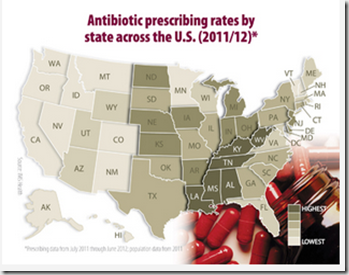
Last November, in AAP/CDC: New Guidance On For Antibiotics For Children, we saw guidelines issued – in part – due to the geographic disparity in the amount of antibiotics being prescribed across this country, with doctors some regions much quicker write ABx scripts than doctors in other areas (see map below).
image


Tp address this growing problem, tomorrow (March 4th) the CDC will hold a Telebriefing on Antibiotic prescribing practices (details below).


CDC Telebriefing: New Vital Signs Report - Are Prescribing Practices Putting Hospital Patients at Risk?

What

Poor antibiotic-prescribing practices in hospitals can needlessly put patients at risk for Clostridium difficile infection (deadly diarrhea) and future drug-resistant infections. This month, the CDC Vital Signs report looks at prescribing practices and variations, and calls on all U.S. hospitals to improve antibiotic-prescribing practices.

Who

Tom Frieden, M.D., M.P.H., Director, Centers for Disease Control and Prevention
John R. Combes, M.D., Senior Vice President, American Hospital Association

When

Tuesday, March 4 at Noon ET   (Content embargoed until 1pm ET)

DIAL-IN:

Media: 888-795-0855
Non-Media: 800-369-1605
International: 1-630-395-0331
PASSCODE: CDC MEDIA

Important Instructions: If you would like to ask a question during the call, press *1 on your touchtone phone. Press *2 to withdraw your question. You may queue up at any time. You will hear a tone to indicate your question is pending.

TRANSCRIPT
A transcript of this media availability will be available following the briefing at CDC’s web site:
www.cdc.gov/media.

###


For more on the importance of proper antibiotic stewardship, you may wish to revisit these earlier blogs.

Chan: World Faces A `Post-Antibiotic Era’

Get Smart About Antibiotics Week

IDSA: Educational Guidelines Lower Antibiotic Use

And for a far more complete discussion of antimicrobial resistance issues, I can think of no better primer than Maryn McKenna’s book SUPERBUG: The Fatal Menace of MRSA.

Superbug (MRSA) Book

Superbug (MRSA) Book

Meanwhile, Maryn’s SUPERBUG Blog, continues to provide the best day-to-day coverage of these issues.

Monday, November 18, 2013

AAP/CDC: New Guidance On For Antibiotics For Children

image

# 7989


As the graphic above shows, there is considerable geographic disparity in the amount of antibiotics being prescribed across this country, with doctors some parts of the country being much quicker write ABx scripts than doctors in other regions.


In an attempt to bring some sensible level of standardization to the prescribing these drugs – and in so doing, hopefully reduce the creation and spread of antibiotic resistant bacteria - the American Academy of Pediatrics (AAP) and the CDC have produced a new set of guidelines for doctors to encourage  the judicious use of antibiotics when treating children with suspected bacterial infections.


First, some excerpts from the CDC’s press release, and then a link to the article in the journal Pediatrics.


New guidance limits antibiotics for common infections in children

Get Smart About Antibiotics Week 2013 calls for responsible antibiotic prescribing

Every year as many as 10 million U.S. children risk side effects from antibiotic prescriptions that are unlikely to help their upper respiratory conditions. Many of these infections are caused by viruses, which are not helped by antibiotics.

This overuse of antibiotics, a significant factor fueling antibiotic resistance, is the focus of a new report Principles of Judicious Antibiotic Prescribing for Bacterial Upper Respiratory Tract Infections in Pediatrics by the American Academy of Pediatrics (AAP) in collaboration with the Centers for Disease Control and Prevention (CDC).

Released today during Get Smart About Antibiotics Week, the report amplifies recent AAP guidance and promotes responsible antibiotic prescribing for three common upper respiratory tract infections in children: ear infections, sinus infections, and sore throats.

Antibiotic resistance occurs when bacteria evolve and are able to outsmart antibiotics, making even common infections difficult to treat. According to a landmark CDC report from September 2013, each year more than two million Americans get infections that are resistant to antibiotics and 23,000 die as a result.

For Clinicians:

3 Principles of Responsible Antibiotic Use

  1. Determine the likelihood of a bacterial infection: Antibiotics should not be used for viral diagnoses when a concurrent bacterial infection has been reasonably excluded.
  2. Weigh benefits versus harms of antibiotics: Symptom reduction and prevention of complications and secondary cases should be weighed against the risk for side effects and resistance, as well as cost.
  3. Implement accurate prescribing strategies: Select an appropriate antibiotic at the appropriate dose for the shortest duration required.

“Our medicine cabinet is nearly empty of antibiotics to treat some infections,” said CDC Director Tom Frieden, M.D., M.P.H.  “If doctors prescribe antibiotics carefully and patients take them as prescribed we can preserve these lifesaving drugs and avoid entering a post-antibiotic era.”

By providing detailed clinical criteria to help physicians distinguish between viral and bacterial upper respiratory tract infections, the recommendations provide guidance for physicians that will improve care for children. At the same time, it will help limit antibiotic prescriptions, giving bacteria fewer chances to become resistant and lowering children’s risk of side effects.

(Continue . . .)


The entire 11 page PDF is available online from the American Academy of Pediatrics (see link below).  The authors describe this guidance:


This clinical report focuses on antibiotic prescribing for key pediatric URIs that, in certain instances, may benefit from antibiotic therapy: AOM, acute bacterial sinusitis, and  pharyngitis. The specific recommendations are applicable to healthy children who do not have underlying medical conditions (eg, immunosuppression) placing themat increased risk of developing serious complications. The purpose of this report is to provide practitioners specific context using the most current recommendations and guidelines while applying 3 principles of judicious antibiotic use: (1) determination of the likelihood of a bacterial infection, (2) weighing the benefits and harms of antibiotics, and (3) implementing judicious prescribing strategies.


Follow the link to read and download the entire report:


Principles of Judicious Antibiotic Prescribing for Bacterial Upper Respiratory Tract Infections in Pediatrics

Adam L. Hersh, Mary Anne Jackson, Lauri A. Hicks and the COMMITTEE ON INFECTIOUS DISEASES

DOI: 10.1542/peds.2013-3260 ; originally published online November 18, 2013; Pediatrics

The online version of this article, along with updated information and services, is located on the World Wide Web at: http://pediatrics.aappublications.org/content/early/2013/11/12/peds.2013-3260


For more on this week’s focus on better stewardship of our antibiotic arsenal, you may wish to visit these recent blogs:


Surviving Winter’s Ills Without Abusing Antibiotics
The Lancet: Antibiotic Resistance - The Need For Global Solutions
ECDC: Antibiotic Resistance In the EU – 2012

Tuesday, April 23, 2013

National Take Back Initiative - April 27th


image


Note:  While H7N9 has been the big story for the past three weeks in Flublogia – and seems poised to remain so for some time - thus far it hasn’t shown any signs of ongoing or efficient human-to-human transmission.


As H7N9 isn’t the only topic worthy of attention, starting today I’ll be returning to my regular - somewhat more eclectic format - and try to slip some non-H7N9 content into the mix each day.


That said, I anticipate that H7N9 will continue to grab the lion’s share of this blog’s space for the foreseeable future.


# 7177


Every year millions of pills are dispensed in the United States that – for a variety of reasons – never get taken by the person for whom they were intended.


Sometimes a doctor changes a prescription, or a patient simply doesn’t take their meds.  Often a patient dies with a medicine cabinet full of pills (a situation I was faced with last year with the death of my father).


Whatever the reason, these drugs pose a serious threat, both to people, and to the environment. 


Too often, they end up flushed down the drain, or tossed into the trash, only to end up contaminating rivers and streams.


And while most parents worry about the use of so-called `street drugs’, Increasingly. misappropriated prescription drugs are ending up in the hands of teenagers, and are being used recreationally.


Which brings us to a survey, released today, that shows:


National study: Teen misuse and abuse of prescription drugs up 33 percent since 2008

Public release date: 23-Apr-2013

New, nationally projectable survey results released today by The Partnership at Drugfree.org and MetLife Foundation confirmed that one in four teens has misused or abused a prescription drug at least once in their lifetime -- a 33 percent increase over the past five years.

image

(Continue . . . )


For many, the dilemma is how to properly dispose of these pills. To this end, the National Take Back Initiative was created by the DEA, in conjunction local law enforcement agencies, to provide a safe place to anonymously take these drugs.


NATIONAL TAKE-BACK INITIATIVE


Upcoming Take-Back Day — April 27, 2013
(10:00AM - 2:00PM)

The Drug Enforcement Administration (DEA) has scheduled another National Prescription Drug Take-Back Day which will take place on Saturday, April 27, 2013, from 10:00 a.m. to 2:00 p.m.  This is a great opportunity for those who missed the previous events, or who have subsequently accumulated unwanted, unused prescription drugs, to safely dispose of those medications.


In the five previous Take-Back events, DEA in conjunction with our state, local, and tribal law enforcement partners have collected more than 2 million pounds (1,018 tons) of prescription medications were removed from circulation.


The National Prescription Drug Take-Back Day aims to provide a safe, convenient, and responsible means of disposal, while also educating the general public about the potential for abuse of these medications.


The DOJ website has a handy search engine where you can locate a take back facility near you.


image

Friday, March 22, 2013

Study: Risks & Benefits Of Antibiotics For Acute Respiratory Infections


image

Credit CDC Get Smart Campaign


# 7021


One of the most common ailments seen by family physicians and emergency departments is the ARI, or acute respiratory infection.


Typically the result of a viral infection (e.g. influenza, rhinovirus, adenovirus, coronavirus, parainfluenzavirus, etc.) – conditions that do not respond to antibiotics – they can occasionally progress into a life threatening bacterial pneumonia.


For that reason many patients insist on having a round of antibiotics `just in case’.  A practice of long-standing that has been linked to the rapidly growing problem of increased antibiotic resistance.


Caught in between are busy doctors who must quickly balance each individual patient’s needs (based on patient age, history, frailty - and  sometimes - just how `sick’ they look), against prudent public health policy.


To avoid a protracted discussion, all-but-predictable disgruntled patient returns – and the remote, but real possibility of a patient progressing to a bacterial pneumonia – doctors will often oblige and prescribe a course of prophylactic antibiotics.


Today, we’ve a reassuring study appearing in the Annals of Family Medicine, that helps to quantify the risks of not prescribing antibiotics for acute nonspecific respiratory infections (ARIs). 


Researchers in the UK used cohort of more than 1.5 million adult patient visits with ARI visits to their primary care provider over a 20 year period (1986-2006). Of these 65% received antibiotics.


Patients receiving antibiotics saw an overall small decrease in the rate of bacterial pneumonia hospitalizations – roughly 8.16 fewer per 100,000 (95% CI, –13.24 to –3.08; P = .002) than those not prescribed antibiotics.


First a link to the study and then a Reuters report, after which I’ll be back with more.


Risks and Benefits Associated With Antibiotic Use for Acute Respiratory Infections: A Cohort Study

Sharon B. Meropol, MD, PhD, A. Russell Localio, PhD and Joshua P. Metlay, MD, PhD

RESULTS The cohort included 1,531,019 visits with an ARI diagnosis; prescriptions for antibiotics were given in 65% of cases.


The adjusted risk difference for treated vs untreated patients per 100,000 visits was 1.07 fewer adverse events (95% CI, −4.52 to 2.38; P = .54) and 8.16 fewer pneumonia hospitalizations (95% CI, −13.24 to −3.08; P = .002).


The number needed to treat to prevent 1 hospitalization for pneumonia was 12,255.


And this report from Reuters Health.


Antibiotics not worth risk in most chest colds: study

By Andrew M. Seaman

NEW YORK | Thu Mar 21, 2013 4:12pm EDT

(Reuters Health) - Doctors need to give antibiotics to more than 12,000 people with acute respiratory infections to prevent just one of them from being hospitalized with pneumonia, according to a new study.


And that small benefit is outweighed by the very real risks that go along with antibiotics - both from serious side effects and the promotion of resistant "superbugs," researchers say.

(Continue . . . )


The practice of medicine is still very much an art, dependent upon the skill and yes, the intuition, of the health care provider. Patients are not statistics, and a one size-fits-all policy for dispensing antibiotics is neither practical or desirable. 


But despite decades of warnings, the persistent overuse of antibiotics has led us to the precipice, and we now face an uncertain and potentially frightening future where previously curable infections may run rampant.  


A few recent warnings include:


UK CMO: Antimicrobial Resistance Poses `Catastrophic Threat’

MMWR Vital Signs: Carbapenem-Resistant Enterobacteriaceae (CRE)

CDC HAN Advisory: Increase In CRE Reports In The United States

PNAS: Abundant Antibiotic Resistance Genes In Chinese Swine Farms


Chan: World Faces A `Post-Antibiotic Era’


The bottom line is that our antibiotic development pipeline is pathetically inadequate, and that bacteria are rapidly learning to evade our current arsenal. 


If we fail to control the rise in antibiotic resistance, and our current antimicrobial armamentarium fails, the decision whether to give – or not give – antibiotics will eventually become moot.


While it is unlikely to sway many patient’s opinions, hopefully today’s study will provide doctors with a little more reassurance when they opt not to prescribe antibiotics for routine ARIs. 


For a more complete look at the complex issues of antibiotic resistance, and the dearth of new drugs on the horizon, I can think of no resource better than Maryn McKenna’s superb book (and recent winner of the 2013 June Roth Memorial Book Award, American Society of Journalists and AuthorsSuperbug: The Fatal Menace of MRSA.

Superbug (MRSA) Book

And while I dabble in the issues of antibiotic resistance, undoubtedly the best coverage can be found on Maryn’s  Superbug blog.

Wednesday, August 08, 2012

Study: Antimicrobial Prescribing Practices During The 2009 Pandemic

image

Photo Credit – CDC


# 6479


One of the most common dilemmas that doctors face is whether or not to prescribe an antibiotic for a patient presenting with an FRI (Febrile Respiratory Illness) often defined as a fever > 38C accompanied by a cough, sore throat, or runny nose.


While these illnesses are often caused by a simple viral infection, there is always the possibility that the patient may have (or may subsequently develop) a bacterial infection.


Since there is little in a patients physical appearance that can help distinguish between a viral and a bacterial respiratory infection, many doctors will decide to err on the side of caution and prescribe an antibiotic, “just in case”.


The problem is that the over-prescribing of antibiotics is viewed as one of the main forces driving the continual growth of antibiotic resistance.  


Guidelines (created by the CDC in cooperation with other medical organizations) have been developed to assist the doctor in the prescribing of antibiotics for upper respiratory infections (Adult Treatment Guidelines, Pediatric Treatment Guidelines).


The CDC has also prepared patient education information on when antibiotics are appropriate (see the CDC’s GET SMART ABOUT ANTIBIOTICS website).

 image


But in the end, it often comes down to the primary care provider’s gut feeling whether or not to prescribe an antibiotic. According to a study that appeared yesterday in the Annals of Internal Medicine, Epidemiological Context – not just patient appearance - can be one of the factors that influences this decision.


The study is called:


The Influence of Context on Antimicrobial Prescribing for Febrile Respiratory Illness: A Cohort Study

Courtney Hebert, MD; Jennifer Beaumont, MS; Gene Schwartz, MD; and Ari Robicsek, MD


The authors undertook a 5.5 year retrospective cohort study on the prescribing of antibiotics to patients seen by a network of Midwest primary care providers during influenza seasons between 2006 and 2011.


Their results, compiled from 28,301 patient encounters with signs of an FRI – seen by 69 physicians across 26 practices - is illuminating.


  • They found that during the pandemic flu season (April to June 2009 - Sept 2009 to March 2010) antibiotic prescribing dropped significantly over that seen during non-pandemic flu seasons (39.2% versus 47.5%)
  • Furthermore, they found the odds that a doctor would prescribe an antibiotic decreased as the number of FRI cases that they had seen in the previous week increased.


In other words, the more viral illness that a doctor perceives to be circulating in their community, the less likely that doctor is to prescribe an antibiotic.


Perhaps more surprising was the range of antibiotic script writing by doctors across this limited geographic region.


Overall, antibiotics were prescribed in just under half (45.2%) of all FRI cases, but among individual clinicians that number ranged from a low of 17.9% to a high of 83.7%.


While there may be other factors not readily apparent from these numbers, there does appear to be a surprising diversity of opinion among clinicians over the appropriateness of prescribing of antibiotics for FRIs.


Although limited in both size and scope, this study suggests that finding ways to keep doctors better informed on what illnesses are currently circulating in their community might help moderate the unnecessary prescribing of antibiotics.


You’ll also find an accompanying editorial in the same issue of Annals Of Internal Medicine, that stresses it is important to not only determine which external factors affect clinician’s decisions, “but how and why”.


The Context of Antibiotic Overuse

Sara Ackerman, PhD, MPH; and Ralph Gonzales, MD, MSPH


For more on the importance of proper antibiotic usage, you may wish to revisit these earlier blogs.


Chan: World Faces A `Post-Antibiotic Era’

Get Smart About Antibiotics Week

IDSA: Educational Guidelines Lower Antibiotic Use


And for a far more complete (and eye-opening) discussion of antimicrobial resistance issues, I can think of no better primer than Maryn McKenna’s book SUPERBUG: The Fatal Menace of MRSA.


And Maryn’s SUPERBUG Blog, part of Wired Science Blogs, continues to provide the best day-to-day coverage of these issues.

Sunday, May 13, 2012

A Prescription For Any Disaster

Photo Credit – Wikipedia Commons


# 6323


With Hurricane season a little over two weeks away the time has come for those of us who live anywhere within the reach of these storms (and that can be hundreds of miles in from the coast) to begin our yearly storm preparations.


This year National Hurricane Preparedness Week  runs from May 27th through June 2nd, and I’ll have a good deal of coverage at that time. But today a preparedness step that could be life saving in any disaster situation.


As our population ages, more and more of us are dependent upon daily prescription medications. Blood pressure pills, cardiac drugs, and meds for a host of other conditions are taken by tens of millions of Americans every day.


As many people discovered after Hurricane Katrina devastated New Orleans in 2005, getting refills when you’ve had to evacuate, or your pharmacy is flooded, can be nearly impossible. 


Which makes maintaining an adequate supply of essential prescription medication in your emergency kit, along with copies of your prescriptions, a particularly important part of many individual’s and family’s preparedness plan.


Most doctors will gladly write an extra 14 or 30 day `disaster stash’ script for your most vital medications if you express your concern, and the AMA endorsed this idea several years ago (see AMA Now Supports Personal Rx Stockpiling For Disasters).


Depending upon your insurance coverage, you may have to pay for them out of pocket, but it certainly beats the alternative.


And if you do obtain a disaster stash, make sure to use and rotate those meds before they expire.


FEMA has long recommended that those with special needs make special preparations.


Considerations for people responsible for disabled individuals:

  • For those on respirators or other electric-powered medical equipment, make prior arrangements with your physician or check with your oxygen supplier about emergency plans, and be sure to have electrical back-up for any medical equipment.
  • Maintain a two-week supply of items such as dressings, nasal cannulas and suction catheters.
  • Maintain a two-week supply of both prescription and non-prescription medications.
  • Keep copies of your medical records.
  • Keep copies of prescriptions for medical equipment, supplies and medications.
  • Keep extra contact lenses and supplies, extra eyeglasses and extra batteries for hearing aids.
  • Make plans now to have accessible transportation in case of evacuation.
  • Shelters may be limited in accommodations to meet some of the needs of those with disabilities. Prepare ahead of time to ensure you will have what you need.


There are federal  programs designed to assist those in a federally declared disaster zone with their emergency prescription needs.  It is called EPAP or Emergency Prescription Assistance Program.

The goals of EPAP are to:

  • Ensure access to covered prescription drugs and DME for eligible individuals who present at a pharmacy with a valid prescription, at no cost to the affected individual.
  • Implement real-time point-of-sale eligibility checks and system edits for claims where the pharmacist has found no other coverage to limit dispensing of EPAP covered drugs and DME to eligible individuals.
  • Facilitate legitimate pharmacy claims from new pharmacy locations and other out of network pharmacies on an as-needed basis.


But of course, you’ll need to be able to prove you are eligible and that you have a valid prescription (see Eligibility Information Sheet For Emergency Prescription Assistance Program (EPAP)).


And depending upon the size and scope of the disaster, there could be delays in getting your prescriptions processed. 


So having an extra supply on hand is still important.


As is knowing what to do if your prescriptions are damaged in a disaster.   Here, the FDA offers some advice.

 
Safe Drug Use After a Natural Disaster

The Center for Drug Evaluation and Research (CDER) at the FDA offers the following information on the use of drugs that have been potentially affected by fire, flooding or unsafe water and the use of temperature-sensitive drug products when refrigeration is temporarily unavailable.

(Continue . . . )


And on a related subject, everyone should have a readily available (preferably carried in your wallet or purse), EMERGENCY medical history.


I addressed that issue in a blog called Those Who Forget Their History . . . .   A few excerpts (but follow the link to read the whole thing):


Since you can’t always know, in advance, when you might need medical care it is important to carry with you some kind of medical history at all times.  It can tell doctors important information about your history, medications, and allergies when you can’t.


Many hospitals and pharmacies provide – either free, or for a very nominal sum – folding wallet medical history forms with a plastic sleeve to protect them.


I’ve scanned the one offered by one of our local hospitals below. It is rudimentary, but covers the basics.

medhx1

medhx2

In a medical emergency, minutes can make the difference between life and death.  And even in less urgent cases, having all of this information can go a long ways towards speeding your treatment.


While disasters like hurricanes, floods, and earthquakes are never pleasant experiences, the things we do in advance can make the difference between being inconvenienced and uncomfortable, and being irreparably harmed.


Those with special medical needs are all the more vulnerable during a disaster, and so extra preparations are warranted.

Saturday, April 28, 2012

Turn In Your Old Rx Drugs Today

image


# 6301


Millions of medicine cabinets around the country are filled with unused, expired, and potentially dangerous prescription drugs that – for a variety of reasons – never get taken by the person for whom they were intended.


Often a doctor changes a prescription, or a patient doesn’t finish their meds.  Sometimes a patient dies with a medicine cabinet full of pills.


Whatever the reason, these drugs pose a serious threat, both to people, and to the environment. 


Too often, they end up flushed down the drain, or tossed into the trash, only to end up in rivers and streams. Or worse, they can end up in the hands of the wrong persons, and are used recreationally – particularly by teenagers.


For many, the dilemma is how to properly dispose of these pills. To this end, the National Take Back Initiative was created by the DEA, in conjunction local law enforcement agencies, to provide a safe – no question’s asked - place to take these drugs.


Today (April 28th), there will be thousands of drop-off points set up around the country where you can take these drugs.


You’ll find handy links for a search engine that will provide you with local drop off locations around the country.


NATIONAL TAKE-BACK INITIATIVE
April 28, 2012
10:00 AM - 2:00 PM

The Drug Enforcement Administration (DEA) has scheduled another National Prescription Drug Take-Back Day which will take place on Saturday, April 28, 2012, from 10:00 a.m. to 2:00 p.m.  This is a great opportunity for those who missed the previous events, or who have subsequently accumulated unwanted, unused prescription drugs, to safely dispose of those medications.

Americans that participated in the DEA’s third National Prescription Drug Take-Back Day on October 29, 2011, turned in more than 377,086 pounds (188.5 tons) of unwanted or expired medications for safe and proper disposal at the 5,327 take-back sites that were available in all 50 states and U.S. territories. When the results of the three prior Take-Back Days are combined, the DEA, and its state, local, and tribal law-enforcement and community partners have removed 995,185 pounds (498.5 tons) of medication from circulation in the past 13 months.

“The amount of prescription drugs turned in by the American public during the past three Take-Back Day events speaks volumes about the need to develop a convenient way to rid homes of unwanted or expired prescription drugs,” said DEA Administrator Michele M. Leonhart. “DEA remains hard at work to establish just such a drug disposal process, and will continue to offer take-back opportunities until the proper regulations are in place.”

“With the continued support and hard work of our more than 3,945 state, local, and tribal law enforcement and community partners, these three events have dramatically reduced the risk of prescription drug diversion and abuse, and increased awareness of this critical public health issue,” said Leonhart.

Collection Site Locator:

Find a collection site near you. Check back frequently as collection sites are continuously being added.

image

Friday, August 26, 2011

A Prescription For Disasters


# 5787


Photo Credit – Wikipedia Commons


I’ve written before of my visit to New Orleans five weeks after Katrina struck to help my twin brother retrieve what belongings we could from his French Quarter apartment.  


While we were in town one of his planned tasks was to get refills on his prescriptions from his local pharmacy.  But 5 weeks after the storm, his Mom & Pop pharmacy was still shuttered and vacant.


Like thousands of others post-Katrina, he was in a bind.


He had no way of contacting his doctor, no way to prove he had refills left at his pharmacy, and would be forced to find a new doctor and schedule an appointment in order to get new prescriptions.


For my brother, it wasn’t a life or death situation.  But for many others, daily medications are literally a matter of survival. 


Maintaining an adequate supply of essential prescription medication in your emergency kit, along with copies of your prescriptions, is an important part of individual and family preparedness.


Most doctors will gladly write an extra 14 or 30 day `disaster stash’ script for your most vital medications if you express your concern, and the AMA endorsed this idea several years ago (see AMA Now Supports Personal Rx Stockpiling For Disasters).


Depending upon your insurance coverage, you may have to pay for them out of pocket, but it certainly beats the alternative.


And if you do obtain a disaster stash, make sure to use and rotate those meds before they expire.


FEMA has long recommended that those with special needs make special preparations.


Considerations for people responsible for disabled individuals:

  • For those on respirators or other electric-powered medical equipment, make prior arrangements with your physician or check with your oxygen supplier about emergency plans, and be sure to have electrical back-up for any medical equipment.
  • Maintain a two-week supply of items such as dressings, nasal cannulas and suction catheters.
  • Maintain a two-week supply of both prescription and non-prescription medications.
  • Keep copies of your medical records.
  • Keep copies of prescriptions for medical equipment, supplies and medications.
  • Keep extra contact lenses and supplies, extra eyeglasses and extra batteries for hearing aids.
  • Make plans now to have accessible transportation in case of evacuation.
  • Shelters may be limited in accommodations to meet some of the needs of those with disabilities. Prepare ahead of time to ensure you will have what you need.


There are federal  programs designed to assist those in a federally declared disaster zone with their emergency prescription needs.  It is called EPAP or Emergency Prescription Assistance Program.

The goals of EPAP are to:

  • Ensure access to covered prescription drugs and DME for eligible individuals who present at a pharmacy with a valid prescription, at no cost to the affected individual.
  • Implement real-time point-of-sale eligibility checks and system edits for claims where the pharmacist has found no other coverage to limit dispensing of EPAP covered drugs and DME to eligible individuals.
  • Facilitate legitimate pharmacy claims from new pharmacy locations and other out of network pharmacies on an as-needed basis.


But of course, you’ll need to be able to prove you are eligible and that you have a valid prescription (see Eligibility Information Sheet For Emergency Prescription Assistance Program (EPAP)).


And depending upon the size and scope of the disaster, there could be delays in getting your prescriptions processed. 


So having an extra supply on hand is still important.


As is knowing what to do if your prescriptions are damaged in a disaster.   Here, the FDA offers some advice.


Safe Drug Use After a Natural Disaster

The Center for Drug Evaluation and Research (CDER) at the FDA offers the following information on the use of drugs that have been potentially affected by fire, flooding or unsafe water and the use of temperature-sensitive drug products when refrigeration is temporarily unavailable.

(Continue . . . )


And on a related subject, everyone should have a readily available (preferably carried in your wallet or purse), EMERGENCY medical history.


I addressed that issue in a blog called Those Who Forget Their History . . . .   A few excerpts (but follow the link to read the whole thing):


Since you can’t always know, in advance, when you might need medical care it is important to carry with you some kind of medical history at all times.  It can tell doctors important information about your history, medications, and allergies when you can’t.


Many hospitals and pharmacies provide – either free, or for a very nominal sum – folding wallet medical history forms with a plastic sleeve to protect them.


I’ve scanned the one offered by one of our local hospitals below. It is rudimentary, but covers the basics.

medhx1

medhx2

In a medical emergency, minutes can make the difference between life and death.  And even in less urgent cases, having all of this information can go a long ways towards speeding your treatment.


While disasters like hurricanes, floods, and earthquakes are never pleasant experiences, the things we do in advance of them can make the difference between being inconvenienced and uncomfortable, and being irreparably harmed.


Those with special medical needs are all the more vulnerable during a disaster, and so extra preparations are warranted.