Showing posts with label Virology. Show all posts

Sunday, September 15, 2013

Study: Inactivation Of A/H7N9 By Temperature, UV, pH, and Disinfectants

image


# 7775


While we’ve heard very little regarding the H7N9 avian flu virus over the past four months, many experts worry that status could change as cooler temperature arrive this fall. So over the summer we’ve watched as a small parade of studies on this emerging virus have been published that have looked at everything from its susceptibility to antivirals, transmissibility in ferrets and mice, to its ability to bind to mammalian receptor cells.


Today, we’ve another study, this time looking at the effectiveness of common disinfection techniques in inactivating the H7N9 virus.


You may recall that 4 1/2  years ago, in Study: (H5N1): Effects Of Physico-Chemical Factors On Its Survival we looked at similar research done on the  H5N1 virus. Should any pandemic virus begin to spread, the ability to disinfect hospital rooms, ambulances, medical equipment .  .  and yes - even sick rooms in private residences – becomes an important issue. 


Today’s open access study appears in the Virology Journal, and may be viewed in its entirety at the link below:


Inactivation of the novel avian influenza A (H7N9) virus under physical conditions or chemical agents treatment

Shumei Zou, Junfeng Guo, Rongbao Gao, Libo Dong, Jianfang Zhou, Ye Zhang, Jie Dong, Hong Bo, Kun Qin and Yuelong Shu

Virology Journal 2013, 10:289 doi:10.1186/1743-422X-10-289

Published: 15 September 2013


ABSTACT (Excerpts)

Methods

To determine the inactivation effectiveness of the novel avian influenza A (H7N9) virus under various physical conditions and chemical treatments, two H7N9 viruses A/Anhui/1/2013 and A/Shanghai/1/2013 were treated by varied temperatures, ultraviolet light, varied pHs and different disinfectants. The viruses with107.7 EID50 were exposed to physical conditions (temperature, ultraviolet light and pH) or treated with commercial chemical agents (Sodium Hypochlorite, Virkon(R)-S, and Ethanol) respectively. After these treatments, the viruses were inoculated in SPF embryonated chicken eggs, the allantoic fluid was collected after 72--96 hours culture at 35[degree sign]C and tested by haemagglutination assay.

Results

Both of the tested viruses could tolerate conditions under 56[degree sign]C for 15 minutes or 60[degree sign]C for 5 minutes, but their infectivity was completely lost under 56[degree sign]C for 30 minutes, 65[degree sign]C for 10 minutes, 70[degree sign]C,75[degree sign]C and 100[degree sign]C for 1 minute. It was also observed that the H7N9 viruses lost their infectivity totally after exposure of ultraviolet light irradiation for 30 minutes or longer time. Additionally, the viruses were completely inactivated at pH less than 2 for 0.5 hour or pH 3 for 24 hours, however, viruses remained infectious under pH treatment of 4--12 for 24 hours. The viruses were totally disinfected when treated with Sodium Hypochlorite, Virkon(R)-S and Ethanol at recommended concentrations after only 5minutes.

Conclusions

The novel avian influenza A (H7N9) virus can be inactivated under some physical conditions or with chemical treatments, but they present high tolerance to moderately acidic or higher alkali conditions. The results provided the essential information for public health intervention of novel H7N9 avian influenza outbreak.

(Continue . . . )


Like it’s H5 avian cousin, H7N9 is susceptible to heat (70C > 1 min), prolonged UV exposure (30 mins), strong acids and alkalis, and the usual disinfectants like bleach (Sodium Hypochlorite), alcohol (75%), and Virkon ®-S when applied at their recommended concentrations and for the recommended length of time (usually 5 minutes).


H7N9 appears unusually tolerant of moderate acids and alkalis', maintaining its infectivity under pH 4–12 conditions  for 24 hours, or under pH 3 conditions for 30 minutes.  To illustrate of the relative acidity and alkalinity of various common substances, I’ve reproduced the following chart from  Wikipedia.

image


By comparison, the 2009 study (Avian influenza virus (H5N1); effects of physico-chemical factors on its survival) found the H5N1 subtype was a less tolerant of its environmental pH – losing its viability when exposed to pH 1, 3, 11 and 13 after 6 hours, and was inactivated at pH 5 after 24 hours.


I’ve reproduced  today’s study conclusion below:


Conclusion


The results indicated that the novel avian influenza H7N9 viruses can  be completely inactivated using high temperature (e.g. 56°C or above),UV light irradiation,and commercial disinfectants (Sodium Hypochlorite, Virkon®-S and Ethanol). But the virus presents a high tolerance to moderately acidic or higher alkali conditions. The present results would provide essential information for public health intervention of novel avian influenza H7N9 outbreaks.


Perhaps the biggest takeaway message here is that while disinfection of surfaces using standard techniques will work, attention must be paid to disinfectant concentrations and to (disinfectant, heat, UV) exposure times. Tasks that housecleaning personnel in hospitals are quite familiar with.


On the other hand, the kind of cursory cleaning one might do in one’s home, or that might be done by a cleaning  staff at a motel, hotel, restaurant, or at work  (ie. giving a surface a quick wipe down with a household cleaner/disinfectant)  might not be sufficient to kill the virus.


Something to consider during every cold & flu season, not just when a novel virus threatens.


And an excellent reason to remember to practice good flu hygiene (frequent hand washing/sanitizing, avoid touching your face, covering coughs & sneezes, and staying home if you are sick) all year round. 

Wednesday, April 03, 2013

Virology Down Under

image

Credit Ian M. MacKay – Virology Down Under


# 7060


My thanks to Dr. Ian M. Mackay from the University of Queensland in Australia for the link to his blog – Virology Down Under - where he has put together a very helpful timeline, and commentary, on the H7N9 cases reported out of China (link).


In addition to providing extensive background information on human viruses, his blog also covers breaking news.  


Some recent posts include:


Break news of interest to virology


I’ll definitely be adding Ian’s blog to the list of resources in my side panel.

Sunday, February 03, 2013

Online Virology Course: 2013

image

Virology Course 2013


# 6905


A little more than 3 years ago in an Online Virology Course, I wrote about Vincent Racaniello’s taping and sharing on the internet of his spring virology lectures.


Racaniello, who pens the excellent virology blog and hosts the always fascinating This Week In Virology (TWiV), This week in Parasitism (TWiP) and This week in Microbiology (TWiM) podcasts, is a professor of virology at Columbia University.


On Friday Dr. Racaniello announced the start of his 4th year posting his lectures in A virology course for all, explaining:


Readers of virology blog can watch every lecture in the course. You will find a videocast of each lecture at the course website, at my YouTube channel, and at iTunes University. The complete 2012 version of this course is available online, at iTunes University, and YouTube.


Follow this link to Vince’s blog for more details. 


I watched many of the first season of lectures, but as age and time conspire against one’s memory, I look forward to this year’s offerings as a refresher course.


The first three lectures for 2013 are now up, and ready for viewing – something I’ll be doing later today.


While these lectures are geared towards advanced undergraduates, and parts may be a bit advanced, the great thing about the internet is you can pause and look up terms you don’t fully understand.

Based on the videos I saw in 2010, I happily recommend these lectures to disease and science geeks everywhere.

Tuesday, January 03, 2012

Racaniello On H5N1’s Fatality Rate


# 6050


Vincent Racaniello, Professor of Microbiology at Columbia University Medical Center and host of 3 weekly podcasts (TWIP, TWIM and TWIV), also pens the outstanding Virology blog.


Today he has a post on the supposed CFR (Case Fatality Ratio) of the H5N1 virus. 


The mantra in the popular press is that bird flu kills `60% of those infected’. We seen it used a lot over the past month, particularly in cautionary media stories regarding the dangers of bird flu research.


It’s a simplistic view, of course, because we don’t know how many mild or even asymptomatic cases occur that are never reported.


This is something we’ve discussed often, including last December, in Study: Subclinical H5 & H9 Infections In Humans, where we saw a report out of China on the detection of antibodies to both H9 and H5 avian influenza viruses among a small number of villagers in and around Beijing, China.


Similarly, last September we saw a study that reported the results of serological testing conducted in a rural village in Thailand in 2008 (see Bangladesh To Share H9N2 Bird Flu Virus). 


Out of 800 villagers tested, the authors found 4.7% were seropositive for the Hong Kong H9N2 avian strain, 5.6% had antibodies to A/Thailand/676/2005 H5N1 bird flu, and 3.5% were shown to be seropositive to A/Thailand/384/2006 H5N1.


The implications of these studies are that human infection with these avian viruses – while still pretty rare – probably occur more often than current surveillance and reporting suggests.


And if true, that would dilute the 60% CFR number.


Perhaps considerably.


As Professor Racaniello explains, until we can get a good handle on how many `mild or asymptomatic’ infections occur, we really can’t determine the true fatality rate of the virus.


Follow the link below to read:


Should we fear avian H5N1 influenza?

3 January 2012

By Vincent Racaniello

influenza virus

Sunday, December 19, 2010

Nathan Wolfe And The Doomsday Strain


# 5160


Yes, I know the above sounds like the title to a Tom Swift adventure, but don’t let that deter you. As Crof so aptly put it in his blog overnight, the article below (penned by Michael Specter) is The must-read of the month.


Go now and read this PDF of a feature that appears in this week’s New Yorker Magazine, called The Doomsday Strain.


I’ll wait.


I’ve been an unabashed fan of Doctor Nathan Wolfe for quite some time, and have featured him in this blog on more than one occasion.


Wolfe is pretty much the Indiana Jones of Virology, spending about half of his time in the jungles of Africa looking for the next doomsday virus.


I wrote about Dr. Wolfe  last year (see Nathan Wolfe: Virus Hunter), and also featured an absolutely fascinating TED Talk by Dr. Wolfe.


TED stands for Technology, Entertainment, Design.  Each year they hold a 4 day long event at Long Beach, California where 50 people are urged to give the 18-minute talk of their lives.


And believe me, this is one talk you don’t want to miss.

image
About this talk

Virus hunter Nathan Wolfe is outwitting the next pandemic by staying two steps ahead: discovering new, deadly viruses where they first emerge -- passing from animals to humans among poor subsistence hunters in Africa -- before they claim millions of lives

Full bio and more links

image

(Click Image to view video)

Tuesday, December 14, 2010

Referral: TWiV - Dengue In Florida


# 5137


Vincent_Racaniello’s Virology Blog is a favorite of mine, as are his TWiV (This week in Virology) and TWiP (This Week in Parasitism) podcasts. While some of his blogs, shows, and lectures may occasionally wander into some fairly advanced topics, for the most part, I’m able to keep up.


This week, Vincent and the TWiV gang (Alan Dove, Rich Condit) are joined by Ed Fussell, Andrea Leal, and Amy Sargent of the Florida Keys Mosquito Control District at Florida Gulf Coast University (Ft. Myers) for a 105 minute show on Dengue in Florida and Mosquito control in the Florida Keys.


I’m multi-tasking this morning, listening to the podcast as I search for something else to blog on, and so I’ve not heard the whole show yet.  But  I’m certain you’ll find it entertaining and informative.


TWiV 111: Live at Florida Gulf Coast University

13 December 2010

TWiV at FGCU
Hosts: Vincent Racaniello, Alan Dove, Rich Condit, Ed Fussell, Andrea Leal, and Amy Sargent

On episode #111 of the podcast This Week in Virology, the TWiV crew meets with members of the Florida Keys Mosquito Control District at Florida Gulf Coast University to discuss dengue in Florida and how to control it.


Download TWiV #111 (76 MB .mp3, 105 minutes). To download, right-click or control-click on the link, then select save as.


For more on Florida’s Dengue and mosquito borne disease issues, you can check out the recent blogs.


Florida: Locally Acquired Malaria Case Suspected
ASTMH: Dengue and Insect-Borne EIDs In The US
MMWR: Dengue Fever In Key West
Eastern Equine Encephalitis (EEE)

Wednesday, September 15, 2010

Ferreting Out The Transmissibility Of Aerosolized H5N1


# 4903


One of the (many) unanswered questions about H5N1 avian flu is why it doesn’t more easily infect humans and why is human-to-human transmission so rare?


We think we know part of the reason:


Avian adapted influenza viruses bind preferentially to Alpha 2,3 receptor cells, which are commonly found in the digestive tract of birds.  This explains why most avian flu viruses are gastrointestinal infections in birds.


Human adapted viruses have an affinity for the alpha 2,6 receptor cell, which populate the upper airway and lungs.  This is why influenza is a respiratory virus in humans.


But of course, we’ve got at least 500 exceptions to the rule.   H5N1 does, on rare occasion, find a home in a human host. 


Some scientists believe these rare human infection occur due to the presence of α2-3 receptor cells deep in the lungs and in the human gut, areas where the virus can reach, albeit with difficulty.


But of course, until proven, that remains a less than satisfactory answer. 


Adding to our list of unanswered questions, is exactly how influenza viruses are transmitted from one host to the next. The easy answer is via coughs and sneezes, but we are actually looking for something more specific than that.


The three commonly cited routes are large-droplets, aerosols, and  direct contact with secretions and fomites. Most scientists concede that all three probably play a role in transmission, but how much each method contributes is less certain.


Coughing and sneezing produces virus laden large-droplets that remain airborne for a very short period of time, and then settle to the ground (or other surfaces).


The `range’ of these droplets is assumed to be 6 to 10 feet, and traditionally this has been considered the primary route of transmission.


image

Photo Credit PHIL (Public Health Image Library)


But coughs and sneezes also produce fine aerosolized particles, that can remain airborne for extended periods.  


Tellier, in Review of Aerosol Transmission of Influenza A Virus, makes the case for the aerosol transmission of influenza as being an important mode of transmission.


Aerosolized particles, in addition to remaining airborne longer, are also more likely to be drawn deeper into a human’s respiratory system. 


This would – theoretically, at least – give an avian virus with an affinity for the  α2-3 receptor cells found deep in the lungs a better shot at binding and taking hold.


The third mode of transmission, is the transfer of virus particles or secretions from fomites (inanimate objects) or an infected host to a new host’s oral, conjunctival and nasal mucus membranes.


All of which is prelude to a study, published today in the Virology Journal titled:


Ferrets develop fatal influenza after inhaling small particle aerosols of highly pathogenic avian influenza virus A/Vietnam/1203/2004 (H5N1)

John A Lednicky , Sara B Hamilton , Richard S Tuttle , William A Sosna , Deirdre E Daniels  and David E Swayne

Virology Journal 2010, 7:231doi:10.1186/1743-422X-7-231

Background

There is limited knowledge about the potential routes for H5N1 influenza virus transmission to and between humans, and it is not clear whether humans can be infected through inhalation of aerosolized H5N1 virus particles. Ferrets are often used as a animal model for humans in influenza pathogenicity and transmissibility studies.

In this manuscript, a nose-only bioaerosol inhalation exposure system that was recently developed and validated was used in an inhalation exposure study of aerosolized A/Vietnam/1203/2004 (H5N1) virus in ferrets. The clinical spectrum of influenza resulting from exposure to A/Vietnam/1203/2004 (H5N1) through intranasal verses inhalation routes was analyzed.

Results

Ferrets were successfully infected through intranasal instillation or through inhalation of small particle aerosols with four different doses of Influenza virus A/Vietnam/1203/2004 (H5N1).

The animals developed severe influenza encephalomyelitis following intranasal or inhalation exposure to 10E1, 10E2, 10E3, or 10E4 infectious virus particles per ferret.

Conclusions

Aerosolized Influenza virus A/Vietnam/1203/2004 (H5N1) is highly infectious and lethal in ferrets. Clinical signs appeared earlier in animals infected through inhalation of aerosolized virus compared to those infected through intranasal instillation.

The complete article is available as a provisional PDF. The fully formatted PDF and HTML versions are in production.


Of course, this doesn’t really answer the question as to why H5N1 doesn’t more readily infect humans.  In fact, it raises questions, since ferrets appear to be quite susceptible to aerosolized H5N1.


That aside, there are some very interesting findings in this study.


The researchers first simulated large-droplet infection of test ferrets with direct intranasal inoculation of three different H5N1 viruses (A/Mongolia/244/2005, A/Iraq/207-NAMRU3/2006, and A/Vietnam/1203/2004).


Although all three strains induced influenza infection in the ferrets, one; A/Vietnam/1203/2004 (VN/04) caused neurological symptoms and was seen as particularly virulent.


This strain was selected for aerosol testing using a nose-only bioaerosol inhalation exposure system (NBIES). 


While they caution that the number of test subjects was small, and large conclusions shouldn’t be drawn, the authors note that infection through inhalation of aerosols resulted in more abrupt clinical signs and a greater probability of developing neurological disease than through intranasal inoculation.

They write:


Some general conclusions inferred from our histology/ immunohistochemistry and virology work are that:

(a) histologic changes may not be present even with high virus titer in particular tissues, and

(b) that brain lesions are possible without lung lesions in H5N1 infections suggesting direct extension of the virus from posterior nasal cavity through olfactory nerves into the brain, in agreement with a previous report


They also write:


Furthermore, sneezing, which primarily results in the formation of droplets, was rarely observed in the infected animals. Thus, droplet transmission may be lower than that encountered with seasonal influenza viruses. It remains unclear why ferret to ferret transmission is inefficient with this virus; perhaps the virus is not present in significant quantities in aerosols that might accompany sneezes or coughs.


After reviewing some of the theories regarding why H5N1 has yet to transmit efficiently in humans, the authors write:


Taken together, tropism for cells of the LRT tract, and the rarity of sneezing/coughing in ferrets, result in poor transmissibility of the virus. This study predicts that person-to-person transmission will readily occur if H5N1 acquires the ability to replicate in the URT and is readily aerosolized or expelled in droplets.


Something, we obviously hope, will never happen.


The entire article is open access, interesting, and worth reading in its entirety.  I’ve only provided a brief overview in order to hopefully whet your appetite. 

Tuesday, April 27, 2010

Two Referrals For the Price Of One


# 4528


I confess that I am a bit of a science geek, although in truth, my level of understanding of most of these subjects is about a yard wide and only a half an inch deep.  Still, I enjoy reading selected articles from science journals and the works of a number of science bloggers.


Two of my favorites are Professor Vincent Racaniello’s Virology Blog and Ian York’s Mystery Rays blog.


Today both are dealing with viral mysteries, and if your reading tastes run in that direction, you may find them as fascinating as I did.


First, Vincent Racaniello brings us the story of a plant virus that would rather switch than fight, in: 


A plant virus that switched to vertebrates

by Vincent Racaniello on 26 April 2010


And then Ian York delves into a question I’ve had for some time; how many variants (mutations) of a flu virus are produced when a host becomes infected? 


Influenza variations

By iayork


Interesting reading to satisfy the inner science geek in all of us.

Thursday, March 25, 2010

Congratulations In Order


# 4461


It is always a pleasure to see excellence in blogging acknowledged, and so I’m happy to report that Professor Vincent Racaniello’s terrific Virology Blog has been selected by the Seed Media Group for an award for best clinical research blog.


Here’s a link to all of the Winners.   Congratulations to all of the nominees, and to the winners.


And here’s Vincent’s announcement on his blog.


Virology blog receives award at researchblogging.org


Those of us who follow Racaniello’s blog, and his TWiV and TWiP podcasts, know that this is a well deserved honor.

Monday, March 22, 2010

Referral: TWiV on Influenza


# 4452


Vincent Racaniello has a special one-on-one interview with Adolfo Garcia-Sastre on the origin and pathogenesis novel H1N1 virus on this week’s TWiV podcast.


Dr. García-Sastre is a Professor in the Department of Microbiology at Mount Sinai School of Medicine in New York.


While a great many topics are covered, the significance of the D225G mutation is discussed at length.  This week’s TWiV podcast runs about 45 minutes.


If you aren’t a regular listener to TWiV (This Week In Virology), and a regular visitor to Racaniello’s Virology Blog,  you really should be. 


TWiV #74: Influenza with Professor Adolfo Garcia-Sastre

Friday, March 19, 2010

Referral: Virology Blog On D225G Mutation


# 4447


There has been a lot of speculation regarding the D225G mutation first announced in Norway last November, suggesting that it may increase the virulence of the novel H1N1 virus.


This mutation, sometimes called D222G (or D225G in influenza H3 numbering) had actually been detected months earlier, and in many other countries.  Norway was simply the first country to announce a possible connection between that mutation and greater virulence.


This mutation involves a single amino acid change in the HA1 gene at position 222 from aspartic acid (D) to glycine (G).


The World Health Organization’s take on this mutation has been pretty consistent.  It is worth following, and studying, but there is no evidence (as yet) that it poses a substantial public health hazard.


In January, in a blog entitled WER Review: D222G Mutation In H1N1, I quoted the latest WHO report that stated:


`Based on currently available virological, epidemiological and clinical information, the D222G substitution does not appear to pose a major public health issue.’


This view is not universally held, however.  There are some who have maintained that that the WHO is underestimating the impact of this mutation.


Not being a virologist (or scientist of any flavor), I don’t have a pathogen in this fight. Therefore, I’m not offering any theories of my own.


The best I can do is offer up the opinions of scientists and agencies that I view as credible (admittedly a subjective evaluation), along with the caveat that we are still learning about such things.


Nothing is writ in stone.


That said, today I’ll refer you to Vincent Racaniello’s excellent Virology Blog, where he takes us on a tour of some of the possibilities that surround this D225G mutation.  


A bit technical at times, granted.  But well worth reading, even if you don’t get every reference.   


The upshot here being that the interaction between pathogen and host is very complex, incompletely understood, and that simplistic models are likely to fall short of the mark.


Read Vincent Racaniello’s:


The D225G change in 2009 H1N1 influenza virus

Saturday, March 06, 2010

A Tale Of Two Hemispheres


# 4408


An interesting comparison this morning between the mix of influenza viruses being seen in the Northern and Southern Hemispheres right now.


North of the equator, we are still in the middle of what would be traditionally the peak of our influenza season, and yet influenza activity is declining and is below what is normally seen this time of year in most regions.


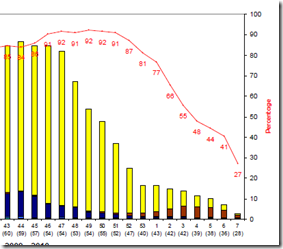
Globally, what little influenza activity that is being reported is predominantly influenza B, as indicated by this chart from the latest virological data supplied by the World Health Organization.


The yellow bars indicated pandemic H1N1 flu.


image

 image

image

(blowup of last 18 weeks of data)


Pandemic influenza (in the northern hemisphere) has gone from representing more than 90% of all flu cases 3 months ago, to only 27% today. 


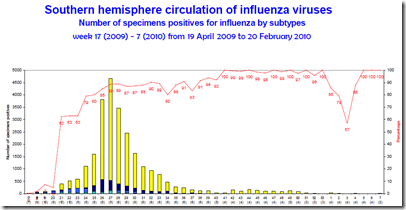
Flu season south of the equator is still several months away, and the levels of influenza being reported there are understandably very low. Interestingly, nearly 100% of what is being reported is coming back as pandemic H1N1. 


Note the scale change from the above chart. 


image

image


Quite obviously novel H1N1 isn’t having the same `summer impact’ in the Southern Hemisphere that we experienced last year north of the equator (even taking into account the disparity in populations).


And even across the Northern Hemisphere, there is a wide divergence in the mix of influenza being seen.


image


The WHO’s latest virological report indicates that Influenza B is now the big player in China and Hong Kong, although its impact remains low in North America.


As for what all this bodes for the rest of the year?  


Well . . . influenza is notoriously unpredictable. 


Stay tuned.


Pandemic (H1N1) 2009 - update 90

Weekly virological surveillance update

5 March 2010 -- Pandemic influenza A(H1N1) 2009 circulating viruses have continued to decrease in most countries of the Northern Hemisphere in recent weeks. Little activity has been reported in the Southern Hemisphere in 2010 to date. In most countries where detection of human influenza virus was reported, the pandemic influenza A(H1N1) continues to be predominating subtype among all influenza A viruses subtyped (87.3% in North America region, 86% in the European region and 75% globally). The number of pandemic influenza A(H1N1) viruses tested globally has decreased over recent weeks. Seasonal A(H1N1) viruses continue to be detected very sporadically in only a few countries. Sporadic influenza A(H3N2) activity has also been reported from some countries. As in recent weeks, influenza B activity has continued to increase in China and China, Hong Kong SAR. Other countries reporting an increase in influenza B activity included Iran, Mongolia and United Republic of Tanzania.


Based on FluNet reporting for the week from 14-20 February 2010, the total number of specimens reportedly positive for influenza viruses by National Influenza Centre (NIC) laboratories from 28 countries was 898. Of these, 365/898 (40.6%) were typed as influenza A and 533 (59.4%) as influenza B. Compared the previous reporting week, this represents an overall decrease in the proportion of influenza A positive specimens relative to the influenza B positives. Of all sub-typed influenza A viruses, 75% (243/365) were pandemic A(H1N1) 2009. China continued to report increased influenza B activity accounting for 88.4% of all influenza detections in the reporting week, while in China, Hong Kong SAR it represented 54.5% of circulating influenza.

(Continue . . . .)


Friday, February 26, 2010

Influenza B Rising


# 4386


While pandemic H1N1 continues to be reported in many areas of the world, the levels being seen today are far lower than what was reported a couple of months ago.  The other seasonal strains (H1N1 and H3N2) are being reported only sporadically around the world.


The question on everyone’s mind is; what (if anything) will rise to fill the void?


Over the past few weeks, reports of influenza B infections have been steadily increasing, particularly out of Hong Kong and China.   The short course on influenza B from the CDC reads:


Influenza Type B

Influenza B viruses are usually found only in humans. Unlike influenza A viruses, these viruses are not classified according to subtype. Influenza B viruses can cause morbidity and mortality among humans, but in general are associated with less severe epidemics than influenza A viruses. Although influenza type B viruses can cause human epidemics, they have not caused pandemics.


The chart(s) below show that of the 2076 samples recently tested by FluNet that proved positive for influenza (week of Feb 6-13), more than 50% were Influenza B.

What this portends for the future is unknown, since the start of the flu season in the southern hemisphere is still several weeks away.  Will H1N1 make a comeback? 

We’ll have to wait and see.


image

(blow up of last 3 months)

image

image

Here then is the latest influenza virological surveillance report from the World Health Organization.   You’ll find additional information in Pandemic (H1N1) 2009 - update 89.


Weekly virological surveillance update

26 February 2010 -- Pandemic influenza A(H1N1) 2009 infections have continued to decrease in most countries of the Northern Hemisphere in recent weeks. Little activity has been reported in the Southern Hemisphere in 2010 to date. In nearly all countries where human influenza infection is reported, the pandemic influenza A (H1N1) continues to be the predominant subtype among all influenza A viruses subtyped (87.3% in North America region, AMR, 94% in EUR and 90% global). Seasonal A(H1N1) viruses continue to be detected very sporadically. Sporadic influenza A(H3N2) activity has been reported from some countries in recent weeks. Influenza B activity continued to increase in China and Hong Kong SAR China.


Based on FluNet reporting for the week from 6-13 February 2010*, the total number of specimens reportedly positive for influenza viruses by NIC laboratories was 2,076. Of these, 1,003/2,076 (48.3%) were typed as influenza A and 1,073 (51.7%) as influenza B. Of all sub-typed influenza A viruses, 90% (781/866) were pandemic A(H1N1) 2009. Hong Kong SAR China has reported increased influenza B activity in recent weeks accounting for 56.1% of all influenza detections in the reporting week, while in China it accounted for 83.5%.

(Continue . . . )

Sunday, January 24, 2010

Online Virology Course


# 4285


Vincent Racaniello, who pens the excellent virology blog and hosts the This Week In Virology (TWiV) podcast, is a professor of virology at Columbia University.   


This Spring he is taping his Virology lectures and posting them online so that a wider audience can benefit from his instruction.


In an announcement on his blog site last week, Racaniello explained:


Each lecture will be recorded, and a video screencast will be posted at the course website. I’ve previously posted a screencast of my vaccine lecture. The screencasts will also be posted at iTunes University; I’ll update this page with the link when it’s available.


The first 70 minute lecture is now up, and available both on the virology blog and on the course website.


Virology lecture #1: What is a virus?

by Vincent Racaniello on 21 January 2010

I’ve just watched the first lecture (and have saved it to my iPod to watch again).  While some of this is –of necessity – a bit technical (hence the prerequisites), I was able to glean a good deal from my first viewing of the video.

The video download links, along with a course description, are available at the course website.


Virology - Biology W3310.001

This is a new virology course offered for the first time in the Spring of 2010.

Prerequisite: Two semesters of a rigorous, molecularly-oriented Introductory Biology course (such as C2005), or the Instructor's permission (vrr1@columbia.edu).

Course Name: Virology

Sessions: M, W 4:10 - 5:25 PM

Start date: Wednesday, January 20, 2010

Points: 3

Location: Hamilton Hall 603

Course #: Biology W3310.001

Instructors: Prof. V. Racaniello, Prof. S. Silverstein


Highly recommended for disease and science geeks everywhere.

Wednesday, January 13, 2010

Yale Research: Stopping The Next Swine Flu


# 4249


One of the `up’ sides to the H5N1 scare and the H1N1 pandemic has been the increase in research into influenza, and other emerging infectious diseases it has generated.  


Wars (hot and cold), along with pandemics – it seems - often spur advances in scientific knowledge.


The space race of the 1950s and 1960s was a much about the cold war as it was about exploration and the advancement of scientific knowledge. 


And yet today nearly every facet of our lives – from medical telemetry to computer chips to the Internet – can be traced back to the manned space program. 


A pity mankind often needs these sorts of motivators.   We ought to do scientific research simply because it helps makes the world a better place to live in.   


But I digress . . . .


The fruits of this pandemic – in terms of scientific data collected – will be studied for years to come.   Over time, they may lead to new treatments, new preventatives, and a better understanding of the inner workings of a variety of pathogens.


Scientific research can open unexpected doors.   You never know where a new discovery, or a better understanding of our universe, will lead.


From the Yale Daily News we get some early details of one example of this sort of research.    Not specifically about influenza, but hopefully applicable to future pandemic viruses.


Will this research stop the next swine flu? 


Maybe, maybe not. 


But anything that advances our knowledge of how viruses work has got to help in that regard.


Stopping the next swine flu

By Carol Hsin

Staff Reporter

Published Wednesday, January 13, 2010

The evolutionary path of a virus can help scientists predict whether it may be the next swine flu virus, Yale researchers have found.


Post-doctoral fellow Nadya Morales, who works in Ecology and Evolutionary Biology professor Paul Turner’s lab, has shown that viruses that have evolved to infect multiple hosts are more likely to shift hosts. Her research findings, currently in review, may be used to prepare for epidemics like swine flu and avian flu by creating vaccines before the virus infects humans, Morales said.


“From this experiment, we have direct evidence for what scientists have suspected about the success of emerging pathogens,” Turner said.


Previously, scientists had little evidence to prove that viruses that can infect multiple hosts would be more able to infect new hosts, Turner said. Since swine flu and avian flu were caused by RNA viruses, which are known for high mutation rates, Morales used laboratory-created strains of a certain RNA virus carried by insects as a model to test this theory. When introduced to new host cells, specialized strains that were grown on either only human cancer cells or only dog cells grew less than a generalized strain that grew alternately on both species.


“The experiment supports the idea that generalists would do better in a new environment,” Morales said.


(Continue . . .  )

Tuesday, January 12, 2010

Radio Interviews Available For Download


# 4245


Yesterday’s Radio Sandy Springs interview of Revere from Effect Measure, and last week’s interview of Professor Vincent Racaniello of the Virology Blog are now archived and available for download or listening to.


These interviews, conducted by Sharon Sanders of FluTrackers, each run an hour and are both entertaining and informative. 


01/11/10 Guest Revere of Effect Measure

Sharon Sander interviews one of the Reveres of the Effect Measure Blog

01/04/10 Guest Vincent Racaniello, PhD

Sharon Sander interviews Vincent Racaniello, PhD


You’ll also find these older interviews archived and available as well.


11/02/09 Guest Dr. David Fedson

08/17/09 Guest William Schaffner, MD

08/10/09 Guest Author John Barry

06/29/09 Guest Gregory Härtl of the WHO

05/26/09 Guest Dr. Michael Osterholm

05/18/09 Guest Dr. David Fedson

Monday, December 07, 2009

Referrals: TWiV and Visualizing The Flu Vaccine


# 4130


I’ve just finished listening to the latest TWiV podcast, this week featuring Professors Vincent Racaneillo and Dickson Despommier.  As always, these are fascinating and entertaining excursions into the world of viruses, with influenza often being a part of the discussion.


Hosts: Vincent Racaniello and Dickson Despommier

On episode 61 of the podcast “This Week in Virology”, Vincent and Dick muse about the symbiotic bacterium, Wolbachia, that protects flies from viral infection, the origin of 2009 influenza H1N1 virus, and the lure of original antigenic sin.


Download TWiV #61 (45 MB .mp3, 62 minutes)


You’ll find the lastest TWiV episodes posted on Vincent’s excellent Virology Blog each weekend. 


The discussion on the origins (lab or nature) of the novel H1N1 virus, and of the possibility of original antigenic sin with flu vaccines, are of particular interest to Flublogia. 


At the end of each podcast, the host and guests all make weekly science picks.    This week I found Vincent’s pick on visualizing the use and safety of the flu vaccine particularly interesting.


Information is Beautiful – is swine flu vaccine safe? by David McCandless, a London-based author, writer and designer


Below is just a snippet.  Follow the link to view the entire visualization.


image

(More data visualizations . . . )

Tuesday, November 24, 2009

Referral: Virology Blog On D225G Mutation


# 4073


Vincent Racaniello – who is a Professor of Microbiology at Columbia University Medical Center - gives us a virology lesson today on the much discussed H1N1 mutations announced in Norway last week.


He argues that the  change – an amino acid substitution (D225G) –impairs the `fitness’ of the virus to transmit to other hosts, and therefore isn’t as big of threat as some have suggested.


Since I am woefully out of my league here (despite listening to his excellent podcasts each week on TWiV), I’ll simply step aside and direct you to his informative blog entry.  


The D225G change in 2009 H1N1 influenza virus is not a concern

by Vincent Racaniello  on 24 November 2009


Sunday, November 15, 2009

TWiV & TWiP Podcasts


# 4015


While I’ve mentioned it a couple of times in the past (here and here), Professor Vincent Racaniello who writes the excellent Virology Blog - which you’ll find in my sidebar -  also co-hosts the fascinating TWiV (This Week In Virology) podcast.


image


Along with Dick Despommier, Racaniello and 1 or 2 guests each week discuss some of the most interesting virology stories of the week.  If you aren’t listening, you should be.


There are 58 episodes available.   This week’s episode covers:

Along with several other issues. 


I’m slowly going back through the archives, trying to catch up.  This is a terrific resource for anyone interested virology, or science.  


  • Recent Episodes
  •  


    If your interests run to parasites (and whose doesn’t?), then you’ll be excited to learn that Racaniello and Despommier have launched TWiP (This week is Parasitism). 


    Episode 1 is now online 

    TWiP 1: Introduction to Parasitism

    image