Showing posts with label Australia. Show all posts

Thursday, October 17, 2013

NSW: 400K Birds To Be Culled For H7N2 Outbreak

image


# 7868


An update to Tuesday’s report of avian flu at a poultry farm in New South Wales, Australia (see NSW: H7 Avian Influenza Reported In Poultry), we now know that the virus has been identified as HPAI (highly pathogenic) H7N2 and the decision has been made to cull 400,000 birds and destroy upwards of 3,000,000 eggs.


Highly pathogenic avian viruses are a concern because they cause a high mortality rate among infected birds and are easily spread among flocks, but even low pathogenic (LPAI) H7 and H5 avian viruses are reportable diseases, because of their their ability to mutate from a low pathogenic virus to highly pathogenic virus.


The latest update from the NSW DPI reads:


Current situation

Updated: 17 Oct 2013

Avian Influenza confirmed in an egg production flock near Young

H7 Avian Influenza has been confirmed in a flock of 400,000 layer hens near Young.

This is not the highly pathogenic H5NI strain that has gained worldwide attention – nor is it closely related to that strain.

The egg farm has been placed under strict quarantine and movements on and off the property are being controlled.

More than 18,000 chickens on the site died as a result of the virus.

Agreement has been reached on the eradication of the virus and the depopulation of the remaining birds has now commenced.

The Department of Primary Industries and the Livestock Health and Pest Authority are continuing surveillance and tracing to confirm the virus has not spread.

If you notice sick or dead birds you need to contact your local veterinarian or call the Emergency Animal Disease Watch Hotline 1800 675 888.


Amid the testing and quarantine at this poultry facility, a bit of a kerfuffle has erupted between the media and government officials over the lack of quarantine signage at the farm, and alleged `trespassing’ by reporters after being told not visit the farm.


We’ve two audio reports from ABC news, the first including a testy exchange between DPI Chief Veterinarian Ian Roth and Michael Condon (6 minutes), and the second (4 minutes) with the director CSIRO's Animal Health Laboratory, Kurt Zuelke, explaining the testing process for avian flu.


DPI confirms chickens will be destroyed

 image

New South Wales Department of Primary Industries chief vet, Ian Roth tells Michael Condon that more than 400,000 chickens will be destroyed after a bird flu outbreak on an egg farm near Young, and responds to reports that the DPI didn't erect 'keep out' signs on the property as soon as it was quarantined.

Scientist explains how bird flu was tested

 image

Director of the CSIRO's Animal Health Laboratory, Kurt Zuelke explains to Lucy Barbour how his team tested and confirmed the H7 avian influenza found on an egg farm near Young, in south-west New South Wales.



Although human infection with H7 avian influenza isn’t unheard of, it has been fairly rare and the risk to the public from these avian viruses is generally considered low.  The exception to this rule being the recently emerged H7N9 virus in China, which has proven unexpectedly pathogenic in humans.


On October 7th, the World Health Organization  published an updated Influenza at the human-animal interface Summary and assessment,  which contained the following risk assessment on H7 avian viruses in response to the recent report of 3 poultry workers in Italy contracting H7N7 ( ECDC Update & Assessment: Human Infection By Avian H7N7 In Italy).


Influenza A(H7) viruses have been detected in poultry populations in many countries throughout the world. Occasionally, human cases of infection with A(H7) viruses have been detected, mainly in people directly exposed to infected poultry or contaminated environments. Generally, these infections cause conjunctivitis or mild influenza like illness, however in rare cases of human A(H7) infections, notably with A(H7N9), severe and fatal disease was reported.

Overall public health risk assessment for this influenza A(H7N7) virus: Further human cases and small clusters may be expected if the virus continues to circulate in poultry. The current likelihood of community level spread of this virus is considered low.


Any country experiencing outbreaks of influenza virus infection in animals should implement appropriate biosafety measures to protect people working with or living nearby infected and potentially infected animals. Collaboration with animal health partners is necessary to optimally control this disease and decrease risks to public health.

Close monitoring of people at risk (cullers, people working on affected farms, veterinarians) and their close contacts is warranted to detect potential human to human transmission.


For more on H7 avian viruses in general, you may wish to revisit last March’s Brief History Of H7 Avian Flu Infections.

Tuesday, October 15, 2013

NSW: H7 Avian Influenza Reported In Poultry

image


# 7860


With the caveat that all H7 viruses are not created equal - and that with the exception of H7N9 - H7 viruses are generally considered to pose only a low threat to human health, Australian authorities are reporting an outbreak of an H7 virus (N subtype not specified) at a poultry farm in New South Wales. 


First the report from the NSW  Department of Primary Industries, after which I’ll return with more.


Avian Influenza confirmed at Young egg farm

15 Oct 2013

H7 Avian Influenza has been confirmed in a flock of 400,000 layer hens near Young, NSW Chief Veterinary Officer Ian Roth said today.

"The results were confirmed by the NSW Department of Primary Industries’ (DPI) State Veterinary Diagnostic Laboratories at the Elizabeth Macarthur Agricultural Institute and CSIRO’s Australian Animal Health Laboratory," Mr Roth said.

"The results confirm that this virus is the H7 Avian Influenza strain, NOT the highly pathogenic H5N1 strain that has gained worldwide attention.

"The property has been quarantined and DPI's First Response Team has been activated to oversee the response and work with the property owners and the egg industry.

"The remaining birds on the property will now be culled in-line with national agreements.

"Control restrictions are now in place within a 10km radius of the quarantined egg farm and extensive surveillance and tracing is now underway to ensure the virus does not spread.”

"The NSW Food Authority has confirmed that there are no food safety issues and that poultry and eggs remain safe to eat.

"There is no evidence that eating food from farms that have been affected by avian influenza have ever caused human illness," NSW Food Authority Chief Scientist, Lisa Szabo said.

Mr Roth said Australia has previously had a small number of outbreaks of H7 Avian Influenza viruses which were all quickly and successfully eradicated.

"Late last year, the DPI and Livestock Health and Pest Authority (LHPA) successfully eradicated an outbreak of H7 Avian Influenza at an egg farm near Maitland," Mr Roth said.

People who notice sick or dead birds should contact their local veterinarian or call the Emergency Animal Disease Watch Hotline 1800 675 888.


Although human infection with H7 viruses have been only rarely reported, and (with the exception of H7N9 in China) have caused mostly mild symptoms, H7 viruses over the past decade have been increasingly viewed as having at least some public health implications.


In 2008 we saw a study in  PNAS that suggested the H7 virus might just be inching its way towards better adaptation to humans (see Contemporary North American influenza H7 viruses possess human receptor specificity: Implications for virus transmissibility).


You can read more about this in a couple of blogs from 2008, H7's Coming Out Party and H7 Study Available Online At PNAS.


The emergence of a highly pathogenic (in humans) H7N9 in China last spring has increased these concerns, as has the revelation that a new H7N7 strain emerged in Chinese poultry at roughly the same time (see Nature: Genesis Of The H7N9 Virus).


Ten years ago, the largest known H7 outbreak of human cases (at least until H7N9 in China) was recorded in the Netherlands. In that outbreak, the culprit was H7N7 (albeit from a different lineage than the H7N7 virus described in this Nature Journal letter above).


Details on that cluster were reported in the December 2005 issue of the Eurosurveillance Journal (see Human-to-human transmission of avian influenza A/H7N7, The Netherlands, 2003). Roughly 30 million birds residing on more than 1,000 farms were culled to control the outbreak. One person - a veterinarian who visited an infected farm – died a week later of respiratory failure.


The rest of the symptomatic cases were relatively mild.


The Fraser Valley, British Columbia H7N3 outbreak of 2004 resulted in at least two human infections, as reported in this EID Journal report: Sporadic human cases of avian H7 virus infection linked to outbreaks in poultry have also been reported the UK, Mexico, and most recently Italy (see ECDC Update & Assessment: Human Infection By Avian H7N7 In Italy).


Again, cases were generally mild, with conjunctivitis being the most commonly reported symptom.


While most H7 viruses are currently considered primarily a threat to the poultry industry, H7 flu strains - like all influenza viruses - are constantly mutating and evolving. What is mild, or relatively benign today in humans, may not always remain so. 


Which is why we take note of outbreaks such as the one reported today in NSW.


For more on the history of H7 viruses, you may wish to revisit A Brief History Of H7 Avian Flu Infections.

Tuesday, May 28, 2013

Australia: Acute Flaccid Paralysis & EV71

image

WHO Guidance On HFMD


# 7324


ProMed Mail carried a report over the weekend from Professor Bruce Thorley of the National Enterovirus Reference Laboratory in Australia that described 5 recent cases of acute flaccid paralysis (AFP) in children who tested positive for the EV71 virus.


EV71 – which is most often reported in Asia and the Western Pacific region - is one of more than 60 non-polio enteroviruses that can cause human illness. While it is frequently linked to severe outbreaks of HFMD (Hand, Foot, & Mouth Disease), EV71 is capable of producing other serious neurological illnesses – including poliomyelitis-like paralysis - as well.


A snippet from the ProMed  report, then I’ll return with more.


Detection of enterovirus 71 sub-genogroup C4a in specimens from cases of acute flaccid paralysis, Australia


Australia conducts surveillance for cases of acute flaccid paralysis (AFP) in children less than 15 years of age as part of the national polio surveillance program funded by the Australian government.


From January to early May 2013, human enterovirus 71 (EV71) was detected in stool specimens from 5 of 14 (36 percent) AFP cases in children. EV71 was also detected in specimens from cases of hand-foot-mouth disease (HFMD) and non-paralytic neurological illness by members of the Enterovirus Reference Laboratory Network of Australia.


A phylogenetic analysis of the VP1 genomic region identified homology with the EV71 C4a sub-genogroup circulating in China and South East Asia, which has been associated with more severe neurological complications than other sub-genogroups in recent years.


(Continue . . . )


HFMD is normally a mild childhood illness, most often caused by the Coxsackie A16 virus and more rarely by Coxsackie A10 here in the United States. In recent years, we’ve seen the emergence of the Coxsackie A6 virus which has been linked to somewhat more severe HFMD cases (see MMWR: Coxsackievirus A6 Notes From The Field).


But Enterovirus 71 has been linked to the most severe cases of HFMD – particularly across Asia - with serious outbreaks recorded over the past 15 years in places like China, Taiwan, Malaysia, Hong Kong, and last year in both Vietnam and Cambodia (see Updating The Cambodian EV71 Story).


An article that appeared in early 2001 in Clinical Infectious Diseases (cite Neurological Manifestations of Enterovirus 71 Infection in Children during an Outbreak of Hand, Foot, and Mouth Disease in Western Australia Peter McMinn, Ivan Stratov, Lakshmi Nagarajan, and Stephen Davis) describes its impact this way:


Children <4 years of age are particularly susceptible to the most severe forms of EV71-associated neurological disease, including meningitis, brain-stem and/or cerebellar encephalitis, and poliomyelitis-like paralysis.


The neurological complications of EV71 infection may occasionally cause permanent paralysis or death. Several large epidemics of severe EV71 infection in young children, including numerous cases of fatal brain-stem encephalitis, have recently been reported in Southeast Asia [1012].


Like other RNA viruses we monitor, EV71 is constantly evolving, creating new strains or lineages, and as a result we’ve seen repeated outbreaks over the years.


During the late 1990s and early 2000s, genotypes C1, C2, B3, and B4 were most commonly reported as sparking outbreaks in Malaysia, Singapore, and Taiwan.


By 2005 emerging genotype C4 had replaced B4 in Taiwan, while in China C4 (which had split into 2 distinct lineages, C4a and C4b) caused major HFMD outbreaks in 2007–2009 (see Phylogenetic analysis of Enterovirus 71 circulating in Beijing, China from 2007 to 2009.)


image

The spread and diversity of EV71 – Credit WHO


As shown in the chart above, the more aggressive C4 genotype – which first appeared in China in 1998 - has made significant inroads across much of Asia and the Western Pacific over the past 15 years. 


Among the challenges of controlling EV71 outbreaks are:


For now, control and prevention are limited to promoting good hygiene, and removing children with signs of the disease from child care or school environments. 


This from the Queensland Health Department.


Transmission

EV71 infection is transmitted from person to person by direct contact with nose and throat secretions, saliva, fluid from blisters or the faeces of infected people.
The virus may continue to be excreted in the faeces for several weeks. A person is infectious for as long as the virus is present in the faeces.

Treatment

Treatment of EV71 neurological disease usually focuses on the person's symptoms. Currently there is no specific treatment.

Prevention

Good hygiene is the single most effective way of preventing the spread of EV71 infection. Hands should be washed thoroughly in soap and water for at least 20  seconds and then dried thoroughly. It is important to wash hands after going to the toilet, touching soiled linen or articles, changing nappies and before preparing or eating food. Teach children to wash their hands effectively before eating or drinking and after going to the toilet.

Control

Children with hand foot and mouth disease should be excluded from child care and schools until all blisters have healed.

Children with enterovirus 71 neurological disease should be excluded from childcare/school until they have a written medical clearance from a doctor or public health unit confirming that the virus is no longer being excreted in their faeces.


A growing problem, in 2009 China reported 1,155,525 HFMD cases, including 13,810 severe cases and 353 deaths. Among laboratory confirmed cases, EV71 was responsible for 41% of cases, 82% of severe cases, and 93% of the deaths (cite WHO HFMD Guide Pg.6). 


Numbers that illustrate just how big an impact this normally `mild’ childhood disease can have.


For more on HFMD, including the more severe Enterovirus-71 (EV-71), you may wish to revisit the following blogs:


The Emerging Threat Of EV71
China: A Recombinant EV-71
HFMD Rising In China
China Sounds Alert Over EV-71 Virus

Tuesday, April 30, 2013

Australia Reports Flu Vaccine Shortages

image

Mash up of U.S. Flu seasons from Multiple FluView Reports


# 7207


Having watched the United States come off perhaps the worst flu season in a decade – one that particularly impacted the elderly - and with early flu cases already showing up across Australia, and it is no surprise that the demand for the seasonal flu jab has skyrocketed down under.


Australia’s NCIRS (National Centre for Immunisation Research & Surveillance) urges broad based vaccination each year (see below), but the uptake of the vaccine rarely exceeds 20% of the population.

image


Since vaccines take months to prepare, quantities must be ordered well in advance. This year, based on previous vaccine uptakes, Australia ordered about 4 million doses.


While flu season generally doesn’t get started in earnest in the Southern Hemisphere until June, early flu cases are making headlines, and the demand for flu vaccines has outstripped the supply.


This report from Ninemsn.


Australia suffers flu vaccine shortage

Alys Francis, ninemsn

April 30, 2013

Australia is suffering a nationwide shortage of flu vaccine due to unprecedented demand from people seeking immunisation, the federal health department has warned. A department spokesperson told the Daily Telegraph the shortage could last until June if the high demand continued.


"Demand for seasonal influenza vaccine usually drops off in April but this has not occurred this year and it is difficult to know if the demand will continue through to the end of April and May," the spokesperson said.


They said the department had purchased extra vaccines for the National Immunisation Program, which provides free vaccines to those most vulnerable from flu, including pregnant women, and elderly and indigenous people.


bioCSL, Australia’s vaccine supplier, announced today they will resume production, and hope to have more vaccine available in 4 to 6 weeks.


bioCSL Goes Back into Influenza Vaccine Production for Australia

Melbourne, Australia — 30/04/2013

bioCSL announced today that it has recently restarted production of influenza vaccine for the Australian market in response to higher than expected demand this season.


Additional doses are expected to be ready for delivery by the end of May and will be prioritised for age-appropriate at-risk groups under the National Immunisation Program.


bioCSL General Manager, Dr John Anderson said the demand for influenza vaccine had increased significantly in the first two weeks of April in both the public and private markets.


“All our customers are reporting a much earlier and much higher uptake of influenza vaccine this year, compared to the last few years.”


bioCSL is the only manufacturer of influenza vaccine in the Southern Hemisphere and is a major supplier of seasonal and pandemic influenza vaccines to the Australian market. The company also supplies influenza vaccine to overseas markets including the US, UK and New Zealand.


For many people, getting the flu vaccine each year is an impulse decision - based on their perception of the risk during any given flu season - rather than a routine, yearly preventative step.


Which makes trying to figure out what the public’s demand for the vaccine will be – six months in advance – pretty much a crap shoot.

Thursday, April 04, 2013

Australian Influenza Experts Weigh In On H7N9


image

Credit NIAID 


# 7069


It’s been five days since China announced their detection of a new strain of bird flu (H7N9) in humans, and to date there is a great deal we do not know about this emerging pathogen.  


Currently our most concerning gaps in understanding this threat are how this virus has been transmitted to (now 10) humans, and from what animal reservoir is it has jumped.


Despite overly reassuring pronouncements from some public figures, the simple truth is, no one really knows where this is going. This virus could simply fade away over time, become a worrisome (albeit sporadic) viral threat, or at some point it could take off.


These are very early days, where the gathering and analysis of data is going to take some time.


And we must always remember that whatever this virus is biologically capable of doing today could easily change tomorrow, next week, or next year. 


The Australian Science Media Centre (AusSMC)  has put together a group of expert opinions on the H7N9 virus, and made it available to journalists around the world called RAPID REACTION: Bird flu (H7N9) in China – experts respond.


Initial reactions from a half dozen experts (Professor Adrian Sleigh, Professor Anton Middelberg, Dr Alan Hampson, Dr Jenny McKimm-Breschkin, Professor Dominic Dwyer, and Dr Nikolai Petrovsky) are provided, and are all worth exploring.


Perhaps the most recognizable name to regular readers of this blog is Dr Alan Hampson - Chair of the Australian Influenza Specialist Group.


You find earlier mentions of him in  Dr. Alan Hampson Interview On Indonesia’s New Bird Flu Clade, Australia: Radio Interview On Bird Flu Threat, Singapore Medical Journal: Avian Flu Edition.


Dr. Hampson provides one of the longer comments, and nicely sums up, I think,  the current level of uncertainty regarding this emerging virus.


Dr Alan Hampson is an influenza consultant and Chair of the Australian Influenza Specialist Group

“At the moment it’s very hard to have any real idea of what is happening but the reports are certainly concerning. There is a virus out there which, like the H5N1 strain, appears to be causing serious illness, but how widespread that illness is at this very early stage, we don’t know. We don’t know whether we’re seeing the tip of the iceberg or whether we’re actually seeing most of the existing cases presenting as severe infection. If it’s the latter then it’s a concern. The other thing to consider is, of course, that there is no obvious source of the virus at the moment. Undoubtedly it’s going to turn out to be domestic poultry, but whether it’s chicken or ducks we don’t know. In the case of H5N1 in Thailand and Vietnam in 2002/03 when people started to become ill, it was only after that that it was recognised that the virus was actually causing significant outbreaks in poultry. So maybe in the fullness of time it will be found this virus is also causing severe disease in poultry. If it isn’t and it is being transmitted among poultry without any obvious signs then that’s going to make it very difficult to get any idea of how you might control it, we have to wait and see and we have to wait to see if this is the tip of the iceberg in humans.”

About the particular H7N9 strain:

“The H7 virus has been known to cause mild infection in humans and to cause severe infections in poultry. But the particular neuraminidase type [the N in H7N9] of this virus is different than we’ve seen reported. There have been 3 other neuraminidase types associated with the infections that have been in poultry and have transmitted to humans. So in this H7N9, the N9 is the different aspect of this, and whether that is contributing something to the virulence, we don’t know.”

Will this affect Australia’s flu season or lead to a pandemic?:

“No, we really hope not. If a virus starts to transmit among humans then there’s no telling how quickly it might travel and where it might travel too. We really don’t know, it’s very early days to know what we’re dealing with at this stage. Does it have pandemic potential? Yes, any influenza that jumps from an animal species to a human has pandemic potential. If it learns to spread in humans, if it actually acquires that ability, then it’s a high likelihood it will become pandemic. Can we do much about it? The world improved its pandemic responsiveness after the H1N1 outbreak, but I think we have a long way to go in learning about this new strain.”

For more expert analysis and commentary, visit:


RAPID REACTION: Bird flu (H7N9) in China – experts respond

Wednesday, April 03, 2013

Virology Down Under

image

Credit Ian M. MacKayVirology Down Under


# 7060


My thanks to Dr. Ian M. Mackay from the University of Queensland in Australia for the link to his blog – Virology Down Under - where he has put together a very helpful timeline, and commentary, on the H7N9 cases reported out of China (link).


In addition to providing extensive background information on human viruses, his blog also covers breaking news.  


Some recent posts include:


Break news of interest to virology


I’ll definitely be adding Ian’s blog to the list of resources in my side panel.

Tuesday, March 19, 2013

Research: Antiviral Resistance In 2009 H1N1 Influenza A Strain


image


# 7014


Readers with good memories will recall that in December of 2011, in NEJM: Oseltamivir Resistant H1N1 in Australia, we looked at a cluster of oseltamivir (Tamiflu ®) resistant H1N1 viruses in and around the Newcastle area of New South Wales.


The lead author of that NEJM correspondence was Aeron C. Hurt, Ph.D. from the World Health Organization (WHO) Collaborating Centre for Reference and Research on Influenza, North Melbourne, VIC, Australia.  


What Hurt and his colleagues found was evidence for the sustained community transmission of a resistant strain of the H1N1pdm09 virus.


After analyzing viral samples pulled from 182 patients seen in emergency departments, intensive care units, and doctor’s offices in New South Wales between May and August of 2011, they found 29 (16%) carried the H275Y resistance mutation.


H275Y is where a single amino acid substitution (histidine (H) to tyrosine (Y)) occurs at the neuraminidase position 275

  • (Note: some scientists use 'N2 numbering' (H274Y) and some use 'N1 numbering' (H275Y)).

Most of the patients lived within 50km of Newcastle, and while 10 of the cases could be epidemiologically linked (2 in 4 households, 2 in a shared car trip), the rest could not.


Only one had been treated with oseltamivir prior to testing.


While globally the percentage of Tamiflu resistant H1N1 viruses remains low (about 2%), it does appear to be increasing.


Today, Dr. Hurt will present his research at ASID (Annual Scientific Meeting of the Australasian Society for Infectious Diseases) in Canberra, where he will warn of the dangers of growing resistance (see MedPage Today article Tamiflu Resistance May Be Rising).


Should the incidence of resistant H1N1 increase, it would not be without precedent.


Not too many years ago Amantadine (an M2 ion channel blocker) was the preferred influenza antiviral.  It was cheap, plentiful, and effective. But by the mid 2000s Amantadine began to lose its ability to combat the H3N2 seasonal flu virus along with some strains of the H5N1 bird flu.


It has been suggested that the prophylactic use of Amantadine by Chinese poultry farmers (who supposedly included it in their chicken feed for several years) may have contributed to this sudden resistance.


But whatever the cause, by January of 2006 the CDC had issued a warning to doctors not to rely on Amantadine (or Rimantadine) to treat influenza.


Oseltamivir (Tamiflu) – a newer neuraminidase (NA) inhibitor drug  introduced in 1999 - while far more expensive, became the new treatment standard. But by 2008 seasonal H1N1 began to show growing resistance to Oseltamivir as well (although H3N2 remained sensitive).


By the spring of 2009, - in the space of just about a  year seasonal H1N1 had gone from almost 100% sensitive to the drug to nearly 100% resistant.

The arrival of the novel 2009 H1N1 pandemic virus was a game changer, in that it – unlike seasonal H1N1 – was still sensitive to oseltamivir. Since then, we’ve been watching to see if – like its predecessor – learns to evade oseltamivir as well.


So far, the news is good; resistance in the (formerly pandemic) 2009 H1N1 strain remains rare. 


But pharmacological victories over constantly evolving viruses (and bacteria) tend to be fleeting, and so the need for new classes of antivirals and antibiotics is great.

Monday, March 18, 2013

Australia: Hendra Vaccine Hurdles


image

Credit WHO


# 7011


Hendra, a bat-borne virus found in Australia that occasionally infects horses and has killed at least four people over the past two decades, prompted the release of an equine vaccine last November (see Vaccine for killer Hendra virus launched).


Despite concerns over the virus, and urgings by the government, many horse owners have been slow to embrace this new vaccine.


A recent news report ('Lax' vets mean few Hendra vaccines) appearing in The Australian indicated that so far that fewer than 25,000 doses have been sold; far below the 120,000 anticipated by now, and low enough that there are now concerns the vaccine may not be a commercial success.


Recently the organizers of the show Royal Queensland Show in Brisbane (EKKA, an annual agricultural show) required all horses in attendance be inoculated, a move that some horse owners are resisting as the vaccine is relatively new, and full safety studies won’t be available until 2014 (cite).


Against this mixed backdrop, today we’ve some encouraging news from CSIRO (Commonwealth Scientific and Industrial Research Organisation) showing that at the six month mark, horses remain protected against the Hendra virus.  


This from ABC Rural news.


Hendra vaccine still working after six months

By Neroli Roocke

Monday, 18/03/2013

Researchers have confirmed that the Hendra virus vaccine gives horses six months' protection from the fatal bat-borne illness.


A group of horses vaccinated at the CSIRO's Geelong Animal Health Laboratory have remained healthy despite being exposed, in a secure setting, to a big dose of Hendra.


Veterinary pathologist Dr Deborah Middleton is hoping the vaccine also passes a 12-month test.


"A lot of vaccines are given with an annual booster and that sort of regularity is tolerated by the industry, so it's the 12-month data that will also be very important, but after that period of time it's unlikely we'd look for years and years and years."

(Continue . . . )


Hendra first came to light after the deaths of 13 horses and their trainer in Hendra, a suburb of Brisbane, Australia in 1994. A stable hand, who also cared for the horses, was hospitalized, but survived.


Another outbreak was later identified as having taken place in MacKay, 1000 km to the north of Brisbane, the month before. Two horses died, and the owner was hospitalized several weeks later with meningitis. He recovered, but developed neurological symptoms and died 14 months later.


Over the past 18 years more than 40 outbreaks of Hendra virus – all involving horses – have been reported in Australia.  Four human deaths have been recorded as well.


Compared to Nipah, another Henipavirus of the same family (Paramyxoviridae) found in Asia – one that has killed hundreds and has demonstrated a limited ability to spread from human-to-human - Hendra would seem to be less of a public health concern.


Nevertheless, the World Health Organization, along with other researchers, continue to watch this virus carefully for any signs of change.  This from the WHO Hendra FAQ.


Although Hendra virus has caused only a few outbreaks, its potential for further spread and ability to cause disease and death in people have made it a public health concern. The concern has heightened in the most recent outbreaks, as the horses’ symptoms have shifted to become largely neurological instead of respiratory. This suggests the possibility of genetic diversity in the strain, and potentially a more infective virus.

Friday, February 15, 2013

Queensland: Rare Australian Bat Lyssavirus Infection

image

Fruitbats In Australia – Credit Wikipedia


# 6939


Rabies - the best known of the Lyssaviruses - is believed responsible for roughly 55,000 deaths each year around the world.  


According to the World Health Organization rabies FAQ` . . . rabies still poses a significant public health problem in many countries in Asia and Africa where 95% of human deaths occur even though safe, effective vaccines for both human and veterinary use exist’.


In Greek mythology, Lyssa was the Goddess of rage or madness, hence the adoption of name Lyssavirus for the genus that includes rabies, and others including the Australian bat lyssavirus (ABLV), Duvenhage virus, European bat lyssaviruses 1 and 2, and Lagos bat virus.


Australia is somewhat unique in that it is one of the few regions in the world where rabies has never been detected.  Others include New Zealand, Iceland, and the Hawaiian islands, while elsewhere rabies has been eliminated in a number of other countries.


Australia does have Australian Bat Lyssavirus (ABLV), which is a close cousin to the rabies virus.


First identified in 1996, ABLV is known to be carried by at least four varieties of flying foxes/fruit bats and one species of insectivore microbat in Australia (see MMWR  1996 Dispatch Encephalitis Caused by a Lyssavirus in Fruit Bats in Australia).


Up until this past week, only two human infections with ABLV have been reported, both fatal, and both in Queensland.  In one of those cases, symptoms did not appear until two years after the bat exposure, a phenomenon that has rarely been reported with rabies as well.


This week, we learn of a third case, an 8-year old boy who is in a coma in a Queensland hospital.


Queensland child critical after contracting deadly bat lyssavirus

  • From: AAP
  • February 15, 2013 3:28PM

AN eight-year-old Queensland boy is critically ill with a bat-borne virus that causes fits, paralysis and death.


(Continue . . .)


According to this article, this latest case, on top of the infrequent outbreaks of Hendra virus (see Queensland: A Hendra Watch & A New Vaccine) has already led to renewed calls for the culling of bats, a highly divisive topic in Australia.


There are many who fear that the indiscriminate culling of bats would simply increase human exposure to bat-borne viruses, and the loss of native bats could upset the ecological balance.


For now, the Australian government advises:


The best protection against being exposed to the virus is for members of the community to avoid handling any bat or flying fox.


The Australian Government’s Immunization Handbook has some extensive information on ABLV, its prophylaxis, and treatment.


3.1 Australian bat lyssavirus infection and rabies


Virology

Australian bat lyssavirus (ABL) and rabies virus are members of the family Rhabdoviridae, genus Lyssavirus. There are 7 known genotypes within the genus Lyssavirus; ABL (genotype 7) is more closely related to rabies virus (genotype 1) than any of the other 6 genotypes.

Clinical features

Based on the 2 recognised human cases of ABL infection, it has to be assumed that ABL has the same clinical features as rabies. The incubation period of rabies is usually 3 to 8 weeks, but can range from as short as a week to, on rare occasions, several years. The risk of rabies is higher, and the incubation period shorter, after severe and multiple wounds proximate to the central nervous system (such as on the head and neck) and in richly innervated sites (such as the fingers).

Typically, in the prodromal phase of rabies, which lasts up to 10 days, the patient may experience non-specific symptoms such as anorexia, cough, fever, headache, myalgia, nausea, sore throat, tiredness and vomiting. Paraesthesiae and/or fasciculations at or near the site of the wound may be present at this stage. Anxiety, agitation and apprehension may also occur.


Most rabies patients present with the furious or encephalitic form. In the encephalitic phase, objective signs of nervous system involvement include aerophobia, hydrophobia, bizarre behaviour, disorientation and hyperactivity. Signs of autonomic instability such as hypersalivation, hyperthermia and hyperventilation may occur.


The neurological status of the patient deteriorates over a period of up to 12 days, and the patient either dies abruptly from cardiac or respiratory arrest, or lapses into a coma. Rabies is almost invariably fatal.

Epidemiology

Rabies is endemic throughout much of Africa, Asia, the Americas and Europe, where the virus is maintained in certain species of mammals.

Australia, New Zealand, Japan, Papua New Guinea and Pacific Island nations are free of endemic rabies but it must be remembered that this can change at any time. For example in 2008, rabies was reported in dogs on the island of Bali, Indonesia. Prior to this, Bali was considered to be free of rabies although rabies was known to occur in other areas of Indonesia. Human rabies characteristically follows a bite from a rabid animal, most frequently a dog, but in some parts of the world, other animals, such as jackals and bats, are important sources of exposure. In countries where rabies vaccination of domestic animals is widespread (North America and Europe), wild animals such as raccoons and foxes are important reservoirs.


Cases of rabies after animal scratches, the licking of open wounds or saliva contact with intact mucous membranes are very rare. Cases have been recorded after exposure to aerosols in a laboratory and in caves infested with rabid bats, and cases have been reported following tissue transplantation from donors who died with undiagnosed rabies.

(SNIP)

In Australia, 2 cases of a fatal rabies-like illness caused by ABL have been reported, one in 1996 and the other in 1998.6 Both patients had been bitten by bats. Evidence of ABL infection has since been identified in all 4 species of Australian fruit bats (flying foxes) and in several species of Australian insectivorous bats. It should therefore be assumed that all Australian bats have the potential to be infected with ABL.

Wednesday, January 16, 2013

Anticipating The Flu Season Down Under


The red band signifies the tropics, which has no distinct flu season.  Viruses circulate there, at a low level, year round. – Credit Wikipedia


# 6859


Although flu season south of the equator won’t begin for several more months, health authorities in Australia and New Zealand are watching our busy flu season closely, and are warning the public to get vaccinated in advance of what could be a difficult flu season.


Watching what happens during the flu season in the opposite hemisphere can sometimes provide clues as to what the next flu season will bring.


Of course, it doesn’t always prove predictive. 


Last year, Australia and New Zealand saw a moderately active flu season, despite North America’s unusually quiet 2011-12 flu season (see The 2012 Flu Season Down Under).


While the media coverage is a bit hyperbolic (the flu season here is being described as moderately-severe), I’ve linked to a few recent news stories from down under to provide the `flavor’ of the coverage.


Warning over killer flu

Karen O'Sullivan, Yahoo!7 January 15, 2013, 3:46 pm

Health experts are warning a deadly flu that has spread across the United States will inevitably hit our shores.

Doctors want Australians to be prepared and to make sure they are vaccinated.


The devastating flu outbreak in the US could be on its way here

  • Tory Shepherd From: news.com.au
  • January 15, 2013 12:00AM
  • 20 children have died from flu in the US
  • Influenza strains travel the globe
  • Australia should consider US season a "forewarning"


NZ preparing for deadly flu

Tuesday, 15 January 2013 10:50

Medical experts in New Zealand are bracing themselves for the arrival of a deadly flu that is sweeping the US which has already killed 20 children.


The southern hemisphere flu season doesn’t usually begin in earnest until May or June, but the flu vaccine will be available starting in March. Public health officials are urging early vaccination in order blunt the flu’s impact.


Since it takes roughly six months to produce enough flu vaccine for the next flu season, twice each year (February & September) experts gather to decide on the strains to include in the next vaccine.


Last September participants from divisions of the World Health Organization’s GISRS (Global Influenza Surveillance and Response System), along with members of OFFLU (the OIE/FAO Network on Animal Influenza), and other experts met in Beijing, China.


After group consultation, the experts opted for the same vaccine formulation that is currently being used in the northern hemisphere (see WHO: Southern Hemisphere 2013 Flu Vaccine Composition).


They recommended that trivalent vaccines for use in the 2013 influenza season (southern hemisphere winter) contain the following:

  • an A/California/7/2009 (H1N1)pdm09-like virus;
  • an A/Victoria/361/2011 (H3N2)-like virus;
  • a B/Wisconsin/1/2010-like virus

They also recommended that quadrivalent vaccines containing two influenza B viruses contain the above three viruses and a B/Brisbane/60/2008-like virus.


Recent studies (see (A Comprehensive Flu Vaccine Effectiveness Meta-Analysis) have shown the flu shot to be moderately effective in preventing influenza – at least among healthy adults under the age of 65.


Similarly, last Friday in FluView Week 1 & MMWR Vaccine Effectiveness Report, we saw the first estimate of this year’s flu vaccine’s effectiveness, and early numbers suggest it to be around 62%.


For the elderly and for those with immune problems the flu vaccine’s effectiveness is often lower (see Study: Flu Vaccines And The Elderly).


In 2011, NFID - the National Foundation for Infectious Diseases - convened a group of experts to address the issues of influenza and the elderly. From that panel a 5-page brief has emerged, called: Understanding the Challenges and Opportunities in Protecting Older Adults from Influenza.

image


While the elderly generally see less protection from the flu vaccine, they state that older individuals may still mount a robust immune response. Even if the vaccine doesn’t always prevent infection in the elderly, studies suggest that the vaccine may blunt the seriousness of the illness in those over 65.


Although there is a pressing need for better flu vaccines (see CIDRAP: The Need For `Game Changing’ Flu Vaccines), flu shots are still considered the best preventative action you can take against influenza, and serious side effects are extremely rare.


So while not a guarantee against getting influenza, they do provide a moderate degree of protection.


Beyond the vaccine, the CDC also reminds us:


Take everyday preventive actions to stop the spread of germs.

  • Cover your nose and mouth with a tissue when you cough or sneeze. Throw the tissue in the trash after you use it.
  • Wash your hands often with soap and water. If soap and water are not available, use an alcohol-based hand rub.*
  • Avoid touching your eyes, nose and mouth. Germs spread this way.
  • Try to avoid close contact with sick people.
  • If you are sick with flu–like illness, CDC recommends that you stay home for at least 24 hours after your fever is gone except to get medical care or for other necessities. (Your fever should be gone without the use of a fever-reducing medicine.)
  • While sick, limit contact with others as much as possible to keep from infecting them.

Wednesday, December 12, 2012

Dr. Alan Hampson Interview On Indonesia’s New Bird Flu Clade

image

Photo Credit – FAO


# 6775


On Monday we began to see reports that a previously unseen clade of the H5N1 virus had recently turned up in Indonesia, causing the deaths of tens of thousands of ducks (see Report: Clade 2.3.2 H5N1 Detected In Indonesia) in and around central Java.


Today, Radio Australia has an excellent interview (audio & transcript available) with Dr. Alan Hampson about this recent news.


Dr. Hampson, who is chair of Australia’s Influenza Specialist Group (ISG), is the former Deputy Director of the Australian World Health Organization Collaborating Centre for Reference and Research on Influenza.


Dr. Hampson assesses the risks, discusses how the virus may have arrived in Indonesia,  and defines the difficulties in controlling H5N1 in that country.  


He also warns that the H5N1 strains currently circulating in the Middle East appear to be the ones moving quickest towards `being able to become a human influenza virus.’


Follow the link to read/listen to this five-minute, highly informative interview.


Indonesia identifies new strain of bird flu: report

Updated 12 December 2012, 17:36 AEST

The Indonesian Agriculture Ministry has reportedly identified a new, more virulent type of bird flu that's killed hundreds of thousands of ducks in recent weeks.


There are suspicions the virus entered Indonesia from other countries - like Vietnam or Thailand.


To determine this, the agriculture ministry's veterinary chief has reportedly written a letter to local government offices and the World Health Organisation calling for further research into the origins of the virus.


(Continue . . . )

Thursday, November 15, 2012

NSW: Hen Facility Quarantined Under Suspicion Of Avian Influenza

image

Photo Credit – FAO

UPDATED: I see Crof has picked up a story indicating Australia: Bird flu at chicken farm is H7 strain


# 6718


While H5N1 gets most of our attention, there are many varieties of avian influenza including H7s and H9s. Some are highly pathogenic (HPAI)  and produce high rates of morbidity and mortality in flocks – while others are of lower pathogenicity (LPAI).


The OIE requires their notification whenever an avian influenza of the H5 or H7 strains are identified, because these strains have a history of evolving from LPAI into HPAI strains.


We’ve seen many non-H5N1 outbreaks in local poultry operations in places like the UK, Mexico, and Canada. And while exceeding rare, we’ve seen sporadic human infection from these strains as well (see MMWR: Mild H7N3 Infections In Two Poultry Workers - Jalisco, Mexico).


If not quickly contained, these outbreaks can force the culling of tens of millions of bird and can inflict devastating economic losses.


Today authorities in Australia’s state of New South Wales are reporting a suspected outbreak of an as-yet unidentified avian influenza (not suspected to be H5N1) at a hen facility in the Lower Hunter region.


Details are a bit scant, but here is the official release  from the  NSW Department of Primary Industries.


Authorities respond to suspect NSW Avian Influenza case

15 Nov 2012

The Department of Primary Industries (DPI) has quarantined a layer hen facility in the Lower Hunter region following a suspect case of Avian Influenza.


"The suspected virus is definitely not the highly pathogenic H5N1 strain that has gained worldwide attention — nor is it closely related to that strain," NSW Chief Veterinary Officer Ian Roth said.


"Australia has previously had a small number of outbreaks of Avian Influenza viruses which were all quickly and successfully eradicated.


"The property has been placed under quarantine and initial tracing and surveillance is being undertaken to confirm that the virus hasn’t spread. We currently have no evidence to suggest it has.


"DPI’s First Response Team has been dispatched to monitor the locked-down property."


Dr Roth said the peak egg industry body Australian Egg Corporation has been advised and the property owners are co-operating with authorities.


"We are still waiting on final confirmation from CSIRO’s Australian Animal Health Laboratory which is expected later this afternoon," Dr Roth said.


Dr Roth said people who notice sick or dead birds should contact their local veterinarian or call the Emergency Animal Disease Watch Hotline 1800 675 888.


For further information on avian influenza is available.


Beyond the question of the type of avian influenza at work here will come questions on how this virus was introduced into this flock.  


Although Australia has been largely spared from avian influenza outbreaks over the past decade, this is not the first incident reported in 2012.


In Janaury a duck farm in Victoria was depopulated due to a LPAI outbreak. Although the strain is not identified in the government press release below, according to the OIE REPORT it was an LPAI H5 strain.


Low Pathogenic Outbreak January 2012

6 June 2012

In January 2012 The Department of Primary Industries (DPI) quarantined a commercial duck farm in two locations north-west of Melbourne after birds there tested positive to Low Pathogenicity Avian Influenza (LPAI).


To prevent spread of the disease, and in accordance with the Livestock Disease Control Act 1994, the Minister of Agriculture declared Restricted and Control areas around the infected properties in which movement of birds and eggs was restricted.


Subsequently, the infected properties were depopulated and decontaminated and the results of surveillance have shown that LPAI is no longer present. On 5th June 2012 the Minister revoked the movement restrictions around the infected properties.


I’ll post an update to this blog when CSIRO releases their analysis of the strain.

Friday, November 09, 2012

Queensland: A Hendra Watch & A New Vaccine

image

Nipah/Hendra Virus & Fruit Bat Home Range – WHO


# 6706


Although long known to carry rabies, over the past two decades bats have increasingly been linked to emerging infectious diseases.


The SARS-CoV (coronavirus) outbreak of 2002-2003 – which infected roughly 8,000 people and killed nearly 800 – is undoubtedly the best known of these diseases, but is by no means the only one to emerge.


Genetic analysis of two recent novel coronavirus infections in the Middle East suggest (but fall short of proving) that bats may be the primary host for this virus as well (see Coronavirus `Closely Related’ To HK Bat Strains).


And the natural reservoir for the Ebola viruses (including Marburg) are believed to be fruit bats of the Pteropodidae family.


Prior to the SARS outbreak - during the 1990s – two new bat-borne viruses made headlines; Nipah and Hendra, both henipaviruses of the family Paramyxoviridae.


Of the two, Nipah has been the deadliest, causing outbreaks primarily in India and Bangladesh. But the virus was first discovered in April of 1999 when an outbreak occurred at a pig farm in Malaysia. 


During this initial outbreak, the virus jumped to local swine herds from bats, and infected more than 250 people, killing more than 100. The virus was then exported via live pigs to Singapore, where 11 more people died (see MMWR Update: Outbreak of Nipah Virus -- Malaysia and Singapore, 1999)


Over the past decade, Nipah has sparked a hand full of smaller outbreaks across Southern Asia with the greatest activity centered around Northern India and Bangladesh. Fruit bats (Pteropodidae) are considered the natural host of Nipah virus.


Perhaps most concerning has been evidence of limited nosocomial, or human-to-human transmission, of the Nipah virus (see Bangladesh: Updating The Nipah Outbreak).


The Nipah virus, like it’s close cousin the Hendra virus, is classified as a biosecurity level 4 (BSL-4) agent.


While not associated with as many human fatalities, the Hendra virus was first identified after the deaths of 13 horses and a trainer in Hendra, a suburb of Brisbane, Australia in 1994. A stable hand, who also cared for the horses, was hospitalized, but survived.


Another outbreak was later identified as having taken place in MacKay, 1000 km to the north of Brisbane, the previous month. Two horses died, and the owner was hospitalized several weeks later with meningitis. He recovered, but developed neurological symptoms and died 14 months later.


Over the past 18 years 40 outbreaks of Hendra virus – all involving horses – have been reported in Australia. Four human fatalities have been linked to the virus as well.


Subsequent studies have showed a high prevalence of the newly identified Hendra virus in Pteropid fruit bats (flying foxes) in the region.


Unlike Nipah, to date no human-to-human transmission of Hendra has been documented.


All of which brings us to the latest outbreak news, and hope for a new vaccine for horses that just became available. First stop, an update from the QLD Department of Agriculture, Fisheries, and Forestry.


November 2012


Hendra virus communique no.10-5 November 2012

Hendra virus incident Ingham

Biosecurity Queensland is managing a Hendra virus incident in Ingham after a positive test result was received on Friday 2 November 2012.


A mare was first noticed unwell on Wednesday 31 October 2012 by her owner. She was not interested in food, had a slight nasal discharge, rapid, laboured breathing, elevated heart rate, lowered head and was unsteady on her feet.


A private veterinarian visited the horse and collected samples for Hendra virus testing. The horse deteriorated and went down and was euthanased on Thursday 1 November 2012.

Movement restrictions

Biosecurity Queensland has quarantined the property and undertaken tracing and risk assessments to determine susceptible animals that may have had exposure to the virus.


There are eight horses remaining on the property as well as dogs and cats. Several rounds of testing will be conducted on animals assessed to be at risk of being exposed to Hendra virus before the quarantine can be lifted.


Restrictions will apply to moving horses and horse materials on and off the infected property, and the property will be quarantined for at least one month. There are no other movement restrictions for the general Queensland horse population because of Hendra virus.

Hendra virus vaccine

A commercial pharmaceutical company has released a Hendra virus vaccine for use in horses under a Minor Use Permit. Under permit conditions, only accredited veterinarians can administer the vaccine.


The vaccine provides another option for the horse industry to reduce the risk of Hendra virus infection; however it is important to remember no vaccine is 100% effective and people in contact with horses need to continue to practice good biosecurity and hygiene measures even if horses are vaccinated.


Horse owners should discuss with their veterinarian whether vaccinating their horse is appropriate.


From CSIRO (Commonwealth Scientific and Industrial Research Organisation) we get more details on this newly available vaccine, via a 9 minute audio podcast & transcript.


Vaccine for killer Hendra virus launched

Australian horse owners and the equine industry have received an important boost in their fight against the deadly Hendra virus with the introduction of Equivac® HeV vaccine. (9:02)

  • 1 November 2012


A final note, in the QLD notice above, it mentions that dogs and cats are quarantined, as well as horses. This comes about primarily because in 2011, we saw the first evidence of canine infection with the virus (see Australia: Dog Tests Positive For Hendra Virus).


The Queensland DAFF maintains a FAQ file on Hendra and dogs, where they write:


What animals have been shown to get Hendra virus?

Naturally occurring infection is limited to horses, flying foxes, humans and dogs. In animals, naturally occurring clinical disease is limited to horses.


Hendra virus is present in wild flying fox populations but does not appear to cause disease in them.

Laboratory studies have shown that other species including cats, guinea pigs, ferrets and pigs can develop disease when inoculated with Hendra virus in an experimental setting. Other species, including rabbits and dogs, have developed antibodies to Hendra virus in an experimental setting, but did not develop any signs of illness.


Although transmission from animals other than horses to humans has not been demonstrated, it is always a concern whenever a virus adapts to or jumps to a new host.


It not only gives the pathogen fresh opportunities to mutate and evolve, it provides another potential vector to spread the disease.


And when that host is a dog or a cat – animals with whom humans closely interact – it naturally serves to increases those concerns.

Tuesday, October 23, 2012

CSIRO: The Quest For Flu Resistant Poultry


# 6657


The idea of creating genetically modified chickens with a built-in resistance to the H5N1 virus has been around for some time, and given the threat posed by an avian flu pandemic, and the costs of the virus to the world’s poultry industry, I can understand the allure.


At the forefront of research in this field has been Australia's national science agency called CSIRO (Commonwealth Scientific and Industrial Research Organisation).


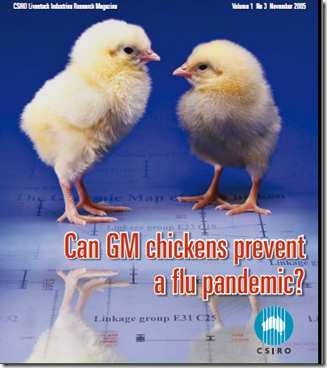
Below is a snapshot of a 2005 cover of CSIRO’s Livestock Research Magazine, where Cambridge University virologist Laurence Tiley stated, “The tools to make poultry resistant to flu infection already exist”. His bigger concern was whether they could persuade the public of the benefits of Genetically Modified (GM) poultry.

image

 
Since 2005, research on how best to make resistant poultry has been conducted at the Australian Animal Health Laboratory (AAHL), a BSL-4 facility located in Geelong, Victoria.


Earlier this summer, CSIRO released a 7-minute audio podcast where one of their researchers – Dr Tim Doran – is interviewed about the research.


image

The audio and transcript are available at this link.


Overnight,  The Conversation – which is a combined journalistic effort by a number of Australian Universities – published details of a presentation by Dr. Doran at CSIRO’s Emerging Infectious Diseases Symposium, where he announced that the first `challenge study’ will be conducted on transgenic chickens later this year.


23 October 2012, 3.39pm AEST


Silencing the bird flu gene: scientists prep live hen trials

Researchers hoping to produce modified chickens hatched with in-built resistance to bird flu will conduct trials on live hens later this year, an Australian scientist said on Tuesday.


CSIRO research scientist, Dr Tim Doran, has been using a technique called gene silencing to “switch off” virus genes that make chickens susceptible to H5N1, the bird flu that has devastated livestock and killed 359 people worldwide since 2003.

(Continue . . .)


This experiment is being billed as a `proof of concept’, and given the regulatory hurdles that lie ahead, we are still quite some time away from seeing GM flu resistant chickens entering the food chain.


Assuming this challenge study works, the biggest barrier will be getting the public to willingly accept the idea of eating transgenic chicken & dumplings for Sunday dinner.


Although I’m not a part of the `anything genetically modified must be bad’ camp, I’m always mindful of the law of unintended consequences. History is filled with examples of experiments that `seemed like a good idea’ at the time, but turned out to be less so in the long run.


Two particularly famous examples of this law in action come from Australia. The introduction of rabbits for food stock in the 18th century, and the importation of the Cane toad (Bufo marinus) to control the cane beetle in 1935.


Both spread quickly as invasive and environmentally damaging species, and both continue to require expensive control programs to this day.


The rabbit overpopulation became such a problem in the 1950s, scientists deliberately released the Myxoma virus into the rabbit population. While that virus quickly decreased the rabbit population, the resistant survivors quickly re-gained lost ground.


Another attempt was made with the release  of RHD(Rabbit Hemorrhagic Disease) in the 1990s, and while initially effective, its efficacy appears to be waning (cite).


Given the furor we’ve seen over the release of GM mosquitoes (see Key West: Public Debate Over GM Mosquitoes), and some high profile miscalculations in the past, getting the public to accept transgenic chickens at this point may prove a hard sell.


Of course, one severe flu pandemic springing out of poultry, and public sentiment might change in a hurry.