Showing posts with label Webster. Show all posts

Wednesday, December 04, 2013

H2N2: What Went Around, Could Come Around Again

image

H2N2  Pandemic Waves - NEJM 2009


# 8040


Although our understanding and identification of humanized influenza viruses only goes back about a century, in our limited experience only three subtypes of influenza (H1, H2, H3) have circulated widely in humans.  Yes, occasionally we’ve seen one-off infections and small clusters of H5 and H7 avian strains, but so far (knock on wood), these remain primarily avian-centric pathogens.


Currently, and for almost the past 40 years, the two humanized flu strains have been the H1N1 and H3N2 varieties.  But in 1957, after roughly 40 years of flu dominance by the H1N1 descendants of the Spanish Flu of 1918, a new H2N2 flu virus emerged from China and sparked a pandemic.


For the next decade – until 1968 – H2N2 influenza reigned supreme, supplanting the old H1N1 strain, and causing millions of flu related deaths.  It was replaced in 1968 by the last pandemic strain of the 20th century – H3N2 – and has not been seen in the human population in the last 45 years.


Which means that a substantial portion of the world’s population – particularly those under the age of 50 – have little or no immunity to the H2N2 influenza virus, making them an easy target for the virus should it re-emerge.  For now the virus resides quietly (primarily) in aquatic birds, but that status could change as it did in the 1950s.


While we don’t have any good data on what flu viruses may have circulated in the 19th century or earlier, some scientists believe that they were likely of the H1, H2, or H3 variety – as they are the ones best adapted to human hosts.  All of which suggests that the next pandemic virus could well come from a reassortment of an H1, H2, or H3 virus.


In 2011, in Nature: A Preemptive H2N2 Vaccine Strike?, we looked at an article in Nature, where authors Gary J. Nabel,Chih-Jen Wei & Julie E. Ledgerwood  discuss the idea of possibly heading off the next pandemic by launching a preemptive strike against the H2N2 virus.


And in 2007, friend and fellow flu blogger Scott McPherson broached the subject of H2 returning as a pandemic virus way back in 2007 in the following blog:


Will H2N3 reassortant prove Maurice Hilleman correct?

Posted on Wednesday, December 19, 2007


Earlier this year, in MIT: The Risks Of An Emerging H3N2 Pandemic Virus, we looked at concerns over seeing a reassorted H3N2 virus emerge from swine. And the surprise H1N1 pandemic of 2009 proved that a reassorted H1 virus – a cousin to the most durable human flu virus of the past century – could indeed spark a global outbreak.


All of which serves as prelude to a new study, which appears in the Journal of Virology, that takes the most detailed look at H2N2 viruses in the wild to date, and concludes that this virus could well pose a threat to humanity again.  First a link, and some excerpts from the abstract, then part of the press release from St. Jude Children's Research Hospital.


Risk Assessment of H2N2 Influenza Viruses from the Avian Reservoir

Jeremy C. Jones, Tatiana Baranovich, Bindumadhav M. Marathe, Angela F. Danner, Jon P. Seiler, John Franks, Elena A. Govorkova, Scott Krauss and Robert G. Webster#

Department of Infectious Diseases, St. Jude Children's Research Hospital, Memphis, TN, USA

ABSTRACT

H2N2 influenza A viruses were the cause of the 1957-1958 pandemic. Historical evidence demonstrates they arose from avian virus ancestors, and while the H2N2 subtype has disappeared from humans, it persists in wild and domestic birds. Re-emergence of H2N2 in humans is a significant threat due to the absence of humoral immunity in individuals under the age of 50. Thus, examination of these viruses, particularly those from the avian reservoir, must be addressed through surveillance, characterization, and antiviral testing.

The data presented here are a risk assessment of 22 avian H2N2 viruses isolated from wild and domestic birds over 6 decades. Our data showed that they have a low rate of genetic and antigenic evolution and remained similar to isolates circulating near the time of the pandemic. Most isolates replicated in mice and human bronchial epithelial cells, but replication in swine tissues was low or absent. Multiple isolates replicated in ferrets, and 3 viruses were transmitted to direct-contact cagemates. Markers of mammalian adaptation in HA and PB2 proteins were absent from all isolates, and they retained a preference for avian-like α2-3 linked sialic acid receptors.

Most isolates remained antigenically similar to pandemic A/Singapore/1/57 (H2N2) virus, suggesting they could be controlled by the pandemic vaccine candidate. All viruses were susceptible to neuraminidase inhibitors and adamantanes. Nonetheless, the sustained pathogenicity of avian H2N2 viruses in multiple mammalian models elevates their risk potential for human infections and stresses the need for continual surveillance as a component of pre-pandemic planning.

While this study is behind a pay wall, we have a press release from St. Jude Children's Research Hospital to provide additional detail.  Follow the link to read it in its entirety, after which I’ll return with a bit more.


1950s pandemic influenza virus remains a health threat, particularly to those under 50

St. Jude Children's Research Hospital scientists report that avian H2N2 influenza A viruses related to 1957-1958 pandemic infect human cells and spread among ferrets; may aid identification of emerging threats

(MEMPHIS, TENN. – December 3, 2013) St. Jude Children's Research Hospital scientists have evidence that descendants of the H2N2 avian influenza A virus that killed millions worldwide in the 1950s still pose a threat to human health, particularly to those under 50. The research has been published in an advance online edition of the Journal of Virology.


The study included 22 H2N2 avian viruses collected from domestic poultry and wild aquatic birds between 1961 and 2008, making it the most comprehensive analysis yet of avian H2N2 viruses.


Researchers reported the viruses could infect human respiratory cells. Several strains also infected and spread among ferrets, which are susceptible to the same flu viruses as humans. Based on those and other indicators, one virus was classified as posing a high risk for triggering a pandemic.


Researchers found evidence the viruses were susceptible to current antiviral medications and could likely be controlled with an available prototype vaccine.


Such protection was unavailable in 1957 when an H2N2 virus that included genes from avian flu viruses emerged. Federal health officials estimate the 1957-58 pandemic killed 1 to 2 million people worldwide. While the H2N2 strain disappeared from flu viruses circulating in humans in 1968, it has persisted in the world's bird population.


"This study suggests H2N2 has the characteristics necessary to re-emerge as a significant threat to human health in part because most individuals under the age of 50 lack immunity to the virus," said corresponding author Robert Webster, Ph.D., a member of the St. Jude Department of Infectious Diseases. "This highlights the importance of continued surveillance of viruses circulating in animals and additional research to enhance our ability to identify viruses that are emerging health threats."

(Continue . . . )


In early 1976, after an absence of nearly two decades, a never-before-seen strain of H1N1 swine flu appeared at Ft. Dix, New Jersey – prompting a national emergency response for its expected return in the fall.  While that virus failed to return (see Deja Flu, All Over Again),  the following year we were blindsided by the abrupt return of the H1N1 virus last seen in the mid-1950s.


Although those over the age of 20 carried some immunity to the virus, it slammed kids and teenagers very hard, and today is viewed as a `pseudo-pandemic’ (see  Pseudo Pandemics And Viral Interlopers).


While we understandably watch novel flu strains like H5N1 and H7N9 with a certain amount of trepidation – if you base your risk assessment on pandemics past – then we should be preparing for a variation of one of the H1, H2, H3 viruses which actually have a track record of sparking a pandemic.


Or to put it another way, those who forget their viral history may well be doomed to repeat it.

Tuesday, July 16, 2013

mBio: Antiviral Resistance In H7N9

image


# 7485


Early reports of H7N9 out of China have indicated a small, but worrisome number of oseltamivir (Tamiflu ®) resistant strains detected among those infected during the first wave (see The Lancet: Antiviral Resistance In Two H7N9 Patients).


In most cases, patients were believed to have developed resistance after being placed on the antiviral medication.


What is commonly called `spontaneous resistance’


The Lancet study found that a mutation R292K (Arginine to Lysine at position 292 in the NA) – also known as Arg292Lys – already known to confer antiviral resistance to seasonal flu (see Resistant influenza A viruses in children treated with oseltamivir: descriptive study), appeared in two patients after several days of oseltamivir therapy.


Today we’ve a new study appearing in the open access journal mBio that finds that the standard laboratory tests for antiviral susceptibility can miss `mixed population’ infections (comprised of both resistant and susceptible strains), and that antiviral treatment could suppress the susceptible strains while allowing resistant strains to flourish.


And this particular mutation can provide resistance not only to oseltamivir, but to to zanamivir and peramivir as well.


The corresponding author of the study is Dr. Robert Webster of St. Jude Children’s Hospital, considered the dean of influenza virology.  In a press release from the American Society for Microbiology, we get a summary of what this study discovered.


In the mBio study, the authors tested antiviral susceptibility of an H7N9 strain isolated from the first confirmed human case of avian H7N9 influenza using a method that tests the activity of the neuraminidase enzyme. The reassuring results were, unfortunately, misleading: the enzyme-based test indicated that the flu strain was susceptible to NA inhibiting antiviral drugs, but it is not.


A closer look at the viral isolate revealed it is actually made up of two distinct types of H7N9 viruses. Roughly 35% of the viruses carry the R292K mutation, making them resistant to NA inhibitors, and 65% are sensitive to these same drugs. The enzyme-based testing gave misleading results, says Webster, because the functioning wild-type enzymes masked the presence of the non-functioning mutant enzymes.


Using NA inhibitors to treat a patient infected with a resistant strain of H7N9 only encourages the virus to proliferate and can lead to enhanced spread of the resistant strain. The authors write that these results prove that it is crucial to use a gene-based surveillance technique that can detect these resistant influenza strains in a mixed infection.

<SNIP>


But the news isn't all bad. Webster also points out that antiviral resistance is something of a burden for influenza viruses, and that fitter wild-type H7N9 strains may eventually win out over resistant strains. In the absence of a drug like Tamiflu, Webster says, it seems unlikely that these resistant viruses would acquire epidemic characteristics.

<SNIP>


"The great need at the moment are additional drugs aimed at additional sites in the influenza genome. There are some [drugs] in the pipeline, but they are still under testing at the moment," says Webster. "We'd better get some vaccine seed stocks up and ready. The antiviral option for controlling H7N9 isn't too good."

(Continue . . . )


Here is a link to the mBio study, after which I’ll be back with a cautionary tale about our previous experiences with evolving antiviral resistance and seasonal flu.


Resistance to Neuraminidase Inhibitors Conferred by an R292K Mutation in a Human Influenza Virus H7N9 Isolate Can Be Masked by a Mixed R/K Viral Population

H.-L. Yen, J. L. McKimm-Breschkin, K.-T. Choy, D. D. Y. Wong, P. P. H. Cheung, J. Zhou, I. H. Ng, H. Zhu, R. J. Webby, Y. Guan, R. G. Webster and J. S. M. Peiris

doi:10.1128/mBio.00396-13

(EXCERPT)

Our results confirmed that the NA R292K mutation confers resistance to oseltamivir, peramivir, and zanamivir in the novel human H7N9 viruses. Importantly, detection of the resistance phenotype may be masked in the clinical samples containing a mixed population of R/K at NA residue 292 in the enzyme-based NA inhibition assay.


IMPORTANCE The neuraminidase (NA) inhibitors oseltamivir and zanamivir are currently the front-line therapeutic options against the novel H7N9 influenza viruses, which possess an S31N mutation that confers resistance to the M2 ion channel blockers. It is therefore important to evaluate the sensitivity of the clinical isolates to NA inhibitors and to monitor for the emergence of resistant variants.

We characterized the A/Shanghai/1/2013 (H7N9) isolate which contained a mixed population of R/K at NA residue 292. While the clinical isolate exhibited a phenotype of sensitivity to NA inhibitors using the enzyme-based NA inhibition assay, the plaque-purified A/Shanghai/1/2013 virus with dominant K292 was resistant to zanamivir, peramivir, and oseltamivir.

Resistance to NA inhibitors conferred by the R292K mutation in a human influenza virus H7N9 isolate can be masked by a mixed R/K viral population, and this should be taken into consideration while monitoring antiviral resistance in patients with H7N9 infection.

(Full Text . . .)


While it is true that resistant strains of influenza A tend to be less transmissible than their susceptible `wild type’ counterparts, we have some examples where resistant strains have been `fit’ enough spread globally.


By 2005, nearly all of the influenza samples around the globe had developed resistant to the older M2 ion channel blockers like Amantadine, leaving oseltamivir and zanamivir (neuraminidase inhibitors) as the two remaining treatments.


In 2006 we saw a smattering of oseltamivir resistant seasonal H1N1 cases, almost always attributed to `spontaneous mutations’ within a patient receiving the drug.  While of concern to the patient being treated, it appeared to be poorly transmissible.


In the 2006-2007 flu season, laboratories found no resistant strains in Europe or Japan, and in less than 1% of samples from the United States.


This resistance in this viral strain was mostly caused by a mutation called H275Y, where a single amino acid substitution (histidine (H) to tyrosine (Y)) occurs at the neuraminidase position 275.


(Note: some scientists use 'N2 numbering' (H274Y) and some use 'N1 numbering' (H275Y))


The following year, during the 2007-2008 flu season, oseltamivir resistant viruses suddenly took flight, and by the spring of 2008 roughly 25% of European samples tested showed the H275Y mutation (see Increased Tamiflu Resistance In Seasonal Influenza).


By December of 2008, the  CDC was forced to issue major new guidance for the use of antivirals for the second time in just three years (see CIDRAP article With H1N1 resistance, CDC changes advice on flu drugs).


The `replacement’ 2009 pandemic virus, that supplanted the largely resistant seasonal strain the following spring, was fortunately sensitive to Tamiflu. While we’ve seen some scattered cases of resistance in the new H1N1 strain, so far they are relatively few, and highly scattered (see Antiviral Resistance In 2009 H1N1 Influenza A Strain).


Granted, H7N9 is a different influenza A strain, and it carries a different mutation than the old H1N1 virus, but this bit of history shows how quickly our pharmaceutical options can evaporate.


The concern with today’s study is the use of antivirals on patients who have both susceptible and resistant viruses could help promote the replication and spread of resistant strains.


Which could inadvertently help drive the evolution of the H7N9 virus towards a predominantly resistant strain.

Tuesday, September 11, 2012

mBio: Taubenberger et al. On the 1918 Spanish Flu

image

Credit CDC PHIL


# 6549


mBio, the American Society for Microbiology’s online, open access journal, has published a long and fascinating review this morning on what we’ve learned over the past 15 years about the 1918 H1N1 `Spanish Flu’ pandemic virus, written by some of the biggest experts in the field.


At this point, I’ll just step aside and invite you to read:


Reconstruction of the 1918 Influenza Virus: Unexpected Rewards from the Past


Jeffery K. Taubenberger, David Baltimore, Peter C. Doherty, Howard Markel, David M. Morens, Robert G. Webster and Ian A. Wilson


doi:10.1128/mBio.00201-12


Highly recommended.

Monday, September 10, 2012

PNAS: Virulence & Transmissibility Of H1N2 Influenza Virus In Ferrets


# 6547


Timing is, as they say, everything.


And coming on the heels the announcement 10 days ago of three human infections with a swine-origin H1N2 influenza (see Minnesota Reports Swine H1N2v Flu), a study that appears today in PNAS is certainly well timed.


The study, conducted at Chungbuk National University South Korea examined viruses circulating in Korean swine (H1N2 & H3N2), and found - for the most part - they were not particularly pathogenic in ferrets.


The exception was a triple reassortant H1N2 virus dubbed Sw/1204, that had picked up two notable mutations, and it not only transmitted efficiently, it also caused severe (even fatal) disease in the test animals.


The study, is called:


Virulence and transmissibility of H1N2 influenza virus in ferrets imply the continuing threat of triple-reassortant swine viruses

Philippe Noriel Q. Pascua, Min-Suk Song, Jun Han Lee, Yun Hee Baek, Hyeok-il Kwon, Su-Jin Park, Eun Hye Choi, Gyo-Jin Lim, Ok-Jun Lee, Si-Wook Kim, Chul-Joong Kim, Moon Hee Sung, Myung Hee Kim, Sun-Woo Yoon, Elena A. Govorkova, Richard J. Webby, Robert G. Webster, and Young-Ki Choi


Ed Yong, writing for Nature has the details  on this paper:


Need for flu surveillance reiterated

Study of Korean pigs finds virus with pandemic potential.

Ed Yong 10 September 2012


One to the two mutations discussed in this paper is hemagglutinin (HA) (Asp-225-Gly) – also known as D225G – which is something we’ve looked at a number of times in the past.


This mutation involves a single amino acid change in the HA gene at position 225 (H3 numbering) from aspartic acid (D) or Asp to glycine (G), and was first linked to more severe pandemic flu by Norwegian Scientists in 2009.


The evidence for the D222G/N  amino acid substitution driving increased virulence, and deep lung infection, has been mixed, however. A few earlier blogs include:


Eurosurveillance: Debating The D222G/N Mutation In H1N1
Study: Receptor Binding Changes With H1N1 D222G Mutation
WER Review: D222G Mutation In H1N1


The second mutation, called NA-315 (serine to asparagine the in neuraminidase) isn’t as well studied, but is believed to assist the virus in breaking out of infected cells after replicating.


As Ed Yong mentions in his article - viruses often have multiple amino acid changes – and we are really just beginning to understand the ramifications of these different genetic combinations. 


Whether this particular virus ever ends up posing a public health threat is impossible to say, but it does illustrate these swine reassortant viruses aren’t always mild in mammals.


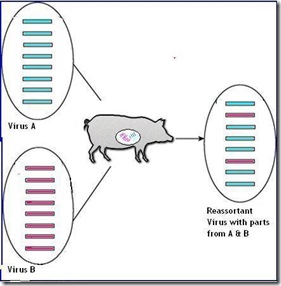
New strains of influenza come about from reassortment; the swapping of genetic material between two different flu strains in a common host. We tend to focus on swine, simply because they are highly susceptible to a variety of influenza viruses, and have a history of producing reassorted viruses.  


Reassortant pig


The pandemic virus that emerged in the spring of 2009 was the end product of several influenza strains that had kicked around the world’s swine population for many years, trading bits of genetic material back and forth, until they produced a version capable of jumping to humans.


But any host (human, swine, avian, or other mammal) could produce a reassorted virus.


For more on the flu risks from swine reassortments, I continue to heartily recommend Helen Branswell’s terrific piece in SciAm  from late 2010 called Flu Factories.

Flu Factories

The next pandemic virus may be circulating on U.S. pig farms, but health officials are struggling to see past the front gate

By Helen Branswell  | December 27, 2010 |


And for some of my earlier looks at swine influenza, you may wish to revisit:


H3N2v: When Pigs Flu

You Say You Want An Evolution?

The (Swine) Influenza Reassortment Puzzle

Friday, June 22, 2012

Revisiting The H5N1 CFR Debate


image

Source – WHO as of 6/7/12


# 6401


One of the more contentious aspects of the H5N1 research debate of the past 8 months has been the argument over the `real’ CFR (Case Fatality Ratio) of the H5N1 virus in humans.


The `official’ number – a fatality rate of roughly 60% – is derived from the total known human infections by the virus (606 as of June 7th, 2012), and the total number of fatalities within that group (357)


Critics point out that only the sickest of the sick would end up in a testing environment, and that many mild cases would recover and never be counted.


The numbers, they maintain, are badly skewed.


Last February (see Science: Peter Palese On The CFR of H5N1) the journal Science published a meta-analysis by  Taia T. Wang,  Michael K. Parides &  Peter Palese, that argued that we are likely missing a great many H5N1 infections (perhaps millions), and that the virus is far less lethal than has been assumed in the past.


That argument was countered by CIDRAP director Michael T. Osterholm and Nick Kelley in an mBio  article, where they found little serological evidence to suggest that we are missing `millions’ of uncounted H5N1 infections (see mBio: Mammalian-Transmissible H5N1 Influenza: Facts and Perspective).


Today, we’ve a new response to the Palese meta-analysis appearing in the journal Science. One with a remarkable pedigree; attached you’ll find some of the biggest names in influenza research:


Comment on “Seroevidence for H5N1 Influenza Infections in Humans: Meta-Analysis”

Science 22 June 2012:
Vol. 336 no. 6088 p. 1506
DOI: 10.1126/science.1221434

Maria D. Van Kerkhove, Steven Riley,Marc Lipsitch, Yi Guan, Arnold S. Monto, Robert G. Webster, Maria Zambon, Angus Nicoll, J. S. Malik Peiris, Neil M. Ferguson

Abstract

A better understanding of the severity of H5N1 in humans is needed. Wang et al. (Brevia, 23 March 2012, p. 1463; published online 23 February 2012) over interpret the results of seroprevalence studies and take too little account of underlying uncertainties. Although the true risk of death from H5N1 infection will likely be lower than the 60% of reported laboratory-confirmed cases, there is little evidence of millions of missed infections.


Their entire rationale may be read here, and it strongly counters the assessment presented by Wang et al. in the original paper.


Dueling opinion pieces, regardless of the credentials of those involved, can’t really settle this argument. What we need are more, and better, seroprevalence studies in places where the H5N1 virus is endemic to come to any firm conclusions.


While most researchers accept that the 60% CFR number is probably far too high, as the authors of today’s article caution, in the absence of compelling data to the contrary:


“The precautionary principle dictates that we continue to assume that natural H5N1 infection in humans carries a high risk of death”


A policy I would certainly endorse.

Sunday, September 18, 2011

Robert Webster on The Bird Flu Threat


# 5848


I know Crof already posted excerpts last night, but the interview and bird flu backgrounder with Dr. Robert G. Webster that appeared yesterday in The Guardian is certainly worthy of further mention. 


Webster, as most of you know, is one of the world’s most acclaimed virologists, and is the head of the virology department of St Jude Children's Research Hospital in Memphis.


Robert Webster: 'We ignore bird flu at our peril'

With the UN issuing renewed warnings and a Hollywood disaster movie stoking our fears, bird flu is back in the news. We meet the man who first warned of a pandemic 50 years ago – and who is worried again now


Like many flu observers, Webster finds the evolution of the H5N1 virus in Egypt of particular concern.


Egypt has reported the greatest number of human infections over the past couple of years, and the virus has shown signs it may be slowly adapting more towards human physiology (see PLoS: Human-Type H5N1 Receptor Binding In Egypt).


While Webster’s greatest concern is with the H5N1 bird flu virus – mostly due to its high lethality - he acknowledges that other pandemic flu threats exist, and mentions the H9N2 avian virus which is widespread across much of Asia.


Earlier this summer (see PNAS: Reassortment Potential Of Avian H9N2) we looked at some of the ways that this avian virus could reassort into a more easily transmitted pathogen.


Last week, another virologist with impeccable credentials – Professor John Oxford, Scientific Director of Retroscreen Virology Ltd. and a Professor of Virology at St Bartholomew’s and the Royal London Hospital – expressed his own pandemic concerns in a online webinar (see Webinar: John Oxford On Pandemic Preparedness).


And 3 weeks ago, in Professor Peter Doherty On Bird Flu, we looked at his worries on the possibility that the H5N1 virus might one day swap genes (reassort) with the H1N1 virus and produce an easily transmitted, highly virulent flu strain.


And indeed, just last Friday we saw research (see Study: Reassorted H1N1-H5N1 Produced Virulent Strain) where a laboratory-created reassortant virus with genes taken from the H5N1 and H1N1 virus produced a highly transmissible and virulent strain.


Of course, while the world was waiting for bird flu, in 2009 a Swine flu virus unexpectedly sparked a global pandemic. We were fortunate that it wasn’t any more severe than it was, but it illustrates that there are many ways a pandemic can evolve.


 Zoonotic Jump


Detections of  trH3N2 swine flu viruses in Pennsylvania and Indiana over the past month are a fresh reminder of the need for establishing better global surveillance of humans, and of farm animals, in order to detect the next emerging influenza virus before it can spread widely.


There is a chance, albeit it small, that a limited outbreak could be stopped if detected early enough. 


That was done successfully in Hong Kong in 1997 when the H5N1 virus first emerged.


While it is always possible that the next pandemic will spring directly from the wild, the odds favor that it will come from a farm – where large numbers of animals intermingle, swap viruses, and come in daily contact with humans.


For more on the reassortment potential of avian, swine, and human flu viruses, you can’t do better than  Helen Branswell’s excellent Scientific American article from last December called Flu Factories, or her SciAm Podcast interview.


And for good measure, a sampling of a few of my earlier blogs on reassortment:


Review: Evolution & Adaptation Of The 2009 pdmH1N1 Virus

You Say You Want An Evolution?

EID Journal: Co-Infection By Influenza Strains

EID Journal: Swine Flu Reassortants In Pigs

If You’ve Seen One Triple Reassortant Swine Flu Virus . . .


Although we could get lucky and go years - or even decades - before the next pandemic emerges, another one could just as easily start tomorrow.


As Dr. Webster points out, we ignore these risks at our own peril.

Sunday, September 05, 2010

The Hong Kong Flu Conference


# 4870


Robert Webster Warns of Complacency


Friday marked the beginning of a 5-day International Options For The Control of Influenza (VII) conference being held in Hong Kong.


Organized this year by such notables as Dr. Malik Peiris, Dr. Yi Guan, and Dr. Gavin Smith of the University of Hong Kong, the roster of speakers is a veritable who’s who in the world of influenza research.


Conference Program


During the first morning session attendees heard from such familiar names as Malik Peiris, York Chow, Kennedy Shortridge, Daniel Jernigan, Sherif Zaki and perhaps the most famous of all, Dr. Robert Webster.


Robert G. Webster is regarded as the father of influenza virology, having correctly posited 5 decades ago that human flu's are derived from avian flu strains.


Webster holds the Rose Marie Thomas Chair in Virology at St. Jude Children's Research Hospital, and is also a fellow of the Royal Society of London, the Royal Society of Medicine and the Royal Society of New Zealand, and a member of the National Academy of Sciences of the United States.


Now in his late-70s, Dr. Webster continues his research at St. Judes Research Hospital, which has been named one of  six Centers of Excellence for Influenza Research and Surveillance funded by the National Institute of Allergy and Infectious Diseases (NIAID), a part of the National Institutes of Health.


Today the Associated Press is carrying a story out of this influenza conference which includes some sideline comments from Dr. Webster and others. 


Expert warns of complacency after swine flu fizzle

By MIN LEE (AP)


In it Webster is quoted as saying, "We may think we can relax and influenza is no longer a problem. I want to assure you that that is not the case."


Webster also predicted that the next pandemic could easily arise from a virus that moves from waterfowl to swine, and then to humans.


A prime candidate he fears is H5N1 -  although he cautions that we can’t say when - or if – that might happen.


You’ll find other quotes from Webster, along with statements by Malik Peiris and the head of WHO’s global influenza program, Sylvie Briand on future pandemic threats, and on the pandemic just past.  


Follow the link to read the article in its entirety.


Hopefully the next few days will provide us with a stream of reports out of this conference.