Showing posts sorted by relevance for query H5N8. Sort by date Show all posts

Wednesday, June 16, 2021

V. Evolution: Genomic Evolution, Transmission Dynamics, and Pathogenicity of Avian H5N8 Viruses Emerging in China, 2020


#16,020

Although the pandemic has garnered the bulk of our attention, we've also been keeping a close eye on the gradual return and spread of Avian H5 viruses (primarily H5N8) following a 3-year hiatus across much of the globe.  

While once - along with H7N9 - atop our pandemic worry list, both subtypes went to ground following China's massive poultry vaccination campaign of 2017. 

Some pockets of HPAI H5 remained, of course, and we saw scattered reports from Russia, Eastern Europe, and the Middle East in 2018-2019, but nothing on the scale that we'd seen prior to 2017. And reports of human infections with H5N1, H7N9 and H5N6 all but disappeared. 

While China's H7N9 remains greatly suppressed, since early in 2020 we've seen a resurgence of HPAI H5 - in particular HPAI H5N8 - both in Europe and Asia.  While related to the subtype that sparked the 2016 European epizootic (clade 2.3.4.4b), these new incursions were described as `genetically distinct' from past incarnations we'd seen. 

Pre-Print: Novel Incursion of a HPAI H5N8 Virus in the Netherlands, October 2020

Influenza virus evolution is driven primarily by antigenic drift (replication errors), and antigenic shift (reassortment).  Generally, reassortment (see below) causes the most dramatic changes. 


A reassortment of a far more benign H5N8 virus in either China or Russia over the summer of 2016 led to Europe's largest avian epizootic on record (see EID Journal: Reassorted HPAI H5N8 Clade 2.3.4.4. - Germany 2016).

Other reassortment events, often in China, have led to further expansion of HPAI H5 viruses, including the infamous 2005 bird die off at Qinghai Lake, China signaling the emergence of clade 2.2 (aka QH05) of the H5N1 virus, when then quickly moved into Europe and the Middle East.

Over the past year we've seen a number of suspicious bird die offs, both in Russia and in China, which often indicate the emergence of a new, more virulent (at least in birds), avian flu subtype. Over the summer of 2020, Russia reported die offs of wild birds, and outbreaks in poultry, due to HPAI H5N8.

Followed last fall by Europe's second largest avian epizootic on record, with - you guessed it - a `genetically distinct' H5N8 virus.

Since then we've seen several H5N8 related wild bird die offs in China (see here , here, and here)  - and most notably - in February of 2021, Russia reported the first confirmed human infections with avian H5N8 (see Russian Media Reports 7 Human Infections With Avian H5N8).

While how much of a threat avain H5N8 will pose in the future is unknown, in May the CDC Added Zoonotic Avian A/H5N8 To Their IRAT List, while last March the WHO called for the creation of a Candidate Vaccine Virus (CVV) for this new H5N8 virus (see WHO: Candidate Vaccine Viruses for Pandemic Preparedness - March 2021). 

In May, in Science: Emerging H5N8 Avian Influenza Viruses, we looked at a cautionary report by two well respected Chinese scientists who warn on the zoonotic potential of H5N8. 

PERSPECTIVE PUBLIC HEALTH

Emerging H5N8 avian influenza viruses
Weifeng Shi1,2,
George F. Gao3,4

Today we've another look at the quiet evolution of HPAI H5N8 in China, this time published in Virus Evolution, that describes the rapid rise last summer of an antigenically distinct H5N8 virus that is lethal to chickens and mice, that is similar to the Russian Zoonotic strain, and shows signs of mammalian adaptation.


Genomic evolution, transmission dynamics, and pathogenicity of avian influenza A (H5N8) viruses emerging in China, 2020
 
Jiahao Zhang, Xudong Li, Xiaomin Wang, Hejia Ye, Bo Li, Yiqun Chen, Junhong Chen, Tao Zhang, Ziwen Qiu, Huanan Li ... Show more
 
Virus Evolution, Volume 7, Issue 1, January 2021, veab046, https://doi.org/10.1093/ve/veab046
Published:
 
06 May 2021

 
Abstract

Multiple recent outbreaks of highly pathogenic H5N8 viruses originating in aquatic birds frequently occurred in most European countries, Russia, South Korea, and Japan during the winter of 2020–21, and one zoonotic event of poultry workers infected with novel H5N8 viruses were reported in Russia. 

Strikingly, these novel H5N8 viruses had emerged and been co-circulating in wild birds and poultry in multiple provinces of China during 2020–21. In China, the population of aquatic birds has risen significantly in the past twenty years, and China is regarded as the largest reservoir for influenza viruses carried in aquatic birds across the globe. Hence, the co-circulation of these novel H5N8 viruses poses an alarming threat to not only poultry industry but also human health. 

In this study, we sequenced full-length genomes of these H5N8 viruses circulating in China. Phylogenetic analysis demonstrated that poultry-origin H5N8 viruses in China fell within wild birds-origin clade 2.3.4.4b H5N8 viruses from Europe during 2020–21, and notably, were genetically closely related to human-infecting H5N8 viruses in Russia. Moreover, they possessed several molecular markers associated with mammalian adaption. 

Bayesian coalescent analysis showed that these H5N8 viruses might have introduced into China during June–September 2020, suggesting that these H5N8 viruses might have introduced via wild bird migration or poultry trade. Besides, we also found that the effective population size of clade 2.3.4.4b H5N8 viruses dramatically increased during the winter season of 2020/21, as is consistent with previous increase of genetic diversity during the winter seasons of 2013/14 and 2016/17, which indicated that the wild bird migration accelerates the genetic diversity of these H5N8 viruses during the winter season of 2020/21. 

Notably, these novel H5N8 viruses were lethal to chickens and mice, highly transmissible to ducks, and were antigenically distinct from 2.3.4.4h H5 viruses circulating in China, posing considerable threats to public health. Our findings offer novel insights into the evolution and risk assessment of H5N8 viruses during the winter season of 2020–21.

          (Continue . . . )

In addition to H5N8, we've also seen an uptick in human H5N6 infections in China, the first known Human Avian H10N3 Infection In China, an as-yet unconfirmed report of human H5N1 infections in Nigeria (see The ECDC On The Recent Nigeria H5N1 Report Of Suspected Human Infections), and a recent surge in H5 avian flu activity in the Middle East. 

Since it is summer in the Northern Hemisphere, avian flu activity is currently somewhat restricted, but come the fall tens of millions of birds will leave their high-latitude roosting sites and head south for the winter. 

We can't predict what kind of avian flu season they are going to bring, but we can see that avian flu activity is ramping up globally, and is evolving in worrisome directions.  While we've still got our hands full dealing with the coronavirus pandemic, we ignore other potential zoonotic threats at our own peril.  

Sunday, January 14, 2018

Virology: The Zoonotic Potential Of Multiple Subgroups of Clade 2.3.4.4. H5N8 Virus


#13,066


Ever since clade 2.3.4.4 H5N8 first emerged in South Korea as a major bird flu threat in January of 2014, many governments around the world have been quick to reassure that - unlike its cousins H5N1 and H5N6 - the H5N8 virus poses no threat to human health.
And while it is true we haven't seen a human infection with this particular subtype, past performance is never a guarantee of future results. 
The CDC's Influenza Risk Assessment Tool (IRAT) ranks H5N8 in the middle of the pack among the 14 novel viruses with pandemic potential they currently track, ranking its threat in the low-moderate range (less than 5).
H5N8: [A/gyrfalcon/Washington/41088/2014]
In December 2014, an H5N8 highly pathogenic avian influenza virus was first isolated from a sample collected in the United States from a captive gyrfalcon.Subsequently this virus was isolated from wild birds, captive wild birds, backyard flocks and commercial flocks in the United States.This virus (clade 2.3.4.4) is similar to Eurasian lineage H5N8 viruses that have been isolated in South Korea, China, Japan, the Netherlands, the United Kingdom and Germany in late 2014-early 2015.There have been no reports of human cases.
Summary: The average risk score for the virus to achieve sustained human-to-human transmission was in the low-moderate range< (less than 5). The average summary risk score for the virus to significantly impact public health if it were to achieve sustained human-to-human transmission fell in the low-moderate range (less than 5).

This current lack of infectivity among humans, while welcome, may not last forever. Clade 2.3.4.4 H5N6 has infected humans, and these HPAI H5 viruses have proven themselves to a promiscuous lot, reassorting at the drop of a gene segment, generating not only new genotypes, but new subtypes as well (see DEFRA: Update #12 On HPAI H5Nx In UK/Europe).

Over the past 12 months we've seen a number of studies that have looked at the potential for H5N8 or its spinoffs to evolve into a human health threat.  A few include:

J Vet Sci: Evolution, Global Spread, And Pathogenicity Of HPAI H5Nx Clade 2.3.4.4 
Study: Virulence Of HPAI H5N8 Enhanced By 2 Amino Acid Substitutions

Sci Rpts: H5N8 - Rapid Acquisition of Virulence Markers After Serial Passage In Mice
Perhaps most telling of these came last September in J. Virulence : Altered Virulence Of (HPAI) H5N8 Reassortant Viruses In Mammalian Models, which found:
Taken together, our study demonstrates that a single gene substitution from other avian influenza viruses can alter the pathogenicity of recent H5N8 viruses, and therefore emphasizes the need for intensive monitoring of reassortment events among co-circulating avian and mammalian viruses.
Last October, in J. Virulence Editorial: HPAI H5N8 - Should We Be Worried?
reviewed and summarized the literature, and found enough reasons to be concerned over the future evolutionary path of H5N8, stating that:

The extensive distribution of HPAI H5N8, as well as the gene reassortment with other circulating avian viruses already observed for H5N8 suggests there is a potential risk for human cases of H5N8 infections.
We've a new study, published in the journal Virology (alas, mostly behind a paywall) that finds some differences between distinct subgroups of H5N8 viruses isolated in South Korea.
While none were well adapted to human hosts, one (H2102) was a bit closer than the others.

First the abstract, then I'll return with a bit more.
Evaluation of the zoonotic potential of multiple subgroups of clade 2.3.4.4 influenza A (H5N8) virus
Yu-Na Lee1, Eun-Kyoung Lee1, Byung-Min Song, Gyeong-Beom Heo, Sang-Hee Woo, Sun-Ha Cheon, Youn-Jeong Lee,  Show more

https://doi.org/10.1016/j.virol.2017.12.037Get rights and content


Highlights

  • H2102 HPAIV (H5N8) caused relatively severe disease in mice at high doses.•
  • All H5N8 viruses replicated restrictively in the respiratory tract of ferrets.•
  • All H5N8 viruses displayed a HA phenotype that was poorly adapted to mammals.•
  • H2102 HPAIV (H5N8) showed higher replication kinetics at 33 °C than other strains.•
  • H5N8 HPAIVs have not yet acquired all features required for mammalian adaptation.
Abstract

Clade 2.3.4.4 H5N8 highly pathogenic avian influenza viruses (HPAIVs) have spread worldwide. Phylogenetic analysis identified two genetic groups of the H5N8 HPAIVs in South Korea; group A evolved further into four subgroups. 


Here, we examined the zoonotic potential, both in vivo and in vitro, of genetically distinct subgroups of H5N8 HPAIVs isolated in South Korea. 

When compared with other subgroups, A/mallard/Korea/H2102/2015 (H2102) virus caused relatively severe disease in mice at high doses. In ferrets, all H5N8 viruses replicated restrictively in the respiratory tract and did not induce significant clinical signs of influenza infection.
In vitro studies, all viruses displayed a hemagglutinin phenotype that was poorly adapted for infection of mammals, although the H2102 virus exhibited higher replication kinetics at 33 °C than the others. 

Although H5N8 HPAIVs have not yet acquired all the characteristics required for adaptation to mammals, their ability to evolve continuously underscores the need for timely risk assessment.

Since clade 2.3.4.4. H5N8 erupted on the Korean peninsula it has spread rapidly around the world via migratory birds (currently being reported in Africa, Russia, The Middle East, China and parts of Asia), and as it has, it has evolved (via reassortment) into scores of distinct genotypes, and has produced several new subtypes (H5N6, H5N5, H5N2, H5N1, etc.).
Other amino acid changes continue to occur -  due to antigenic drift or host adaptation - that futher propell these diverse H5N8 genotypes down their individual evolutionary pathways. 
While none of this means there is a human adapted H5N8 virus in our future, one can't ignore the possibility either. 

Thursday, May 21, 2015

Eurosurveillance: Genetic Diversity Of H5N8 Detected In Japanese Birds

image

Credit U.S. Fish and Wildlife Service


# 10,075


In January of 2014, an emerging HPAI H5N8 appeared in South Korean poultry and wild birds, and although it appears to have originated in China the previous year, it suddenly took off.  It showed up next in Japan, and subsequently showed up across much of China, in Russia, Western Europe, Taiwan, and North America.


Apparently at home in migratory birds, this well-traveled H5N8 virus has reassorted with several local LPAI viruses, producing viable, and highly pathogenic hybrids (H5N2, H5N3, H5N1, etc.) – which taken together have cost the world’s poultry industry billions of dollars over the past 15 months (see Taiwan hit by new type of H5N2, H5N8 for first time).


As with all of the avian flu viruses we’ve been watching, these influenza subtypes (i.e. H5N8 or H5N1) don’t represent a single entity, but rather a family of closely related viruses, all able to `better themselves’  through the evolutionary process. 


As a result, new variants and clades are constantly appearing either through antigenic drift or reassortment. Some fail miserably and quickly fade away, while others are competitive and `biologically fit’ enough to prosper.


We’ve heard a lot about the genetic diversity of H5N1 and the need to update candidate vaccines over the years (see WER: Development Of Candidate Vaccine Viruses For Pandemic Preparedness), but far less is known about how the H5N8 virus is evolving in the wild.


A little a year ago, in EID Journal: Describing 3 Distinct H5N8 Reassortants In Korea, we saw some early evidence of this evolutionary pattern, and last December in NARO: Miyazaki H5N8 Outbreak A Different Sub Clade we learned that a second variation on an H5N8 theme had turned up in a Japanese poultry outbreak.

Last fall (see Japan: H5N8 Detected In Izumi Crane) H5N8 was detected among wild and migratory birds in the Izumi bird preserve on southern tip of Japan, a place famed for the yearly arrival and overwintering of thousands of rare Hooded, and White-naped cranes.

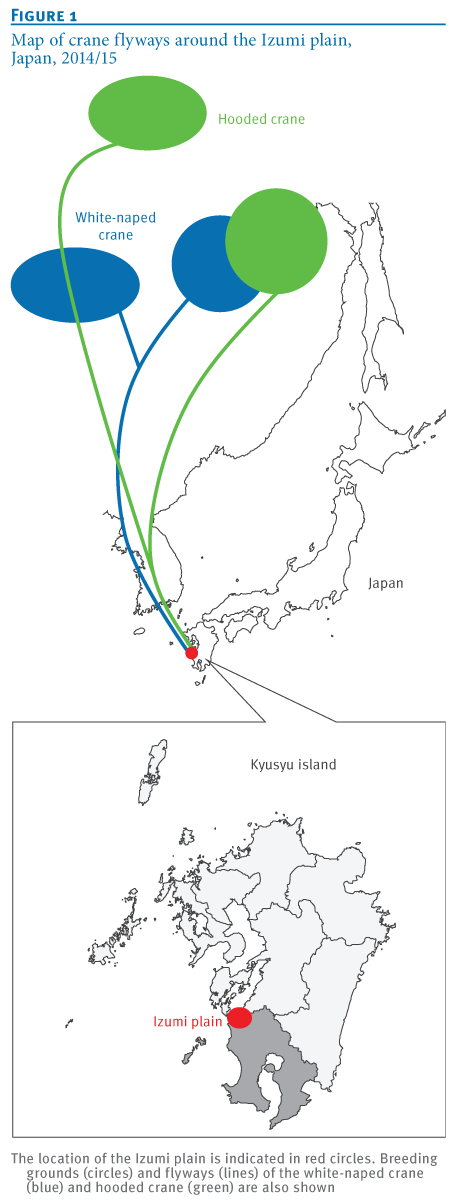
Both species spend their summers in Mongolia, Siberia, or Northwestern China - and of the roughly 10,000 hooded swans in the world - 80% overwinter in Izumi.


All of which serves as prelude to a Rapid Communications that appears in today’s Eurosurveillance that describes the discovery of at least 3 genetically distinct groups of the H5N8 virus.

Eurosurveillance, Volume 20, Issue 20, 21 May 2015

Rapid communications

Genetic diversity of highly pathogenic H5N8 avian influenza viruses at a single overwintering site of migratory birds in Japan, 2014/15

M Ozawa ()1,2,3,4, A Matsuu2,3,4, K Tokorozaki5, M Horie2,3, T Masatani2,3, H Nakagawa1, K Okuya1, T Kawabata2, S Toda5


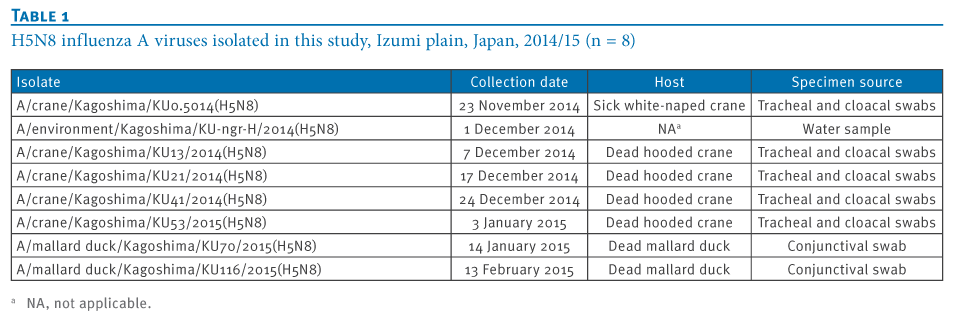
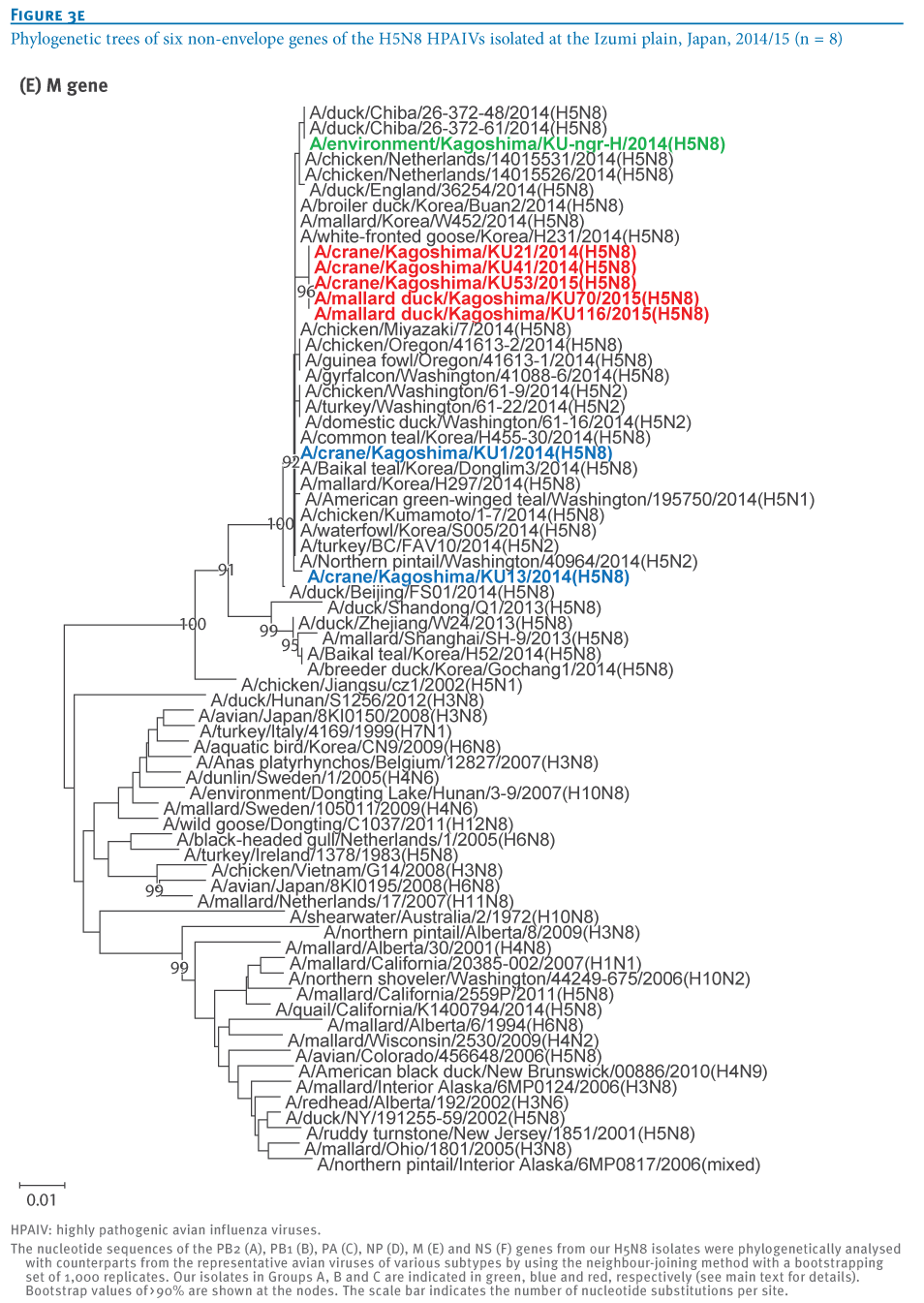
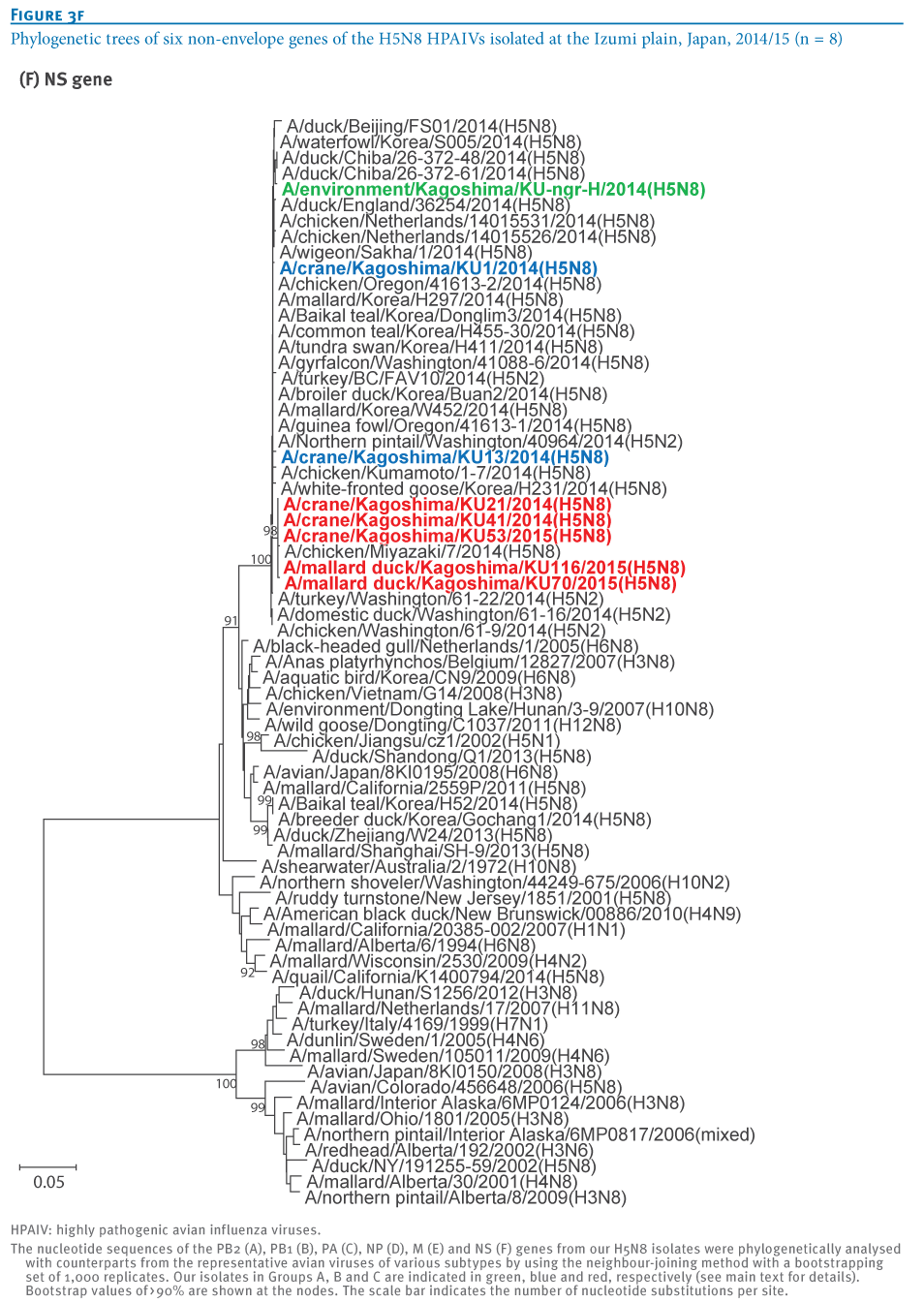
We isolated eight highly pathogenic H5N8 avian influenza viruses (H5N8 HPAIVs) in the 2014/15 winter season at an overwintering site of migratory birds in Japan. Genetic analyses revealed that these isolates were divided into three groups, indicating the co-circulation of three genetic groups of H5N8 HPAIV among these migratory birds. These results also imply the possibility of global redistribution of the H5N8 HPAIVs via the migration of these birds next winter.


In January 2014, newly discovered highly pathogenic H5N8 avian influenza viruses (H5N8 HPAIVs) caused outbreaks in poultry and wild birds in South Korea [1], although their ancestor had been isolated in China in 2013 [2]. Thereafter, these viruses have been circulating in both avian populations in South Korea [3,4] and sporadically in neighbouring countries, including China and Japan. Since November 2014, H5N8 HPAIVs have also appeared in poultry and wild birds in Europe [5,6]. Genetic analyses revealed that these isolates were closely related to the H5N8 viruses circulating in Korean birds. More recently, genetically similar HPAIVs also caused outbreaks in various avian species in North America [7]. These findings suggest that the H5N8 viruses have circulated and evolved in migratory birds.

<SNIP>

Phylogenetic analysis

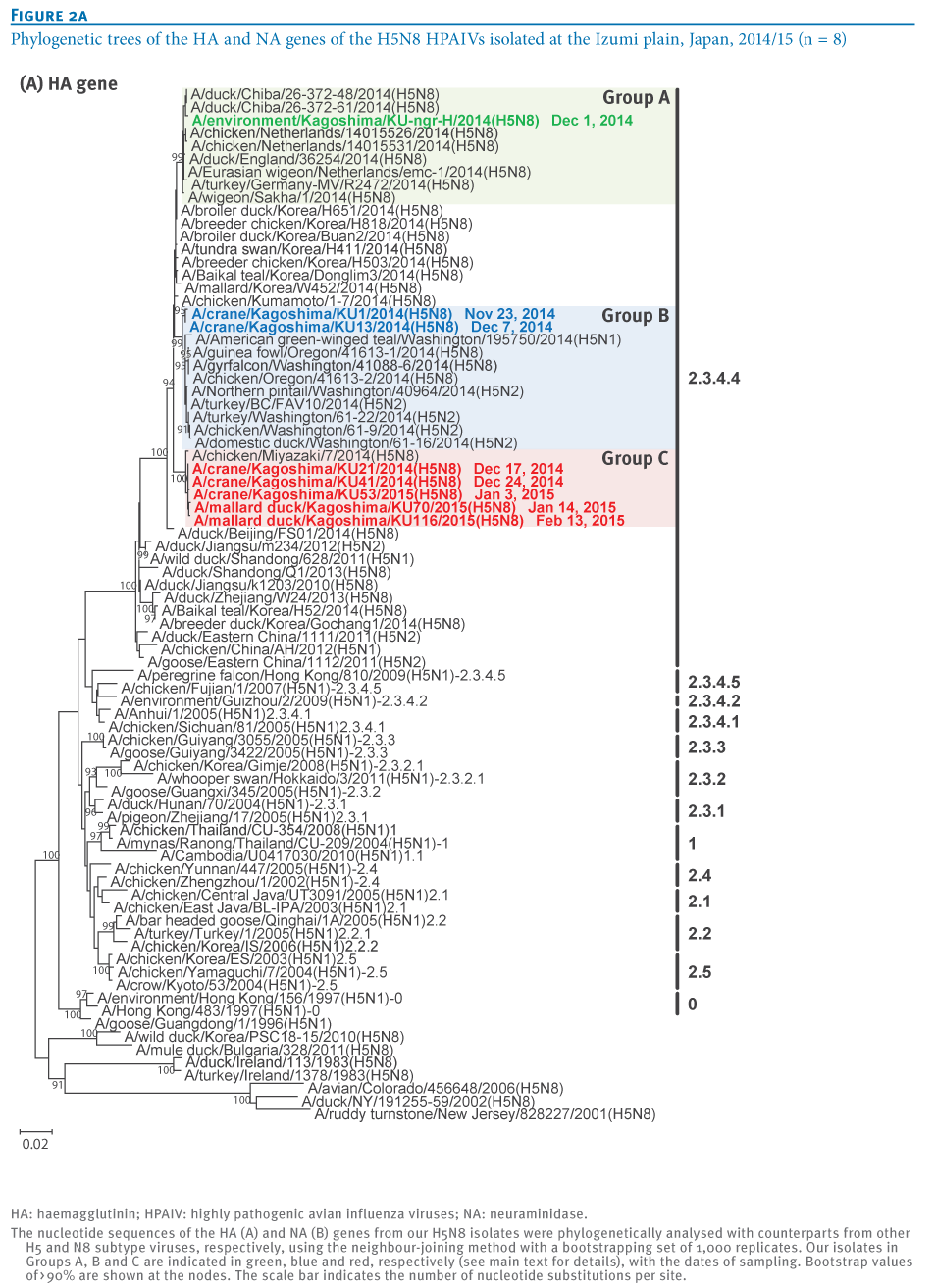
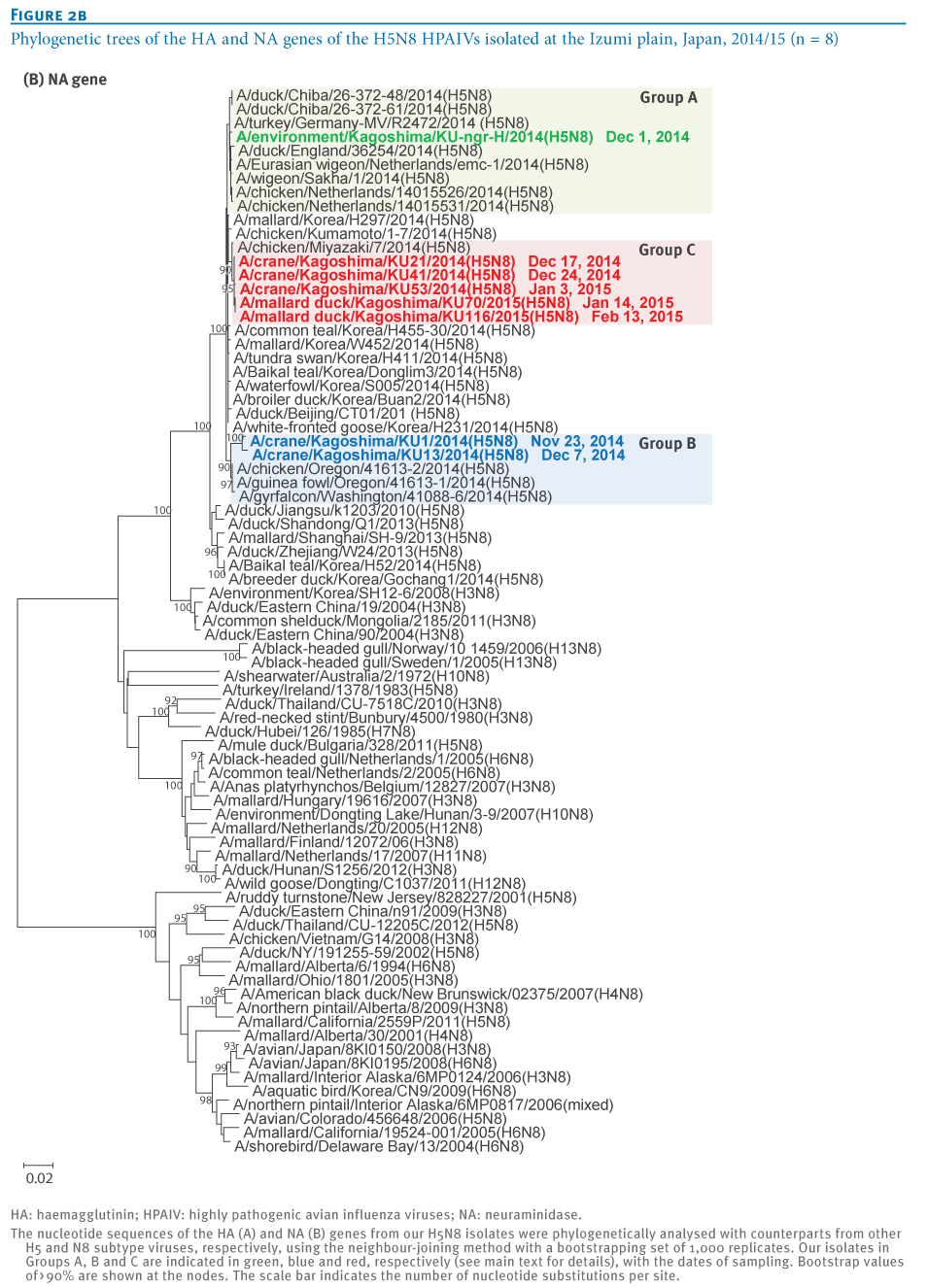
To understand the genetic relationship between our isolates and related viruses, the HA and neuraminidase (NA) genes were phylogenetically analysed with counterparts from the representative avian influenza H5 (Figure 2A) and N8 (Figure 2B) subtypes, respectively.

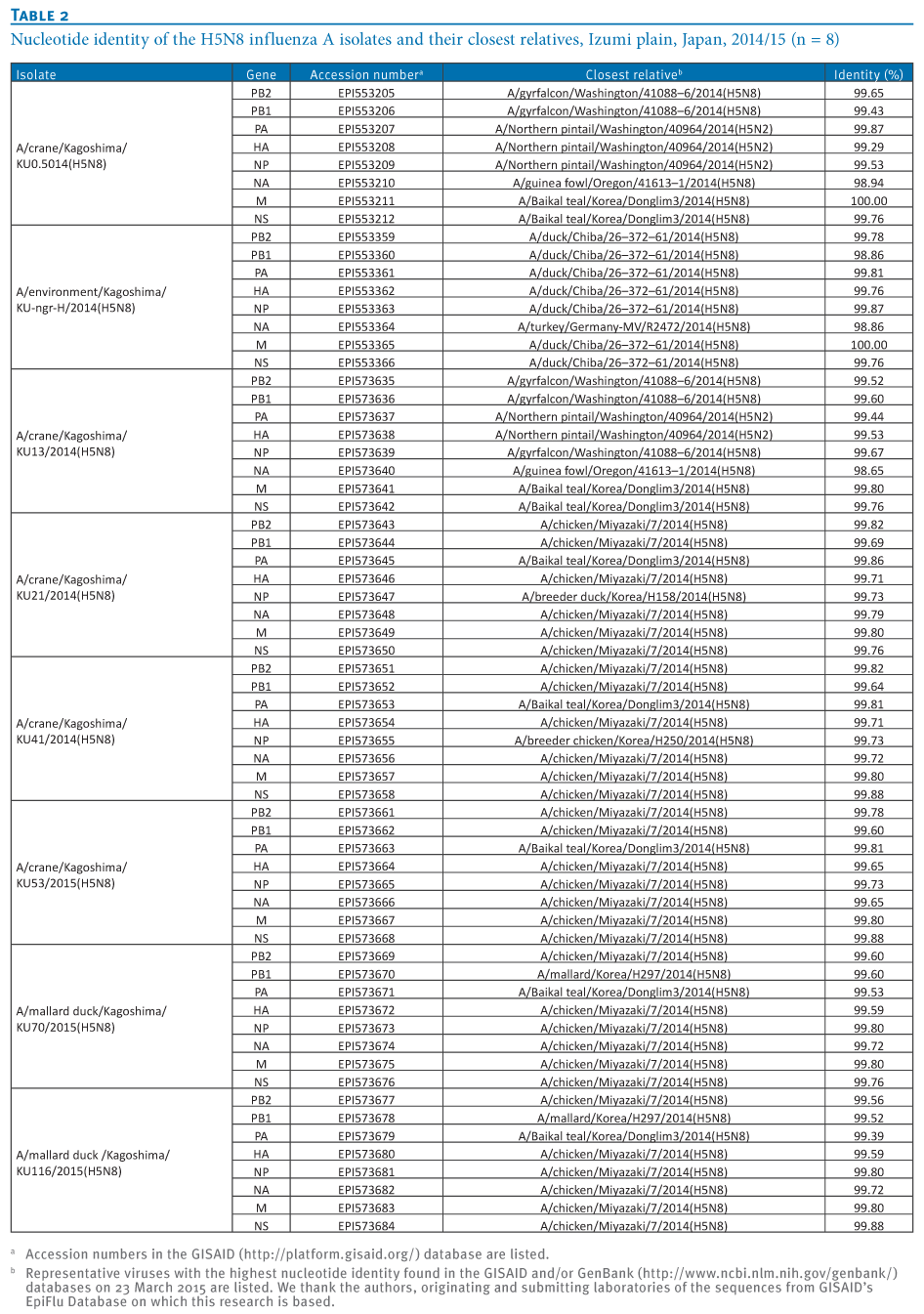
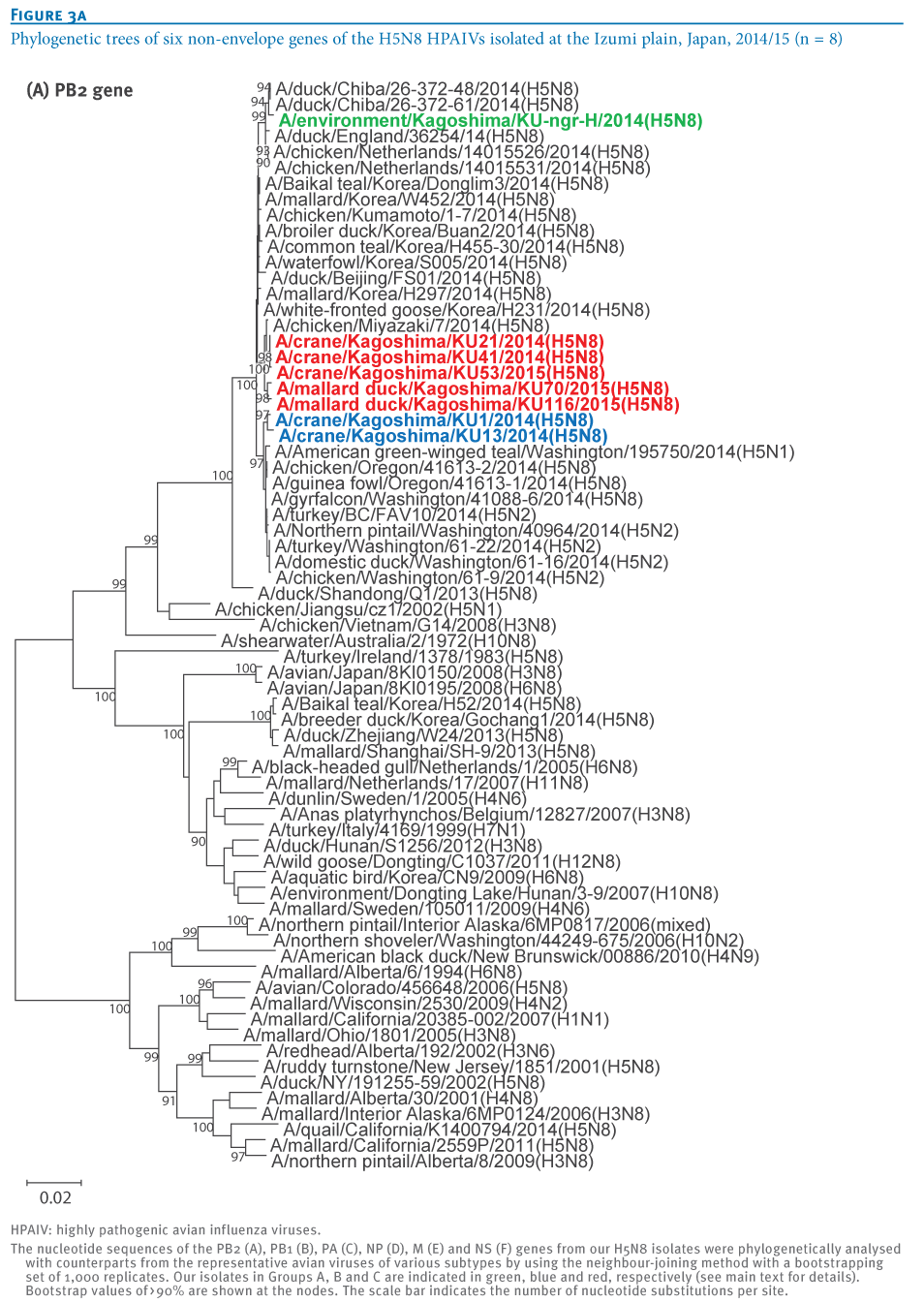
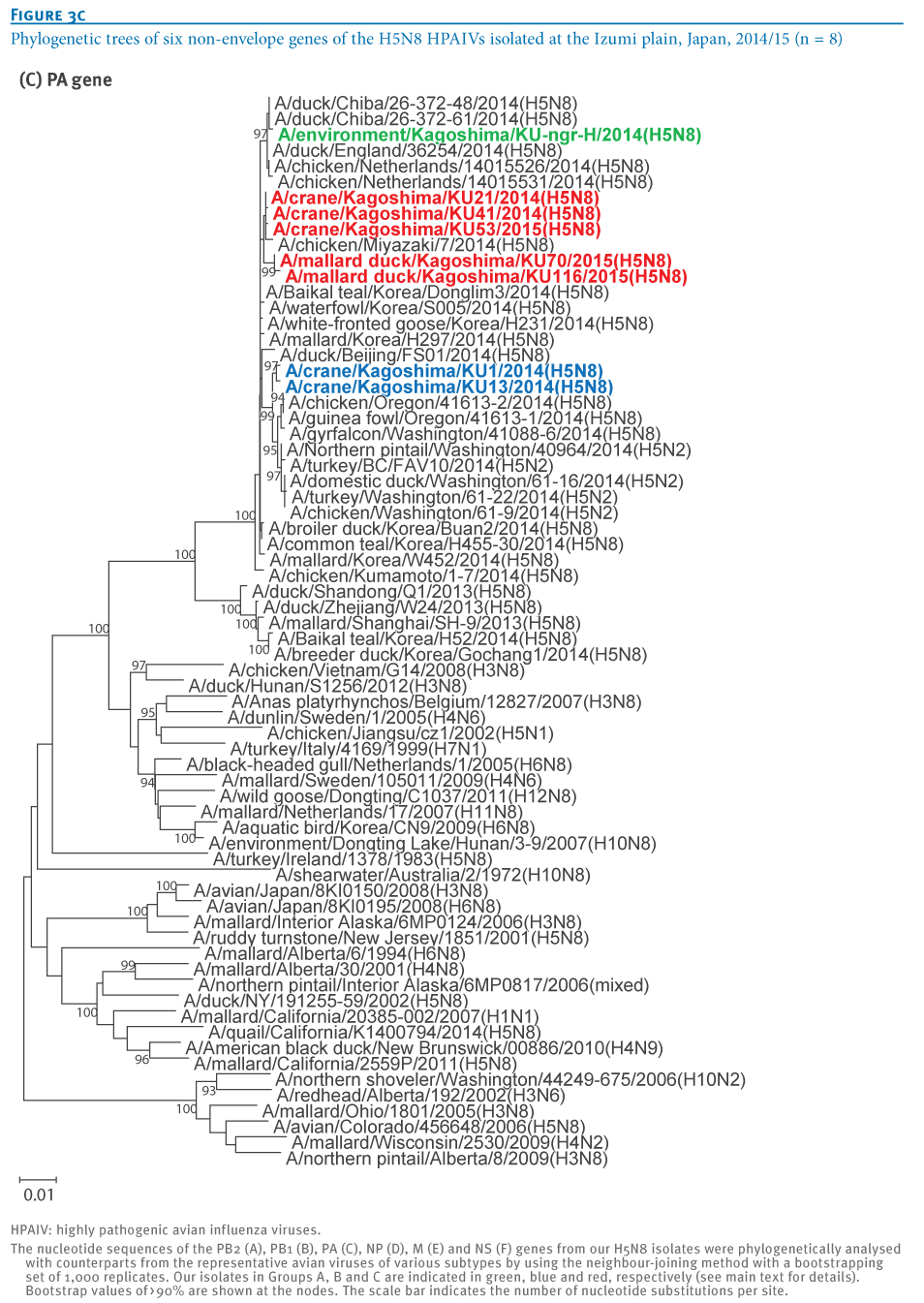
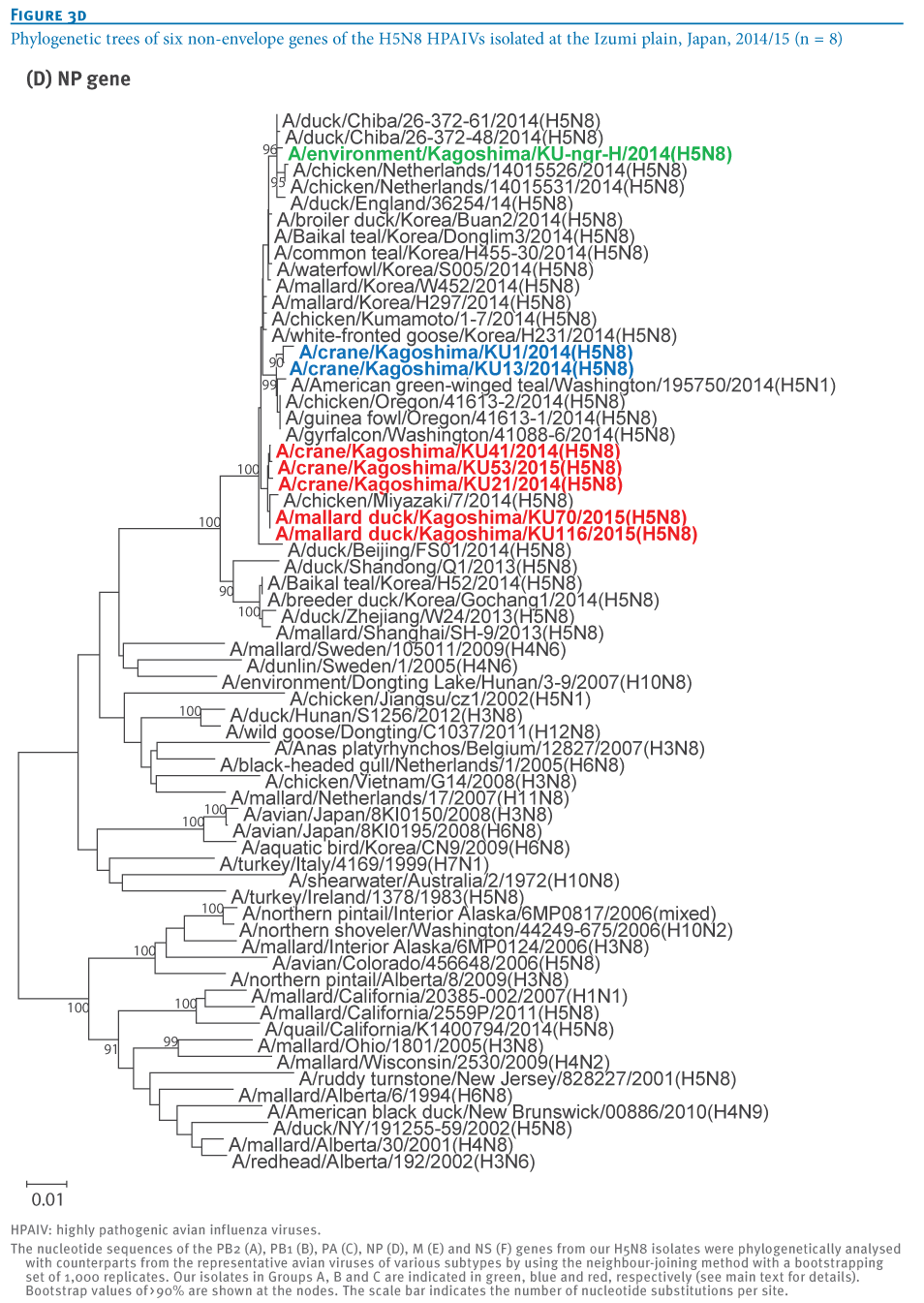
We found that the H5 genes from our eight isolates belonged to clade 2.3.4.4 and were genetically divided into three groups. The water isolate, A/environment/Kagoshima/KU-ngr-H/2014(H5N8), fell into a phylogenetic cluster together with the European isolates and was closely related to two wild duck isolates in Japan (Group A, indicated in green in the Figures). The first and second crane isolates, A/crane/Kagoshima/KU1/2014(H5N8) and A/crane/Kagoshima/KU13/2014(H5N8), were genetically similar to the North American isolates (Group B, blue in the Figures). The HA genes of the rest of our isolates (Group C, red in the Figures), as well as a poultry isolate from Japan were clearly distinct from those of the other recent H5N8 isolates. These findings suggest that three genetically distinct groups of H5N8 HPAIVs were independently circulating among the migratory birds at the Izumi plain.

Intriguingly, the genetic grouping of our isolates matched broadly the dates of sampling; the forth to eighth isolates were categorised into Group C, while earlier isolates were categorised into Group A or B. To determine whether this virus group has genetic characteristics that become predominant among the migratory birds over the remaining virus groups, further investigation would be needed.

<SNIP>

No mutations were found that are known to confer the ability to infect mammalian hosts or to provide resistance against anti-influenza drugs to avian influenza viruses, with the exception of an asparagine at position 31 in the M2 protein, which confers resistance to the M2 ion channel blocker amantadine [11].


Conclusion


We isolated eight H5N8 HPAIVs from migratory birds and the water in their environment at the Izumi plain in southern Japan. Based on their genome sequences, these isolates were genetically divided into three groups. These results indicate the co-circulation of at least three genetic groups of H5N8 HPAIVs among the migratory birds overwintering at a single site in Japan. These H5N8 HPAIVs are most likely to be derived from wild ducks [12], rather than from cranes whose flyways were restricted to East Asian countries (Figure 1A). These findings also imply the possibility of global redistribution of the H5N8 HPAIVs via migration of these ducks next winter.


The birds that overwintered in Japan, Korea, and the Pacific Northwest last fall are now gathered in their summer breeding sites in northern China, Mongolia and Siberia -  sharing lakes, ponds, and streams and no doubt, the occasional avian virus -  and will be winging their way south again in a few short months. 


What new viral variants, clades, or reassortments we will see next fall and winter when they return is anyone’s guess.

Thursday, March 19, 2015

EID Journal: Three Looks At The H5N8 Virus In Europe

image

H5N8 Branching Out To Europe & Japan


# 9847


The EID Journal has posted four articles today on the H5N8 virus, three of which are closely related enough to deserve mention in the same blog post.   All three find the H5N8 virus detected in England, Germany, and The Netherlands to be closely related to the Asian/Korean strains.


Despite the reservations expressed by the UN CMS/FAO Co-Convened Scientific Task Force on Avian Influenza and Wild Birds and others over the spread of the virus via migratory birds, all three papers mention the strong possibilty that wild birds are behind its rapid geographic expansion.


Volume 21, Number 5—May 2015
Dispatch

Influenza A(H5N8) Virus Similar to Strain in Korea Causing Highly Pathogenic Avian Influenza in Germany

Timm HarderComments to Author , Sebastian Maurer-Stroh, Anne Pohlmann, Elke Starick, Detlef Höreth-Böntgen, Karin Albrecht, Gunter Pannwitz, Jens Teifke, Vithiagaran Gunalan, Raphael T.C. Lee, Carola Sauter-Louis, Timo Homeier, Christoph Staubach, Carola Wolf, Günter Strebelow, Dirk Höper, Christian Grund, Franz J. Conraths, Thomas C. Mettenleiter, and Martin Beer

 Abstract

Highly pathogenic avian influenza (H5N8) virus, like the recently described H5N8 strain from Korea, was detected in November 2014 in farmed turkeys and in a healthy common teal (Anas crecca) in northeastern Germany. Infected wild birds possibly introduced this virus.

Conclusions

The HPAI outbreak in northeastern Germany in November 2014 resulted from an HPAI (H5N8) subtype virus, represented by isolate AR2472/14, which is closely related to H5N8 subtype viruses that have hitherto been confined to the Far East. Fourteen unique coding mutations of AR2472/14 show differences between this virus and previous isolates from South Korea, but the mutations are shared with the recent H5N8 isolate A/duck/Chiba/26-372-61/2014 from Japan. Epidemiologic and phylogenetic data collected so far are insufficient to establish definite pathways of introduction into Germany. All possible routes, including relay transmission by subclinically infected wild birds, must be thoroughly examined. Enhanced active monitoring of sites frequented by aquatic wild birds and waterfowl is also recommended.


Volume 21, Number 5—May 2015
Dispatch

Full-Genome Sequence of Influenza A(H5N8) Virus in Poultry Linked to Sequences of Strains from Asia, the Netherlands, 2014

Ruth BouwstraComments to Author , Rene Heutink, Alex Bossers, Frank Harders, Guus Koch, and Armin Elbers

Abstract

Genetic analyses of highly pathogenic avian influenza A(H5N8) virus from the Netherlands, and comparison with strains from Europe, South Korea, and Japan, showed a close relation. Data suggest the strains from Europe were probably carried to the Netherlands by migratory wild birds from Asia, possibly through overlapping flyways and common breeding sites in Siberia.

Conclusions

Genetic analysis of influenza A(H5N8) virus from the Netherlands indicates that the virus probably was spread by migratory wild birds from Asia, possibly through overlapping flyways and common breeding sites in Siberia. In addition to the outbreak in the Netherlands, several other outbreaks of HPAI (H5N8) virus infections were reported in Europe at the end of 2014 after exponentially increasing deaths occurred in chicken and turkey flocks. Genetic sequences submitted to the EpiFlu database indicated that the viruses from Europe showed a strong similarity to viruses isolated earlier in 2014 in South Korea, China, and Japan.

An H5N8 virus isolated from a wigeon in Russia in September 2014 is located in the phylogenetic tree near the node of all sequences for H5N8 viruses from Europe. In regard to time, this location fits the hypothesized route of H5N8 virus introduction into Europe. Furthermore, for several reasons, it is highly likely that the introduction of HPAI (H5N8) virus into the indoor-layer farm in the Netherlands occurred via indirect contact. First, despite intensive monitoring, H5N8 viruses have never been detected in commercial poultry or wild birds in the Netherlands. Second, when the virus was detected, the Netherlands had no direct trade contact with other European countries or Asia that might explain a route of introduction. Third, because of the severity of disease in galliforms, outbreaks of H5N8 in the Netherlands before November 2014 would have been noticed.


Volume 21, Number 5—May 2015
Dispatch

Genetic Characterization of Highly Pathogenic Avian Influenza (H5N8) Virus from Domestic Ducks, England, November 2014

Amanda HannaComments to Author , Jill Banks, Denise A. Marston, Richard J. Ellis, Sharon M. Brookes, and Ian H. Brown

Abstract

Genetic sequences of a highly pathogenic avian influenza (H5N8) virus in England have high homology to those detected in mainland Europe and Asia during 2014. Genetic characterization suggests this virus is an avian-adapted virus without specific affinity for zoonoses. Spatio-temporal detections of H5N8 imply a role for wild birds in virus spread.

Conclusions

The genome of the H5N8 virus isolated in England suggests that it is still predominantly an avian-adapted virus, without any specific increased affinity for humans. Close genetic homology among the viral genes of the H5N8 viruses detected in England, the Netherlands, and Germany suggest they share a common ancestor with the recent H5N8 viruses isolated from wild ducks in Japan, a result of reassortment estimated to have occurred in June 2014. Reliable interpretation of the topology of the European and Japanese cluster cannot be made with these similar sequences. Phylogenetic analysis of sequences from more viruses will help to resolve these relationships. Detection of H5N8 (HPAI) viruses in 3 countries in Europe over a short time period in different poultry species without the establishment of clear epidemiologic links implicates a role for wild birds in spreading of viruses. The potential for further dissemination of HPAI (H5N8) viruses in Europe is a threat to poultry. Viral sequence analysis from new outbreaks is recommended to monitor virus evolution, understand risk pathways for introduction, and assess the emergence of mutations that may be relevant for veterinary and public health.

Monday, October 09, 2017

Avian Flu: That Was Then . . This Is Now


#12,804


Since both seasonal and avian influenza follow a seasonal pattern, here in the Northern Hemisphere we tend to think of October as the start of a new flu `year'. That's when China resets their yearly H7N9 counts, poultry interests begin to ramp up their biosecurity, and when the CDC, ECDC, and other public health agencies begin tracking seasonal flu in earnest.
As the map above attests, over the past 12 months Asia, Africa, Europe, and the Middle East have been hit particularly hard by avian flu - while North America, South America, and Australia/NZ have been largely spared. 
While telling, what this map doesn't show is how the H5N8, H5N6, and H7N9 viruses have  changed - both genetically, geographically, and behaviorally - over the past year.  While we've covered all of these changes in past blogs, it is easy to forget how much different the bird flu threat appeared just 12 months ago.

Therefore, with `Then'  meaning late summer 2016, a brief comparison.


H7N9 Then


While certainly still on our radar screens, reports of H7N9 cases in China had been on a steady decline since the winter of 2013-2014.

During the summer of 2016, we saw a smattering of late season cases (see China: 5 H7N9 Cases In July), and in May a study (see EID Journal: Human Infection With H7N9 During 3 Epidemic Waves - China) identified a few minor behavioral changes in the virus, but for the most part H7N9 appeared to be a virus still struggling to get a foothold in China. 


H7N9 Now


Beginning in December, H7N9 literally exploded in China, with nearly as many cases (n=766) reported over the next 6 months as had been reported in the first four epidemic waves combined. 
Geographically,  H7N9 spread to 8 new Provinces in China over the past 12 months, and Macao reported their first local infection.
Driving this impressive surge have been substantial genetic changes in the virus, including the emergence (and dominance) of a new lineage (Yangtze River) and a rapidly spreading HPAI version of the virus.

While data is limited, there is some evidence to suggest this HPAI version may pose more of a threat to humans than the LPAI version (see Eurosurveillance: Epidemiology of Human HPAI H7N9 Infection - Guangdong Province).

We've also seen reports that up to 10% of human infections have shown resistance to one or more NA inhibitors (see MMWR Report), and plans for the development of a new Candidate Vaccine Virus (CVV) by the the WHO to address these evolutionary changes.

Over the past couple of months we've seen an avalanche of new studies on H7N9, none of which are particularly reassuring:
J. Virology: Genesis and Spread of Newly Emerged HPAI H7N9 In China

J. Infect. Diseases: Human Clusters Of H7N9 In China - March 2013 to June 2015
  
Sci. Repts: Adaptation of H7N9 in Primary Human Airway Epithelial cells
Obviously worried, for the very first time, China's MOA Ordered An HPAI H7N9 Vaccine Deployed Nationwide This Fall.

While H7N9 hasn't managed to adapt well enough to human physiology to transmit efficiently, the CDC's IRAT system ranks the newly emerged Yangtze River Delta lineage along with the original Pearl River Delta Lineage (see Updating the CDC's IRAT (Influenza Risk Assessment Tool) Rankings) at the top of their list of viruses with the greatest pandemic potential.


All things considered, this has been a remarkable turn around for H7N9.


H5N8 Then

After emerging on the world stage in January of 2014 in South Korea, H5N8 forced the culling of 15 million chickens over the next three months.  From there, H5N8 spread into China - and the following fall turned up in Russia and Europe - and sparked the largest avian epizootic in North American history.
By the summer of 2015, H5N8 had vanished outside of Asia (see PNAS: The Enigma Of Disappearing HPAI H5 In North American Migratory Waterfowl). While still causing losses in Korea and China, to everyone's surprise H5N8 did not return the following winter to Europe or North America.
While highly pathogenic in poultry, H5N8 was notable for causing relatively few wild bird deaths, and the virus appeared short-lived in the environment. Best of all, H5N8 - unlike H5N1 and H5N6 - showed no signs of infecting humans.


H5N8 Now

Over the summer of 2016 we saw reports of H5N8 detected at Ubsu-Nur Lake, Russia in wild and migratory birds (see FAO/EMPRES: H5N8 Clade 2.3.4.4 Detected Over Summer In Russia), followed by reports of H5N8 turning up first in India, and then Kazakhstan  in mid-October.


In late October (see FAO Notification Of H5N8 In Hungary) H5N8 returned to Europe. Three weeks later, on Nov 19th, in the WHO: Assessment Of Risk Associated With HPAI H5N8, we get the following description of its remarkable spread.
Since June 2016, countries in both Europe and Asia have detected infections in wild birds and/or domestic poultry with A(H5N8) including Austria, Croatia, Denmark, Germany, Hungary, India, Israel, Netherlands, Poland, Russian Federation and Switzerland. Many of these recent detections were associated with mortality in wild birds.
By the end of November H5N8 would have arrived in Iran, Egypt,  Finland, Sweden, and the Ukraine. Beyond its rapid geographic spread, H5N8 was also making headlines for its Unusual Mortality Among WIld Birds - a distinct change in its behavior over previous years. 


Over time we would discover that before the H5N8 arrived it had reassorted - either in Russia or China (see EID Journal: Reassorted HPAI H5N8 Clade 2.3.4.4. - Germany 2016) - picking up virulence in wild birds, an expanded avian host range, and most recently, unusual environmental persistence into the summer.  
By spring H5N8 had hit wild birds and poultry in nearly every European country, and had spread into West Central and Central Africa.  By summer, it had made it - for the very first time - into the Southern Hemisphere (Zimbabwe & South Africa) where it continues to spread. 
While H5N8 still remains only a health threat to wild birds and poultry, there are increasing concerns (see J. Virulence Editorial: HPAI H5N8 - Should We Be Worried?) that H5N8 could someday acquire the genetic changes that would make it a human health threat as well. 

After nearly disappearing for 18 months outside of Asia, H5N8 over the past 12 months has grown to become the dominant HPAI virus around the globe.


H5N6 Then


Emerging in the spring of 2014, just months after H5N8, H5N6's range had remained confined mostly to China, with occasional outbreaks in Vietnam and Laos.  Roughly 15 human infections - all in China - had been reported over 2 years, with more than a 50% fatality rate.

Despite its ability to infect humans, and a growing genetic diversity (see Cell Host Microbe: Genesis, Evolution and Prevalence of HPAI H5N6 In China), H5N6 had shown far less ability to spread via migratory birds than had H5N1 and H5N8.

H5N6 Now

At the same time that H5N8 was conquering Europe, H5N6 suddenly arrived - first in South Korea - and then in Japan in November of 2016.  As with H5N8, H5N6 appeared to be spreading easily via migratory birds, and as we saw in Europe, wild bird deaths were suddenly widely reported in Japan and South Korea.
South Korea took the brunt of last winter's H5N6 epizootic (300+ outbreaks), but Japan reported hundreds of wild bird and environmental detections, and about a dozen poultry outbreaks. Over the winter Taiwan reported H5N6 outbreaks, and this summer the virus arrived in the Philippines. 
After two-plus years of being China-bound, H5N6 has begun to follow in the footsteps of H5N8, spreading easily via migratory birds.   While we've not seen any human infections reported since November of 2016, the virus is constantly evolving (see Virology: Five Distinct Reassortants of HPAI H5N6 In Japan - Winter 2016–2017) and so there are no guarantees that streak will last.

This new found mobility now has experts in Europe wondering whether H5N6 will one day follow both H5N1 and H5N8 and make its way across Asia and into Europe  DEFRA's: HPAI H5N8 In Europe - Update #15) noted last week:
This year, the cases in wild birds and poultry are already occurring. It is also important to note the pattern of H5N8 HPAI emergence in 2014 when the virus was observed in Japan and South Korea in wild birds and a few months later it was detected in Europe and North America.
If the same pattern of wild bird transmission occurs this year, we might expect to see expansion in the range of H5N6 HPAI potentially to similar areas, as it was reported in high numbers of migratory wild birds in Japan over the summer together with waves of infection in poultry in the Republic of Korea. This virus has some affinity for human cells unlike H5N8 HPAI virus, therefore public health issues will also need to be considered carefully.
These are only a few highlights from an incredibly busy bird flu year. But any way you figure it, the past 12 months have seen remarkable changes in our top avian flu threats.
What all of this portends for this winter is unknowable. As is suggested by the absence of human infections from H5N6 over the past year, evolution doesn't  always move toward greater virulence.
But what it does tell us is that we can't assume that these pathogens - and others - will behave tomorrow the same way they behaved yesterday. With viruses, the only constant is change. 
 
And we need to be prepared to deal with those changes, which ever way they go.


Thursday, November 19, 2020

DEFRA Update # 5: Highly pathogenic avian influenza (HPAI) in the UK, and Europe

#15,569

After three years of relative quiet, Northern Europe and the UK - and to a lesser extent East Asia - continue to report their biggest surge in HPAI H5 activity (in wild birds & in poultry) since the end of their last major epizootic in the spring of 2017.

The primary culprit - in Northern Europe, at least - appears to be due to a fresh introduction of HPAI H5N8 that has been described as `genetically distinct' from recently circulating strains (see Pre-Print: Novel Incursion of a HPAI H5N8 Virus in the Netherlands, October 2020).

This year's activity is reminiscent of what we saw leading up to the 2016 epizootic in Europe - which  (like this year), began over the summer with increased flu activity in Siberia and the discovery of an incursion by a new variant of the H5N8 virus. 

The good news is that HPAI H5N8, and its reassorted spinoffs (i.e. H5N5, H5N1, etc.) have not shown the ability to infect humans, and for now, remain only a threat to poultry and wild birds. 

Today DEFRA has published their 5th update on avian flu activity in the UK and Northern Europe this fall which lists 5 affected nations (UK, Ireland, Denmark, Netherlands & Germany). The document - while dated November 17th - is already somewhat out of date, as several additional European nations (e.g. Sweden, France, Belgium & Croatia) have reported avian flu over the past few days.


Confirmed avian influenza in Koprivnica-Križevci County  -  Croatia

Sweden culls over 3,000 turkeys as bird flu moves through northern Europe - Sweden

Bird flu has returned to Belgium: extra measures announced to contain the virus - Belgium

I've some excerpts from the latest DEFRA report, but you'll want to follow the link to read the report in its entirety.   I'll have a brief postscript when you return.

Updated Outbreak Assessment #5

Highly pathogenic avian influenza (HPAI) in the UK, and Europe

17 November 2020

Ref: VITT/1200 HPAI in the UK and Europe
Disease Report

Since our last report on 10 November, in the United Kingdom there have been two new reports of HPAI H5N8 in wild birds, and one new outbreak of HPAI H5N8 in domestic poultry; in Herefordshire. In the Netherlands there have been six reports of HPAI H5N8 in wild birds. Germany has reported 76 cases of HPAI H5N8 in wild birds, and four outbreaks in poultry. Denmark has reported five cases of HPAI H5N8 in wild birds.
Situation Assessment

Since our last report on 10 November, there have been new reports of HPAI H5N8 in wild birds and in domestic poultry in the United Kingdom. The first report in domestic poultry was on 03 November, in the north-west (NW) of England. Since then, on 12 November a second infected premises was reported with HPAI H5N8 in domestic poultry, near Leominster, in Herefordshire. This was a premises with broiler breeder chickens. A 3 km Protection Zone and a 10 km Surveillance Zone have been put in place around the infected premises.

The first report of HPAI H5N8 in wild birds in the UK was on 09 November at a site in Gloucestershire, where five wild birds (a greylag goose and four Canada geese) were found dead on 03 November. On 11 November, there was a second report of HPAI H5N8 in the UK in wild black swans, near Dawlish, in Devon. The third report of HPAI H5N8 in wild birds in the UK was on 12 November, near Weymouth, in Dorset: HPAI H5N8 was identified in one Canada Goose (Branta canadensis) which was found dead on 09 November. As these wild birds are all considered to be native, sedentary species, they must have been infected via introduction by other species of migratory birds.

HPAI H5N8 in Western Europe

Since our last report on 10 November, there have been six further HPAI H5N8 cases in wild birds in the Netherlands. In addition to this, on 10 November there was one report of HPAI H5N8 in 25 captive birds of mixed ‘wild bird species’. These events represent a wide geographical distribution in wild birds and domestic poultry across the Netherlands (see map).

Since our last report on 10 November, in Germany there have been 76 further reports of HPAI H5N8 in wild birds. All continue to be in the north of the country. While the majority were in South Jutland, there were five cases around Hamburg, and a number of additional cases on the island of Rugen and its surroundings. There were also four outbreaks reported of HPAI H5N8 in poultry. Two were in the Northern district of Vorpommern-Rügen: one being a turkey premises of 16,100 birds, and the other a smaller premises of 257 mixed chicken ducks and geese. The other two outbreaks were in Landkreis Rostock (again, in the north of the country), and both were in premises with laying hens, one having approximately 53,000 birds and the other 2,865 birds.

On 13 November, Denmark reported five cases of HPAI H5N8 in wild birds. All were in Jutland, in the Danish regions of Aabenraa, Aalbord, Sonderborg, Tonder and Vejle.

Other HPAI H5 in Western Europe

Since our last report on 10 November, there have been no new reports of other HPAI H5 subtypes in Western Europe.

Implications for the UK

The presence of H5N8 in the UK was not unexpected given the annual autumn migration, and the rapidly developing epidemiological situation (first in southern Russia during the early autumn, and more recently in Continental Europe). Taken together with the findings of HPAI H5N8 in UK domestic poultry in NW and western (W) England, and the wide geographical distribution of the reports in wild birds (in NW, W and southwest of England), this suggests that circulating HPAI H5N8 virus may be widespread in wild birds.

In GB, the sensitivity of surveillance has been increased, to ensure collection and analyses of targeted species of wild birds (ducks, geese, swans, gulls and birds of prey) known to carry risk of infection with H5 HPAI viruses. Single dead birds of target species, where possible, will be collected and tested. Several systems are in place, including working through NGOs (non-governmental organisations), and members of the public reporting wild bird mortality.

The migration season for wild waterfowl to overwinter in the UK has begun, although numbers may not peak until December/January, depending on the species and the weather conditions in Continental Europe. Generally the Netherlands has a far higher number of wintering water birds than the UK, but cold weather on the Continent can force birds to move across the North Sea to the British Isles.

Following confirmation of one Highly Pathogenic Avian Influenza (HPAI) H5N8 outbreak in ‘Cheshire West and Chester’ district of England and one Low Pathogenic Avian Influenza (LPAI) H5N2 outbreak near Dover District, England the UK is no longer free from notifiable avian influenza under the World Organisation for Animal Health (OIE) rules.

Where disease is confirmed, we put in place measures in accordance with Council Directive 2005/94/EC. The EU will put safeguard measures in place, meaning that no trade with the EU in live poultry or poultry products will be permitted from either the Restricted Zone in Kent or the Protection or Surveillance Zone in Cheshire and Herefordshire.

Public Health England has confirmed that the risk to public health is very low, and the Food Standards Agency has said that avian influenza does not pose a food safety risk for UK consumers.

Conclusion

As a consequence of the H5N8 HPAI poultry outbreaks in the UK, and in Germany and the Netherlands; as well as the increasing HPAI H5N8 cases in wild birds in the UK, Netherlands and Germany this week, and the known migration routes on to the UK from these countries: the risk of HPAI incursion in wild birds in the UK is HIGH. The overall risk of infection of poultry in the UK is MEDIUM; although it should be noted that the risk of introduction to individual premises depends upon the level of biosecurity implemented on farm to prevent direct or indirect contact with wild birds.

In response to the increased risk, an Avian Influenza Prevention Zone has been declared in England, Scotland and Wales and the Chief Veterinary Officers from England, Scotland, Wales and Northern Ireland are urging bird keepers across the UK to maintain and strengthen their biosecurity measures; in order to prevent further outbreaks of avian influenza in the UK.

(Continue . . . )

A mentioned at the top of this blog, the HPAI H5 viruses detected in Northern Europe this fall are genetically distinct from other HPAI H5 viruses that have been detected over the past year in Europe. Wageningen Bioveterinary Research (WBVR) center has published the following characterization of these recent isolates, including confirmation that they are similar to viruses which were recently collected in Siberia. 

Current avian flu virus resembles viruses found in Egypt, Kazakhstan and Russia

Published on November 18, 2020

A study by Wageningen Bioveterinary Research (WBVR) has shown that the 'new' HPAI H5N8 virus – detected in October 2020 in mute swans in the Netherlands – shares a common ancestor with viruses that were last reported in Egypt in 2018-2019. The new H5N8 virus also has a similar genetic composition. WBVR has investigated the relationship between the viruses in more detail.
Notably, the virus is not directly related to the European H5N8 viruses that were identified in the first half of 2020.

Genetic analysis of the avian flu virus detected in October in the Netherlands suggests that the ancestor of this H5N8 virus has been circulating in Egypt since March 2017 and caused outbreaks there in 2018-2019. After these outbreaks, the virus went unreported until it was detected in the Netherlands in October 2020.
This H5N8 introduction is not related to outbreaks in Eastern Europe, Germany and Bulgaria that occurred earlier in 2020. It also seems unlikely that the H5N8 virus has been circulating unnoticed in the Netherlands in the wild bird population since 2017.

Mute swans do not migrate over long distances, so the virus may have been introduced by other waterfowl species that migrate from their breeding grounds in northern Russia to wintering grounds in the Netherlands. Prior to the bird migration season in 2020, no highly pathogenic avian influenza (HPAI) H5N8 viruses or deaths in wild birds from these breeding grounds were reported. Beginning in August 2020, however, there were several reports of HPAI H5N8 viruses being found in wild birds and poultry in southern Russia and northern Kazakhstan.

Genetic relationship

The sequences of the viruses detected in Russia and Kazakhstan have recently been published, and these suggest a genetic relationship between these viruses and the HPAI H5N8 virus in the Netherlands. Some waterfowl species, such as wigeon, tufted duck and white-headed goose, are known to reside in these regions of Russia and Kazakhstan, from where they migrate to wintering grounds the Netherlands. The HPAI H5N8 virus was detected in a wigeon found near the location of the dead mute swans, which suggests that the wigeon may have introduced the virus to the Netherlands. The virus has also been detected in various species of geese, such as barnacle geese and greylag geese, that also migrate to the Netherlands from their breeding grounds in Russia.​


The world's major migratory bird flyways - as depicted in graphic below - serve as a global highway for avian influenza viruses. While primarily north-south conduits, there is enough overlap to allow for considerable east-west movement as well.


Which means that new variants, genotypes, or reassortments that emerge in the Middle East, China,  or Siberia, can - if they are biologically `fit' enough - quickly make their way across continents, and even oceans. 

The last major diaspora of HPAI H5 occurred in 2016 (see FAO On HPAI H5's 4th Intercontinental Wave), and the virus spread across Asia, Europe, The Middle East, and a wide swath of the African continent. 

While it is too soon to make comparisons, this year's wave of HPAI across Northern Europe appears to be intensifying. 

Stay tuned.  

Saturday, May 22, 2021

Science: Emerging H5N8 Avian Influenza Viruses


Avian Flu Activity Nov 2020 - May 2021 - Credit DEFRA

#15,976

Since it emerged with a vengeance in South Korean poultry in January of 2014, we've been watching the evolution and global spread of the H5N8 avian flu virus. A cousin of the zoonotic - but fading - H5N1 virus, H5N8 until recently was thought incapable of infecting humans and only a threat to wild birds and poultry. 

Viruses change over time - through antigenic drift (replication errors) and antigenic shift (reassortment) - and there have been warnings that H5N8 could evolve into zoonotic virus. 

Perhaps most telling of these came in September of 2017 in J. Virulence : Altered Virulence Of (HPAI) H5N8 Reassortant Viruses In Mammalian Models, which found:
Taken together, our study demonstrates that a single gene substitution from other avian influenza viruses can alter the pathogenicity of recent H5N8 viruses, and therefore emphasizes the need for intensive monitoring of reassortment events among co-circulating avian and mammalian viruses.
Also in 2017, we looked at a J. Virulence Editorial: HPAI H5N8 - Should We Be Worried?, which reviewed and summarized the literature, and found enough reasons to be concerned over the future evolutionary path of H5N8, stating that:
The extensive distribution of HPAI H5N8, as well as the gene reassortment with other circulating avian viruses already observed for H5N8 suggests there is a potential risk for human cases of H5N8 infections.

Again, in 2018, we saw a study (see Virology: The Zoonotic Potential Of Multiple Subgroups of Clade 2.3.4.4. H5N8 Virus) that warned of the potential for H5N8 to adapt into a more `mammalian' virus.  Some highlights from their report include:

Highlights
  • H2102 HPAIV (H5N8) caused relatively severe disease in mice at high doses.
  • All H5N8 viruses replicated restrictively in the respiratory tract of ferrets.
  • All H5N8 viruses displayed a HA phenotype that was poorly adapted to mammals.
  • H2102 HPAIV (H5N8) showed higher replication kinetics at 33 °C than other strains.
  • H5N8 HPAIVs have not yet acquired all features required for mammalian adaptation.

Not every study agreed. Also in 2018, in Emerg. Microbes & Infect.: Low Zoonotic Potential Of Clade 2.3.4.4B H5N8 Virus researchers argued that the recently evolved ". . . H5N8B is avian-adapted with augmented virulence for waterfowl, but has low zoonotic potential."

But between the two-decade track record of H5N1 occasionally jumping to, and often killing, humans and the emergence of a clearly zoonotic H5N6 virus in China (see HK CHP Notification: Fatal Human Case of Avian H5N6 In Guangxi Province, China), H5N8 has been viewed as having at least some pandemic potential. 

Since 2015 the CDC's IRAT (Influenza Risk Assessment Tool) has listed H5N8 [A/gyrfalcon/Washington/41088/2014] as posing a low-moderate pandemic threat.

While H5N8 has picked up increased virulence over the years - particularly in wild birds - and has sparked major epizootics in the Americas, Europe, Asia, and even South Africa, until earlier this year we never had confirmation of human infection with this particular subtype. 

Last February, we saw the announcement by Anna Popova - Chief State Sanitary Physician of the Russian Federation - of the first detection of human (asymptomatic) infection with avian H5N8 (see Russian Media Reports 7 Human Infections With Avian H5N8).

Since that announcement, we've see confirmation by the WHO and a risk assessment by the ECDC, both of which determined the risk of human infection to be low or very low.  

The WHO summarizing:
As mentioned earlier, all the seven cases with PCR-positive results were clinically asymptomatic. All close contacts of these cases were clinically monitored, and no one showed signs of clinical illness. Infections with avian influenza viruses of the same clade (H5 clade 2.3.4.4) have been reported from China since 2014 in people with exposure to infected birds. The likelihood of human infections with influenza A(H5N8) viruses has been considered to be low.
While the ECDC stating: 
This assessment is based on very limited data and there is therefore considerable uncertainty regarding the conclusions reached. The risk of infection related to avian influenza influenza A (H5N8) virus for the general public is assessed as very low, and for occupationally exposed people as low.

Nevertheless, in early March the WHO prudently called for the development of a Candidate Vaccine Virus (CVV) against avian H5N8 (see WHO: Candidate Vaccine Viruses for Pandemic Preparedness - March 2021), just in case it becomes a more common zoonotic threat.  

And just over two weeks ago, in the CDC Adds Zoonotic Avian A/H5N8 To IRAT List, we looked at their assessment of the pandemic potential of this virus, scoring it in  ". . . the lower to middle range of the moderate risk category, (which ranges from 4.0 to 7.9)."

This is marginally higher than the 2015 strain assessment (5.2 vs. 4.6), but far from the top of the list. 

We are, of course, still learning about the infections in Russia, and avian flu surveillance has taken a backseat to the coronavirus pandemic in many regions, making H5N8's evolution difficult to track. Exactly how big a threat H5N8 really is - or is likely to become - is difficult to say. 

Attempting to quantify those risks, we've a new perspective, published in Science by two highly respected Chinese researchers who should be well known to long-time readers of this blog; Weifeng Shi and George F. Gao. 

Their article begins with detailed, but remarkably easy-to-read history of HPAI H5  viruses, going back to Scotland in 1959, HPAI H5N1's emergence in China in 1996, and evolution, spread, and divergence into other subtypes (H5N6, H5N8, etc.) since. 

It doesn't address H5N8's jump to humans in Russia until every near the end (likely because data is still emerging on that incident), but the authors express deep concerns over this development, stating that:

  •  the  ". . . global spread of AIVs, particularly the H5N8 subtype, has become a major concern to poultry farming and wildlife security but, critically, also to global public health."
  • And due to the ". . . long-distance migration of wild birds, the innate capacity for reassortment of AIVs, the increased human-type receptor binding capability, and the constant antigenic variation of HPAIVs  the authors warned that it was imperative that " . . . the global spread and potential risk of H5N8 AIVs to poultry farming, avian wildlife, and global public health are not ignored."
You can read the full perspective at the link below.  I'll have a brief postscript when you return. 

PERSPECTIVE PUBLIC HEALTH

Emerging H5N8 avian influenza viruses
Weifeng Shi1,2,
George F. Gao3,4

1 School of Public Health, Shandong First Medical University and Shandong Academy of Medical Sciences, Ji'nan 250000, China.
2 Key Laboratory of Etiology and Epidemiology of Emerging Infectious Diseases in Universities of Shandong, Shandong First Medical University and Shandong Academy of Medical Sciences, Taian 271000, China.
3 National Institute for Viral Disease Control and Prevention, Chinese Center for Disease Control and Prevention, Beijing 102206, China.
4 CAS Key Laboratory of Pathogenic Microbiology and Immunology, Institute of Microbiology, Chinese Academy of Sciences (CAS), Beijing 100101, China.
 
Science 21 May 2021:
Vol. 372, Issue 6544, pp. 784-786
DOI: 10.1126/science.abg6302
 
PDF


While policy makers tend to view pandemics as rare events that come around every 30 to 40 years (and hopefully not on their watch) - and have been known to kick the pandemic-preparedness can down the road rather than deal with it - recent (and past history) suggests pandemics come around more often than is commonly believed. 

In April of 2019, on the 10 year anniversary of the start of the 2009 H1N1 pandemic, we looked at pandemic frequency, in The CDC & Novel Flu Investigations. In it, I cited 3 times in just over the past century that pandemics (or pseudo pandemics) had occurred with gaps of 11 years or less between them.

  • 11 years between the 1889 Russian flu and the 1900 Old Hong Kong Flu
  • 11 years between the 1957 H2N2 pandemic and the 1968 H3N2 Hong Kong flu
  • And just 9 years later - in 1977 - H1N1 re-emerged after a 20 years absence
As we've discussed previously, we only know the subtypes of influenza that have circulated in humans since early in the last century, but historic accounts suggest at least a dozen `influenza-like’ pandemics occurred in the 400 years prior to the 20th century.

Credit Pandemic Influenza's 500th Anniversary

Although some of these dates are a bit fuzzy, there are several instances where pandemics appear to be separated by fewer than 10 years. Making the notion that we don't have to worry for decades for the next pandemic to emerge clearly erroneous.

While the last thing anyone want to hear is that we need to be preparing for the next pandemic now, even as we are hip-deep in COVID-19, the reality is we could get blindsided at any time by another emerging virus. 

Despite years of warnings (see partial list below) the world went into the COVID-19 pandemic largely unprepared, and has paid a heavy price both in lives lost and severe economic and societal disruptions.  


DNI: An Influenza Pandemic As A National Security Threat

Few listened - and acted - then, and I suspect few are in the mood to listen now. 

According to the work of anthropologist and researcher George Armelagos (May 22, 1936 - May 15, 2014) of Emory University, we are living in the  The Third Epidemiological Transition, an age of newly emerging infectious diseases, re-emerging diseases and a rise in antimicrobial resistant pathogens.

Whether HPAI H5N8 turns out to be the next global public health crisis, or we see a different influenza subtype,another coronavirus, a novel orthopoxvirus, or something altogether unexpected, the odds are something nasty, and unexpected, will emerge.  Perhaps sooner than anyone expects. 

And when that happens, the only thing we will have any control over is our ability to respond.  

That is, assuming we go in prepared to deal with it.