Showing posts with label Caribbean. Show all posts

Thursday, March 05, 2015

The Caribbean’s Hidden Tsunami Potential (Revisited)

image


# 9784


Although little appreciated outside of the Indian and Pacific Ocean basins, tsunamis are a rare, but genuine threat to almost any coastal region of the globe.  Today we’ve word of a new study that finds evidence that a major tsunami struck the Yucatan coastline between 1500 and 1900 years ago.


A little over a year ago – in The Caribbean’s Hidden Tsunami Potential – we looked at a brief history of some of the destructive waves that have been spawned in the tropical waters to our south. 


In that blog I presented a  list of known or suspected Atlantic & Caribbean Tsunamis, starting off with the Great Lisbon Earthquake of 1755 (see A Look At Europe’s Seismic Risks), which also included:


    • November 1, 1755 - Lisbon, Portugal
    • October 11, 1918 - Puerto Rico
    • November 18, 1929 - Newfoundland
    • August 4, 1946 - Dominican Republic
    • August 18, 1946 - Dominican Republic
    • November 14, 1840 - Great Swell on the Delaware River
    • November 17, 1872 - Maine
    • January 9, 1926 - Maine
    • May 19, 1964 - Northeast USA

      POSSIBLE TSUNAMI

    • June 9, 1913 - Longport, NJ
    • August 6, 1923 - Rockaway Park, Queens, NY. An article on triplicate waves."
    • August 8, 1924 - Coney Island, NY. Contains a discussion, “An Observed Tsunami Building In Coastal Waters?"
    • August 19, 1931 - Atlantic City, NJ
    • September 21, 1938 - Hurricane, NJ coast.
    • July 3-4, 1992 - Daytona Beach, FL


The last suspected entry – the infamous Daytona Beach `rogue wave’ of 1992 - was described by witnesses as being between 10 and 18 feet tall, slammed onto a 27 mile stretch of Florida Beaches without warning and smashed hundreds of cars, causing as many as 75 (mostly minor) injuries.


In A Brief History of Tsunamis in the Caribbean Sea (2002), researchers James F. Lander, Lowell S. Whiteside, and Patricia A. Lockridge of NOAA’s National Geophysical Data Center  list descriptions of of  91 reported  waves over the past 500 years that might  have been  tsunamis  within  the Caribbean  region. 


Of  these, the authors judged 27 to be actual tsunamis, while nine more were considered `likely’ tsunamis’.

image

Credit - A Brief History of Tsunamis in the Caribbean Sea


Adding to this list, today we’ve a press release from the University of Colorado at Boulder which describes recently discovered evidence suggesting  a major tsunami struck along the eastern shore of Yucatan, Mexico within the past 2,000 years.


Public Release: 5-Mar-2015

Evidence indicates Yucatan Peninsula hit by tsunami 1,500 years ago

University of Colorado at Boulder

The eastern coastline of Mexico's Yucatan Peninsula, a mecca for tourists, may have been walloped by a tsunami between 1,500 and 900 years ago, says a new study involving Mexico's Centro Ecological Akumal (CEA) and the University of Colorado Boulder.

There are several lines of evidence for an ancient tsunami, foremost a large, wedge-shaped berm about 15 feet above sea level paved with washing machine-sized stones, said the researchers. Set back in places more than a quarter of a mile from shore, the berm stretches for at least 30 miles, alternating between rocky headlands and crescent beaches as it tracks the outline of the Caribbean coast near the plush resorts of Playa del Carmen and Cancun.

Radiocarbon dates of peat beneath the extensive berm indicate a tsunami, which may have consisted of two or even three giant waves, likely slammed the coastline sometime after A.D. 450. In addition, ruins of Post-Classic Mayan structures built between A.D. 900 and 1200 were found atop parts of the berm, indicating the tsunami occurred prior to that time.

<SNIP>

One implication of the Yucatan tsunami is the potential destruction another one could cause. While the geologic evidence indicates tsunamis in the region are rare -- only 37 recorded in the Caribbean basin since 1492 -- the Yucatan coastline, which was only lightly populated by Mayans 1,500 years ago, is now home to a number of lavish resort communities and villages inhabited by some 1.4 million people.

"If such an event occurs in the future, it would wreak havoc along the built-up coastline, probably with a great loss of life," said Benson. But it's far more likely that powerful hurricanes like the Class 5 Hurricane Gilbert that made landfall on the Yucatan Peninsula in 1988, killing 433 people in the Caribbean and the Gulf of Mexico and causing more than $7 billion in damage, will slam the coastline, said the researchers.


In 2013 the  USGS warned the Earthquake/Tsunami Hazard in Caribbean Higher Than Previously Thought, stating `Enough strain may be currently stored in an earthquake zone near the island of Guadeloupe to cause a magnitude 8 or larger earthquake and subsequent tsunami in the Caribbean’


Beyond damage to local islands, it is not inconceivable that a large Caribbean or Atlantic origin tsunami could negatively impact the coastlines of the Gulf states, the Eastern Seaboard, Mexico, Central and South America, and even parts of Africa and Europe.


You can access current Tsunami warnings and arrival times at the  Pacific Tsunami Warning Center.


As far as what to do before a tsunami threatens, READY.GOV has a Tsunami Awareness Page with helpful hints.NOAA  provides several useful documents, including a Tsunami Zone PDF (see below) and Tsunami Web page.

image

Tsunamis, while comparatively rare, are just one of scores of possible disaster scenarios that one can find themselves suddenly thrust into.


When you add in the risks from earthquakes, hurricanes, tornadoes, floods, blizzards, and other – even more common – emergencies, it makes sense to maintain a general level of preparedness against `all threats’.

Everyone needs an appropriate disaster plan, just as everyone should have a good first aid kit, a `bug-out bag’, and sufficient emergency supplies to last a bare minimum of 72 hours.


As the graphic above from NOAA advises, people should consider maintaining a 2-week supply of supplies in their home.  A topic I address in When 72 Hours Isn’t Enough.


As we move into the spring severe storm season, and ultimately back into the Atlantic Hurricane season, now is a good time to review and refresh your emergency preparedness plans.

Saturday, June 28, 2014

PAHO Chikungunya Update & Videos

image

Aedes Albopictus – Asian Tiger Mosquito


# 8792


Up until about a decade ago, Chikungunya was a rarely seen mosquito-borne virus pretty much limited to central and eastern Africa.  All of that changed in 2005 when it jumped to Reunion Island in the Indian Ocean, where it reportedly infected about 1/3rd of that island’s population (266,000 case out of  pop.770,000) in a matter of a few months.


From there, apparently aided and abetted by a recent mutation that allowed it to be carried by the Aedes Albopictus `Asian tiger’ mosquito (see A Single Mutation in Chikungunya Virus Affects Vector Specificity and Epidemic Potential), it quickly cut a swath across the Indian ocean and into the Pacific. 

image


That is, until about six months ago, when one (or more) infected travelers apparently arrived on the French Part of St. Martins, introducing the virus into the local mosquito population.  On December 10th there were 2 confirmed, 4 probable and 20 suspected cases of chikungunya on the island. 


A short six months later, and the virus has spread across nearly the entire Caribbean basin, and has infected at least 260,000 people

image

Further expansion into North, South, and Central America seems but a matter of time.


A textbook example of what happens when a emerging infectious disease enters an immunologically naive population under favorable environmental conditions.  And the reason why we talk so much about the global spread of disease in this age of globalization and increased international travel  (see The Global Reach Of Infectious Disease).


Yesterday’s update from PAHO has already made headlines, as it shows an increase of roughly 93,000 cases over the previous week (a 40% increase), although not all of those cases emerged over the past 7 days. 


As you’ll see by the chart below, some countries are still several weeks behind in their reporting, and surveillance and reporting in some regions is `sub-optimal’, so these numbers are still likely a significant undercount.


image

image


This week the WHO/PAHO Youtube Channel released several short videos showing the effects of the illness. The first one is more of a slide show, but shows the symptoms of the disease.  The second video on Clinical Management is in Spanish, but has English sub-titles. 


image


image


There are currently at total of five videos in their CHIKUNGUNYA Playlist.


For more on how the State of Florida and the CDC are working to meet the challenges of chikungunya, you may wish to revisit:


Florida Prepares For Chikungunya 

Chikungunya Update & CDC Webinar Online

CDC HAN Advisory On Recognizing & Treating Chikungunya Infection


Saturday, June 14, 2014

PAHO Chikungunya Surveillance Update – June 13th

image


# 8742


The Chikungunya virus – which was only first reported in this hemisphere last December on the French Part of St. Martins - continues to spread across the Caribbean and make incursions into Central and South America at an impressive rate. 


Two weeks ago (see PAHO Chikungunya Epidemiological Update – May 30th) the estimated number of cases had grown to just over 100,000 – today that number exceeds 165,0000.


As impressive as these growth numbers are, it should be noted that surveillance in some of the reporting nations is sub-optimal, and in some cases, reporting to PAHO lags behind by several weeks.  Meaning the number of reported cases today is likely to be an undercount.  


First a look at the latest numbers, then I’ll be back with more:


The hardest hit areas are islands in the `Latin Caribbean’, which have reported more than 90% of all of the cases in this outbreak to date.  Particularly hard hit are Martinique and the Dominican Republic, although anecdotal reports suggest the situation in Haiti is badly underreported.

image


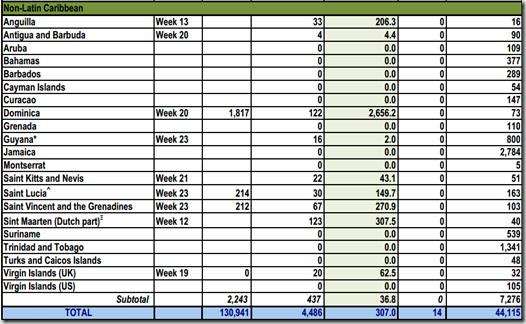
While lagging well behind, the Non-Latin Caribbean nations have reported a roughly 30% increase in cases over the past two weeks.

image


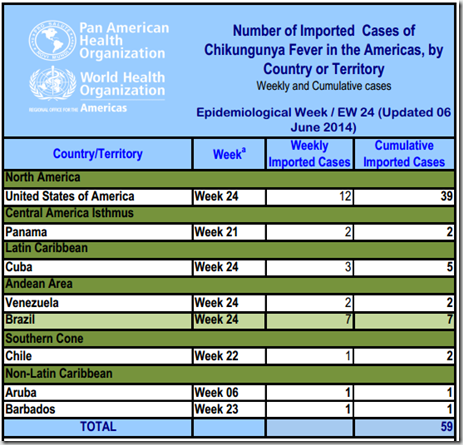
And lastly, a look at nations that have reported imported Chikungunya cases – but as of yet, no local transmission of the virus. 

image


While this virus has spread quite efficiently through just the normal tourist trade and international travel, this week the month-long FIFA World Cup begins in Brazil, which is expected to draw more than 500,000 visitors.  And among them will be some who either reside in, or have recently visited, areas where this virus is currently spreading (see  The ECDC Risk Assessment On Brazil’s FIFA World Cup).


With an incubation period of between 3 and 7 days, and the enormous amount of international travel to, and from, the Caribbean, the concern is that this virus will soon migrate to other areas that also have a favorable climate and the right kind of mosquitoes.


In April, in Study: Chikungunya’s Growing Threat To The Americas, we looked at models showing how the spread of CHKV could be aided and abetted by the spike in travelers to the World Cup this summer. 


Until about a decade ago, the Chikungunya virus was fairly localized in Central Africa, and only believed transmitted by the Aedes Aegypti mosquito.  In 2005  the virus took off on the wings of the Aedes Albopictus mosquito, and quickly conquered the Indian Ocean and parts of Asia, and moved into the Pacific.


Between the two, these mosquito vectors cover a lot of territory, including much of the Eastern United States and Southern Europe.

image


While no one knows how well the virus will spread, once it gets a foot hold in the United States or Europe, public health agencies are trying to be as proactive as they can in anticipation of its arrival. The state of Florida is concerned enough that it has issued warnings to the public, and is actively Preparing For Chikungunya. 


In March the CDC held a Chikungunya Webinar, in December they released a CDC HAN Advisory On Recognizing & Treating Chikungunya Infection, and just last week the MMWR published a report on  Chikungunya In the Caribbean & South America.


Chikungunya – while rarely fatal, can cause prolonged fever and severe polyarthralgias (joint pain), which in some cases can last weeks, months, or even longer.  


While the kind of widespread epidemic we are seeing in the Caribbean seems highly unlikely in the United States or Europe (based primarily on differences in lifestyle, better mosquito control, and other socio-economic factors), no one really knows what will happen when this emerging arbovirus, aided and abetted by a pair of competent and ubiquitous vectors, is introduced to a highly susceptible and immunologically naive population.


But considering Chikungunya’s remarkable run over the past 10 years, it seems likely that this virus will continue to spread to new territories, bringing with it serious public health challenges.

Saturday, June 07, 2014

PAHO: Chikungunya Numbers Jump Nearly 30K In Past Week

image


# 8717


With the caveat that an exact count of cases is impossible, and the numbers we have are likely an undercount, yesterday PAHO (Pan American Health Organization) released their weekly update on Chikungunya, which shows a jump of nearly 30,000 cases across the Caribbean during the past week. 


Last week (see PAHO Chikungunya Epidemiological Update – May 30th) the number of suspected and confirmed cases sat at just over 103,000.


This latest update (June 6th) sits at nearly 131,0000, with the vast majority of cases being reported on the Latin Caribbean islands, with Haiti and the Dominican Republic showing the fastest rise in cases.


image image


Previously, Chikungunya has shown the ability to spread explosively among an immunologically naive population when the competent vectors (Aedes mosquitoes) and favorable environmental and societal conditions converge.


The 2005 outbreak on Reunion Island in the Indian Ocean reportedly resulted in the infection of roughly 1/3rd of that island’s population (266,000 case out of  pop.770,000) in a matter of a few months.


In the past couple of days Crof has carried a number of reports from Haiti and the Dominican Republic (see Dr. Halverson on Haiti's chikungunya numbers) that give us some idea on how pervasive this virus has become in 6 short months in parts of the Caribbean.


While rarely fatal, Chikungunya can produce a severe fever and excruciating joint pain usually lasting for at least a week.  Some studies (cite) indicate significant arthritis-like sequelae can persist for months or even years post-infection.


With an incubation period of between 3 and 7 days, and the enormous amount of international travel to, and from, the Caribbean, the concern is that this virus will soon migrate to other areas that also have a favorable climate and the right kind of mosquitoes. 


Brazil is particularly at risk this summer with the FIFA World Cup, something we discussed yesterday.


But then, so is the United States, and even parts of Europe (Italy saw a mini-epidemic in 2007 when just one infected traveler started a chain of infection that eventually touched 300 people).  


The good news, at least in most of the United States, is that most of us live and work in air-conditioned spaces, and live in regions that maintain pretty good mosquito control programs, and so we aren’t as apt to be continually exposed to (and bitten by) mosquitoes as people living in the Caribbean.


But as a native Floridian, I can assure you that it is pretty much impossible to totally avoid feeding our unofficial `state bird’.


The state of Florida is concerned enough that it has issued warnings to the public, and is actively Preparing For Chikungunya.  In March the CDC held a Chikungunya Webinar and last December they released a CDC HAN Advisory On Recognizing & Treating Chikungunya Infection


No one knows if Chikungunya will spread rapidly in the United States, like West Nile Virus has over the past 15 years, or produce infrequent and highly sporadic outbreaks, as has Dengue.  


But given its rapid global expansion over the past nine years, no one in public health is taking the threat lightly.

Tuesday, February 18, 2014

Caribbean 6.5 Mag Quake – No Widespread Tsunami Threat

image

# 8308


Just over a month ago, after a pair of earthquakes stuck Cuba (m 5.1) and just north of Puerto Rico (m 6.4), we talked about The Caribbean’s Hidden Tsunami Potential, and its not inconsequential history of seismic events. Earthquakes, major volcanic eruptions, and deadly tsunamis – while rare – are not unheard of across the Caribbean basin.


Earlier this morning another earthquake – this time pegged by the USGS as a 6.5 magnitude – struck west of Barbados, and while it doesn’t appear to have generated a tsunami or produced any serious damage in the region, reminds us of the destructive potential of such quakes in the region.

image


The NWS Pacific Tsunami Warning Center issued the following statement regarding this quake:

EVALUATION

A DESTRUCTIVE WIDESPREAD TSUNAMI THREAT DOES NOT EXIST BASED ON HISTORICAL EARTHQUAKE AND TSUNAMI DATA. HOWEVER - THERE IS THE SMALL POSSIBILITY OF A LOCAL OR REGIONAL TSUNAMI THAT COULD AFFECT COASTS LOCATED USUALLY NO MORE THAN A FEW HUNDRED KILOMETERS FROM THE EARTHQUAKE EPICENTER. AUTHORITIES IN THE REGION NEAR THE EPICENTER SHOULD BE MADE AWARE OF THIS POSSIBILITY.


Early reports from Sky News indicated no damage at the Island’s capital city Bridgetown.


While rare, READY.GOV has a Tsunami Awareness Page with helpful hints. NOAA  provides several useful documents, including a Tsunami Zone PDF (see below) and Tsunami Web page.

image


Tsunami awareness and preparedness for those in living or working in coastal regions is just one facet of what should be an all-threats preparedness plan, designed to handle a wide range of scenarios including tornadoes, hurricanes, floods, earthquakes, and even a pandemic.


As we move towards the spring severe storm season, and ultimately back into the Atlantic Hurricane season, now is a good time to review and refresh your emergency preparedness plans.


For more on  disaster preparedness, I would invite you to visit Ready.gov, FEMA,  or revisit these blogs:

In An Emergency, Who Has Your Back?

An Appropriate Level Of Preparedness

The Gift Of Preparedness: 2013

Monday, January 13, 2014

The Caribbean’s Hidden Tsunami Potential

image

Credit http://oceantoday.noaa.gov/tsunamiawareness/


# 8167


With two moderately strong earthquakes rocking the Caribbean in the past week, and dozens of smaller temblors, it’s probably a good time to talk about the small – but still very real– potential of seeing a destructive tsunami generated from a Caribbean earthquake. 

image

Caribbean Quakes last 7 day – USGS


Last week’s 5.1 quake in Cuba was felt in Miami and Key West, and even as far north as Tampa, Florida (see Tampa Bay Times article Effects of moderate earthquake near Cuba felt in Tampa Bay area).


Admittedly, the Pacific and Indian Oceans are best known for these destructive tidal waves, with 2004’s Sumatran Earthquake / Tsunami and 2011’s Great Japan Earthquake / Tsunami together claiming more than 200,000 lives.  But  these are not the only oceans capable of generating destructive waves.


Last March, in Tsunami Preparedness Week, I presented a a  list of known or suspected Atlantic & Caribbean Tsunamis, starting off with the Great Lisbon Earthquake of 1755 (see A Look At Europe’s Seismic Risks), which included:

    • November 1, 1755 - Lisbon, Portugal
    • October 11, 1918 - Puerto Rico
    • November 18, 1929 - Newfoundland
    • August 4, 1946 - Dominican Republic
    • August 18, 1946 - Dominican Republic
    • November 14, 1840 - Great Swell on the Delaware River
    • November 17, 1872 - Maine
    • January 9, 1926 - Maine
    • May 19, 1964 - Northeast USA

      POSSIBLE TSUNAMI

    • June 9, 1913 - Longport, NJ
    • August 6, 1923 - Rockaway Park, Queens, NY. An article on triplicate waves."
    • August 8, 1924 - Coney Island, NY. Contains a discussion, “An Observed Tsunami Building In Coastal Waters?"
    • August 19, 1931 - Atlantic City, NJ
    • September 21, 1938 - Hurricane, NJ coast.
    • July 3-4, 1992 - Daytona Beach, FL

The last suspected entry – the infamous Daytona Beach `rogue wave’ of 1992 - was described by witnesses as being between 10 and 18 feet tall, slammed onto a 27 mile stretch of Florida Beaches without warning and smashed hundreds of cars, causing as many as 75 (mostly minor) injuries.


Twice in 1946, Caribbean earthquakes generated (minimal) tsunamis recorded along the Eastern Seaboard as far north as Atlantic City, NJ although they did considerable damage, and claimed lives, closer to the epicenter. 


In A Brief History of Tsunamis in the Caribbean Sea (2002), researchers James F. Lander, Lowell S. Whiteside, and Patricia A. Lockridge of NOAA’s National Geophysical Data Center  list descriptions of of  91 reported  waves over the past 500 years that might  have been  tsunamis  within  the Caribbean  region. 


Of  these, the authors judged 27 to be actual tsunamis, while nine more were considered `likely’ tsunamis’.image

Credit - A Brief History of Tsunamis in the Caribbean Sea


In 2005, The Woods Hole Oceanographic Institution warned:


Major Caribbean Earthquakes and Tsunamis a Real Risk

Events rare, but scientists call for public awareness, warning system

January 13, 2005

Shelley Dawicki

A dozen major earthquakes of magnitude 7.0 or greater have occurred in the Caribbean near Puerto Rico, the U.S. Virgin Islands and the island of Hispaniola, shared by Haiti and the Dominican Republic, in the past 500 years, and several have generated tsunamis. The most recent major earthquake, a magnitude 8.1 in 1946, resulted in a tsunami that killed a reported 1,600 people.


With nearly twenty million people now living in this tourist region and a major earthquake occurring on average every 50 years, scientists say it is not a question of if it will happen but when. They are calling for the establishment of tsunami early warning systems in the Caribbean Sea, Gulf of Mexico and Atlantic Ocean, and better public education about the real tsunami threats in these regions.

(Continue . . . )


And just last month the USGS warned of the threat in the following press release:


Earthquake/Tsunami Hazard in Caribbean Higher Than Previously Thought


Released: 12/20/2013 6:18:08 PM

Contact Information:
U.S. Department of the Interior, U.S. Geological Survey
Office of Communications and Publishing
 

Enough strain may be currently stored in an earthquake zone near the island of Guadeloupe to cause a magnitude 8 or larger earthquake and subsequent tsunami in the Caribbean, according to a new U.S. Geological Survey study.

USGS and French researchers studying the plate boundary in the Lesser Antilles region—the area where 20 of the 26 Caribbean islands are located—estimate that enough unreleased strain may have accumulated offshore of Guadeloupe to potentially create a magnitude 8.0-8.4 earthquake. A magnitude 7.5-8.5 quake in 1843 killed several thousand people in Guadeloupe, and a similar quake in the future could cause several tens to several hundreds of fatalities, and hundreds of millions to billions of U.S. dollars in damages. The paper was recently published in the Geophysical Journal International.

"Perception that a mega quake can occur in the Caribbean is low because none have been observed over the past century, and the rate at which the tectonic plates converge is fairly slow," said USGS scientist Gavin Hayes, lead author of the paper. "Nevertheless, we show that enough unreleased strain may have accumulated on the subduction zone since the 19th century to generate a mega quake in the future."

(Continue . . . )


From NOAA, we’ve a short (3 minute) video on Tsunamis that helps explain the threat.  Click through to watch on their website:

image


You can access current Tsunami warnings and arrival times at the  Pacific Tsunami Warning Center.

image


As far as what to do before a tsunami threatens, READY.GOV has a Tsunami Awareness Page with helpful hints.NOAA  provides several useful documents, including a Tsunami Zone PDF (see below) and Tsunami Web page.

image

Tsunamis, while comparatively rare, are just one of scores of possible disaster scenarios that one can find themselves suddenly thrust into.


When you add in the risks from earthquakes, hurricanes, tornadoes, floods, blizzards, and other – even more common – emergencies, it makes sense to maintain a general level of preparedness against `all threats’.

Everyone needs an appropriate disaster plan, just as everyone should have a good first aid kit, a `bug-out bag’, and sufficient emergency supplies to last a bare minimum of 72 hours.


As the graphic above from NOAA advises, people should consider maintaining a 2-week supply of supplies in their home.  A topic I address in When 72 Hours Isn’t Enough.


As we move into the spring severe storm season, and ultimately back into the Atlantic Hurricane season, now is a good time to review and refresh your emergency preparedness plans.


For more on  disaster preparedness, I would invite you to visit Ready.gov, FEMA,  or revisit these blogs:


In An Emergency, Who Has Your Back?

An Appropriate Level Of Preparedness

The Gift of Preparedness 2012


Thursday, December 19, 2013

CDC Update On Chikungunya In The Caribbean

image

We can now add the island of St. Martin to this list.


# 8091


In an update to a story we’ve been following for better than a week now, yesterday the CDC has released the following update on the Chikungunya outbreak on the island of St. Martin. Chikungunya is a mosquito-borne virus that originated in Africa, but in recent years has spread across the Indian Ocean and, in recent weeks, has turned up in the Caribbean.


You’ll find earlier blogs on this emerging infectious disease at:


CDC HAN Advisory On Recognizing & Treating Chikungunya Infection

WHO: Chikungunya In Caribbean – French Part of St. Martins

The Risks Of Chikungunya Outbreaks In The United States


Although not currently endemic in the United States, each year we see a substantial number of travelers arriving in this country infected with mosquito borne viruses such as malaria, dengue, and increasingly . . . Chikungunya.  With this virus now in the Americas, the odds go up that we will see more introductions of this virus into the country, and with that comes the possibility of local transmission (see Another Message Of Import)

.

This from the CDC.


First reports of Chikungunya in Western Hemisphere

CDC issues travel advisory for U.S. residents traveling to St. Martin

The Centers for Disease Control and Prevention (CDC) is closely following new reports of the mosquito-borne chikungunya (chik-un-GUHN-ya) virus among residents of the French side of St. Martin in the Caribbean. While outbreaks of chikungunya have been reported in some parts of Africa, Europe, Asia, and the Pacific, this marks the first time the disease has been reported among non-travelers in the Western Hemisphere.


The World Health Organization has reported 10 confirmed cases on the island. Testing to confirm other suspected cases is ongoing. Chikungunya virus is transmitted by the same mosquitoes that spread dengue virus (Aedes aegypti and Aedes albopictus); these mosquitoes are widely found in the Caribbean and the tropics.


The affected St. Martin residents had not traveled recently, suggesting that chikungunya virus is now present in island populations of mosquitoes and is being spread locally. Further spread on St. Martin, to other Caribbean islands, and to the surrounding mainland areas is possible in the coming months and years. The mosquitoes that spread it are also found in some areas of the United States.


“Microbes know no boundaries, and the appearance of chikungunya virus in the Western hemisphere represents another threat to health security,” said CDC Director Tom Frieden, M.D., M.P.H. “CDC experts have predicted and prepared for its arrival for several years and there are surveillance systems in place to help us track it. To protect Americans, we have to support and maintain capacity to detect and respond to the emergence of new viruses."


CDC has been working since 2006 with the Pan American Health Organization (PAHO) and countries in the Americas to prepare for the arrival of chikungunya in the Americas. CDC and PAHO issued joint guidelines in 2011 to help establish regional response plans.


CDC also conducted a planning workshop for 22 Caribbean countries to build local capacity to detect and respond to cases of chikungunya and other mosquito-borne diseases. CDC trained laboratory staff from 10 regional reference labs in testing techniques for chikungunya virus.


A total of 109 laboratory-confirmed cases of chikungunya were identified in the United States from 1995 through 2009. All were in travelers, and all but three of them occurred between 2006 and 2009 when there were large outbreaks of the disease ongoing in India and Indian Ocean Islands. From 2006 through 2009, an average of 26 travel-related chikungunya cases was identified per year. None of the cases triggered a local outbreak in the United States.


CDC estimates that about 9 million U.S. residents travel to the Caribbean each year. Given that volume of travelers, chikungunya could occur more frequently in returning U.S. mainland travelers if the virus expands in the region. Infected travelers could then cause local transmission of the virus in the United States if mosquitoes bite infected people and then bite other people.


CDC has issued a travel health notice advising those planning to travel to St. Martin to take steps to protect themselves from mosquito bites. These steps include using insect repellent, wearing long sleeves and pants, and using air conditioning and screens on windows and doors to keep mosquitoes out.


Travelers returning from the Caribbean who experience fever and joint pains as well as other symptoms of chikungunya (e.g., headache, muscle pains, or rash) should seek medical care, and health care providers should be on the alert for possible cases. People infected with chikungunya should protect themselves from further mosquito bites during the first few days of illness, in order to prevent other mosquitoes from becoming infected and reduce the risk of further spread.


The term chikungunya comes from a word in the Makonde language (spoken in southeast Tanzania and northern Mozambique in Africa) and means “that which bends up,” because patients often are stooped in pain while suffering from the disease. The symptoms resemble those of dengue, another serious mosquito-borne infection that is common throughout the Caribbean islands.


Infection with chikungunya virus is rarely fatal but the joint pain seen with chikungunya can often be severe and debilitating. The virus is not spread person to person. There is no vaccine and no specific treatment for the infection. Patients recover in about a week, although long-term joint pain occurs in some people. Infection is thought to confer lifelong immunity.

Monday, July 26, 2010

Dengue Reports From The Caribbean


# 4756


Twelve days ago I posted the Dengue Surveillance numbers out of Puerto Rico showing the rapid spread of the disease (see Puerto Rico: Dengue Running Above Epidemic Threshold).


Today, updates from Puerto Rico, Trinidad, and the Dominican Republic . . .  plus a little background on the hemorrhagic form of the disease.


Caribbean

The latest summary shows a slight leveling off of cases over the past two weeks in Puerto Rico, but the rate of detection remains very high – roughly 400 suspected cases a week.


image

(Note: Contents of link will change over time)


image

This represents an increase of 2 deaths and about 1200 suspected cases in the past 3 weeks.


Further south, in Trinidad and Tobago, the Associated Press is reporting on 3 recent deaths due to Dengue.


Jul. 25, 2010

Trinidad: 3 Deaths From Severe Form Of Dengue

3 Die From Hemorrhagic Variant Of Dengue Fever In Trinidad And Tobago

(AP) PORT-OF-SPAIN, Trinidad (AP) - Health officials in Trinidad says three people have died from a severe form of mosquito-borne dengue fever.


The health ministry says its epidemiologists have confirmed three deaths from the hemorrhagic form of dengue and are investigating two others.


(Continue . . .)


Meanwhile the Trinidad and Tobago Guardian is reporting a serious outbreak of Dengue in the Dominican Republic. 


Region on dengue alert

Published: 26 Jul 2010

The dengue fever situation in the Dominican Republic, where they have declared an epidemic, is worse than the rest of the region.


A report on BBC Caribbean.com said that across the Caribbean, health officials were tallying growing numbers of cases and advising residents to take precautionary measures. The report said officials were worried that mosquito-borne dengue fever was reaching epidemic stages in the region. The report noted that dozens of deaths had been reported and officials said they were concerned it could get much worse as the rainy season advances.

(Continue . . .)


Although Classical Dengue - or  Dengue-like illness – is usually a non-fatal illness producing severe flu-like symptoms (and body aches) – in a small percentage of cases the virus can be serious or even fatal.


In the 1950s, a new form of Dengue was identified in Southeast Asia  – DHF (Dengue Hemorrhagic Fever) – that while still relatively rare, if left untreated, can have a fatality rate as high as 50%.


Since there are 4 different serotypes of the Dengue Fever virus, a person can become infected several times over their lifetime.  


Although the process is not fully understood, the evidence suggests that  those having a prior Dengue infection are at greatest risk of developing DHF. 


One of the theories (greatly simplified, so even I can understand it . . .  scientists may want to avert their eyes) is the body’s immune system falsely `recognizes’ the new infection as being the old virus and attacks it, but its antibodies are unable to successfully inactivate it.


In response, the immune system releases a flood of cytokines that have the unfortunate side-effect of increasing the permeability of endothelial tissues (the lining inside blood vessels) which can lead to blood and fluids leaking into surrounding tissues.


This `leakage’ can lead to Hypovolemic shock, anemia, and sometimes death.


Treatment is mostly supportive while the body builds the proper antibodies to fight the infection; blood transfusions, IV fluids, Oxygen, and rehydration.  


Crof at Crofsblog and  Arkanoid Legent are both providing nearly daily coverage of Dengue outbreaks around the world.  You’ll also find extensive coverage on Chen Qi. 


These are my `go to’ sources for up-to-date Dengue information.


A few of my recent blogs on the subject include:


MMWR: Dengue Epidemic In Puerto Rico
MMWR: Travel Associated Dengue Surveillance 2006-2008
MMWR: Dengue Fever In Key West
Dengue Resurfaces In Key West
The Threat Of Vector Borne Diseases


While not yet a major public health issue in the United States and most of Europe, many officials believe it is just a matter of time before this mosquito borne disease makes greater inroads into these areas.