Showing posts with label Climatology. Show all posts

Thursday, July 03, 2014

Hurricane Arthur, July Climatology & NHC’s New 5-Day Graphical Forecast

image


# 8803


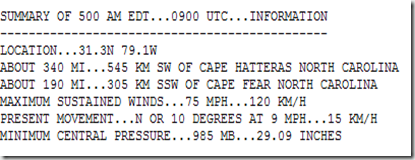
Arthur, a category one hurricane, is expected to pass very close to the outer banks of North Carolina this evening on its trek north.  While most of the worst of the weather will likely remain offshore, areas along the coastline are likely to take a pounding. 
 

image

Residents in the affected areas should be completing their hurricane preparations now (see Hurricane Preparedness Week: Make A Plan).


Storms that form in June and early July generally form in the Caribbean, the Gulf of Mexico, or just off the coast of the United States – as has Arthur. 

June Tropical Climatology

image

Credit NOAA

As the summer progresses the spawning grounds for Hurricanes moves further east into the warming Atlantic ocean.  But it usually isn’t until  August and September that the Cape Verde basin begins to produce what often turn into the largest and most persistent storms.


July & August Tropical Climatology

image


And the number of storms increases as we get later in the summer, with the peak of activity usually in the first half of September.  Hurricane season lasts through November 30th, however, and so late season storms are always possible.

image


You can find much more on Hurricane Climatology at NOAA’s  Tropical Cyclone Climatology page.

When it comes to getting the latest information on hurricanes, your first stop should always be the National Hurricane Center in Miami, Florida. These are the real pros, and the only ones you should rely on to track and forecast the storm.

  • Tropical storm watches will be issued when tropical storm conditions are possible along the coast within 48 hours.
  • Tropical storm warnings will be issued when those conditions are expected within 36 hours. Similar increases in lead-time will apply to hurricane watches and warnings.


This year the NHC has also introduced a new five-day graphical forecast, showing the areas of the tropics where tropical development is possible (or expected) over the next 120 hours.   Here is how NOAA describes this new feature:


Five-Day Graphical Tropical Weather Outlook Introduced


Beginning at 2 p.m. EDT July 1st , NOAA’s National Hurricane Center (NHC) will introduce an experimental five-day Graphical Tropical Weather Outlook (GTWO) to accompany its text Tropical Weather Outlook (TWO).


The new five-day GTWO, available for both the Atlantic and eastern North Pacific basins, will indicate the formation potential of  current and future disturbances during the next five days.

Shaded areas will represent the potential tropical cyclone  formation areas,  color-coded by development likelihood, with yellow representing a low (<30%) chance, orange denoting a medium (30%  to 50%) chance, and red  corresponding to a high (>50%) chance of tropical cyclone formation during the next five days. The location of each current disturbance will be denoted by an “X”. A mouse-over feature will allow users to see the accompanying Outlook text for each system. Clicking on an area will display a graphic showing only that disturbance, which should improve clarity when the forecast genesis areas overlap. Because the new five-day GTWO will tend to be busier than the current 48-hour GTWO, the five-day graphic will not display the locations of existing tropical cyclones.


Here is an example of the new five-day GTWO:

 image


For now, with the exception of Arthur, the Atlantic Basin and Caribbean are quiet, with no tropical development expected.

image


Making this 4th of July weekend a good time to go over your hurricane (and other disaster) preparedness plans, making sure you, your family, and your business are prepared to deal with whatever unexpected situation that life, and nature, can throw at you.


In addition to the preparedness information you can find on the FEMA and READY.GOV websites, a few of my earlier preparedness blogs include:


 When 72 Hours Isn’t Enough

The Gift Of Preparedness: 2013

In An Emergency, Who Has Your Back?

Monday, July 29, 2013

August Tropical Climatology

image

Photo Credit NOAA 


# 7523


Mariner’s Poem On Hurricanes

June too soon.
July stand by.
August look out you must.
September remember.
October all over.

- Published in “Weather Lore” by R. Inwards in 1898


As a native Floridian, and a long-time boater, I’m used to keeping a weather-eye out year round. But come the 1st of August my attention grows keener, and my gaze moves eastward, as the next three months are historically the time when the Atlantic produces the most dangerous tropical activity.


As you can see by the chart at the top of this post, the peak of the hurricane season comes in the second week of September, and then slowly tapers off.


Hurricanes are driven by the heat of the oceans, and so they tend to form over the shallower Caribbean and Gulf waters – which heat up fastest in the summer – first.  The map below shows the areas likely to produce tropical systems in June.


image


By early August, the deeper waters of the eastern and middle Atlantic have soaked up enough heat to make them fertile breeding grounds as well.  These storms are also likely to be stronger, and longer lasting.  


image


This morning finds the Atlantic basin fairly quiet, with only the remnants of T.S. Dorian – which sputtered and died last week on its way across the Atlantic – given a 50% chance of resurrection.


image

Credit NHC  Jul 29th, 2013


But as we saw last May, NOAA: Expects An Active Hurricane Season Ahead. Their prediction:


NOAA’s Atlantic Hurricane Season Outlook says there is a 70 percent likelihood of 13 to 20 named storms (winds of 39 mph or higher), of which 7 to 11 could become hurricanes (winds of 74 mph or higher), including 3 to 6 major hurricanes (Category 3, 4 or 5; winds of 111 mph or higher).


This year’s relatively slow start to the hurricane season tells us very little about the months ahead. Horrific Category 5 hurricane Andrew in 1992 – the first named storm of that season – didn’t show up until mid-August.


When it comes to getting the latest information on hurricanes, your first stop should always be the National Hurricane Center in Miami, Florida. These are the real pros, and the only ones you should rely on to track and forecast the storm.


  • Tropical storm watches will be issued when tropical storm conditions are possible along the coast within 48 hours.
  • Tropical storm warnings will be issued when those conditions are expected within 36 hours. Similar increases in lead-time will apply to hurricane watches and warnings.


NOAA’s NWS National Hurricane Center in Miami also has a Facebook page, where you can keep up with the latest tropical developments.


The second official information source you should have bookmarked is your local Office of Emergency Management.  Here you’ll be able to access local warnings, flood maps and evacuation information.


To find your local one, you can Google or Yahoo search with your county/parish name and the words `Emergency Management’.  


If you are on Twitter, you should also follow @FEMA, @CraigatFEMA, @NHC_Atlantic, @NHC_Pacific and @ReadyGov


If you haven’t already downloaded the Tropical Cyclone Preparedness Guide, now would be an excellent time to do so. It is a short (12-page), easy to follow guide that will walk you through the basics of understanding (and surviving) hurricanes and tropical storms.

image


Although September is National Preparedness Month, those who potentially live in the path of these storms (and that can be hundreds of miles inland) are urged every year to prepare in May, during National Hurricane Preparedness Week.


image


Some of my blogs on getting ready for this year’s tropical season include:


Hurricane Preparedness Week: Day 6 & 7

Grady Norton: The First Hurricane Forecaster

Hurricane Preparedness Week: Inland Flooding

Hurricane Preparedness Week & The Tale Of The Tape

Storm Surge Monday

National Hurricane Preparedness Week – Day 1

Sunday, July 01, 2012

July Tropical Climatology


image

Mariner’s Poem On Hurricanes

June too soon.
July stand by.
August look out you must.
September remember.
October all over.

- Published in “Weather Lore” by R. Inwards in 1898


# 6412


Typically tropical activity in the Atlantic and Caribbean doesn’t really begin to pick up in earnest until August, although as the chart above illustrates, in some years we do see storms in June and July.


In 2005 we saw 3 storms (Cindy, Dennis, Emily) develop in the first half of July, and so far this year, we’ve already seen 4 named storms.


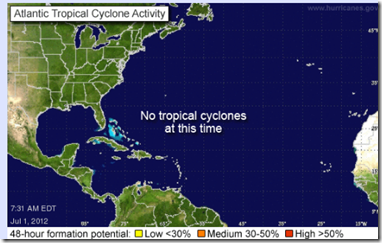
According to The National Hurricane Center in Miami, right now things are pretty quiet in the Atlantic tropical basin, but that could quickly change.


 image

8am July 1st, 2012 – NHC 

Below you’ll see the the areas that historically have spawned tropical systems in July. 

image


Unlike later in the year when we watch for long-track storms to form in the Cape Verde basin, cyclone genesis is more apt to occur in the shallower, earlier to warm waters, closer to the United States and the Caribbean.


Over the next several months we are likely to see dozens of areas of suspicion develop in the Atlantic and Caribbean.   Many will likely fizzle . . . but long range forecasts are calling for as many as 15 of these to become named storms, and 4 to 8 to be hurricanes.


How many of those will make landfall is unknown, but it only takes one major storm to ruin your entire day.


As an example, the 1992 hurricane season was particularly quiet, without a named storm forming until August. But that first storm was Andrew – the infamous CAT 5 monster that devastated south Florida. 


Which means that if you live anywhere within reach of one of these storms (and that can be hundreds of miles inland), you need to be reviewing your hurricane plans now.


Every year I give hurricane preparedness a prominent place in this blog because more than 50 million Americans live in susceptible coastal areas (along with millions more in other countries).


Live along the coastline long enough, and the odds say you’ll be visited by one of these storms. 


image

From Escambia County Hurricane Preparedness Information


The end of May was National Hurricane Preparedness week, and a few of my blogs on the subject included:


Hurricane Preparedness Week: Taking Action
Hurricane Preparedness Week: Inland Flooding
A Matter Of Respect
 

The National Hurricane Center (NHC) should be your primary source of information on tropical threats. In addition to visiting their website, they issue alert via  two Twitter accounts, one for the Atlantic basin (which includes the Gulf of Mexico and the Caribbean Sea):

Follow NHC_Atlantic on Twitter U.S. National Hurricane Center (Atlantic) - @NHC_Atlantic

and one for the Eastern North Pacific basin:

Follow NHC_Pacific on Twitter U.S. National Hurricane Center (Eastern Pacific) - @NHC_Pacific


In addition to the Twitter notifications, NHC also provides product notifications by email. Please visit hurricanes.gov/signup.shtml to sign up for this service.


And if you aren’t already following

on twitter, you might want to add them to your list.


And finally, if you haven’t already downloaded the Tropical Cyclone Preparedness Guide, now would be an excellent time to do so. It is a short (12-page), easy to follow guide that will walk you through the basics of understanding (and surviving) hurricanes and tropical storms.

image


The time to prepare for a hurricane, or any other disaster, is now  . . . while the sun is shining, and you have the time and resources to do it right.

Monday, October 24, 2011

A Late Season Tropical Threat


# 5919


Since it has been chilly the past couple of mornings here in central Florida, it can be hard to remember that there are another 5 weeks left to the 2011 Altantic Hurricane season.


Hurricane season runs through the end of November.


It was just 6 years ago today that category 3 Hurricane Wilma struck south Florida, doing considerable damage to Ft. Lauderdale, Miami, Naples, and the Florida Keys while contributing to deaths of at least 35 people.


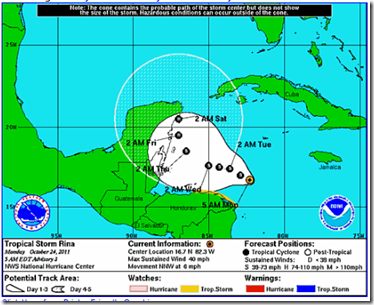
While it is too soon to tell if Tropical Storm Rinaforecast to intensify further – will affect the U.S. mainland, interests in the western Caribbean and all along the shores of the Gulf of Mexico need to keep an eye on this system.


image


While occurring far less frequently than do August and September storms, October hurricanes have a nasty habit of paying Floridians a visit.


Most form this time of year in the same general area as Rina sits right now, where the water temperatures are still toasty and wind shear is light, both of which are conducive to intensification. 


image

October Tropical Climatology – NOAA 


Rina has a long way to go before it could affect the Gulf coast - and a number of obstacles to overcome -  but history tells us not to be complacent.


Interests who may be impacted by this storm should follow the forecasts on the National Hurricane Center’s website.


And as my good buddy Cliff reminded me last week, it doesn’t have to be a tropical system to wreak havoc. No-Name Storms can deliver a sizable punch as well.


The ‘93 Superstorm – while not a hurricane – delivered hurricane force winds to the west coast of Florida and piled up a 7 to 12 foot surge tide, before tracking up the eastern seaboard as an unforgettable March blizzard.


Before it expired over the north Atlantic, this `no-name storm’  had claimed more than 300 lives and caused more than 6 billion dollars in damage from Cuba north to Canada.


All of which illustrates why those of us who went through her (I was aboard my 36’ sailboat, trying to keep her from being battered against the pilings at our marina) keep a wary eye on the weather year round.


Regardless of the season, everyone should have an emergency plan and preparations already in place to deal with a variety of threats. Storms, floods, wildfires, earthquakes, and tornadoes can happen anytime, and practically anywhere.


Ready.gov urges all Americans to follow these 3 steps to better preparedness:


image

GET A KIT

MAKE A PLAN

BE INFORMED


And for those who live in areas where tropical storms are a threat, I would invite you to download the NOAA, FEMA, and American Red Cross updated preparedness guide for the 2011 tropical season.


image

Sunday, July 31, 2011

August Tropical Climatology


# 5727


image


Although August is still one day away, it appears likely that the 5th named tropical system of the 2011 Atlantic Hurricane season is about to form about 600 miles east of the Windward Islands.


The National Hurricane Center in Miami, Florida has this area of disturbed weather listed as having a high chance – nearly 100% - of forming into a depression or storm in the next 48 hours. 


From the looks of the latest satellite photos, that may yet happen today.


image


The 8am EST tropical outlook states:

IF THE LOW BECOMES A TROPICAL
CYCLONE LATER TODAY... TROPICAL STORM WATCHES OR WARNINGS WOULD LIKELY BE REQUIRED FOR PORTIONS OF THE NORTHERN WINDWARD ISLANDS AND THE LEEWARD ISLANDS.

INTERESTS IN THESE AREAS SHOULD CLOSELY MONITOR THE PROGRESS OF THIS SYSTEM.  AN AIR FORCE RESERVE UNIT RECONNAISSANCE AIRCRAFT IS SCHEDULED TO INVESTIGATE THIS DISTURBANCE LATER THIS AFTERNOON.


It is a little too soon to project where this storm will go, as hurricane computer models don’t really initialize well until the storm’s circulation matures.


Early guidance, however, suggests that beyond the Windward & Leeward Islands . . . Puerto Rico, Hispaniola, and the Bahamas need to be paying close attention. 


image


August is when the Atlantic hurricane season really begins to pick up steam, and that trend usually peaks in mid-September. 


image


Compare the areas of origin and typical hurricane tracks in these two maps (below) showing July and August, and you will see a considerable amount of difference.


image


You’ll notice that the system we are watching is just now entering the  orange `Most Likely’ area of development east of the Windward Islands.   


As the summer progresses the spawning grounds for Hurricanes moves further east into the warming Atlantic ocean. It isn’t until August and September that the Cape Verde basin begins to produce what often turn into very large and persistent hurricanes.


You can find much more on Hurricane Climatology at NOAA’s  Tropical Cyclone Climatology page.


When it comes to getting the latest information on hurricanes, your first stop should always be the National Hurricane Center in Miami, Florida. These are the real experts, and the only ones you should rely on to track and forecast the storm.


image

Last year there were some significant changes in how the NHC will advise us on hurricanes.   Some of the (excerpted) highlights include:


Watches and warnings for tropical storms and hurricanes along threatened coastal areas will be issued 12 hours earlier than in previous years.

  • Tropical storm watches will be issued when tropical storm conditions are possible along the coast within 48 hours.
  • Tropical storm warnings will be issued when those conditions are expected within 36 hours. Similar increases in lead-time will apply to hurricane watches and warnings.


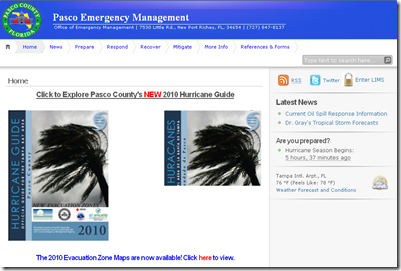
The second official information source you should have bookmarked is your local Office of Emergency Management.  Here you’ll be able to access local warnings, flood maps and evacuation information.


To find it, you can Google or Yahoo search with your county/parish name and the words `Emergency Management’.   Below you’ll find a screenshot of the entry page to my county’s page.


image


If you are on Twitter, you should also follow @FEMA, @CraigatFEMA, @NHC_Atlantic, @NHC_Pacific and @ReadydotGov.


NOAA’s NWS National Hurricane Center in Miami also has a Facebook page, where you can keep up with the latest tropical developments.


image


Of course, knowing about an approaching storm isn’t enough.  You need to be prepared as well.


Since last May was National Hurricane Preparedness week, this blog devoted considerable time to the subject.  A few of my blogs on hurricane preparedness included:


National Hurricane Preparedness Week 2011

Hurricane Preparedness Week: Inland Flooding

How Not To Be Gone With The Wind

Getting SLOSHed For Hurricane Season


With the busiest two months of the hurricane season about to begin, if you haven’t already done so,  now is the right time to make preparations.

Saturday, July 02, 2011

Tropical Atlantic Climatology: July


# 5667


Most years, July isn’t a big month for Hurricanes in the Atlantic and Caribbean, although in 2005 we saw 3 storms (Cindy, Dennis, Emily) develop in the first half of that month.


Normally, things don’t start to get active until mid-August.  


image


But this year, the forecast once again is for a very busy season, and so it isn’t too early to be paying attention.


Thus far in 2001 we’ve seen one moderate tropical Storm (Arlene) which impacted the Mexican coast last week, reportedly killing at least 2 people.


According to The National Hurricane Center in Miami, all is quiet right now in the Atlantic tropical basin.

image


Below you’ll see the the areas that historically have spawned tropical systems in July. 


image

Unlike later in the year, when we watch for long-track storms to form in the Cape Verde basin, cyclone genesis is more apt to occur in the warmer, shallower waters closer to the United States. 


Over the next several months we are likely to see dozens of areas of suspicion develop in the Atlantic and Caribbean.   Many will likely fizzle . . . but long range forecasts are calling for as many as 18 of these to become named storms, and 6 to 10 to be hurricanes.


How many of those will make landfall is unknown.


Last year (see NOAA 2010 Atlantic Hurricane Outlook) NOAA called for an above average tropical season, and that is exactly what we had, although the coastline of the United States was largely spared.


image

2010 Hurricane/Storm Tracks


Other years, we aren’t so lucky.


It just takes one major storm to ruin your entire day.


The 1992 hurricane season was particularly quiet, with only 7 storms forming and just two impacting the United States. But one of them was Andrew - the CAT 5 monster that ripped across south Florida.


Which means that if you live anywhere within reach of one of these storms (and that can be hundreds of miles inland), you need to be reviewing your hurricane plans now.


May was National Hurricane Preparedness week, and during that month this blog devoted considerable time to the subject.  A few of my blogs on the subject included:


National Hurricane Preparedness Week 2011

Hurricane Preparedness Week: Inland Flooding

How Not To Be Gone With The Wind

Getting SLOSHed For Hurricane Season


Along with some general preparedness blogs:


When 72 Hours Isn’t Enough

In An Emergency, Who Has Your Back?

An Appropriate Level Of Preparedness


Some essential hurricane resources to get you started include:


http://www.fema.gov/hazard/hurricane/index.shtm

http://www.ready.gov/america/beinformed/hurricanes.html


You may also wish to revisit my blog entitled Hurricane Resources On The Net for links to storm resources online.

Wednesday, June 01, 2011

Hurricane Season Begins: June Climatology


# 5590


Today, June 1st, marks the start of this year’s Atlantic Hurricane season, although hurricanes in June are a fairly rare event.  Over the past 50 years 9 Hurricanes have formed during the first month of Hurricane season.


As you can see by the NOAA chart below, early season tropical storms are a bit more common, but the season doesn’t usually pick up steam until August.


image


Mariner’s Poem On Hurricanes

June too soon.
July stand by.
August look out you must.
September remember.
October all over.

- Published in “Weather Lore” by R. Inwards in 1898


Of course, some years are exceptions. 


In 2010 Hurricane Alex – a strong CAT 2 hurricane – slammed into Mexican state of Tamaulipas after intensifying to hurricane strength on June 29th.


Hurricane Audrey in 1957 was the only June storm in modern history known to reach CAT 4 strength, and it claimed 550 lives after it made landfall in eastern Texas and western Louisiana.


Below are a few notable June Hurricane tracks, including 1957’s notorious Audrey.


image 


When hurricanes and tropical storms do form in June, they tend to form in the warmer, comparatively shallower waters of the the Gulf of Mexico.


June Climatology

image


All of which means that while it is very early in the Hurricane season, it isn’t too early to be prepared.


Last March NOAA, FEMA, and the American Red Cross released an updated preparedness guide for the 2011 tropical season.


image

To become better prepared as an individual, family, business owner, or community to deal with hurricanes, or any other type of disaster: visit the following preparedness sites.


FEMA http://www.fema.gov/index.shtm

READY.GOV http://www.ready.gov/

AMERICAN RED CROSS http://www.redcross.org/


And lastly, you may wish to revisit some of my preparedness essays, including:


In An Emergency, Who Has Your Back?

An Appropriate Level Of Preparedness